REVIEW 3 major objections 4 minor 56 references
Improve Language Model and Brain Alignment via Associative Memory
T0 review · 3 major / 4 minor · reviewed 2026-08-15 · deepseek-v4-flash
Pith's one-line read The paper claims that appending simulated associative memory to story stimuli improves how well language model activations predict fMRI brain responses, and that fine-tuning a large language model on associative content adds further gains…
desk verdict Augmentation result is promising but statistically thin; the SFT result is confounded by train/eval story overlap and needs a control before the 2-7% claim is credible. read the letter →
The pith
A machine-rendered reading of the paper's core claim, the machinery that carries it, and where it could break.
The reading
What carries the argument
The machinery is a linear encoding framework: ridge regression maps mean-pooled activations from a chosen Transformer layer to fMRI frames with a finite impulse response model, and the Pearson correlation between predicted and actual fMRI is the brain score. The associative memory score is the difference between the brain score with augmented text and the brain score on original text, and the instruction tuning score is the percentage gain after fine-tuning. The load-bearing maneuver is to place augmented association content at the end of the sentence that triggered it, with the same onset time as the last word, so the association signal lands in the same fMRI frames as the trigger. Low-rank adaptation (LoRA) and frozen-layer fine-tuning are the two training schemes used to adapt LLaMA-2 on the Association dataset.
What would settle it
Shift the onsets of the appended association content by one, two, or three fMRI TRs after the triggering word's offset and recompute the associative memory score; if the gain vanishes or becomes negative, the reported improvement depends on the simultaneous-onset assumption. A second check: replace the associated words with equally frequent but content-bearing unrelated words; if the gain persists, the effect is not specific to association.
Extended reading notes
Core claim
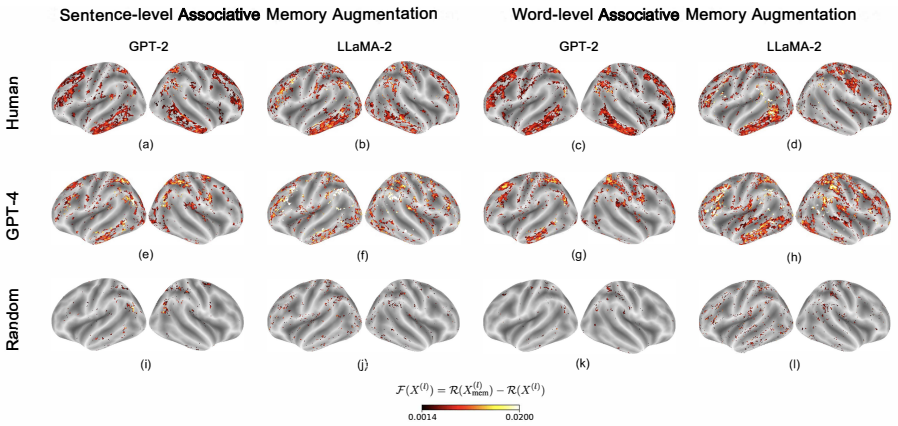
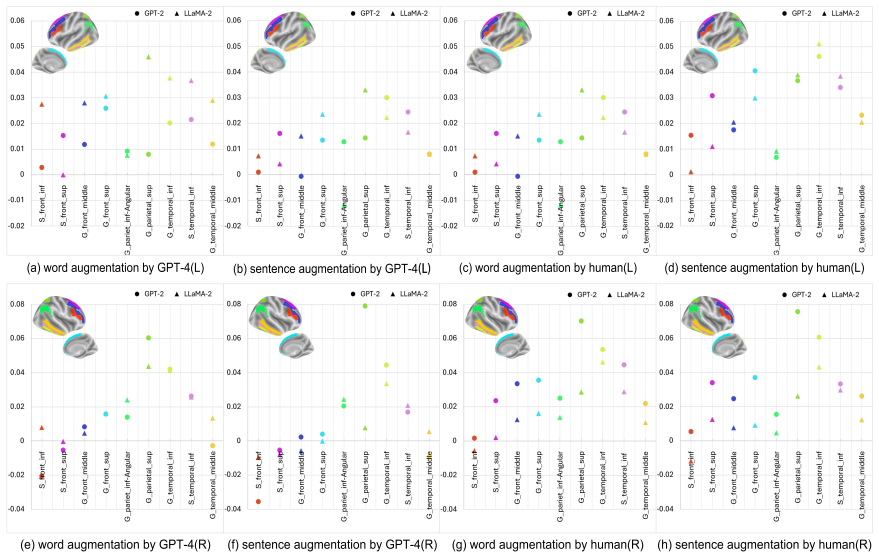
The central discovery is that aligning language models to the brain can be improved by injecting associative content into the model's input, without changing the brain data. For the first research question, each story sentence that triggers association is augmented with associative words or sentences; the language model is then run on the augmented sequence, and its activations are mean-pooled into fMRI frames through a finite-impulse-response model and ridge regression. The resulting correlation, the brain score, rises in nine regions of interest including inferior and middle temporal regions, frontal and parietal regions, and the medial temporal lobe, with word-level human-annotated augmentation giving the strongest and most consistent gains and random augmentation giving none. For the second question, LLaMA-2 fine-tuned on the Association dataset using LoRA or frozen-layer training shows a 2% to 7% gain in medial temporal lobe score over the base model, and a 50% to 60% gain in the superior parietal lobule at the subject level.
Load-bearing premise
The load-bearing assumption is temporal: augmented association content is treated as if it enters the brain at the same instant as the last word of the sentence that triggered it, so the model's added tokens are pooled into those same fMRI frames.
Editorial extensions
If this is right
- Word-level human-annotated association is the strongest augmentation for improving brain scores; sentence-level and GPT-4-generated content also help but less consistently, so future datasets should favor multi-aspect lexical associations.
- Supervised fine-tuning on the Association dataset transfers to better brain prediction in memory-related regions: the medial temporal lobe gains 2–7% and the superior parietal lobule gains 50–60% at the subject level.
- Random word and sentence augmentation does not improve and can hurt brain scores, implying the gains are not just from longer input.
- For LLaMA-2 the best-fitting layer is shallower (14 of 32) than for GPT-2 (9 of 12), so the linear mapping should be evaluated per model rather than at a fixed layer.
Reading between the lines
- The authors leave the timing mechanism implicit: the paper collapses associative retrieval into the trigger word's fMRI frame; a natural extension is to let association content enter several TRs later or with a learned temporal kernel and test whether alignment improves further.
- Because word-level augmentation outperforms sentence-level, the inference is that content-word associations, not grammatical expansions, carry the brain-alignment signal; this could be tested by comparing augmentation with high-frequency synonyms versus low-frequency associated words.
- The paper does not fully separate associative memory from general semantic relatedness; one could test specificity by using related-but-nonassociative paraphrases or word-association norms, a distinction that would change the interpretation.
- The authors note the limitation that their data and annotators share a specific language and cultural context, so a direct extension is to test whether the same gains appear in other languages and participant populations.
Signed reviews
Editorial analysis
A structured set of objections, weighed in public.
Referee Report
Summary. The paper studies whether adding associative memory content to text stimuli improves the linear encoding-model alignment between language models (GPT-2 and LLaMA-2) and fMRI responses from the Narratives dataset. It first computes baseline brain scores by mapping per-layer LM activations to fMRI frames with a finite impulse response model and ridge regression. It then augments the text with human- or GPT-4-generated word- or sentence-level associations, defining the associative memory score as the difference between augmented and original brain scores. Finally, it builds the Association instruction-tuning dataset and fine-tunes LLaMA-2 with LoRA or frozen-layer training, reporting instruction tuning scores. The paper's two central claims are that simulated associative memory improves LM-brain alignment and that instructing LLMs to generate associative content through SFT also improves alignment.
Significance. If the reported effects were statistically robust and the training/evaluation confound were removed, the paper would make a useful contribution to the growing LM-brain alignment literature: it proposes a concrete augmentation mechanism for a cognitive process that is comparatively underexplored, releases a new instruction-tuning dataset, and includes a random-augmentation control. The paper also uses held-out fMRI data for the encoding model and provides detailed implementation information. However, the two central claims are currently under-supported: the associative memory score is reported without inferential statistics, the SFT result appears to train on the same Narratives stories used for evaluation, and the augmented content is placed in the same fMRI time bins under an untested simultaneity assumption. The significance of the findings is therefore conditional on addressing these load-bearing issues.
major comments (3)
- [§5.3, Appendix A.3, §4.1] The instruction-tuning result is confounded by a training/evaluation overlap. Appendix A.3 states that the Association dataset is composed of sentences from the filtered Narratives stories, and §4.1 states that after filtering short articles, 15 Narratives stories are used for the reported experiments. As written, the same story text used to compute the brain scores in §5.3 appears in the SFT training data, so the 2–7% MTL gain in Figure 6 could reflect in-domain exposure to the evaluation stimuli rather than learning to generate associative content. The comparison against base LLaMA-2 does not control for this exposure. Please re-evaluate on Narratives stories (or other naturalistic stimuli) that are held out from Association, or explicitly document a split and demonstrate non-overlap; the manuscript currently provides no split information and no code to verify it.
- [§5.2, Figures 4 and 5, Eq. (10)] The associative memory score is the paper's first central result, but it is reported without error bars, confidence intervals, significance tests, or multiple-comparison correction. The raw differences are 0.0014–0.02 in Figure 4 and 0–0.05 in Figure 5, against baseline brain scores around 0.126 (Figure 3), so the gains are small relative to the score scale. The qualitative statement that random augmentation leads to 'none and even negative growth' is not a substitute for a statistical comparison. Please provide subject-level or story-level bootstrap/permutation intervals for the difference scores, and account for the number of ROIs and layers examined.
- [§3.3, Eqs. (9)–(10)] The temporal alignment of the augmented content is a load-bearing modeling choice. All expanded content is placed at the end of the triggering sentence and assigned the last word's offset, 'as if the associative memory forms simultaneously when subject receives specific text stimuli.' This means the augmented tokens are pooled into the same fMRI frames as the trigger words. If associative retrieval in the brain is delayed or distributed over a longer time window, the reported improvement could be an artifact of injecting extra context into the same time bin. No behavioral or neural evidence is offered for this simultaneity, and no robustness analysis is given. I request an exploration of alternative alignments, for example shifting the augmented content by one or more TRs relative to the trigger or extending the FIR window, to show the gain is not an artifact of the alignment.
minor comments (4)
- [Appendix A.2] The text says 'RidgeClassifierCV' regressor from scikit-learn is used to predict continuous features, but RidgeClassifierCV is a classification estimator; the ridge regression in Eq. (6) and the continuous fMRI targets imply the regressor variant (e.g., RidgeCV) is intended. Please correct this inconsistency.
- [Table 1] There is a typo in the sentence-level human augmentation example: 'creatin' should be 'creating'.
- [Figure 5] The caption says the dot color corresponds to the specific ROI, but the figure as printed does not provide a legend mapping colors to the nine ROIs. A legend would make the figure interpretable.
- [§5.3, Figure 6] The instruction tuning scores in Figure 6 are reported as percentages without error bars; the subject-level confidence intervals in Figure 7 are informative and should also be used for the whole-brain percentage scores in Figure 6.
Circularity Check
No circularity: brain scores are held-out correlations; augmentation and SFT are not fitted to brain data, though the SFT setup has a train/evaluation overlap worth flagging as a soundness concern.
full rationale
Score 0, no circularity. The derivation chain is self-contained against external fMRI data. Brain score (Eq. 7) is a Pearson correlation between a ridge-regression prediction fit on held-out training frames and the original held-out fMRI response; neither the augmented text used in Eq. 9 nor the fine-tuned model activations used in Eq. 11 are derived from the voxel labels. Associative memory score (Eq. 10) and instruction tuning score (Eq. 11) are defined as differences or growth percentages between two independently evaluated brain scores, and the reported gains are not obtained by fitting a parameter to the fMRI response. The random-augmentation control in Section 5.2 further supports the causal reading of the augmentation result. I checked the self-citation patterns: prior work is cited for standard encoding-model methodology and for base models (GPT-2, LLaMA-2), but no load-bearing 'uniqueness' theorem is imported from the authors' own prior papers. The temporal-alignment choice in Section 3.3, which places all expanded content at the end of the triggering sentence 'as if the associative memory forms simultaneously when subject receives specific text stimuli,' is a modeling assumption that could be empirically wrong, but it is not circular: the augmented input is pooled into fMRI frames by a fixed onset rule, not by optimizing against the brain score. One confound is flagged for the soundness pass rather than the circularity pass: Appendix A.3 states that the Association SFT dataset 'is composed of sentences from filtered stories of Narratives,' while Section 4.1 selects the same 15 Narratives stories for evaluation; the Limitations section acknowledges annotator noise but not this exposure overlap. In-domain exposure could inflate the reported 2-7% medial temporal lobe gain in Section 5.3, but that is data leakage, not a reduction of the predicted score to a fitted value.
Assumptions & free parameters
free parameters (3)
- Layer index l for brain score =
9 (GPT-2), 14 (LLaMA-2)
- FIR delay k =
not reported
- Ridge regularization lambda =
selected via RidgeClassifierCV from 10 values log-spaced 1e-1 to 1e8
assumptions (4)
- domain assumption Brain activity can be predicted by a linear map from language model activations (linear encoding model).
- ad hoc to paper Appended associative content is processed by the brain simultaneously with the triggering word, so it belongs in the same fMRI time bin.
- domain assumption The nine selected ROIs correspond to associative memory, working memory, and speech processing functions.
- domain assumption Human and GPT-4 generated associations faithfully simulate the associative memory of the fMRI subjects.
Cite this review
Pith. "Pith review of Improve Language Model and Brain Alignment via Associative Memory." pith.science (2026). https://pith.science/paper/GQHRIJA7
@misc{pith2026250513844,
  author       = {Pith},
  title        = {Pith review of: Improve Language Model and Brain Alignment via Associative Memory},
  year         = {2026},
  howpublished = {\url{https://pith.science/paper/GQHRIJA7}},
  note         = {Machine review of arXiv:2505.13844}
}
read the original abstract
Associative memory engages in the integration of relevant information for comprehension in the human cognition system. In this work, we seek to improve alignment between language models and human brain while processing speech information by integrating associative memory. After verifying the alignment between language model and brain by mapping language model activations to brain activity, the original text stimuli expanded with simulated associative memory are regarded as input to computational language models. We find the alignment between language model and brain is improved in brain regions closely related to associative memory processing. We also demonstrate large language models after specific supervised fine-tuning better align with brain response, by building the \textit{Association} dataset containing 1000 samples of stories, with instructions encouraging associative memory as input and associated content as output.
Figures


Figures from the paper (3 more)

Reference graph
Works this paper leans on
-
[1]
Francisco Aboitiz and Ricardo Garcı́a V. 1997. https://doi.org/https://doi.org/10.1016/S0165-0173(97)00053-2 The evolutionary origin of the language areas in the human brain. a neuroanatomical perspective . Brain Research Reviews, 25(3):381--396
-
[2]
Josh Achiam, Steven Adler, Sandhini Agarwal, Lama Ahmad, Ilge Akkaya, Florencia Leoni Aleman, Diogo Almeida, Janko Altenschmidt, Sam Altman, Shyamal Anadkat, et al. 2023. Gpt-4 technical report. arXiv preprint arXiv:2303.08774
arXiv 2023
-
[3]
Nicolas Affolter, Beni Egressy, Damian Pascual, and Roger Wattenhofer. 2020. Brain2word: decoding brain activity for language generation. arXiv preprint arXiv:2009.04765
work page Pith review arXiv 2020
-
[4]
John R Anderson and Gordon H Bower. 2014. Human associative memory. Psychology press
work page 2014
-
[5]
Richard Antonello and Alexander Huth. 2024. Predictive coding or just feature discovery? an alternative account of why language models fit brain data. Neurobiology of Language, 5(1):64--79
work page 2024
-
[6]
Richard Antonello, Aditya Vaidya, and Alexander Huth. 2024. Scaling laws for language encoding models in fmri. Advances in Neural Information Processing Systems, 36
work page 2024
-
[7]
Alan Baddeley. 2003. Working memory and language: An overview. Journal of communication disorders, 36(3):189--208
work page 2003
-
[8]
Jeffrey R Binder. 2015. The wernicke area: Modern evidence and a reinterpretation. Neurology, 85(24):2170--2175
work page 2015
Show all 56 references
-
[9]
Jeffrey R Binder and Rutvik H Desai. 2011. The neurobiology of semantic memory. Trends in cognitive sciences, 15(11):527--536
2011
-
[10]
Rafal Bogacz and Malcolm W Brown. 2003. Comparison of computational models of familiarity discrimination in the perirhinal cortex. Hippocampus, 13(4):494--524
2003
-
[11]
Charlotte Caucheteux, Alexandre Gramfort, and Jean-Remi King. 2021. Disentangling syntax and semantics in the brain with deep networks. In International conference on machine learning, pages 1336--1348. PMLR
2021
-
[12]
Charlotte Caucheteux, Alexandre Gramfort, and Jean-R \'e mi King. 2022. Deep language algorithms predict semantic comprehension from brain activity. Scientific reports, 12(1):16327
2022
-
[13]
Charlotte Caucheteux, Alexandre Gramfort, and Jean-R \'e mi King. 2023. Evidence of a predictive coding hierarchy in the human brain listening to speech. Nature human behaviour, 7(3):430--441
2023
-
[14]
Charlotte Caucheteux and Jean-R \'e mi King. 2020. Language processing in brains and deep neural networks: computational convergence and its limits. BioRxiv, pages 2020--07
2020
-
[15]
Charlotte Caucheteux and Jean-R \'e mi King. 2022. Brains and algorithms partially converge in natural language processing. Communications biology, 5(1):134
2022
-
[16]
Chang, Erik Edwards, Srikantan S
Edward F. Chang, Erik Edwards, Srikantan S. Nagarajan, Noa Fogelson, Sarang S. Dalal, Ryan T. Canolty, Heidi E. Kirsch, Nicholas M. Barbaro, and Robert T. Knight. 2011. https://doi.org/10.1162/jocn.2010.21466 Cortical Spatio-temporal Dynamics Underlying Phonological Target Det...
2011
-
[17]
Christophe Destrieux, Bruce Fischl, Anders Dale, and Eric Halgren. 2010. https://doi.org/https://doi.org/10.1016/j.neuroimage.2010.06.010 Automatic parcellation of human cortical gyri and sulci using standard anatomical nomenclature . NeuroImage, 53(1):1--15
2010 doi
-
[18]
Nina F Dronkers, Odile Plaisant, Marie Therese Iba-Zizen, and Emmanuel A Cabanis. 2007. Paul broca's historic cases: high resolution mr imaging of the brains of leborgne and lelong. Brain, 130(5):1432--1441
2007
-
[19]
Nadir Durrani, Hassan Sajjad, and Fahim Dalvi. 2021. https://doi.org/10.18653/v1/2021.findings-acl.438 How transfer learning impacts linguistic knowledge in deep NLP models? In Findings of the Association for Computational Linguistics: ACL-IJCNLP 2021, pages 4947--4957, Online...
2021 doi
-
[20]
Howard Eichenbaum. 2017. Time (and space) in the hippocampus. Current opinion in behavioral sciences, 17:65--70
2017
-
[21]
Changjiang Gao, Shujian Huang, Jixing Li, and Jiajun Chen. 2023. http://arxiv.org/abs/2310.19084 Roles of scaling and instruction tuning in language perception: Model vs. human attention
2023 arXiv
-
[22]
NORMAN GESCHWIND. 1965. https://doi.org/10.1093/brain/88.2.237 DISCONNEXION SYNDROMES IN ANIMALS AND MAN1 . Brain, 88(2):237--237
1965 doi
-
[23]
Ariel Goldstein, Zaid Zada, Eliav Buchnik, Mariano Schain, Amy Price, Bobbi Aubrey, Samuel A Nastase, Amir Feder, Dotan Emanuel, Alon Cohen, et al. 2020. Thinking ahead: spontaneous prediction in context as a keystone of language in humans and machines. BioRxiv, pages 2020--12
2020
-
[24]
Ariel Goldstein, Zaid Zada, Eliav Buchnik, Mariano Schain, Amy Price, Bobbi Aubrey, Samuel A Nastase, Amir Feder, Dotan Emanuel, Alon Cohen, et al. 2022. Shared computational principles for language processing in humans and deep language models. Nature neuroscience, 25(3):369--380
2022
-
[25]
Boris Gourévitch, Régine Le Bouquin Jeannès , Gérard Faucon, and Catherine Liégeois-Chauvel. 2008. https://doi.org/https://doi.org/10.1016/j.heares.2007.12.003 Temporal envelope processing in the human auditory cortex: Response and interconnections of auditory cortical areas ....
2008 doi
-
[26]
u nt \"u rk \
Marnie E Halpern, Onur G \"u nt \"u rk \"u n, William D Hopkins, and Lesley J Rogers. 2005. Lateralization of the vertebrate brain: taking the side of model systems. Journal of Neuroscience, 25(45):10351--10357
2005
-
[27]
Edward J Hu, Yelong Shen, Phillip Wallis, Zeyuan Allen-Zhu, Yuanzhi Li, Shean Wang, Lu Wang, and Weizhu Chen. 2021. Lora: Low-rank adaptation of large language models. arXiv preprint arXiv:2106.09685
2021 arXiv
-
[28]
Alexander G Huth, Wendy A De Heer, Thomas L Griffiths, Fr \'e d \'e ric E Theunissen, and Jack L Gallant. 2016. Natural speech reveals the semantic maps that tile human cerebral cortex. Nature, 532(7600):453--458
2016
-
[29]
Alexander G Huth, Shinji Nishimoto, An T Vu, and Jack L Gallant. 2012. A continuous semantic space describes the representation of thousands of object and action categories across the human brain. Neuron, 76(6):1210--1224
2012
-
[30]
Shailee Jain and Alexander Huth. 2018. Incorporating context into language encoding models for fmri. Advances in neural information processing systems, 31
2018
-
[31]
David Marr, David Willshaw, and Bruce McNaughton. 1991. Simple memory: a theory for archicortex. Springer
1991
-
[32]
Andrew Mayes, Daniela Montaldi, and Ellen Migo. 2007. Associative memory and the medial temporal lobes. Trends in cognitive sciences, 11(3):126--135
2007
-
[33]
James L McClelland, Bruce L McNaughton, and Randall C O'Reilly. 1995. Why there are complementary learning systems in the hippocampus and neocortex: insights from the successes and failures of connectionist models of learning and memory. Psychological review, 102(3):419
1995
-
[34]
Danielle S McNamara and Joe Magliano. 2009. Toward a comprehensive model of comprehension. Psychology of learning and motivation, 51:297--384
2009
-
[35]
Tom M Mitchell, Svetlana V Shinkareva, Andrew Carlson, Kai-Min Chang, Vicente L Malave, Robert A Mason, and Marcel Adam Just. 2008. Predicting human brain activity associated with the meanings of nouns. science, 320(5880):1191--1195
2008
-
[36]
Nasrin Mostafazadeh, Nathanael Chambers, Xiaodong He, Devi Parikh, Dhruv Batra, Lucy Vanderwende, Pushmeet Kohli, and James Allen. 2016. http://arxiv.org/abs/1604.01696 A corpus and evaluation framework for deeper understanding of commonsense stories
2016 arXiv
-
[37]
Omer Moussa, Dietrich Klakow, and Mariya Toneva. 2024. Improving semantic understanding in speech language models via brain-tuning. arXiv preprint arXiv:2410.09230
2024 arXiv
-
[38]
narratives
Samuel A Nastase, Yun-Fei Liu, Hanna Hillman, Asieh Zadbood, Liat Hasenfratz, Neggin Keshavarzian, Janice Chen, Christopher J Honey, Yaara Yeshurun, Mor Regev, et al. 2021. The “narratives” fmri dataset for evaluating models of naturalistic language comprehension. Scientific d...
2021
-
[39]
SUBBAREDDY OOTA, Manish Gupta, and Mariya Toneva. 2024. Joint processing of linguistic properties in brains and language models. Advances in Neural Information Processing Systems, 36
2024
-
[40]
Fabian Pedregosa, Ga \"e l Varoquaux, Alexandre Gramfort, Vincent Michel, Bertrand Thirion, Olivier Grisel, Mathieu Blondel, Peter Prettenhofer, Ron Weiss, Vincent Dubourg, et al. 2011. Scikit-learn: Machine learning in python. the Journal of machine Learning research, 12:2825--2830
2011
-
[41]
Amy Poremba, Megan Malloy, Richard C Saunders, Richard E Carson, Peter Herscovitch, and Mortimer Mishkin. 2004. Species-specific calls evoke asymmetric activity in the monkey's temporal poles. Nature, 427(6973):448--451
2004
-
[42]
Alec Radford, Jeffrey Wu, Rewon Child, David Luan, Dario Amodei, Ilya Sutskever, et al. 2019. Language models are unsupervised multitask learners. OpenAI blog, 1(8):9
2019
-
[43]
St \'e phanie K Ri \`e s, Nina F Dronkers, and Robert T Knight. 2016. Choosing words: Left hemisphere, right hemisphere, or both? perspective on the lateralization of word retrieval. Annals of the New York Academy of Sciences, 1369(1):111--131
2016
-
[44]
Hassan Sajjad, Nadir Durrani, Fahim Dalvi, Firoj Alam, Abdul Khan, and Jia Xu. 2022. https://doi.org/10.18653/v1/2022.naacl-main.225 Analyzing encoded concepts in transformer language models . In Proceedings of the 2022 Conference of the North American Chapter of the Associati...
2022 doi
-
[45]
Roger C Schank. 1972. Conceptual dependency: A theory of natural language understanding. Cognitive psychology, 3(4):552--631
1972
-
[46]
Steven C Schwering and Maryellen C MacDonald. 2020. Verbal working memory as emergent from language comprehension and production. Frontiers in human neuroscience, 14:68
2020
-
[47]
Edward E Smith, John Jonides, Christy Marshuetz, and Robert A Koeppe. 1998. Components of verbal working memory: evidence from neuroimaging. Proceedings of the National Academy of Sciences, 95(3):876--882
1998
-
[48]
Reisa A Sperling, Julianna F Bates, Andrew J Cocchiarella, Daniel L Schacter, Bruce R Rosen, and Marilyn S Albert. 2001. Encoding novel face-name associations: A functional mri study. Human brain mapping, 14(3):129--139
2001
-
[49]
Mariya Toneva and Leila Wehbe. 2019. Interpreting and improving natural-language processing (in machines) with natural language-processing (in the brain). Advances in neural information processing systems, 32
2019
-
[50]
Hugo Touvron, Louis Martin, Kevin Stone, Peter Albert, Amjad Almahairi, Yasmine Babaei, Nikolay Bashlykov, Soumya Batra, Prajjwal Bhargava, Shruti Bhosale, et al. 2023. Llama 2: Open foundation and fine-tuned chat models. arXiv preprint arXiv:2307.09288
2023 arXiv
-
[51]
Endel Tulving et al. 1972. Episodic and semantic memory. Organization of memory, 1(381-403):1
1972
-
[52]
Leila Wehbe, Brian Murphy, Partha Talukdar, Alona Fyshe, Aaditya Ramdas, and Tom Mitchell. 2014. Simultaneously uncovering the patterns of brain regions involved in different story reading subprocesses. PloS one, 9(11):e112575
2014
-
[53]
Daniel LK Yamins and James J DiCarlo. 2016. Using goal-driven deep learning models to understand sensory cortex. Nature neuroscience, 19(3):356--365
2016
-
[54]
Zhengyan Zhang, Zhiyuan Zeng, Yankai Lin, Chaojun Xiao, Xiaozhi Wang, Xu Han, Zhiyuan Liu, Ruobing Xie, Maosong Sun, and Jie Zhou. 2023. Emergent modularity in pre-trained transformers. arXiv preprint arXiv:2305.18390
2023 arXiv
-
[55]
URL: " 'urlintro :=
ENTRY address author booktitle chapter edition editor howpublished institution journal key month note number organization pages publisher school series title type volume year eprint doi pubmed url lastchecked label extra.label sort.label short.list INTEGERS output.state before...
-
[56]
write newline
" write newline "" before.all 'output.state := FUNCTION n.dashify 't := "" t empty not t #1 #1 substring "-" = t #1 #2 substring "--" = not "--" * t #2 global.max substring 't := t #1 #1 substring "-" = "-" * t #2 global.max substring 't := while if t #1 #1 substring * t #2 gl...
Reviewed August 15, 2026 · model on record in the stance chip above.
Discussion (0). Continue with ORCID to comment.