REVIEW 4 major objections 6 minor 32 references
An Explorative Analysis of SVM Classifier and ResNet50 Architecture on African Food Classification
T0 review · 4 major / 6 minor · reviewed 2026-08-15 · deepseek-v4-flash
Pith's one-line read On six African dishes, a fine-tuned ResNet50 and a classical SVM both reach about 81% accuracy, with the SVM slightly ahead on macro F1.
desk verdict A modest, honest empirical comparison of SVM and ResNet50 on a small African foods dataset; the result is plausible, but the evaluation is thin on variance and the test set is unvalidated. read the letter →
The pith
A machine-rendered reading of the paper's core claim, the machinery that carries it, and where it could break.
The reading
What carries the argument
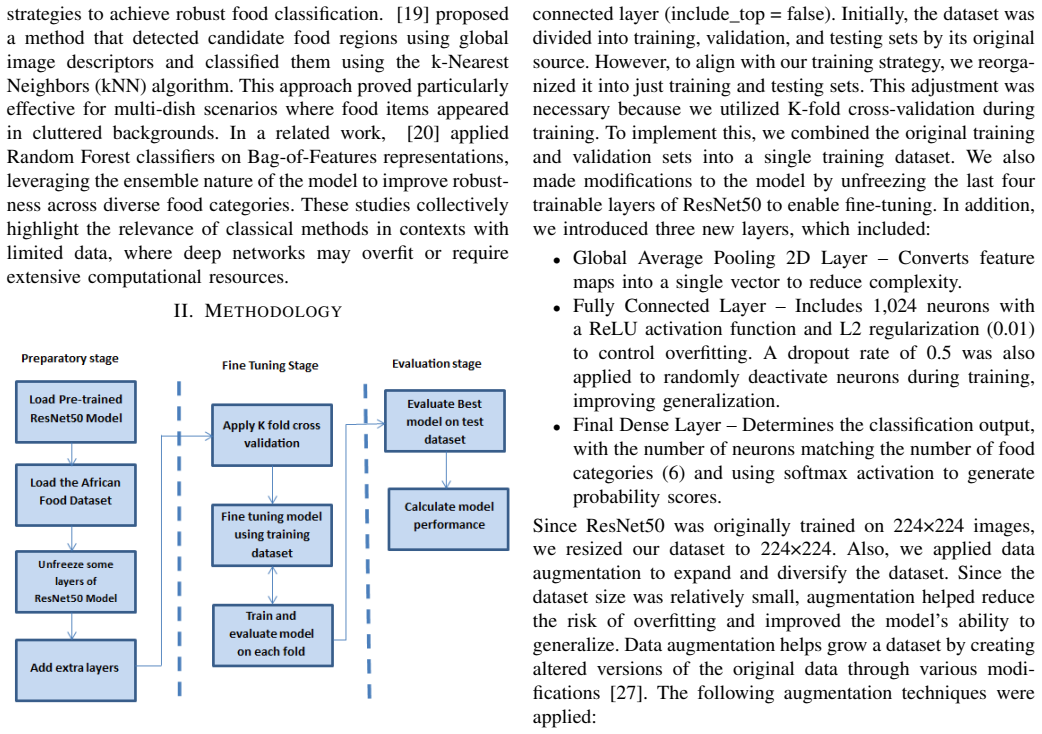
The comparison rests on two pipelines. The SVM pipeline uses raw RGB pixel intensities resized to 100×100, flattened into 30,000-element vectors, and classified by an RBF-kernel SVM with default settings. The ResNet50 pipeline fine-tunes the last four layers of an ImageNet-pretrained ResNet50 with a global average pooling layer, a 1,024-neuron dense layer with dropout 0.5 and L2 regularization, and a 6-way softmax head, trained with 5-fold cross-validation and data augmentation. The 5-fold validation-based model selection and the fixed public test split are what make the two pipelines comparable.
What would settle it
Re-running the two pipelines on the same train/test split while excluding any test images that are near-duplicates of training images, or re-testing on an independently collected set of the same six dishes, would settle the claim: if accuracy of either model falls well below 81% under that check, the reported comparison is an artifact of the dataset split.
Extended reading notes
Core claim
The central claim is empirical and comparative. On the African Foods dataset of 1,658 images across six classes, a fine-tuned ResNet50 and a radial-basis-function SVM fed with flattened 100×100 RGB pixels both achieve an overall test accuracy of about 81%. Per-class results diverge: ResNet50 is strongest on Ndole (precision 1.00, F1 0.91) and Palm-nut soup (recall 0.90), while the SVM is more consistent, leading in Ekwang and Eru and posting the better macro F1 (0.82 vs 0.81). The paper reads these results as evidence that classical methods remain competitive on small, imbalanced food datasets and that per-class behaviour, not just overall accuracy, should drive model choice.
Load-bearing premise
The entire comparison is read from a single 251-image test split of the African Foods dataset; if those images are mislabeled or contain near-duplicates of training images, both 81% figures would be inflated and the two models could no longer be compared as reported.
Editorial extensions
If this is right
- If the 81% figures are accurate, a lightweight SVM with raw pixels is a viable baseline for African food recognition on small datasets.
- The macro F1 advantage of the SVM suggests that classical models can generalize more evenly across imbalanced classes in this setting.
- ResNet50's strengths on particular classes imply that ensembles or hybrid pipelines could exploit the complementary errors of the two models.
- The dataset-specific comparison indicates that without large, balanced data, deep transfer learning may not deliver a decisive advantage over a well-tuned classical method.
Reading between the lines
- The result is specific to a 251-image test set; a natural next test is whether the SVM's edge survives on a larger, more balanced African food dataset, which the paper itself lists as future work.
- The large confusion between palm-nut soup and ekwang suggests a visually similar pair that could be targeted with class-aware losses or hierarchical classification.
- Because the SVM uses only raw pixels, adding handcrafted features or color histograms might improve it further, a direction the paper does not test.
- The paper's reliance on a single public dataset means the 81% figure should be read as a benchmark for this dataset, not a claim about African food recognition in general.
Signed reviews
Editorial analysis
A structured set of objections, weighed in public.
Referee Report
Summary. This paper presents an empirical comparison between a fine-tuned ResNet50 and a default RBF-kernel SVM using raw RGB pixel features for classifying six African food classes from a public Mendeley dataset of 1,658 images. The authors combine the original training and validation splits, use five-fold cross-validation for the ResNet50 and select the fold with the highest validation accuracy, train the SVM on the same combined training set, and evaluate both models on the original 251-image test split. They report overall accuracy of about 81% for both models, with the SVM obtaining a slightly higher macro-averaged F1 score (0.82 versus 0.81), and they conclude that a classical model can remain competitive with a transfer-learned deep network on this small dataset. The paper also provides per-class precision, recall, F1, and confusion matrices, and it releases code for the ResNet50 pipeline.
Significance. If the empirical claims hold, this is a modest but useful benchmark for African food recognition. The explicit comparison of a raw-pixel SVM with a fine-tuned CNN on a public African foods dataset is a data point that the community can build on, and the paper has the concrete strengths of using a publicly available dataset, reporting per-class metrics rather than only overall accuracy, and releasing code for the deep learning pipeline. However, the central comparative claim currently rests on a single small test split, a single selected validation fold, and an untuned SVM baseline, so the quantitative conclusion that SVM is more consistent than ResNet50 is not yet firmly established.
major comments (4)
- [Section II-A and Table III] The ResNet50 result is obtained from the single fold with the highest validation accuracy among five folds, rather than from repeated runs, averaged folds, or an ensemble. Selecting the best validation fold is an additional model-selection step on validation noise, so the reported 81% test accuracy does not represent the expected performance of the fine-tuning procedure. Please report per-fold test results and the mean plus/minus standard deviation, or use an ensemble over the folds, and also run multiple random seeds.
- [Section III-C and Table III] The headline comparative claim that the SVM is more consistent than ResNet50 rests on a macro-F1 difference of 0.01 (0.82 versus 0.81) and equal overall accuracy on a single 251-image test set. With per-class test sizes of 31 to 59 images, one or two misclassifications change a class-level F1 score by roughly 0.02 to 0.03, so the observed gap is within the magnitude of sampling noise. Bootstrap confidence intervals or a significance test are needed before concluding that one model is more consistent.
- [Section II-B and Section III-C] The SVM is trained with default scikit-learn hyperparameters (C=1.0, gamma='scale'), while the ResNet50 pipeline was manually tuned through a hyperparameter-selection process. This comparison confounds the model family with the amount of tuning effort. A simple grid search over C and gamma, or an explicit framing of the SVM as an untuned baseline, is needed before the paper can conclude that classical methods 'can still hold their ground' as a general alternative to deep learning.
- [Sections I-A, II-A, and II-B] All conclusions are read from the original 251-image test split, which the authors state they kept unchanged but did not audit. The paper reports no check for near-duplicate images across the training/test boundary, no label-noise analysis, and no representativeness analysis of the test images. Accidental leakage or systematic label errors would inflate both reported 81% accuracy figures, so a duplicate and near-duplicate check and, if feasible, a label audit should be added.
minor comments (6)
- [Abstract and text] There are several language and typographical issues: 'Food recognition systems has advanced' should be 'have advanced', 'african' should be capitalized, and 'Ghanian' should be 'Ghanaian'.
- [Section II-A] The phrase 'Randomly rotate images vertically (0.2)' is ambiguous; clarify whether this is a random rotation range or a different transformation, and distinguish it from the listed horizontal flip.
- [Section II-A] The hyperparameter selection is described only as 'manually selected' with no search ranges or number of trials, which limits reproducibility of the tuning process.
- [Contributions and Section II-A] The paper states that the full codebase is available, but only a GitHub link for the ResNet50 fine-tuning code is provided; no SVM or evaluation scripts are linked. Please add the missing code or adjust the claim.
- [References] Reference [18] is cited for the use of HOG features with SVMs, but the cited paper is titled 'Image classification using random forests and ferns'; please verify and correct this citation.
- [Figure 6] The plot shows average training and validation loss across five folds but does not show fold-to-fold variance; adding a shaded standard-deviation band would make the claim of stable convergence more informative.
Circularity Check
No circularity: the paper's reported accuracies and F1-scores are empirical measurements on a held-out test split, with no fitted quantity renamed as a prediction.
full rationale
The paper contains no derivation chain whose conclusion is equivalent to its inputs. Both models are evaluated on a test set that was kept unchanged from the source dataset, while training used a combination of the original training and validation splits. The ResNet50 hyperparameters were selected manually based on validation accuracy during 5-fold cross-validation, and the SVM used default scikit-learn settings; neither selection feeds back into the definition of the reported metrics. The evaluation metrics (accuracy, precision, recall, F1, confusion matrix) are standard and computed directly from predictions on the 251-image test set. There are no fitted parameters that are then reinterpreted as predictions, no uniqueness theorem imported from prior work, and no ansatz smuggled in via citation. The two self-references involving the authors are incidental background citations for CNN concepts and residual learning, and they do not support the empirical comparison. Potential concerns about test-set label quality or near-duplicate leakage would be threats to external validity or correctness, not circularity, because the claims are measured rather than derived.
Assumptions & free parameters
free parameters (9)
- ResNet50 learning rate =
0.0001
- ResNet50 batch size =
32
- ResNet50 number of epochs =
100
- ResNet50 dropout rate =
0.5
- ResNet50 L2 regularization =
0.01
- Number of unfrozen ResNet50 layers =
4
- Data augmentation strength =
0.2 for rotation, shear, height shift, zoom; horizontal flip
- SVM regularization C =
1.0
- SVM gamma =
scale
assumptions (4)
- domain assumption The public African Foods dataset labels are correct and the supplied train/test split is independent and identically distributed.
- domain assumption Image-level data augmentation does not bridge the training and test sets.
- domain assumption ImageNet-pretrained ResNet50 features transfer to African food images.
- standard math Macro and weighted F1 are appropriate summary metrics for an imbalanced six-class problem.
Cite this review
Pith. "Pith review of An Explorative Analysis of SVM Classifier and ResNet50 Architecture on African Food Classification." pith.science (2026). https://pith.science/paper/MND5FKMF
@misc{pith2026250513923,
  author       = {Pith},
  title        = {Pith review of: An Explorative Analysis of SVM Classifier and ResNet50 Architecture on African Food Classification},
  year         = {2026},
  howpublished = {\url{https://pith.science/paper/MND5FKMF}},
  note         = {Machine review of arXiv:2505.13923}
}
read the original abstract
Food recognition systems has advanced significantly for Western cuisines, yet its application to African foods remains underexplored. This study addresses this gap by evaluating both deep learning and traditional machine learning methods for African food classification. We compared the performance of a fine-tuned ResNet50 model with a Support Vector Machine (SVM) classifier. The dataset comprises 1,658 images across six selected food categories that are known in Africa. To assess model effectiveness, we utilize five key evaluation metrics: Confusion matrix, F1-score, accuracy, recall and precision. Our findings offer valuable insights into the strengths and limitations of both approaches, contributing to the advancement of food recognition for African cuisines.
Figures


Figures from the paper (4 more)


Reference graph
Works this paper leans on
-
[1]
Automatic Food Recognition Using Deep Convolutional Neural Networks with Self-attention Mechanism
Abiyev, R., Adepoju, J.(2024). Automatic Food Recognition Using Deep Convolutional Neural Networks with Self-attention Mechanism. Hum- Cent Intell Syst 4, 171–186. https://doi.org/10.1007/s44230-023-00057-9
-
[2]
Chaitanya, A., Shetty, J., and Chiplunkar, P. (2023). Food image classi- fication and data extraction using convolutional neural network and web crawlers. Procedia Computer Science, 218, 143-152
work page 2023
-
[3]
Yadav, S., and Chand, S. (2021, March). Automated food image clas- sification using deep learning approach. In 2021 7th international con- ference on advanced computing and communication systems (ICACCS) (V ol. 1, pp. 542-545). IEEE
work page 2021
-
[4]
Zhang, Y ., Deng, L., Zhu, H., Wang, W., Ren, Z., Zhou, Q., ... and Wang, S. (2023). Deep learning in food category recognition. Information Fusion, 98, 101859
work page 2023
- [5]
-
[6]
Usha S.S., Thummaala B.R., Panditi A., and Yerramiya S. Y . A(2022). Automatic Food Image Classification Using Deep Learning Approach. Internation Research journal of Education and Technology. V olume: 04 Issue: 04
work page 2022
-
[7]
Adene, G., Makuo, N. J., Ejike, C. O., Emeka, I. O., and Mbonu, C. E. (2024). Detection and Classification of Human Gender into Binary (Male and Female) Using Convolutional Neural Network (CNN) Model. Asian Journal of Research in Computer Science, 17(6), 135-144
work page 2024
-
[8]
Dewan, J. H., Das, R., Thepade, S. D., Jadhav, H., Narsale, N., Mhasawade, A., and Nambiar, S. (2023, April). Image classification by transfer learning using pre-trained CNN models. In 2023 International Conference on Recent Advances in Electrical, Electronics, Ubiquitous Communication, and Computational Intelligence (RAEEUCCI) (pp. 1- 6). IEEE
work page 2023
Show all 32 references
-
[9]
Chun, M., Jeong, H., Lee, H., Yoo, T., and Jung, H. (2022). Development of korean food image classification model using public food image dataset and deep learning methods. IEEE Access, 10, 128732-128741
2022
-
[10]
(2020, March)
Phiphiphatphaisit, S., and Surinta, O. (2020, March). Food image classi- fication with improved MobileNet architecture and data augmentation. In Proceedings of the 3rd International Conference on Information Science and Systems (pp. 51-56)
2020
-
[11]
M.(2021).Food Classifi- cation Using Deep Learning
Sridevi G M., Raksha Raj K., and Roshini B. M.(2021).Food Classifi- cation Using Deep Learning. International Journal of Advance Research and Innovative Ideas in Education. V ol-7 Issue-4
2021
-
[12]
Xu, B., He, X., and Qu, Z. (2021). Asian food image classification based on deep learning. Journal of Computer and Communications, 9(03), 10
2021
-
[13]
E., and Rajaseela, S
Nithiyaraj, E. E., and Rajaseela, S. (2021). Indian Food Image Recog- nition using a Deep Learning Approach. Indian Journal of Food Engi- neering (IJFE), 1(1)
2021
-
[14]
Ogunyale, K. (2020). Convolutional neural network on Nigerian foods
2020
-
[15]
A., and Vincent, O
Iheanacho, C. A., and Vincent, O. R. (2022, November). Classification and recommendation of food intake in West Africa for healthy diet using Deep Learning. In 2022 5th Information Technology for Education and Development (ITED) (pp. 1-6). IEEE
2022
-
[16]
Mezgec, S., and Korou ˇsi´c Seljak, B. (2017). NutriNet: a deep learn- ing food and drink image recognition system for dietary assessment. Nutrients, 9(7), 657
2017
-
[17]
(2009, November)
Joutou, T., and Yanai, K. (2009, November). A food image recognition system with multiple kernel learning. In 2009 16th IEEE International Conference on Image Processing (ICIP) (pp. 285-288). IEEE
2009
-
[18]
(2007, October)
Bosch, A., Zisserman, A., and Munoz, X. (2007, October). Image classification using random forests and ferns. In 2007 IEEE 11th international conference on computer vision (pp. 1-8). Ieee
2007
-
[19]
(2012, July)
Matsuda, Y ., Hoashi, H., and Yanai, K. (2012, July). Recognition of multiple-food images by detecting candidate regions. In 2012 IEEE international conference on multimedia and expo (pp. 25-30). IEEE
2012
-
[20]
(2010, June)
Yang, S., Chen, M., Pomerleau, D., and Sukthankar, R. (2010, June). Food recognition using statistics of pairwise local features. In 2010 IEEE computer society conference on computer vision and pattern recognition (pp. 2249-2256). IEEE
2010
-
[21]
A., Wanji, S., and Tcheuntue, F
Abia, W. A., Wanji, S., and Tcheuntue, F. (2007). Energy and nutrient contents of waterfufu and eru. African Journal of Food Science, 1(2), 016-019
2007
-
[22]
Ataguba, G., Ezekiel, R., Daniel, J., Ogbuju, E., and Orji, R. (2024). African foods for deep learning-based food recognition systems dataset. Data in Brief, 53, 110092
2024
-
[23]
Mandal, B., Okeukwu, A., and Theis, Y . (2021). Masked face recognition using resnet-50. arXiv preprint arXiv:2104.08997
2021 arXiv
-
[25]
H., and Mbonu, C
Amangeldi, A., Taigonyrov, A., Jawad, M. H., and Mbonu, C. E. (2025). CNN and ViT Efficiency Study on Tiny ImageNet and DermaMNIST Datasets. arXiv preprint arXiv:2505.08259
2025
-
[26]
A., and Adebanjo, A
Al-Haija, Q. A., and Adebanjo, A. (2020, September). Breast cancer diagnosis in histopathological images using ResNet-50 convolutional neural network. In 2020 IEEE International IOT, Electronics and Mecha- tronics Conference (IEMTRONICS) (pp. 1-7). IEEE
2020
-
[27]
S., Jim, J
Islam, T., Hafiz, M. S., Jim, J. R., Kabir, M. M., and Mridha, M. F. (2024). A systematic review of deep learning data augmentation in medical imaging: Recent advances and future research directions. Healthcare Analytics, 100340
2024
-
[28]
and Meenakshi Sundaram (2024)
Anand, M. and Meenakshi Sundaram (2024). Hybrid deep transfer learning and feature fusion architecture for diabetic retinopathy clas- sification and severity grading. Journal of Engineering Science.DOI: 10.52783/jes.4944
2024 doi
-
[29]
Muralidharan, V ., Sugumaran, V ., and Sakthivel, N. R. (2011). Wavelet decomposition and support vector machine for fault diagnosis of monoblock centrifugal pump. International Journal of Data Analysis Techniques and Strategies, 3(2), 159-177
2011
-
[30]
Cortes, C., and Vapnik, V . (1995). Support-vector networks. Machine learning, 20, 273-297
1995
-
[31]
Hossin, M., and Sulaiman, M. N. (2015). A review on evaluation metrics for data classification evaluations. International journal of data mining and knowledge management process, 5(2), 1
2015
-
[32]
Behar, N., and Shrivastava, M. (2022). ResNet50-Based Effective Model for Breast Cancer Classification Using Histopathology Images. CMES- Computer Modeling in Engineering and Sciences, 130(2)
2022
-
[33]
Grandini, M., Bagli, E., and Visani, G. (2020). Metrics for multi-class classification: an overview. arXiv preprint arXiv:2008.05756
2020 arXiv
Reviewed August 15, 2026 · model on record in the stance chip above.
Discussion (0). Continue with ORCID to comment.