REVIEW 4 major objections 4 minor 1 cited by
Large-Scale Multi-Character Interaction Synthesis
T0 review · 4 major / 4 minor · reviewed 2026-08-07 · deepseek-v4-flash
Pith's one-line read A scalable, data-free pipeline for multi-character interaction that pairs a two-person diffusion model with an RL transition planner.
desk verdict A clever pipeline for multi-character interaction without multi-person data, but the evaluation is too circular and internally inconsistent to support the claims as stated. read the letter →
The pith
A machine-rendered reading of the paper's core claim, the machinery that carries it, and where it could break.
The reading
The reported evaluation is narrow. The two main metrics, transition smoothness and hip distance, closely resemble the rewards used to train the planner, so the numbers partly measure the training objective rather than independent quality. The main comparison table has no error bars, and one sentence about hip distance contradicts the numbers in the table. The supplementary material states that without comparable ground truth, only self-contained metrics can be computed. The paper also includes qualitative frame snapshots and a small user study.
The core idea, representing coordination as high-level regrouping decisions and learning those decisions with reinforcement learning, is plausible and potentially useful.
Extended reading notes
Core claim
The paper's central claim is that multi-character coordinated interactions can be synthesized without multi-character data by decomposing them into pairwise interactions, generated by a pre-trained two-character diffusion model, plus a learned transition-planning policy: 'we propose a framework to synthesize large-scale multiple characters by decomposing their coordinated interactions into interaction synthesis and transition planning' (Contributions). If true, this pipeline produces natural, smoothly transitioning group interactions that are scalable to many characters and transferable to other motion types.
Load-bearing premise
The load-bearing assumption is that multi-character close interactions are faithfully approximated by composing independent two-character groups: 'we simplify the interaction space for multiple characters by dividing multiple characters into two-character groups' (Section 3.3). The conclusion acknowledges this as 'the dividing approximation between multiple characters and two characters.' If this assumption fails for interactions where three or more characters are genuinely coupled, such as group lifts or complex formations, the generated group scenes will not be natural. No experiment tests a genuinely three-plus coupled interaction; the supplementary test of three-character division still uses the same self-defined metrics.
Editorial analysis
A structured set of objections, weighed in public.
Referee Report
Summary. The paper proposes a framework for large-scale multi-character interaction synthesis without a multi-character dataset. The pipeline decomposes coordinated interactions into interaction synthesis and transition planning: a pre-trained two-character diffusion model (InterGen) is extended to multiple characters by dividing them into independent two-character groups, with classifier guidance that penalizes hip-distance overlap and acceleration discontinuities; a reinforcement-learned policy predicts high-level re-grouping choices to plan transitions among local groups of four characters. The method is evaluated on dancing motions using transition smoothness (TS) and hip distance (HD), with additional applications for adding characters, generating large scenes, and transferring to boxing motions. The paper includes a supplementary user study, ablation studies, and a discussion of limitations.
Significance. If the central assumption that multi-character close interactions can be faithfully approximated by independently generated two-character groups holds, the paper offers a practical and scalable solution to a task that currently lacks dedicated datasets. The decomposition into interaction synthesis and transition planning, with re-grouping as a motion-agnostic action space, is a clean and potentially reusable abstraction. The authors are transparent about limitations and provide a supplementary user study and ablations. However, the current evidence does not convincingly establish that the composed independent groups capture genuinely coupled multi-person interactions, and the reported quantitative metrics are closely tied to the method's own training and guidance objectives. The significance is therefore conditional on a stronger empirical demonstration than the manuscript currently provides.
major comments (4)
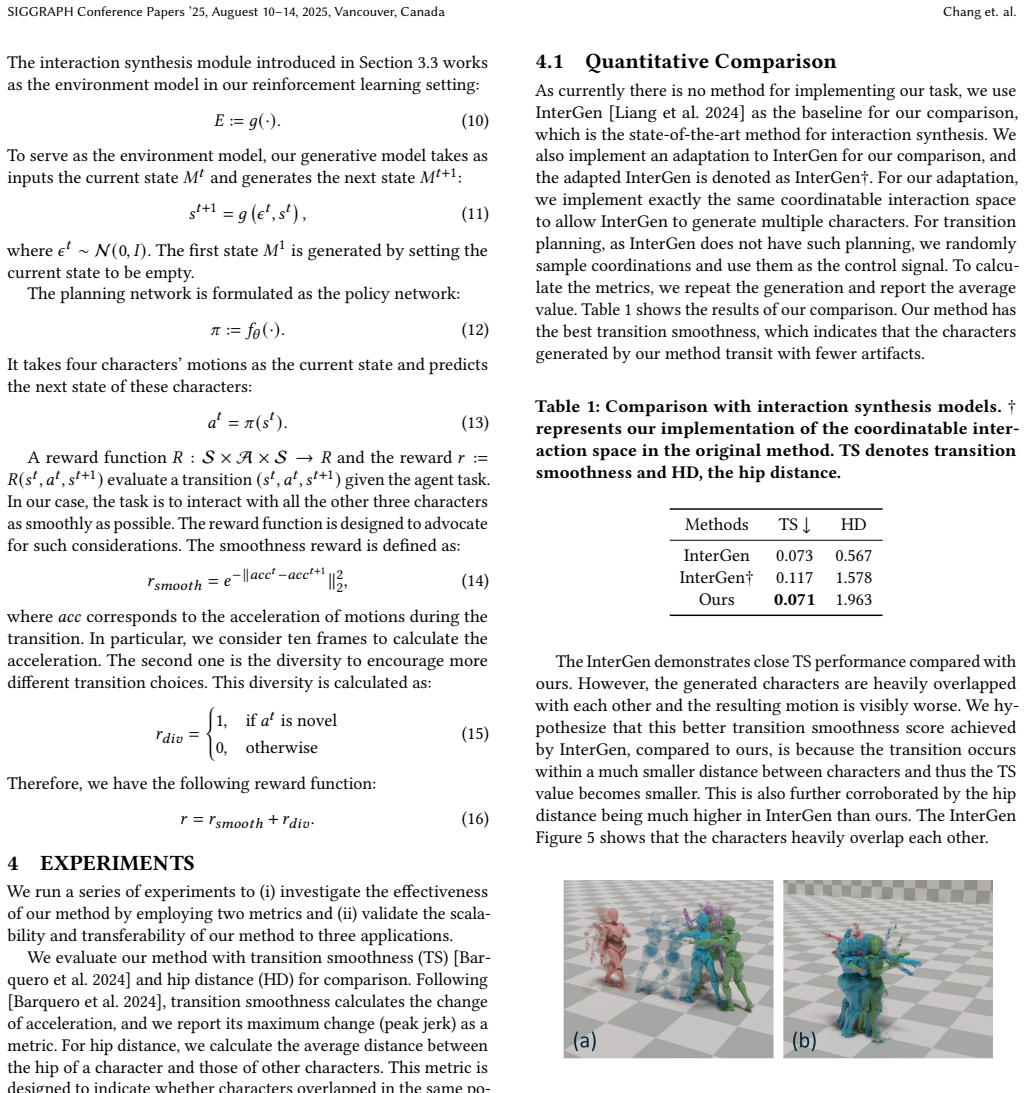
- [Section 4.1, Table 1] The text states that 'the hip distance being much higher in InterGen than ours' is corroborating evidence for InterGen's poor visual quality, but Table 1 reports HD = 0.567 for InterGen and HD = 1.963 for Ours. Since lower HD indicates closer/overlapping characters, the comparison in the text is reversed. This internal contradiction undermines the argument and must be corrected.
- [Section 3.3 and Supplementary Section 1] The load-bearing assumption that multi-character close interactions can be decomposed into independent two-character groups is not tested for genuinely triadic interactions. The supplementary three-character division experiment still uses exactly the TS and HD metrics (Supplementary Table 1), which are the objectives the method optimizes, and the differences between two- and three-character division are small (TS 0.071 vs 0.079; HD 1.963 vs 1.888). No experiment involves a group lift, a formation change, or any interaction where three or more characters are physically coupled. The conclusion itself acknowledges 'the dividing approximation.' Without a test that could fail under strong triadic coupling, the central claim of natural large-scale interaction synthesis remains unsupported.
- [Sections 3.3, 3.4, and 4.1] The two quantitative metrics are directly aligned with the method's training and guidance objectives. The TS metric measures the change of acceleration, and the smoothness reward in Eq. (14) is an exponential decay of the same acceleration-change quantity. The HD metric is the average hip distance, and the classifier guidance in Eq. (4) minimizes a truncated hip-distance term. Thus Table 1 compares a method that explicitly optimizes these quantities against baselines that do not. This does not provide an independent measure of naturalness or realism. The authors should either add metrics that are not part of the objectives (e.g., penetration depth, foot skating, or a more detailed user study) or explicitly discuss why these objectives are necessary conditions for naturalness; the current evaluation is circular.
- [Section 4.1, Table 1] The reported TS values for Ours (0.071) and InterGen (0.073) differ by 0.002, which is within the likely stochastic variation of diffusion-based generation. No error bars, standard deviations, or significance tests are reported for any of the quantitative tables, including the supplementary ablations. The claim that 'our method has the best transition smoothness' is not supported by the reported numbers without variance information.
minor comments (4)
- [Page headers] The page header contains the typo 'Auguest' instead of 'August' (e.g., on the first pages of the main text and supplementary material).
- [Section 3.4] The description of the local four-character planning window would benefit from clarification: the text says transition planning is implemented 'locally within four characters' but it is not immediately clear how the four-character group is selected and how the resulting re-grouping choice is applied to the full scene.
- [Figure 6] The claim that the two modes in the hip-distance density for Ours indicate 'minimal character overlap and clear transitions' is not self-explanatory; the authors should explain why bimodality in hip distance corresponds to good transition behavior, especially since a larger HD could simply indicate characters moving apart.
- [Supplementary Section 2.1] The user study report ('94.12% prefers ours') lacks essential details: the number of participants, the exact ranking question, and whether the comparison was pairwise or against both baselines jointly. These details should be reported for the result to be interpretable.
Assumptions & free parameters
free parameters (4)
- distance threshold tau =
not stated; ablated over 0.5 to 3.0 in supplementary Table 5
- smoothness reward weight =
1.0 (implicit)
- acceleration window in smoothness reward =
10 frames
- local planning window size =
4 characters
assumptions (5)
- ad hoc to paper Multi-character close interactions can be approximated by independently generated two-character groups.
- domain assumption Close continuous interactions rarely involve more than two people, so pairwise grouping is a natural modeling choice.
- domain assumption Hip distance is a sufficient signal for social spacing between generated groups.
- domain assumption The pre-trained two-character diffusion model (InterGen) generates sufficiently natural and diverse interactions to serve as the environment for RL training.
- ad hoc to paper High-level regrouping choices are a sufficient action space for transition planning and are motion-agnostic.
invented entities (1)
-
Virtual/imaginary character
Cite this review
Pith. "Pith review of Large-Scale Multi-Character Interaction Synthesis." pith.science (2026). https://pith.science/paper/2CSBQ2WU
@misc{pith2026250514087,
  author       = {Pith},
  title        = {Pith review of: Large-Scale Multi-Character Interaction Synthesis},
  year         = {2026},
  howpublished = {\url{https://pith.science/paper/2CSBQ2WU}},
  note         = {Machine review of arXiv:2505.14087}
}
read the original abstract
Generating large-scale multi-character interactions is a challenging and important task in character animation. Multi-character interactions involve not only natural interactive motions but also characters coordinated with each other for transition. For example, a dance scenario involves characters dancing with partners and also characters coordinated to new partners based on spatial and temporal observations. We term such transitions as coordinated interactions and decompose them into interaction synthesis and transition planning. Previous methods of single-character animation do not consider interactions that are critical for multiple characters. Deep-learning-based interaction synthesis usually focuses on two characters and does not consider transition planning. Optimization-based interaction synthesis relies on manually designing objective functions that may not generalize well. While crowd simulation involves more characters, their interactions are sparse and passive. We identify two challenges to multi-character interaction synthesis, including the lack of data and the planning of transitions among close and dense interactions. Existing datasets either do not have multiple characters or do not have close and dense interactions. The planning of transitions for multi-character close and dense interactions needs both spatial and temporal considerations. We propose a conditional generative pipeline comprising a coordinatable multi-character interaction space for interaction synthesis and a transition planning network for coordinations. Our experiments demonstrate the effectiveness of our proposed pipeline for multicharacter interaction synthesis and the applications facilitated by our method show the scalability and transferability.
Figures


Figures from the paper (7 more)



Forward citations
Cited by 1 Pith paper
-
Real-time and Controllable Reactive Motion Synthesis via Intention Guidance
A neural system predicts key-joint intentions from motion history and uses adversarially regularized codebook matching to synthesize controllable, real-time reactive motions.
Reference graph
Works this paper leans on
-
[2]
In Proceedings of the IEEE/CVF Conference on Computer Vision and Pattern Recognition
Multi-track timeline control for text-driven 3D human motion generation. In Proceedings of the IEEE/CVF Conference on Computer Vision and Pattern Recognition. 1911–1921. Soobin Um, Suhyeon Lee, and Jong Chul Ye
work page 1911
-
[2023]
IEEE Transactions on Circuits and Systems for Video Technology 33, 12 (2023), 7749–7763
Hierarchical graph convolutional networks for action quality assessment. IEEE Transactions on Circuits and Systems for Video Technology 33, 12 (2023), 7749–7763
work page 2023
-
[2024]
In Proceedings of the IEEE/CVF Conference on Computer Vision and Pattern Recognition
Two-person interaction augmentation with skeleton priors. In Proceedings of the IEEE/CVF Conference on Computer Vision and Pattern Recognition . 1900–1910. Mathis Petrovich, Or Litany, Umar Iqbal, Michael J Black, Gul Varol, Xue Bin Peng, and Davis Rempe
work page 1900
Reviewed August 7, 2026 · model on record in the stance chip above.
Discussion (0). Continue with ORCID to comment.