REVIEW 72 references
Intra-class Patch Swap for Self-Distillation
T0 review · reviewed 2026-08-07 · deepseek-v4-flash
Pith's one-line read An intra-class patch swap augmentation plus instance-to-instance KL distillation lets a single network train itself and beat several teacher-based and self-distillation baselines on image tasks.
desk verdict Novel self-distillation augmentation with a genuinely new idea, but the main CIFAR100 tables do not match the described protocol, so the headline claims need a correction before I would trust them. read the letter →
The pith
A machine-rendered reading of the paper's core claim, the machinery that carries it, and where it could break.
The reading
The authors test this on CIFAR-100, ImageNet, fine-grained bird and dog datasets, semantic segmentation on PASCAL VOC and Cityscapes, and object detection on PASCAL VOC. They report gains of 1.3 to 3.4 points in top-1 accuracy over plain training, and better performance than several self-distillation and teacher-based distillation baselines. They also report improved robustness to adversarial attacks and better-calibrated predictions.
There are caveats. The main CIFAR-100 tables appear to use a progressive swap schedule that is not described in the method section, and the corruption-table averages do not match the per-corruption numbers. The ImageNet results are single runs. Because of these reporting problems, the exact size of the improvement is uncertain, but the core idea is simple and plausible.
Extended reading notes
Core claim
"Extensive experiments across image classification, semantic segmentation, and object detection show that our method consistently outperforms both existing self-distillation baselines and conventional teacher-based KD approaches." The paper also claims that "the success of self-distillation could hinge on the design of the augmentation itself."
Load-bearing premise
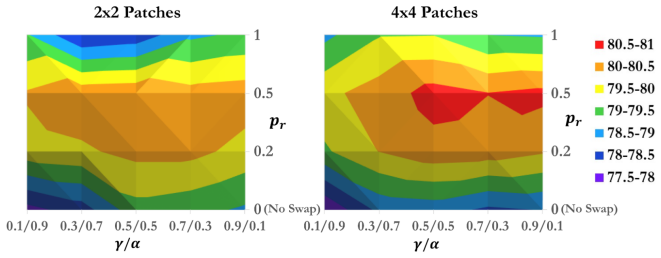
The paper depends on the assumption that the accuracy numbers in the main tables were produced by the method exactly as described in Section 4.2 (fixed pr=0.5, 4x4 patches, gamma=alpha=1.0). Cross-checking Table 3 against Table 15 shows that the CIFAR100 results match the progressive-pr variant labeled 'bpr', not the constant-pr variant 'pbar' that the text claims is used in all experiments. If the main tables actually use the undisclosed schedule, then the central performance claims, as stated, are not reproducible and the reported gains may partly reflect a tuned schedule rather than the patch-swap augmentation itself.
Editorial analysis
A structured set of objections, weighed in public.
Assumptions & free parameters
free parameters (4)
- Patch size (grid) =
4x4 (also 2x2, 3x3 explored)
- Swap probability pr =
0.5 constant or progressive 0.1 to 0.5
- Temperature T =
4
- Loss weights gamma and alpha =
1.0 (or 0.5 for ResNet34/50/101, VGG16)
assumptions (3)
- domain assumption Swapping patches between same-class images preserves the validity of the original class label for both images.
- domain assumption The KL divergence between the two swapped outputs provides a useful teaching signal (simulated teacher-student).
- domain assumption Random patch selection creates a meaningful confidence gap between the two swapped samples.
Cite this review
Pith. "Pith review of Intra-class Patch Swap for Self-Distillation." pith.science (2026). https://pith.science/paper/TDW4GAI3
@misc{pith2026250514124,
  author       = {Pith},
  title        = {Pith review of: Intra-class Patch Swap for Self-Distillation},
  year         = {2026},
  howpublished = {\url{https://pith.science/paper/TDW4GAI3}},
  note         = {Machine review of arXiv:2505.14124}
}
read the original abstract
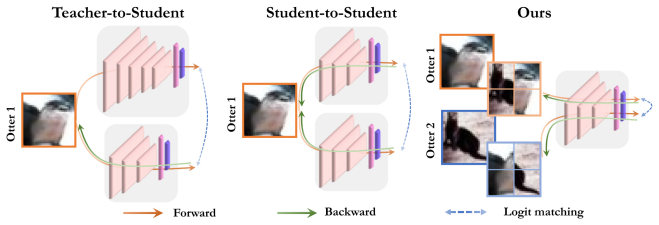
Knowledge distillation (KD) is a valuable technique for compressing large deep learning models into smaller, edge-suitable networks. However, conventional KD frameworks rely on pre-trained high-capacity teacher networks, which introduce significant challenges such as increased memory/storage requirements, additional training costs, and ambiguity in selecting an appropriate teacher for a given student model. Although a teacher-free distillation (self-distillation) has emerged as a promising alternative, many existing approaches still rely on architectural modifications or complex training procedures, which limit their generality and efficiency. To address these limitations, we propose a novel framework based on teacher-free distillation that operates using a single student network without any auxiliary components, architectural modifications, or additional learnable parameters. Our approach is built on a simple yet highly effective augmentation, called intra-class patch swap augmentation. This augmentation simulates a teacher-student dynamic within a single model by generating pairs of intra-class samples with varying confidence levels, and then applying instance-to-instance distillation to align their predictive distributions. Our method is conceptually simple, model-agnostic, and easy to implement, requiring only a single augmentation function. Extensive experiments across image classification, semantic segmentation, and object detection show that our method consistently outperforms both existing self-distillation baselines and conventional teacher-based KD approaches. These results suggest that the success of self-distillation could hinge on the design of the augmentation itself. Our codes are available at https://github.com/hchoi71/Intra-class-Patch-Swap.
Figures


Figures from the paper (7 more)


Reference graph
Works this paper leans on
- [1]
-
[2]
S. Zagoruyko, N. Komodakis, Paying more attention to attention: Improving the performance of convolutional neural networks via attention transfer, in: Proceedings of the International Conference on Learning Representations, 2017
work page 2017
-
[3]
F. Tung, G. Mori, Similarity-preserving knowledge distillation, in: Proceedings of the IEEE International Conference on Computer Vision, 2019, pp. 1365–1374. 22
work page 2019
- [4]
-
[5]
C. Tan, J. Liu, Improving knowledge distillation with a customized teacher, IEEE Transactions on Neural Networks and Learning Systems (2022)
work page 2022
- [6]
-
[7]
L. Yuan, F. E. Tay, G. Li, T. Wang, J. Feng, Revisiting knowledge distillation via label smoothing regularization, in: Proceedings of the IEEE Conference on Computer Vision and Pattern Recognition, 2020, pp. 3903–3911
work page 2020
- [8]
Show all 72 references
-
[9]
Moslemi, A
A. Moslemi, A. Briskina, Z. Dang, J. Li, A survey on knowledge distillation: Recent advancements, Machine Learning with Applications (2024) 100605
2024
-
[10]
Chaudhari, A
P. Chaudhari, A. Choromanska, S. Soatto, Y . LeCun, C. Baldassi, C. Borgs, J. Chayes, L. Sagun, R. Zecchina, Entropy-sgd: Biasing gradient descent into wide valleys, Journal of Statistical Mechanics: Theory and Experiment 2019 (12) (2019) 124018
2019
-
[11]
Pereyra, G
G. Pereyra, G. Tucker, J. Chorowski, L. Kaiser, G. E. Hinton, Regularizing neural networks by penalizing confident output distributions, in: Proceedings of the International Conference on Learning Representations Workshop, 2017. URL https://openreview.net/forum?id=HyhbYrGYe
2017
-
[12]
N. S. Keskar, D. Mudigere, J. Nocedal, M. Smelyanskiy, P. T. P. Tang, On large-batch training for deep learning: Generalization gap and sharp minima, in: Proceedings of the International Conference on Learning Representations, 2017. URL https://openreview.net/forum?id=H1oyRlYgg
2017
-
[13]
Kumar Singh, Y
K. Kumar Singh, Y . Jae Lee, Hide-and-seek: Forcing a network to be meticulous for weakly-supervised object and action localization, in: Proceedings of the IEEE International Conference on Computer Vision, 2017, pp. 3524–3533
2017
-
[14]
Zhang, M
H. Zhang, M. Cisse, Y . N. Dauphin, D. Lopez-Paz, mixup: Beyond empirical risk minimization, in: Proceedings of the International Confer- ence on Learning Representations, 2018
2018
-
[15]
S. Yun, D. Han, S. J. Oh, S. Chun, J. Choe, Y . Yoo, Cutmix: Regularization strategy to train strong classifiers with localizable features, in: Proceedings of the IEEE International Conference on Computer Vision, 2019, pp. 6023–6032
2019
-
[16]
H. Choi, E. S. Jeon, A. Shukla, P. Turaga, Understanding the role of mixup in knowledge distillation: An empirical study, in: Proceedings of the IEEE/CVF Winter Conference on Applications of Computer Vision, 2023, pp. 2319–2328
2023
-
[17]
W. Park, D. Kim, Y . Lu, M. Cho, Relational knowledge distillation, in: Proceedings of the IEEE Conference on Computer Vision and Pattern Recognition, 2019, pp. 3967–3976
2019
-
[18]
Zhang, P.-T
C.-B. Zhang, P.-T. Jiang, Q. Hou, Y . Wei, Q. Han, Z. Li, M.-M. Cheng, Delving deep into label smoothing, IEEE Transactions on Image Processing 30 (2021) 5984–5996
2021
-
[19]
Xu, C.-L
T.-B. Xu, C.-L. Liu, Data-distortion guided self-distillation for deep neural networks, in: Proceedings of the AAAI Conference on Artificial Intelligence, V ol. 33, 2019, pp. 5565–5572
2019
-
[20]
Y . Shen, L. Xu, Y . Yang, Y . Li, Y . Guo, Self-distillation from the last mini-batch for consistency regularization, in: Proceedings of the IEEE/CVF Conference on Computer Vision and Pattern Recognition, 2022, pp. 11943–11952
2022
-
[21]
S. Yun, J. Park, K. Lee, J. Shin, Regularizing class-wise predictions via self-knowledge distillation, in: Proceedings of the IEEE Conference on Computer Vision and Pattern Recognition, 2020, pp. 13876–13885
2020
-
[22]
C. Yang, Z. An, H. Zhou, L. Cai, X. Zhi, J. Wu, Y . Xu, Q. Zhang, Mixskd: Self-knowledge distillation from mixup for image recognition, in: European Conference on Computer Vision, Springer, 2022, pp. 534–551
2022
-
[23]
W. Cui, S. Yan, Isotonic data augmentation for knowledge distillation, in: Z.-H. Zhou (Ed.), Proceedings of the Thirtieth International Joint Conference on Artificial Intelligence (IJCAI), International Joint Conferences on Artificial Intelligence Organization, 2021, pp. 2314–...
2021 doi
-
[24]
T. Wang, L. Yuan, X. Zhang, J. Feng, Distilling object detectors with fine-grained feature imitation, in: Proceedings of the IEEE/CVF Conference on Computer Vision and Pattern Recognition (CVPR), 2019, pp. 4933–4942
2019
-
[25]
D. Wang, D. Wen, J. Liu, W. Tao, T.-W. Chen, K. Osa, M. Kato, Fully supervised and guided distillation for one-stage detectors, in: Proceedings of the Asian Conference on Computer Vision (ACCV), 2020, pp. 171–188
2020
-
[26]
Zhang, S
L. Zhang, S. Huang, W. Liu, Intra-class part swapping for fine-grained image classification, in: Proceedings of the IEEE/CVF Winter Conference on Applications of Computer Vision, 2021, pp. 3209–3218
2021
-
[27]
J. Gou, B. Yu, S. J. Maybank, D. Tao, Knowledge distillation: A survey, International Journal of Computer Vision (IJCV) 129 (6) (2021) 1789–1819
2021
-
[28]
T. Wen, S. Lai, X. Qian, Preparing lessons: Improve knowledge distillation with better supervision, Neurocomputing 454 (2021) 25–33
2021
-
[29]
E. S. Jeon, H. Choi, A. Shukla, P. Turaga, Leveraging angular distributions for improved knowledge distillation, Neurocomputing 518 (2023) 466–481
2023
-
[30]
K. He, X. Zhang, S. Ren, J. Sun, Deep residual learning for image recognition, in: Proceedings of the IEEE Conference on Computer Vision and Pattern Recognition, 2016, pp. 770–778
2016
-
[31]
Krizhevsky, G
A. Krizhevsky, G. Hinton, et al., Learning multiple layers of features from tiny images, Technical report (2009). URL https://www.cs.toronto.edu/˜kriz/cifar.html
2009
-
[32]
Simonyan, A
K. Simonyan, A. Zisserman, Very deep convolutional networks for large-scale image recognition, in: Proceedings of the International Con- ference on Learning Representations, 2015. URL http://arxiv.org/abs/1409.1556
2015 arXiv
-
[33]
N. Ma, X. Zhang, H.-T. Zheng, J. Sun, Shufflenet v2: Practical guidelines for efficient cnn architecture design, in: Proceedings of the European Conference on Computer Vision, 2018, pp. 116–131
2018
-
[34]
Szegedy, V
C. Szegedy, V . Vanhoucke, S. Ioffe, J. Shlens, Z. Wojna, Rethinking the inception architecture for computer vision, in: Proceedings of the 23 IEEE Conference on Computer Vision and Pattern Recognition, 2016, pp. 2818–2826
2016
-
[35]
L. Xie, J. Wang, Z. Wei, M. Wang, Q. Tian, Disturblabel: Regularizing cnn on the loss layer, in: Proceedings of the IEEE Conference on Computer Vision and Pattern Recognition, 2016, pp. 4753–4762
2016
-
[36]
X. Deng, Y . Xiao, B. Long, Z. Zhang, Reducing flipping errors in deep neural networks, in: Proceedings of the AAAI Conference on Artificial Intelligence, 2022
2022
-
[37]
Y . Tian, D. Krishnan, P. Isola, Contrastive representation distillation, in: Proceedings of the International Conference on Learning Represen- tations, 2019
2019
-
[38]
J. Deng, W. Dong, R. Socher, L.-J. Li, K. Li, L. Fei-Fei, Imagenet: A large-scale hierarchical image database, in: Proceedings of the IEEE Conference on Computer Vision and Pattern Recognition, 2009, pp. 248–255. URL https://image-net.org/download.php
2009
-
[39]
C. Wah, S. Branson, P. Welinder, P. Perona, S. Belongie, The caltech-ucsd birds-200-2011 dataset, Technical Report CNS-TR-2011-001 (2011). URL https://www.vision.caltech.edu/datasets/cub_200_2011/
2011
-
[40]
Khosla, N
A. Khosla, N. Jayadevaprakash, B. Yao, F.-F. Li, Novel dataset for fine-grained image categorization: Stanford dogs, in: Proceedings of the CVPR workshop on fine-grained visual categorization, V ol. 2, Citeseer, 2011. URL http://vision.stanford.edu/aditya86/ImageNetDogs/
2011
-
[41]
Sandler, A
M. Sandler, A. Howard, M. Zhu, A. Zhmoginov, L.-C. Chen, Mobilenetv2: Inverted residuals and linear bottlenecks, in: Proceedings of the IEEE Conference on Computer Vision and Pattern Recognition (CVPR), 2018, pp. 4510–4520
2018
-
[42]
Li, C.-Y
Y . Li, C.-Y . Wu, H. Fan, K. Mangalam, B. Xiong, J. Malik, C. Feichtenhofer, Mvitv2: Improved multiscale vision transformers for classifica- tion and detection, in: Proceedings of the IEEE/CVF Conference on Computer Vision and Pattern Recognition, 2022, pp. 4804–4814
2022
-
[43]
Liang, L
J. Liang, L. Li, Z. Bing, B. Zhao, Y . Tang, B. Lin, H. Fan, Efficient one pass self-distillation with zipf’s label smoothing, in: Proceedings of the European Conference on Computer Vision, 2022, pp. 104–119
2022
-
[44]
DeVries, G
T. DeVries, G. W. Taylor, Improved regularization of convolutional neural networks with cutout, arXiv preprint arXiv:1708.04552 (2017)
2017 arXiv
-
[45]
L.-C. Chen, Y . Zhu, G. Papandreou, F. Schroff, H. Adam, Encoder-decoder with atrous separable convolution for semantic image segmenta- tion, in: Proceedings of the European Conference on Computer Vision, 2018, pp. 801–818
2018
-
[46]
Everingham, L
M. Everingham, L. Van Gool, C. K. I. Williams, J. Winn, A. Zisserman, The PASCAL Visual Object Classes Challenge 2012 (VOC2012) Results. URL http://www.pascal-network.org/challenges/VOC/voc2012/workshop/index.html
2012
-
[47]
Cordts, M
M. Cordts, M. Omran, S. Ramos, T. Rehfeld, M. Enzweiler, R. Benenson, U. Franke, S. Roth, B. Schiele, The cityscapes dataset for semantic urban scene understanding, in: Proceedings of the IEEE Conference on Computer Vision and Pattern Recognition, 2016, pp. 3213–3223. URL http...
2016
-
[48]
Wigness, S
M. Wigness, S. Eum, J. G. Rogers, D. Han, H. Kwon, A rugd dataset for autonomous navigation and visual perception in unstructured outdoor environments, in: Proceedings of the IEEE/RSJ International Conference on Intelligent Robots and Systems, 2019, pp. 5000–5007. URL http://r...
2019
-
[49]
T. Guan, D. Kothandaraman, R. Chandra, A. J. Sathyamoorthy, K. Weerakoon, D. Manocha, Ga-nav: Efficient terrain segmentation for robot navigation in unstructured outdoor environments, IEEE Robotics and Automation Letters 7 (3) (2022) 8138–8145
2022
-
[50]
H. Zhao, J. Shi, X. Qi, X. Wang, J. Jia, Pyramid scene parsing network, in: Proceedings of the IEEE conference on computer vision and pattern recognition, 2017, pp. 2881–2890
2017
-
[51]
J. Long, E. Shelhamer, T. Darrell, Fully convolutional networks for semantic segmentation, in: Proceedings of the IEEE conference on computer vision and pattern recognition, 2015, pp. 3431–3440
2015
-
[52]
J. Fu, J. Liu, H. Tian, Y . Li, Y . Bao, Z. Fang, H. Lu, Dual attention network for scene segmentation, in: Proceedings of the IEEE/CVF conference on computer vision and pattern recognition, 2019, pp. 3146–3154
2019
-
[53]
Y . Yuan, X. Chen, J. Wang, Object-contextual representations for semantic segmentation, in: Proceedings of the European conference on computer vision (ECCV), 2020, pp. 173–190
2020
-
[54]
H. Zhao, Y . Zhang, S. Liu, J. Shi, C. C. Loy, D. Lin, J. Jia, Psanet: Point-wise spatial attention network for scene parsing, in: Proceedings of the European conference on computer vision (ECCV), 2018, pp. 267–283
2018
-
[55]
C. Yu, C. Gao, J. Wang, G. Yu, C. Shen, N. Sang, Bisenet v2: Bilateral network with guided aggregation for real-time semantic segmentation, International Journal of Computer Vision 129 (2021) 3051–3068
2021
-
[56]
T. Wu, S. Tang, R. Zhang, J. Cao, Y . Zhang, Cgnet: A light-weight context guided network for semantic segmentation, IEEE Transactions on Image Processing 30 (2020) 1169–1179
2020
-
[57]
R. P. Poudel, S. Liwicki, R. Cipolla, Fast-scnn: Fast semantic segmentation network, arXiv preprint arXiv:1902.04502 (2019)
2019 arXiv
-
[58]
H. Wu, J. Zhang, K. Huang, K. Liang, Y . Yu, Fastfcn: Rethinking dilated convolution in the backbone for semantic segmentation, arXiv preprint arXiv:1903.11816 (2019)
2019 arXiv
-
[59]
Zheng, J
S. Zheng, J. Lu, H. Zhao, X. Zhu, Z. Luo, Y . Wang, Y . Fu, J. Feng, T. Xiang, P. H. Torr, et al., Rethinking semantic segmentation from a sequence-to-sequence perspective with transformers, in: Proceedings of the IEEE/CVF conference on computer vision and pattern recogni- tio...
2021
-
[60]
Ranftl, A
R. Ranftl, A. Bochkovskiy, V . Koltun, Vision transformers for dense prediction, in: Proceedings of the IEEE/CVF International Conference on Computer Vision, 2021, pp. 12179–12188
2021
-
[61]
E. Xie, W. Wang, Z. Yu, A. Anandkumar, J. M. Alvarez, P. Luo, Segformer: Simple and efficient design for semantic segmentation with transformers, Advances in Neural Information Processing Systems 34 (2021) 12077–12090
2021
-
[62]
Strudel, R
R. Strudel, R. Garcia, I. Laptev, C. Schmid, Segmenter: Transformer for semantic segmentation, in: Proceedings of the IEEE/CVF interna- tional conference on computer vision, 2021, pp. 7262–7272
2021
-
[63]
W. Liu, D. Anguelov, D. Erhan, C. Szegedy, S. Reed, C.-Y . Fu, A. C. Berg, Ssd: Single shot multibox detector, in: Proceedings of the European Conference on Computer Vision, 2016, pp. 21–37
2016
-
[64]
Everingham, L
M. Everingham, L. Van Gool, C. K. I. Williams, J. Winn, A. Zisserman, The PASCAL Visual Object Classes Challenge 2007 (VOC2007) 24 Results. URL http://www.pascal-network.org/challenges/VOC/voc2007/workshop/index.html
2007
-
[65]
X. Yuan, P. He, Q. Zhu, X. Li, Adversarial examples: Attacks and defenses for deep learning, IEEE transactions on neural networks and learning systems 30 (9) (2019) 2805–2824
2019
-
[66]
Geifman, G
Y . Geifman, G. Uziel, R. El-Yaniv, Bias-reduced uncertainty estimation for deep neural classifiers, in: Proceedings of the International Conference on Learning Representations, 2018
2018
-
[67]
M. P. Naeini, G. Cooper, M. Hauskrecht, Obtaining well calibrated probabilities using bayesian binning, in: Proceedings of the AAAI Conference on Artificial Intelligence, 2015
2015
-
[68]
Gneiting, A
T. Gneiting, A. E. Raftery, Strictly proper scoring rules, prediction, and estimation, Journal of the American statistical Association 102 (477) (2007) 359–378
2007
-
[69]
Y . Wang, X. Ma, Z. Chen, Y . Luo, J. Yi, J. Bailey, Symmetric cross entropy for robust learning with noisy labels, in: Proceedings of the IEEE International Conference on Computer Vision, 2019, pp. 322–330
2019
-
[70]
R. R. Selvaraju, M. Cogswell, A. Das, R. Vedantam, D. Parikh, D. Batra, Grad-cam: Visual explanations from deep networks via gradient- based localization, in: Proceedings of the IEEE International Conference on Computer Vision, 2017, pp. 618–626
2017
-
[71]
Bengio, J
Y . Bengio, J. Louradour, R. Collobert, J. Weston, Curriculum learning, in: Proceedings of the 26th annual international conference on machine learning, 2009, pp. 41–48
2009
-
[72]
C. Finn, P. Abbeel, S. Levine, Model-agnostic meta-learning for fast adaptation of deep networks, in: International conference on machine learning, PMLR, 2017, pp. 1126–1135. 25
2017
Reviewed August 7, 2026 · model on record in the stance chip above.
Discussion (0). Continue with ORCID to comment.