REVIEW 3 major objections 5 minor 1 cited by
Information-optimal measurement: From fixed sampling protocols to adaptive spectroscopy
T0 review · 3 major / 5 minor · reviewed 2026-08-07 · deepseek-v4-flash
Pith's one-line read Adaptive Bayesian spectroscopy can beat fixed Nyquist-rate measurement.
desk verdict Standard Bayesian experimental design applied to FTS, with a genuine but unproven 'never below baseline' guarantee and a synthetic benchmark that doesn't stress the failure mode. read the letter →
The pith
A machine-rendered reading of the paper's core claim, the machinery that carries it, and where it could break.
The reading
What carries the argument
The mechanism is BAS, a sequential Bayesian inference scheme that chooses interferometer delays by expected information gain. Its mathematical core is the Gaussian prior-to-posterior update, a rank-1 covariance reduction per measurement, with expected information gain $\frac{1}{2}\log\left|I+R\Sigma R^T/(\sigma^2)\right|$ for each candidate delay. Under a uniform large-variance prior, maximizing this gain is D-optimal experimental design, and the paper cites the classical theorem that equispaced samples are D-optimal for trigonometric models, which is how Nyquist sampling emerges as a limiting case. The other load-bearing mechanism is the sequential model evidence weighting, which scores each candidate prior by how well it predicts each new measurement, so that informed priors are followed when they work and discarded when they do not.
What would settle it
Run BAS on spectra drawn from a distribution deliberately different from all candidate priors, with an overconfident prior that initially predicts early measurements well, and compare the cumulative reconstruction error to an uninformed Nyquist-sampled baseline; if the weighted BAS estimate remains below the baseline after enough measurements for the evidence to switch, the asserted floor fails. A second direct test is to run the molecular-fingerprinting pipeline on real (not synthetic) blood-plasma interferograms and compare adaptive BAS against standard FTS.
Extended reading notes
Core claim
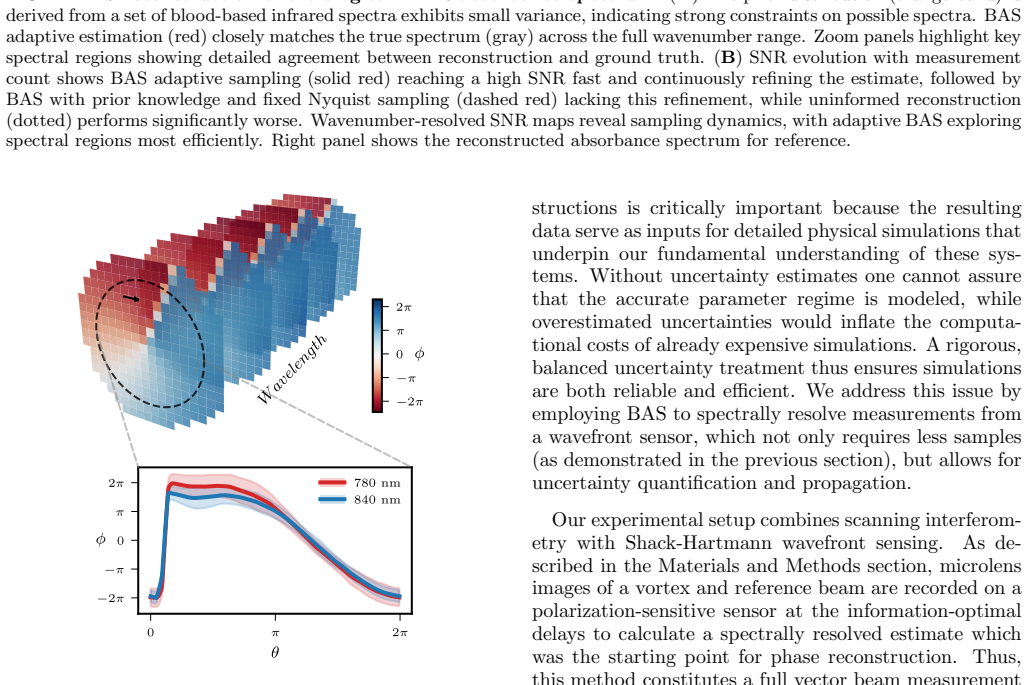
Bayesian Autocorrelation Spectroscopy treats spectral reconstruction as sequential Bayesian inference: each measurement at delay $\tau$ is a noisy linear projection $F(\tau)=\int S(\omega)[1+\cos(\omega\tau)]d\omega$ of the spectrum, and a Gaussian prior over spectral coefficients is updated by Bayes' rule (Eq. 3). The next delay is chosen to maximize the information gain $\frac{1}{2}\log(|\Sigma_{\mathrm{prior}}|/|\Sigma_{\mathrm{posterior}}|)$ (Eq. 4), which reduces to D-optimality and hence to equidistant Nyquist sampling when the prior is a large isotropic covariance. When several candidate priors are available, BAS computes sequential Bayesian evidence for each, weights them by a softmax over log-evidence, and can revert to the uninformed model if informed priors predict the data poorly. On synthetic blood-plasma infrared spectra modeled from real clinical data, adaptive BAS reaches higher signal-to-noise ratios with fewer measurements than Nyquist sampling; on vortex beams it produces wavelength-resolved phase with fully propagated covariances; and combined with an RGB filter array and a liquid-crystal retarder it reconstructs hyperspectral data from a handful of delay steps.
Load-bearing premise
The performance floor (BAS never worse than FTS) rests on the unproven assumption that the softmax-weighted evidence across the small, hand-chosen set of prior models can detect a misleading prior before it has corrupted the estimate; an overconfident prior that earns high early weights could push the method below the uninformed baseline.
Editorial extensions
If this is right
- Standard Fourier transform spectroscopy is mathematically a limiting case of BAS, so upgrading an existing FTIR instrument to adaptive selection requires software, not new hardware, to reach the same spectrum faster.
- When a clinically relevant spectral prior is available, adaptive BAS needs substantially fewer delay measurements to reach a given SNR, which shortens measurement time for high-throughput blood analysis.
- Because BAS returns a full spectral covariance matrix, downstream analyses such as vortex phase retrieval can propagate correlated uncertainties in closed form, replacing point estimates with calibrated error bars.
- Combining coarse RGB color responses with a few interferometric delays gives a compact hyperspectral imager that keeps full spatial resolution, a capability that does not exist for fixed Nyquist-style RGB sampling alone.
Reading between the lines
- A natural next step would be to use the same evidence machinery to choose between sensor modalities (which color channel, which delay, which detector) as well as within a modality, turning the RGB-plus-retarder demo into a general active-sensor fusion rule.
- The 'never below FTS' guarantee is asserted from simulations rather than proven; a rigorous version would need a non-asymptotic bound on the softmax model selection, including the temperature parameter.
- If the framework transfers as claimed, any instrument whose observations are linear projections of a field, such as optical coherence tomography, X-ray ptychography, or NMR, could adopt the same adaptive scheme using a covariance prior.
- The blood-plasma gain is plausibly upper-bounded by the fact that the test spectra were generated from the same multivariate Gaussian fits that define the priors; prospective real FTIR data would show how much of the gain survives distribution shift.
Editorial analysis
A structured set of objections, weighed in public.
Referee Report
Summary. The manuscript proposes Bayesian Autocorrelation Spectroscopy (BAS), an adaptive framework for Fourier transform spectroscopy and related linear inverse problems. After each measurement, a Gaussian posterior over the spectrum is updated through Eq. (3), and the next interferometric delay is chosen to maximize the expected information gain of Eq. (4). The authors argue that under an uninformed prior this criterion reduces to D-optimality and recovers Nyquist sampling as the optimal fixed design, while with informative priors BAS can sample adaptively and outperform conventional FTS. The claims are supported by three demonstrations: reconstruction of synthetic blood-plasma FTIR spectra, spectral phase retrieval of an optical vortex with propagated uncertainties, and hyperspectral imaging from an RGB camera combined with an interferometric delay stage.
Significance. If the central performance guarantee were established, the paper would provide a useful unification of classical sampling theory with Bayesian experimental design, with practical potential for faster spectroscopic measurements and multiplexed imaging. The linear-Gaussian update equations and information-gain criterion are standard and correctly presented; the use of existing D-optimality results to recover equispaced sampling for trigonometric models is legitimate; and the covariance propagation through the vortex phase-retrieval chain is a genuine methodological contribution. However, the headline claim that BAS 'never falls below conventional sampling' is not proved, and the main quantitative benchmark is weakened by the fact that the synthetic test spectra are drawn from the same Gaussian model family used to build the priors. These issues are load-bearing for the abstract and Section I, although they do not invalidate the underlying framework.
major comments (3)
- [Section I, last paragraph; S2.4.2, Eqs. (S248)-(S249)] The claim that BAS 'at least matches' FTS even with unhelpful priors is asserted rather than derived. The only specified prior-selection mechanism is the softmax weighting of cumulative log evidence in Eq. (S249), where each evidence contribution includes the complexity penalty (1/2) log det(Sigma_F + R Sigma_S R^T) in Eq. (S248). For the uninformed baseline Sigma_0 = alpha I of Eq. (S221), this determinant term grows with alpha, so the more diffuse the baseline is, the less weight it receives; the mechanism is structurally biased against the model that is supposed to represent FTS. No threshold, decision rule, or temperature regime is specified that would implement a 'fall back to baseline' behavior, and because the adaptive delay schedule is steered by the currently weighted posterior, a misspecified informative prior can dominate the sampling policy before the evidence reweights it. The guarantee therefore needs either a theorem with explicit misspecification assumptions, an explicit fallback algorithm with a correctness argument, or a substantial reformulation of the claim to a statement about typical rather than guaranteed performance.
- [S1, 'Synthetic data on molecular fingerprinting'; Fig. 1] The quantitative demonstration that BAS outperforms FTS is conducted entirely on synthetic spectra generated by fitting multivariate Gaussian distributions to the L4L cohort, with the same training-set means and covariances serving as prior models. The test draws therefore come from the same distribution family used to construct the priors, which is a within-model validation loop and does not exercise the misspecification regime in which the 'never below FTS' guarantee matters. A convincing demonstration would need held-out real spectra or a deliberate misspecification experiment, such as priors derived from one subgroup evaluated on another, and the reported gains should be presented as applying to the well-specified case rather than as a general clinical-performance statement.
- [S2.4.2, Eqs. (S247)-(S248)] The evidence computation as written is ambiguous. Equation (S247) correctly defines the model evidence as a product of one-step-ahead predictive densities p(F_i | F_1,...,F_{i-1}, M_k), but Eq. (S248) is stated with mu_S and Sigma_S as 'the moments of the prior.' If these are the original prior moments rather than the posterior moments after F_1,...,F_{i-1}, the product is not the marginal likelihood and the softmax weights in Eq. (S249) are not Bayesian model evidence. If they are instead meant to be the current posterior moments, that should be stated explicitly and the sequential update shown. This distinction matters because the claimed robustness to prior misspecification relies on the evidence weighting being a valid predictive measure.
minor comments (5)
- [Eq. (3) and S2.3.1] The main text describes gamma as a 'Bayesian update weight,' but in the vector case gamma is a matrix, specifically Sigma_old R^T (R Sigma_old R^T + sigma_add^2)^(-1); the notation should be reconciled between the main text and the supplement.
- [S1, Vortex and RGB paragraphs] The phrase 'starting from prior set of prior set with zero mean' contains a duplicated phrase and should read 'starting from a prior set with zero mean.'
- [Fig. 1B] The curve labeled 'informed Nyquist sampling' should be defined explicitly as fixed equispaced delays with an informative prior, since the distinction between adaptive and fixed-informed sampling is central to the message.
- [S2.2.1.5, Eq. (S224)] The function g(z) is presented without derivation; a short derivation or a citation would help the reader verify the claimed maximum at z approximately 1.164 pi.
- [Abstract and Section I] The phrase 'performance never falls below conventional sampling' is a strong universal guarantee; the main text supports it only with the sentence 'we can guarantee,' which is not backed by a theorem or algorithm. The abstract should be tempered to what is actually proved or validated empirically.
Circularity Check
No load-bearing circularity: the Nyquist/D-optimality argument rests on external results (Pukelsheim, Slepian-Landau), and the BAS update equations are standard linear-Gaussian Bayesian inference; the 'never below FTS' guarantee and same-family synthetic benchmark are robustness limitations rather than circular derivations.
full rationale
The central derivation chain is self-contained against external mathematics. Eq. (3) and Eq. (4) are the standard linear-Gaussian Bayesian update and mutual-information criterion, and the posterior update is derived from Bayes' rule in S2.1 and S2.3.1 without importing the target claim. The emergence of Nyquist sampling is argued via the Slepian-Pollak-Landau eigenanalysis (S2.2.1.1), a Karhunen-Loeve truncation, and the external D-optimal design theorem of Pukelsheim (S2.2.1.4), not from a prior paper by the same authors. The statements that uninformed Nyquist BAS reduces to classical FTS are true by construction from Eq. (S228) and the alpha-I prior, and are used as a consistency check rather than as evidence for the adaptive gains. The only self-referential element is the synthetic blood-plasma benchmark: the test spectra are drawn from the same multivariate Gaussian family used to build the prior models, so the reported gains are in-distribution and do not independently validate robustness to misspecified priors. This is a validation-loop limitation, not a derivation that reduces to its inputs. Likewise, the abstract's claim that performance 'never falls below conventional sampling' is asserted rather than proven; the softmax evidence weighting of Eq. (S249) and the absence of an explicit fallback threshold mean the guarantee is not demonstrated, but an unsupported guarantee is not circularity. Minor self-citations ([18], [28]) appear only as background motivation and are not load-bearing. Overall, no step in the derivation chain is equivalent by construction to its own input.
Assumptions & free parameters
free parameters (6)
- RBF prior correlation length l =
set to l approximately pi/tau_max
- RBF prior variance scale sigma^2 =
not specified; set per application
- Softmax temperature T =
not specified
- Noise parameters sigma_add and sigma_mult =
approx 99 dB time-domain SNR from QC data
- Per-group Gaussian prior means and covariances =
fit to L4L training spectra
- Blackbody illumination temperature =
1200 K
assumptions (6)
- standard math Cox's theorem and the Bayesian update rule justify representing all uncertainty by probabilities
- standard math Gaussian prior and additive Gaussian noise lead to a conjugate Gaussian posterior via linear updates
- domain assumption Bandlimited and time-limited signals are effectively finite-dimensional with about 2BT degrees of freedom and can be represented in a trigonometric basis
- standard math D-optimality theorem for trigonometric regression: equispaced samples are D-optimal
- domain assumption Measurement noise in FTIR can be modeled as additive plus multiplicative Gaussian with a small product term
- ad hoc to paper The synthetic blood-plasma dataset generated by fitting multivariate Gaussians to the L4L cohort faithfully reproduces real spectral variation
Cite this review
Pith. "Pith review of Information-optimal measurement: From fixed sampling protocols to adaptive spectroscopy." pith.science (2026). https://pith.science/paper/MPKBH2XE
@misc{pith2026250514364,
  author       = {Pith},
  title        = {Pith review of: Information-optimal measurement: From fixed sampling protocols to adaptive spectroscopy},
  year         = {2026},
  howpublished = {\url{https://pith.science/paper/MPKBH2XE}},
  note         = {Machine review of arXiv:2505.14364}
}
read the original abstract
All measurements of continuous signals rely on taking discrete snapshots, with the Nyquist-Shannon theorem dictating sampling paradigms. We present a broader framework of information-optimal measurement, showing that traditional sampling is optimal only when we are entirely ignorant about the system under investigation. This insight unlocks methods that efficiently leverage prior information to overcome long-held fundamental sampling limitations. We demonstrate this for optical spectroscopy - vital to research and medicine - and show how adaptively selected measurements yield higher information in medical blood analysis, optical metrology, and hyperspectral imaging. Through our rigorous statistical framework, performance never falls below conventional sampling while providing complete uncertainty quantification in real time. This establishes a new paradigm where measurement devices operate as information-optimal agents, fundamentally changing how scientific instruments collect and process data.
Figures


Forward citations
Cited by 1 Pith paper
-
Information-Optimal Sensing and Control in High-Intensity Laser Experiments
The authors propose that optimal measurement and control in high-intensity laser experiments should maximize mutual information about task-relevant parameters, unifying their prior diagnostics and optimization work.
Reference graph
Works this paper leans on
-
[1]
Shannon, Proceedings of the IRE37, 10 (1949)
C. Shannon, Proceedings of the IRE37, 10 (1949)
work page 1949
-
[2]
M. Mishali and Y. C. Eldar, IEEE Signal Processing Magazine28, 98 (2011)
work page 2011
-
[3]
E. J. Cands, J. K. Romberg, and T. Tao, Communications on Pure and Applied Mathematics59, 1207 (2006), eprint: https://onlinelibrary.wiley.com/doi/pdf/10.1002/cpa.20124
-
[4]
R. T. Cox, American journal of physics14, 1 (1946)
work page 1946
-
[5]
E. T. Jaynes,Probability theory: The logic of science (Cambridge university press, 2003)
work page 2003
-
[6]
D. Gabor, Journal of the Institution of Electrical Engineers-part III: radio and communication engineering 93, 429 (1946)
work page 1946
-
[7]
F. Pukelsheim,Optimal Design of Experiments(Society for Industrial and Applied Mathematics, Philadelphia, Pa, 2006)
work page 2006
-
[8]
P. R. Griffiths and J. A. de Haseth,Fourier Transform Infrared Spectrometry, 2nd ed. (WileyInterscience, Hobo- ken, NJ, 2007)
work page 2007
Show all 50 references
-
[9]
A. A. Enders, N. M. North, C. M. Fensore, J. Velez- Alvarez, and H. C. Allen, Analytical Chemistry93, 9711 (2021), publisher: American Chemical Society
2021
-
[10]
Dendisov, A
M. Dendisov, A. Jenitov, A. Parchask-Kokaislov, P. Matjka, V. Prokopec, and M. vecov, Analytica Chim- ica Acta1031, 1 (2018)
2018
-
[11]
S. O. Fakayode, B. , Gary A., B. , David K., B. , Nakara, E. , Brianda, S. , Noureen, M. , Saman- tha, P. , David A., P. , Rocio L., D. , A’ja V., , and I. M. Warner, Applied Spectroscopy Reviews 55, 647 (2020), publisher: Taylor & Francis eprint: https://doi.org/10.1080/05704...
2020
-
[12]
Movasaghi, S
Z. Movasaghi, S. Rehman, and D. I. ur Rehman, Applied Spectroscopy Reviews43, 134 (2008)
2008
-
[13]
C. M. Simonescu, inAdvanced Aspects of Spectroscopy, edited by M. A. Farrukh (IntechOpen, 2012) pp. 49–84
2012
-
[14]
E. D. Becker and T. C. Farrar, Science178, 361 (1972)
1972
-
[15]
A. C. S. Talari, M. A. G. Martinez, Z. Movasaghi, S. Rehman, and I. U. Rehman, Applied Spectroscopy Re- views52, 456 (2017)
2017
-
[16]
D. I. Ellis and R. Goodacre, Analyst131, 875 (2006)
2006
-
[17]
Huber, K
M. Huber, K. V. Kepesidis, L. Voronina, F. Fleischmann, E. Fill, J. Hermann, I. Koch, K. Milger-Kneidinger, T. Kolben, G. B. Schulz, F. Jokisch, J. Behr, N. Har- beck, M. Reiser, C. Stief, F. Krausz, and M. Zigman, eLife10, e68758 (2021), publisher: eLife Sciences Publi- cations, Ltd
2021
-
[18]
K. V. Kepesidis, M.-G. Stoleriu, N. Feiler, L. Gigou, F. Fleischmann, J. Aschauer, S. Eiselen, I. Koch, N. Rein- muth, A. Tufman,et al., BMC medicine23, 101 (2025)
2025
-
[19]
Alonso, A
B. Alonso, A. D¨ opp, and S. W. Jolly, APL Photonics9, 070901 (2024)
2024
-
[20]
Heckenberg, R
N. Heckenberg, R. McDuff, C. Smith, and A. White, Op- tics letters17, 221 (1992)
1992
-
[21]
A. M. Yao and M. J. Padgett, Advances in optics and 7 photonics3, 161 (2011)
2011
-
[22]
Vieira, R
J. Vieira, R. M. G. M. Trines, E. P. Alves, R. A. Fonseca, J. T. Mendona, R. Bingham, P. Norreys, and L. O. Silva, Nature Communications7, 10371 (2016), publisher: Na- ture Publishing Group
2016
-
[23]
Fickler, R
R. Fickler, R. Lapkiewicz, S. Ramelow, and A. Zeilinger, Physical Review A89, 060301 (2014), publisher: Amer- ican Physical Society
2014
-
[24]
Parigi, V
V. Parigi, V. DAmbrosio, C. Arnold, L. Marrucci, F. Sciarrino, and J. Laurat, Nature Communications6, 7706 (2015), publisher: Nature Publishing Group
2015
-
[25]
Pariente, V
G. Pariente, V. Gallet, A. Borot, O. Gobert, and F. Qu´ er´ e, Nature Photonics10, 547 (2016)
2016
-
[26]
Piccardo, M
M. Piccardo, M. de Oliveira, V. R. Policht, M. Russo, B. Ardini, M. Corti, G. Valentini, J. Vieira, C. Manzoni, G. Cerullo,et al., Nature Photonics17, 822 (2023)
2023
-
[27]
Jeandet,Spatio-temporal characterization of fem- tosecond laser pulses using self-referenced Fourier trans- form spectroscopy, Ph.D
A. Jeandet,Spatio-temporal characterization of fem- tosecond laser pulses using self-referenced Fourier trans- form spectroscopy, Ph.D. thesis, Universit´ e Paris-Saclay (2020)
2020
-
[28]
Weisse, J
N. Weisse, J. Esslinger, S. Howard, F. M. Foerster, F. Haberstroh, L. Doyle, P. Norreys, J. Schreiber, S. Karsch, and A. D¨ opp, Optics Express31, 19733 (2023)
2023
-
[29]
Lu and B
G. Lu and B. Fei, Journal of biomedical optics19, 010901 (2014)
2014
-
[30]
Feng and D.-W
Y.-Z. Feng and D.-W. Sun, Critical Re- views in Food Science and Nutrition52, 1039 (2012), publisher: Taylor & Francis eprint: https://doi.org/10.1080/10408398.2011.651542
2012
-
[31]
L. M. Dale, A. Thewis, C. Boudry, I. Rotar, P. Dardenne, V. Baeten, and J. A. F. Pierna, Applied Spectroscopy Re- views48, 142 (2013), publisher: Taylor & Francis eprint: https://doi.org/10.1080/05704928.2012.705800
2013
-
[32]
X. Dong, M. Jakobi, S. Wang, M. H. Khler, X. Zhang, and A. W. Koch, Applied Spectroscopy Reviews54, 285 (2019), publisher: Taylor & Francis eprint: https://doi.org/10.1080/05704928.2018.1463235
2019
-
[33]
A. F. H. Goetz, Remote Sensing of Environment Imaging Spectroscopy Special Issue,113, S5 (2009)
2009
-
[34]
N. A. Hagen and M. W. Kudenov, Optical Engineering 52, 090901 (2013), publisher: SPIE
2013
-
[35]
G. R. Arce, D. J. Brady, L. Carin, H. Arguello, and D. S. Kittle, IEEE Signal Processing Magazine31, 105 (2014)
2014
-
[36]
L. V. Jospin, H. Laga, F. Boussaid, W. Buntine, and M. Bennamoun, IEEE Computational Intelligence Mag- azine17, 29 (2022)
2022
-
[37]
Wang and S
Z. Wang and S. Jegelka, inInternational conference on machine learning(PMLR, 2017) pp. 3627–3635
2017
-
[38]
Beleites, U
C. Beleites, U. Neugebauer, T. Bocklitz, C. Krafft, and J. Popp, Analytica Chimica Acta760, 25 (2013)
2013
-
[39]
Eissa, K
T. Eissa, K. V. Kepesidis, M. Zigman, and M. Huber, Analytical Chemistry95, 6523 (2023), publisher: Amer- ican Chemical Society
2023
-
[40]
Slepian, Proceedings of the IEEE64, 292 (1976)
D. Slepian, Proceedings of the IEEE64, 292 (1976)
1976
-
[41]
Daubechies, IEEE Transactions on Information Theory 34, 605 (1988)
I. Daubechies, IEEE Transactions on Information Theory 34, 605 (1988)
1988
-
[42]
H. J. Landau and H. O. Pollak, Bell System Technical Journal41, 1295 (1962)
1962
-
[43]
C. E. Rasmussen, inSummer school on machine learning (Springer, 2003) pp. 63–71
2003
-
[44]
Wang,Karhunen-Loeve expansions and their applica- tions(London School of Economics and Political Science (United Kingdom), 2008)
L. Wang,Karhunen-Loeve expansions and their applica- tions(London School of Economics and Political Science (United Kingdom), 2008)
2008
-
[45]
Latz, SIAM Review65, 831 (2023), publisher: Society for Industrial and Applied Mathematics
J. Latz, SIAM Review65, 831 (2023), publisher: Society for Industrial and Applied Mathematics
2023
-
[46]
M. J. Baker, J. Trevisan, P. Bassan, R. Bhargava, H. J. Butler, K. M. Dorling, P. R. Fielden, S. W. Fogarty, N. J. Fullwood, K. A. Heys, C. Hughes, P. Lasch, P. L. Martin- Hirsch, B. Obinaju, G. D. Sockalingum, J. Sul-Suso, R. J. Strong, M. J. Walsh, B. R. Wood, P. Gardner, an...
2014
-
[47]
C. L. M. Morais, K. M. G. Lima, M. Singh, and F. L. Martin, Nature Protocols15, 2143 (2020), publisher: Na- ture Publishing Group
2020
-
[48]
Casella and R
G. Casella and R. L. Berger,Statistical Inference, 2nd ed. (Duxbury Press, Pacific Grove, CA, 2002). ACKNOWLEDGMENTS We thank Prof. Ferenc Krausz for supporting this work. We thank the Federal Republic of Germany and the Free State of Bavaria for funding the CALA infras- truct...
2002
-
[49]
Global (designing a set of measurements to maximize total information gain)
-
[50]
unknown signal
Myopic (choosing each next measurement to maximize immediate information gain) S2.2.1. Specifications leading to classical sampling To complement the more intuitive explanations given in the main text, this section provides more rigorous deriva- tions how Nyquist sampling emer...
Reviewed August 7, 2026 · model on record in the stance chip above.
Discussion (0). Sign in to comment.