REVIEW 3 major objections 4 minor 1 cited by
Searching for entanglement in final polarization states of the neutron-proton scattering
T0 review · 3 major / 4 minor · reviewed 2026-08-07 · deepseek-v4-flash
Pith's one-line read This paper predicts that elastic neutron-proton scattering at 100 MeV can leave the outgoing neutron and proton in nearly perfect Bell-type entangled spin states, with as little as about 2% contamination.
desk verdict The pure-state Bell-type predictions are real progress; the mixed-state entanglement claims are not supported by the measures used, and the 2% admixture needs a convergence check. read the letter →
The pith
A machine-rendered reading of the paper's core claim, the machinery that carries it, and where it could break.
The reading
What carries the argument
The machinery is the transition operator $T$ of the Lippmann-Schwinger equation, $T=v_{np}+v_{np}G_0T$, together with the final density matrix $\rho_{\rm out}=T\rho_{\rm in}T^\dagger/\mathrm{Tr}(T\rho_{\rm in}T^\dagger)$, whose 15 tensor components are fixed by the outgoing polarizations and spin correlations. The operative mechanism is the selectivity of the T-matrix: its largest elements preserve the sign of each nucleon's spin projection, reducing the effective number of amplitudes from 16 to about 4, and at favourable energies and angles these four amplitudes acquire the magnitudes and phases of a Bell state. The Bell states are the four maximally entangled two-spin states of Eq. (19), e.g. $(|{+}{+}\rangle\pm|{-}{-}\rangle)/\sqrt2$ and $(|{+}{-}\rangle\pm|{-}{+}\rangle)/\sqrt2$.
What would settle it
Repeat the calculation of Table III at $E_{\rm lab}=100$ MeV using a higher partial-wave cutoff such as $j_{\max}=7$ or an independent high-precision nucleon-nucleon potential; if the entanglement maxima disappear, shift by more than a few degrees, or the spoiling admixture in state No. 6 rises well above 2%, the central claim is not robust.
Extended reading notes
Core claim
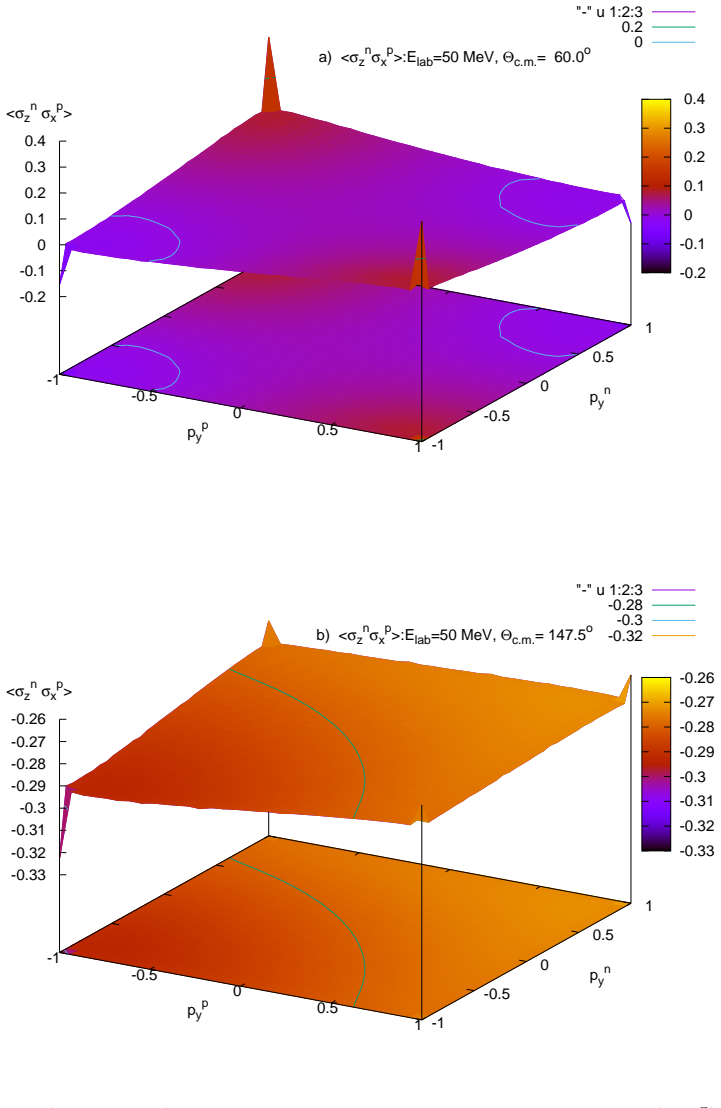
The central discovery is that the transition operator of elastic np scattering, computed from the AV18 potential, can act as an entanglement generator when the incoming spins are prepared in a pure maximally polarized product state. Because parity conservation leaves only six nonvanishing observables—the neutron and proton $y$-polarizations and the correlations $\langle\sigma^n_x\sigma^p_x\rangle$, $\langle\sigma^n_y\sigma^p_y\rangle$, $\langle\sigma^n_z\sigma^p_z\rangle$, $\langle\sigma^n_x\sigma^p_z\rangle$, and $\langle\sigma^n_z\sigma^p_x\rangle$—those observables completely determine $\rho_{\rm out}$. The authors compute all four contributions to each observable, including the double polarization-transfer terms from a doubly polarized initial state, and show that the final pure states produced by $p^n_y,p^p_y=\pm1$ obey $\langle\sigma^n_y\sigma^p_y\rangle=\pm1$ exactly at all energies and angles. At $E_{\rm lab}=100$ MeV the angular distributions of entanglement power and concurrence develop sharp maxima at which the decomposition of the final state into spin projections collapses onto two dominant amplitudes, reproducing Bell states of all four types with small contaminating amplitudes; the cleanest example is state No. 6 at $\Theta_{\rm cm}=143^\circ$ for $p^n_y=p^p_y=-1$, with about 2% contamination.
Load-bearing premise
The Bell-state predictions assume the AV18 potential's spin-dependent T-matrix elements are quantitatively accurate at $E_{\rm lab}=100$ MeV with partial waves truncated at $j_{\max}=5$; the paper shows no convergence test in $j_{\max}$ and no comparison with another potential, so the angular positions and the roughly 2% admixture could be artifacts of that choice.
Editorial extensions
If this is right
- A polarized neutron-proton scattering experiment at $E_{\rm lab}=100$ MeV tuned to the identified angles should see nearly perfect correlated or anticorrelated spin outcomes, with the cleanest state at $\Theta_{\rm cm}=143^\circ$.
- The final pure states have $\langle\sigma^n_y\sigma^p_y\rangle=\pm1$ exactly for all energies and angles, so any deviation from $\pm1$ in an experiment would signal impurity rather than a different entangled structure.
- Because entanglement of the impure states strengthens with energy, higher-energy elastic np scattering below the pion-production threshold is the more promising regime for practical entanglement generation.
- Double spin-polarization transfer from a doubly polarized initial state, isolated here for the first time, is the dominant source of $\langle\sigma^n_y\sigma^p_y\rangle$ and cannot be neglected in future analyses of final-state entanglement.
Reading between the lines
- If the AV18-based prediction survives a change of potential or partial-wave cutoff, elastic np scattering becomes a practical strong-interaction source of nearly pure Bell states, needing only maximally polarized beam and target and no post-selection.
- The same T-matrix selectivity argument suggests that reactions such as nucleon-induced deuteron breakup, which the authors list as an open problem, may also generate entangled outgoing pairs; a few-body calculation with the same density-matrix reconstruction would be a direct test.
- The exact $\pm1$ value of $\langle\sigma^n_y\sigma^p_y\rangle$ in pure states could serve as an experimental self-test of the density-matrix reconstruction, since it is fixed by identities among transfer coefficients rather than by the potential.
- Because the $y$-correlation saturates at $\pm1$ while the other correlations carry the Bell-state signature, using concurrence alone could mis-rank states; full density-matrix tomography is needed to certify which Bell type is produced.
Editorial analysis
A structured set of objections, weighed in public.
Referee Report
Summary. The paper studies the spin state of the outgoing neutron--proton pair in elastic np scattering, starting from independently polarized incoming neutron and proton beams with polarizations along y. Using the AV18 potential solved through the Lippmann--Schwinger equation in a partial-wave basis truncated at jmax=5, the authors compute final polarizations and spin correlations, including, for the first time, the double polarization/correlation transfers from a doubly spin-polarized initial state. They find that almost all final states are mixed states; pure final states occur only when both initial polarizations are maximal (pn_y, pp_y = ±1). Their central numerical claims are (i) entanglement of impure final states, as quantified by ǫ = 1 − Tr(ρ_n²) and C = 1/2|⟨σ_y^n σ_y^p⟩|, increases with energy, and (ii) at E_lab = 100 MeV some pure final states approximate Bell states, the most striking being state No. 6 in Table III with only about 2% entanglement-spoiling admixture.
Significance. If the pure-state Bell-type results survive scrutiny, the paper would provide a concrete, falsifiable prediction: double-polarized np scattering at E_lab = 100 MeV and specific center-of-mass angles should yield final spin states close to Bell states. The explicit decomposition of final observables into induced, single-transfer, and double-transfer contributions is a useful formal addition, and the pure-state amplitude identification in Table III is a direct, internally consistent read of the T-matrix with no fitted parameters. However, the manuscript's mixed-state entanglement measures are not valid measures of entanglement, and the headline numerical claims lack convergence tests and inter-potential comparisons. The paper therefore needs substantive revision before its conclusions can be accepted.
major comments (3)
- [Section II, Eq. (21)] The quantity C(ρnp) = 1/2|⟨σ_y^n σ_y^p⟩| is not the concurrence, even for pure states. For the product state |+y⟩_n |+y⟩_p, C = 1/2 while the state is not entangled; for the separable mixed state (1/2)(|++⟩⟨++| + |−−⟩⟨−−|), C = 1/2 as well. Thus the reported value C = 0.5 for the pure final states generated from pn_y, pp_y = ±1, which follows from ⟨σ_yσ_y⟩ = ±1 in Eq. (39) and Fig. 16, does not indicate maximal entanglement. This invalidates the concurrence-based claims for impure final states in Figs. 13b–15b and the corresponding text.
- [Section II, Eq. (20)] The quantity ǫ(ρnp) = 1 − Tr(ρ_n^2) measures the mixedness of the reduced state, not entanglement, when the global state is mixed. The separable mixed state (1/2)(|++⟩⟨++| + |−−⟩⟨−−|) gives ǫ = 1/2. Therefore the abstract and Section IV claims that "the entanglement of impure final states increases with energy," based on Figs. 13a–15a, are unsupported. The authors should either use a valid mixed-state entanglement monotone (e.g., negativity or mixed-state concurrence) or restrict the entanglement discussion to the pure final states.
- [Section III, Table III] The headline prediction, state No. 6 in Table III (E = 100 MeV, Θ_cm = 143°, spoiling admixture ≈ 1.8%), depends on near-cancellation of small spin-flip T-matrix elements. The calculation uses AV18 with jmax = 5, but no convergence test in jmax and no comparison with another high-precision NN potential are given. Since double spin-polarization transfer observables have not been measured, these T-matrix elements are not directly constrained by data. The authors should add jmax = 6 and jmax = 7 calculations and at least one other potential (e.g., CD-Bonn or a chiral N3LO potential) for the entries of Table III, and ideally show how the angular positions and admixtures shift.
minor comments (4)
- [Section II, Eq. (22)] Equation (22) lists ⟨σ_x^n⟩², ⟨σ_y^n⟩², and then ⟨σ_y^n⟩² again; the last term should presumably be ⟨σ_z^n⟩². Please correct the formula and verify the resulting expression 1/2√(1 − ⟨σ_y^n⟩²) in the parity-restricted case.
- [Table III] Rows 9 and 11 contain entries that are not fully populated (no angle or coefficients are listed, only "- 0.175 0.325"). These rows should either be removed or clearly marked as states that were searched for but not identified, with the text explaining the 0.175/0.325 values.
- [References] Reference [22] is cited as "Phys. Rev. Lett. C 133, 050202 (2024)"; this journal name appears malformed and should be checked.
- [General presentation] There are several OCR/proofreading artifacts, including the author field "H. Wita/suppress la", the symbol sequence "△ /greaterorapproxeql0.5" in Section III, and numerous garbled sub/superscripts in Appendix A. A careful copy edit is needed.
Circularity Check
No significant circularity: the Bell-type state predictions are numerical consequences of the external AV18 potential and the Lippmann-Schwinger equation, with no fitted entanglement input.
full rationale
The paper's central prediction—Bell-type pure final states with small admixtures at E_lab=100 MeV—follows from solving the Lippmann-Schwinger equation (24) with the external AV18 potential and then computing the final spin density matrix via Eqs. (3), (35), and (37). The final-state amplitudes in Table III are read off from Eq. (38) after the T-matrix is fixed; no parameter is fitted to the entanglement measures, and the search over angles minimizes the computed smaller amplitudes rather than adjusting an input. The purity of final states from maximally polarized pure initial states is proven in Eq. (36), not assumed. The only self-citation, [21], is a pointer for the formalism of double polarization-transfer coefficients and is not load-bearing for the entanglement claim. Therefore the derivation is self-contained against an external benchmark (AV18), and there is no circular step.
Assumptions & free parameters
assumptions (4)
- domain assumption The AV18 potential is an accurate representation of the nucleon-nucleon interaction.
- domain assumption Truncation of the partial-wave basis at j_max=5 yields converged spin observables at the considered energies.
- standard math Parity conservation in np scattering forbids certain polarizations and spin correlations.
- ad hoc to paper The quantities ε=1-Tr(ρ_n^2) and C=1/2|⟨σ_y^n σ_y^p⟩| measure entanglement for mixed states.
Cite this review
Pith. "Pith review of Searching for entanglement in final polarization states of the neutron-proton scattering." pith.science (2026). https://pith.science/paper/67CBFMSF
@misc{pith2026250514401,
  author       = {Pith},
  title        = {Pith review of: Searching for entanglement in final polarization states of the neutron-proton scattering},
  year         = {2026},
  howpublished = {\url{https://pith.science/paper/67CBFMSF}},
  note         = {Machine review of arXiv:2505.14401}
}
abstract
We investigate polarization states of the outgoing neutron-proton ($np$) pair in elastic polarized neutron and proton scattering, aiming to find unambiguous evidence for entanglement of their spin states. To obtain complete information about these states, we calculate, using the high precision nucleon-nucleon potential AV18, the final polarizations of the neutron and proton as well as their spin correlation coefficients, which unequivocally define the corresponding spin density matrix. We compute all terms contributing to polarizations and spin correlations, e.g. not only induced polarizations and correlations resulting from unpolarized $np$ scattering, but also contributions from single polarization and correlation transfers from individual polarized incoming nucleons, and, for the first time, allotment to both quantities stemming from a doubly spin polarized initial state. We find that for the most part the final spin states are statistical mixture of states.The only pure states occur for highly polarized incoming neutrons and protons with maximal polarizations. By quantifying the degree of entanglement through entanglement power and concurrence, we observed that the entanglement of impure final states increases with energy. Among the pure spin states resulting from incoming states with maximal neutron and proton polarizations, we found, at $E_{lab}=100$~MeV, cases of strongly entangled Bell-type states with only a small admixture of entanglement-spoiling contributions.
Figures


Figures from the paper (15 more)




Forward citations
Cited by 1 Pith paper
-
Photon-nucleon entanglement in Compton scattering at low and high energies
Photon-nucleon entanglement in polarized Compton scattering is generically present and, for neutrons, strongly controlled by the nucleon electric and magnetic polarizabilities.
Reference graph
Works this paper leans on
-
[1]
K z′,0 0,x = √ 2 2 (t10,00 00,1−1 −t10,00 00,1+1)
-
[2]
K z′,0 0,y = − i √ 2 2 (t10,00 00,1−1 +t10.00 00,1+1)
-
[3]
K z′,0 0,z =t10,00 00,10
-
[4]
K x′,0 0,x = 1 2(t1−1,00 00,1−1 −t1+1,00 00,1−1 −t1−1,00 00,1+1 +t1+1,00 00,1+1)
-
[5]
K x′,0 0,y = − i 2(t1−1,00 00,1−1 −t1+1,00 00,1−1 +t1−1,00 00,1+1 −t1+1,00 00,1+1)
-
[6]
K x′,0 0,z = √ 2 2 (t1−1,00 00,10 −t1+1,00 00,10 )
-
[7]
K y′,0 0,x = i 2(t1+1,00 00,1+1 +t1+1,00 00,1−1 −t1−1,00 00,1+1 −t1+1,00 00,1+1)
-
[8]
K y′,0 0,y = 1 2(t1−1,00 00,1−1 +t1+1,00 00,1−1 +t1−1,00 00,1+1 +t1+1,00 00,1+1)
Show all 168 references
-
[9]
Double polarization transfers K n′,0 p,n 25
K y′,0 0,z = i √ 2 2 (t1−1,00 00,10 +t1+1,00 00,10 ) II. Double polarization transfers K n′,0 p,n 25
-
[10]
K z′,0 x,x = 1 2(t10,00 1−1,1−1 −t10,00 1−1,1+1 −t10,00 1+1,1−1 +t10,00 1+1,1+1)
-
[11]
K z′,0 y,x = − i 2(t10,00 1−1,1−1 −t10,00 1−1,1+1 +t10,00 1+1,1−1 −t10,00 1+1,1+1)
-
[12]
K z′,0 z,x = √ 2 2 (t10,00 10,1−1 −t10,00 10,1+1)
-
[13]
K z′,0 x,y = − i 2(t10,00 1−1,1−1 +t10,00 1−1,1+1 −t10,00 1+1,1−1 −t10,00 1+1,1+1)
-
[14]
K z′,0 y,y = − 1 2(t10,00 1−1,1−1 +t10,00 1−1,1+1 +t10,00 1+1,1−1 +t10,00 1+1,1+1)
-
[15]
K z′,0 z,y = − i √ 2 2 (t10,00 10,1−1 +t10,00 10,1+1)
-
[16]
K z′,0 x,z = √ 2 2 (t10,00 1−1,10 −t10,00 1+1,10)
-
[17]
K z′,0 y,z = − i √ 2 2 (t10,00 1−1,10 +t10,00 1+1,10)
-
[18]
K z′,0 z,z =t10,00 10,10
-
[19]
K x′,0 x,x = √ 2 4 (t1−1,00 1−1,1−1−t1+1,00 1−1,1−1−t1−1,00 1−1,1+1+t1+1,00 1−1,1+1−t1−1,00 1+1,1−1+t1+1,00 1+1,1−1+t1−1,00 1+1,1+1−t1+1,00 1+1,1+1)
-
[20]
K x′,0 y,x = − i √ 2 4 (t1−1,00 1−1,1−1 −t1+1,00 1−1,1−1 −t1−1,00 1−1,1+1 +t1+1,00 1−1,1+1 +t1−1,00 1+1,1−1 −t1+1,00 1+1,1−1 −t1−1,00 1+1,1+1 + t1+1,00 1+1,1+1)
-
[21]
K x′,0 z,x = 1 2(t1−1,00 10,1−1 −t1+1,00 10,1−1 −t1−1,00 10,1+1 +t1+1,00 10,1+1)
-
[22]
K x′,0 x,y = − i √ 2 4 (t1−1,00 1−1,1−1 −t1+1,00 1−1,1−1 +t1−1,00 1−1,1+1 −t1+1,00 1−1,1+1 −t1−1,00 1+1,1−1 +t1+1,00 1+1,1−1 −t1−1,00 1+1,1+1 + t1+1,00 1+1,1+1)
-
[23]
K x′,0 y,y = √ 2 4 (−t1−1,00 1−1,1−1 +t1+1,00 1−1,1−1 −t1−1,00 1−1,1+1 +t1+1,00 1−1,1+1 −t1−1,00 1+1,1−1 +t1+1,00 1+1,1−1 −t1−1,00 1+1,1+1 + t1+1,00 1+1,1+1)
-
[24]
K x′,0 z,y = − i 2(t1−1,00 10,1−1 −t1+1,00 10,1−1 +t1−1,00 10,1+1 −t1+1,00 10,1+1)
-
[25]
K x′,0 x,z = 1 2(t1−1,00 1−1,10 −t1+1,00 1−1,10 −t1−1,00 1+1,10 +t1+1,00 1+1,10)
-
[26]
K x′,0 y,z = − i 2(t1−1,00 1−1,10 −t1+1,00 1−1,10 +t1−1,00 1+1,10 −t1+1,00 1+1,10)
-
[27]
K x′,0 z,z = √ 2 2 (t1−1,00 10,10 −t1+1,00 10,10 )
-
[28]
K y′,0 x,x = i √ 2 4 (t1−1,00 1−1,1−1+t1+1,00 1−1,1−1−t1−1,00 1−1,1+1−t1+1,00 1−1,1+1−t1−1,00 1+1,1−1−t1+1,00 1+1,1−1+t1−1,00 1+1,1+1+t1+1,00 1+1,1+1)
-
[29]
K y′,0 y,x = √ 2 4 (t1−1,00 1−1,1−1+t1+1,00 1−1,1−1−t1−1,00 1−1,1+1−t1+1,00 1−1,1+1+t1−1,00 1+1,1−1+t1+1,00 1+1,1−1−t1−1,00 1+1,1+1−t1+1,00 1+1,1+1)
-
[30]
K y′,0 z,x = i 2(t1−1,00 10,1−1 +t1+1,00 10,1−1 −t1−1,00 10,1+1 −t1+1,00 10,1+1)
-
[31]
K y′,0 x,y = √ 2 4 (t1−1,00 1−1,1−1+t1+1,00 1−1,1−1+t1−1,00 1−1,1+1+t1+1,00 1−1,1+1−t1−1,00 1+1,1−1−t1+1,00 1+1,1−1−t1−1,00 1+1,1+1−t1+1,00 1+1,1+1)
-
[32]
K y′,0 y,y = − i √ 2 4 (t1−1,00 1−1,1−1 +t1+1,00 1−1,1−1 +t1−1,00 1−1,1+1 +t1+1,00 1−1,1+1 +t1−1,00 1+1,1−1 +t1+1,00 1+1,1−1 +t1−1,00 1+1,1+1 + t1+1,00 1+1,1+1)
-
[33]
K y′,0 z,y = 1 2(t1−1,00 10,1−1 +t1+1,00 10,1−1 +t1−1,00 10,1+1 +t1+1,00 10,1+1)
-
[34]
K y′,0 x,z = i 2(t1−1,00 1−1,10 +t1+1,00 1−1,10 −t1−1,00 1+1,10 −t1+1,00 1+1,10)
-
[35]
K y′,0 y,z = 1 2(t1−1,00 1−1,10 +t1+1,00 1−1,10 +t1−1,00 1+1,10 +t1+1,00 1+1,10)
-
[36]
Single spin correlation transfers K n′,p′ 0,n
K y′,0 z,z = i √ 2 2 (t1−1,00 10,10 +t1+1,00 10,10 ) 26 III. Single spin correlation transfers K n′,p′ 0,n
-
[37]
K z′,x′ 0,x = 1 2(t10,1+1 00,1+1 −t10,1+1 00,1−1 −t10,1−1 00,1+1 +t10,1−1 00,1−1)
-
[38]
K z′,y′ 0,x = i 2(−t10,1+1 00,1+1 +t10,1+1 00,1−1 −t10,1−1 00,1+1 +t10,1−1 00,1−1)
-
[39]
K z′,z′ 0,x = √ 2 2 (−t10,10 00,1+1 +t10,10 00,1−1)
-
[40]
K z′,x′ 0,y = i 2(t10,1+1 00,1+1 +t10,1+1 00,1−1 −t10,1−1 00,1+1 −t10,1−1 00,1−1)
-
[41]
K z′,y′ 0,y = 1 2(t10,1+1 00,1+1 +t10,1+1 00,1−1 +t10,1−1 00,1+1 +t10,1−1 00,1−1)
-
[42]
K z′,z′ 0,y = − i √ 2 2 (t10,10 00,1+1 +t10,10 00,1−1)
-
[43]
K z′,x′ 0,z = √ 2 2 (−t10,1+1 00,10 +t10,1−1 00,10 )
-
[44]
K z′,y′ 0,z = i √ 2 2 (t10,1+1 00,10 +t10,1−1 00,10 )
-
[45]
K z′,z′ 0,z =t10,10 00,10
-
[46]
K x′,x′ 0,x = √ 2 4 (−t1+1,1+1 00,1+1 +t1−1,1+1 00,1+1 +t1+1,1+1 00,1−1 −t1−1,1+1 00,1−1 +t1+1,1−1 00,1+1 −t1−1,1−1 00,1+1 −t1+1,1−1 00,1−1 + t1−1,1−1 00,1−1 )
-
[47]
K x′,y′ 0,x = i √ 2 4 (t1+1,1+1 00,1+1 −t1−1,1+1 00,1+1 −t1+1,1+1 00,1−1 +t1−1,1+1 00,1−1 +t1+1,1−1 00,1+1 −t1−1,1−1 00,1+1 −t1+1,1−1 00,1−1 + t1−1,1−1 00,1−1 )
-
[48]
K x′,z′ 0,x = 1 2(t1+1,10 00,1+1 −t1−1,10 00,1+1 −t1+1,10 00,1−1 +t1−1,10 00,1−1)
-
[49]
K x′,x′ 0,y = − i √ 2 4 (−t1+1,1+1 00,1+1 +t1−1,1+1 00,1+1 −t1+1,1+1 00,1−1 +t1−1,1+1 00,1−1 +t1+1,1−1 00,1+1 −t1−1,1−1 00,1+1 +t1+1,1−1 00,1−1 − t1−1,1−1 00,1−1 )
-
[50]
K x′,y′ 0,y = √ 2 4 (−t1+1,1+1 00,1+1 +t1−1,1+1 00,1+1 −t1+1,1+1 00,1−1 +t1−1,1+1 00,1−1 −t1+1,1−1 00,1+1 +t1−1,1−1 00,1+1 −t1+1,1−1 00,1−1 + t1−1,1−1 00,1−1 )
-
[51]
K x′,z′ 0,y = − i 2(t1+1,10 00,1+1 −t1−1,10 00,1+1 +t1+1,10 00,1−1 −t1−1,10 00,1−1)
-
[52]
K x′,x′ 0,z = 1 2(t1+1,1+1 00,10 −t1−1,1+1 00,10 −t1+1,1−1 00,10 +t1−1,1−1 00,10 )
-
[53]
K x′,y′ 0,z = − i 2(t1+1,1+1 00,10 −t1−1,1+1 00,10 +t1+1,1−1 00,10 −t1−1,1−1 00,10 )
-
[54]
K x′,z′ 0,z = √ 2 2 (−t1+1,10 00,10 +t1−1,10 00,10 )
-
[55]
K y′,x′ 0,x = i √ 2 4 (t1+1,1+1 00,1+1 +t1−1,1+1 00,1+1 −t1+1,1+1 00,1−1 −t1−1,1+1 00,1−1 −t1+1,1−1 00,1+1 −t1−1,1−1 00,1+1 +t1+1,1−1 00,1−1 + t1−1,1−1 00,1−1 )
-
[56]
K y′,y′ 0,x = √ 2 4 (t1+1,1+1 00,1+1 +t1−1,1+1 00,1+1 −t1+1,1+1 00,1−1 −t1−1,1+1 00,1−1 +t1+1,1−1 00,1+1 +t1−1,1−1 00,1+1 −t1+1,1−1 00,1−1 −t1−1,1−1 00,1−1 )
-
[57]
K y′,z′ 0,x = − i 2(t1+1,10 00,1+1 +t1−1,10 00,1+1 −t1+1,10 00,1−1 −t1−1,10 00,1−1)
-
[58]
K y′,x′ 0,y = √ 2 4 (−t1+1,1+1 00,1+1 −t1−1,1+1 00,1+1 −t1+1,1+1 00,1−1 −t1−1,1+1 00,1−1 +t1+1,1−1 00,1+1 +t1−1,1−1 00,1+1 +t1+1,1−1 00,1−1 + t1−1,1−1 00,1−1 )
-
[59]
K y′,y′ 0,y = i √ 2 4 (t1+1,1+1 00,1+1 +t1−1,1+1 00,1+1 +t1+1,1+1 00,1−1 +t1−1,1+1 00,1−1 +t1+1,1−1 00,1+1 +t1−1,1−1 00,1+1 +t1+1,1−1 00,1−1 +t1−1,1−1 00,1−1 )
-
[60]
K y′,z′ 0,y = 1 2(t1+1,10 00,1+1 +t1−1,10 00,1+1 +t1+1,10 00,1−1 +t1−1,10 00,1−1) 27
-
[61]
K y′,x′ 0,z = − i 2(t1+1,1+1 00,10 +t1−1,1+1 00,10 −t1+1,1−1 00,10 −t1−1,1−1 00,10 )
-
[62]
K y′,y′ 0,z = 1 2(−t1+1,1+1 00,10 −t1−1,1+1 00,10 −t1+1,1−1 00,10 −t1−1,1−1 00,10 )
-
[63]
Double spin correlation transfers K n′,p′ p,n
K y′,z′ 0,z = i √ (2) 2 (t1+1,10 00,10 +t1−1,10 00,10 ) IV. Double spin correlation transfers K n′,p′ p,n
-
[64]
K z′,x′ x,x = √ 2 4 (−t10,1+1 1+1,1+1 +t10,1+1 1+1,1−1 +t10,1−1 1+1,1+1 −t10,1−1 1+1,1−1 +t10,1+1 1−1,1+1 −t10,1+1 1−1,1−1 −t10,1−1 1−1,1+1 + t10,1−1 1−1,1−1)
-
[65]
K z′,y′ x,x = i √ 2 4 (t10,1+1 1+1,1+1−t10,1+1 1+1,1−1+t10,1−1 1+1,1+1−t10,1−1 1+1,1−1−t10,1+1 1−1,1+1+t10,1+1 1−1,1−1−t10,1−1 1−1,1+1+t10,1−1 1−1,1−1)
-
[66]
K z′,z′ x,x = 1 2(t10,10 1+1,1+1 −t10,10 1+1,1−1 −t10,10 1−1,1+1 +t10,10 1−1,1−1)
-
[67]
K z′,x′ y,x = i √ 2 4 (−t10,1+1 1+1,1+1 +t10,1+1 1+1,1−1 +t10,1−1 1+1,1+1 −t10,1−1 1+1,1−1 −t10,1+1 1−1,1+1 +t10,1+1 1−1,1−1 +t10,1−1 1−1,1+1 − t10,1−1 1−1,1−1)
-
[68]
K z′,y′ y,x = √ 2 4 (−t10,1+1 1+1,1+1+t10,1+1 1+1,1−1−t10,1−1 1+1,1+1+t10,1−1 1+1,1−1−t10,1+1 1−1,1+1+t10,1+1 1−1,1−1−t10,1−1 1−1,1+1+t10,1−1 1−1,1−1)
-
[69]
K z′,z′ y,x = i 2(t10,10 1+1,1+1 −t10,10 1+1,1−1 +t10,10 1−1,1+1 −t10,10 1−1,1−1)
-
[70]
K z′,x′ z,x = 1 2(t10,1+1 10,1+1 −t10,1+1 10,1−1 −t10,1−1 10,1+1 +t10,1−1 10,1−1)
-
[71]
K z′,y′ z,x = i 2(−t10,1+1 10,1+1 +t10,1+1 10,1−1 −t10,1−1 10,1+1 +t10,1−1 10,1−1)
-
[72]
K z′,z′ z,x = √ 2 2 (−t10,10 10,1+1 +t10,10 10,1−1)
-
[73]
K z′,x′ x,y = i √ 2 4 (−t10,1+1 1+1,1+1 −t10,1+1 1+1,1−1 +t10,1−1 1+1,1+1 +t10,1−1 1+1,1−1 +t10,1+1 1−1,1+1 +t10,1+1 1−1,1−1 −t10,1−1 1−1,1+1 − t10,1−1 1−1,1−1)
-
[74]
K z′,y′ x,y = √ 2 4 (−t10,1+1 1+1,1+1 −t10,1+1 1+1,1−1 −t10,1−1 1+1,1+1 −t10,1−1 1+1,1−1 +t10,1+1 1−1,1+1 +t10,1+1 1−1,1−1 +t10,1−1 1−1,1+1 + t10,1−1 1−1,1−1)
-
[75]
K z′,z′ x,y = i 2(t10,10 1+1,1+1 +t10,10 1+1,1−1 −t10,10 1−1,1+1 −t10,10 1−1,1−1)
-
[76]
K z′,x′ y,y = √ 2 4 (t10,1+1 1+1,1+1+t10,1+1 1+1,1−1−t10,1−1 1+1,1+1−t10,1−1 1+1,1−1+t10,1+1 1−1,1+1+t10,1+1 1−1,1−1−t10,1−1 1−1,1+1−t10,1−1 1−1,1−1)
-
[77]
K z′,y′ y,y = − i √ 2 4 (+t10,1+1 1+1,1+1 +t10,1+1 1+1,1−1 +t10,1−1 1+1,1+1 +t10,1−1 1+1,1−1 +t10,1+1 1−1,1+1 +t10,1+1 1−1,1−1 +t10,1−1 1−1,1+1 + t10,1−1 1−1,1−1)
-
[78]
K z′,z′ y,y = − 1 2(t10,10 1+1,1+1 +t10,10 1+1,1−1 +t10,10 1−1,1+1 +t10,10 1−1,1−1)
-
[79]
K z′,x′ z,y = i 2(t10,1+1 10,1+1 +t10,1+1 10,1−1 −t10,1−1 10,1+1 −t10,1−1 10,1−1)
-
[80]
K z′,y′ z,y = 1 2(t10,1+1 10,1+1 +t10,1+1 10,1−1 +t10,1−1 10,1+1 +t10,1−1 10,1−1)
-
[81]
K z′,z′ z,y = − i √ 2 2 (t10,10 10,1+1 +t10,10 10,1−1)
-
[82]
K z′,x′ x,z = 1 2(t10,1+1 1+1,10 −t10,1−1 1+1,10 −t10,1+1 1−1,10 +t10,1−1 1−1,10)
-
[83]
K z′,y′ x,z = i 2(−t10,1+1 1+1,10 −t10,1−1 1+1,10 +t10,1+1 1−1,10 +t10,1−1 1−1,10)
-
[84]
K z′,z′ x,z = √ 2 2 (−t10,10 1+1,10 +t10,10 1−1,10) 28
-
[85]
K z′,x′ y,z = i 2(t10,1+1 1+1,10 −t10,1−1 1+1,10 +t10,1+1 1−1,10 −t10,1−1 1−1,10)
-
[86]
K z′,y′ y,z = 1 2(t10,1+1 1+1,10 +t10,1−1 1+1,10 +t10,1+1 1−1,10 +t10,1−1 1−1,10)
-
[87]
K z′,z′ y,z = − i √ 2 2 (t10,10 1+1,10 +t10,10 1−1,10)
-
[88]
K z′,x′ z,z = √ 2 2 (−t10,1+1 10,10 +t10,1−1 10,10 )
-
[89]
K z′,y′ z,z = i √ 2 2 (t10,1+1 10,10 +t10,1−1 10,10 )
-
[90]
K z′,z′ z,z =t10,10 10,10
-
[91]
K x′,x′ x,x = 1 4(t1+1,1+1 1+1,1+1 −t1−1,1+1 1+1,1+1 −t1+1,1+1 1+1,1−1 +t1−1,1+1 1+1,1−1 −t1+1,1−1 1+1,1+1 +t1−1,1−1 1+1,1+1 +t1+1,1−1 1+1,1−1 − t1−1,1−1 1+1,1−1 −t1+1,1+1 1−1,1+1 +t1−1,1+1 1−1,1+1 +t1+1,1+1 1−1,1−1 −t1−1,1+1 1−1,1−1 +t1+1,1−1 1−1,1+1 −t1−1,1−1 1−1,1+1 −t1+1,1...
-
[92]
K x′,y′ x,x = i 4(−t1+1,1+1 1+1,1+1 +t1−1,1+1 1+1,1+1 +t1+1,1+1 1+1,1−1 −t1−1,1+1 1+1,1−1 −t1+1,1−1 1+1,1+1 +t1−1,1−1 1+1,1+1 +t1+1,1−1 1+1,1−1 − t1−1,1−1 1+1,1−1 +t1+1,1+1 1−1,1+1 −t1−1,1+1 1−1,1+1 −t1+1,1+1 1−1,1−1 +t1−1,1+1 1−1,1−1 +t1+1,1−1 1−1,1+1 −t1−1,1−1 1−1,1+1 −t1+1,...
-
[93]
K x′,z′ x,x = √ 2 4 (−t1+1,10 1+1,1+1 +t1−1,10 1+1,1+1 +t1+1,10 1+1,1−1 −t1−1,10 1+1,1−1 +t1+1,10 1−1,1+1 −t1−1,10 1−1,1+1 −t1+1,10 1−1,1−1 + t1−1,10 1−1,1−1)
-
[94]
K x′,x′ y,x = i 4(t1+1,1+1 1+1,1+1 −t1−1,1+1 1+1,1+1 −t1+1,1+1 1+1,1−1 +t1−1,1+1 1+1,1−1 −t1+1,1−1 1+1,1+1 +t1−1,1−1 1+1,1+1 +t1+1,1−1 1+1,1−1 − t1−1,1−1 1+1,1−1 +t1+1,1+1 1−1,1+1 −t1−1,1+1 1−1,1+1 −t1+1,1+1 1−1,1−1 +t1−1,1+1 1−1,1−1 −t1+1,1−1 1−1,1+1 +t1−1,1−1 1−1,1+1 +t1+1,1...
-
[95]
K x′,y′ y,x = 1 4(t1+1,1+1 1+1,1+1 −t1−1,1+1 1+1,1+1 −t1+1,1+1 1+1,1−1 +t1−1,1+1 1+1,1−1 +t1+1,1−1 1+1,1+1 −t1−1,1−1 1+1,1+1 −t1+1,1−1 1+1,1−1 + t1−1,1−1 1+1,1−1 +t1+1,1+1 1−1,1+1 −t1−1,1+1 1−1,1+1 −t1+1,1+1 1−1,1−1 +t1−1,1+1 1−1,1−1 +t1+1,1−1 1−1,1+1 −t1−1,1−1 1−1,1+1 −t1+1,1...
-
[96]
K x′,z′ y,x = i √ 2 4 (−t1+1,10 1+1,1+1 +t1−1,10 1+1,1+1 +t1+1,10 1+1,1−1 −t1−1,10 1+1,1−1 −t1+1,10 1−1,1+1 +t1−1,10 1−1,1+1 +t1+1,10 1−1,1−1 − t1−1,10 1−1,1−1)
-
[97]
K x′,x′ z,x = √ 2 4 (−t1+1,1+1 10,1+1 +t1−1,1+1 10,1+1 +t1+1,1+1 10,1−1 −t1−1,1+1 10,1−1 +t1+1,1−1 10,1+1 −t1−1,1−1 10,1+1 −t1+1,1−1 10,1−1 + t1−1,1−1 10,1−1 )
-
[98]
K x′,y′ z,x = i √ 2 4 (t1+1,1+1 10,1+1 −t1−1,1+1 10,1+1 −t1+1,1+1 10,1−1 +t1−1,1+1 10,1−1 +t1+1,1−1 10,1+1 −t1−1,1−1 10,1+1 −t1+1,1−1 10,1−1 + t1−1,1−1 10,1−1 )
-
[99]
K x′,z′ z,x = 1 2(t1+1,10 10,1+1 −t1−1,10 10,1+1 −t1+1,10 10,1−1 +t1−1,10 10,1−1)
-
[100]
K x′,x′ x,y = i 4(t1+1,1+1 1+1,1+1 −t1−1,1+1 1+1,1+1 +t1−1,1+1 1+1,1−1 −t1−1,1+1 1+1,1+1 −t1+1,1−1 1+1,1+1 +t1−1,1−1 1+1,1+1 −t1+1,1−1 1+1,1−1 + t1−1,1−1 1+1,1−1 −t1+1,1+1 1−1,1+1 +t1−1,1+1 1−1,1+1 −t1+1,1+1 1−1,1−1 +t1−1,1+1 1−1,1−1 +t1+1,1−1 1−1,1+1 −t1−1,1−1 1−1,1+1 +t1+1,1...
-
[101]
K x′,y′ x,y = 1 4(t1+1,1+1 1+1,1+1 −t1−1,1+1 1+1,1+1 +t1+1,1+1 1+1,1−1 −t1−1,1+1 1+1,1−1 +t1+1,1−1 1+1,1+1 −t1−1,1−1 1+1,1+1 +t1+1,1−1 1+1,1−1 − t1−1,1−1 1+1,1−1 −t1+1,1+1 1−1,1+1 +t1−1,1+1 1−1,1+1 −t1+1,1+1 1−1,1−1 +t1−1,1+1 1−1,1−1 −t1+1,1−1 1−1,1+1 +t1−1,1−1 1−1,1+1 −t1+1,1...
-
[102]
K x′,z′ x,y = i √ 2 4 (−t1+1,10 1+1,1+1 +t1−1,10 1+1,1+1 −t1+1,10 1+1,1−1 +t1−1,10 1+1,1−1 +t1+1,10 1−1,1+1 −t1−1,10 1−1,1+1 +t1+1,10 1−1,1−1 − t1−1,10 1−1,1−1)
-
[103]
K x′,x′ y,y = 1 4(−t1+1,1+1 1+1,1+1 +t1−1,1+1 1+1,1+1 −t1+1,1+1 1+1,1−1 +t1−1,1+1 1+1,1−1 +t1+1,1−1 1+1,1+1 −t1−1,1−1 1+1,1+1 +t1+1,1−1 1+1,1−1 − t1−1,1−1 1+1,1−1 −t1+1,1+1 1−1,1+1 +t1−1,1+1 1−1,1+1 −t1+1,1+1 1−1,1−1 +t1−1,1+1 1−1,1−1 +t1+1,1−1 1−1,1+1 −t1−1,1−1 1−1,1+1 +t1+1,...
-
[104]
K x′,y′ y,y = i 4(+t1+1,1+1 1+1,1+1 −t1−1,1+1 1+1,1+1 +t1+1,1+1 1+1,1−1 −t1−1,1+1 1+1,1−1 +t1+1,1−1 1+1,1+1 −t1−1,1−1 1+1,1+1 +t1+1,1−1 1+1,1−1 − t1−1,1−1 1+1,1−1 +t1+1,1+1 1−1,1+1 −t1−1,1+1 1−1,1+1 +t1+1,1+1 1−1,1−1 −t1−1,1+1 1−1,1−1 +t1+1,1−1 1−1,1+1 −t1−1,1−1 1−1,1+1 +t1+1,...
-
[105]
K x′,z′ y,y = √ 2 4 (t1+1,10 1+1,1+1−t1−1,10 1+1,1+1+t1+1,10 1+1,1−1−t1−1,10 1+1,1−1+t1+1,10 1−1,1+1−t1−1,10 1−1,1+1+t1+1,10 1−1,1−1−t1−1,10 1−1,1−1)
-
[106]
K x′,x′ z,y = i √ 2 4 (−t1+1,1+1 10,1+1 +t1−1,1+1 10,1+1 −t1+1,1+1 10,1−1 +t1−1,1+1 10,1−1 +t1+1,1−1 10,1+1 −t1−1,1−1 10,1+1 +t1+1,1−1 10,1−1 − t1−1,1−1 10,1−1 )
-
[107]
K x′,y′ z,y = √ 2 4 (−t1+1,1+1 10,1+1 +t1−1,1+1 10,1+1 −t1+1,1+1 10,1−1 +t1−1,1+1 10,1−1 −t1+1,1−1 10,1+1 +t1−1,1−1 10,1+1 −t1+1,1−1 10,1−1 + t1−1,1−1 10,1−1 )
-
[108]
K x′,z′ z,y = i 2(t1+1,10 10,1+1 −t1−1,10 10,1+1 +t1+1,10 10,1−1 −t1−1,10 10,1−1)
-
[109]
K x′,x′ x,z = √ 2 4 (−t1+1,1+1 1+1,10 +t1−1,1+1 1+1,10 +t1+1,1−1 1+1,10 −t1−1,1−1 1+1,10 +t1+1,1+1 1−1,10 −t1−1,1+1 1−1,10 −t1+1,1−1 1−1,10 + t1−1,1−1 1−1,10 )
-
[110]
K x′,y′ x,z = i √ 2 4 (t1+1,1+1 1+1,10 −t1−1,1+1 1+1,10 +t1+1,1−1 1+1,10 −t1−1,1−1 1+1,10 −t1+1,1+1 1−1,10 +t1−1,1+1 1−1,10 −t1+1,1−1 1−1,10 + t1−1,1−1 1−1,10 )
-
[111]
K x′,z′ x,z = 1 2(t1+1,10 1+1,10 −t1−1,10 1+1,10 −t1+1,10 1−1,10 +t1−1,10 1−1,10)
-
[112]
K x′,x′ y,z = i √ 2 4 (−t1+1,1+1 1+1,10 +t1−1,1+1 1+1,10 +t1+1,1−1 1+1,10 −t1−1,1−1 1+1,10 −t1+1,1+1 1−1,10 +t1−1,1+1 1−1,10 +t1+1,1−1 1−1,10 − t1−1,1−1 1−1,10 )
-
[113]
K x′,y′ y,z = √ 2 4 (−t1+1,1+1 1+1,10 +t1−1,1+1 1+1,10 −t1+1,1−1 1+1,10 +t1−1,1−1 1+1,10 −t1+1,1+1 1−1,10 +t1−1,1+1 1−1,10 −t1+1,1−1 1−1,10 + t1−1,1−1 1−1,10 )
-
[114]
K x′,z′ y,z = i 2(t1+1,10 1+1,10 −t1−1,10 1+1,10 +t1+1,10 1−1,10 −t1−1,10 1−1,10)
-
[115]
K x′,x′ z,z = 1 2(t1+1,1+1 10,10 −t1−1,1+1 10,10 −t1+1,1−1 10,10 +t1−1,1−1 10,10 )
-
[116]
K x′,y′ z,z = i 2(−t1+1,1+1 10,10 +t1−1,1+1 10,10 −t1+1,1−1 10,10 +t1−1,1−1 10,10 )
-
[117]
K x′,z′ z,z = √ 2 2 (−t1+1,10 10,10 +t1−1,10 10,10 )
-
[118]
K y′,x′ x,x = i 4(−t1+1,1+1 1+1,1+1 −t1−1,1+1 1+1,1+1 +t1+1,1+1 1+1,1−1 +t1−1,1+1 1+1,1−1 +t1+1,1−1 1+1,1+1 +t1−1,1−1 1+1,1+1 −t1+1,1−1 1+1,1−1 − t1−1,1−1 1+1,1−1 +t1+1,1+1 1−1,1+1 +t1−1,1+1 1−1,1+1 −t1+1,1+1 1−1,1−1 −t1−1,1+1 1−1,1−1 −t1+1,1−1 1−1,1+1 −t1−1,1−1 1−1,1+1 +t1+1,...
-
[119]
K y′,y′ x,x = 1 4(−t1+1,1+1 1+1,1+1 −t1−1,1+1 1+1,1+1 +t1+1,1+1 1+1,1−1 +t1−1,1+1 1+1,1−1 −t1+1,1−1 1+1,1+1 −t1−1,1−1 1+1,1+1 +t1+1,1−1 1+1,1−1 + t1−1,1−1 1+1,1−1 +t1+1,1+1 1−1,1+1 +t1−1,1+1 1−1,1+1 −t1+1,1+1 1−1,1−1 −t1−1,1+1 1−1,1−1 +t1+1,1−1 1−1,1+1 +t1−1,1−1 1−1,1+1 −t1+1,...
-
[120]
K y′,z′ x,x = i √ 2 4 (t1+1,10 1+1,1+1+t1−1,10 1+1,1+1−t1+1,10 1+1,1−1−t1−1,10 1+1,1−1−t1+1,10 1−1,1+1−t1−1,10 1−1,1+1+t1+1,10 1−1,1−1+t1−1,10 1−1,1−1)
-
[121]
K y′,x′ y,x = 1 4(t1+1,1+1 1+1,1+1 +t1−1,1+1 1+1,1+1 −t1+1,1+1 1+1,1−1 −t1−1,1+1 1+1,1−1 −t1+1,1−1 1+1,1+1 −t1−1,1−1 1+1,1+1 +t1+1,1−1 1+1,1−1 + t1−1,1−1 1+1,1−1 +t1+1,1+1 1−1,1+1 +t1−1,1+1 1−1,1+1 −t1+1,1+1 1−1,1−1 −t1−1,1+1 1−1,1−1 −t1+1,1−1 1−1,1+1 −t1−1,1−1 1−1,1+1 +t1+1,1...
-
[122]
K y′,y′ y,x = i 4(−t1+1,1+1 1+1,1+1 −t1−1,1+1 1+1,1+1 +t1+1,1+1 1+1,1−1 +t1−1,1+1 1+1,1−1 −t1+1,1−1 1+1,1+1 −t1−1,1−1 1+1,1+1 +t1+1,1−1 1+1,1−1 + t1−1,1−1 1+1,1−1 −t1+1,1+1 1−1,1+1 −t1−1,1+1 1−1,1+1 +t1+1,1+1 1−1,1−1 +t1−1,1+1 1−1,1−1 −t1+1,1−1 1−1,1+1 −t1−1,1−1 1−1,1+1 +t1+1,...
-
[123]
K y′,z′ y,x = √ 2 4 (−t1+1,10 1+1,1+1 −t1−1,10 1+1,1+1 +t1+1,10 1+1,1−1 +t1−1,10 1+1,1−1 −t1+1,10 1−1,1+1 −t1−1,10 1−1,1+1 +t1+1,10 1−1,1−1 + t1−1,10 1−1,1−1) 30
-
[124]
K y′,x′ z,x = i √ 2 4 (t1+1,1+1 10,1+1 +t1−1,1+1 10,1+1 −t1+1,1+1 10,1−1 −t1−1,1+1 10,1−1 −t1+1,1−1 10,1+1 −t1−1,1−1 10,1+1 +t1+1,1−1 10,1−1 + t1−1,1−1 10,1−1 )
-
[125]
K y′,y′ z,x = √ 2 4 (t1+1,1+1 10,1+1 +t1−1,1+1 10,1+1 −t1+1,1+1 10,1−1 −t1−1,1+1 10,1−1 +t1+1,1−1 10,1+1 +t1−1,1−1 10,1+1 −t1+1,1−1 10,1−1 −t1−1,1−1 10,1−1 )
-
[126]
K y′,z′ z,x = i 2(−t1+1,10 10,1+1 −t1−1,10 10,1+1 +t1+1,10 10,1−1 +t1−1,10 10,1−1)
-
[127]
K y′,x′ x,y = 1 4(t1+1,1+1 1+1,1+1 +t1−1,1+1 1+1,1+1 +t1+1,1+1 1+1,1−1 +t1−1,1+1 1+1,1−1 −t1+1,1−1 1+1,1+1 −t1−1,1−1 1+1,1+1 −t1+1,1−1 1+1,1−1 − t1−1,1−1 1+1,1−1 −t1+1,1+1 1−1,1+1 −t1−1,1+1 1−1,1+1 −t1+1,1+1 1−1,1−1 −t1−1,1+1 1−1,1−1 +t1+1,1−1 1−1,1+1 +t1−1,1−1 1−1,1+1 +t1+1,1...
-
[128]
K y′,y′ x,y = i 4(−t1+1,1+1 1+1,1+1 −t1−1,1+1 1+1,1+1 −t1+1,1+1 1+1,1−1 −t1−1,1+1 1+1,1−1 −t1+1,1−1 1+1,1+1 −t1−1,1−1 1+1,1+1 −t1+1,1−1 1+1,1−1 − t1−1,1−1 1+1,1−1 +t1+1,1+1 1−1,1+1 +t1−1,1+1 1−1,1+1 +t1+1,1+1 1−1,1−1 +t1−1,1+1 1−1,1−1 +t1+1,1−1 1−1,1+1 +t1−1,1−1 1−1,1+1 +t1+1,...
-
[129]
K y′,z′ x,y = √ 2 4 (−t1+1,10 1+1,1+1 −t1−1,10 1+1,1+1 −t1+1,10 1+1,1−1 −t1−1,10 1+1,1−1 +t1+1,10 1−1,1+1 +t1−1,10 1−1,1+1 +t1+1,10 1−1,1−1 + t1−1,10 1−1,1−1)
-
[130]
K y′,x′ y,y = i 4(t1+1,1+1 1+1,1+1 +t1−1,1+1 1+1,1+1 +t1+1,1+1 1+1,1−1 +t1−1,1+1 1+1,1−1 −t1+1,1−1 1+1,1+1 −t1−1,1−1 1+1,1+1 −t1+1,1−1 1+1,1−1 − t1−1,1−1 1+1,1−1 +t1+1,1+1 1−1,1+1 +t1−1,1+1 1−1,1+1 +t1+1,1+1 1−1,1−1 +t1−1,1+1 1−1,1−1 −t1+1,1−1 1−1,1+1 −t1−1,1−1 1−1,1+1 −t1+1,1...
-
[131]
K y′,y′ y,y = 1 4(t1+1,1+1 1+1,1+1 +t1−1,1+1 1+1,1+1 +t1+1,1+1 1+1,1−1 +t1−1,1+1 1+1,1−1 +t1+1,1−1 1+1,1+1 +t1−1,1−1 1+1,1+1 +t1+1,1−1 1+1,1−1 + t1−1,1−1 1+1,1−1 +t1+1,1+1 1−1,1+1 +t1−1,1+1 1−1,1+1 +t1+1,1+1 1−1,1−1 +t1−1,1+1 1−1,1−1 +t1+1,1−1 1−1,1+1 +t1−1,1−1 1−1,1+1 +t1+1,1...
-
[132]
K y′,z′ y,y = − i √ 2 4 (t1+1,10 1+1,1+1 +t1−1,10 1+1,1+1 +t1+1,10 1+1,1−1 +t1−1,10 1+1,1−1 +t1+1,10 1−1,1+1 +t1−1,10 1−1,1+1 +t1+1,10 1−1,1−1 + t1−1,10 1−1,1−1)
-
[133]
K y′,x′ z,y = √ 2 4 (−t1+1,1+1 10,1+1 −t1−1,1+1 10,1+1 −t1+1,1+1 10,1−1 −t1−1,1+1 10,1−1 +t1+1,1−1 10,1+1 +t1−1,1−1 10,1+1 +t1+1,1−1 10,1−1 + t1−1,1−1 10,1−1 )
-
[134]
K y′,y′ z,y = i √ 2 4 (t1+1,1+1 10,1+1 +t1−1,1+1 10,1+1 +t1+1,1+1 10,1−1 +t1−1,1+1 10,1−1 +t1+1,1−1 10,1+1 +t1−1,1−1 10,1+1 +t1+1,1−1 10,1−1 +t1−1,1−1 10,1−1 )
-
[135]
K y′,z′ z,y = 1 2(t1+1,10 10,1+1 +t1−1,10 10,1+1 +t1+1,10 10,1−1 +t1−1,10 10,1−1)
-
[136]
K y′,x′ x,z = i √ 2 4 (t1+1,1+1 1+1,10 +t1−1,1+1 1+1,10 −t1+1,1−1 1+1,10 −t1−1,1−1 1+1,10 −t1+1,1+1 1−1,10 −t1−1,1+1 1−1,10 +t1+1,1−1 1−1,10 + t1−1,1−1 1−1,10 )
-
[137]
K y′,y′ x,z = √ 2 4 (t1+1,1+1 1+1,10 +t1−1,1+1 1+1,10 +t1+1,1−1 1+1,10 +t1−1,1−1 1+1,10 −t1+1,1+1 1−1,10 −t1−1,1+1 1−1,10 −t1+1,1−1 1−1,10 −t1−1,1−1 1−1,10 )
-
[138]
K y′,z′ x,z = i 2(−t1+1,10 1+1,10 −t1−1,10 1+1,10 +t1+1,10 1−1,10 +t1−1,10 1−1,10)
-
[139]
K y′,x′ y,z = √ 2 4 (−t1+1,1+1 1+1,10 −t1−1,1+1 1+1,10 +t1+1,1−1 1+1,10 +t1−1,1−1 1+1,10 −t1+1,1+1 1−1,10 −t1−1,1+1 1−1,10 +t1+1,1−1 1−1,10 + t1−1,1−1 1−1,10 )
-
[140]
K y′,y′ y,z = i √ 2 4 (t1+1,1+1 1+1,10 +t1−1,1+1 1+1,10 +t1+1,1−1 1+1,10 +t1−1,1−1 1+1,10 +t1+1,1+1 1−1,10 +t1−1,1+1 1−1,10 +t1+1,1−1 1−1,10 +t1−1,1−1 1−1,10 )
-
[141]
K y′,z′ y,z = 1 2(t1+1,10 1+1,10 +t1−1,10 1+1,10 +t1+1,10 1−1,10 +t1−1,10 1−1,10)
-
[142]
K y′,x′ z,z = i 2(−t1+1,1+1 10,10 −t1−1,1+1 10,10 +t1+1,1−1 10,10 +t1−1,1−1 10,10 )
-
[143]
K y′,y′ z,z = 1 2(−t1+1,1+1 10,10 −t1−1,1+1 10,10 −t1+1,1−1 10,10 −t1−1,1−1 10,10 )
-
[144]
K y′,z′ z,z = i √ 2 2 (t1+1,10 10,10 +t1−1,10 10,10 ) 31
-
[145]
G. G. Ohlsen, Rep. Prog. Phys. 35, 717 (1972)
1972
-
[146]
Simonius, Lecture Notes in Physics 30, 38 (1973)
M. Simonius, Lecture Notes in Physics 30, 38 (1973)
1973
-
[147]
Beane et al., Phys
S. Beane et al., Phys. Rev. Lett. 122, 102001 (2019)
2019
-
[148]
Beane et al., Int
S. Beane et al., Int. J. Mod. Phys. A 36, 2150205 (2021)
2021
-
[149]
Bai and Z
D. Bai and Z. Ren, Phys. ReV. C 106, 064005 (2022)
2022
-
[150]
Bai, Phys
D. Bai, Phys. ReV. C 107, 044005 (2023)
2023
-
[151]
Liu et al., Phys
Q. Liu et al., Phys. ReV. C 107, 025204 (2023)
2023
-
[152]
Kirchner et al., Few-Body Syst
T. Kirchner et al., Few-Body Syst. 65, 29 (2024)
2024
-
[153]
Dong Bai, Phys. Rev. C 109, 034001 (2024)
2024
-
[154]
V. G. J. Stoks, R. A. M. Klomp, M. C. M. Rentmeester, J. J. d e Swart, Phys. Rev. C 48, 792 (1993); and references therein
1993
-
[155]
R. A. Arndt, I. I. Strakovsky, R. L. Workman, Phys. Rev. C 50, 2731 (1994); and references therein
1994
-
[156]
Machleidt, Adv
R. Machleidt, Adv. Nuclear Phys. 19, 189 (1989)
1989
-
[157]
Stoks, R.A.M
V.G.J. Stoks, R.A.M. Klomp, C.P.F. Terheggen, J.J. de S wart, Phys. Rev. C49, 2950 (1994)
1994
-
[158]
Wiringa, V.G.J
R.B. Wiringa, V.G.J. Stoks, R. Schiavilla, Phys. Rev. C 51, 38 (1995)
1995
-
[159]
Machleidt, Phys
R. Machleidt, Phys. Rev. C 63, 024001 (2001)
2001
-
[160]
Machleidt and D
R. Machleidt and D. Entem, Phys. Rep. 503, 1 (2011)
2011
-
[161]
Epelbaum, H
E. Epelbaum, H. Krebs, and U. Meißner, Phys. Rev. Lett. 115, 122301 (2015)
2015
-
[162]
Reinert, H
P. Reinert, H. Krebs, and E. Epelbaum, Eur. Phys. J. A 54, 86 (2018)
2018
-
[163]
H. H. Barschall and W. Haeberli (Eds.), Polarization Phenomena in Nuclear Reactions: Pro- ceedings (USA: Madison, University of Wisconsin Press, 1971)
1971
-
[164]
D. M. Brink and G. R. Satchler, Angular Momentum, Claren don Press Oxford 1993
1993
-
[165]
Wita/suppress la, J
H. Wita/suppress la, J. Golak, and R. Skibi´ nski, Phys. Rev. C111, 044003 (2025)
2025
-
[166]
J. I. de Vincente, Phys. Rev. Lett. C 133, 050202 (2024)
2024
-
[167]
Nielsen and Issac L
Michael A. Nielsen and Issac L. Chuang, Quantum Computa tion aand Quantum Information, Cambridge University Press 2000
2000
-
[168]
-" u 1:2:3 0.2 0 -1 -0.5 0 0.5 1 py p -1 -0.5 0 0.5 1 py n -0.2 -0.1 0 0.1 0.2 0.3 0.4 <σz n σx p> -0.2 -0.1 0 0.1 0.2 0.3 0.4 a) <σz nσx p>:Elab=50 MeV, Θ c.m.= 60.0o
W. Gl¨ ockle, The Quantum Mechanical Few-Body Problem,Springer Verlag 1983. 32 0 60 120 180 Θ c.m. [deg] 0 0.4 0.8 E=50 MeV p(n,n)p <σ y n > <σ y p > <σ y n σ y p > <σ x n σ x p > <σ z n σ z p > <σ x n σ z p > <σ z n σ x p > ∆ FIG. 1. (color online) The induced outgoing neutro...
1983
Reviewed August 7, 2026 · model on record in the stance chip above.
Discussion (0). Continue with ORCID to comment.