REVIEW 2 major objections 6 minor 63 references
Neural Video Compression with Context Modulation
T0 review · 2 major / 6 minor · reviewed 2026-08-07 · deepseek-v4-flash
Pith's one-line read This paper claims that modulating propagated temporal context with a bit-free oriented context mined from the reference frame makes a neural codec, DCMVC, cut bitrate by 22.7% average versus H.266/VVC and 10.1% versus the previous best…
desk verdict Solid incremental SOTA codec; ablation baseline is underpowered and distorts the module attribution. read the letter →
The pith
A machine-rendered reading of the paper's core claim, the machinery that carries it, and where it could break.
The reading
What carries the argument
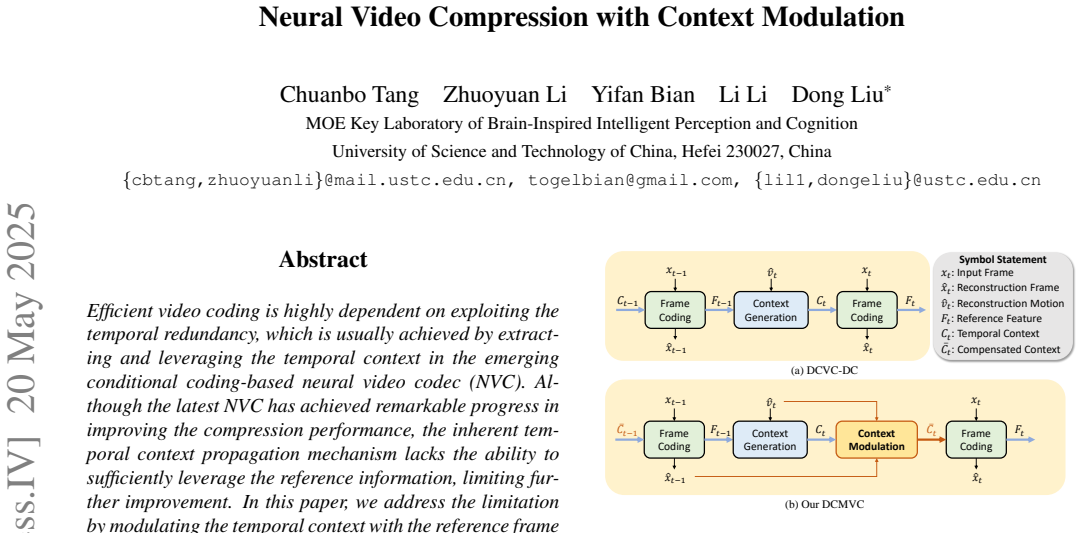
The machinery is a pair of modules inserted into the DCVC-DC conditional coding pipeline. Flow orientation: the decoded frame and reference frame are fed to a pyramid inter-frame correlation extractor (SpyNet) to obtain an 'oriented flow'; warping the reference frame with this flow yields the oriented temporal context $\check{C}_t^0$ with no extra bit cost. Context compensation: global and local extractors (local ones using invertible affine coupling layers) pull features from the oriented and propagated contexts; the global features are added and fused, the local features are added and fused, and a shared mutual fusion produces the compensated context $\bar{C}_t^0$. The decoupling loss $L_{\text{decouple}} = \frac{(\text{Cor}(\check{L}_t^0, L_t^0))^2}{(\text{Cor}(\check{G}_t^0, G_t^0))^2 + \delta}$ supervises the extractors so that global structure correlates across the two contexts while local texture stays decorrelated, which the authors say removes irrelevant propagated information and alleviates error accumulation.
What would settle it
Obtain the original DCVC-DC model and rerun the Section 4.3 ablations and the Table 1/2 BD-rate comparisons on HEVC Class D with intra-period 32. If the rate-distortion gap between DCMVC and the original DCVC-DC is far below the reported 10.3% ablation gain, the context-modulation improvements are partly artifacts of the baseline reproduction.
Extended reading notes
Core claim
The central discovery is that the propagated reference feature in conditional coding carries irrelevant accumulated information, while the adjacent reconstructed reference frame is cleaner; a codec can exploit this by generating a second temporal context from the reference frame via an oriented flow field, then using that oriented context to modulate the propagated context. The paper shows experimentally that this context modulation, together with a decoupling loss that decorrelates local details while correlating global structure, improves rate-distortion performance on six test sets under both 32-frame and infinite intra-periods, with the best model beating H.266/VVC by an average 22.7% bitrate and the previous best neural codec by 10.1%. The ablation attributes the gain to both the oriented-context path and the compensation/synergy mechanism, and per-frame plots indicate the modulation also slows quality decay in long prediction chains.
Load-bearing premise
The ablation results assume the authors' reproduced DCVC-DC baseline ('Ma') is a faithful stand-in for the original DCVC-DC, whose training code is not public, so the reported per-module gains could be inflated if their reproduction is weaker than the original.
Editorial extensions
If this is right
- If the 22.7% average bitrate saving over H.266/VVC holds, DCMVC is the strongest reported conditional-coding neural codec on UVG, MCL-JCV, HEVC B–E, and USTC-TD under the tested low-delay settings.
- Each proposed component is claimed to contribute: flow orientation alone saves 1.9% BD-rate, context compensation adds up to 4.4%, decoupling loss another 1.0%, and 32-frame long-sequence training 4.3%, for a combined 10.3% over the reproduced baseline.
- The per-frame plots show the modulation keeps quality flatter across the prediction chain while spending fewer bits than DCVC-FM, so the method is claimed to mitigate error propagation, not just improve average rate-distortion.
- Because the oriented context costs no additional side information, the bitrate savings come entirely from better conditioning of the contextual coder, making the architecture a drop-in change to existing conditional coding pipelines.
Reading between the lines
- An implication the authors do not draw: the oriented-flow idea is a learned analogue of multi-hypothesis prediction in classical codecs, recovering correlation that motion-compensated prediction loses without transmitting a second motion field; a natural extension is to generalize it to multiple reference frames or higher-order temporal contexts.
- The global-local decoupling loss is a generic synergy regularizer that could be transplanted to other multi-source fusion tasks in compression or image fusion, where one source is reliable in structure and another in texture.
- A testable extension is to apply context compensation at all three temporal-context scales rather than only the largest scale $C_t^0$, since the paper applies it at one scale and the complexity analysis shows the gains come at substantial MAC cost (4131G); whether the method is practical depends on deployment constraints.
Editorial analysis
A structured set of objections, weighed in public.
Referee Report
Summary. The paper proposes DCMVC, a conditional-coding neural video codec that augments the DCVC-DC framework with two components: flow orientation, which uses SpyNet to extract an oriented flow between the reference frame and the prediction frame and generates an additional oriented temporal context; and context compensation, which modulates the propagated temporal context with the oriented context via global-local extractors, fusion networks, and a decoupling loss. Experiments on UVG, MCL-JCV, HEVC Classes B/C/D/E, and USTC-TD claim an average 22.7% bitrate reduction over VTM-13.2 and a 10.1% bitrate saving over DCVC-FM under intra-period -1, with a 19.4% average saving over VTM under intra-period 32. Ablations on HEVC report a cumulative 10.3% BD-rate improvement over a reproduced DCVC-DC baseline Ma, broken down into contributions from the two architectural components and two training-strategy components.
Significance. If the reported results are reproducible, DCMVC would be a new state of the art among conditional coding NVCs on the tested datasets, with a generous margin over the previous SOTA and a competitive trade-off in complexity. The paper ships a code link, compares on multiple standard datasets under two intra-period settings, includes complexity analysis, and provides visualizations of flows, contexts, and global/local features. The main weakness is the uncalibrated ablation baseline: the reproduced DCVC-DC (Ma) appears substantially weaker than the published DCVC-DC on the same datasets, which inflates the per-component gains and obscures how much of the final margin over DCVC-FM comes from the proposed architecture versus the 32-frame training strategy. The final-model comparison against external codecs is not directly invalidated, but the paper's attribution of gains to the proposed modules is conditional on resolving this inconsistency.
major comments (2)
- [§4.3, Table 3 vs Table 1] The ablation baseline Ma is stated in Section 4.3 to be a reproduced DCVC-DC, but the numbers in Table 1 imply otherwise. On HEVC Classes B/C/D/E with intra-period 32, DCMVC beats the published DCVC-DC by only 4.8 percentage points on average (Table 1: -14.5 vs -13.9, -14.4 vs -8.8, -31.6 vs -27.7, -28.1 vs -19.1; average difference 4.8 pp), whereas Table 3 reports that the full model Mg gains 10.3% BD-rate over Ma on the same datasets and setting. If Ma were equivalent to the published DCVC-DC, DCMVC should be about 10.3 pp better than the published numbers, not 4.8 pp. The implied Ma is roughly 5.5 pp weaker than the published DCVC-DC. Since the absolute RD performance of Ma is never reported, the per-component gains (1.9, 3.5, 4.4, 1.0, 4.3) cannot be calibrated or trusted as contributions of the proposed modules. Please report Ma's absolute BD-rate versus VTM on the HEVC datasets, reconcile the ablation with Table 1, and re-state the module contributions accordingly.
- [§4.3, Table 3] The paper attributes the headline improvement to context modulation, but Table 3 shows that long-sequence training alone (Mf) accounts for 4.3 of the total 10.3 percentage point gain over Ma, i.e., about 42% of the total. Combined with the uncalibrated baseline discussed above, the reader cannot determine how much of the 10.1% margin over DCVC-FM is due to the proposed flow orientation and context compensation versus the 32-frame cascaded training procedure. The paper should separate these factors more explicitly, for example by evaluating Mf (trained with long sequences but without the proposed modules) directly against the published DCVC-FM and DCVC-DC numbers, and by reporting the absolute RD curves for Ma and Mf. This would also clarify whether the gain attributed to flow orientation and context compensation is robust when the baseline is at the published DCVC-DC level.
minor comments (6)
- [§3.2, first paragraph] In 'the prediction frame ˇxt is obtained by warping the reference frame ˆxt', the subscript should be t-1 for the reference frame; the current text is a typo.
- [Eq. (1) and §3.3] The text says 'Ldecouple consists of the cosine similarity of both global features and local features', but Eq. (1) defines a ratio of squared local correlation to squared global correlation. Please state explicitly that the objective minimizes this ratio and that the global correlation appears in the denominator.
- [§3.3, Fig. 3] The notation for the compensated context is inconsistent between the figure caption (C with a bar) and the main text; please unify the symbol used for C̅_t^0 throughout.
- [§4.1, training data] The description of the 32-frame cascaded training set as 'a subset of 9000 sequences' from raw Vimeo videos should specify the selection criterion or random seed, since the composition of this subset can affect the long-sequence training results.
- [§4.2, Tables 1-2] It is not stated whether the DCVC-DC and DCVC-FM results in Tables 1 and 2 are taken from the original papers or re-evaluated with the authors' own test pipeline. The note in Table 1 about quality indexes suggests some adjustment; please describe the exact protocol (e.g., which models, which weight points, whether re-encoding was performed) so the comparison is reproducible.
- [§4.4, Table 4] The complexity table reports MACs and timings for 1080p inputs, but the RD evaluations use 96 frames with intra-period 32 or -1; please clarify whether the encoding/decoding times are per-frame averages and whether the reported MACs refer to the entire model including the proposed context modulation at the largest resolution.
Circularity Check
Central RD claims are externally benchmarked; only minor self-confirmatory decoupling-loss observation, with the Ma baseline as a reproducibility concern rather than a logical loop.
-
self definitional
[Section 3.3, Eq. (1); Section 4.3, Fig. 8]
"Under the supervision of decoupling loss, the global information (e.g., structure and background) in both temporal contexts becomes more correlated, while the local information (e.g., texture and edges), being more specific to different contexts, tends to be less correlated."
Eq. (1) defines Ldecouple as the squared local cosine similarity divided by the squared global cosine similarity plus a small constant, so minimizing this loss directly encourages high global correlation and low local correlation. The later statement in Section 4.3 that, with the decoupling loss, global features are more correlated than local features is therefore a restatement of the training objective that was optimized, not an independent empirical discovery. This observation is self-confirmatory by construction, but it is not load-bearing for the paper's main compression claims, which are evaluated against external codecs rather than derived from this loss.
full rationale
The paper's central rate-distortion claims are experimental comparisons against external anchors: VTM-13.2 and published neural codecs (DCVC, DCVC-TCM, DCVC-HEM, DCVC-DC, DCVC-FM, SDD) in Tables 1 and 2. These anchors are outside the paper's own definitions, so the headline 22.7% saving over H.266/VVC and 10.1% saving over DCVC-FM cannot reduce to the paper's inputs by construction. The proposed modules are validated by ablations relative to a reproduced baseline Ma. The paper states: 'Ma represents our reproduced baseline model DCVC-DC since its training code is not open-sourced.' This is a real reproducibility limitation: the absolute RD performance of Ma is never reported, and the internal inconsistency between the 10.3% ablation gain over Ma (Table 3) and the roughly 4.8 percentage-point gain over the published DCVC-DC on the same HEVC intra-period-32 setting (Table 1) suggests Ma is weaker than the original DCVC-DC. That is a baseline-calibration and reporting concern, not a circularity in the derivation chain. The only self-referential element is the decoupling-loss visualization, which simply confirms what Eq. (1) was designed to enforce. Overall, the derivation and evaluation are self-contained with respect to circularity, and the identified issues do not undermine the logical independence of the main experimental comparisons.
Assumptions & free parameters
free parameters (1)
- alpha =
0.2
assumptions (3)
- domain assumption The reproduced DCVC-DC baseline (Ma) matches the original DCVC-DC performance.
- ad hoc to paper The oriented flow extracted by SpyNet contains complementary temporal correlation not present in the decoded flow, and this information can be exploited without extra bitrate.
- ad hoc to paper Global features of the two contexts should be correlated and local features decorrelated to improve context fusion.
Cite this review
Pith. "Pith review of Neural Video Compression with Context Modulation." pith.science (2026). https://pith.science/paper/K32JKMMG
@misc{pith2026250514541,
  author       = {Pith},
  title        = {Pith review of: Neural Video Compression with Context Modulation},
  year         = {2026},
  howpublished = {\url{https://pith.science/paper/K32JKMMG}},
  note         = {Machine review of arXiv:2505.14541}
}
read the original abstract
Efficient video coding is highly dependent on exploiting the temporal redundancy, which is usually achieved by extracting and leveraging the temporal context in the emerging conditional coding-based neural video codec (NVC). Although the latest NVC has achieved remarkable progress in improving the compression performance, the inherent temporal context propagation mechanism lacks the ability to sufficiently leverage the reference information, limiting further improvement. In this paper, we address the limitation by modulating the temporal context with the reference frame in two steps. Specifically, we first propose the flow orientation to mine the inter-correlation between the reference frame and prediction frame for generating the additional oriented temporal context. Moreover, we introduce the context compensation to leverage the oriented context to modulate the propagated temporal context generated from the propagated reference feature. Through the synergy mechanism and decoupling loss supervision, the irrelevant propagated information can be effectively eliminated to ensure better context modeling. Experimental results demonstrate that our codec achieves on average 22.7% bitrate reduction over the advanced traditional video codec H.266/VVC, and offers an average 10.1% bitrate saving over the previous state-of-the-art NVC DCVC-FM. The code is available at https://github.com/Austin4USTC/DCMVC.
Figures


Figures from the paper (5 more)


Reference graph
Works this paper leans on
-
[1]
Scale-space flow for end-to-end optimized video compression
Eirikur Agustsson, David Minnen, Nick Johnston, Johannes Balle, Sung Jin Hwang, and George Toderici. Scale-space flow for end-to-end optimized video compression. In Pro- ceedings of the IEEE/CVF Conference on Computer Vision and Pattern Recognition (CVPR), pages 8503–8512, 2020. 2
work page 2020
-
[2]
Task-driven Image Fusion with Learnable Fusion Loss
Haowen Bai, Jiangshe Zhang, Zixiang Zhao, Yichen Wu, Lilun Deng, Yukun Cui, Tao Feng, and Shuang Xu. Task- driven image fusion with learnable fusion loss. arXiv preprint arXiv:2412.03240, 2024. 5
work page Pith review arXiv 2024
-
[3]
ReFusion: Learning image fusion from reconstruction with learnable loss via meta-learning
Haowen Bai, Zixiang Zhao, Jiangshe Zhang, Yichen Wu, Lilun Deng, Yukun Cui, Baisong Jiang, and Shuang Xu. ReFusion: Learning image fusion from reconstruction with learnable loss via meta-learning. International Journal of Computer Vision, pages 1–21, 2024. 5
work page 2024
-
[4]
End-to-end optimized image compression
Johannes Ball ´e, Valero Laparra, and Eero P Simoncelli. End-to-end optimized image compression. arXiv preprint arXiv:1611.01704, 2016. 2
arXiv 2016
-
[5]
Variational image compres- sion with a scale hyperprior
Johannes Ball ´e, David Minnen, Saurabh Singh, Sung Jin Hwang, and Nick Johnston. Variational image compres- sion with a scale hyperprior. In International Conference on Learning Representations (ICLR), 2018. 2
work page 2018
-
[6]
Calculation of average psnr differences between rd-curves
Gisle Bjontegaard. Calculation of average psnr differences between rd-curves. VCEG-M33, 2001. 5
work page 2001
-
[7]
Common hm test conditions and software ref- erence configurations (JCTVC-l1100)
Frank Bossen. Common hm test conditions and software ref- erence configurations (JCTVC-l1100). Joint Collaborative Team on Video Coding (JCT-VC) of ITU-T SG, 2013. 5
work page 2013
-
[8]
Benjamin Bross, Jianle Chen, Jens-Rainer Ohm, Gary J Sul- livan, and Ye-Kui Wang. Developments in international video coding standardization after avc, with an overview of versatile video coding (VVC). Proceedings of the IEEE ,
Show all 63 references
-
[9]
NeRV: Neural representations for videos
Hao Chen, Bo He, Hanyu Wang, Yixuan Ren, Ser Nam Lim, and Abhinav Shrivastava. NeRV: Neural representations for videos. Advances in Neural Information Processing Systems, 34:21557–21568, 2021. 2
2021
-
[10]
HNeRV: A hybrid neural representation for videos
Hao Chen, Matthew Gwilliam, Ser-Nam Lim, and Abhi- nav Shrivastava. HNeRV: A hybrid neural representation for videos. In Proceedings of the IEEE/CVF Conference on Computer Vision and Pattern Recognition (CVPR), pages 10270–10279, 2023. 2
2023
-
[11]
Group-aware parameter-efficient updating for content- adaptive neural video compression
Zhenghao Chen, Luping Zhou, Zhihao Hu, and Dong Xu. Group-aware parameter-efficient updating for content- adaptive neural video compression. arXiv preprint arXiv:2405.04274, 2024. 2
2024 arXiv
-
[12]
Learned image compression with discretized gaussian mixture likelihoods and attention modules
Zhengxue Cheng, Heming Sun, Masaru Takeuchi, and Jiro Katto. Learned image compression with discretized gaussian mixture likelihoods and attention modules. InProceedings of the IEEE/CVF Conference on Computer Vision and Pattern Recognition (CVPR), 2020. 2
2020
-
[13]
Deformable convolutional networks
Jifeng Dai, Haozhi Qi, Yuwen Xiong, Yi Li, Guodong Zhang, Han Hu, and Yichen Wei. Deformable convolutional networks. In Proceedings of the IEEE International Con- ference on Computer Vision (ICCV) , pages 764–773, 2017. 2
2017
-
[14]
Temporal wavelet transform-based low-complexity per- ceptual quality enhancement of compressed video
Cunhui Dong, Haichuan Ma, Zhuoyuan Li, Li Li, and Dong Liu. Temporal wavelet transform-based low-complexity per- ceptual quality enhancement of compressed video. IEEE Transactions on Circuits and Systems for Video Technology, 34(5):4040–4053, 2023. 1
2023
-
[15]
Tom- czak, and Taco S
Amirhossein Habibian, Ties van Rozendaal, Jakub M. Tom- czak, and Taco S. Cohen. Video compression with rate- distortion autoencoders. In Proceedings of the IEEE/CVF International Conference on Computer Vision (ICCV), 2019. 2
2019
-
[16]
Checkerboard context model for effi- cient learned image compression
Dailan He, Yaoyan Zheng, Baocheng Sun, Yan Wang, and Hongwei Qin. Checkerboard context model for effi- cient learned image compression. In Proceedings of the IEEE/CVF Conference on Computer Vision and Pattern Recognition (CVPR), pages 14771–14780, 2021. 2
2021
-
[17]
ELIC: Efficient learned image compres- sion with unevenly grouped space-channel contextual adap- tive coding
Dailan He, Ziming Yang, Weikun Peng, Rui Ma, Hongwei Qin, and Yan Wang. ELIC: Efficient learned image compres- sion with unevenly grouped space-channel contextual adap- tive coding. In Proceedings of the IEEE/CVF Conference on Computer Vision and Pattern Recognition (CVPR), pa...
2022
-
[18]
CANF-VC: Conditional augmented normalizing flows for video compression
Yung-Han Ho, Chih-Peng Chang, Peng-Yu Chen, Alessan- dro Gnutti, and Wen-Hsiao Peng. CANF-VC: Conditional augmented normalizing flows for video compression. In Computer Vision–ECCV 2022: 17th European Conference, Tel Aviv, Israel, October 23–27, 2022, Proceedings, Part XVI, pa...
2022
-
[19]
Complexity-guided slimmable de- coder for efficient deep video compression
Zhihao Hu and Dong Xu. Complexity-guided slimmable de- coder for efficient deep video compression. In Proceedings of the IEEE/CVF Conference on Computer Vision and Pat- tern Recognition (CVPR), pages 14358–14367, 2023. 2
2023
-
[20]
Improving deep video com- pression by resolution-adaptive flow coding
Zhihao Hu, Zhenghao Chen, Dong Xu, Guo Lu, Wanli Ouyang, and Shuhang Gu. Improving deep video com- pression by resolution-adaptive flow coding. In European Conference on Computer Vision (ECCV) , pages 193–209. Springer, 2020
2020
-
[21]
FVC: A new framework towards deep video compression in feature space
Zhihao Hu, Guo Lu, and Dong Xu. FVC: A new framework towards deep video compression in feature space. In Pro- ceedings of the IEEE/CVF Conference on Computer Vision and Pattern Recognition (CVPR), pages 1502–1511, 2021. 2
2021
-
[22]
Coarse-to-fine deep video coding with hyperprior- guided mode prediction
Zhihao Hu, Guo Lu, Jinyang Guo, Shan Liu, Wei Jiang, and Dong Xu. Coarse-to-fine deep video coding with hyperprior- guided mode prediction. In Proceedings of the IEEE/CVF Conference on Computer Vision and Pattern Recognition (CVPR), pages 5921–5930, 2022. 2
2022
-
[23]
Ecvc: Ex- ploiting non-local correlations in multiple frames for contex- tual video compression
Wei Jiang, Junru Li, Kai Zhang, and Li Zhang. Ecvc: Ex- ploiting non-local correlations in multiple frames for contex- tual video compression. arXiv preprint arXiv:2410.09706 ,
-
[24]
C3: High- performance and low-complexity neural compression from a single image or video
Hyunjik Kim, Matthias Bauer, Lucas Theis, Jonathan Richard Schwarz, and Emilien Dupont. C3: High- performance and low-complexity neural compression from a single image or video. arXiv preprint arXiv:2312.02753,
-
[25]
HiNeRV: Video compression with hierarchical encoding-based neural representation
Ho Man Kwan, Ge Gao, Fan Zhang, Andrew Gower, and David Bull. HiNeRV: Video compression with hierarchical encoding-based neural representation. Advances in Neural Information Processing Systems (NeurIPS), 36, 2024. 2
2024
-
[26]
Deep contextual video com- pression
Jiahao Li, Bin Li, and Yan Lu. Deep contextual video com- pression. Advances in Neural Information Processing Sys- tems (NeurIPS), 34:18114–18125, 2021. 1, 2, 6, 7
2021
-
[27]
Hybrid spatial-temporal en- tropy modelling for neural video compression
Jiahao Li, Bin Li, and Yan Lu. Hybrid spatial-temporal en- tropy modelling for neural video compression. In Proceed- ings of the 30th ACM International Conference on Multime- dia, pages 1503–1511, 2022. 1, 3, 6, 7
2022
-
[28]
Neural video compression with diverse contexts
Jiahao Li, Bin Li, and Yan Lu. Neural video compression with diverse contexts. In Proceedings of the IEEE/CVF Conference on Computer Vision and Pattern Recognition (CVPR), pages 22616–22626, 2023. 1, 3, 4, 6, 7, 8
2023
-
[29]
Neural video compression with feature modulation
Jiahao Li, Bin Li, and Yan Lu. Neural video compression with feature modulation. In Proceedings of the IEEE/CVF Conference on Computer Vision and Pattern Recognition (CVPR), pages 26099–26108, 2024. 1, 2, 3, 6, 7, 8
2024
-
[30]
High visual-fidelity learned video compression
Meng Li, Yibo Shi, Jing Wang, and Yunqi Huang. High visual-fidelity learned video compression. In Proceedings of the 31st ACM International Conference on Multimedia , pages 8057–8066, 2023. 2
2023
-
[31]
Spiking tucker fusion transformer for audio-visual zero-shot learning
Wenrui Li, Penghong Wang, Ruiqin Xiong, and Xiaopeng Fan. Spiking tucker fusion transformer for audio-visual zero-shot learning. IEEE Transactions on Image Processing,
-
[32]
Global homography motion compensation for versatile video coding
Yao Li, Zhuoyuan Li, Li Li, Dong Liu, and Houqiang Li. Global homography motion compensation for versatile video coding. In 2022 IEEE International Conference on Visual Communications and Image Processing (VCIP) , pages 1–5. IEEE, 2022. 1
2022
-
[33]
Uniformly accelerated motion model for inter pre- diction
Zhuoyuan Li, Yao Li, Chuanbo Tang, Li Li, Dong Liu, and Feng Wu. Uniformly accelerated motion model for inter pre- diction. In 2024 IEEE International Conference on Visual Communications and Image Processing (VCIP) , pages 1–5. IEEE, 2024. 1
2024
-
[34]
USTC-TD: A test dataset and bench- mark for image and video coding in 2020s
Zhuoyuan Li, Junqi Liao, Chuanbo Tang, Haotian Zhang, Yuqi Li, Yifan Bian, Xihua Sheng, Xinmin Feng, Yao Li, Changsheng Gao, et al. USTC-TD: A test dataset and bench- mark for image and video coding in 2020s. arXiv preprint arXiv:2409.08481, 2024. 5
2024 arXiv
-
[35]
Object segmentation-assisted inter prediction for versatile video coding
Zhuoyuan Li, Zikun Yuan, Li Li, Dong Liu, Xiaohu Tang, and Feng Wu. Object segmentation-assisted inter prediction for versatile video coding. IEEE Transactions on Broadcast- ing, 2024. 1
2024
-
[36]
M- LVC: multiple frames prediction for learned video compres- sion
Jianping Lin, Dong Liu, Houqiang Li, and Feng Wu. M- LVC: multiple frames prediction for learned video compres- sion. In Proceedings of the IEEE/CVF Conference on Com- puter Vision and Pattern Recognition (CVPR), pages 3546– 3554, 2020. 2
2020
-
[37]
Learned image compression with mixed transformer-cnn architectures
Jinming Liu, Heming Sun, and Jiro Katto. Learned image compression with mixed transformer-cnn architectures. In Proceedings of the IEEE/CVF Conference on Computer Vi- sion and Pattern Recognition (CVPR), pages 14388–14397,
-
[38]
Region-adaptive transform with segmentation prior for image compression
Yuxi Liu, Wenhan Yang, Huihui Bai, Yunchao Wei, and Yao Zhao. Region-adaptive transform with segmentation prior for image compression. In European Conference on Com- puter Vision (ECCV), pages 181–197. Springer, 2025. 2
2025
-
[39]
DVC: An end-to-end deep video compression framework
Guo Lu, Wanli Ouyang, Dong Xu, Xiaoyun Zhang, Chun- lei Cai, and Zhiyong Gao. DVC: An end-to-end deep video compression framework. In Proceedings of the IEEE/CVF conference on Computer Vision and Pattern Recognition (CVPR), pages 11006–11015, 2019. 2
2019
-
[40]
Content adaptive and error propagation aware deep video compression
Guo Lu, Chunlei Cai, Xiaoyun Zhang, Li Chen, Wanli Ouyang, Dong Xu, and Zhiyong Gao. Content adaptive and error propagation aware deep video compression. In Euro- pean Conference on Computer Vision (ECCV) , pages 456–
-
[41]
An end-to-end learning framework for video compression
Guo Lu, Xiaoyun Zhang, Wanli Ouyang, Li Chen, Zhiyong Gao, and Dong Xu. An end-to-end learning framework for video compression. IEEE Transactions on Pattern Analysis and Machine Intelligence, 2020. 2
2020
-
[42]
Deep guided learning for fast multi- exposure image fusion
Kede Ma, Zhengfang Duanmu, Hanwei Zhu, Yuming Fang, and Zhou Wang. Deep guided learning for fast multi- exposure image fusion. IEEE Transactions on Image Pro- cessing, 29:2808–2819, 2019. 4
2019
-
[43]
UVG dataset: 50/120fps 4k sequences for video codec analysis and development
Alexandre Mercat, Marko Viitanen, and Jarno Vanne. UVG dataset: 50/120fps 4k sequences for video codec analysis and development. In Proceedings of the 11th ACM Multimedia Systems Conference, pages 297–302, 2020. 5
2020
-
[44]
Channel-wise autoregres- sive entropy models for learned image compression
David Minnen and Saurabh Singh. Channel-wise autoregres- sive entropy models for learned image compression. In 2020 IEEE International Conference on Image Processing (ICIP), pages 3339–3343. IEEE, 2020. 2
2020
-
[45]
End-to-end learning of video compression using spatio-temporal autoencoders
Jorge Pessoa, Helena Aidos, Pedro Tom ´as, and M ´ario AT Figueiredo. End-to-end learning of video compression using spatio-temporal autoencoders. In 2020 IEEE Workshop on Signal Processing Systems (SiPS), pages 1–6. IEEE, 2020. 2
2020
-
[46]
Mo- tion information propagation for neural video compression
Linfeng Qi, Jiahao Li, Bin Li, Houqiang Li, and Yan Lu. Mo- tion information propagation for neural video compression. In Proceedings of the IEEE/CVF Conference on Computer Vision and Pattern Recognition (CVPR) , pages 6111–6120,
-
[47]
Optical flow estima- tion using a spatial pyramid network
Anurag Ranjan and Michael J Black. Optical flow estima- tion using a spatial pyramid network. In Proceedings of the IEEE/CVF Conference on Computer Vision and Pattern Recognition (CVPR), pages 4161–4170, 2017. 2, 3
2017
-
[48]
Temporal context mining for learned video compression
Xihua Sheng, Jiahao Li, Bin Li, Li Li, Dong Liu, and Yan Lu. Temporal context mining for learned video compression. IEEE Transactions on Multimedia, 2022. 1, 2, 3, 6, 7
2022
-
[49]
Spatial decomposition and temporal fusion based inter prediction for learned video compression
Xihua Sheng, Li Li, Dong Liu, and Houqiang Li. Spatial decomposition and temporal fusion based inter prediction for learned video compression. IEEE Transactions on Circuits and Systems for Video Technology, 2024. 1, 6, 7, 8
2024
-
[50]
NVC-1B: A large neural video coding model
Xihua Sheng, Chuanbo Tang, Li Li, Dong Liu, and Feng Wu. NVC-1B: A large neural video coding model. arXiv preprint arXiv:2407.19402, 2024. 2
2024 arXiv
-
[51]
AlphaVC: High-performance and efficient learned video compression
Yibo Shi, Yunying Ge, Jing Wang, and Jue Mao. AlphaVC: High-performance and efficient learned video compression. In European Conference on Computer Vision (ECCV), pages 616–631. Springer, 2022. 2
2022
-
[52]
PWC-Net: Cnns for optical flow using pyramid, warping, and cost volume
Deqing Sun, Xiaodong Yang, Ming-Yu Liu, and Jan Kautz. PWC-Net: Cnns for optical flow using pyramid, warping, and cost volume. In Proceedings of the IEEE Conference on Computer Vision and Pattern Recognition (CVPR), pages 8934–8943, 2018. 2
2018
-
[53]
High-quality single- model deep video compression with frame-conv3d and multi-frame differential modulation
Wenyu Sun, Chen Tang, Weigui Li, Zhuqing Yuan, Huazhong Yang, and Yongpan Liu. High-quality single- model deep video compression with frame-conv3d and multi-frame differential modulation. In Computer Vision– ECCV 2020: 16th European Conference, Glasgow, UK, Au- gust 23–28, 202...
2020
-
[54]
Offline and online optical flow en- hancement for deep video compression
Chuanbo Tang, Xihua Sheng, Zhuoyuan Li, Haotian Zhang, Li Li, and Dong Liu. Offline and online optical flow en- hancement for deep video compression. In Proceedings of the AAAI Conference on Artificial Intelligence (AAAI), pages 5118–5126, 2024. 1, 2
2024
-
[55]
RAFT: Recurrent all-pairs field transforms for optical flow
Zachary Teed and Jia Deng. RAFT: Recurrent all-pairs field transforms for optical flow. In Computer Vision–ECCV 2020: 16th European Conference, Glasgow, UK, August 23– 28, 2020, Proceedings, Part II 16, pages 402–419. Springer,
2020
-
[56]
MCL-JCV: a JND-based H.264/A VC video quality assessment dataset
Haiqiang Wang, Weihao Gan, Sudeng Hu, Joe Yuchieh Lin, Lina Jin, Longguang Song, Ping Wang, Ioannis Katsavouni- dis, Anne Aaron, and C-C Jay Kuo. MCL-JCV: a JND-based H.264/A VC video quality assessment dataset. In2016 IEEE International Conference on Image Processing (ICIP), ...
2016
-
[57]
Video enhancement with task-oriented flow
Tianfan Xue, Baian Chen, Jiajun Wu, Donglai Wei, and William T Freeman. Video enhancement with task-oriented flow. International Journal of Computer Vision , 127(8): 1106–1125, 2019. 5
2019
-
[58]
Learning for video compression with hierarchical quality and recurrent enhancement
Ren Yang, Fabian Mentzer, Luc Van Gool, and Radu Timo- fte. Learning for video compression with hierarchical quality and recurrent enhancement. InProceedings of the IEEE/CVF Conference on Computer Vision and Pattern Recognition (CVPR), pages 6628–6637, 2020. 2
2020
-
[59]
Generalized gaus- sian model for learned image compression
Haotian Zhang, Li Li, and Dong Liu. Generalized gaus- sian model for learned image compression. arXiv preprint arXiv:2411.19320, 2024. 2
2024 arXiv
-
[60]
Practical learned image compression with online encoder optimization
Haotian Zhang, Feihong Mei, Junqi Liao, Li Li, Houqiang Li, and Dong Liu. Practical learned image compression with online encoder optimization. In 2024 Picture Coding Sym- posium (PCS), pages 1–5. IEEE, 2024. 2
2024
-
[61]
Dnerv: Model- ing inherent dynamics via difference neural representation for videos
Qi Zhao, M Salman Asif, and Zhan Ma. Dnerv: Model- ing inherent dynamics via difference neural representation for videos. In Proceedings of the IEEE/CVF Conference on Computer Vision and Pattern Recognition (CVPR), pages 2031–2040, 2023. 2
2023
-
[62]
CDDFuse: Correlation-driven dual-branch feature decompo- sition for multi-modality image fusion
Zixiang Zhao, Haowen Bai, Jiangshe Zhang, Yulun Zhang, Shuang Xu, Zudi Lin, Radu Timofte, and Luc Van Gool. CDDFuse: Correlation-driven dual-branch feature decompo- sition for multi-modality image fusion. In Proceedings of the IEEE/CVF Conference on Computer Vision and Pattern...
2023
-
[63]
Equivariant multi-modality image fusion
Zixiang Zhao, Haowen Bai, Jiangshe Zhang, Yulun Zhang, Kai Zhang, Shuang Xu, Dongdong Chen, Radu Timofte, and Luc Van Gool. Equivariant multi-modality image fusion. In Proceedings of the IEEE/CVF conference on computer vi- sion and pattern recognition, pages 25912–25921, 2024. 4
2024
Reviewed August 7, 2026 · model on record in the stance chip above.
Discussion (0). Sign in to comment.