REVIEW 3 major objections 5 minor 1 cited by
Phenomenological constraints of the building blocks of the cluster hadronization model
T0 review · 3 major / 5 minor · reviewed 2026-08-07 · deepseek-v4-flash
Pith's one-line read The paper proposes perturbatively motivated matrix elements for cluster fission and decay that remove an unphysical plateau in the cluster mass distribution and improve low-energy e+e− di-hadron data.
desk verdict Genuine progress on cluster hadronization building blocks with a real Belle improvement, but the title overpromises and the fission matrix element's key momentum-conservation assumption goes untested. read the letter →
The pith
A machine-rendered reading of the paper's core claim, the machinery that carries it, and where it could break.
The reading
What carries the argument
The central object is the factorized $2\to4$ phase space $f_{\rm PS}(M_1,M_2)$ built from Källén functions, combined with the soft-emission matrix element of Eqs. (9)–(12). The fission matrix element carries a t-channel gluon exchange regulated by a gluon constituent mass and a soft function $S(q_1,q_2,q,\bar q)$ constructed from eikonal factors $I_{ij}$; it simultaneously drives the cluster mass distribution toward lower masses and produces collinear angular distributions that smoothly match the parton shower. The cluster decay uses the t-channel-like matrix element $1/[(p_1-h_1)^2 - M_S^2]^2$, replacing isotropic decay with a kinematics that continues the fission picture. These objects define the new building blocks that the paper tests against data.
What would settle it
A precise measurement of the di-hadron invariant mass distribution in the highest fractional-energy bin at 10.58 GeV would settle it: if the matrix-element fission, after a complete tune with colour reconnection included, does not remove the low-mass plateau or does not match the turn-on shape, the central improvement claim fails.
Extended reading notes
Core claim
At its core, the paper claims that cluster fission should be viewed as a low-scale, perturbatively motivated continuation of the parton shower rather than a purely longitudinal splitting with power-law-distributed cluster masses. It writes the fission rate as a factorized phase space times a tree-level soft quark-antiquark emission matrix element, $|\mathcal{M}_{2\to4}|^2 = A_0 |\mathcal{M}_{2\to2}|^2_t\,S(q_1,q_2,q,\bar q)$, where the t-channel gluon denominator is regulated by a gluon constituent mass and the soft function is built from eikonal factors. This matrix element shifts the cluster mass distribution away from the default triangular behaviour, eliminating the flat plateau that is not seen in the measured di-hadron spectra. For cluster decay the paper proposes a t-channel-like hadron matrix element proportional to $1/[(p_1-h_1)^2 - M_S^2]^2$ with $M_S = \max\{(m_1-m_{h_1}),(m_2-m_{h_2})\}$, which smoothly interpolates between the fission and hadron kinematics. Together these building blocks, with default parameters otherwise untouched, improve the description of the di-hadron invariant mass distribution at B-factory energies and introduce no new tensions in high-energy event-shape observables.
Load-bearing premise
The load-bearing premise is that the simplified soft-emission formula for cluster fission continues to be correct when applied to real clusters with full momentum conservation and massive constituents, even though that formula is normally derived only for very low-energy emissions.
Editorial extensions
If this is right
- The default cluster mass distribution plateau near the constituent-mass threshold disappears when the soft matrix element drives fission, so di-hadron invariant mass spectra at low energies match data without new tuning.
- Cluster fission can be treated as a smooth, perturbative continuation of the parton shower rather than a longitudinal split with power-law masses, reducing the number of tunable parameters in the hadronization model.
- Infrared-dangerous soft-takes-all energy correlations are nearly insensitive to cluster decay, while winner-takes-all correlations are sensitive to both fission and decay, so the two probes together isolate the two building blocks.
- The t-channel-inspired cluster decay leaves established high-energy event-shape distributions without new tensions while improving some regions.
- The same building-block logic extends to colour reconnection and cluster propagators in a future unified hadronization model.
Reading between the lines
- If these matrix elements survive a global tune, the hadronization start could be defined at a factorization scale rather than at a shower cutoff, making predictions less dependent on where the shower stops.
- The observed energy independence of the soft-takes-all correlation could be turned into a direct test of hadronization universality: any measured energy dependence of that correlator would signal energy-dependent hadronization.
- The decay matrix element's pseudo-mass parameter $M_S$ is set by a kinematical maximum; a natural extension would be to promote it to a fitted form factor and constrain it with the decay-sensitive winner-takes-all correlations.
- Since colour reconnection is not yet included, the extracted sensitivities of the discriminating observables may shift once it is added, so the observables should be re-run in the unified model before finalizing the building blocks.
Editorial analysis
A structured set of objections, weighed in public.
Referee Report
Summary. The paper proposes new building blocks for the cluster hadronization model in Herwig, focusing on cluster fission and cluster decay. For fission, the authors factorize the phase space and introduce a matrix element built from a t-channel gluon exchange and a soft q-qbar function (Eqs. 9-12), evaluated with on-shell constituent masses and exact momentum conservation. For decay, they introduce a t-channel-like matrix element with a pseudo-mass parameter M_S. The model is implemented in Herwig and compared with DELPHI and Belle data; the new fission model removes an unphysical plateau in the cluster mass distribution and improves the Belle di-hadron invariant-mass spectra (Figs. 11-12). The paper also proposes angularity and energy-correlation observables intended to discriminate between fission and decay dynamics, but these are shown only as model-variant comparisons, not compared to data.
Significance. If the proposed fission matrix element is a valid continuation of the infrared-factorized soft limit, the work is a meaningful step toward a more principled cluster hadronization model, and the external Belle comparison provides a valuable anchor for the improvement claim. The clean phase-space factorization in Sec. 2.3 is a useful contribution in itself, and the proposed observables in Sec. 4 could be genuinely discriminating for future tuning. However, the central 'phenomenological constraints' advertised in the title are not yet delivered: the new observables are validated only against the model itself, and the key fission matrix element rests on an explicitly acknowledged assumption that is not stress-tested. The improvement over the default model is real but is not yet isolated to the matrix element as opposed to the corrected phase space.
major comments (3)
- [Sec. 2.4, Eqs. (9)-(12)] The load-bearing step of the paper is the continuation of the infrared-factorized soft matrix element to full phase space with momentum-conserving on-shell kinematics. The authors state explicitly that the soft limit 'would normally not provide us with such an expression' and that they assume energy-momentum conservation can be implemented. This assumption underlies the removal of the plateau in Fig. 12 and the Belle improvement in Fig. 11, yet no estimate or validation of subleading-power corrections is provided. The only robustness check mentioned, varying the gluon constituent mass, is not performed. I ask for at least one concrete test, such as a comparison with the full tree-level 2-to-4 matrix element for the diagrams in Fig. 6, or a scan over the regulator parameter epsilon and m_g, to show that the qualitative improvement is not accidental to the chosen continuation.
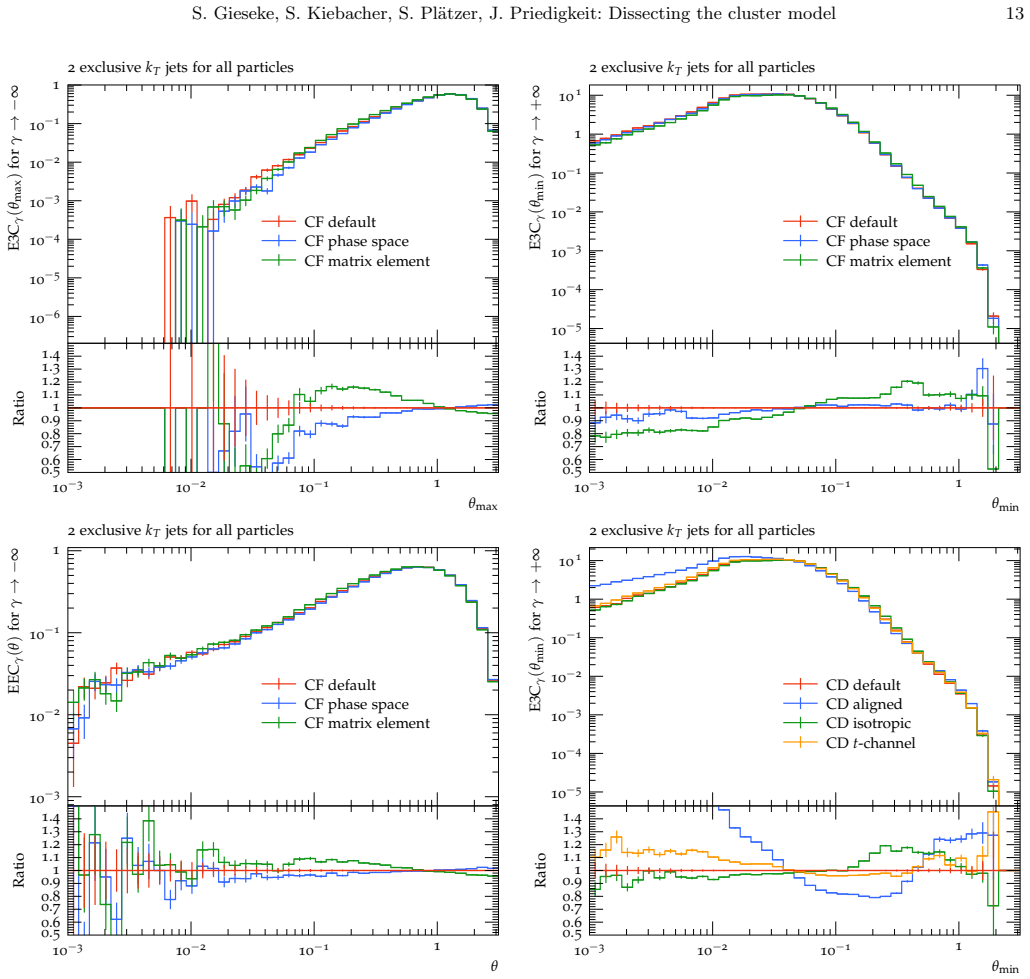
- [Sec. 4, Figs. 14-21] The title and abstract promise 'phenomenological constraints' and observables with 'constraining power on the individual building blocks,' but none of the observables studied in Sec. 4 is compared to experimental data. All conclusions there are drawn from comparisons among Herwig variants with different fission/decay models, which demonstrates sensitivity but not constraint. To support the advertised claims, the authors should either overlay data from DELPHI or Belle for the angularities and energy correlators (at least where they exist), or explicitly reframe Sec. 4 as a model-diagnostic study for future tuning and adjust the title and abstract accordingly.
- [Sec. 3.2, Figs. 11-12] The improvement over the Herwig default is presented for an otherwise untuned model, as the authors acknowledge ('still untuned' in Sec. 3.2). Moreover, the 'CF phase space' variant (blue) also removes the plateau, so the specific role of the new matrix element, as opposed to the corrected phase space alone, is not cleanly isolated. A quantitative comparison of the CF phase-space and CF matrix-element variants (for example, chi-square per bin for the Belle distributions in Figs. 11 and 12) is needed to support the claim that the matrix element itself is the relevant building block.
minor comments (5)
- [Sec. 2.5, step 2] The text says the masses M1 and M2 are sampled uniformly in the 'triangular phase space of Fig. 5,' but the allowed region in Fig. 5 is not triangular due to the Källén-function thresholds; please rephrase.
- [Sec. 2.5, Eq. (15)] The fitted proposal-distribution parameters A, beta1, beta2 and the overestimate lambda_OE used for the rejection sampling are not reported; including their values, or a link to the implementation, would make the algorithm reproducible.
- [Sec. 2.6, cluster decay matrix element] The pseudo-mass choice M_S = max{(m1-mh1),(m2-mh2)} is introduced without derivation; since the authors label it a model assumption and the LEP/Belle comparisons show no new tensions, this is acceptable but should be flagged more visibly as a phenomenological input.
- [Sec. 4.2, Fig. 21] The claim that the STA correlation is approximately independent of sqrt(s) is supported only by visual inspection; a quantitative ratio with uncertainties would be more convincing.
- [Whole paper] There are several typographical and formatting issues, including 'infrafred' in Sec. 5, 'ap1p2-dipole' in Sec. 2.4, and stray '/Bullet' artifacts in Fig. 3 and elsewhere; these should be cleaned up.
Circularity Check
No significant circularity: new fission and decay matrix elements are checked against external Belle, DELPHI, and ARGUS data; only minor motivational self-citations remain.
full rationale
No circular step is present. The new building blocks are proposed as ansaetze (Sec 2.4: 'we make the following ansatz'; Sec 2.6: 'we choose a t-channel like interaction') and are then confronted with external data: DELPHI in Fig 10, Belle in Figs 11 and 13, and ARGUS in Fig 3. The acceptance-sampling parameters A, beta1, and beta2 in Eqs (13)-(14) are fitted to histograms of the matrix element (Fig 8) purely to make rejection sampling efficient; they are not physical predictions and do not bias the acceptance weight in Eq (15). The removal of the cluster-mass plateau follows from the phase-space thresholds of Eq (8) and the regulated t-channel poles of Eqs (9)-(12); its phenomenological relevance is judged against Belle di-hadron data, not against the model itself. The Sec 4 angularity and energy-correlator studies are explicitly model-vs-model sensitivity scans, not fitted predictions, so they cannot reduce to their inputs. The momentum-conservation extrapolation of the soft matrix element noted in Sec 2.4 is an uncontrolled approximation, but an approximation is a correctness risk, not a circularity. The framework is motivated by same-author refs [18,19,20], and the conclusion refers to a 'unique consequence' of [18], but these citations are not the evidence for the data improvements and do not define the Catani-Grazzini-based matrix element; hence at most a minor, non-load-bearing self-citation burden.
Assumptions & free parameters
free parameters (3)
- epsilon (gluon-mass regulator in fission matrix element) =
1
- Proposal distribution parameters A, beta1, beta2 =
fitted to weighted histograms of the matrix element (Sec 2.4)
- Constituent quark and gluon masses (m_u/d = 0.325 GeV, m_g = 0.95 GeV) =
m_u/d = 0.325 GeV, m_g = 0.95 GeV
assumptions (5)
- domain assumption The hadronization model should smoothly continue the parton shower, with the shower cutoff as a factorization scale (refs [18,19]).
- ad hoc to paper The IR factorized soft emission formula (Catani-Grazzini [28]) remains valid when evaluated with on-shell constituent masses and exact momentum conservation.
- ad hoc to paper Effective expansion around on-shell quarks and gluons, neglecting four-point functions that evolve clusters into themselves.
- ad hoc to paper The cluster decay is governed by a t-channel exchange with pseudo mass M_S = max{(m1-mh1),(m2-mh2)}.
- domain assumption Cluster constituents are on their constituent mass shell and gluons have mass m_g = 0.95 GeV.
invented entities (1)
-
Pseudo-mass M_S in the cluster decay t-channel
Cite this review
Pith. "Pith review of Phenomenological constraints of the building blocks of the cluster hadronization model." pith.science (2026). https://pith.science/paper/OZTYHBQ4
@misc{pith2026250514542,
  author       = {Pith},
  title        = {Pith review of: Phenomenological constraints of the building blocks of the cluster hadronization model},
  year         = {2026},
  howpublished = {\url{https://pith.science/paper/OZTYHBQ4}},
  note         = {Machine review of arXiv:2505.14542}
}
read the original abstract
We introduce building blocks for the cluster hadronization model in light of a new structure, focusing on cluster fission and cluster decay. We propose theoretically motivated matrix elements for cluster fission and decay as building blocks and study some first phenomenological implications at different energies. In particular we develop a set of observables which can be used to dissect the hadronization history and have constraining power on the individual building blocks. Our analysis will be completed by including colour reconnection in a follow-up work.
Figures


Figures from the paper (13 more)



Forward citations
Cited by 1 Pith paper
-
Herwig 7 with the Lund String Model: Tuning and Comparative Hadronization Studies
A Lund string model tune inside Herwig 7, the LH Tune, gives competitive descriptions of many LEP and LHC observables and enables fixed-shower comparison of string vs cluster hadronization.
Reference graph
Works this paper leans on
-
[1]
Bellm et al., Herwig 7.0/Herwig++ 3.0 release note , Eur
J. Bellm et al., Herwig 7.0/Herwig++ 3.0 release note , Eur. Phys. J. C 76 (2016), no. 4 196, [arXiv:1512.01178]
arXiv 2016
-
[2]
Bellm et al., Herwig 7.1 Release Note , arXiv:1705.06919
J. Bellm et al., Herwig 7.1 Release Note , arXiv:1705.06919
-
[3]
Bellm et al., Herwig 7.2 release note , Eur
J. Bellm et al., Herwig 7.2 release note , Eur. Phys. J. C 80 (2020), no. 5 452, [ arXiv:1912.06509]
arXiv 2020
-
[4]
Bewick et al., Herwig 7.3 release note , Eur
G. Bewick et al., Herwig 7.3 release note , Eur. Phys. J. C 84 (2024), no. 10 1053, [ arXiv:2312.05175]
arXiv 2024
-
[5]
Bierlich et al., A comprehensive guide to the physics and usage of PYTHIA 8.3 , SciPost Phys
C. Bierlich et al., A comprehensive guide to the physics and usage of PYTHIA 8.3 , SciPost Phys. Codeb. 2022 (2022) 8, [ arXiv:2203.11601]
arXiv 2022
-
[6]
Bothmann et al., Event generation with Sherpa 3 , JHEP 12 (2024) 156, [arXiv:2410.22148]
Sherpa Collaboration, E. Bothmann et al., Event generation with Sherpa 3 , JHEP 12 (2024) 156, [arXiv:2410.22148]
arXiv 2024
-
[7]
M. Dasgupta, F. A. Dreyer, K. Hamilton, P. F. Monni, G. P. Salam, and G. Soyez, Parton showers beyond leading logarithmic accuracy, Phys. Rev. Lett. 125 (2020), no. 5 052002, [ arXiv:2002.11114]
arXiv 2020
-
[8]
J. R. Forshaw, J. Holguin, and S. Pl¨ atzer, Building a consistent parton shower , JHEP 09 (2020) 014, [arXiv:2003.06400]
arXiv 2020
Show all 40 references
-
[9]
Nagy and D
Z. Nagy and D. E. Soper, Summations of large logarithms by parton showers , Phys. Rev. D 104 (2021), no. 5 054049, [arXiv:2011.04773]
2021 arXiv
-
[10]
Herren, S
F. Herren, S. H¨ oche, F. Krauss, D. Reichelt, and M. Schoenherr, A new approach to color-coherent parton evolution, JHEP 10 (2023) 091, [ arXiv:2208.06057]
2023 arXiv
-
[11]
van Beekveld, S
M. van Beekveld, S. Ferrario Ravasio, G. P. Salam, A. Soto-Ontoso, G. Soyez, and R. Verheyen, PanScales parton showers for hadron collisions: formulation and fixed-order studies, JHEP 11 (2022) 019, [arXiv:2205.02237]
2022 arXiv
-
[12]
H¨ oche, F
S. H¨ oche, F. Krauss, and D. Reichelt, The Alaric parton shower for hadron colliders , arXiv:2404.14360
-
[13]
van Beekveld et al., New Standard for the Logarithmic Accuracy of Parton Showers , Phys
M. van Beekveld et al., New Standard for the Logarithmic Accuracy of Parton Showers , Phys. Rev. Lett. 134 (2025), no. 1 011901, [ arXiv:2406.02661]
2025 arXiv
-
[14]
Pl¨ atzer,Summing Large-N Towers in Colour Flow Evolution, Eur
S. Pl¨ atzer,Summing Large-N Towers in Colour Flow Evolution, Eur. Phys. J. C 74 (2014), no. 6 2907, [arXiv:1312.2448]
2014 arXiv
-
[15]
J. R. Forshaw, J. Holguin, and S. Pl¨ atzer, Parton branching at amplitude level , JHEP 08 (2019) 145, [arXiv:1905.08686]
2019 arXiv
-
[16]
De Angelis, J
M. De Angelis, J. R. Forshaw, and S. Pl¨ atzer, Resummation and Simulation of Soft Gluon Effects beyond Leading Color, Phys. Rev. Lett. 126 (2021), no. 11 112001, [ arXiv:2007.09648]
2021 arXiv
-
[17]
J. R. Forshaw, S. Pl¨ atzer, and F. T. Gonz´ alez,Exact colour evolution for jet observables , arXiv:2502.12133
-
[18]
Pl¨ atzer,Colour evolution and infrared physics , JHEP 07 (2023) 126, [ arXiv:2204.06956]
S. Pl¨ atzer,Colour evolution and infrared physics , JHEP 07 (2023) 126, [ arXiv:2204.06956]
2023 arXiv
-
[19]
A. H. Hoang, O. L. Jin, S. Pl¨ atzer, and D. Samitz, Matching Hadronization and Perturbative Evolution: The Cluster Model in Light of Infrared Shower Cutoff Dependence, arXiv:2404.09856
-
[20]
Gieseke, P
S. Gieseke, P. Kirchgaeßer, S. Pl¨ atzer, and A. Siodmok, Colour Reconnection from Soft Gluon Evolution , JHEP 11 (2018) 149, [ arXiv:1808.06770]
2018 arXiv
-
[21]
Bahr et al., Herwig++ Physics and Manual , Eur
M. Bahr et al., Herwig++ Physics and Manual , Eur. Phys. J. C 58 (2008) 639–707, [ arXiv:0803.0883]
2008 arXiv
-
[22]
Adam et al., Insight into particle production mechanisms via angular correlations of identified particles in pp collisions at √s = 7 TeV, Eur
ALICE Collaboration, J. Adam et al., Insight into particle production mechanisms via angular correlations of identified particles in pp collisions at √s = 7 TeV, Eur. Phys. J. C 77 (2017), no. 8 569, [ arXiv:1612.08975]. [Erratum: Eur.Phys.J.C 79, 998 (2019)]
2017 arXiv
-
[23]
Acharya et al., Studying strangeness and baryon production mechanisms through 16 S
ALICE Collaboration, S. Acharya et al., Studying strangeness and baryon production mechanisms through 16 S. Gieseke, S. Kiebacher, S. Pl¨ atzer, J. Priedigkeit: Dissecting the cluster model angular correlations between charged Ξ baryons and identified hadrons in pp collisions ...
-
[24]
Gieseke, P
S. Gieseke, P. Kirchgaeßer, and S. Pl¨ atzer,Baryon production from cluster hadronisation, Eur. Phys. J. C 78 (2018), no. 2 99, [ arXiv:1710.10906]
2018 arXiv
-
[25]
Albrecht et al., Results on Baryon anti-Baryon Correlations in e+ e- Annihilation , Z
ARGUS Collaboration, H. Albrecht et al., Results on Baryon anti-Baryon Correlations in e+ e- Annihilation , Z. Phys. C 43 (1989) 45
1989
-
[26]
Albrecht et al., Hyperon Production in e+e− Annihilation at 10-GeV Center-of-mass Energy, Z
ARGUS Collaboration, H. Albrecht et al., Hyperon Production in e+e− Annihilation at 10-GeV Center-of-mass Energy, Z. Phys. C 39 (1988) 177
1988
-
[27]
Belle Collaboration, S. L. Olsen, The BELLE experiment at KEKB , in 1994 Meeting of the American Physical Society, Division of Particles and Fields (DPF 94), pp. 1908–1913, 8, 1994
1994
-
[28]
Catani and M
S. Catani and M. Grazzini, Infrared factorization of tree level QCD amplitudes at the next-to-next-to-leading order and beyond, Nucl. Phys. B 570 (2000) 287–325, [hep-ph/9908523]
2000 arXiv
-
[29]
Pl¨ atzer and M
S. Pl¨ atzer and M. Sjodahl,Amplitude factorization in the electroweak standard model, Phys. Rev. D 110 (2024), no. 5 056023, [ arXiv:2204.03258]
2024 arXiv
-
[30]
Kupco, Cluster hadronization in HER WIG 5.9, in Workshop on Monte Carlo Generators for HERA Physics (Plenary Starting Meeting), pp
A. Kupco, Cluster hadronization in HER WIG 5.9, in Workshop on Monte Carlo Generators for HERA Physics (Plenary Starting Meeting), pp. 292–300, 4, 1998. hep-ph/9906412
1998 arXiv
-
[31]
Abreu et al., Tuning and test of fragmentation models based on identified particles and precision event shape data , Z
DELPHI Collaboration, P. Abreu et al., Tuning and test of fragmentation models based on identified particles and precision event shape data , Z. Phys. C 73 (1996) 11–60
1996
-
[32]
Bierlich, A
C. Bierlich, A. Buckley, J. Butterworth, C. H. Christensen, L. Corpe, D. Grellscheid, J. F. Grosse-Oetringhaus, C. Gutschow, P. Karczmarczyk, J. Klein, L. L¨ onnblad, C. S. Pollard, P. Richardson, H. Schulz, and F. Siegert, Robust independent validation of experiment and theor...
2020
-
[33]
Seidl et al., Invariant-mass and fractional-energy dependence of inclusive production of di-hadrons in e+e− annihilation at √s = 10.58 GeV , Phys
Belle Collaboration, R. Seidl et al., Invariant-mass and fractional-energy dependence of inclusive production of di-hadrons in e+e− annihilation at √s = 10.58 GeV , Phys. Rev. D 96 (2017), no. 3 032005, [arXiv:1706.08348]
2017 arXiv
-
[34]
P. Gras, S. H¨ oche, D. Kar, A. Larkoski, L. L¨ onnblad, S. Pl¨ atzer, A. Si´ odmok, P. Skands, G. Soyez, and J. Thaler, Systematics of quark/gluon tagging , JHEP 07 (2017) 091, [ arXiv:1704.03878]
2017 arXiv
-
[35]
A. J. Larkoski, I. Moult, and D. Neill, Toward Multi-Differential Cross Sections: Measuring Two Angularities on a Single Jet , JHEP 09 (2014) 046, [arXiv:1401.4458]
2014 arXiv
-
[36]
Bertolini, T
D. Bertolini, T. Chan, and J. Thaler, Jet observables without jet algorithms , Journal of High Energy Physics 2014 (Apr., 2014)
2014
-
[37]
A. J. Larkoski, D. Neill, and J. Thaler, Jet shapes with the broadening axis , Journal of High Energy Physics 2014 (Apr., 2014)
2014
-
[38]
Cacciari, G
M. Cacciari, G. P. Salam, and G. Soyez, FastJet User Manual, Eur. Phys. J. C 72 (2012) 1896, [arXiv:1111.6097]
2012 arXiv
-
[39]
Holguin, I
J. Holguin, I. Moult, A. Pathak, M. Procura, R. Sch¨ ofbeck, and D. Schwarz,Top Quark Mass Extractions from Energy Correlators: A Feasibility Study , arXiv:2407.12900
-
[40]
Catani, Y
S. Catani, Y. L. Dokshitzer, M. Olsson, G. Turnock, and B. R. Webber, New clustering algorithm for multi - jet cross-sections in e+ e- annihilation , Phys. Lett. B 269 (1991) 432–438
1991
Reviewed August 7, 2026 · model on record in the stance chip above.
Discussion (0). Sign in to comment.