REVIEW 2 major objections 5 minor 1 cited by
UniGen: Enhanced Training & Test-Time Strategies for Unified Multimodal Understanding and Generation
T0 review · 2 major / 5 minor · reviewed 2026-08-07 · deepseek-v4-flash
Pith's one-line read UniGen claims that a 1.5B unified multimodal model reaches state-of-the-art text-to-image results by verifying its own generated images step-by-step, scoring 0.78 on GenEval and 85.19 on DPG-Bench.
desk verdict CoT-V is a solid and transferable test-time scaling idea, but the SOTA claims rest on a Best-of-20 vs single-sample comparison and a partially trained GenEval metric. read the letter →
The pith
A machine-rendered reading of the paper's core claim, the machinery that carries it, and where it could break.
The reading
What carries the argument
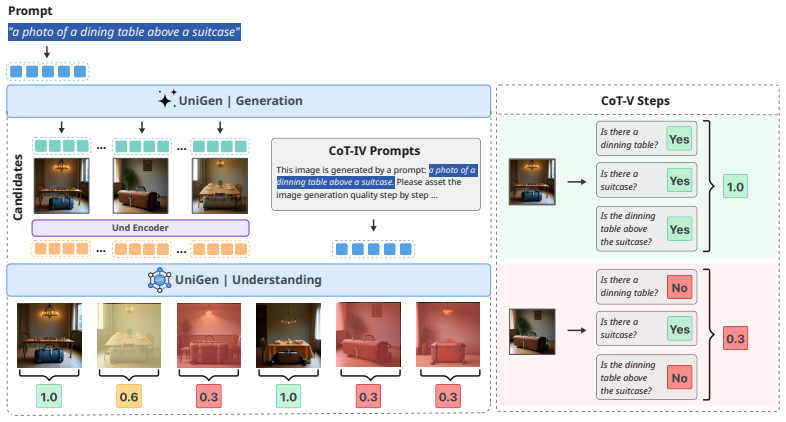
The central object is CoT-V (Chain-of-Thought Verification), a test-time scaling strategy in which UniGen acts simultaneously as image generator and image verifier. Given a text prompt, the model first produces N candidate images (N=20 in the main experiments), then for each candidate it is prompted to break the prompt into atomic visual questions, answer each question with yes or no inside a chain-of-thought block, and the final quality score is the fraction of 'yes' answers; the top K=4 candidates by score are selected. The machinery also includes the training recipe that makes this possible: masked token prediction with a cosine masking schedule for generation, decoupled SigLIP and MAGVIT-v2 encoders, a DPO stage for preference alignment, and the 500-step CoT-V post-training that teaches the model to emit the verification format using pseudo-labeled question-answer triplets.
What would settle it
Run GenEval and DPG-Bench under a matched protocol: give Janus-Pro, Show-o, and Janus the same 20-sample Best-of-N budget (using their own confidence scores or a shared verifier) and also report UniGen with a single sample per prompt; if UniGen's margin over baselines disappears, the state-of-the-art claim rests on extra inference compute rather than on CoT-V. A second direct check is to compare CoT-V's top-4 selection with random selection among the same 20 samples on DPG-Bench; if random selection scores equally well, the verifier itself is not the cause of the gain.
Extended reading notes
Core claim
The paper's central claim is that a single autoregressive LLM with decoupled visual encoders—a continuous encoder for understanding and a discrete tokenizer for generation—can, with the right open-data training recipe, surpass larger and more specialized text-to-image models on GenEval and DPG-Bench while matching strong understanding-focused MLLMs. The key discovery is that letting the same model verify its own outputs, in a step-by-step chain-of-thought manner, produces reliable enough quality scores to make Best-of-N selection work: UniGen goes from 0.74 to 0.78 on GenEval and 85.02 to 85.19 on DPG-Bench when CoT-V is applied, whereas a single yes/no outcome question gives no improvement. The paper also establishes that this verification ability can be instilled with only 500 steps of lightweight post-training and that the resulting CoT-V post-trained model preserves the model's general understanding performance almost unchanged.
Load-bearing premise
The reported state-of-the-art comparison assumes that a test-time-scaled UniGen, which sees 20 generated candidates per prompt and keeps the top 4 by its own verifier's score, can be directly compared with published baseline scores obtained without that same selection budget.
Editorial extensions
If this is right
- A model can improve its own generation quality by spending more test-time compute in a verifier loop, so unified understanding capability becomes a direct asset for generation rather than a separate head.
- Open-source training data plus careful stage-wise recipes can bring a 1.5B unified model to benchmark levels previously reached by much larger or proprietary-data models.
- CoT-V transfers: fine-tuning Show-o with the same DPO and CoT-V data raises its GenEval from 0.56 to 0.64 and DPG-Bench from 71.70 to 76.32.
- The per-stage gains (pre-training, SFT, DPO, CoT-V) are additive on both GenEval and DPG-Bench, so each pipeline component earns its keep.
Reading between the lines
- Because CoT-V's score is an average over atomic yes/no answers, selection quality is bounded by the question decomposition; using a stronger decomposer or human-filtered CoT labels should raise the ceiling, and the paper's own failure cases on long prompts are consistent with this.
- The headline margins over Janus-Pro and Show-o are reported with UniGen using 20 samples per prompt and top-4 selection, while baselines are quoted without that budget; until matched-budget comparisons exist, the margin should be read as including extra test-time compute.
- The same CoT-V scorer could be recycled as a reward model for another round of preference optimization or reinforcement learning, since it scores arbitrary image-prompt pairs; the paper does not explore this closed loop.
Editorial analysis
A structured set of objections, weighed in public.
Referee Report
Summary. The paper presents UniGen, a 1.5B unified multimodal LLM that handles both image understanding and text-to-image generation. The authors describe a three-stage training pipeline (pre-training, SFT, DPO) built from open-source datasets, and propose Chain-of-Thought Verification (CoT-V), a test-time scaling method in which the model generates N candidate images, verifies each in a step-by-step manner, and selects top-K. On GenEval and DPG-Bench they report scores of 0.78 and 85.19, claiming state-of-the-art among unified models, and they provide extensive ablations of each training stage and design choice.
Significance. If the results withstand scrutiny, the paper makes a useful contribution: it demonstrates a clean open-data recipe for unified MLLMs, provides careful ablations of each training stage, and shows that a lightweight CoT-V post-training (500 steps) can turn the model into an effective self-verifier, with transfer to Show-o. The internal ablations in Tables 3 through 6 are consistent and well-controlled. However, the headline SOTA claim on generation is currently not supported because the evaluation protocol is asymmetric and partially circular. The CoT-V mechanism itself remains promising but needs re-evaluation under a fair protocol.
major comments (2)
- [Sec. 4.1-4.2, Tables 2-3] The reported GenEval score of 0.78 and DPG-Bench score of 85.19 are obtained with N=20 candidate images per prompt and top-K=4 selection by the CoT-V verifier (Sec. 4.1), while all baseline numbers in Table 2 (Janus-Pro, Show-o, etc.) are single-sample published results. This asymmetry is load-bearing: Table 3 shows UniGen-DPO without CoT-V already reaches 0.73 on GenEval, identical to Janus-Pro's 0.73 in Table 2, so the headline +0.05 margin on GenEval is entirely produced by the test-time selection budget, not by model quality. The paper neither reports UniGen's single-sample GenEval/DPG-Bench scores in Table 2 nor runs baselines under the same Best-of-20 protocol. Moreover, it is not specified how the K selected images are aggregated into the official metric (best-of-K vs. averaging); if each selected image is submitted and the maximum is taken, this further inflates the score. The abstract's 'state-of-the-art' claim therefore conflates inference budget with model quality. Please report single-sample numbers, specify the aggregation rule, and, ideally, evaluate baselines under the same selection budget.
- [Sec. 3.4 and Appendix E.0.5] The GenEval evaluation is partially circular with the training data. For short prompts, DPO preference pairs are selected using GenEval metrics (Sec. 3.4), and the CoT-V post-training labels for PARM prompts are derived from GenEval's templated sub-questions and rules (Appendix E.0.5). The same GenEval benchmark is then used for the main evaluation in Table 2. This means the model is in part trained to reproduce GenEval's scoring criteria, so the GenEval improvements (0.73 to 0.78) cannot be taken as evidence of general text-to-image alignment. The authors should demonstrate that the CoT-V gain persists on a benchmark not used in any training or data-labeling stage, or at least analyze per-category results after excluding categories whose rules were used for labeling.
minor comments (5)
- [Sec. 3.1] The symbol X_U is used both for the input image and its encoded feature sequence; please use distinct notation (e.g., X_U and Z_U) to avoid confusion.
- [Fig. 4] The scores in panels (b) and (c) are not clearly mapped to the formula in Eq. (2); please add a caption explaining how 0.66 is computed.
- [Sec. 4.1] The phrase 'select top-K (K=4) out of it, sending for evaluation' is ambiguous; state explicitly whether the reported GenEval and DPG-Bench numbers are the average over the K selected images or the best of them.
- [Sec. 5 (Limitations)] The acknowledged failure of CoT-V on free-form complex prompts (also shown in Fig. 9) is in tension with the DPG-Bench claim; consider tempering the SOTA wording or reporting a DPG-Bench breakdown for prompts of varying complexity.
- [Table 2] The 'Color Attri.' column for UniGen (0.54) is lower than Janus-Pro's 0.56, yet the text claims an 'overwhelming advantage' on Counting; please make the per-category discussion balanced.
Circularity Check
GenEval headline is partially trained into the pipeline: DPO preferences are scored using GenEval metrics and CoT-V post-training labels are generated by GenEval rules, and the same benchmark is then used for evaluation.
-
fitted input called prediction
[Section 3.4 (Direct Preference Optimization), 'Preference Dataset', short-prompts paragraph]
"For short prompts, we use the prompts from PARM [18], which generally depict the objects, and their attributes and relationship in the scene. Following [18], we use the GENEVAL metrics to evaluate the generation quality of the images. We select the highest-scored example as preferred and the lowest as rejected."
The DPO stage constructs its preference labels using the GenEval metric itself, and Section 4.2/Table 2 then reports GenEval as headline evidence of generation quality. The reported GenEval gains from DPO (0.63 to 0.73 in Table 3, and the final 0.78 with CoT-V) are thus not independent measurements of the generation policy: the reward signal used to fit the model is the same benchmark used for evaluation. The generator is not forced to satisfy GenEval by construction, but a high GenEval score is statistically expected after optimizing toward GenEval-rule-based preferences.
-
fitted input called prediction
[Appendix E.0.5 (CoT-V Post-Training Data)]
"For PARM, we separate each prompt into fine-grained sub-questions according to the templates originally used for generating the prompt. Rules of GENEVAL are used to label each sub-question corresponding to the image with yes or no."
The CoT-V verifier is trained on labels produced by GenEval's own rules, and then during test-time scaling it is used to score and select the top-K candidates that are sent to the GenEval benchmark (Sections 3.5 and 4.1). Table 4's 0.74-to-0.78 GenEval improvement from CoT-V is therefore the verifier applying a learned approximation of GenEval's scoring rule to choose among candidates; the selection mechanism and the evaluation metric share the same ground-truth labels. This makes the GenEval component of the CoT-V claim partially self-fulfilling, although the image generator itself still produces unconstrained candidates.
full rationale
The clearest circularity-like issue is that GenEval is used both as a training signal and as the headline evaluation benchmark. In Sec. 3.4, DPO preference pairs for short prompts are selected by scoring images with GenEval metrics; in Appendix E.0.5, the CoT-V verifier is trained on sub-question labels produced by GenEval rules. The final GenEval score of 0.78 is then reported as evidence that CoT-V boosts generation quality. This is not a fully forced equivalence, because image candidates are still sampled from a generator whose training objective is masked token prediction, and the verifier can make mistakes. However, the CoT-V gain on GenEval is substantially a fit to the evaluation metric: the verifier is literally trained to reproduce GenEval's rule-based judgments and then used to select which samples are scored by that same benchmark. The DPG-Bench result is less affected, because the CoT-V labels for T2I-Comp prompts come from Qwen2.5-VL pseudo-labels rather than DPG-Bench rules. The comparison of Best-of-20 top-4 UniGen scores against single-sample published baselines is a real evaluation-protocol concern, but it is not a circularity issue under the requested criteria. No load-bearing self-citation chain was found: the cited PARM, Show-o, and Janus-Pro works are independent prior work, and the understanding-benchmark results are not entangled with the benchmark-labeled training loop. Overall, the central method has independent content, but the headline GenEval number is partially trained into the pipeline, giving a score of 6.
Assumptions & free parameters
free parameters (6)
- DPO regularization beta =
not reported
- Classifier-free guidance scale =
5.0
- Best-of-N sample count N =
20
- Top-K selected images K =
4
- Masked generation inference steps T =
50
- CoT-V post-training steps =
500
assumptions (4)
- domain assumption Pseudo-labels from Qwen2.5-7B and Qwen2.5-VL-7B are reliable enough to serve as preference and CoT-V supervision.
- domain assumption GenEval and DPG-Bench scores are valid proxies for text-to-image alignment, and optimizing toward them improves real-world generation.
- domain assumption Frozen encoders (SigLIP and MAGVITv2) and the pretrained Qwen2.5-1.5B provide sufficient base capabilities.
- domain assumption Test-time Best-of-N selection with a learned verifier is comparable to the published baseline evaluation protocols.
Cite this review
Pith. "Pith review of UniGen: Enhanced Training & Test-Time Strategies for Unified Multimodal Understanding and Generation." pith.science (2026). https://pith.science/paper/ULW6Q5O4
@misc{pith2026250514682,
  author       = {Pith},
  title        = {Pith review of: UniGen: Enhanced Training & Test-Time Strategies for Unified Multimodal Understanding and Generation},
  year         = {2026},
  howpublished = {\url{https://pith.science/paper/ULW6Q5O4}},
  note         = {Machine review of arXiv:2505.14682}
}
read the original abstract
We introduce UniGen, a unified multimodal large language model (MLLM) capable of image understanding and generation. We study the full training pipeline of UniGen from a data-centric perspective, including multi-stage pre-training, supervised fine-tuning, and direct preference optimization. More importantly, we propose a new Chain-of-Thought Verification (CoT-V) strategy for test-time scaling, which significantly boosts UniGen's image generation quality using a simple Best-of-N test-time strategy. Specifically, CoT-V enables UniGen to act as both image generator and verifier at test time, assessing the semantic alignment between a text prompt and its generated image in a step-by-step CoT manner. Trained entirely on open-source datasets across all stages, UniGen achieves state-of-the-art performance on a range of image understanding and generation benchmarks, with a final score of 0.78 on GenEval and 85.19 on DPG-Bench. Through extensive ablation studies, our work provides actionable insights and addresses key challenges in the full life cycle of building unified MLLMs, contributing meaningful directions to the future research.
Figures


Figures from the paper (6 more)


Forward citations
Cited by 1 Pith paper
-
Reconstruction Alignment Improves Unified Multimodal Models
RECA, a self-supervised post-training objective that conditions unified multimodal models on their own visual understanding embeddings to reconstruct input images, improves text-to-image and editing benchmarks across ...
Reference graph
Works this paper leans on
-
[1]
Phi-3 technical report: A highly capable language model locally on your phone.arXiv:2404.14219, 2024
Marah Abdin, Jyoti Aneja, Hany Awadalla, Ahmed Awadallah, Ammar Ahmad Awan, Nguyen Bach, Amit Bahree, Arash Bakhtiari, Jianmin Bao, Harkirat Behl, et al. Phi-3 technical report: A highly capable language model locally on your phone.arXiv:2404.14219, 2024. 16
arXiv 2024
-
[2]
Flamingo: a visual language model for few-shot learning.NeurIPS, 2022
Jean-Baptiste Alayrac, Jeff Donahue, Pauline Luc, Antoine Miech, Iain Barr, Yana Hasson, Karel Lenc, Arthur Mensch, Katherine Millican, Malcolm Reynolds, et al. Flamingo: a visual language model for few-shot learning.NeurIPS, 2022
2022
-
[3]
Shuai Bai, Keqin Chen, Xuejing Liu, Jialin Wang, Wenbin Ge, Sibo Song, Kai Dang, Peng Wang, Shijie Wang, Jun Tang, et al. Qwen2. 5-vl technical report.arXiv:2502.13923, 2025
arXiv 2025
-
[4]
Improving image generation with better captions
James Betker, Gabriel Goh, Li Jing, Tim Brooks, Jianfeng Wang, Linjie Li, Long Ouyang, Juntang Zhuang, Joyce Lee, Yufei Guo, et al. Improving image generation with better captions. Computer Science., 2023
2023
-
[5]
Maskgit: Masked generative image transformer
Huiwen Chang, Han Zhang, Lu Jiang, Ce Liu, and William T Freeman. Maskgit: Masked generative image transformer. InCVPR, 2022
2022
-
[6]
Conceptual 12m: Pushing web-scale image-text pre-training to recognize long-tail visual concepts
Soravit Changpinyo, Piyush Sharma, Nan Ding, and Radu Soricut. Conceptual 12m: Pushing web-scale image-text pre-training to recognize long-tail visual concepts. InCVPR, 2021
2021
-
[7]
Sets: Leveraging self-verification and self-correction for improved test-time scaling
Jiefeng Chen, Jie Ren, Xinyun Chen, Chengrun Yang, Ruoxi Sun, and Sercan Ö Arık. Sets: Leveraging self-verification and self-correction for improved test-time scaling. arXiv:2501.19306, 2025
arXiv 2025
-
[8]
Xiaokang Chen, Zhiyu Wu, Xingchao Liu, Zizheng Pan, Wen Liu, Zhenda Xie, Xingkai Yu, and Chong Ruan. Janus-pro: Unified multimodal understanding and generation with data and model scaling.arXiv:2501.17811, 2025
arXiv 2025
Show all 95 references
-
[9]
Deepseek-v3 technical report.arXiv:2412.19437, 2024
DeepSeek-AI. Deepseek-v3 technical report.arXiv:2412.19437, 2024
2024 arXiv
-
[10]
Molmo and pixmo: Open weights and open data for state-of-the-art multimodal models.arXiv:2409.17146, 2024
Matt Deitke, Christopher Clark, Sangho Lee, Rohun Tripathi, Yue Yang, Jae Sung Park, Mohammadreza Salehi, Niklas Muennighoff, Kyle Lo, Luca Soldaini, et al. Molmo and pixmo: Open weights and open data for state-of-the-art multimodal models.arXiv:2409.17146, 2024
2024 arXiv
-
[11]
Insight-v: Exploring long-chain visual reasoning with multimodal large language models.arXiv:2411.14432, 2024
Yuhao Dong, Zuyan Liu, Hai-Long Sun, Jingkang Yang, Winston Hu, Yongming Rao, and Ziwei Liu. Insight-v: Exploring long-chain visual reasoning with multimodal large language models.arXiv:2411.14432, 2024
2024 arXiv
-
[12]
Taming transformers for high-resolution image synthesis
Patrick Esser, Robin Rombach, and Bjorn Ommer. Taming transformers for high-resolution image synthesis. InCVPR, 2021
2021
-
[13]
Got: Unleashing reasoning capability of multimodal large language model for visual generation and editing.arXiv:2503.10639, 2025
Rongyao Fang, Chengqi Duan, Kun Wang, Linjiang Huang, Hao Li, Shilin Yan, Hao Tian, Xingyu Zeng, Rui Zhao, Jifeng Dai, et al. Got: Unleashing reasoning capability of multimodal large language model for visual generation and editing.arXiv:2503.10639, 2025
2025 arXiv
-
[14]
Seed-x: Multimodal models with unified multi-granularity comprehension and generation.arXiv:2404.14396, 2024
Yuying Ge, Sijie Zhao, Jinguo Zhu, Yixiao Ge, Kun Yi, Lin Song, Chen Li, Xiaohan Ding, and Ying Shan. Seed-x: Multimodal models with unified multi-granularity comprehension and generation.arXiv:2404.14396, 2024
2024 arXiv
-
[15]
Geneval: An object-focused frame- work for evaluating text-to-image alignment
Dhruba Ghosh, Hannaneh Hajishirzi, and Ludwig Schmidt. Geneval: An object-focused frame- work for evaluating text-to-image alignment. InAdvances in Neural Information Processing Systems, 2023
2023
-
[16]
https://x.ai/news/grok-1.5v, 2024
Grok-1.5. https://x.ai/news/grok-1.5v, 2024
2024
-
[17]
Deepseek-r1: Incentivizing reasoning capability in llms via reinforcement learning.arXiv:2501.12948, 2025
Daya Guo, Dejian Yang, Haowei Zhang, Junxiao Song, Ruoyu Zhang, Runxin Xu, Qihao Zhu, Shirong Ma, Peiyi Wang, Xiao Bi, et al. Deepseek-r1: Incentivizing reasoning capability in llms via reinforcement learning.arXiv:2501.12948, 2025
2025 arXiv
-
[18]
Can we generate images with cot? let’s verify and reinforce image generation step by step.arXiv:2501.13926, 2025
Ziyu Guo, Renrui Zhang, Chengzhuo Tong, Zhizheng Zhao, Peng Gao, Hongsheng Li, and Pheng-Ann Heng. Can we generate images with cot? let’s verify and reinforce image generation step by step.arXiv:2501.13926, 2025
2025 arXiv
-
[19]
Infinity: Scaling bitwise autoregressive modeling for high-resolution image synthesis
Jian Han, Jinlai Liu, Yi Jiang, Bin Yan, Yuqi Zhang, Zehuan Yuan, Bingyue Peng, and Xiaobing Liu. Infinity: Scaling bitwise autoregressive modeling for high-resolution image synthesis. arXiv:2412.04431, 2024
2024 arXiv
-
[20]
Classifier-free diffusion guidance.arXiv:2207.12598, 2022
Jonathan Ho and Tim Salimans. Classifier-free diffusion guidance.arXiv:2207.12598, 2022. 17
2022 arXiv
-
[21]
Ella: Equip diffusion models with llm for enhanced semantic alignment.arXiv:2403.05135, 2024
Xiwei Hu, Rui Wang, Yixiao Fang, Bin Fu, Pei Cheng, and Gang Yu. Ella: Equip diffusion models with llm for enhanced semantic alignment.arXiv:2403.05135, 2024
2024 arXiv
-
[22]
Efficient test-time scaling via self-calibration.arXiv:2503.00031, 2025
Chengsong Huang, Langlin Huang, Jixuan Leng, Jiacheng Liu, and Jiaxin Huang. Efficient test-time scaling via self-calibration.arXiv:2503.00031, 2025
2025 arXiv
-
[23]
T2i-compbench: A com- prehensive benchmark for open-world compositional text-to-image generation
Kaiyi Huang, Kaiyue Sun, Enze Xie, Zhenguo Li, and Xihui Liu. T2i-compbench: A com- prehensive benchmark for open-world compositional text-to-image generation. InNeurIPS, 2023
2023
-
[24]
Gqa: A new dataset for real-world visual reasoning and compositional question answering
Drew A Hudson and Christopher D Manning. Gqa: A new dataset for real-world visual reasoning and compositional question answering. InCVPR, 2019
2019
-
[25]
Unpacking dpo and ppo: Disentangling best practices for learning from preference feedback.NeurIPS, 2024
Hamish Ivison, Yizhong Wang, Jiacheng Liu, Zeqiu Wu, Valentina Pyatkin, Nathan Lambert, Noah A Smith, Yejin Choi, and Hanna Hajishirzi. Unpacking dpo and ppo: Disentangling best practices for learning from preference feedback.NeurIPS, 2024
2024
-
[26]
text-to-image-2m: A high-quality, diverse text-to-image training dataset
jackyhate. text-to-image-2m: A high-quality, diverse text-to-image training dataset. https: //huggingface.co/datasets/jackyhate/text-to-image-2M, 2024
2024
-
[27]
Unitoken: Harmonizing multimodal understanding and generation through unified visual encoding.arXiv:2504.04423, 2025
Yang Jiao, Haibo Qiu, Zequn Jie, Shaoxiang Chen, Jingjing Chen, Lin Ma, and Yu-Gang Jiang. Unitoken: Harmonizing multimodal understanding and generation through unified visual encoding.arXiv:2504.04423, 2025
2025 arXiv
-
[28]
A diagram is worth a dozen images
Aniruddha Kembhavi, Mike Salvato, Eric Kolve, Minjoon Seo, Hannaneh Hajishirzi, and Ali Farhadi. A diagram is worth a dozen images. InECCV, 2016
2016
-
[29]
Segment anything
Alexander Kirillov, Eric Mintun, Nikhila Ravi, Hanzi Mao, Chloe Rolland, Laura Gustafson, Tete Xiao, Spencer Whitehead, Alexander C Berg, Wan-Yen Lo, et al. Segment anything. In ICCV, 2023
2023
-
[30]
Llava-onevision: Easy visual task transfer
Bo Li, Yuanhan Zhang, Dong Guo, Renrui Zhang, Feng Li, Hao Zhang, Kaichen Zhang, Peiyuan Zhang, Yanwei Li, Ziwei Liu, et al. Llava-onevision: Easy visual task transfer. arXiv:2408.03326, 2024
2024 arXiv
-
[31]
Seed-bench: Benchmarking multimodal llms with generative comprehension.arXiv:2307.16125, 2023
Bohao Li, Rui Wang, Guangzhi Wang, Yuying Ge, Yixiao Ge, and Ying Shan. Seed-bench: Benchmarking multimodal llms with generative comprehension.arXiv:2307.16125, 2023
2023 arXiv
-
[32]
Blip-2: Bootstrapping language-image pre-training with frozen image encoders and large language models
Junnan Li, Dongxu Li, Silvio Savarese, and Steven Hoi. Blip-2: Bootstrapping language-image pre-training with frozen image encoders and large language models. InICML, 2023
2023
-
[33]
Evaluating object hallucination in large vision-language models
Yifan Li, Yifan Du, Kun Zhou, Jinpeng Wang, Wayne Xin Zhao, and Ji-Rong Wen. Evaluating object hallucination in large vision-language models. InEMNLP, 2023
2023
-
[34]
Hunyuan-dit: A powerful multi- resolution diffusion transformer with fine-grained chinese understanding.arXiv:2405.08748, 2024
Zhimin Li, Jianwei Zhang, Qin Lin, Jiangfeng Xiong, Yanxin Long, Xinchi Deng, Yingfang Zhang, Xingchao Liu, Minbin Huang, Zedong Xiao, et al. Hunyuan-dit: A powerful multi- resolution diffusion transformer with fine-grained chinese understanding.arXiv:2405.08748, 2024
2024 arXiv
-
[35]
Imagegen-cot: Enhancing text-to-image in-context learning with chain-of-thought reasoning
Jiaqi Liao, Zhengyuan Yang, Linjie Li, Dianqi Li, Kevin Lin, Yu Cheng, and Lijuan Wang. Imagegen-cot: Enhancing text-to-image in-context learning with chain-of-thought reasoning. arXiv:2503.19312, 2025
2025 arXiv
-
[36]
Improved baselines with visual instruction tuning
Haotian Liu, Chunyuan Li, Yuheng Li, and Yong Jae Lee. Improved baselines with visual instruction tuning. InCVPR, 2024
2024
-
[37]
Visual instruction tuning.NeurIPS, 2023
Haotian Liu, Chunyuan Li, Qingyang Wu, and Yong Jae Lee. Visual instruction tuning.NeurIPS, 2023
2023
-
[38]
Nvila: Efficient frontier visual language models
Zhijian Liu, Ligeng Zhu, Baifeng Shi, Zhuoyang Zhang, Yuming Lou, Shang Yang, Haocheng Xi, Shiyi Cao, Yuxian Gu, Dacheng Li, et al. Nvila: Efficient frontier visual language models. arXiv:2412.04468, 2024
2024 arXiv
-
[39]
Oryx MLLM: On-demand spatial-temporal understanding at arbitrary resolution.ICLR, 2025
Zuyan Liu, Yuhao Dong, Ziwei Liu, Winston Hu, Jiwen Lu, and Yongming Rao. Oryx MLLM: On-demand spatial-temporal understanding at arbitrary resolution.ICLR, 2025. 18
2025
-
[40]
Unified-io 2: Scaling autoregressive multimodal models with vision, language, audio, and action.arXiv:2312.17172, 2023
Jiasen Lu, Christopher Clark, Sangho Lee, Zichen Zhang, Savya Khosla, Ryan Marten, Derek Hoiem, and Aniruddha Kembhavi. Unified-io 2: Scaling autoregressive multimodal models with vision, language, audio, and action.arXiv:2312.17172, 2023
2023 arXiv
-
[41]
Unified-io: A unified model for vision, language, and multi-modal tasks.arXiv:2206.08916, 2022
Jiasen Lu, Christopher Clark, Rowan Zellers, Roozbeh Mottaghi, and Aniruddha Kembhavi. Unified-io: A unified model for vision, language, and multi-modal tasks.arXiv:2206.08916, 2022
2022 arXiv
-
[42]
Mathvista: Evaluating mathematical reasoning of foundation models in visual contexts
Pan Lu, Hritik Bansal, Tony Xia, Jiacheng Liu, Chunyuan Li, Hannaneh Hajishirzi, Hao Cheng, Kai-Wei Chang, Michel Galley, and Jianfeng Gao. Mathvista: Evaluating mathematical reasoning of foundation models in visual contexts. InICLR, 2024
2024
-
[43]
Janusflow: Harmonizing autoregression and rectified flow for unified multimodal understanding and generation.arXiv:2411.07975, 2024
Yiyang Ma, Xingchao Liu, Xiaokang Chen, Wen Liu, Chengyue Wu, Zhiyu Wu, Zizheng Pan, Zhenda Xie, Haowei Zhang, Liang Zhao, et al. Janusflow: Harmonizing autoregression and rectified flow for unified multimodal understanding and generation.arXiv:2411.07975, 2024
2024 arXiv
-
[44]
Mm1: methods, analysis and insights from multimodal llm pre-training
Brandon McKinzie, Zhe Gan, Jean-Philippe Fauconnier, Sam Dodge, Bowen Zhang, Philipp Dufter, Dhruti Shah, Xianzhi Du, Futang Peng, Anton Belyi, et al. Mm1: methods, analysis and insights from multimodal llm pre-training. InECCV, 2024
2024
-
[45]
Finite scalar quantization: Vq-vae made simple.arXiv:2309.15505, 2023
Fabian Mentzer, David Minnen, Eirikur Agustsson, and Michael Tschannen. Finite scalar quantization: Vq-vae made simple.arXiv:2309.15505, 2023
2023 arXiv
-
[46]
4M: Massively multimodal masked modeling
David Mizrahi, Roman Bachmann, O ˘guzhan Fatih Kar, Teresa Yeo, Mingfei Gao, Afshin Dehghan, and Amir Zamir. 4M: Massively multimodal masked modeling. InNeurIPS, 2023
2023
-
[48]
Gpt-4o, 2024
OpenAI. Gpt-4o, 2024
2024
-
[49]
The refinedweb dataset for falcon llm: outperforming curated corpora with web data, and web data only
Guilherme Penedo, Quentin Malartic, Daniel Hesslow, Ruxandra Cojocaru, Alessandro Cappelli, Hamza Alobeidli, Baptiste Pannier, Ebtesam Almazrouei, and Julien Launay. The refinedweb dataset for falcon llm: outperforming curated corpora with web data, and web data only. arXiv:23...
2023 arXiv
-
[50]
Sdxl: Improving latent diffusion models for high-resolution image synthesis
Dustin Podell, Zion English, Kyle Lacey, Andreas Blattmann, Tim Dockhorn, Jonas Müller, Joe Penna, and Robin Rombach. Sdxl: Improving latent diffusion models for high-resolution image synthesis. InICLR, 2024
2024
-
[51]
Tokenflow: Unified image tokenizer for multimodal understanding and generation.arXiv:2412.03069, 2024
Liao Qu, Huichao Zhang, Yiheng Liu, Xu Wang, Yi Jiang, Yiming Gao, Hu Ye, Daniel K Du, Zehuan Yuan, and Xinglong Wu. Tokenflow: Unified image tokenizer for multimodal understanding and generation.arXiv:2412.03069, 2024
2024 arXiv
-
[52]
Learning transferable visual models from natural language supervision
Alec Radford, Jong Wook Kim, Chris Hallacy, Aditya Ramesh, Gabriel Goh, Sandhini Agarwal, Girish Sastry, Amanda Askell, Pamela Mishkin, Jack Clark, et al. Learning transferable visual models from natural language supervision. InICML, 2021
2021
-
[53]
Direct preference optimization: Your language model is secretly a reward model
Rafael Rafailov, Archit Sharma, Eric Mitchell, Christopher D Manning, Stefano Ermon, and Chelsea Finn. Direct preference optimization: Your language model is secretly a reward model. InNeurIPS, 2023
2023
-
[54]
Hierarchical text-conditional image generation with clip latents.arXiv:2204.06125, 2022
Aditya Ramesh, Prafulla Dhariwal, Alex Nichol, Casey Chu, and Mark Chen. Hierarchical text-conditional image generation with clip latents.arXiv:2204.06125, 2022
2022 arXiv
-
[55]
Imagenet-21k pretraining for the masses.arXiv:2104.10972, 2021
Tal Ridnik, Emanuel Ben-Baruch, Asaf Noy, and Lihi Zelnik-Manor. Imagenet-21k pretraining for the masses.arXiv:2104.10972, 2021
2021 arXiv
-
[56]
Conceptual captions: A cleaned, hypernymed, image alt-text dataset for automatic image captioning
Piyush Sharma, Nan Ding, Sebastian Goodman, and Radu Soricut. Conceptual captions: A cleaned, hypernymed, image alt-text dataset for automatic image captioning. InACL, 2018
2018
-
[57]
Journeydb: A benchmark for generative image understanding
Keqiang Sun, Junting Pan, Yuying Ge, Hao Li, Haodong Duan, Xiaoshi Wu, Renrui Zhang, Aojun Zhou, Zipeng Qin, Yi Wang, et al. Journeydb: A benchmark for generative image understanding. InNeurIPS, 2023. 19
2023
-
[58]
Aligning large multimodal models with factually augmented rlhf.arXiv:2309.14525, 2023
Zhiqing Sun, Sheng Shen, Shengcao Cao, Haotian Liu, Chunyuan Li, Yikang Shen, Chuang Gan, Liang-Yan Gui, Yu-Xiong Wang, Yiming Yang, Kurt Keutzer, and Trevor Darrell. Aligning large multimodal models with factually augmented rlhf.arXiv:2309.14525, 2023
2023 arXiv
-
[59]
Chameleon: Mixed-modal early-fusion foundation models
Chameleon Team. Chameleon: Mixed-modal early-fusion foundation models. arXiv:2405.09818, 2024
2024 arXiv
-
[60]
Kimi k1.5: Scaling reinforcement learning with llms.arXiv:2501.12599, 2025
Kimi Team, Angang Du, Bofei Gao, Bowei Xing, Changjiu Jiang, Cheng Chen, Cheng Li, Chenjun Xiao, Chenzhuang Du, Chonghua Liao, et al. Kimi k1.5: Scaling reinforcement learning with llms.arXiv:2501.12599, 2025
2025 arXiv
-
[61]
Cambrian-1: A fully open, vision-centric exploration of multimodal llms
Peter Tong, Ellis Brown, Penghao Wu, Sanghyun Woo, Adithya Jairam Vedagiri IYER, Sai Charitha Akula, Shusheng Yang, Jihan Yang, Manoj Middepogu, Ziteng Wang, et al. Cambrian-1: A fully open, vision-centric exploration of multimodal llms. InNeurIPS, 2024
2024
-
[62]
Metamorph: Multimodal under- standing and generation via instruction tuning.arXiv:2412.14164, 2024
Shengbang Tong, David Fan, Jiachen Zhu, Yunyang Xiong, Xinlei Chen, Koustuv Sinha, Michael Rabbat, Yann LeCun, Saining Xie, and Zhuang Liu. Metamorph: Multimodal under- standing and generation via instruction tuning.arXiv:2412.14164, 2024
2024 arXiv
-
[63]
Llama: Open and efficient foundation language models.arXiv:2302.13971, 2023
Hugo Touvron, Thibaut Lavril, Gautier Izacard, Xavier Martinet, Marie-Anne Lachaux, Timo- thée Lacroix, Baptiste Rozière, Naman Goyal, Eric Hambro, Faisal Azhar, et al. Llama: Open and efficient foundation language models.arXiv:2302.13971, 2023
2023 arXiv
-
[64]
Siglip 2: Multilingual vision-language encoders with improved semantic understanding, localization, and dense features.arXiv:2502.14786, 2025
Michael Tschannen, Alexey Gritsenko, Xiao Wang, Muhammad Ferjad Naeem, Ibrahim Alab- dulmohsin, Nikhil Parthasarathy, Talfan Evans, Lucas Beyer, Ye Xia, Basil Mustafa, et al. Siglip 2: Multilingual vision-language encoders with improved semantic understanding, localization, an...
2025 arXiv
-
[65]
Neural discrete representation learning.NeurIPS, 2017
Aaron Van Den Oord, Oriol Vinyals, et al. Neural discrete representation learning.NeurIPS, 2017
2017
-
[66]
Illume: Illuminating your llms to see, draw, and self-enhance.arXiv:2412.06673, 2024
Chunwei Wang, Guansong Lu, Junwei Yang, Runhui Huang, Jianhua Han, Lu Hou, Wei Zhang, and Hang Xu. Illume: Illuminating your llms to see, draw, and self-enhance.arXiv:2412.06673, 2024
2024 arXiv
-
[67]
Simplear: Pushing the frontier of autoregressive visual generation through pretraining, sft, and rl.arXiv:2504.11455, 2025
Junke Wang, Zhi Tian, Xun Wang, Xinyu Zhang, Weilin Huang, Zuxuan Wu, and Yu-Gang Jiang. Simplear: Pushing the frontier of autoregressive visual generation through pretraining, sft, and rl.arXiv:2504.11455, 2025
2025 arXiv
-
[68]
Qwen2-vl: Enhancing vision-language model’s perception of the world at any resolution.arXiv:2409.12191, 2024
Peng Wang, Shuai Bai, Sinan Tan, Shijie Wang, Zhihao Fan, Jinze Bai, Keqin Chen, Xuejing Liu, Jialin Wang, Wenbin Ge, et al. Qwen2-vl: Enhancing vision-language model’s perception of the world at any resolution.arXiv:2409.12191, 2024
2024 arXiv
-
[69]
Enhancing the reasoning ability of multimodal large language models via mixed preference optimization.arXiv:2411.10442, 2024
Weiyun Wang, Zhe Chen, Wenhai Wang, Yue Cao, Yangzhou Liu, Zhangwei Gao, Jinguo Zhu, Xizhou Zhu, Lewei Lu, Yu Qiao, et al. Enhancing the reasoning ability of multimodal large language models via mixed preference optimization.arXiv:2411.10442, 2024
2024 arXiv
-
[70]
Visualprm: An effective process reward model for multimodal reasoning.arXiv:2503.10291, 2025
Weiyun Wang, Zhangwei Gao, Lianjie Chen, Zhe Chen, Jinguo Zhu, Xiangyu Zhao, Yangzhou Liu, Yue Cao, Shenglong Ye, Xizhou Zhu, et al. Visualprm: An effective process reward model for multimodal reasoning.arXiv:2503.10291, 2025
2025 arXiv
-
[71]
Emu3: Next-token prediction is all you need
Xinlong Wang, Xiaosong Zhang, Zhengxiong Luo, Quan Sun, Yufeng Cui, Jinsheng Wang, Fan Zhang, Yueze Wang, Zhen Li, Qiying Yu, et al. Emu3: Next-token prediction is all you need. arXiv:2409.18869, 2024
2024 arXiv
-
[72]
Mint: Multi-modal chain of thought in unified generative models for enhanced image generation.arXiv:2503.01298, 2025
Yi Wang, Mushui Liu, Wanggui He, Longxiang Zhang, Ziwei Huang, Guanghao Zhang, Fangxun Shu, Zhong Tao, Dong She, Zhelun Yu, et al. Mint: Multi-modal chain of thought in unified generative models for enhanced image generation.arXiv:2503.01298, 2025
2025
-
[73]
Large language models are better reasoners with self-verification
Yixuan Weng, Minjun Zhu, Fei Xia, Bin Li, Shizhu He, Shengping Liu, Bin Sun, Kang Liu, and Jun Zhao. Large language models are better reasoners with self-verification. InEMNLP, 2023
2023
-
[74]
Janus: Decoupling visual encoding for unified multimodal understanding and generation.arXiv:2410.13848, 2024
Chengyue Wu, Xiaokang Chen, Zhiyu Wu, Yiyang Ma, Xingchao Liu, Zizheng Pan, Wen Liu, Zhenda Xie, Xingkai Yu, Chong Ruan, et al. Janus: Decoupling visual encoding for unified multimodal understanding and generation.arXiv:2410.13848, 2024. 20
-
[75]
Vila-u: a unified foundation model integrating visual understanding and generation
Yecheng Wu, Zhuoyang Zhang, Junyu Chen, Haotian Tang, Dacheng Li, Yunhao Fang, Ligeng Zhu, Enze Xie, Hongxu Yin, Li Yi, et al. Vila-u: a unified foundation model integrating visual understanding and generation. InICLR, 2025
2025
-
[76]
Show-o: One single transformer to unify multimodal understanding and generation.arXiv:2408.12528, 2024
Jinheng Xie, Weijia Mao, Zechen Bai, David Junhao Zhang, Weihao Wang, Kevin Qinghong Lin, Yuchao Gu, Zhijie Chen, Zhenheng Yang, and Mike Zheng Shou. Show-o: One single transformer to unify multimodal understanding and generation.arXiv:2408.12528, 2024
2024 arXiv
-
[77]
Llava-critic: Learning to evaluate multimodal models.arXiv:2410.02712, 2024
Tianyi Xiong, Xiyao Wang, Dong Guo, Qinghao Ye, Haoqi Fan, Quanquan Gu, Heng Huang, and Chunyuan Li. Llava-critic: Learning to evaluate multimodal models.arXiv:2410.02712, 2024
2024 arXiv
-
[78]
Slowfast-llava: A strong training-free baseline for video large language models.arXiv:2407.15841, 2024
Mingze Xu, Mingfei Gao, Zhe Gan, Hong-You Chen, Zhengfeng Lai, Haiming Gang, Kai Kang, and Afshin Dehghan. Slowfast-llava: A strong training-free baseline for video large language models.arXiv:2407.15841, 2024
2024 arXiv
-
[79]
Slowfast-llava-1.5: A family of token-efficient video large language models for long-form video understanding.arXiv:2503.18943, 2025
Mingze Xu, Mingfei Gao, Shiyu Li, Jiasen Lu, Zhe Gan, Zhengfeng Lai, Meng Cao, Kai Kang, Yinfei Yang, and Afshin Dehghan. Slowfast-llava-1.5: A family of token-efficient video large language models for long-form video understanding.arXiv:2503.18943, 2025
2025 arXiv
-
[81]
Qwen2.5 technical report
An Yang, Baosong Yang, Beichen Zhang, Binyuan Hui, Bo Zheng, Bowen Yu, Chengyuan Li, Dayiheng Liu, Fei Huang, Haoran Wei, Huan Lin, Jian Yang, Jianhong Tu, Jianwei Zhang, Jianxin Yang, Jiaxi Yang, Jingren Zhou, Junyang Lin, Kai Dang, Keming Lu, Keqin Bao, Kexin Yang, Le Yu, Me...
2024 arXiv
-
[82]
Mmar: Towards lossless multi-modal auto-regressive probabilistic modeling.arXiv:2410.10798, 2024
Jian Yang, Dacheng Yin, Yizhou Zhou, Fengyun Rao, Wei Zhai, Yang Cao, and Zheng-Jun Zha. Mmar: Towards lossless multi-modal auto-regressive probabilistic modeling.arXiv:2410.10798, 2024
2024 arXiv
-
[83]
Hermesflow: Seamlessly closing the gap in multimodal understanding and generation
Ling Yang, Xinchen Zhang, Ye Tian, Chenming Shang, Minghao Xu, Wentao Zhang, and Bin Cui. Hermesflow: Seamlessly closing the gap in multimodal understanding and generation. arXiv:2502.12148, 2025
2025
-
[84]
Mulberry: Empowering mllm with o1-like reasoning and reflection via collective monte carlo tree search.arXiv:2412.18319, 2024
Huanjin Yao, Jiaxing Huang, Wenhao Wu, Jingyi Zhang, Yibo Wang, Shunyu Liu, Yingjie Wang, Yuxin Song, Haocheng Feng, Li Shen, et al. Mulberry: Empowering mllm with o1-like reasoning and reflection via collective monte carlo tree search.arXiv:2412.18319, 2024
2024 arXiv
-
[85]
X-vila: Cross-modality alignment for large language model
Hanrong Ye, De-An Huang, Yao Lu, Zhiding Yu, Wei Ping, Andrew Tao, Jan Kautz, Song Han, Dan Xu, Pavlo Molchanov, et al. X-vila: Cross-modality alignment for large language model. arXiv:2405.19335, 2024
2024 arXiv
-
[86]
Language model beats diffusion-tokenizer is key to visual generation
Lijun Yu, Jose Lezama, Nitesh Bharadwaj Gundavarapu, Luca Versari, Kihyuk Sohn, David Minnen, Yong Cheng, Agrim Gupta, Xiuye Gu, Alexander G Hauptmann, et al. Language model beats diffusion-tokenizer is key to visual generation. InICLR, 2024
2024
-
[87]
Gundavarapu, Luca Versari, Kihyuk Sohn, David Minnen, Yong Cheng, Agrim Gupta, Xiuye Gu, Alexander G
Lijun Yu, José Lezama, Nitesh B. Gundavarapu, Luca Versari, Kihyuk Sohn, David Minnen, Yong Cheng, Agrim Gupta, Xiuye Gu, Alexander G. Hauptmann, Boqing Gong, Ming-Hsuan Yang, Irfan Essa, David A. Ross, and Lu Jiang. Language model beats diffusion – tokenizer is key to visual ...
-
[88]
Mmmu: A massive multi-discipline multimodal understanding and reasoning benchmark for expert agi
Xiang Yue, Yuansheng Ni, Kai Zhang, Tianyu Zheng, Ruoqi Liu, Ge Zhang, Samuel Stevens, Dongfu Jiang, Weiming Ren, Yuxuan Sun, Cong Wei, Botao Yu, Ruibin Yuan, Renliang Sun, Ming Yin, Boyuan Zheng, Zhenzhu Yang, Yibo Liu, Wenhao Huang, Huan Sun, Yu Su, and Wenhu Chen. Mmmu: A m...
2024
-
[89]
Sigmoid loss for language image pre-training
Xiaohua Zhai, Basil Mustafa, Alexander Kolesnikov, and Lucas Beyer. Sigmoid loss for language image pre-training. InICCV, 2023
2023
-
[90]
VideoLLaMA 3: Frontier multimodal foundation models for image and video understanding.arXiv:2501.13106, 2025
Boqiang Zhang, Kehan Li, Zesen Cheng, Zhiqiang Hu, Yuqian Yuan, Guanzheng Chen, Sicong Leng, Yuming Jiang, Hang Zhang, Xin Li, et al. VideoLLaMA 3: Frontier multimodal foundation models for image and video understanding.arXiv:2501.13106, 2025
2025 arXiv
-
[91]
Haotian Zhang, Mingfei Gao, Zhe Gan, Philipp Dufter, Nina Wenzel, Forrest Huang, Dhruti Shah, Xianzhi Du, Bowen Zhang, Yanghao Li, et al. Mm1. 5: Methods, analysis & insights from multimodal llm fine-tuning.arXiv:2409.20566, 2024
2024 arXiv
-
[92]
Video instruction tuning with synthetic data.arXiv:2410.02713, 2024
Yuanhan Zhang, Jinming Wu, Wei Li, Bo Li, Zejun Ma, Ziwei Liu, and Chunyuan Li. Video instruction tuning with synthetic data.arXiv:2410.02713, 2024
2024 arXiv
-
[93]
Image and video tokenization with binary spherical quantization.arXiv:2406.07548, 2024
Yue Zhao, Yuanjun Xiong, and Philipp Krähenbühl. Image and video tokenization with binary spherical quantization.arXiv:2406.07548, 2024
2024 arXiv
-
[94]
Transfusion: Predict the next token and diffuse images with one multi-modal model.arXiv:2408.11039, 2024
Chunting Zhou, Lili Yu, Arun Babu, Kushal Tirumala, Michihiro Yasunaga, Leonid Shamis, Jacob Kahn, Xuezhe Ma, Luke Zettlemoyer, and Omer Levy. Transfusion: Predict the next token and diffuse images with one multi-modal model.arXiv:2408.11039, 2024
2024 arXiv
-
[95]
Internvl3: Exploring advanced training and test-time recipes for open-source multimodal models.arXiv:2504.10479, 2025
Jinguo Zhu, Weiyun Wang, Zhe Chen, Zhaoyang Liu, Shenglong Ye, Lixin Gu, Yuchen Duan, Hao Tian, Weijie Su, Jie Shao, et al. Internvl3: Exploring advanced training and test-time recipes for open-source multimodal models.arXiv:2504.10479, 2025
2025 arXiv
-
[96]
Vargpt-v1
Xianwei Zhuang, Yuxin Xie, Yufan Deng, Dongchao Yang, Liming Liang, Jinghan Ru, Yuguo Yin, and Yuexian Zou. Vargpt-v1. 1: Improve visual autoregressive large unified model via iterative instruction tuning and reinforcement learning.arXiv:2504.02949, 2025
2025 arXiv
-
[97]
Apollo: An exploration of video understanding in large multimodal models.arXiv:2412.10360, 2024
Orr Zohar, Xiaohan Wang, Yann Dubois, Nikhil Mehta, Tong Xiao, Philippe Hansen-Estruch, Licheng Yu, Xiaofang Wang, Felix Juefei-Xu, Ning Zhang, et al. Apollo: An exploration of video understanding in large multimodal models.arXiv:2412.10360, 2024. 22
2024 arXiv
Reviewed August 7, 2026 · model on record in the stance chip above.
Discussion (0). Sign in to comment.