REVIEW 4 major objections 4 minor 51 references
Complementarity of Gravitation Collapse (II) XOB and the Damping Gravitational Waveform as Evidences
T0 review · 4 major / 4 minor · reviewed 2026-08-07 · deepseek-v4-flash
Pith's one-line read The paper argues that binary black-hole merger waveforms damp only if black holes have extended inner structure that deforms like a banana during merger.
desk verdict The new waveform calculation is real but the central exclusivity claim is contradicted by the standard black-hole perturbation theory cited in the paper's own references. read the letter →
The pith
A machine-rendered reading of the paper's core claim, the machinery that carries it, and where it could break.
The reading
The waveform calculation starts from the usual quadrupole formula and multiplies it by a factor zeta = sin(4GMz/a)/(4GMz/a). The variable z is supposed to measure a banana-shape deformation of the merging black holes, and its time evolution is set by a chosen exponent nbnn and a scale zf, with optional extra coefficients c1 and so on. For the equal-mass case the author sets zf=1.2 and nbnn=2 and reports a 0.7062 match against the EOBNRv2 waveform. The abstract instead promises 99% agreement with numerical relativity, which does not match the comparison reported inside the paper.
On this basis the paper argues that numerical relativity actually describes black holes with extended internal mass and no true event horizon, because a real horizon would prevent finite-time merger and would kill the damping tail. It also derives upper and lower bounds on the lowest ringdown frequency from the Hamiltonian and compares them with GWTC catalog data. The logic is circular in an important way: the inner-structure assumption enters through the deformation factor, and the resulting waveform agreement is then offered as evidence for that inner structure.
Extended reading notes
Core claim
The load-bearing assertion, stated in the abstract and conclusion, is that the damping tail with quasi-normal-mode features in binary black-hole merger waveforms is possible only when the black holes possess extended inner mass distributions and experience banana-shape deformation, so observed damping is evidence for the inner structure proposed in the complementarity of gravitational collapse. If correct, numerical relativity's apparent-horizon boundary conditions would be interpreted as describing horizonless, extended objects, and ringdown frequencies would be traceable to this interior structure.
Load-bearing premise
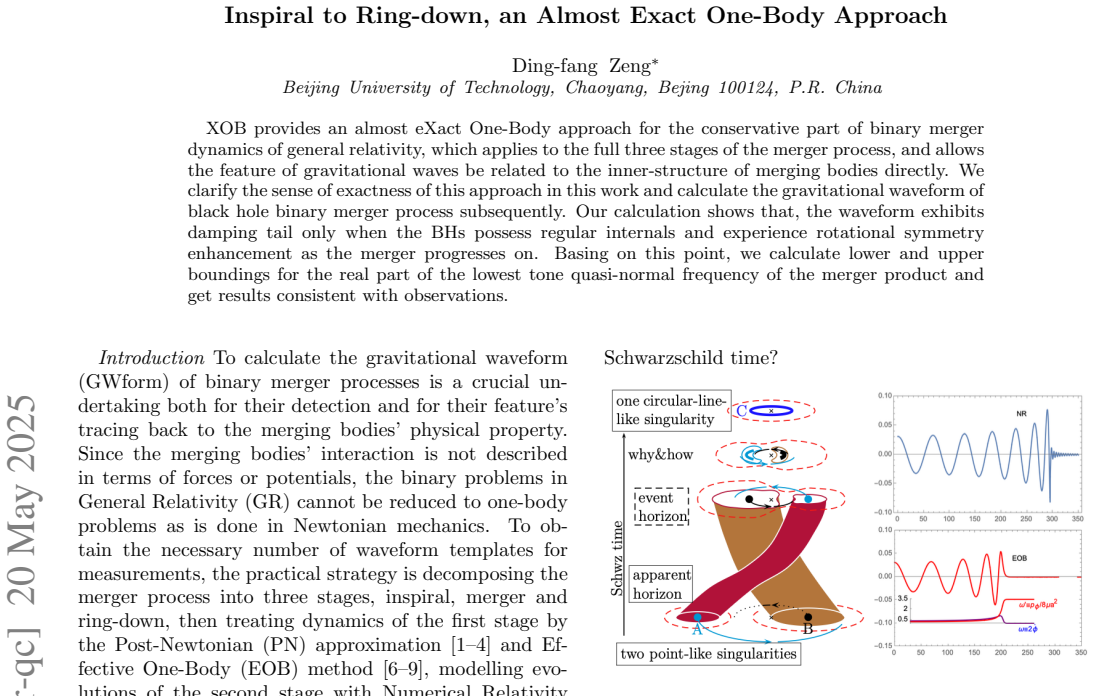
The argument depends on the claim that a true event horizon would make the observed merger and damping impossible, because two point-like singularities could not become a circular-line singularity in finite Schwarzschild time. This coordinate-time argument appears in the Figure 1 caption and Introduction. If the reasoning is wrong, the inference from a damping tail to 'no event horizon' loses its foundation, independent of any waveform fitting.
Editorial analysis
A structured set of objections, weighed in public.
Referee Report
Summary. This paper proposes an 'exact one-body' (XOB) description of binary black-hole merger dynamics, in which each body is treated as a test particle in a Schwarzschild-like geometry generated by the other, supplemented by a dissipative quadrupole radiation force. It claims that the weak-field-low-speed expansion of XOB matches the post-Newtonian series to all orders for the conservative dynamics, uses a 'banana-shape deformation' reduction factor zeta in the quadrupole formula to generate merger waveforms, reports a match of 0.7062 to EOBNRv2 for an equal-mass binary, and derives upper and lower bounds on the real part of the fundamental quasi-normal-mode frequency. The paper concludes that damped QNM waveforms are possible only if black holes have no true event horizon, possess extended internal mass distributions, and undergo banana-shape deformation, interpreting numerical relativity's apparent-horizon treatment as evidence for such an interior structure.
Significance. If the central claim were established, the paper would offer a radically different interpretation of merger ringdown, connecting observed damping to interior structure rather than to horizon boundary conditions, and it would reinterpret numerical relativity as describing horizonless extended objects. The manuscript is commendably transparent about its numerical limitations: it explicitly reports the modest 0.7062 match score and acknowledges that additional parameters in Eq. (17) can tune the waveform arbitrarily. However, the central exclusivity claim is not supported. Standard black-hole perturbation theory, cited in the paper's own references [17]-[20], already produces damped QNM ringdown from perturbed Schwarzschild/Kerr geometries with genuine event horizons, and the paper's coordinate-time argument against horizons does not survive scrutiny. The abstract's all-orders PN and 99% agreement claims are also contradicted by the body of the paper. As it stands, the paper does not provide a valid test of its proposed inner structure.
major comments (4)
- [Abstract; Section 3, Eqs. (9)-(11); Fig. 5] The abstract claims that XOB's weak-field-low-speed expansion matches the post-Newtonian series to all orders for the conservative dynamics and that waveforms agree with numerical relativity to 99%. Both claims are contradicted later in the text: after Eqs. (9)-(11) the paper states 'This does not coincide with the PN expansion of ref. [4] & [5]', and Fig. 5 reports a match score of 0.7062, described as 'not a high score'. The all-orders claim is an internal inconsistency, not merely a wording issue, because the paper's clarified notion of exactness is that the equations of motion differ from standard PN, and the 99% statement is the headline quantitative validation in the abstract. These claims must be corrected or reconciled before the paper's main assertions can be assessed.
- [Introduction, Fig. 1 caption, Conclusion] The load-bearing premise that QNM damping is impossible with true event horizons rests on the assertion that two point-like initial singularities cannot become a circular-line singularity in finite Schwarzschild time. This is not a physical obstruction. In a dynamical binary spacetime there is no global Schwarzschild time; the infinite infall time in the static exterior is a coordinate property of Schwarzschild coordinates, and the final ring singularity in the maximal extension is not an evolved worldline of the initial singularities. Moreover, the paper's own references [17]-[20] show that damped quasi-normal ringdown is a standard solution of black-hole perturbation theory on Schwarzschild/Kerr backgrounds with genuine event horizons, where the damping follows from boundary conditions at the horizon and at infinity, not from an extended inner mass distribution. Since the 'only when' statement in the Conclusion depends on this premise, the central inference from observed damping to banana-shaped interiors loses its foundation.
- [Eqs. (14)-(17), Fig. 5] The waveform comparison is not an independent validation. The damping tail is produced by the reduction factor zeta = sin(4GMz/a)/(4GMz/a) in Eq. (16), with z modeled by Eq. (17); the match in Fig. 5 uses fitted parameters zf = 1.2, nbnn = 2, and the text explicitly states that 'by switching on the additional banana-shape deformation parameters in (17), such as c1, ..., our waveforms can be tuned to match those of EOBNRv2 as closely as desired.' Thus the QNM feature is inserted through the free deformation parameters and then cited as evidence for the inner structure that the parameters represent. This is a fitting exercise rather than a test of the proposed interior structure, and it cannot support the exclusivity claim.
- [Fig. 5 upper panel and adjacent text] The claimed lower and upper bounds on omega_re^022 are asserted without derivation. The text states that setting H = MA + MB or H to the minimal allowed value in Eq. (13) yields bounds on the real part of the lowest quasi-normal frequency, but no mapping from the Hamiltonian value to the ringdown frequency is given, and no justification is provided for taking the minimal-H configuration as the lower bound or H = MA + MB as the upper bound. Because these bounds are presented as the quantitative observational support for the model, the missing derivation is a load-bearing gap. The agreement with GWTC1-3 data cannot be assessed without this derivation.
minor comments (4)
- [Eq. (9)] The displayed expression for H0 contains garbled notation, reading 'n ≡ q/q' or similar; the intended dot product n·p should be clarified.
- [Fig. 1 caption] The caption states 'The waveform of EOB has no QNM feature', but the text and Fig. 5 describe EOBNRv2 waveforms with QNM features obtained by EOB+NR+BHPT; this apparent discrepancy should be reconciled.
- [Throughout] The manuscript contains numerous typographical and grammatical errors, such as 'ultilizes' in the Conclusion and inconsistent article use, and several references are incomplete; a careful language and reference edit is needed.
- [Fig. 5 lower panel] The match-score comparison omits important details, including the number of cycles used, the alignment procedure, and the mass-ratio and spin parameters of the EOBNRv2 template; without these details the 0.7062 score is under-specified.
Assumptions & free parameters
free parameters (3)
- zf =
1.2 (equal-mass case)
- nbnn =
2 (equal-mass case)
- c1, ... =
unspecified (tunable)
assumptions (6)
- ad hoc to paper The two-patch synchronous Schwarzschild geometry in Eq. (1) describes the full conservative dynamics of the binary merger.
- domain assumption Center-of-mass fixing plus synchronous inspiral gives rA=MB r/M and EB=MB^3/M^2 in Eqs. (5)-(6).
- ad hoc to paper The dissipative force is given by the quadrupole formula with banana-shape reduction factor zeta=sin(4GMz/a)/(4GMz/a).
- domain assumption A real event horizon would prevent the observed finite-time merger and damping because two point singularities cannot become a circular singularity in finite Schwarzschild time.
- ad hoc to paper Setting H=MA+MB or H=H_min in Eq. (13) yields valid upper and lower bounds on the real part of the lowest QNM frequency.
- standard math The Legendre transform and double series expansion in 1/q and p^2 are valid.
invented entities (1)
-
Black holes with extended internal mass distribution, no true event horizon, and banana-shape deformation during merger.
independent evidence
Cite this review
Pith. "Pith review of Complementarity of Gravitation Collapse (II) XOB and the Damping Gravitational Waveform as Evidences." pith.science (2026). https://pith.science/paper/27ZAQPR5
@misc{pith2026250514749,
  author       = {Pith},
  title        = {Pith review of: Complementarity of Gravitation Collapse (II) XOB and the Damping Gravitational Waveform as Evidences},
  year         = {2026},
  howpublished = {\url{https://pith.science/paper/27ZAQPR5}},
  note         = {Machine review of arXiv:2505.14749}
}
read the original abstract
This is the second paper of our working series on the complementarity of gravitational collapse. In this paper we prove that dynamics of XOB (an eXact One-Body Method) under the weak-field-low-speed expansion matches with the post-newtonian series to all orders for the conservative part of binary dynamics in general relativity. Using XOB and an inner-structure modulated quadrupole formula, we generate gravitational waveforms for the black hole binary merger process agreeing with numeric relativity to 99\% degree. Basing on this agreement, we argue that black holes in numerical relativities have inner structures we propose in the complementarity of gravitational collapse.
Figures


Figures from the paper (1 more)

Reference graph
Works this paper leans on
-
[17]
Scattering of Gravitational Radi- ation by a Schwarzschild Black-hole
C. V. Vishveshwara, “Scattering of Gravitational Radi- ation by a Schwarzschild Black-hole”, Nature vol.227 (1970) 936–938, doi.org/10.1038/227936a0
doi:10.1038/227936a0 1970
-
[20]
P., William H. Long Wave Trains of Gravitational Waves from a Vibrating Black Hole, Astrophysical Journal vol.170 (1971) L105, dx.doi.org/10.1086/180849
doi:10.1086/180849 1971
-
[4]
& [5]. This is because the Hamiltonian of the sys- tem contains the contribution from the merging bodies as well as the spacetime geometry. The rotation of of 3 PN spacetime geometry is far-near-asynchronous, while that of XOB is globally synchronous, see FIG.2 for refer- ences. In this sense, XOB provides a Full process appli- cable One-Body (FOB) descri...
-
[5]
Higher-Order Relativistic Periastron Advances and Binary Pulsars
T. Damour and G. Sch¨ afer, “Higher-Order Relativistic Periastron Advances and Binary Pulsars”, Nuovo Ci- mento 10, 123 1988, doi.org/10.1007/BF02828697
-
[1]
Gravitational-Radiation Damping of Compact Binary Systems to Second Post-Newtonian Order
L. Blanchet, T. Damour, B. R. Iyer, C. M. Will, and A. G. Wiseman, “Gravitational-Radiation Damping of Compact Binary Systems to Second Post-Newtonian Order”, Phys. Rev. Lett. 74 (1995) 3515, arXiv: gr- qc/9501027, doi.org/10.1103/PhysRevLett.74.3515
arXiv 1995
-
[2]
M. E. Pati, C. M. Will, “Post-Newtonian Gravitational Radiation and Equations of Motion via Direct Integra- tion of the Relaxed Einstein Equations. I. Foundations”, Phys. Rev. D62 (2000) 124015, arXiv: gr-qc/0007087, doi.org/10.1103/PhysRevD.62.124015
arXiv 2000
-
[3]
Third post-Newtonian dynamics of compact binaries: Equations of motion in the center-of-mass frame
L. Blanchet, and Iyer, B. R., “Third post-Newtonian dynamics of compact binaries: Equations of motion in the center-of-mass frame”, Class. Quantum Grav., 20 (2003), 755, arXiv: gr-qc/0209089, doi.org/10.1088/ 0264-9381/20/4/309
arXiv 2003
-
[6]
Gravitational Radiation from Post- Newtonian Sources and Inspiralling Compact Binaries
L. Blanchet, “Gravitational Radiation from Post- Newtonian Sources and Inspiralling Compact Binaries”, Living Rev. Relativity 17 (2014) 2, arXiv: 1310.1528, doi.org/10.12942/lrr-2014-2
arXiv 2014
Show all 51 references
-
[7]
Transition from in- spiral to plunge in binary black hole coalescences
A. Buonanno and T. Damour, “Transition from in- spiral to plunge in binary black hole coalescences” Phys. Rev.D62 (2000) 064015, DOI:10.1103/PhysRevD. 6 62.064015
2000 doi
-
[8]
Effective one-body ap- proach to general relativistic two-body dynamics
A. Buonanno and T. Damour “Effective one-body ap- proach to general relativistic two-body dynamics”, Phys. Rev. D59 (1999) 084006, DOI:10.1103/PhysRevD.59. 084006
1999 doi
-
[9]
On the de- termination of the last stable orbit for circular general relativistic binaries at the third post-Newtonian approx- imation
T. Damour, P. Jaranowski, G. Schaefer, “On the de- termination of the last stable orbit for circular general relativistic binaries at the third post-Newtonian approx- imation”, Phys. Rev. D62 (2000) 084011, arXiv: gr- qc/0005034, doi.org/10.1103/PhysRevD.62.084011
2000
-
[10]
Improved resummation of post-Newtonian multipolar waveforms from circularized compact binaries
T. Damour, B. R. Iyer, and Alessandro Nagar, “Improved resummation of post-Newtonian multipolar waveforms from circularized compact binaries”, Phys. Rev.D79 (2009) 064004, DOI:10.1103/PhysRevD.79.064004
2009 doi
-
[11]
Accurate Evolutions of Orbiting Black- Hole Binaries without Excision
M. Campanelli, C. O. Lousto, P. Marronetti, and Y. Zlochower, “Accurate Evolutions of Orbiting Black- Hole Binaries without Excision”, Phys. Rev. Lett. 96 (2006) 111101, arXiv: gr-qc/0511048, doi.org/10.1103/ PhysRevLett.96.111101
2006 arXiv
-
[12]
Evolution of Binary Black-Hole Space- times
F. Pretorius, “Evolution of Binary Black-Hole Space- times”, Phys. Rev. Lett. 95 (2004) 121101, arXiv: gr- qc/0507014, doi.org/10.1103/PhysRevLett.95.121101
2004
-
[13]
Single-domain spectral method for black hole puncture data
M. Ansorg, B. Brugmann, W. Tichy, “Single-domain spectral method for black hole puncture data”, Phys. Rev. D70 (2004) 064011, arXiv: gr-qc/0404056 doi.org/ 10.1103/PhysRevD.70.064011
2004 arXiv
-
[14]
Gravitational- Wave Extraction from an Inspiraling Configuration of Merging Black Holes
J. G. Baker, J. Centrella, D. Choi & et al, “Gravitational- Wave Extraction from an Inspiraling Configuration of Merging Black Holes”, Phys. Rev. Lett.96 (2006) 111102, arXiv: gr-qc/0511103, doi.org/10.1103/PhysRevLett. 96.111102
2006 arXiv
-
[15]
Comparison of binary black hole initial data sets
V. Varma, M. A. Scheel,H. P. Pfeiffer, “Comparison of binary black hole initial data sets”, Phys. Rev. D98 (2018) 104011, arXiv: 1808.08228, doi.org/10.1103/ PhysRevD.98.104011
2018 arXiv
-
[16]
Filling the holes: Evolving excised binary black hole initial data with puncture techniques
Z. B. Etienne, J. A. Faber, Y. T. Liu et al, “Filling the holes: Evolving excised binary black hole initial data with puncture techniques”, Phys. Rev. D76 (2007) 101503, doi.org/10.1103/PhysRevD.76.101503
2007 doi
-
[18]
Interior of a Binary Black Hole Merger
D. Pook-Kolb, O. Birnholtz, B. Krishnan, and E. Schnet- ter, “Interior of a Binary Black Hole Merger”, Phys. Rev. Lett. 123 (2019) 171102, arXiv:1903.05626. doi.org/10. 1103/PhysRevLett.123.171102
2019 arXiv
-
[19]
The quasi-normal modes of the Schwarzschild black hole
S. Chandrasekhar, S. Detweiler, “The quasi-normal modes of the Schwarzschild black hole”, Astrophys. J. 170 (1971) L105, doi.org/10.1098/rspa.1975.0112
1971
-
[21]
Relativistic theory of tidal Love numbers
T. Binnington and E. Poisson, “Relativistic theory of tidal Love numbers”, Phys. Rev. D80 (2009) 084018, DOI:10.1103/PhysRevD.80.084018
2009 doi
-
[22]
We display in the upper panel of FIG.5 these two bounds’ dependence on the symmetric mass ratio ν and compar- isons with the observational data. The lower bound pro- vides a quantitative estimation for the typical value of ωre 022 because in setting H = H min allow of (13), th...
2020
-
[23]
Quasinormal modes of black holes and black branes
E. Berti, V. Cardoso, A. O. Starinets, “Quasinormal modes of black holes and black branes”, Class. Quantum Grav. 26 (2009) 163001, arXiv: 0905.2975, doi.org/10. 1088/0264-9381/26/16/163001
2009 arXiv
-
[24]
Relativistic tidal properties of neutron stars
T. Damour and A. Nagar, “Relativistic tidal properties of neutron stars”, Phys. Rev. D80 (2009) 084035, DOI: 10.1103/PhysRevD.80.084035
2009 doi
-
[25]
No-Hair Theorem for BHs in Astrophys- ical Environments
N. G¨ urlebeck, “No-Hair Theorem for BHs in Astrophys- ical Environments”, Phys. Rev. Lett.114 (2015) 151102, DOI:10.1103/PhysRevLett.114.151102
2015 doi
-
[26]
Spinning BHs Fall in Love
A. Le Tiec and M. Casals, “Spinning BHs Fall in Love”, Phys. Rev. Lett126 (2021) 131102, DOI:10.1103/ PhysRevLett.126.131102
2021
-
[27]
Toroidal horizons in binary BH mergers
A. Bohn, L. E. Kidder, and S. A. Teukolsky, “Toroidal horizons in binary BH mergers” Phys. Rev. D94 (2016) 064009, 10.1103/PhysRevD.94.064009
2016 doi
-
[28]
Gravity Newtonian, Post- Newtonian, Relativistic
E. Poisson, & C. M. Will, “ Gravity Newtonian, Post- Newtonian, Relativistic”, chapter 12, Cambridge Uni- versity Press, 2014, ISBN: 9781139507486, doi.org/10. 1017/CBO9781139507486
2014
-
[29]
Microscopic State of BHs and an Ex- act One Body Method for Binary Dynamics in General Relativity
Ding-fang Zeng, “Microscopic State of BHs and an Ex- act One Body Method for Binary Dynamics in General Relativity”, accepted by EPJC, arXiv:2311.11764
-
[30]
Resolving the Schwarzschild singular- ity in both classic and quantum gravities
Ding-fang Zeng, “Resolving the Schwarzschild singular- ity in both classic and quantum gravities”, Nucl. Phys. B917 (2017) 178, arXiv: 1606.06178, doi.org/10.1016/ j.nuclphysb.2017.02.005
2017 arXiv
-
[31]
Exact inner metric and microscopic state of AdS 3-Schwarzschild BHs
Ding-fang Zeng, “Exact inner metric and microscopic state of AdS 3-Schwarzschild BHs”, Nucl. Phys. B954 (2020) 115001, arXiv: 1812.06777, doi.org/10.1016/j. nuclphysb.2020.115001
2020 arXiv
-
[32]
Spontaneous Radiation of BHs
Ding-fang Zeng, “Spontaneous Radiation of BHs”, Nucl. Phys. B977 (2022) 115722, arXiv: 2112.12531, doi.org/ 10.1016/j.nuclphysb.2022.115722
2022 arXiv
-
[33]
Gravity Induced Spontaneous Ra- diation
Ding-fang Zeng, “Gravity Induced Spontaneous Ra- diation”, Nucl. Phys. B990 (2023) 116171,arXiv: 2207.05158, doi.org/10.1016/j.nuclphysb.2023. 116171
2023 arXiv
-
[34]
Schwarzschild Fuzzball and Explic- itly Unitary Hawking Radiations
Ding-fang Zeng, “Schwarzschild Fuzzball and Explic- itly Unitary Hawking Radiations”, Nucl. Phys. B930 (2018) 533-544, arXiv: 1802.00675, doi.org/10.1016/ j.nuclphysb.2018.03.012
2018 arXiv
-
[35]
Information missing puzzle, where is hawking’s error?
Ding-fang Zeng, “Information missing puzzle, where is hawking’s error?”, Nucl. Phys. B941 (2018) 665, arXiv: 1804.06726, doi.org/10.1016/j.nuclphysb. 2019.02.023
2018 arXiv
-
[36]
Statistical Interpretation of the Bekenstein Entropy for Systems with a Stretched Horizon
O. Lunin and S. D. Mathur, “Statistical Interpretation of the Bekenstein Entropy for Systems with a Stretched Horizon”, Phys. Rev. Lett. 88(2002) 211303, DOI:10. 1103/PhysRevLett.88.211303
2002
-
[37]
Fuzzball Solutions for BHs and D1-Brane–D5-Brane Microstates
K. Skenderis and M. Taylor, “Fuzzball Solutions for BHs and D1-Brane–D5-Brane Microstates”, Phys. Rev. Lett. 98 (2007) 071601, DOI:10.1103/PhysRevLett.98. 071601
2007 doi
-
[38]
Fuzzball Shadows: Emergent Horizons from Microstructure
F. Bacchini, D. R. Mayerson, B. Ripperda et al, “Fuzzball Shadows: Emergent Horizons from Microstructure”, Phys. Rev. Lett.127 (2021) 171601
2021
-
[39]
Modave Lectures on Horizon-Size Mi- crostructure, Fuzzballs and Observations
D. R. Mayerson, “Modave Lectures on Horizon-Size Mi- crostructure, Fuzzballs and Observations”, arxiv:2202. 11394
-
[40]
PyCBC software, DOI: 10.5281/zenodo.10473621, PyCBC,v2.3.6
-
[41]
FIND- CHIRP: An Algorithm for detection of gravitational waves from inspiraling compact binaries
B. Allen, W. Anderson, P. Brady & et al, “FIND- CHIRP: An Algorithm for detection of gravitational waves from inspiraling compact binaries” Phys. Rev. D85 (2012) 122006, DOI:10.1103/PhysRevD.85.122006, gr-qc/0509116
2012 arXiv
-
[42]
Chi squared time-frequency discriminator for gravita- tional wave detection
“Chi squared time-frequency discriminator for gravita- tional wave detection”, Phys. Rev. D71 (2005) 062001, DOI:10.1103/PhysRevD.71.062001, gr-qc/0405045
2005 arXiv
-
[43]
Detecting bi- nary compact-object mergers with gravitational waves: Understanding and Improving the sensitivity of the Py- CBC search
A. Nitz, T. Dent, T. Canton & et al, “Detecting bi- nary compact-object mergers with gravitational waves: Understanding and Improving the sensitivity of the Py- CBC search”, Astrophys. J. 849 (2017) 2, 118, DOI: 10.3847/1538-4357/aa8f50 arXiv:1705.01513
2017 arXiv
-
[44]
Implementing a search for aligned-spin neutron star- black hole systems with advanced ground based gravita- 7 tional wave detectors
“Implementing a search for aligned-spin neutron star- black hole systems with advanced ground based gravita- 7 tional wave detectors”, Phys. Rev.D90 (2014) 8, 082004, DOI:10.1103/PhysRevD.90.082004, arXiv:1405.6731
2014 arXiv
-
[45]
GWTC-1: A Gravitational-Wave Transient Catalog of Compact Binary Mergers Observed by LIGO and Virgo during the First and Second Observing Runs
“GWTC-1: A Gravitational-Wave Transient Catalog of Compact Binary Mergers Observed by LIGO and Virgo during the First and Second Observing Runs”, GWTC-1: Phys. Rev. X9 (2019) 031040, arXiv: 1811.12907, doi. org/10.1103/PhysRevX.9.031040
2019 arXiv
-
[46]
GWTC-2: Compact Binary Coalescences Observed by LIGO and Virgo During the First Half of the Third Ob- serving Run
“GWTC-2: Compact Binary Coalescences Observed by LIGO and Virgo During the First Half of the Third Ob- serving Run”, GWTC-2: Phys. Rev.X11 (2021) 021053, doi.org/10.1103/PhysRevX.11.021053
2021 doi
- [47]
-
[48]
BH spectroscopy: Systematic errors and ringdown en- ergy estimates
V. Baibhav, E. Berti, V. Cardoso, and G. Khanna, “BH spectroscopy: Systematic errors and ringdown en- ergy estimates” Phys. Rev. D97 (2018) 044048, DOI: 10.1103/PhysRevD.97.044048
2018 doi
- [49]
-
[50]
Gravitational-wave signatures of exotic compact objects and of quantum corrections at the horizon scale
V. Cardoso, S. Hopper, C F. B. Macedo and et al, “Gravitational-wave signatures of exotic compact objects and of quantum corrections at the horizon scale”, Phys. Rev. D94 (2016) no.8, 084031, arXiv:1608.08637
2016 arXiv
-
[51]
Analytical Black-Hole Binary Merger Waveforms
S. T. McWilliams, “Analytical Black-Hole Binary Merger Waveforms”, Phys. Rev. Lett.122 (2019) 191102, doi: 10.1103/PhysRevLett.122.191102
2019 doi
Reviewed August 7, 2026 · model on record in the stance chip above.
Discussion (0). Sign in to comment.