REVIEW 4 major objections 6 minor 1 cited by
In-Context Learning Boosts Speech Recognition via Human-like Adaptation to Speakers and Language Varieties
T0 review · 4 major / 6 minor · reviewed 2026-08-07 · deepseek-v4-flash
Pith's one-line read This paper shows that in-context learning on a multimodal speech model produces human-like, rapidly saturating speaker adaptation, cutting word error rates by a relative 19.7% with as few as 12 example utterances.
desk verdict The WER drop from in-context exemplars is probably real, but the paper's human-like acoustic adaptation story needs a text-only control before it can be believed. read the letter →
The pith
A machine-rendered reading of the paper's core claim, the machinery that carries it, and where it could break.
The reading
What carries the argument
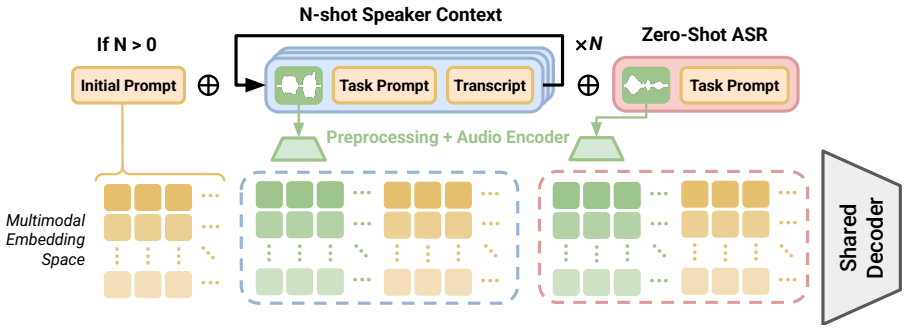
The load-bearing device is an N-shot in-context learning prompt: a task instruction, N interleaved audio clips with their transcripts, and then an unlabeled target clip, all processed through the model's shared multimodal context window. This lets the model condition its transcription of the target on speaker-specific acoustic evidence without any weight updates. The paper uses this device to produce a fast, saturating error-reduction curve and to separate a speaker-specific phase, where 4-6 same-speaker examples give a 19.6% relative advantage, from a variety-general phase, where at 10-12 shots different-speaker examples match or slightly beat same-speaker ones.
What would settle it
Run the same 1- to 12-shot prompts with the example transcripts supplied as text only, without the example audio, and compare word error rates with the audio-plus-text condition; if text-only context reproduces the improvement, the claim that the audio carries a human-like speaker-adaptation signal is false.
Extended reading notes
Core claim
The paper claims that inference-time prompting alone adapts a state-of-the-art spoken language model to a new speaker or language variety in a way that tracks human perceptual learning. Supplying 0 to 12 interleaved audio-transcript pairs reduces average word error rates by a relative 19.7% (1.2 percentage points) across English corpora, with the largest absolute and relative gains for low-resource varieties such as Spanish-heritage English, L1 Hindi, and L1 Korean. Adaptation is strongest when the context and target share a speaker at 4-6 examples, that advantage disappears at longer contexts, and gains show diminishing returns that plateau around 6-10 examples, a shape the paper reads as fast acoustic-phonetic recalibration followed by variety-level generalization. Baseline disparities persist: zero-shot word error rate is 1.2% for native English speakers and 11.4% for non-native speakers reading identical text, so adaptation narrows but does not close the gap.
Load-bearing premise
The paper credits the word error rate gains to acoustic-phonetic adaptation to the example audio, yet every few-shot prompt pairs the audio with a written transcript, so the improvement could in principle come from language-model priors in the text alone.
Editorial extensions
If this is right
- With 9-12 examples, the model reaches below 2% word error rate on high-resource American English and reduces errors by 10-45% relative for several low-resource varieties.
- Most of the available benefit appears within 25-30 seconds of transcribed audio, since error reduction plateaus around 6-10 examples.
- Same-speaker context matters only in the 4-6 shot range, giving a 19.6% relative advantage; beyond that, different-speaker examples match or slightly beat it.
- Explicit prompt cues help: labeling speech as non-native improves zero-shot word error rate by 0.1-0.3 percentage points, and explicit answer markers cut early-shot volatility and improve low-resource few-shot word error rate by up to 0.9 percentage points.
- Baseline disparities persist: zero-shot word error rate is 1.2% for native and 11.4% for non-native speakers reading identical text, so adaptation narrows but does not close the gap.
Reading between the lines
- A natural control the paper does not run is text-only context: the same transcripts supplied without the example audio. If word error rate gains persist there, the acoustic-adaptation story would need revision, so this is the first thing I would check.
- If the effect is genuinely acoustic, it should transfer to test words that never appeared in the exemplars; that prediction can be tested by holding out lexical items from the context set.
- The cross-over at 10-12 shots, where different-speaker examples slightly outperform same-speaker ones, suggests the model is generalizing variety-level patterns; a direct extension would test whether a small set of diverse speakers of the same variety outperforms many clips from one speaker at high shot counts.
- Because the method needs no gradients, it is directly applicable to streaming or on-device speech recognition, where context could be accumulated utterance by utterance.
Editorial analysis
A structured set of objections, weighed in public.
Referee Report
Summary. The paper proposes an in-context learning (ICL) framework for the multimodal speech-language model Phi-4-Multimodal (Phi-4-MM) in which transcribed audio-text pairs from a target speaker or variety are interleaved in the prompt before transcribing an unlabeled test clip. Across CMU-Arctic, L2-ARCTIC, and the Hispanic-English Corpus, the authors report that 0 to 12 shots reduce average word error rates by a relative 19.7% (1.2 percentage points), with diminishing returns, larger gains for low-resource varieties, and a same-speaker advantage in the 4-6 shot range. The paper interprets these results as evidence of human-like acoustic-phonetic adaptation, paralleling perceptual learning in human listeners, and argues that ICL can improve ASR robustness without parameter updates. The Appendices provide detailed prompt templates, preprocessing, seed management, and speaker-level results, and the authors release code on GitHub.
Significance. If the central claim is correct, this would be a practically useful and scientifically interesting result: inference-time prompting alone would improve ASR robustness across speakers and language varieties, with no fine-tuning, and it would suggest that large multimodal models exhibit adaptation profiles resembling human perceptual learning. The paper is valuable for its systematic evaluation across multiple corpora, its careful documentation of prompts and seeds, and its release of reproducible code and detailed speaker-level tables. However, the interpretive claim that the gains arise from acoustic-phonetic adaptation to the exemplar audio is currently not supported by the experimental design, because no condition separates the contribution of the audio from the contribution of the accompanying written transcripts. The raw WER reduction is plausibly real, but the mechanism and the human-adaptation analogy require additional controls before the headline conclusion can be accepted.
major comments (4)
- [§5.1, §6.1, §7] The experimental design always presents context as audio-transcript pairs, and never includes a text-only condition (transcripts without the corresponding audio), an audio-only condition, or a mismatched audio/transcript condition. The paper's central claim—that ICL produces human-like acoustic-phonetic recalibration—requires that the audio signal carries the causal weight. Without a text-only control, the observed WER improvements could be driven entirely by lexical, register, or format priming from the written transcripts, which is especially plausible because Phi-4-MM is a text-conditioned decoder and the transcripts appear in the same conversation format as the target. Please add at least a text-only context control and, if feasible, a mismatched-audio control (e.g., same transcripts paired with a different speaker's audio) to distinguish acoustic adaptation from transcript-driven prior biasing.
- [§6.1, Table 3] The reported 1.2 pp average improvement is heavily influenced by one outlier speaker in HEC (Speaker 7, 0-shot WER 63.9%, 12-shot WER 41.0%). From Table 3, this single speaker contributes roughly 0.6 pp to the speaker-averaged improvement across the 36 speakers, i.e., about half of the reported average gain. The paper acknowledges the outlier but still reports the mean as the primary result. Please report median WERs, leave-one-out results, and confidence intervals for the aggregate improvement, and discuss what the effect is when this speaker is excluded. The current presentation overstates the typical benefit.
- [§6.2, Table 1] The claim of 'consistent improvements' is not supported by the fine-grained shot-count trajectories. In L2-ARCTIC, the average WER rises from 6.5% at 0 shots to 10.5% at 1 shot; Korean WER swings from 4.2% to 15.2% across shot counts; and Mandarin WER is slightly worse at 12 shots than at 0 shots (+3.9%). These patterns are discussed only briefly, but they undermine the 'steep, rapidly-saturating learning curve' narrative and the 'consistent improvements' statement in Section 6.1. Please provide a more nuanced analysis, including per-variety statistical tests or at least variance estimates, and temper the general claim accordingly.
- [§6.1, §A.6] The statistical claim that '9-12 examples at a 95% confidence level (two-sample t-test)' are better than 0-3 is not accompanied by the test statistic, degrees of freedom, p-value, or effect size. More importantly, the t-test appears to treat individual trials as independent observations, but trials are clustered by speaker and by corpus, and the same test utterances may appear across different shot conditions within a speaker. Please use a mixed-effects model or cluster-robust standard errors with speaker as a random effect, and report the corresponding estimates.
minor comments (6)
- [§6.1 vs. Abstract] The Abstract states that 12 example utterances correspond to '~50 seconds' of speech, while Section 6.1 says 'approximately 25-30 seconds of transcribed audio captures most adaptation benefits.' Please reconcile these numbers, or clarify that the 25-30 second figure refers to a smaller number of shots.
- [§3.2, Table 1] The 'Other' category in CMU-Arctic is said to include 'Scottish, Canadian, and Israeli backgrounds,' but the mapping from speaker IDs to these varieties is not shown. Please include the full mapping in the appendix.
- [§1] The Introduction states that spoken language models have pushed performance 'beyond human levels in many settings' and cites two references, but this claim is not central to the paper and is too broad as stated; please qualify it with the specific settings and conditions.
- [§A.4] The text refers to 'Appendix 7' for prompt templates, but the appendix is structured as Appendix A; please fix the cross-reference.
- [§6.4] The exact prompts used for the zero-shot and few-shot variation conditions are listed only in the appendix; given that prompt sensitivity is one of the reported findings, consider showing the four templates in the main text or in a dedicated table in Section 6.4.
- [§7] The Discussion claims that the results 'closely parallel psychometric curves observed in human speech perception studies,' but no quantitative comparison to human data is provided. At minimum, please state that this is a qualitative analogy, not a quantitative match, or include the human benchmark curves if available.
Circularity Check
No significant circularity: WER gains are measured on held-out test audio with randomly sampled, non-overlapping context; no parameter is fitted to the target result, and self-citations are not load-bearing.
full rationale
This paper is an empirical evaluation rather than a derivation. The headline result—that 0-12 interleaved audio-text exemplars reduce WER by 19.7% relative (1.2 pp.)—is obtained by running Phi-4-MM greedily on held-out test utterances and computing WER with jiwer against ground-truth transcripts (Section 5.4, Table 1). Context examples are randomly sampled without replacement, exclude transcripts identical to the test clip (A.3.2), and the test clip is not included in its own context. Therefore the measured WER improvement is not equivalent by construction to the input exemplars, and no fitted parameter is renamed as a prediction. The self-citations (Graham and Roll 2024; Roll 2025; Sumner 2011) provide background motivation or human-perception evidence; they do not supply the ASR result, and no uniqueness theorem or ansatz is imported from author prior work. The interpretive claim that the gain reflects 'acoustic-phonetic recalibration' (Section 7) is an inference that could be confounded by the presence of transcript text in the context, since no text-only or audio-mismatched control is run; but a missing control is a soundness limitation, not a circular reduction of the result to its inputs. The Limitations section explicitly acknowledges the reliance on transcribed context and the single-model scope. Accordingly, the derivation chain is self-contained with respect to circularity, and the appropriate finding is no significant circularity.
Assumptions & free parameters
free parameters (1)
- Evaluation filtering thresholds
assumptions (4)
- domain assumption Phi-4-Multimodal's instruction tuning enables reliable in-context learning from interleaved audio-text prompts.
- domain assumption Word error rate computed by jiwer after lowercasing and punctuation removal is a fair measure of recognition quality across all tested varieties.
- domain assumption The shape of human perceptual adaptation curves, as reported by Bradlow and Bent (2008) and Sumner (2011), is the appropriate benchmark for the model's WER trajectory.
- ad hoc to paper Random trial sampling with fixed seeds yields effectively independent observations for the reported t-test.
Cite this review
Pith. "Pith review of In-Context Learning Boosts Speech Recognition via Human-like Adaptation to Speakers and Language Varieties." pith.science (2026). https://pith.science/paper/QURBN5LF
@misc{pith2026250514887,
  author       = {Pith},
  title        = {Pith review of: In-Context Learning Boosts Speech Recognition via Human-like Adaptation to Speakers and Language Varieties},
  year         = {2026},
  howpublished = {\url{https://pith.science/paper/QURBN5LF}},
  note         = {Machine review of arXiv:2505.14887}
}
read the original abstract
Human listeners readily adjust to unfamiliar speakers and language varieties through exposure, but do these adaptation benefits extend to state-of-the-art spoken language models? We introduce a scalable framework that allows for in-context learning (ICL) in Phi-4 Multimodal using interleaved task prompts and audio-text pairs, and find that as few as 12 example utterances (~50 seconds) at inference time reduce word error rates by a relative 19.7% (1.2 pp.) on average across diverse English corpora. These improvements are most pronounced in low-resource varieties, when the context and target speaker match, and when more examples are provided--though scaling our procedure yields diminishing marginal returns to context length. Overall, we find that our novel ICL adaptation scheme (1) reveals a similar performance profile to human listeners, and (2) demonstrates consistent improvements to automatic speech recognition (ASR) robustness across diverse speakers and language backgrounds. While adaptation succeeds broadly, significant gaps remain for certain varieties, revealing where current models still fall short of human flexibility. We release our prompts and code on GitHub.
Figures


Forward citations
Cited by 1 Pith paper
-
Few-shot Personalization via In-Context Learning for Speech Emotion Recognition based on Speech-Language Model
Meta-training a speech-language model with in-context learning lets it recognize emotions for unseen speakers using just a few labeled utterances from that speaker, outperforming prior enrollment-based methods on a ne...
Reference graph
Works this paper leans on
-
[1]
Convert to lowercase
-
[2]
, ? ! ; : " ’ ( ) [ ] (each replaced with space)
Remove punctuation: . , ? ! ; : " ’ ( ) [ ] (each replaced with space)
-
[3]
Normalize whitespace: Multiple spaces col- lapsed to single spaces, leading/trailing whitespace removed Implementation Logic: Convert text to low- ercase, iterate through punctuation list replacing each with space, then split and rejoin to normalize whitespace. A.2.4 Dataset Filtering Criteria Variety-Level Filtering: • Varieties must have ≥2 speakers • F...
-
[4]
arXiv preprint arXiv:2409.10429
Meta-whisper: Speech-based meta-icl for asr on low-resource languages. arXiv preprint arXiv:2409.10429. Wei-Ning Hsu, Benjamin Bolte, Yao-Hung Hubert Tsai, Kushal Lakhotia, Ruslan Salakhutdinov, and Abdel- rahman Mohamed. 2021. Hubert: Self-supervised speech representation learning by masked prediction of hidden units. IEEE/ACM transactions on audio, spee...
arXiv 2021
-
[5]
14 Table 3: Complete speaker-level Word Error Rates (WER) for 0-shot and 12-shot conditions
Evaluation: • Calculate WER using jiwer with normalized texts • Aggregate results maintaining full precision • Store individual trial values, not just averages A.8 Extended Speaker-Level Results The following table provides complete speaker- level results for 0-shot and 12-shot conditions across all corpora, enabling verification of reported aggregate sta...
-
[7]
Can whisper perform speech-based in-context learning? In ICASSP 2024-2024 IEEE International Conference on Acoustics, Speech and Signal Process- ing (ICASSP), pages 13421–13425. IEEE. Steven H Weinberger and Stephen A Kunath. 2011. The speech accent archive: towards a typology of english accents. Language & Computers, 73(1). Guanlong Zhao, Sinem Sonsaat, ...
work page 2024
-
[11]
Reproducible speaker orderings
-
[12]
Consistent context selection across runs
Show all 18 references
-
[13]
an example
Deterministic different-speaker selection A.3.2 Context Example Selection Algorithm Same-Speaker Condition Logic: • Build candidate list excluding current test sam- ple • Filter out samples with identical normalized transcripts • Use trial-specific random seed for selection • ...
-
[14]
Environment Setup: • Use identical package versions (see dependen- cies list) • Set all random seeds (Python, NumPy, Py- Torch)
-
[15]
Data Processing: • Apply exact audio normalization pipeline (in- cluding FLAC bug correction) • Use identical text normalization (case, punc- tuation, whitespace) • Apply same filtering criteria (duration, variety, speaker counts)
-
[16]
Experimental Configuration: • Use hierarchical random seeding as specified • Maintain exact prompt structure (including special tokens) • Follow context selection algorithm precisely
-
[17]
Model Configuration: • Use greedy decoding (do_sample=False) • Set num_logits_to_keep=1 at all levels • Use flash attention implementation 13
-
[2004]
Language and Speech, 47(2):139–154
Effects of Noise and Proficiency on Intelligi- bility of Chinese-Accented English. Language and Speech, 47(2):139–154. Publisher: SAGE Publica- tions Ltd. Nathan Roll. 2025. Polyprompt: Automating knowl- edge extraction from multilingual language models with dynamic prompt gen...
2025 arXiv
-
[2017]
The Journal of the Acoustical Society of America, 141(2):886–899
Language-independent talker-specificity in first-language and second-language speech produc- tion by bilingual talkers: L1 speaking rate predicts L2 speaking rate. The Journal of the Acoustical Society of America, 141(2):886–899. W Byrne, E Knodt, J Bernstein, and F Emami. 201...
2014
-
[2018]
arXiv preprint arXiv:1808.10239
Learning to adapt: a meta-learning ap- proach for speaker adaptation. arXiv preprint arXiv:1808.10239. John Kominek and Alan W Black. 2004. The cmu arctic speech databases. In SSW, pages 223–224. Hang Le, Juan Pino, Changhan Wang, Jiatao Gu, Didier Schwab, and Laurent Besacier...
2004 arXiv
-
[2020]
arXiv preprint arXiv:2005.08100
Conformer: Convolution-augmented trans- former for speech recognition. arXiv preprint arXiv:2005.08100. 9 Ming-Hao Hsu, Kuan Po Huang, and Hung-yi Lee
2005 arXiv
-
[2024]
In ICASSP 2024 - 2024 IEEE Interna- tional Conference on Acoustics, Speech and Signal Processing (ICASSP), pages 13521–13525
SALM: Speech-Augmented Language Model with in-Context Learning for Speech Recognition and Translation. In ICASSP 2024 - 2024 IEEE Interna- tional Conference on Acoustics, Speech and Signal Processing (ICASSP), pages 13521–13525. ISSN: 2379-190X. Yunfei Chu, Jin Xu, Xiaohuan Zh...
2024 arXiv
Reviewed August 7, 2026 · model on record in the stance chip above.
Discussion (0). Continue with ORCID to comment.