REVIEW 4 major objections 5 minor 43 references
An Overview of the MUSES Calculation Engine and How It Can Be Used to Describe Neutron Stars
T0 review · 4 major / 5 minor · reviewed 2026-08-07 · deepseek-v4-flash
Pith's one-line read The specific scheme used to smoothly join a neutron star's crust equation of state to its core equation of state changes the predicted radius by only a few hundred meters, provided the match sits just past the crust-core transition.
desk verdict A solid, narrow validation paper: crust-core interpolation is a subdominant systematic for neutron star observables, with a few addressable gaps that do not threaten the central conclusion. read the letter →
The pith
A machine-rendered reading of the paper's core claim, the machinery that carries it, and where it could break.
The reading
What carries the argument
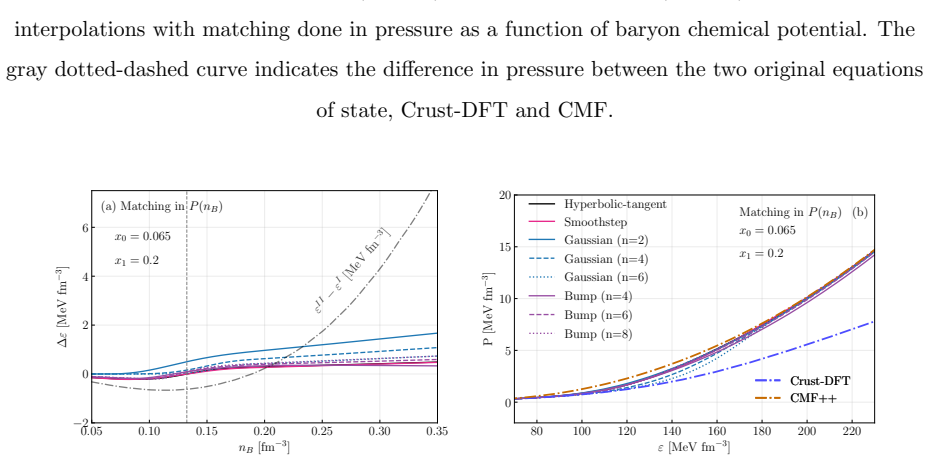
The central object is the switching function $f_\pm(x)$ that blends two equations of state as a function of a chosen thermodynamic variable $x$, together with the rearrangement terms that appear because the interpolated quantity no longer satisfies the original thermodynamic relations. The matching is written as $Y(x) = Y_I(x)\,f_-(x) + Y_{II}(x)\,f_+(x)$ with $f_+(x)=1-f_-(x)$, and the four families considered are the hyperbolic tangent, Gaussian, bump, and smoothstep. The derivative $g(x) = \pm df_\pm/dx$ controls the size of the rearrangement; a steep or long-tailed $g(x)$ produces large corrections, and when the two original equations of state differ strongly in the overlap region the correction can drive the pressure negative, making the matched equation of state thermodynamically unstable. The parameters are fixed by endpoints $x_0,x_1$ and a tolerance $\delta=0.02$ (for the bump, by the midpoint), and the QLIMR module integrates the stable matched equations of state through the Tolman--Oppenheimer--Volkoff equations to obtain masses, radii, and tidal deformabilities.
What would settle it
Compute the mass-radius and tidal deformability curves while varying $\delta$ between, say, $0.01$ and $0.05$ for each of the four interpolation functions; if the spread in the $1.4\,M_\odot$ radius or maximum mass grows well beyond the few-hundred-meter and few-percent ranges reported here, or if some functions become unstable for values of $\delta$ near the chosen one, then the 'modest uncertainty' conclusion would not survive a change in this parameter.
Extended reading notes
Core claim
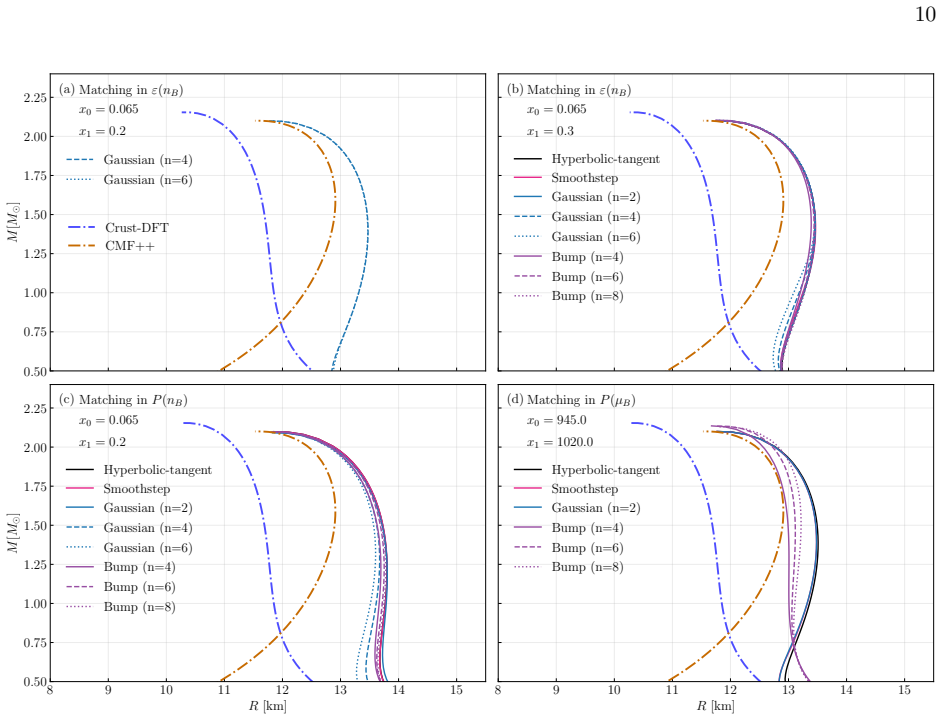
The central claim is that the interpolation scheme used to match a low-density crust equation of state to a high-density core equation of state contributes only modest uncertainty to macroscopic neutron star observables, as long as the matching region is located between the crust-core transition and the densities that set the star's maximum mass. The paper demonstrates this by building $\beta$-equilibrated equations of state from the Crust Density Functional Theory and Chiral Mean Field modules and connecting them with four switching functions. Most stable matches give a $1.4\,M_\odot$ radius within 13.5--13.8 km and preserve the core model's maximum mass; changing the endpoint of the $\varepsilon(n_B)$ interpolation from $0.2\,\mathrm{fm}^{-3}$ to $0.3\,\mathrm{fm}^{-3}$ shifts the mass-radius and tidal deformability curves very little. The exception is the bump function matched in $P(\mu_B)$, whose long power-law tail of the rearrangement term modifies the equation of state up to the star's center and raises the maximum mass.
Load-bearing premise
The load-bearing premise is that the hand-tuned interpolation width parameter $\delta=0.02$, chosen by trial and error so that the transition does not spread beyond its endpoints and does not produce unstable equations of state, is representative of a reasonable transition width.
Editorial extensions
If this is right
- Astrophysical constraints from gravitational-wave detections and mass-radius measurements can be compared with equations of state matched at the crust-core region without treating the interpolation function as a dominant systematic uncertainty.
- Including the crust through interpolation raises the radius of a $1.4\,M_\odot$ star by roughly 500--800 m compared with the core-only equation of state, independent of the interpolation function.
- For matching in $\varepsilon(n_B)$, moving the interpolation endpoint from $0.2\,\mathrm{fm}^{-3}$ to $0.3\,\mathrm{fm}^{-3}$ leaves the mass-radius and tidal deformability curves nearly unchanged, so the precise matching point is subdominant once it lies past the crust-core transition.
- The bump function matched in $P(\mu_B)$ is the outlier: its long-tailed rearrangement modifies the high-density equation of state all the way to the star's center, increasing the maximum mass and shifting the tidal deformability curves.
- The rearrangement terms produce mild bumps in the speed of sound, but these are not extreme enough to produce strong changes in mass, radius, or tidal deformability.
Reading between the lines
- A systematic scan over the tolerance $\delta$ (the paper uses a hand-tuned $\delta=0.02$) would test whether the 'modest uncertainty' conclusion holds for wider or narrower transition widths; near the unstable boundary the spread of radii could grow.
- The same four-function comparison could be applied to a hadron-to-quark-matter transition or other pairs of equations of state with larger energy-density contrasts, where the rearrangement terms are expected to be larger.
- Because the $P(n_B)$ interpolation leaves a globally shifted energy density at densities far above the matching region, observables that depend on the entire $P(\varepsilon)$ relation, such as the moment of inertia, may be more sensitive to the matching variable than the radius at $1.4\,M_\odot$; this is testable with the same pipeline.
- The smoothstep function is only $C^1$ and introduces a discontinuity in the second derivative, which the paper notes is unsuitable for susceptibility computations; any future transport or response calculation across the matched region should therefore avoid it.
Editorial analysis
A structured set of objections, weighed in public.
Referee Report
Summary. The manuscript presents the MUSES Calculation Engine as a framework for building neutron-star equations of state from modular EoS inputs. It combines the Crust-DFT and Chiral Mean Field (CMF++) models in beta equilibrium, connects them with a Synthesis module using four interpolation functions (hyperbolic tangent, Gaussian, bump, and smoothstep), and computes stellar structure and tidal deformability with the QLIMR module. The matching is performed in three thermodynamic variables, ε(nB), P(nB), and P(μB), with different interpolation widths and endpoints. The central claim, stated in the Discussion, is that if the matching is performed around the crust-core transition, the specific interpolation scheme introduces only modest uncertainty in macroscopic observables such as the radius of a 1.4 solar mass star, the maximum mass, and the tidal deformability. This claim is supported by the mass-radius and tidal-deformability curves in Figs. 5 and 6, subject to the caveats discussed below.
Significance. If the central claim holds, the paper provides a practically useful message for the neutron-star EoS community: the details of the crust-core interpolation are not the dominant source of uncertainty when the matching is placed near the crust-core transition. The paper also demonstrates the modular, open-source MUSES workflow, which is a reproducible and composable infrastructure. A particular strength is that the analysis builds on a prior MUSES paper with independently derived rearrangement terms, so the interpolation comparison here is not fitted to the target observables. However, the significance is currently conditional: the conclusion depends on a single hand-picked width parameter δ, on an unspecified thermodynamic stability criterion, and on the absence of reported results for the speed-of-sound matching case that is explicitly listed as one of the tested variables.
major comments (4)
- [Section II, after Eq. (5); Figs. 5 and 6] The central robustness claim is conditioned on δ=0.02, which is selected by trial and error (text after Eq. (5)). Because Γ is fixed by δ through f−(x0)=1−δ and f−(x1)=δ, and because the rearrangement terms that drive both stability and the final EoS scale with g(x)∼1/Γ (Eq. (6) and Table I), a different reasonable δ can change which interpolation functions yield thermodynamically stable EoSs and can alter the spread of radii and tidal deformabilities in Figs. 5 and 6. The authors state that smaller δ produces unstable EoSs and larger δ lets the transition spread too far, but they do not scan δ or report a threshold. The modest-uncertainty conclusion is therefore currently tied to one hand-picked width. Please add a systematic δ scan (or an equivalent width scan for each function) and show how the stable set and the maximum-mass, radius, and tidal-deformability spreads vary with δ.
- [Section II, first paragraph; Figs. 1–6] The paper lists c_s^2(nB) as one of the matching variables (Here we focus on the cases ε(nB), P(nB), P(µB) and c_s^2(nB)), but no results for this case are shown anywhere in the manuscript. The speed of sound is also invoked in the Discussion to explain the observed variations, and it is central to thermodynamic stability (c_s^2 ≥ 0). Either present the c_s^2(nB) matching results or remove this variable from the list and qualify the statements that rely on the speed of sound.
- [Section II, Figs. 1–5] The criterion for calling an interpolated equation of state stable is not stated. The text associates instability with negative pressures in Fig. 1 and Fig. 3, but Figs. 5 and 6 include only stable EoSs without describing the full set of checks, e.g., positivity of pressure and baryon density, c_s^2 ≥ 0, or thermodynamic convexity conditions. Because unstable interpolants are excluded from the central conclusion, the stability check must be defined precisely; if only pressure positivity was checked, the set of surviving interpolants could be incomplete or different.
- [Section II, Eqs. (4)–(5) and text after Eq. (5)] The bump function is not parameter-controlled in the same way as the other functions: it has no Γ or δ, and its transition width is fixed by the midpoint condition f−(xmid)=1/2 and by the exponent n. The paper acknowledges that the functions assign different roles to (xbar,Γ), but the central comparison in Figs. 5 and 6 nevertheless treats the chosen bump widths as representative. A different reasonable choice for the bump width would change the rearrangement tail and could affect both stability and the observable spread. The robustness of the conclusion with respect to this parameter should be demonstrated, or the claim should be restricted to the tested parameterizations.
minor comments (5)
- [Table I] The row for the bump function uses Γ in the expression for gmax, but Γ is not defined for the bump function in Eq. (4); the formula should involve xbar, or the equation should define Γ for the bump case.
- [Discussion and Conclusions] The phrase provided the matching is performed between the crust-core transition is ambiguous: the crust-core transition density of the two models is never computed or quoted, so the reader cannot tell which endpoint choices in Figs. 1–6 satisfy this condition.
- [Figs. 5 and 6] A table listing the radius of the 1.4 solar mass star, the maximum mass, and the tidal deformability for each stable interpolant would make the modest-uncertainty statement quantitative; the present paper relies on visual inspection of the figures.
- [Throughout] There are minor formatting and typographical issues: several figures and the abstract render fm^-3 with a placeholder glyph, and the Discussion refers to crust-EFT where the paper's model is Crust-DFT.
- [Eq. (7)] The limits of integration in Eq. (7) are displayed ambiguously (nB to ¯nB or ¯nB to nB); since the sign and magnitude of ∆ε depend on this, please write the limits explicitly.
Circularity Check
No significant circularity; the interpolation comparison is self-contained and the only self-citation is non-load-bearing.
full rationale
The central claim—that the interpolation scheme introduces only modest uncertainty in macroscopic observables provided the matching is performed around the crust–core transition—is tested directly by building multiple interpolated equations of state from Eq. (1) with four switching functions in three thermodynamic variables and by solving the TOV equations with the QLIMR module. No target observable is used to determine the interpolation parameters: the endpoints are physical density/chemical-potential choices and the width parameter delta=0.02 is selected by trial and error before stellar-structure calculations, not fitted to the mass-radius or tidal-deformability results. The only formally borrowed input is the rearrangement-term set from the authors' prior MUSES paper [21], Eqs. (40)–(52); those expressions are algebraic consequences of Eq. (1) and the definition g(x)=pm df_-/dx, and they are applied identically to every switching function, so the comparison among hyperbolic-tangent, Gaussian, bump, and smoothstep does not reduce to that citation. The paper also reports and isolates the exceptions—unstable interpolations and the bump-in-P(mu_B) maximum-mass increase—rather than selecting only results that support the conclusion. Sensitivity of the conclusion to the chosen delta is a robustness concern, not circularity: the conclusion is not defined in terms of delta, and no prediction is forced by construction. The self-citation to [21] is therefore real, reproducible support and does not raise the circularity score.
Assumptions & free parameters
free parameters (4)
- delta (δ) =
0.02
- x0 (lower endpoint) =
0.065 fm^-3 (for ε(nB), P(nB)) or 945 MeV (for P(µB))
- x1 (upper endpoint) =
0.2 or 0.3 fm^-3 (for ε(nB), P(nB)) or 1020 MeV (for P(µB))
- n (exponent for Gaussian and bump) =
2, 4, 6 for Gaussian; 4, 6, 8 for bump
assumptions (5)
- domain assumption Interpolating a thermodynamic variable with a smooth function and recovering others via thermodynamic relations yields a consistent EoS.
- domain assumption Crust-DFT and CMF are valid descriptions of the crust and core, respectively, in the matched density range.
- domain assumption Cold beta-equilibrated matter with leptons is the appropriate condition for neutron stars in this study.
- ad hoc to paper The chosen set of interpolation functions spans the plausible range of matching uncertainties.
- standard math Standard thermodynamic identities are used to compute pressure, energy density, and speed of sound from the interpolated variables.
Cite this review
Pith. "Pith review of An Overview of the MUSES Calculation Engine and How It Can Be Used to Describe Neutron Stars." pith.science (2026). https://pith.science/paper/KSJP5MQ2
@misc{pith2026250514921,
  author       = {Pith},
  title        = {Pith review of: An Overview of the MUSES Calculation Engine and How It Can Be Used to Describe Neutron Stars},
  year         = {2026},
  howpublished = {\url{https://pith.science/paper/KSJP5MQ2}},
  note         = {Machine review of arXiv:2505.14921}
}
read the original abstract
For densities beyond nuclear saturation, there is still a large uncertainty in the equations of state (EoS) of dense matter that translate into uncertainties in the internal structure of neutron stars. The MUSES Calculation Engine provides a free and open-source composable workflow management system, which allows users to calculate the EoS of dense and hot matter that can be used, e.g. to describe neutron stars. For this work, we make use of two MUSES EoS modules, Crust Density Functional Theory and Chiral Mean Field model, with beta-equilibrium with leptons enforced in the Lepton module, then connected by the Synthesis module using different functions: hyperbolic tangent, Gaussian, bump, and smoothstep. We then calculate stellar structure using the QLIMR module and discuss how the different interpolating functions affect our results.
Figures


Figures from the paper (3 more)

Reference graph
Works this paper leans on
-
[1]
G. Baym, T. Hatsuda, T. Kojo, P. D. Powell, Y. Song, and T. Takatsuka, From hadrons to quarks in neutron stars: a review, Rept. Prog. Phys. 81, 056902 (2018), arXiv:1707.04966 [astro-ph.HE]
arXiv 2018
-
[2]
R. Kumar et al. (MUSES), Theoretical and experimental constraints for the equation of state of dense and hot matter, Living Rev. Rel. 27, 3 (2024), arXiv:2303.17021 [nucl-th]
arXiv 2024
-
[3]
MUSES Project Website, https://musesframework.io/ (2024)
work page 2024
-
[4]
X. Du, A. W. Steiner, and J. W. Holt, Hot and Dense Homogeneous Nucleonic Matter Constrained by Observations, Experiment, and Theory, Phys. Rev. C 99, 025803 (2019), arXiv:1802.09710 [nucl-th]
arXiv 2019
-
[5]
X. Du, A. W. Steiner, and J. W. Holt, Hot and dense matter equation of state probability distributions for astrophysical simulations, Phys. Rev. C 105, 035803 (2022), arXiv:2107.06697 [nucl-th]
arXiv 2022
- [6]
-
[7]
R. Machleidt and D. R. Entem, Chiral effective field theory and nuclear forces, Phys. Rept. 503, 1 (2011), arXiv:1105.2919 [nucl-th]
arXiv 2011
-
[8]
C. Drischler, J. W. Holt, and C. Wellenhofer, Chiral Effective Field Theory and the High-Density Nuclear Equation of State, Ann. Rev. Nucl. Part. Sci. 71, 403 (2021), arXiv:2101.01709 [nucl-th]
arXiv 2021
Show all 43 references
-
[9]
Friedenberg and J
D. Friedenberg and J. W. Holt, Chiral EFT Equation of State module (2024)
2024
-
[10]
Dexheimer and S
V. Dexheimer and S. Schramm, Proto-Neutron and Neutron Stars in a Chiral SU(3) Model, Astrophys. J. 683, 943 (2008), arXiv:0802.1999 [astro-ph]
2008 arXiv
-
[11]
V. A. Dexheimer and S. Schramm, A Novel Approach to Model Hybrid Stars, Phys. Rev. C 81, 045201 (2010), arXiv:0901.1748 [astro-ph.SR]
2010 arXiv
-
[12]
Cruz-Camacho, R
N. Cruz-Camacho, R. Kumar, M. Reinke Pelicer, J. Peterson, T. A. Manning, R. Haas, V. Dexheimer, 15 and J. Noronha-Hostler, Phase Stability in the 3-Dimensional Open-source Code for the Chiral mean- field Model (2024), arXiv:2409.06837 [nucl-th]
2024 arXiv
-
[13]
C. N. Cruz Camacho, R. Kumar, M. Pelicer, T. Manning, R. Haas, V. Dexheimer, and J. Noronha- Hostler, Chiral Mean Field Model (CMF++) Equation of State module (2025)
2025
-
[14]
D. G. Ravenhall and C. J. Pethick, Neutron Star Moments of Inertia, Astrophys. J. 424, 846 (1994)
1994
-
[15]
Bejger and P
M. Bejger and P. Haensel, Moments of inertia for neutron and strange stars: Limits derived for the Crab pulsar, Astron. Astrophys. 396, 917 (2002), arXiv:astro-ph/0209151
2002 arXiv
-
[16]
K. Yagi, L. C. Stein, G. Pappas, N. Yunes, and T. A. Apostolatos, Why I-Love-Q: Explaining why universality emerges in compact objects, Phys. Rev. D 90, 063010 (2014), arXiv:1406.7587 [gr-qc]
2014 arXiv
-
[17]
C. A. Conde Ocazionez, H. Tan, and N. Yunes, Qlimr module (2024)
2024
-
[18]
M. G. Alford, A. Haber, and Z. Zhang, Isospin equilibration in neutron star mergers, Phys. Rev. C 109, 055803 (2024), arXiv:2306.06180 [nucl-th]
2024 arXiv
-
[19]
M. G. Alford, A. Haber, and Z. Zhang, Beyond modified Urca: The nucleon width approximation for flavor-changing processes in dense matter, Phys. Rev. C 110, L052801 (2024), arXiv:2406.13717 [nucl-th]
2024 arXiv
-
[20]
Alford and Z
M. Alford and Z. Zhang, Muses flavor equilibration module (2025)
2025
-
[21]
Reinke Pelicer et al., Building neutron stars with the MUSES calculation engine, Phys
M. Reinke Pelicer et al., Building neutron stars with the MUSES calculation engine, Phys. Rev. D 111, 103037 (2025), arXiv:2502.07902 [nucl-th]
2025 arXiv
-
[22]
Kambe, T
T. Kambe, T. Katayama, and K. Saito, Equation of State for Neutron Star Matter with NJL Model and Dirac–Brueckner–Hartree–Fock Approximation, JPS Conf. Proc. 14, 020807 (2017), arXiv:1608.06449 [astro-ph.HE]
2017 arXiv
-
[23]
Q.-w. Wang, C. Shi, Y. Yan, and H.-S. Zong, Exploring hybrid star EOS with constraints from tidal deformability of GW170817, Nucl. Phys. A 1025, 122489 (2022), arXiv:1912.02312 [hep-ph]
2022 arXiv
-
[24]
Albright, J
M. Albright, J. Kapusta, and C. Young, Baryon Number Fluctuations from a Crossover Equation of State Compared to Heavy-Ion Collision Measurements in the Beam Energy Range √sN N= 7.7 to 200 GeV, Phys. Rev. C 92, 044904 (2015), arXiv:1506.03408 [nucl-th]
2015 arXiv
-
[25]
J. I. Kapusta, T. Welle, and C. Plumberg, Embedding a critical point in a hadron to quark-gluon crossover equation of state, Phys. Rev. C 106, 014909 (2022)
2022
-
[26]
H. Tan, J. Noronha-Hostler, and N. Yunes, Neutron Star Equation of State in light of GW190814, Phys. Rev. Lett. 125, 261104 (2020), arXiv:2006.16296 [astro-ph.HE]
2020 arXiv
-
[27]
H. Tan, T. Dore, V. Dexheimer, J. Noronha-Hostler, and N. Yunes, Extreme matter meets ex- treme gravity: Ultraheavy neutron stars with phase transitions, Phys. Rev. D 105, 023018 (2022), arXiv:2106.03890 [astro-ph.HE]
2022 arXiv
-
[28]
H. Tan, V. Dexheimer, J. Noronha-Hostler, and N. Yunes, Finding Structure in the Speed of Sound of Supranuclear Matter from Binary Love Relations, Phys. Rev. Lett. 128, 161101 (2022), arXiv:2111.10260 [astro-ph.HE]
2022 arXiv
-
[29]
Adam et al
J. Adam et al. (ALICE), Enhanced production of multi-strange hadrons in high-multiplicity proton- 16 proton collisions, Nature Phys. 13, 535 (2017), arXiv:1606.07424 [nucl-ex]
2017 arXiv
-
[30]
Plumberg et al., BSQ Conserved Charges in Relativistic Viscous Hydrodynamics solved with Smoothed Particle Hydrodynamics (2024), arXiv:2405.09648 [nucl-th]
C. Plumberg et al., BSQ Conserved Charges in Relativistic Viscous Hydrodynamics solved with Smoothed Particle Hydrodynamics (2024), arXiv:2405.09648 [nucl-th]
2024 arXiv
-
[31]
Noronha-Hostler, P
J. Noronha-Hostler, P. Parotto, C. Ratti, and J. M. Stafford, Lattice-based equation of state at finite baryon number, electric charge and strangeness chemical potentials, Phys. Rev. C 100, 064910 (2019), arXiv:1902.06723 [hep-ph]
2019 arXiv
-
[32]
Jahan, H
J. Jahan, H. Shah, P. Parotto, J. M. Karthein, J. Noronha-Hostler, and C. Ratti, 4D Taylor-expanded lattice (BQS) module v1.0.0 (2025)
2025
-
[33]
Bors´ anyi, Z
S. Bors´ anyi, Z. Fodor, J. N. Guenther, R. Kara, S. D. Katz, P. Parotto, A. P´ asztor, C. Ratti, and K. K. Szab´ o, Lattice QCD equation of state at finite chemical potential from an alternative expansion scheme, Phys. Rev. Lett. 126, 232001 (2021), arXiv:2102.06660 [hep-lat]
2021 arXiv
-
[34]
Kahangirwe, S
M. Kahangirwe, S. A. Bass, E. Bratkovskaya, J. Jahan, P. Moreau, P. Parotto, D. Price, C. Ratti, O. Soloveva, and M. Stephanov, Finite density QCD equation of state: Critical point and lattice-based T’ expansion, Phys. Rev. D 109, 094046 (2024), arXiv:2402.08636 [nucl-th]
2024 arXiv
-
[35]
Kahangirwe, J
M. Kahangirwe, J. Jahan, P. Parotto, M. Stephanov, and C. Ratti, Ising 2D T’-Expansion Scheme (Ising-2DTExS) module v1.0.0 (2025)
2025
-
[36]
Critelli, J
R. Critelli, J. Noronha, J. Noronha-Hostler, I. Portillo, C. Ratti, and R. Rougemont, Critical point in the phase diagram of primordial quark-gluon matter from black hole physics, Phys. Rev. D 96, 096026 (2017), arXiv:1706.00455 [nucl-th]
2017 arXiv
-
[37]
Rougemont, J
R. Rougemont, J. Grefa, M. Hippert, J. Noronha, J. Noronha-Hostler, I. Portillo, and C. Ratti, Hot QCD phase diagram from holographic Einstein–Maxwell–Dilaton models, Prog. Part. Nucl. Phys. 135, 104093 (2024), arXiv:2307.03885 [nucl-th]
2024 arXiv
-
[38]
Grefa, J
J. Grefa, J. Noronha, J. Noronha-Hostler, I. Portillo, C. Ratti, and R. Rougemont, Hot and dense quark-gluon plasma thermodynamics from holographic black holes, Phys. Rev. D 104, 034002 (2021), arXiv:2102.12042 [nucl-th]
2021 arXiv
-
[39]
Hippert, J
M. Hippert, J. Grefa, T. A. Manning, J. Noronha, J. Noronha-Hostler, I. Portillo Vazquez, C. Ratti, R. Rougemont, and M. Trujillo, Bayesian location of the QCD critical point from a holographic per- spective, Phys. Rev. D 110, 094006 (2024), arXiv:2309.00579 [nucl-th]
2024 arXiv
-
[40]
Yang and M
Y. Yang and M. Hippert, Holographic equation of state module v1.0.0 (2025)
2025
-
[41]
Hippert, J
M. Hippert, J. Grefa, T. A. Manning, J. Noronha, J. Noronha-Hostler, I. Portillo Vazquez, C. Ratti, R. Rougemont, and M. Trujillo, Bayesian analysis of the equation of state of quantum chromodynamics from a holographic model (2024)
2024
-
[42]
T. J. Boerner, S. Deems, T. R. Furlani, S. L. Knuth, and J. Towns, ACCESS: Advancing Innovation: NSF’s Advanced Cyberinfrastructure Coordination Ecosystem: Services & Support, in Practice and Experience in Advanced Research Computing 2023: Computing for the Common Good, PEARC ...
2023
-
[43]
T. A. Manning, MUSES Calculation Engine v1.0.0 (2025)
2025
Reviewed August 7, 2026 · model on record in the stance chip above.
Discussion (0). Sign in to comment.