REVIEW 3 major objections 5 minor 11 references
Deformation of Jets Induced by Ambient Medium Flow
T0 review · 3 major / 5 minor · reviewed 2026-08-07 · deepseek-v4-flash
Pith's one-line read The paper argues that ambient medium flow transverse to a jet deforms the jet's soft-subjet distribution into dipole and quadrupole patterns whose preferred angles track the flow direction, and proposes q-vector analysis as an…
desk verdict A clean proposal for a new flow-sensitive jet observable, but the simulation evidence is model-bound and the quadrupole is asserted rather than shown. read the letter →
The pith
A machine-rendered reading of the paper's core claim, the machinery that carries it, and where it could break.
The reading
What carries the argument
The central tool is the q-vector $q_n = \frac{1}{N}\sum_i \binom{\cos(n\theta_i)}{\sin(n\theta_i)}$ for the $N$ soft objects around a jet core, whose angle $\psi_n = \frac{1}{n}\arctan(q_n^y/q_n^x)$ defines the jet's preferred direction at harmonic $n$. Soft objects are subjets reclustered with radius $R=0.1$ carrying 2-10 GeV, and the jet core is the hardest subjet. The mechanism that transfers flow to these subjets runs through the Monte Carlo simulation: the parton shower and energy-loss modules operate in the local fluid rest frame via Lorentz boosts, and hadronization recombines shower partons with sampled medium partons, which is how ambient flow enters the final hadron distribution. The $n=1$ and $n=2$ angles of the q-vector then carry the flow information.
What would settle it
Rerun the same brick simulation with in-medium recombination of flowing medium partons disabled while keeping the energy-loss phase unchanged. If the $n=1$ and $n=2$ angle correlations with the flow direction survive essentially unchanged, the hadronization-transfer premise is not needed and the interpretation would shift; if they vanish, the signal is carried by hadronization, and the next decisive test is a measurement in heavy-ion collision data comparing per-jet q-vector angles with the event-plane flow angle.
Extended reading notes
Core claim
In the simulations reported here, a 100 GeV jet crossing a 4 fm static brick of quark-gluon plasma at T=300 MeV develops a dipole deformation of its soft subjets when the medium flows transversely at $v=0.4$ or $v=0.8$: the azimuthal angles of $R=0.1$ subjets in the 2-10 GeV momentum window become concentrated along the flow direction, and the per-jet $n=1$ q-vector angle tracks the flow angle, sharpening with flow speed. A quadrupole ($n=2$) deformation also appears, and its angle likewise correlates with the flow direction. The paper takes this as evidence that transverse flow leaves a measurable imprint on jet transverse shape, distinct from the random fluctuations seen in vacuum or in a static medium, and proposes the q-vector harmonic angles as the experimental observables.
Load-bearing premise
The predicted flow-aligned deformations rest on the hadronization step genuinely transferring ambient flow into jet constituents through recombination of shower partons with flowing medium partons; if that recombination is much weaker in real quark-gluon plasma than in the model, the correlations would not appear even though the brick setup produces them.
Editorial extensions
If this is right
- In a medium without flow, soft subjet angles are randomly distributed, so any non-zero mean $q_1$ or $q_2$ over a jet ensemble indicates a preferred direction in the ambient medium.
- The correlation of the dipole angle $\psi_1$ with the flow angle becomes stronger as the transverse flow velocity is increased from 0.4 to 0.8.
- Quadrupole deformations also appear, and $\psi_2$ correlates with the flow direction, providing a second independent harmonic signal.
- Selecting jets whose $\psi_1$ and $\psi_2$ angles fall within the same band can enrich a sample for jets that experienced transverse flow, which matters because realistic flow velocities are likely smaller than the values simulated here.
Reading between the lines
- Applying the same q-vector construction to existing heavy-ion data, with the per-jet $\psi_1$ correlated against the bulk event-plane angle, would give an immediate null test: a non-flat distribution would already indicate average flow-induced deformation.
- Running the brick simulation with transverse flow active only during energy loss and only during hadronization would separate the two transfer paths and predict which one dominates the observed angle correlation.
- The joint distribution of $\psi_1$ and $\psi_2$ may be a sharper discriminator than either angle alone, because a single directed kick and a shear-like flow gradient should produce different relative phases between dipole and quadrupole deformations.
Editorial analysis
A structured set of objections, weighed in public.
Referee Report
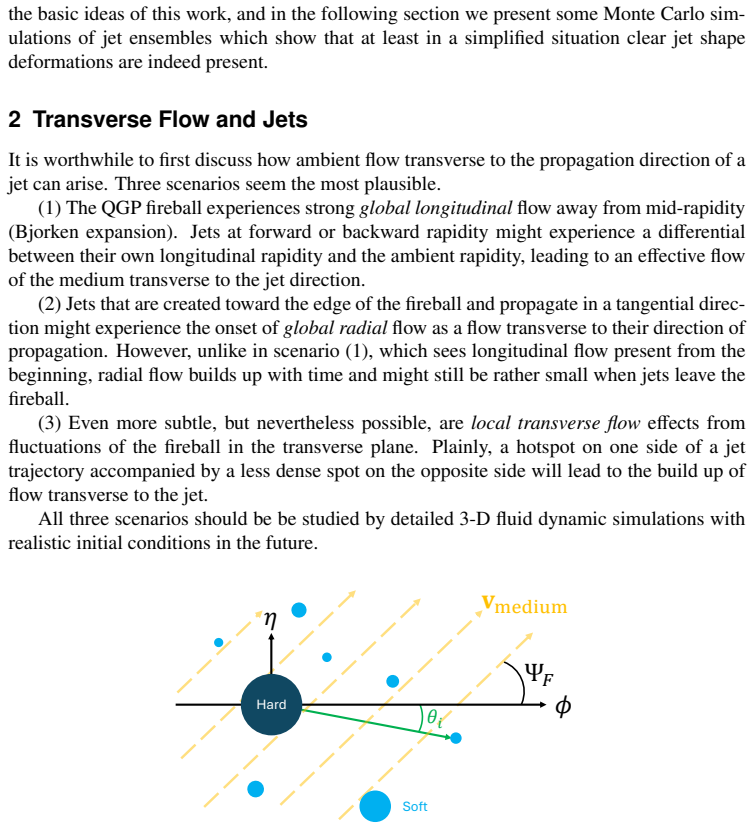
Summary. The paper proposes that transverse flow of the quark-gluon plasma imprints a preferred direction on soft jet constituents, producing dipole and quadrupole deformations of the jet shape in the η-φ plane. It introduces a per-jet q-vector analysis, Eqs. (1)-(2), with the dipole angle ψ1 and quadrupole angle ψ2 proposed as observables correlated with the ambient flow angle ψF. The authors test the idea with JETSCAPE 3.0 in a static QGP brick at T=300 MeV, with jets of initial momentum 100 GeV, using soft subjets of R=0.1 and momentum 2-10 GeV. They compare cases with no flow, transverse flow v=0.4, and v=0.8, all flow being in the y-direction and applied both in the MATTER/LBT partonic stage and in Hybrid Hadronization. Figures 2 and 3 show that soft-subjet angles and dipole event-plane angles become aligned with the flow direction for large flow velocities. The manuscript states that a sizeable quadrupole deformation and a correlation of ψ2 with the flow angle are also present, but explicitly says these results are not shown. The paper concludes that such deformations could be an experimental signal for ambient transverse flow, while acknowledging that realistic flow values may make the effect subtle.
Significance. If the central claim holds, the q-vector deformation observables would be a genuinely new class of jet-flow correlations, extending the older suggestion that collective flow affects jet structure and providing a jet-by-jet probe that could be measured at RHIC and the LHC. The brick setup is a sensible controlled environment, the q-vector formalism is standard, and the paper is clearly written about an interesting idea. However, the evidence presented is incomplete in three load-bearing ways: the quadrupole result is asserted but not plotted; the correlation between ψ1 and ψF is shown only as histograms without statistical uncertainties or a quantitative correlation measure; and the simulation does not separate flow effects in the partonic energy-loss stage from flow transfer through Hybrid Hadronization. The proposed observable is therefore plausible but not yet demonstrated at the level claimed in the abstract.
major comments (3)
- [§3, Figs. 2 and 3] The claim of a 'strong correlation' between the dipole angle and the flow direction is supported only by qualitative histograms. No statistical uncertainties, number of jets, or quantitative correlation measure is provided. Because the per-jet event-plane angle in Eq. (2) is sensitive to the number N of soft subjets and to the magnitude |q_n|, the plotted ψ1 distributions could be significantly affected by statistical fluctuations and by low-multiplicity jets. Please provide a quantitative correlation measure such as ⟨cos(n(ψ_n−ψ_F))⟩ with statistical errors, together with the distribution of |q_n| or an event-plane resolution estimate, to justify the correlation claim.
- [§3, last paragraph] The abstract claims that the simulations demonstrate both dipole and quadrupole deformations, and the text states that 'our simulations also yield a sizeable quadrupole deformation (n=2) for jets (not shown here)' and that ψ2 correlates with the flow angle. Since the n=2 result is half of the central claim, it cannot be left as an assertion. Please show the ψ2 distribution and the corresponding correlation with ψF, along with the q2 magnitude or another measure of the quadrupole deformation, using the same no-flow, v=0.4, and v=0.8 controls as for the dipole.
- [§3, simulation setup and Ref. [9]] Flow is implemented simultaneously in the partonic energy-loss stage (through Lorentz boosts in MATTER/LBT) and in Hybrid Hadronization, and the hadronization-side flow-transfer property is justified only by a citation to the authors' previous work, Ref. [9]. This setup does not establish whether the observed correlations are a generic consequence of ambient flow or a specific property of the recombination mechanism in Hybrid Hadronization. Please run control simulations with flow enabled only in the partonic stage and only in hadronization. If the correlations vanish when Hybrid Hadronization flow is turned off, the abstract's general statement about the ambient medium would need to be qualified; if they persist, that result should be shown explicitly.
minor comments (5)
- [Abstract and §2] There are several typographical errors: 'defomations' in the abstract, 'subjects' for 'subjets' in §2, 'isoptropic' for 'isotropic', and 'di fferential'/'e ffects' spacing issues. These should be corrected.
- [§2, Eq. (1) and Fig. 2 caption] The definition of θ_i is inconsistent between the text, which describes soft objects distributed in azimuthal angle around the core, and the Fig. 2 caption, which says the angles are defined with respect to the medium flow direction. Please clarify whether θ_i is measured relative to the jet core with the zero direction set by ψ_F, or relative to the global flow direction.
- [Fig. 2 and Fig. 3 captions] The captions contain incomplete phrasing: 'with transverse flow velocity v=0.4 during (center panel)' and similar. The intended meaning is presumably 'during both the partonic and hadronization stages'; please complete the captions.
- [§2, scenarios] The sentence 'All three scenarios should be be studied by detailed 3-D fluid dynamic simulations' contains a doubled 'be'. Also, it would be helpful to state explicitly that the static-brick approximation neglects the time-dependent flow profiles of these scenarios.
- [§4 and Fig. 4] Figure 4 is described as a schematic summary, but it is the only visual representation of the claimed quadrupole deformation. Please label it clearly as a cartoon and, once the quantitative n=2 result is added, consider whether it is needed or could be replaced by the actual quadrupole distribution.
Circularity Check
No significant circularity: the flow-angle correlations are nontrivial outputs of the JETSCAPE/Hybrid Hadronization simulation and are not equal to the inputs by construction.
full rationale
The paper's chain is a Monte Carlo demonstration: define q-vector harmonics (Eqs. 1-2), inject a brick medium with fixed transverse flow velocity, run MATTER/LBT with flow implemented via Lorentz boosts and Hybrid Hadronization with flowing medium partons, then histogram the resulting subjet angles and event-plane angles. No parameter is fitted to the target dipole/quadrupole signal and no equation sets psi_n equal to psi_F; the observed psi_1-psi_F correlation is an aggregate output of the simulation, not an identity. The only self-citation is the statement 'As was shown in Ref. [9] medium flow effects can be transferred to jets through in-medium hadronization.' This is contextual support for a known model feature and is not the derivation of the presented correlations; the current simulation itself runs the hadronization code with the same flow, and Ref. [9] is a separate prior study rather than a fitted input. The paper's actual limitations - large flow velocities, no isolation of v_Eloss versus v_HH, and the n=2 quadrupole being asserted but not plotted - weaken evidence strength, but they are not circularity because the output is not equivalent to the input by construction.
Assumptions & free parameters
free parameters (6)
- Transverse flow velocity v =
0.4 and 0.8
- Soft subjet momentum window =
2 to 10 GeV
- Subjet radius R =
0.1
- Brick temperature T =
300 MeV
- Brick length =
4 fm
- Jet initial momentum =
100 GeV
assumptions (4)
- domain assumption JETSCAPE 3.0 with MATTER and LBT correctly implements parton-medium interactions in a flowing medium, using Lorentz boosts into the local fluid rest frame.
- domain assumption Hybrid Hadronization transfers ambient flow to final-state hadrons through recombination with sampled medium partons, as claimed in the authors' Ref. [9].
- domain assumption The hard core of a jet is largely unaffected by transverse flow, so the deformation signal is carried by soft subjets.
- ad hoc to paper A static QGP brick with constant temperature and uniform transverse flow captures the qualitative deformation physics of a realistic expanding fireball.
Cite this review
Pith. "Pith review of Deformation of Jets Induced by Ambient Medium Flow." pith.science (2026). https://pith.science/paper/JGTPNSZ5
@misc{pith2026250514928,
  author       = {Pith},
  title        = {Pith review of: Deformation of Jets Induced by Ambient Medium Flow},
  year         = {2026},
  howpublished = {\url{https://pith.science/paper/JGTPNSZ5}},
  note         = {Machine review of arXiv:2505.14928}
}
abstract
The evolution of jets showers in high energy nuclear collisions is influenced in various ways by the presence of a surrounding medium. The interaction of jet constituents with the medium can happen during the partonic stage of the jet, during hadronization, and even during its hadronic stage. We demonstrate how flow of the ambient medium in a direction transverse to the jet can introduce both dipole and quadrupole defomations. We propose to analyze the $n=1$ and $n=2$ harmonic deformations of soft and semi-hard hadrons or subjets in a jet with respect to the jet core using the method of $q$-vectors. We discuss simulations which show how the transverse shapes and their preferred angles evolve when the ambient environment of jets changes from the vacuum to a parton medium without flow and finally to a medium with various rates of transverse flow. Our study includes the effects of both flow during the development of the parton shower and hadronization. The existence of dipole deformations, and the correlation of the angles of dipole and quadrupole deformations could constitute promising experimental signals for the presence and size of ambient transverse flow.
Figures


Figures from the paper (1 more)

Reference graph
Works this paper leans on
-
[9]
Sengupta et al., Hybrid Hadronization -- A Study of In-Medium Hadronization of Jets
A. Sengupta et al., Hybrid Hadronization -- A Study of In-Medium Hadronization of Jets. arXiv:2501.16482 [hep-ph]
-
[1]
N. Armesto, C. A. Salgado and U. A. Wiedemann, Measuring the collective flow with jets. Phys. Rev. Lett. 93, 242301 (2004). https://doi.org/10.1103/PhysRevLett.93.242301
-
[2]
Y. He, L. G. Pang and X. N. Wang, Gradient Tomography of Jet Quenching in Heavy-Ion Collisions. Phys. Rev. Lett. 125, 122301 (2020). https://doi.org/10.1103/PhysRevLett.125.122301
-
[3]
A. V. Sadofyev, M. D. Sievert and I. Vitev, Ab initio coupling of jets to collective flow in the opacity expansion approach. Phys. Rev. D 104, 094044 (2021). https://doi.org/10.1103/PhysRevD.104.094044
-
[4]
L. Antiporda, J. Bahder, H. Rahman and M. D. Sievert, Jet drift and collective flow in heavy-ion collisions. Phys. Rev. D 105, 054025 (2022). https://doi.org/10.1103/PhysRevD.105.054025
-
[5]
J. Barata, J. G. Milhano and A. V. Sadofyev, Picturing QCD jets in anisotropic matter: from jet shapes to energy energy correlators. Eur. Phys. J. C 84, 174 (2024). https://doi.org/10.1140/epjc/s10052-024-12514-1
-
[6]
A. M. Poskanzer and S. A. Voloshin, Methods for analyzing anisotropic flow in relativistic nuclear collisions. Phys. Rev. C 58, 1671-1678 (1998). https://doi.org/10.1103/PhysRevC.58.1671
-
[7]
J. H. Putschke, K. Kauder, E. Khalaj, A. Angerami, S. A. Bass, S. Cao, J. Coleman, L. Cunqueiro, T. Dai and L. Du, et al. The JETSCAPE framework. arXiv:1903.07706 [nucl-th]
arXiv 1903
Show all 11 references
-
[8]
K. C. Han, R. J. Fries and C. M. Ko, Jet Fragmentation via Recombination of Parton Showers. Phys. Rev. C 93, 045207 (2016). https://10.1103/PhysRevC.93.045207
2016 doi
-
[10]
, " * write output.state after.block = add.period write newline
ENTRY address archive author booktitle chapter collaboration edition editor eid eprint howpublished institution isbn issn journal key month note number numpages organization pages publisher school series title type url doi volume year label extra.label sort.label short.list IN...
-
[11]
write FUNCTION output.bibitem newline
" write FUNCTION output.bibitem newline " " " " * write cite write " " write newline "" before.all 'output.state := FUNCTION n.dashify 't := "" t empty not t #1 #1 substring "-" = t #1 #2 substring "--" = not "--" * t #2 global.max substring 't := t #1 #1 substring "-" = "-" *...
Reviewed August 7, 2026 · model on record in the stance chip above.
Discussion (0). Sign in to comment.