REVIEW 3 major objections 6 minor 14 references
Foundations of Unknown-aware Machine Learning
T0 review · 3 major / 6 minor · reviewed 2026-08-07 · deepseek-v4-flash
Pith's one-line read The thesis claims that models can reliably detect out-of-distribution inputs and LLM hallucinations without any labeled data for the unknown, by synthesizing virtual outliers and using unlabeled wild data.
desk verdict A monograph-style dissertation compiling the author's previously published OOD detection and hallucination detection papers; strong empirical and theoretical components, but no new results, and SAL's formal guarantee is conditional on wild data matching test-time OOD. read the letter →
The pith
A machine-rendered reading of the paper's core claim, the machinery that carries it, and where it could break.
The reading
What carries the argument
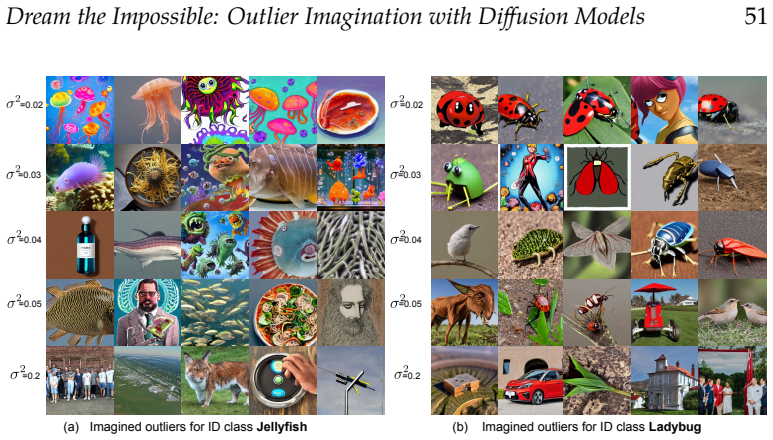
The central object is the low-likelihood outlier: a sample drawn from a region where the in-distribution density is very small, which the model is trained to assign high uncertainty. VOS samples these from class-conditional Gaussians in feature space; Dream-OOD samples them from a text-conditioned latent space and decodes them into images with a diffusion model; SIREN shapes representations into compact von Mises-Fisher clusters so that distance-based detection works at the object level. For unlabeled wild data and LLM generations, the same separation role is played by a singular-value-decomposition score: SAL projects gradients onto the top singular vector of a gradient matrix to single out candidate OOD samples, and HaloScope projects LLM embeddings onto a hallucination subspace to estimate truthful versus hallucinated membership.
What would settle it
A concrete check: train on CIFAR-100 with SAL using a wild mixture of CIFAR-100 and Textures, then evaluate on an OOD dataset made of adversarially perturbed CIFAR-100 images; if ERRout and FPR95 are not small, the (gamma, zeta)-discrepancy condition fails and the core generalization bound does not apply.
Extended reading notes
Core claim
The central claim is that unknown-aware learning, which jointly optimizes in-distribution accuracy and reliability toward unseen inputs, can be realized by contrasting the model against informative unknowns that do not require human annotation. On the thesis's own terms, models trained with empirical risk minimization are overconfident on out-of-distribution inputs because their decision boundaries are not conservative; synthesizing virtual outliers from the low-likelihood region of the feature distribution, or separating candidate outliers from unlabeled wild mixtures, makes the boundary conservative. The thesis further claims these methods are not merely heuristic: SAL provides provable error bounds for filtering and for the OOD classifier, and empirically establishes state-of-the-art results, while HaloScope shows that the membership-estimation idea transfers to LLM hallucination detection with unlabeled generations.
Load-bearing premise
The argument rests on the premise that the synthetic outliers or the unlabeled wild data actually resemble the unknown inputs the model will encounter at test time; if the real OOD distribution is unlike anything in those mixtures, the learned boundary will not transfer.
Editorial extensions
If this is right
- OOD detection can be improved without any labeled OOD data: VOS reaches AUROC 88.70% on COCO for object detectors trained on PASCAL-VOC, approaching Outlier Exposure (90.18%) that uses real outlier images.
- Unlabeled wild data, freely collected at deployment, is provably useful: SAL bounds the filtering errors and the OOD classifier's generalization error, then achieves 1.88% average FPR95 on CIFAR-100.
- The same membership-separation logic carries to foundation models: HaloScope detects LLM hallucinations from unlabeled generations, reaching 78.64% AUROC on TruthfulQA versus 81.04% for a supervised upper bound.
- Representation shaping makes distance-based OOD detection work for object detectors across architectures: SIREN improves AUROC by 22.53% over OW-DETR on PASCAL-VOC with deformable DETR.
- Reliability risk can be added to the training objective as a regularizer without sacrificing in-distribution accuracy: VOS and SIREN report mAP on the ID task equal to or better than the vanilla model.
Reading between the lines
- This suggests a general recipe: reliability against unknowns can be trained by contrasting in-distribution data with counterexamples that are synthesized or collected for free, so the research bottleneck shifts from annotation to choosing the right counterexample distribution.
- The SAL theory implies a practical diagnostic: before trusting a wild-data deployment, one could empirically estimate the (gamma, zeta)-discrepancy between the wild data and the labeled ID distribution, because the guaranteed error bounds no longer apply when that discrepancy is small.
- HaloScope's subspace-projection membership score is a natural candidate for other unlabeled mixture problems, such as detecting prompt injection or filtering biased alignment data, which the thesis itself begins to explore.
- A testable extension would apply the same low-likelihood outlier synthesis to structured domains like time-series or tabular anomaly detection, where a Gaussian or kernel density model in feature space is equally easy to estimate.
Editorial analysis
A structured set of objections, weighed in public.
Referee Report
Summary. The dissertation advances a program of 'unknown-aware machine learning,' in which models are trained to recognize out-of-distribution (OOD) inputs and LLM hallucinations without labeled OOD data. Chapters 4–6 present outlier-synthesis methods (VOS, Dream-OOD, SIREN) for image- and object-level OOD detection; Chapter 8 introduces SAL, an algorithmic and theoretical framework that uses unlabeled wild data to train an OOD classifier; Chapter 10 presents HaloScope for hallucination detection from unlabeled LLM generations. The thesis claims both strong empirical results on standard benchmarks (e.g., SAL 1.88% average FPR95 on CIFAR-100 with wild data) and, for SAL, formal guarantees on filtering error and OOD classifier generalization under a discrepancy condition between the wild mixture and the in-distribution data.
Significance. The individual methods are technically solid: most chapters ship code, report multiple runs for main tables, and compare against external baselines on standard benchmarks. SAL's theoretical analysis is detailed and self-contained, with proofs deferred to the appendix, and it addresses a genuinely open question about when unlabeled wild data provably helps OOD detection. HaloScope demonstrates a practical, annotation-free route to hallucination detection that comes close to a supervised upper bound on TruthfulQA. These are meaningful contributions. The significance is limited by two factors. First, the formal guarantee in SAL is verified only in a matched setting where the wild-data OOD component and the test OOD distribution are the same; the manuscript's broader claim of handling 'unforeseen inputs' extends beyond the proven regime. Second, the thesis is largely a compilation of the author's prior papers, and the 'foundations' framing is not supported by a new unifying theoretical principle beyond the collected results.
major comments (3)
- [§8.3.1, Theorem 8.1 and Appendix 12.4.18] The load-bearing premise of the SAL theory is the (γ, ζ)-discrepancy condition between Pwild and PXY, on which both the filtering-error bound (Eqs. 8.7–8.8) and the OOD-classifier bound (Theorem 8.3) depend. The verification in Appendix 12.4.18, Table 12.17 computes ζ only for wild mixtures whose OOD component is the same dataset used for evaluation (e.g., CIFAR-100 as ID, SVHN as wild and SVHN as test). The unseen-OOD experiments in Appendix 12.4.21 do not re-estimate ζ for the mismatched wild/test setting. Consequently, the abstract's statement that SAL provides 'formal reliability guarantees' for unforeseen inputs is not established; the guarantees are conditional on a distribution-match assumption that is not verified for the deployment scenarios the thesis emphasizes. Please either add an explicit statement of this limitation in the main text or provide a verification or analysis of the discrepancy condition for mismatched wild/test distributions.
- [§8.4.1 and Table 8.1] The headline empirical protocol in Section 8.4.1 constructs the wild mixture from the same OOD dataset used for testing: 'For each dataset, we create corresponding wild mixture distribution ... and test on the corresponding OOD dataset.' Thus the average FPR95 of 1.88% in Table 8.1 is a matched-setting result, not a demonstration of detection of truly unseen OOD data. The appendix's unseen-OOD results (Tables 12.20–12.21) are valuable, but they are not highlighted or connected to the theoretical conditions. The main text should clearly separate matched-setting results from unseen-OOD results and should not let the matched-setting numbers stand as evidence for the thesis's broad 'unknown-aware' claim.
- [Chapters 1, 3, 7, and 9] The title and abstract promise 'foundations' of unknown-aware learning, with 'formal reliability guarantees' as a general property of the framework. However, the thesis does not provide a unified formal model connecting the outlier-synthesis methods (VOS, Dream-OOD, SIREN), the wild-data method (SAL), and the hallucination-detection method (HaloScope). The theory in Chapter 8 applies only to SAL; the other chapters rely on separate heuristics and empirical evaluations. As a result, the 'foundations' claim overstates the degree of theoretical unification the manuscript actually delivers. I recommend either adding a synthesis section that states precisely which properties are shared by the methods and which are method-specific, or softening the foundational framing accordingly.
minor comments (6)
- [Algorithm 1, Chapter 4] The line 'Estimate the multivariate distributions based on ID training objects using Equation 1 and 4.2' should refer to Equations (4.1) and (4.2), not 'Equation 1'.
- [§4.3.2, Eq. (4.5)] The text describes the uncertainty regularization loss as 'completely hyperparameter-free,' but the overall objective in Eq. (4.7) includes the weight β, and the synthesis procedure uses a threshold t and queue size |Qk|. The claim should be scoped to the form of the loss function itself, not the method as a whole.
- [Tables 4.2, 5.2, 6.3, 10.3] Several ablation tables report only point estimates without standard deviations or a statement that they come from a single run. Since the main tables report multiple runs, please provide error bars or explicitly state the number of runs for each ablation.
- [Table 8.1] The WOODS row is typeset without clear separators between FPR95 and AUROC values (e.g., '0.1299.9629.58 90.60'), making the table difficult to read. Please reformat.
- [§10.1] The sentence 'we substantially improve the hallucination detection accuracy by 10.69% (AUROC) on a challenging TruthfulQA benchmark ... (78.64% vs. 81.04%)' is ambiguous about which number is HaloScope and which is the supervised upper bound; please clarify.
- [Chapter 8, Section 12.4.27] The analysis of using random labels for wild data is referenced in the main text but the term 'by˜x' in Eq. (8.3) is introduced without an explicit definition of how predicted labels are obtained from h_{w_{S_in}}; please state this in Section 8.2.1.
Circularity Check
No significant circularity: the thesis's methods and theorems are self-contained and benchmarked externally; self-citations are not load-bearing.
full rationale
I find no circular step in the derivation chain. Each contribution (VOS, Dream-OOD, SIREN, SAL, HaloScope) is evaluated against external baselines and held-out OOD or hallucination benchmarks, so the empirical claims do not reduce to the training inputs by construction. The SAL theory (Theorem 8.1 and Theorem 8.3) provides conditional guarantees under the (γ, ζ)-discrepancy assumption; verifying ζ on the wild mixtures used in experiments is a sanity check of the assumption, not a fitted parameter renamed as a prediction. VOS and Dream-OOD synthesize outliers from the in-distribution data itself, which is the intended mechanism rather than a circular reuse of test labels. SIREN's vMF score is consistent with its representation-shaping loss, but this is a standard density-based OOD detection design, not a self-referential derivation. The dissertation does cite the author's own prior papers extensively, but these citations are contextual and the substantive proofs and experiments are reproduced in the text. I therefore score 0: no prediction or formal result is equivalent to its own input by construction.
Assumptions & free parameters
free parameters (6)
- t (VOS outlier threshold) =
1
- Queue size |Qk| (VOS) =
1000 per class
- sigma^2 (Dream-OOD Gaussian kernel variance) =
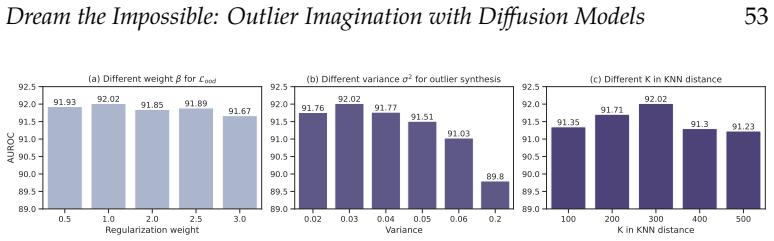
0.03 (best across sweep)
- Beta (OOD regularization weight) =
1.0 (ImageNet-100), 2.5 (CIFAR-100) for Dream-OOD; 1.5 for SIREN
- Hypersphere dimension d (SIREN) =
16 or 64
- Mixing ratio pi (SAL) =
0.1
assumptions (5)
- domain assumption Class-conditional Gaussianity of feature embeddings (VOS)
- domain assumption Huber contamination model P_wild=(1-pi)P_in+pi*P_out (SAL)
- domain assumption (gamma, zeta)-discrepancy condition between P_wild and P_XY (SAL)
- domain assumption Text-conditioned latent space alignment (Dream-OOD)
- domain assumption Top singular vectors of LLM activations capture hallucination (HaloScope)
Cite this review
Pith. "Pith review of Foundations of Unknown-aware Machine Learning." pith.science (2026). https://pith.science/paper/XAIUHXUG
@misc{pith2026250514933,
  author       = {Pith},
  title        = {Pith review of: Foundations of Unknown-aware Machine Learning},
  year         = {2026},
  howpublished = {\url{https://pith.science/paper/XAIUHXUG}},
  note         = {Machine review of arXiv:2505.14933}
}
read the original abstract
Ensuring the reliability and safety of machine learning models in open-world deployment is a central challenge in AI safety. This thesis develops both algorithmic and theoretical foundations to address key reliability issues arising from distributional uncertainty and unknown classes, from standard neural networks to modern foundation models like large language models (LLMs). Traditional learning paradigms, such as empirical risk minimization (ERM), assume no distribution shift between training and inference, often leading to overconfident predictions on out-of-distribution (OOD) inputs. This thesis introduces novel frameworks that jointly optimize for in-distribution accuracy and reliability to unseen data. A core contribution is the development of an unknown-aware learning framework that enables models to recognize and handle novel inputs without labeled OOD data. We propose new outlier synthesis methods, VOS, NPOS, and DREAM-OOD, to generate informative unknowns during training. Building on this, we present SAL, a theoretical and algorithmic framework that leverages unlabeled in-the-wild data to enhance OOD detection under realistic deployment conditions. These methods demonstrate that abundant unlabeled data can be harnessed to recognize and adapt to unforeseen inputs, providing formal reliability guarantees. The thesis also extends reliable learning to foundation models. We develop HaloScope for hallucination detection in LLMs, MLLMGuard for defending against malicious prompts in multimodal models, and data cleaning methods to denoise human feedback used for better alignment. These tools target failure modes that threaten the safety of large-scale models in deployment. Overall, these contributions promote unknown-aware learning as a new paradigm, and we hope it can advance the reliability of AI systems with minimal human efforts.
Figures


Figures from the paper (32 more)







Reference graph
Works this paper leans on
-
[4]
InProceed- ings of IEEE winter conference on applications of computer vision, 1020–1029
Probabilistic object detection: Definition and evaluation. InProceed- ings of IEEE winter conference on applications of computer vision, 1020–1029. He, Kaiming, Xiangyu Zhang, Shaoqing Ren, and Jian Sun. 2016a. Deep residual learning for image recognition. InProceedings of the ieee conference on computer vision and pattern recognition, 770–778. ———. 2016b...
arXiv 2023
-
[6]
Estimating Soft Labels for Out-of-Domain Intent Detection
Estimating soft labels for out-of-domain intent detection.arXiv preprint arXiv:2211.05561. Lee, Kimin, Honglak Lee, Kibok Lee, and Jinwoo Shin. 2018a. Training confidence-calibrated classifiers for detecting out-of-distribution samples. InProceedings of the international conference on learning representations. Lee, Kimin, Kibok Lee, Honglak Lee, and Jinwo...
work page Pith review arXiv 2022
-
[8]
InProceedings of IEEE international conference on robotics and automation, 1–7
Dropout sampling for robust object detection in open-set conditions. InProceedings of IEEE international conference on robotics and automation, 1–7. Min, Sewon, Kalpesh Krishna, Xinxi Lyu, Mike Lewis, Wen-tau Yih, Pang Wei Koh, Mohit Iyyer, Luke Zettlemoyer, and Hannaneh Hajishirzi
-
[11]
On the Powerfulness of Textual Outlier Exposure for Visual OoD Detection
On the powerfulness of textual outlier exposure for visual ood detection.arXiv preprint arXiv:2310.16492. Radford, Alec, Jong Wook Kim, Chris Hallacy, Aditya Ramesh, Gabriel Goh, Sandhini Agarwal, Girish Sastry, Amanda Askell, Pamela Mishkin, Jack Clark, et al. 2021. Learning transferable visual models from natural language supervision. InProceedings of t...
-
[12]
Reddy, Siva, Danqi Chen, and Christopher D Manning
Do imagenet classifiers generalize to imagenet? InInternational conference on machine learning, 5389–5400. Reddy, Siva, Danqi Chen, and Christopher D Manning. 2019. Coqa: A con- versational question answering challenge.Transactions of the Association for Computational Linguistics7:249–266. Ren, Jie, Stanislav Fort, Jeremiah Liu, Abhijit Guha Roy, Shreyas ...
arXiv 2019
-
[13]
InProceedings of the international conference on machine learning, 23631– 23644
Mitigating neural network overconfidence with logit normalization. InProceedings of the international conference on machine learning, 23631– 23644. Wen, Yeming, Dustin Tran, and Jimmy Ba. 2020. Batchensemble: an alternative approach to efficient ensemble and lifelong learning. InInter- national conference on learning representations. Wu, Qitian, Yiting Ch...
arXiv 2020
-
[14]
InProceedings of international conference on learning representa- tions
Deformable DETR: deformable transformers for end-to-end object detection. InProceedings of international conference on learning representa- tions. Zhu, Yao, YueFeng Chen, Chuanlong Xie, Xiaodan Li, Rong Zhang, Hui Xue’, Xiang Tian, bolun zheng, and Yaowu Chen. 2022. Boosting out- of-distribution detection with typical features. InAdvances in neural inform...
arXiv 2022
-
[2005]
Clustering on the unit hypersphere using von mises-fisher distri- butions.J. Mach. Learn. Res.6:1345–1382. Bartlett, Peter L, Philip M Long, Gábor Lugosi, and Alexander Tsigler
Show all 14 references
-
[2018]
Dhamija, Akshay Raj, Manuel Günther, Jonathan Ventura, and Terrance E
Bert: Pre-training of deep bidirectional transformers for language understanding.arXiv preprint arXiv:1810.04805. Dhamija, Akshay Raj, Manuel Günther, Jonathan Ventura, and Terrance E. Boult. 2020. The overlooked elephant of object detection: Open set. In References204 Proceed...
2020 arXiv
-
[2019]
InProceedings of international conference on robotics and automation, 2348–2354
Evaluating merging strategies for sampling-based uncertainty techniques in object detection. InProceedings of international conference on robotics and automation, 2348–2354. Miller, Dimity, Lachlan Nicholson, Feras Dayoub, and Niko Sünderhauf
-
[2020]
Bendale, Abhijit, and Terrance E Boult
Benign overfitting in linear regression.Proceedings of the National Academy of Sciences117(48):30063–30070. Bendale, Abhijit, and Terrance E Boult. 2016. Towards open set deep networks. InProceedings of the ieee/cvf conference on computer vision and pattern recognition, 1563–1...
2016 arXiv
-
[2021]
InPro- ceedings of IEEE international intelligent transportation systems conference, 2938–2943
Out-of-distribution detection for automotive perception. InPro- ceedings of IEEE international intelligent transportation systems conference, 2938–2943. OpenAI. 2023. Gpt-4 technical report.2303.08774. Park, Sangha, Jisoo Mok, Dahuin Jung, Saehyung Lee, and Sungroh Yoon
2023 arXiv
-
[2022]
InProceedings of the international conference on machine learning, 10848–10865
Training OOD detectors in their natural habitats. InProceedings of the international conference on machine learning, 10848–10865. Kingma, Diederik P ., and Jimmy Ba. 2015. Adam: A method for stochastic optimization. In3rd international conference on learning representations, I...
2015
-
[2023]
Ming, Yifei, Ziyang Cai, Jiuxiang Gu, Yiyou Sun, Wei Li, and Yixuan Li
Factscore: Fine-grained atomic evaluation of factual precision in long form text generation.Proceedings of the 2023 Conference on Empirical Methods in Natural Language Processing12076–12100. Ming, Yifei, Ziyang Cai, Jiuxiang Gu, Yiyou Sun, Wei Li, and Yixuan Li. 2022a. Delving...
2023 arXiv
Reviewed August 7, 2026 · model on record in the stance chip above.
Discussion (0). Sign in to comment.