REVIEW 3 major objections 5 minor 7 references
Electric field measurements made in space
T0 review · 3 major / 5 minor · reviewed 2026-08-07 · deepseek-v4-flash
Pith's one-line read Electric field measurements are the indispensable probe of plasma acceleration, and the next US decadal survey's omission of them is a strategic gap.
desk verdict A clear, useful review of electric field measurements in space, but its advocacy rests on an unsupported claim about the 2024 Decadal Survey. read the letter →
The pith
A machine-rendered reading of the paper's core claim, the machinery that carries it, and where it could break.
The reading
What carries the argument
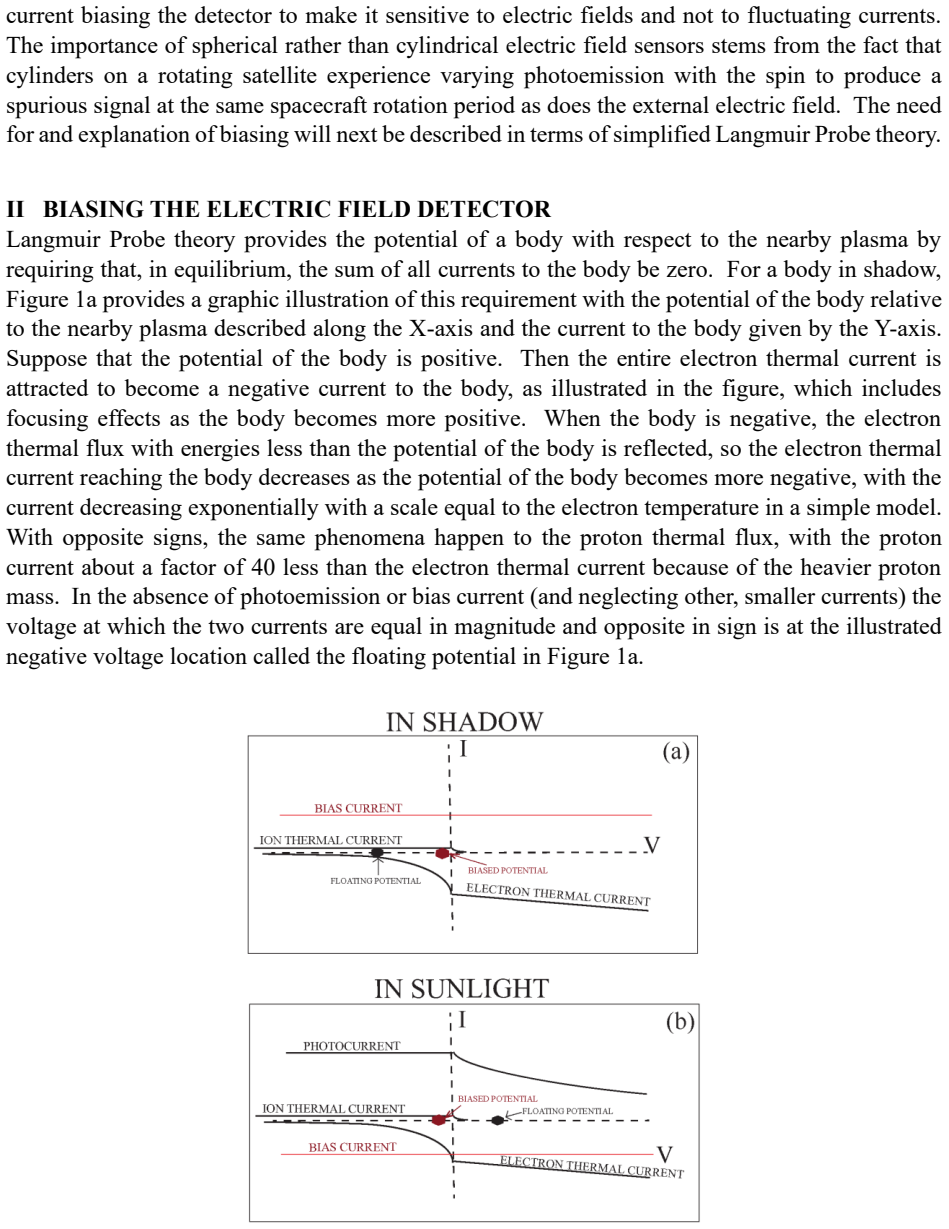
The load-bearing object is the current-biased spherical double-probe electric field detector. Each sphere is biased to sit near zero potential with respect to the local plasma, instead of at the floating potential, so small current imbalances do not produce large spurious voltages; the potential difference between two separated spheres then tracks the ambient electric field. The paper also identifies three future upgrades—automated biasing, continuous high-rate storage, and the Grotifer rotating-boom geometry—as extensions of the same measurement principle.
What would settle it
Fly two electric field booms of different lengths on the same spacecraft and compare the field inferred from each during a quiet, well-characterized plasma interval; if the inferred field depends on boom length beyond calibration uncertainty, the near-zero-potential assumption is violated. Alternatively, compare the probe-measured DC field with the field derived from simultaneous magnetic measurements through Faraday's law during a known electromagnetic wave: persistent disagreement would falsify the technique's core assumption.
Extended reading notes
Core claim
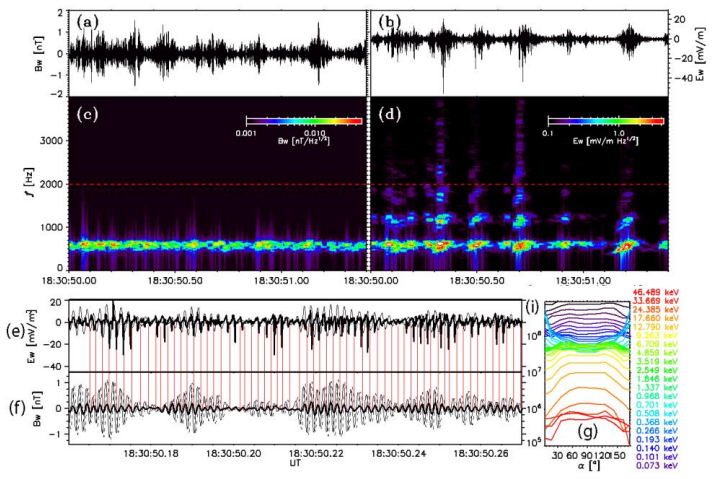
The paper's central claim is that electric field measurements should be a central component of all plasma physics space missions, because Maxwell's equations and Newton's second law identify the electric field as the only force capable of accelerating and heating space plasmas. To support this, the authors establish that the current-biased spherical double-probe detector—first flown on a sounding rocket and then on satellites—turned a previously inaccessible quantity into a routine measurement, and they document the discoveries that followed: parallel electric fields above the aurora, millisecond-scale time domain structures, the Hall electric and magnetic signatures of symmetric reconnection at the magnetopause, triggered ion acoustic waves near the Sun, and nonlinear oblique whistlers whose parallel electric fields trap and accelerate radiation-belt electrons. The paper therefore argues that omitting such instruments from the 2024 Decadal Survey's mission set leaves the next decade unable to address the core acceleration and heating questions of space plasma physics.
Load-bearing premise
The whole technique assumes that each biased sphere sits at a known, near-zero potential with respect to the plasma immediately around it, so the measured voltage difference between two spheres is purely the ambient electric field; if spacecraft wakes, asymmetric sheaths, photoemission differences, or DC offsets shift that potential, the 'field' is partly a spacecraft artifact.
Editorial extensions
If this is right
- Future plasma missions that omit electric field detectors will miss the main agent of particle acceleration and heating.
- A dedicated satellite should revisit the auroral acceleration region to map the parallel fields, waves, and plasma interactions in detail.
- Reconnection missions should target small parallel electric fields, which are predicted but not yet observed, to understand particle acceleration at reconnection sites.
- Instrument improvements—automated bias-current control, continuous high-rate recording with terabyte storage, and three-axis rotating booms—would materially expand what can be measured.
Reading between the lines
- If the survey omission is a real gap, mission planners outside the US may also need to re-examine instrument suites, since comparable plasma physics goals depend on the same measurement.
- The proposed practice of storing all high-rate data in multi-terabyte memory before down-selecting transmission could be tested on a single existing mission by comparing event rates found in continuous versus burst sampling.
- The Grotifer rotating-boom concept, if it flies, could resolve the long-weak third-component problem and would likely benefit magnetic field measurements equally, because the same boom geometry limits both field vectors.
- The same current-biasing logic could be transferred to other magnetized bodies, such as planetary magnetospheres or the solar wind at different heliocentric distances, wherever wave-particle acceleration is suspected.
Editorial analysis
A structured set of objections, weighed in public.
Referee Report
Summary. The paper is a review/advocacy article on DC and low-frequency electric field measurements in space. It explains the current-biased spherical-probe measurement principle using Langmuir probe theory, presents five historical examples—S3-3 parallel electric fields in the auroral acceleration region, time domain structures, Polar's Hall electric and magnetic fields at a subsolar magnetopause reconnection site, Parker Solar Probe triggered ion acoustic waves, and Van Allen Probes observations of nonlinear whistler waves—and lists future improvements including automated biasing, continuous high-rate recording, and the Grotifer three-axis design. The central claim is that electric field measurements are essential for space plasma missions and are currently under-prioritized, as evidenced by the asserted lack of electric field detectors in the 2024 National Academy Decadal Survey payload descriptions.
Significance. If the factual premise about the Decadal Survey is correct, the paper makes a timely and important argument that could influence mission planning. The tutorial description of sphere biasing is concise and accessible, and the historical examples are genuinely important discoveries. The paper also explicitly points to data availability for Polar, PSP, and Van Allen Probes, which is a useful service to the community. However, the persuasive force rests on an unsupported factual claim about the Decadal Survey and on a one-sided citation base; both need to be addressed before the review can serve as a balanced reference.
major comments (3)
- [Section I] The motivating claim that the 2024 National Academy Decadal Survey payloads lack electric field detectors is presented without a specific citation to the Survey's mission/instrument lists, and the term 'electric field detectors' is not operationally defined. This is a checkable factual claim that is load-bearing for the paper's central argument. If even one recommended mission includes a double-probe, wave receiver, or electron-drift electric field instrument, the sentence is inaccurate and the motivation must be qualified. Please cite the relevant pages of the Decadal Survey and state exactly which instrument class is meant.
- [Sections II and III-VII] The measurement principle in Section II assumes that each biased sphere sits at a known potential relative to the nearby plasma, but the paper does not address known error sources such as spacecraft wakes, sheath asymmetries, photoelectron clouds, and DC offsets. Since Sections III-VII use these historical measurements as evidence that the technique is scientifically essential, the review should include a paragraph quantifying or at least referencing published analyses of these uncertainties, rather than asserting without qualification that 'good electric field measurements are made.'
- [Sections III-VII] All five milestone discoveries are attributed exclusively to papers by the same authors' group, with no independent confirmations or alternative interpretations cited. For a review intended to establish the importance of electric field measurements, this one-sided citation pattern is a significant weakness. For example, the S3-3 parallel field results and the Polar reconnection signatures have been studied by other missions and groups; including at least one independent reference per topic would substantially strengthen the review's credibility.
minor comments (5)
- [Section I] The reference '[Gurnett publications, 2025]' is a webpage URL rather than a specific citable publication; please replace it with a representative paper or report.
- [Section III] The phrase 'discreet auroral arcs' contains a typo; it should be 'discrete auroral arcs.'
- [Section VIII, item 2] The data storage estimate should state the assumed sample size and overhead. For three-axis sampling at 1,000,000 samples/s per component for 20 days, the total is 5.184e12 samples; storing this in 10 TB requires about 1.93 bytes/sample, i.e., 2-byte samples with no metadata. With 4-byte samples the requirement is about 20.7 TB, so the current sentence is only valid under an unstated assumption.
- [Section VIII, item 3] The statement 'Recent lab simulations of this system have shown promise' lacks a citation to the lab tests; please add a reference or remove the claim.
- [Figure 2 and accompanying text] The text refers to 'the top panel' and 'the bottom two panels' of Figure 2, but the figure panels are not labeled in the figure or caption; please add labels so the reader can identify the parallel and perpendicular electric field traces.
Circularity Check
No significant circularity; the measurement principle is derived from textbook Langmuir probe theory and the cited milestones are empirical observations, not fitted inputs or self-defined predictions.
full rationale
The paper's measurement principle is developed in Section II from simplified Langmuir probe theory (floating potential, bias current, and the difference between biased antenna potential and spacecraft floating potential). No parameter is fitted to a subset of data and then renamed as a prediction; the measured quantity, spacecraft potential, is operationally defined as the difference between two biased surface potentials, and the electric field is the difference between such potentials at two separated spheres. The scientific examples in Sections III-VII are empirical observations reported in peer-reviewed literature. Although many of these citations are to the authors' own prior work, the load-bearing claims are observational priority claims and physical interpretations, not theorems derived from the cited papers, and the central advocacy argument rests on Maxwell's equations and Newton's second law rather than on self-citation. The claim that the 2024 Decadal Survey payloads lack electric field detectors is uncited and checkable, and the S3-3 data availability limitation is acknowledged, but these are verification or reproducibility weaknesses, not circular reasoning. No specific step reduces by construction to its own input, so the circularity score is 0.
Assumptions & free parameters
assumptions (4)
- domain assumption Maxwell's equations and Newton's second law imply the electric field is the only significant accelerating force in space plasmas.
- domain assumption The 2024 National Academy Decadal Survey payloads lack electric field detectors.
- domain assumption A current-biased spherical probe sits at a known potential relative to the nearby plasma, so the potential difference between two probes equals the ambient electric field.
- domain assumption The cited prior publications accurately report the claimed first observations.
Cite this review
Pith. "Pith review of Electric field measurements made in space." pith.science (2026). https://pith.science/paper/YWWXPJYQ
@misc{pith2026250514979,
  author       = {Pith},
  title        = {Pith review of: Electric field measurements made in space},
  year         = {2026},
  howpublished = {\url{https://pith.science/paper/YWWXPJYQ}},
  note         = {Machine review of arXiv:2505.14979}
}
read the original abstract
The operating principles of a DC and low frequency electric field detector are developed, after which, examples of earlier important electric field measurements are presented, including, the first observation of parallel electric fields in the auroral acceleration region, the first observation of time domain structures in space, the first experimental verification of symmetric magnetic field reconnection, the first observations of triggered ion acoustic waves, and oblique whistlers that directly accelerate electrons. Future possible improvements in the electric field measurement technique are described.
Figures


Figures from the paper (3 more)


Reference graph
Works this paper leans on
-
[1]
V ., Krasnoselskikh, V ., Mozer, F
Agapitov, O. V ., Krasnoselskikh, V ., Mozer, F. S., et al (2015a). Generation of nonlinear electric field bursts in the outer radiation belt through the parametric decay of whistler waves. Geophysical Research Letters, 42(10), 2015GL064145. https://doi.org/10.1002/2015GL064145 Agapitov, O. V ., Artemyev, A. V ., Mourenas, D., et al, (2015b). Nonlinear lo...
-
[17]
Drake, J. F., Agapitov, O. V ., & Mozer, F. S. (2015). The development of a bursty precipitation front with intense localized parallel electric fields driven by whistler waves. Geophysical Research Letters, 42(8), 2015GL063528. https://doi.org/10.1002/2015GL063528 Ergun, R.E., Goodrich, K.A., Wilder, F.D. et al, Magnetospheric Multiscale Satellites Observ...
-
[18]
https://doi.org/10.1007/s11214-025-01144-y Cattell, C., Wygant, J. R., Goetz, K., et al, (2008). Discovery of very large amplitude whistler - mode waves in Earth’s radiation belts. Geophys. Res. Lett., 35,
-
[82]
https://doi.org/10.3847/1538-4357/adb582 National Academies of Sciences, Engineering, and Medicine, 2024, The next decade of discovery in solar and space physics: Exploring and safeguarding humanity’s home in space, Washington, DC: The National Academies Press, https://doi.org/10.17226/27938 Temerin, M., Cerny, K., Lotko, W., and Mozer, F.S., Observations...
-
[1105]
Cattell, C. A., Breneman, A., Dombeck, J., et al., Parker Solar Probe evidence for the absence of whistlers close to the Sun to scatter strahl and to heat halo electrons, 2021, The Astrophysical Journal Letters, 911(1), L29. Cully, C. M., Bonnell, J. W., and Ergun, R. E. (2008). THEMIS observations of long-lived regions of large-amplitude whistler waves i...
work page 2008
-
[8109]
Wygant, J., Breneman, A., Dai, L., Thaller, S., Cattell, C., Bonnell, J., et al. (2014). Measurements from the Van Allen Probes EFW instrument on the role of electric fields in controlling the structure of the inner magnetosphere and the dynamic of particle energization. AGU Fall Meeting Abstracts, 1, 4183
work page 2014
-
[9224]
Lejosne, S., Auslander, D.M., Bonnell J.W., et al, Grotifer: A new electric field instrument design to address the need for highly accurate three-component electric field measurements, 2022, Front. Astron. Space Sci., 9- 2022, https://doi.org/10.3389/fspas.2022.919798 Mao, Y-T., Auslander, D., Pankow, D., et al, Modeling and Control Design for a New Space...
Reviewed August 7, 2026 · model on record in the stance chip above.
Discussion (0). Continue with ORCID to comment.