REVIEW 4 major objections 6 minor 55 references
Cascaded Diffusion Models for Neural Motion Planning
T0 review · 4 major / 6 minor · reviewed 2026-08-07 · deepseek-v4-flash
Pith's one-line read Sequentially trained cascaded diffusion models, conditioned on reference trajectories from the level above and repaired by a one-shot local patch, can plan full collision-free motions directly from raw point clouds and beat flat diffusion…
desk verdict Plausible incremental advance in neural motion planning; the cascade idea deserves referee time, but the unspecified collision-checking in plan repair and missing error bars are load-bearing problems. read the letter →
The pith
A machine-rendered reading of the paper's core claim, the machinery that carries it, and where it could break.
The reading
What carries the argument
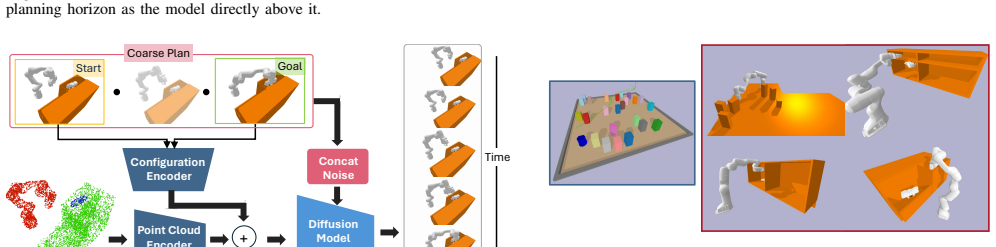
The central object is a sequentially trained cascade of diffusion models, each implemented as a temporal U-Net conditioned on a PointNet++ encoding of a raw point cloud plus start, goal, and reference trajectory points. The high-level model outputs sparse sub-goals and intermediate waypoints, which are linearly interpolated into dense reference trajectory points and fed as extra channels to the low-level denoiser; the low-level model is trained with noise-augmented references so that it tolerates imperfect coarse plans. A final plan-repair step detects contiguous violating states, finds valid edge states, and reruns the low-level model once over those local segments. This mechanism carries the argument because it separates global reasoning from local constraint satisfaction without requiring any inference-time cost functions or ground-truth collision gradients.
What would settle it
Run the plan-repair stage with the point-cloud observation occluded or with the ground-truth scene mesh withheld; if success on the MπNets Global test set does not drop toward the no-refinement baseline, then the claimed raw-perception-only pipeline is actually relying on privileged collision information.
Extended reading notes
Core claim
The paper's central claim is that sequential, cascaded training is what makes hierarchical diffusion work for motion planning: each lower level is bootstrapped from the level above and learns to use the higher level's output as reference conditioning, rather than treating the levels independently. The authors show that this design resolves a division of labor that single-level diffusion cannot achieve: the coarse level owns global structure by keeping a short planning horizon over sub-sampled states, while the low-level model owns local feasibility by generating short, dense, collision-free segments. The result is that the full plan is the product of the coarse plan and the locally refined plan, and the final patching of invalid segments adds roughly two percentage points of success and, more importantly, makes the pipeline tolerant of noisy or imperfect coarse guidance. Empirically the cascade outperforms all tested learning baselines, with the largest gap on the MπNets Global dataset, the setting with the longest horizons and subtlest collisions.
Load-bearing premise
The load-bearing premise is that the plan-repair step can find colliding states using only the raw point-cloud observation, and that the training distribution covers the test scenes; the paper leaves the first mechanism unspecified and concedes that transfer to novel object geometry remains hard.
Editorial extensions
If this is right
- Learned planners can produce full long-horizon plans from raw perception alone, removing the need for classifier guidance, ensemble cost functions, or privileged scene geometry at inference time.
- Hierarchical conditioning on reference trajectories improves both final success and learning efficiency, not just model capacity, since the low-level model bootstraps from coarse outputs.
- Because guidance applied to the high-level model alone raises success to 92.3 percent on the Global dataset, most remaining failures stem from bad sub-goals rather than poor local refinement.
- The repair step stabilizes performance under noisy guidance, losing only about 1.4 percent instead of 5 percent when gradients are perturbed, implying the method is suited to realistic perception noise.
- The same framework works across a 2D navigation task and 7-DOF manipulation, suggesting it transfers across planning domains given a suitable observation encoder.
Reading between the lines
- The paper does not specify how the plan-repair step detects collisions; if that check consumes ground-truth scene geometry, the claim of planning from raw point clouds alone would need to be weakened, and the comparison with EDMP would become less favorable.
- The authors' own stated limitation points to an immediate extension: use the diffusion output to seed a classical sampler rather than as the final plan, which could close the remaining gap to sampling planners while keeping planning fast.
- Since the bottleneck is the iterative denoising loop, replacing the diffusion sampler with a consistency or flow-matching sampler should cut planning time from one to two seconds to near-instant without altering the cascade.
- The 85 percent success on the global benchmark against 100 percent for classical sampling planners suggests the honest framing is a speed-robustness trade: the learned planner is not yet a replacement for sampling planners on hard cases, but a fast prior that can be patched or hybridized.
Editorial analysis
A structured set of objections, weighed in public.
Referee Report
Summary. The paper proposes a cascaded diffusion framework for neural motion planning. A coarse diffusion model at a high temporal level generates sub-goals and sparse reference waypoints; lower-level diffusion models refine these into dense trajectories, conditioned on reference waypoints and raw point-cloud or image observations. A final 'patching' step detects constraint-violating states and re-runs the lowest-level model on those segments. The method is evaluated on a 2D Turtlebot navigation task and on the MπNets Franka Global and Hybrid benchmarks against learned baselines (MπNets, Diffuser, EDMP, independently trained hierarchical diffusion) and classical planners. The main reported result is that the cascaded approach outperforms the hierarchical baseline by about 3% averaged over datasets and 4% on the Franka Global set, with success rates and wall-clock planning times reported in Tables I–III.
Significance. If the claims hold, the contribution is meaningful: it shows that sequentially trained cascaded diffusion with reference-trajectory conditioning improves global planning from raw perception, and the one-shot plan-repair mechanism improves robustness without iterative replanning. The authors compare against several external baselines and classical planners, report held-out test sets, and include a noisy-guidance robustness study. The main reasons for caution are that the plan-repair mechanism's collision-checking input is unspecified, which bears directly on the 'no privileged information' claim and on the fairness of the EDMP comparison, and that all success rates are reported without variance or multiple seeds, so the small reported margins may not be statistically significant. The use of a public benchmark and a qualitative-results website are strengths, but the missing specification of the repair process and the reporting issues prevent the central claim from being fully assessable.
major comments (4)
- [§IV-B (Patching Plans)] The no-privileged-information claim in the Abstract and Section I depends on how plan repair detects constraint violations, but §IV-B does not specify the collision-checking mechanism. The text states only that 'we first find states that violate constraints such as obstacle collisions or self-collisions'; it does not say whether this check uses the raw point-cloud observation, a reconstructed geometry, or ground-truth scene meshes/signed-distance fields. If the checker consumes ground-truth geometry at inference, then the method is not planning 'from raw perceptual input without access to any privileged information' as claimed, and the comparison with EDMP in Table I (explicitly marked as using privileged information) is not apples-to-apples. Please specify the exact input to the violation detector and, if it uses privileged geometry, either replace it with a perception-based check or reframe the contribution accordingly.
- [Table I] Table I reports identical solution times for the two Franka datasets for every method (0.33, 1.61, 1.94, 2.48, and 2.74 seconds for both 'Franka (Hybrid)' and 'Franka (Global)'). Since the two datasets contain different planning problems and different success rates, identical times to three significant figures are implausible and suggest a reporting error. Please correct the table and state which times are measured on which dataset; the wall-clock comparison in Section V-B depends on these numbers.
- [Tables I and III] All success rates are reported as single numbers without error bars, confidence intervals, or multiple-seed variance. The main '≈3%' improvement over H. Diffuser is driven by differences of 3.80 and 4.42 percentage points on Turtlebot and Franka Global, but only 0.60 percentage points on Franka Hybrid; without repeated training runs the reader cannot tell whether the aggregate advantage is statistically reliable. Please report mean and variance over at least three seeds for the proposed method and the key baselines.
- [§IV-C (Training and Architecture Details)] The collision loss added to the diffusion loss ('we also add a collision loss to the output of the diffusion model') is not characterized: it is not stated how collisions are computed during training, nor whether the same collision detector is used at plan-repair time. This matters both for reproducibility and for the privileged-information question, because a mesh-based collision loss at training time is acceptable, but the same checker used at inference in §IV-B is not. Please make the training-time and inference-time geometry usage explicit.
minor comments (6)
- [Section V-B, Table III] The statement that 'path refinement contribute[s] almost equally (≈2%)' refers to the no-guidance column, but with ground-truth guidance the gap between 'Ours' and 'Ours (No refinement)' is 6.69 percentage points; clarify that the equal-contribution claim applies only to the no-guidance setting.
- [Abstract and Section V-B] The Abstract says '~5%' improvement while Section V-B says '≈3% averaged over all datasets'; clarify which comparison the 5% figure refers to, since the reported margins in Table I do not directly support a uniform 5% claim.
- [Section IV-C] The hyperparameters needed to reproduce the results (number of cascade levels K, subsampling frequency n2, diffusion steps/noise schedule, guidance scale, number of refinement iterations) are not given; please add them or point to a public configuration.
- [Figure 6] In Figure 6, the left panel's 'Plan Cost' axis has no units or scale description, and the right panel's success-rate curves should specify how many seeds they average over.
- [Section IV-A] The joint probability expression p(x0 = τK|o,q0,qg) ∏_{k=1}^{K-1} p(x = τK-k|...) has missing spacing and an unclear notation for the trajectory variable; correct the equation and define τ^k consistently.
- [Section V-A (Environments)] Please state whether the Turtlebot observation is the top-down image itself or a point cloud derived from it, since the observation encoder described in Section IV-C is point-cloud based.
Circularity Check
No circularity: the cascaded-diffusion planning result is an empirical comparison on held-out benchmarks, and the plan-repair oracle concern is a correctness/fairness caveat rather than a circular derivation.
full rationale
The paper's derivation chain is not circular. The high-level diffusion model generates a coarse plan, the low-level model conditionally refines it using reference trajectory points, and the patching step re-runs the lowest-level model on detected invalid segments; each stage is trained sequentially on data generated by classical planners (RRT, AIT*) before evaluation. No parameter is fitted to the test success metric, and the reported gains in Table I are held-out comparisons against external baselines and datasets. The MpiNets overlap (Adam Fishman is a coauthor of the MpiNets baseline and dataset) is a normal benchmark relationship and is not load-bearing: the comparison uses the public dataset and reported test sets rather than a self-citation that forces the result. The genuine caveat is not circularity but specification: Section IV-B states 'we first find states that violate constraints such as obstacle collisions or self-collisions' without stating whether this check uses ground-truth scene geometry during inference. If it does, the paper's 'without access to any privileged information' claim and the comparison with EDMP (marked as using privileged information) would be weakened. That is an unsupported assumption or overclaim about the method's inputs, not an equation-level reduction of the prediction to its own inputs, so it does not constitute circularity under the stated criteria. Accordingly, the correct finding is no significant circularity with score 0.
Assumptions & free parameters
free parameters (5)
- Number of cascade levels K =
2
- Subsampling frequency n2 at level 2
- Diffusion denoising steps and noise schedule
- Collision loss weight and guidance scale
- Plan refinement iterations =
1
assumptions (4)
- domain assumption The training datasets (RRT for Turtlebot, AIT* and Geometric Fabrics for Franka) provide near-optimal collision-free ground-truth plans, and those plans are a sufficient training signal for the learned policies.
- domain assumption The raw point-cloud observation plus start and goal configurations contain enough information to predict a globally near-optimal plan.
- ad hoc to paper Collision violations in generated plans are localized to small connected segments, so a single re-run of the lowest-level model suffices.
- standard math The standard diffusion forward and reverse processes described in Section III are taken as valid background.
Cite this review
Pith. "Pith review of Cascaded Diffusion Models for Neural Motion Planning." pith.science (2026). https://pith.science/paper/V5SVPSOH
@misc{pith2026250515157,
  author       = {Pith},
  title        = {Pith review of: Cascaded Diffusion Models for Neural Motion Planning},
  year         = {2026},
  howpublished = {\url{https://pith.science/paper/V5SVPSOH}},
  note         = {Machine review of arXiv:2505.15157}
}
read the original abstract
Robots in the real world need to perceive and move to goals in complex environments without collisions. Avoiding collisions is especially difficult when relying on sensor perception and when goals are among clutter. Diffusion policies and other generative models have shown strong performance in solving local planning problems, but often struggle at avoiding all of the subtle constraint violations that characterize truly challenging global motion planning problems. In this work, we propose an approach for learning global motion planning using diffusion policies, allowing the robot to generate full trajectories through complex scenes and reasoning about multiple obstacles along the path. Our approach uses cascaded hierarchical models which unify global prediction and local refinement together with online plan repair to ensure the trajectories are collision free. Our method outperforms (by ~5%) a wide variety of baselines on challenging tasks in multiple domains including navigation and manipulation.
Figures


Figures from the paper (2 more)


Reference graph
Works this paper leans on
-
[48]
Simple hi- erarchical planning with diffusion,
C. Chen, F. Deng, K. Kawaguchi, C. Gulcehre, and S. Ahn, “Simple hi- erarchical planning with diffusion,” arXiv preprint arXiv:2401.02644, 2024
arXiv 2024
-
[1]
Rrt-connect: An efficient approach to single-query path planning,
J. J. Kuffner and S. M. LaValle, “Rrt-connect: An efficient approach to single-query path planning,” in Proceedings 2000 ICRA. Millennium Conference. IEEE International Conference on Robotics and Automa- tion. Symposia Proceedings (Cat. No. 00CH37065) , vol. 2. IEEE, 2000, pp. 995–1001
2000
-
[2]
A. H. Qureshi, A. Simeonov, M. J. Bency, and M. C. Yip, “Motion planning networks,” in 2019 International Conference on Robotics and Automation (ICRA). IEEE, 2019, pp. 2118–2124
work page 2019
-
[3]
Motion policy networks,
A. Fishman, A. Murali, C. Eppner, B. Peele, B. Boots, and D. Fox, “Motion policy networks,” in Conference on Robot Learning. PMLR, 2023, pp. 967–977
2023
-
[4]
Object rearrangement using learned implicit collision functions,
M. Danielczuk, A. Mousavian, C. Eppner, and D. Fox, “Object rearrangement using learned implicit collision functions,” in 2021 IEEE International Conference on Robotics and Automation (ICRA) . IEEE, 2021, pp. 6010–6017
work page 2021
-
[5]
NeRP: Neural Rearrangement Planning for Unknown Objects
A. H. Qureshi, A. Mousavian, C. Paxton, M. C. Yip, and D. Fox, “Nerp: Neural rearrangement planning for unknown objects,” arXiv preprint arXiv:2106.01352, 2021
work page Pith review arXiv 2021
-
[6]
Ifor: Iterative flow minimization for robotic object rear- rangement,
A. Goyal, A. Mousavian, C. Paxton, Y .-W. Chao, B. Okorn, J. Deng, and D. Fox, “Ifor: Iterative flow minimization for robotic object rear- rangement,” in Proceedings of the IEEE/CVF conference on computer vision and pattern recognition , 2022, pp. 14 787–14 797
work page 2022
-
[7]
Alvinn: An autonomous land vehicle in a neural network,
D. A. Pomerleau, “Alvinn: An autonomous land vehicle in a neural network,” Advances in neural information processing systems , vol. 1, 1988
1988
Show all 55 references
-
[8]
Elucidating the design space of diffusion-based generative models,
T. Karras, M. Aittala, T. Aila, and S. Laine, “Elucidating the design space of diffusion-based generative models,” Advances in Neural Information Processing Systems , vol. 35, pp. 26 565–26 577, 2022
2022
-
[9]
Diffusion policy: Visuomotor policy learning via action diffusion,
C. Chi, S. Feng, Y . Du, Z. Xu, E. Cousineau, B. Burchfiel, and S. Song, “Diffusion policy: Visuomotor policy learning via action diffusion,” arXiv preprint arXiv:2303.04137 , 2023
2023 arXiv
-
[10]
Diffusion policies as an expres- sive policy class for offline reinforcement learning,
Z. Wang, J. J. Hunt, and M. Zhou, “Diffusion policies as an expres- sive policy class for offline reinforcement learning,” arXiv preprint arXiv:2208.06193, 2022
2022 arXiv
-
[11]
Structdif- fusion: Language-guided creation of physically-valid structures using unseen objects,
W. Liu, Y . Du, T. Hermans, S. Chernova, and C. Paxton, “Structdif- fusion: Language-guided creation of physically-valid structures using unseen objects,” arXiv preprint arXiv:2211.04604 , 2022
2022 arXiv
-
[12]
High-resolution image synthesis with latent diffusion models,
R. Rombach, A. Blattmann, D. Lorenz, P. Esser, and B. Ommer, “High-resolution image synthesis with latent diffusion models,” in Proceedings of the IEEE/CVF conference on computer vision and pattern recognition, 2022, pp. 10 684–10 695
2022
-
[13]
Zero-shot text-to-image generation,
A. Ramesh, M. Pavlov, G. Goh, S. Gray, C. V oss, A. Radford, M. Chen, and I. Sutskever, “Zero-shot text-to-image generation,” in International conference on machine learning. Pmlr, 2021, pp. 8821– 8831
2021
-
[14]
Photorealistic text-to-image diffusion models with deep lan- guage understanding,
C. Saharia, W. Chan, S. Saxena, L. Li, J. Whang, E. L. Denton, K. Ghasemipour, R. Gontijo Lopes, B. Karagol Ayan, T. Salimans et al. , “Photorealistic text-to-image diffusion models with deep lan- guage understanding,” Advances in neural information processing systems, vol. 35...
2022
-
[15]
Classifier-free diffusion guidance,
J. Ho and T. Salimans, “Classifier-free diffusion guidance,” arXiv preprint arXiv:2207.12598, 2022
2022 arXiv
-
[16]
Adding conditional control to text-to-image diffusion models,
L. Zhang, A. Rao, and M. Agrawala, “Adding conditional control to text-to-image diffusion models,” in Proceedings of the IEEE/CVF International Conference on Computer Vision , 2023, pp. 3836–3847
2023
-
[17]
Goal-conditioned imi- tation learning using score-based diffusion policies,
M. Reuss, M. Li, X. Jia, and R. Lioutikov, “Goal-conditioned imi- tation learning using score-based diffusion policies,” arXiv preprint arXiv:2304.02532, 2023
2023 arXiv
-
[18]
Plan- ning with diffusion for flexible behavior synthesis,
M. Janner, Y . Du, J. B. Tenenbaum, and S. Levine, “Plan- ning with diffusion for flexible behavior synthesis,” arXiv preprint arXiv:2205.09991, 2022
2022 arXiv
-
[19]
Motion planning diffusion: Learning and planning of robot motions with diffusion models,
J. Carvalho, A. T. Le, M. Baierl, D. Koert, and J. Peters, “Motion planning diffusion: Learning and planning of robot motions with diffusion models,” in 2023 IEEE/RSJ International Conference on Intelligent Robots and Systems (IROS) . IEEE, 2023, pp. 1916–1923
2023
-
[20]
Mixture density networks,
C. M. Bishop, “Mixture density networks,” 1994
1994
-
[21]
Motion planning transformers: A motion planning framework for mobile robots,
J. J. Johnson, U. S. Kalra, A. Bhatia, L. Li, A. H. Qureshi, and M. C. Yip, “Motion planning transformers: A motion planning framework for mobile robots,” arXiv preprint arXiv:2106.02791 , 2021
2021 arXiv
-
[22]
Learning sampling dictionaries for efficient and generalizable robot motion planning with transformers,
J. J. Johnson, A. H. Qureshi, and M. C. Yip, “Learning sampling dictionaries for efficient and generalizable robot motion planning with transformers,” IEEE Robotics and Automation Letters , 2023
2023
-
[23]
Attention is all you need,
A. Vaswani, N. Shazeer, N. Parmar, J. Uszkoreit, L. Jones, A. N. Gomez, Ł. Kaiser, and I. Polosukhin, “Attention is all you need,” Advances in neural information processing systems , vol. 30, 2017
2017
-
[24]
Edmp: Ensemble-of-costs-guided diffusion for motion planning,
K. Saha, V . Mandadi, J. Reddy, A. Srikanth, A. Agarwal, B. Sen, A. Singh, and M. Krishna, “Edmp: Ensemble-of-costs-guided diffusion for motion planning,” arXiv preprint arXiv:2309.11414 , 2023
2023 arXiv
-
[25]
Multi-heuristic a,
S. Aine, S. Swaminathan, V . Narayanan, V . Hwang, and M. Likhachev, “Multi-heuristic a,” The International Journal of Robotics Research , vol. 35, no. 1-3, pp. 224–243, 2016
2016
-
[26]
Anytime heuristic search,
E. A. Hansen and R. Zhou, “Anytime heuristic search,” Journal of Artificial Intelligence Research , vol. 28, pp. 267–297, 2007
2007
-
[27]
Randomized kinodynamic plan- ning,
S. M. LaValle and J. J. Kuffner Jr, “Randomized kinodynamic plan- ning,” The international journal of robotics research , vol. 20, no. 5, pp. 378–400, 2001
2001
-
[28]
Prob- abilistic roadmaps for path planning in high-dimensional configuration spaces,
L. E. Kavraki, P. Svestka, J.-C. Latombe, and M. H. Overmars, “Prob- abilistic roadmaps for path planning in high-dimensional configuration spaces,” IEEE transactions on Robotics and Automation, vol. 12, no. 4, pp. 566–580, 1996
1996
-
[29]
Chomp: Gradient optimization techniques for efficient motion planning,
N. Ratliff, M. Zucker, J. A. Bagnell, and S. Srinivasa, “Chomp: Gradient optimization techniques for efficient motion planning,” in 2009 IEEE international conference on robotics and automation . IEEE, 2009, pp. 489–494
2009
-
[30]
Motion planning with sequential convex optimization and convex collision checking,
J. Schulman, Y . Duan, J. Ho, A. Lee, I. Awwal, H. Bradlow, J. Pan, S. Patil, K. Goldberg, and P. Abbeel, “Motion planning with sequential convex optimization and convex collision checking,”The International Journal of Robotics Research , vol. 33, no. 9, pp. 1251–1270, 2014
2014
-
[31]
Curobo: Parallelized collision-free robot motion generation,
B. Sundaralingam, S. K. S. Hari, A. Fishman, C. Garrett, K. Van Wyk, V . Blukis, A. Millane, H. Oleynikova, A. Handa, F. Ramos et al. , “Curobo: Parallelized collision-free robot motion generation,” in 2023 IEEE International Conference on Robotics and Automation (ICRA) . IEEE...
2023
-
[32]
Stomp: Stochastic trajectory optimization for motion planning,
M. Kalakrishnan, S. Chitta, E. Theodorou, P. Pastor, and S. Schaal, “Stomp: Stochastic trajectory optimization for motion planning,” in 2011 IEEE international conference on robotics and automation . IEEE, 2011, pp. 4569–4574
2011
-
[33]
Adaptively informed trees (ait*): Fast asymptotically optimal path planning through adaptive heuristics,
M. P. Strub and J. D. Gammell, “Adaptively informed trees (ait*): Fast asymptotically optimal path planning through adaptive heuristics,” in 2020 IEEE International Conference on Robotics and Automation (ICRA). IEEE, 2020, pp. 3191–3198
2020
-
[34]
Batch informed trees (bit*): Sampling-based optimal planning via the heuristically guided search of implicit random geometric graphs,
J. D. Gammell, S. S. Srinivasa, and T. D. Barfoot, “Batch informed trees (bit*): Sampling-based optimal planning via the heuristically guided search of implicit random geometric graphs,” in 2015 IEEE international conference on robotics and automation (ICRA) . IEEE, 2015, pp. ...
2015
-
[35]
S. M. LaValle, Planning algorithms . Cambridge university press, 2006
2006
-
[36]
Learning sampling distributions for robot motion planning,
B. Ichter, J. Harrison, and M. Pavone, “Learning sampling distributions for robot motion planning,” in 2018 IEEE International Conference on Robotics and Automation (ICRA) . IEEE, 2018, pp. 7087–7094
2018
-
[37]
Learning to retrieve relevant experiences for motion planning,
C. Chamzas, A. Cullen, A. Shrivastava, and L. E. Kavraki, “Learning to retrieve relevant experiences for motion planning,” in 2022 Interna- tional Conference on Robotics and Automation (ICRA) . IEEE, 2022, pp. 7233–7240
2022
-
[38]
Learning Sampling Distributions Using Local 3D Workspace Decompositions for Motion Planning in High Dimensions,
C. Chamzas, Z. Kingston, C. Quintero-Pe ˜na, A. Shrivastava, and L. E. Kavraki, “Learning Sampling Distributions Using Local 3D Workspace Decompositions for Motion Planning in High Dimensions,” in IEEE International Conference on Robotics and Automation , Jun. 2021, pp. 1283–1...
2021
-
[39]
Learning heuristic search via imitation,
M. Bhardwaj, S. Choudhury, and S. Scherer, “Learning heuristic search via imitation,” in Conference on Robot Learning . PMLR, 2017, pp. 271–280
2017
-
[40]
Path planning using neural a* search,
R. Yonetani, T. Taniai, M. Barekatain, M. Nishimura, and A. Kanezaki, “Path planning using neural a* search,” in International conference on machine learning. PMLR, 2021, pp. 12 029–12 039
2021
-
[41]
Value iter- ation networks,
A. Tamar, Y . Wu, G. Thomas, S. Levine, and P. Abbeel, “Value iter- ation networks,” Advances in neural information processing systems , vol. 29, 2016
2016
-
[42]
Harnessing reinforcement learning for neural motion planning,
T. Jurgenson and A. Tamar, “Harnessing reinforcement learning for neural motion planning,” arXiv preprint arXiv:1906.00214 , 2019
1906 arXiv
-
[43]
Sub-goal trees a framework for goal-based reinforcement learning,
T. Jurgenson, O. Avner, E. Groshev, and A. Tamar, “Sub-goal trees a framework for goal-based reinforcement learning,” in International conference on machine learning . PMLR, 2020, pp. 5020–5030
2020
-
[44]
Se (3)- diffusionfields: Learning smooth cost functions for joint grasp and motion optimization through diffusion,
J. Urain, N. Funk, J. Peters, and G. Chalvatzaki, “Se (3)- diffusionfields: Learning smooth cost functions for joint grasp and motion optimization through diffusion,” in 2023 IEEE International Conference on Robotics and Automation (ICRA) . IEEE, 2023, pp. 5923–5930
2023
-
[45]
Generative skill chaining: Long-horizon skill planning with diffusion models,
U. A. Mishra, S. Xue, Y . Chen, and D. Xu, “Generative skill chaining: Long-horizon skill planning with diffusion models,” in Conference on Robot Learning. PMLR, 2023, pp. 2905–2925
2023
-
[46]
A simple frame- work for contrastive learning of visual representations,
T. Chen, S. Kornblith, M. Norouzi, and G. Hinton, “A simple frame- work for contrastive learning of visual representations,” in Interna- tional conference on machine learning. PMLR, 2020, pp. 1597–1607
2020
-
[47]
Subgoal diffuser: Coarse-to-fine subgoal generation to guide model predictive control for robot manipulation,
Z. Huang, Y . Lin, F. Yang, and D. Berenson, “Subgoal diffuser: Coarse-to-fine subgoal generation to guide model predictive control for robot manipulation,” arXiv preprint arXiv:2403.13085 , 2024
2024 arXiv
-
[49]
The Open Motion Planning Library,
I. A. S ¸ucan, M. Moll, and L. E. Kavraki, “The Open Motion Planning Library,” IEEE Robotics & Automation Magazine , vol. 19, no. 4, pp. 72–82, December 2012, https://ompl.kavrakilab.org
2012
-
[50]
U-net: Convolutional networks for biomedical image segmentation,
O. Ronneberger, P. Fischer, and T. Brox, “U-net: Convolutional networks for biomedical image segmentation,” in Medical image computing and computer-assisted intervention–MICCAI 2015: 18th international conference, Munich, Germany, October 5-9, 2015, pro- ceedings, part III 18 ...
2015
-
[51]
Cascaded diffusion models for high fidelity image generation,
J. Ho, C. Saharia, W. Chan, D. J. Fleet, M. Norouzi, and T. Salimans, “Cascaded diffusion models for high fidelity image generation,” The Journal of Machine Learning Research, vol. 23, no. 1, pp. 2249–2281, 2022
2022
-
[52]
Pointnet++: Deep hierarchical feature learning on point sets in a metric space,
C. R. Qi, L. Yi, H. Su, and L. J. Guibas, “Pointnet++: Deep hierarchical feature learning on point sets in a metric space,” Advances in neural information processing systems , vol. 30, 2017
2017
-
[53]
Geometric fabrics: Generalizing classical mechanics to capture the physics of behavior,
K. Van Wyk, M. Xie, A. Li, M. A. Rana, B. Babich, B. Peele, Q. Wan, I. Akinola, B. Sundaralingam, D. Fox et al. , “Geometric fabrics: Generalizing classical mechanics to capture the physics of behavior,” IEEE Robotics and Automation Letters , vol. 7, no. 2, pp. 3202–3209, 2022
2022
-
[54]
Self-consistent velocity match- ing of probability flows,
L. Li, S. Hurault, and J. M. Solomon, “Self-consistent velocity match- ing of probability flows,” Advances in Neural Information Processing Systems, vol. 36, 2024
2024
-
[55]
Consistency models,
Y . Song, P. Dhariwal, M. Chen, and I. Sutskever, “Consistency models,” arXiv preprint arXiv:2303.01469 , 2023
2023 arXiv
Reviewed August 7, 2026 · model on record in the stance chip above.
Discussion (0). Sign in to comment.