REVIEW 3 major objections 4 minor 62 references
Towards Pre-training an Effective Respiratory Audio Foundation Model
T0 review · 3 major / 4 minor · reviewed 2026-08-07 · deepseek-v4-flash
Pith's one-line read Pre-training on general audio beats respiratory-only pre-training for respiratory sound analysis, and adding respiratory data on top sets a new OPERA benchmark record.
desk verdict Useful benchmark study with a credible core finding, but the combined-pre-training SOTA is contaminated by overlapping training data and benchmark-driven selection, so it needs a disjoint evaluation before the headline number is trusted. read the letter →
The pith
A machine-rendered reading of the paper's core claim, the machinery that carries it, and where it could break.
The reading
What carries the argument
The workhorse is the M2D model (Masked Modeling Duo), a self-supervised audio model that learns by reconstructing masked spectrogram patches, with the M2D-X variant used for further pre-training on small datasets by adding AudioSet as background noise. The paper uses M2D as a controlled testbed to ablate pre-training data, training objective, patch resolution, and feature aggregation. The decisive mechanism is that M2D summarizes a spectrogram by concatenating frequency-wise patch features for each time frame, preserving spectral information; switching to mean pooling drops average AUROC from 0.782 to 0.712. The other load-bearing mechanism is two-stage pre-training: beginning from the AudioSet-trained M2D and refining it on a mix of AudioSet samples and respiratory recordings.
What would settle it
Run the same M2D+Resp recipe but evaluate on a respiratory corpus whose recordings were held out of pre-training entirely, or repeat the pre-training after removing COUGHVID, HF Lung, and ICBHI from the training mix and test on those tasks. If the average AUROC advantage of M2D+Resp over the AudioSet-only M2D collapses to roughly zero or reverses, the central claim that combined pre-training helps would be falsified. A second check is to compare mean-pooled versus frequency-wise concatenation on such held-out tasks to see whether the aggregation benefit persists outside OPERA.
Extended reading notes
Core claim
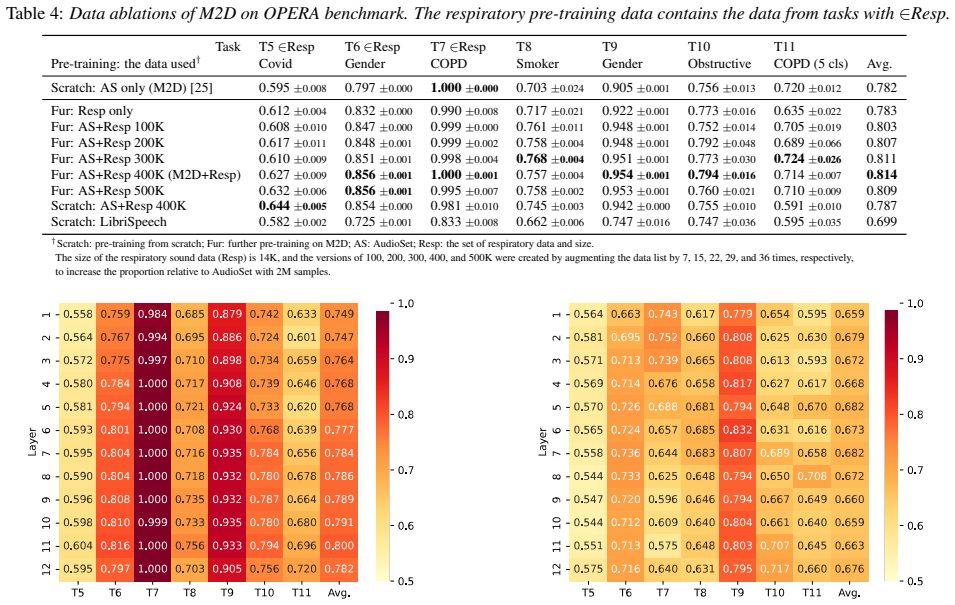
The central discovery is that, for respiratory audio, the variety and scale of pre-training data outweighs domain specificity. Eight of the nineteen general-audio models evaluated beat OPERA-CT, the best respiratory-only model, and the top general-audio models beat it on every task. The strongest configuration is M2D+Resp: the AudioSet-pre-trained M2D model further pre-trained on a combined AudioSet and respiratory dataset of 400,000 samples, which reaches 0.814 average AUROC on OPERA versus 0.733 for OPERA-CT. Ablations on M2D isolate two deciding factors: the data, with further pre-training on AudioSet plus respiratory sounds helping while respiratory sounds alone do not, and the feature aggregation, with concatenating frequency-wise patch features being far better than mean pooling. Speech-based SSL models underperform because their training signals are built from speech clusters that carry few breath-like acoustic patterns.
Load-bearing premise
The load-bearing premise is that the overlap between the further-pre-training dataset, which contains COUGHVID, HF Lung, and ICBHI recordings including the training splits of benchmark tasks T5-T7, does not inflate the reported gains; if it does, the advantage of combining respiratory data with AudioSet may not hold for unseen respiratory recordings.
Editorial extensions
If this is right
- Future respiratory foundation models should pre-train on large diverse audio before any respiratory-specific adaptation, since respiratory-only pre-training is a weak base.
- Two-stage pre-training on AudioSet plus respiratory data is a concrete recipe that raises average AUROC to 0.814, a new OPERA record.
- Feature aggregation choices matter as much as data: frequency-wise concatenation should be the default for respiratory tasks, not mean pooling.
- The penultimate layer of the AudioSet model is the best feature source across tasks, so respiratory systems should use deep-layer outputs rather than early or middle layers.
Reading between the lines
- The reported gain from combining AudioSet with respiratory data is measured on benchmark tasks whose training splits overlap the pre-training set (T5-T7); whether the gain survives on fully unseen respiratory recordings is an open question the paper does not answer.
- The frequency-wise aggregation insight likely transfers to other bioacoustic tasks such as heart-sound or bowel-sound classification, where spectral details carry diagnostic information.
- A natural extension is to apply the same AudioSet-plus-respiratory two-stage recipe to other strong base models, for example ATST-Frame or CED, to see whether the gain is specific to M2D or general.
Editorial analysis
A structured set of objections, weighed in public.
Referee Report
Summary. The paper evaluates 21 pre-trained audio foundation models on seven tasks (T5–T11) of the OPERA respiratory audio benchmark under a linear-probing protocol. It reports that models pre-trained on AudioSet outperform the respiratory-specific OPERA-CT and OPERA-GT models, that further pre-training an AudioSet-pretrained M2D on a combination of AudioSet and respiratory sound data ('M2D+Resp') yields a new state of the art (average AUROC 0.814 vs 0.733), and that preserving frequency-wise information in feature aggregation is important. Ablation experiments vary training objective, patch resolution, data composition, and layer choice, and the paper releases evaluation code.
Significance. If the central result holds, the paper provides actionable guidance for pre-training respiratory audio models and a reusable benchmark harness for the community. The study is a well-structured empirical comparison: it reports means and standard deviations over five runs, compares a broad set of external models (ATST-Frame, MSM-MAE, CLAP, etc.), and makes code publicly available. The claim that general AudioSet pre-training is more effective than the two evaluated respiratory-specific models is supported by multiple models not developed by the authors. However, the headline SOTA claim for M2D+Resp is currently weakened by two issues: the further pre-training data overlaps with the training splits of tasks T5–T7, and the 400K configuration was selected by benchmarking on the same test tasks. These issues need to be addressed before the combined-pretraining benefit can be considered established.
major comments (3)
- [Table 4, §3.2] The headline result M2D+Resp (average AUROC 0.814) comes from further pre-training on a respiratory set that, as the table's own footnote states, 'contains the data from tasks with ∈Resp' — i.e., the training splits of T5–T7. Consequently, the gains on T5 and T6 (0.627 vs 0.595 and 0.856 vs 0.797) may reflect exposure to the exact benchmark training recordings rather than improved generalization to unseen respiratory audio. Gains on the disjoint tasks T8–T10 do exist, which partially mitigates the concern, but the headline average aggregates the overlapping tasks. Please add a held-out evaluation on disjoint tasks or on disjoint splits of the respiratory datasets, or substantially temper the claim that combining AudioSet with respiratory data 'enhances performance.'
- [Table 4, §3.2] The 400K sample count for M2D+Resp was selected by running configurations of 100K, 200K, 300K, 400K, and 500K and choosing the one with the highest average AUROC on the same OPERA benchmark. No validation split or pre-registered selection criterion is used, so the reported 0.814 is the maximum of a configuration sweep and is likely optimistically biased. The same issue appears in Table 2 for the speech SSL models (rows 4–6), where the 'Layer#7' notation indicates a layer chosen by benchmark performance, and in Figure 1, where the penultimate layer is identified as best. Please report the selection procedure explicitly, use a validation split for configuration and layer selection, or present the chosen configuration as exploratory and confirm it on a held-out benchmark.
- [Table 1, Table 2] The average AUROC across the seven tasks is strongly influenced by tasks with very small sample sizes and ceiling effects. T7 has only 35 samples in one class and reaches 1.000 for several models (AST, MSM-MAE, M2D, M2D+Resp), and T10 has 129/105 samples. With only five runs, the reported standard deviations are small, but the class imbalance and saturation make per-task differences less informative and the average less representative. Please report per-task confidence intervals and include a sensitivity analysis that excludes or reweights T7 (and possibly T10) to show that the main conclusions are not driven by these tasks.
minor comments (4)
- [Section 3] The heading 'Emperical Analysis' should be 'Empirical Analysis.'
- [Table 2 caption] The asterisk is explained only in the running text after the table; please add a legend to the caption (e.g., '* indicates better than OPERA-CT').
- [Table 4 footnote] The notation '∈Resp' is used without definition in the caption; please define it explicitly, for example, 'Resp denotes the respiratory pre-training set, which includes the training splits of tasks T5–T7.'
- [Abstract] The abstract states that AudioSet models 'are more effective than the models specifically pre-trained on respiratory sounds,' but only two such models (OPERA-CT and OPERA-GT) are evaluated; 'the evaluated respiratory-specific models' would be more precise.
Circularity Check
Empirical benchmark study; the AudioSet-vs-respiratory finding is independent, but the M2D+Resp SOTA is partly reduced by pre-training on the T5-T7 training splits before evaluating those tasks.
-
fitted input called prediction
[Section 3.2 (RQ2), Table 4 caption and surrounding text]
"The respiratory pre-training data contains the data from tasks with ∈Resp. ... Note that the respiratory sound dataset used for the pre-training contains the training data from tasks T5 to T7."
The reported SOTA model, M2D+Resp, was created by further pre-training on a respiratory set that includes the training splits of benchmark tasks T5-T7. The headline average 0.814 then aggregates the AUROC values for those same tasks. For T5-T7, the feature extractor has already been adapted to the exact unlabeled training recordings whose labels the linear probe subsequently learns, so those three scores are transductive fits rather than predictions for unseen respiratory audio. The paper discloses the overlap, and genuine gains on disjoint tasks T8-T10 do exist, so the reduction is partial rather than total; nevertheless, the magnitude of the combined AudioSet+Resp benefit is not established without a held-out evaluation on disjoint respiratory data.
full rationale
This is an empirical benchmark study, not a formal derivation: there are no equations whose outputs equal their inputs. Self-citation is present (M2D, BYOL-A, MSM-MAE are the authors' models), but it is not load-bearing in the circular sense because the central conclusion that AudioSet pre-training beats respiratory-only pre-training is corroborated by external models such as ATST-Frame and CLAP2023, which also outperform OPERA-CT. The main concrete reduction is the benchmark overlap in the M2D+Resp result: the further pre-training dataset contains the training data of tasks T5-T7, and the reported SOTA averages exactly those tasks, so part of the gain is forced by the pre-training input set overlapping the evaluation tasks. The paper is transparent about this overlap, and gains on disjoint tasks T8-T10 do exist, which mitigates the issue. Model selection on the same benchmark (choosing 400K among several AS+Resp sizes and resolutions) adds optimism but is a statistical selection effect, not equation-level circularity. Overall, the central scientific content is independent, with one partial fitted-input-called-prediction issue.
Assumptions & free parameters
free parameters (2)
- Further pre-training sample count (400K) =
400K (29x augmentation of 14K respiratory samples)
- Base model selection (M2D) =
M2D
assumptions (3)
- domain assumption The OPERA benchmark's linear evaluation protocol is a valid proxy for respiratory audio representation quality.
- domain assumption Pre-training on the same datasets used for evaluation (including exact training samples) does not materially inflate results.
- domain assumption The five-run mean AUROC is a sufficient statistic for model comparison.
Cite this review
Pith. "Pith review of Towards Pre-training an Effective Respiratory Audio Foundation Model." pith.science (2026). https://pith.science/paper/W4V7RKFJ
@misc{pith2026250515307,
  author       = {Pith},
  title        = {Pith review of: Towards Pre-training an Effective Respiratory Audio Foundation Model},
  year         = {2026},
  howpublished = {\url{https://pith.science/paper/W4V7RKFJ}},
  note         = {Machine review of arXiv:2505.15307}
}
read the original abstract
Recent advancements in foundation models have sparked interest in respiratory audio foundation models. However, the effectiveness of applying conventional pre-training schemes to datasets that are small-sized and lack diversity has not been sufficiently verified. This study aims to explore better pre-training practices for respiratory sounds by comparing numerous pre-trained audio models. Our investigation reveals that models pre-trained on AudioSet, a general audio dataset, are more effective than the models specifically pre-trained on respiratory sounds. Moreover, combining AudioSet and respiratory sound datasets for further pre-training enhances performance, and preserving the frequency-wise information when aggregating features is vital. Along with more insights found in the experiments, we establish a new state-of-the-art for the OPERA benchmark, contributing to advancing respiratory audio foundation models. Our code is available online at https://github.com/nttcslab/eval-audio-repr/tree/main/plugin/OPERA.
Figures
Reference graph
Works this paper leans on
-
[1]
Introduction As a trend in non-invasive diagnostic methods using sound [1], respiratory audio foundation models have gained attention, driven by recent advancements in deep learning foundation models [2, 3, 4]. These models may serve as a fundamen- tal block for health monitoring and disease diagnosis applica- tions. Since training foundation models requi...
-
[2]
Experimental Setup We utilized a unified respiratory audio benchmark to evaluate models under the following experimental setup. 2.1. Benchmark We conducted experiments on the publicly available OPERA
-
[3]
HTS-AT [13] 0.577 ±0.002 0.615±0.001 0.765±0.013 0.590±0.010 0.699±0.002 0.778±0.014∗ 0.521±0.031 0.649 Speech SSL models (with the best performing layer used for extracting features)
-
[4]
benchmark and used seven tasks (T5 to T11) for which the data are publicly available. The seven tasks listed in Table 1 are health condition classification problems, where all are binary classification tasks except T11, which is a five-class classifica- tion. The benchmark takes a linear evaluation protocol, where model weights are frozen. A model encodes...
arXiv 2025
-
[5]
AST [11] 0.607 ±0.008∗ 0.739±0.002 1.000±0.000∗ 0.671±0.011 0.833±0.000 0.837±0.007∗ 0.652±0.020∗ 0.763∗
-
[6]
PANNs Cnn14 [12] 0.533±0.006 0.566±0.003 0.606±0.037 0.533±0.014 0.549±0.007 0.447±0.057 0.527±0.022 0.537
-
[7]
wav2vec2Layer#7[14] 0.480 ±0.005 0.634±0.003 0.172±0.013 0.589±0.020 0.606±0.004 0.620±0.021 0.560±0.022 0.523
-
[8]
HuBERTLayer#7[15] 0.558 ±0.002 0.736±0.001 0.644±0.012 0.683±0.004 0.807±0.002 0.689±0.019 0.658±0.018∗ 0.682
Show all 62 references
-
[9]
WavLMLayer#6[16] 0.555 ±0.002 0.700±0.001 0.599±0.016 0.687±0.004∗ 0.771±0.001 0.703±0.020 0.624±0.011 0.663 CLAP models
-
[10]
LAION-CLAP [17] 0.549±0.001 0.660±0.001 0.674±0.062 0.531±0.003 0.714±0.002 0.776±0.015∗ 0.584±0.033 0.641
-
[11]
CLAP2022[18] 0.599 ±0.007∗ 0.665±0.001 0.933±0.005∗ 0.680±0.009 0.742±0.001 0.697±0.004 0.636±0.045∗ 0.707
-
[12]
CLAP2023[19] 0.602 ±0.007∗ 0.779±0.001 0.988±0.004∗ 0.687±0.007∗ 0.866±0.001 0.795±0.012∗ 0.606±0.037 0.760∗ General audio SSL models
-
[13]
BYOL-A [20] 0.531 ±0.011 0.702±0.006 0.950±0.031∗ 0.581±0.035 0.807±0.011 0.710±0.047 0.566±0.029 0.693
-
[14]
ATST-Clip [21] 0.609±0.009∗ 0.793±0.001 0.977±0.007 0.679±0.010 0.850±0.002 0.828±0.012 0.606±0.029 0.763∗
-
[15]
ATST-Frame [21]0.621±0.007∗ 0.801±0.001∗ 0.998±0.001∗ 0.687±0.010∗ 0.908±0.001∗ 0.843±0.006∗ 0.657±0.003∗ 0.788∗
-
[16]
AudioMAE [22] 0.554±0.004 0.628±0.001 0.886±0.017∗ 0.549±0.022 0.724±0.001 0.616±0.041 0.510±0.021 0.638
-
[17]
BEATs [23] 0.555 ±0.002 0.644±0.001 0.823±0.011 0.631±0.004 0.695±0.003 0.723±0.031∗ 0.623±0.015 0.670
-
[18]
MSM-MAE [24] 0.569±0.003 0.781±0.000 1.000±0.000∗ 0.721±0.008∗ 0.879±0.001∗ 0.746±0.009∗ 0.662±0.006∗ 0.765∗
-
[19]
M2D [25] 0.595 ±0.008∗ 0.797±0.000∗ 1.000±0.000∗ 0.703±0.024∗ 0.905±0.001∗ 0.756±0.013∗ 0.720±0.012∗ 0.782∗ Ensemble SSL model (CED), large parameter model (Dasheng 1.2B), and audio-visual contrastive SSL model (OpenL3)
-
[20]
CED [26] 0.614 ±0.001∗ 0.782±0.001 0.997±0.001∗ 0.713±0.007∗ 0.873±0.001 0.833±0.019∗ 0.597±0.117 0.773∗
-
[21]
Dasheng-1.2B [27] 0.582±0.005∗ 0.734±0.002 0.915±0.031∗ 0.662±0.016 0.772±0.002 0.700±0.072 0.660±0.021∗ 0.718
-
[22]
OpenL3[28] 0.608 ±0.011∗ 0.754±0.006 0.978±0.007∗ 0.695±0.018∗ 0.845±0.007 0.751±0.027∗ 0.639±0.025∗ 0.753∗ Respiratory audio SSL models
-
[23]
OPERA-CT [4] 0.578±0.001 0.795±0.001 0.855±0.012 0.685±0.012 0.874±0.000 0.722±0.016 0.625±0.038 0.733
-
[24]
Bold results are better than the models above
OPERA-GT [4] 0.552±0.003 0.735±0.000 0.741±0.011 0.650±0.005 0.825±0.001 0.703±0.016 0.606±0.015 0.687 Reference from Table 3: M2D further pre-trained on AudioSet + Resipratory sound data. Bold results are better than the models above. M2D+Resp 0.627±0.009∗ 0.856±0.001∗ 1.000±...
-
[25]
We also evaluated the layer-wise performance (Figures 1 and 2)
Emperical Analysis We evaluated 21 audio foundation models on the OPERA benchmark (Table 2) and conducted ablation experiments on the M2D model (Table 3) and on data (Table 4). We also evaluated the layer-wise performance (Figures 1 and 2). 3.1. RQ1 What are the better practic...
2023
-
[26]
For further pre-training experiments, we pre- trained the AudioSet-pre-trained M2D for 50 epochs on each Table 4: Data ablations of M2D on OPERA benchmark
We used the same setting with M2D and replaced the pre- training dataset. For further pre-training experiments, we pre- trained the AudioSet-pre-trained M2D for 50 epochs on each Table 4: Data ablations of M2D on OPERA benchmark. The respiratory pre-training data contains the ...
-
[27]
Conclusion We investigated the better practices for pre-training an effective respiratory audio foundation model by comparing numerous au- dio models under the unified respiratory benchmark OPERA. Experiments provided various insights, such as the effective- ness of pre-traini...
-
[28]
Body acoustics for the non-invasive diagnosis of medical conditions,
J. Cook, M. Umar, F. Khalili, and A. Taebi, “Body acoustics for the non-invasive diagnosis of medical conditions,” Bioengineer- ing, vol. 9, no. 4, 2022
2022
-
[29]
HeAR – health acoustic representations,
S. Baur, Z. Nabulsi, W.-H. Weng, J. Garrison, L. Blankemeier, S. Fishman, C. Chen, S. Kakarmath, M. Maimbolwa, N. Sanjase, B. Shuma, Y . Matias, G. S. Corrado, S. Patel, S. Shetty, S. Prab- hakara, M. Muyoyeta, and D. Ardila, “HeAR – health acoustic representations,” arXiv pre...
2024 arXiv
-
[30]
Foun- dation models for cardiovascular disease detection via biosignals from digital stethoscopes,
G. Mathew, D. Barbosa, J. Prince, and S. a. Venkatraman, “Foun- dation models for cardiovascular disease detection via biosignals from digital stethoscopes,” npj Cardiovascular Health, 2024
2024
-
[31]
Towards open respiratory acoustic foundation models: Pretraining and benchmarking,
Y . Zhang, T. Xia, J. Han, Y . Wu, G. Rizos, Y . Liu, M. Mosuily, J. Chauhan, and C. Mascolo, “Towards open respiratory acoustic foundation models: Pretraining and benchmarking,” in NeurIPS, 2024
2024
-
[32]
Auscultabase: A foundational step towards ai-powered body sound diagnostics,
P. Wang, Z. Zhao, L. Zhao, M. He, X. Sun, Y . Zhang, K. Sun, Y . Wang, and Y . Wang, “Auscultabase: A foundational step towards ai-powered body sound diagnostics,” arXiv preprint arXiv:2411.07547, 2024
2024 arXiv
-
[33]
The COUGHVID crowdsourcing dataset, a corpus for the study of large-scale cough analysis algorithms,
L. Orlandic, T. Teijeiro, and D. Atienza, “The COUGHVID crowdsourcing dataset, a corpus for the study of large-scale cough analysis algorithms,” Scientific Data, vol. 8, no. 156, 2021
2021
-
[34]
An open access database for the evaluation of respiratory sound classification algorithms,
B. M. Rocha, D. Filos, L. Mendes, G. Serbes, S. Ulukaya, Y . P. Kahya, N. Jakovljevic, T. L. Turukalo, I. M. V ogiatzis, E. Peran- toni, E. Kaimakamis, P. Natsiavas, A. Oliveira, C. J ´acome, A. Marques, N. Maglaveras, R. P. Paiva, I. Chouvarda, and P. de Carvalho, “An open ac...
2019
-
[35]
Coswara: A respiratory sounds and symp- toms dataset for remote screening of sars-cov-2 infection,
D. Bhattacharya et al., “Coswara: A respiratory sounds and symp- toms dataset for remote screening of sars-cov-2 infection,” Scien- tific Data, vol. 10, no. 397, 2023
2023
-
[36]
A dataset of lung sounds recorded from the chest wall using an elec- tronic stethoscope,
M. Fraiwan, L. Fraiwan, B. Khassawneh, and A. Ibnian, “A dataset of lung sounds recorded from the chest wall using an elec- tronic stethoscope,” Data in Brief, vol. 35, p. 106913, 2021
2021
-
[37]
Mul- timedia respiratory database (respiratorydatabase@tr): Ausculta- tion sounds and chest x-rays,
G. Altan, Y . Kutlu, Y . Garbi, A. O. Pekmezci, and S. Nural, “Mul- timedia respiratory database (respiratorydatabase@tr): Ausculta- tion sounds and chest x-rays,” Natural and Engineering Sciences, vol. 2, no. 3, p. 59–72, 2017
2017
-
[38]
AST: Audio Spectrogram Transformer,
Y . Gong, Y .-A. Chung, and J. Glass, “AST: Audio Spectrogram Transformer,” in Interspeech, 2021, pp. 571–575
2021
-
[39]
PANNs: Large-Scale Pretrained Audio Neural Networks for Audio Pattern Recognition,
Q. Kong, Y . Cao, T. Iqbal, Y . Wang, W. Wang, and M. D. Plumb- ley, “PANNs: Large-Scale Pretrained Audio Neural Networks for Audio Pattern Recognition,” IEEE/ACM Trans. Audio, Speech, Language Process., vol. 28, pp. 2880–2894, 2020
2020
-
[40]
HTS-AT: A hierarchical token-semantic audio transformer for sound classification and detection,
K. Chen, X. Du, B. Zhu, Z. Ma, T. Berg-Kirkpatrick, and S. Dub- nov, “HTS-AT: A hierarchical token-semantic audio transformer for sound classification and detection,” inICASSP, 2022, pp. 646– 650
2022
-
[41]
wav2vec 2.0: A framework for self-supervised learning of speech representa- tions,
A. Baevski, Y . Zhou, A. Mohamed, and M. Auli, “wav2vec 2.0: A framework for self-supervised learning of speech representa- tions,” in NeurIPS, 2020
2020
-
[42]
HuBERT: Self-Supervised Speech Representation Learning by Masked Prediction of Hidden Units,
W.-N. Hsu, B. Bolte, Y .-H. H. Tsai, K. Lakhotia, R. Salakhut- dinov, and A. Mohamed, “HuBERT: Self-Supervised Speech Representation Learning by Masked Prediction of Hidden Units,” IEEE/ACM Trans. Audio, Speech, Language Process. , p. 3451–3460, 2021
2021
-
[43]
WavLM: Large- Scale Self-Supervised Pre-Training for Full Stack Speech Pro- cessing,
S. Chen, C. Wang, Z. Chen, Y . Wu, S. Liu, Z. Chen, J. Li, N. Kanda, T. Yoshioka, X. Xiao, J. Wu, L. Zhou, S. Ren, Y . Qian, Y . Qian, J. Wu, M. Zeng, X. Yu, and F. Wei, “WavLM: Large- Scale Self-Supervised Pre-Training for Full Stack Speech Pro- cessing,” IEEE J. Sel. Top. Si...
2022
-
[44]
Large-Scale Contrastive Language-Audio Pretrain- ing with Feature Fusion and Keyword-to-Caption Augmentation,
Y . Wu, K. Chen, T. Zhang, Y . Hui, T. Berg-Kirkpatrick, and S. Dubnov, “Large-Scale Contrastive Language-Audio Pretrain- ing with Feature Fusion and Keyword-to-Caption Augmentation,” in ICASSP, 2023
2023
-
[45]
CLAP: Learning Audio Concepts From Natural Language Supervision,
B. Elizalde, S. Deshmukh, M. Al Ismail, and H. Wang, “CLAP: Learning Audio Concepts From Natural Language Supervision,” in ICASSP, 2023
2023
-
[46]
Natural language su- pervision for general-purpose audio representations,
B. Elizalde, S. Deshmukh, and H. Wang, “Natural language su- pervision for general-purpose audio representations,” in ICASSP, 2024, pp. 336–340
2024
-
[47]
BYOL for Audio: Exploring Pre-trained General-purpose Audio Representations,
D. Niizumi, D. Takeuchi, Y . Ohishi, N. Harada, and K. Kashino, “BYOL for Audio: Exploring Pre-trained General-purpose Audio Representations,” IEEE/ACM Trans. Audio, Speech, Language Process., vol. 31, p. 137–151, 2023
2023
-
[48]
Self-Supervised Audio Teacher- Student Transformer for Both Clip-Level and Frame-Level Tasks,
X. Li, N. Shao, and X. Li, “Self-Supervised Audio Teacher- Student Transformer for Both Clip-Level and Frame-Level Tasks,” IEEE/ACM Trans. Audio, Speech, Language Process. , vol. 32, pp. 1336–1351, 2024
2024
-
[49]
Masked autoencoders that lis- ten,
P.-Y . Huang, H. Xu, J. Li, A. Baevski, M. Auli, W. Galuba, F. Metze, and C. Feichtenhofer, “Masked autoencoders that lis- ten,” in NeurIPS, 2022
2022
-
[50]
BEATs: Audio Pre-Training with Acoustic Tokenizers,
S. Chen, Y . Wu, C. Wang, S. Liu, D. Tompkins, Z. Chen, and F. Wei, “BEATs: Audio Pre-Training with Acoustic Tokenizers,” in ICML, 2023
2023
-
[51]
Masked Spectrogram Modeling using Masked Autoencoders for Learning General-purpose Audio Representation,
D. Niizumi, D. Takeuchi, Y . Ohishi, N. Harada, and K. Kashino, “Masked Spectrogram Modeling using Masked Autoencoders for Learning General-purpose Audio Representation,” in HEAR: Holistic Evaluation of Audio Representations (NeurIPS 2021 Competition), vol. 166, 2022, pp. 1–24
2021
-
[52]
Masked Modeling Duo: Towards a Universal Audio Pre- Training Framework,
——, “Masked Modeling Duo: Towards a Universal Audio Pre- Training Framework,” IEEE/ACM Trans. Audio, Speech, Lan- guage Process., vol. 32, pp. 2391–2406, 2024
2024
-
[53]
CED: Con- sistent ensemble distillation for audio tagging,
H. Dinkel, Y . Wang, Z. Yan, J. Zhang, and Y . Wang, “CED: Con- sistent ensemble distillation for audio tagging,” in ICASSP, 2024
2024
-
[54]
Scaling up masked audio encoder learning for general audio clas- sification,
H. Dinkel, Z. Yan, Y . Wang, J. Zhang, Y . Wang, and B. Wang, “Scaling up masked audio encoder learning for general audio clas- sification,” in Interspeech, 2024, pp. 547–551
2024
-
[55]
Look, listen and learn more: Design choices for deep audio embeddings,
J. Cramer, H.-H. Wu, J. Salamon, and J. P. Bello, “Look, listen and learn more: Design choices for deep audio embeddings,” in ICASSP, Brighton, UK, May 2019, pp. 3852––3856
2019
-
[56]
Masked autoencoders are scalable vision learners,
K. He, X. Chen, S. Xie, Y . Li, P. Doll´ar, and R. Girshick, “Masked autoencoders are scalable vision learners,” in CVPR, June 2022, pp. 16 000–16 009
2022
-
[57]
Lib- rispeech: An asr corpus based on public domain audio books,
V . Panayotov, G. Chen, D. Povey, and S. Khudanpur, “Lib- rispeech: An asr corpus based on public domain audio books,” in ICASSP, 2015, pp. 5206–5210
2015
-
[58]
Audio Set: An ontology and human-labeled dataset for audio events,
J. F. Gemmeke, D. P. W. Ellis, D. Freedman, A. Jansen, W. Lawrence, R. C. Moore, M. Plakal, and M. Ritter, “Audio Set: An ontology and human-labeled dataset for audio events,” in ICASSP, 2017, pp. 776–780
2017
-
[59]
A progressively expanded database for automated lung sound analysis: An update,
F.-S. Hsu, S.-R. Huang, C.-W. Huang, Y .-R. Cheng, C.-C. Chen, J. Hsiao, C.-W. Chen, and F. Lai, “A progressively expanded database for automated lung sound analysis: An update,” Applied Sciences, vol. 12, no. 15, 2022
2022
-
[60]
M2D-CLAP: Masked Modeling Duo Meets CLAP for Learning General-purpose Audio-Language Representation,
D. Niizumi, D. Takeuchi, Y . Ohishi, N. Harada, M. Yasuda, S. Tsubaki, and K. Imoto, “M2D-CLAP: Masked Modeling Duo Meets CLAP for Learning General-purpose Audio-Language Representation,” in Interspeech, 2024, pp. 57–61
2024
-
[61]
Masked Modeling Duo for Speech: Specializing General- Purpose Audio Representation to Speech using Denoising Distil- lation,
D. Niizumi, D. Takeuchi, Y . Ohishi, N. Harada, and K. Kashino, “Masked Modeling Duo for Speech: Specializing General- Purpose Audio Representation to Speech using Denoising Distil- lation,” in Interspeech, 2023, pp. 1294–1298
2023
-
[62]
Composing General Audio Representation by Fusing Mul- tilayer Features of a Pre-trained Model,
——, “Composing General Audio Representation by Fusing Mul- tilayer Features of a Pre-trained Model,” in EUSIPCO, 2022, pp. 200–204
2022
Reviewed August 7, 2026 · model on record in the stance chip above.
Discussion (0). Continue with ORCID to comment.