REVIEW 3 major objections 5 minor 66 references
FaceCrafter: Identity-Conditional Diffusion with Disentangled Control over Facial Pose, Expression, and Emotion
T0 review · 3 major / 5 minor · reviewed 2026-08-07 · deepseek-v4-flash
Pith's one-line read FaceCrafter claims that two lightweight cross-attention control modules can independently control facial pose, expression, and emotion in identity-conditioned diffusion generation while preserving identity, with around 18 million added…
desk verdict Lightweight control modules and a nice disentanglement loss, but the emotion branch is trained and scored with the same EmoNet, so the headline emotion claim is unproven. read the letter →
The pith
A machine-rendered reading of the paper's core claim, the machinery that carries it, and where it could break.
The reading
What carries the argument
The load-bearing object is the summed cross-attention rule $\text{Attention}_{\mathrm{final}} = \mathrm{Attn}_{\mathrm{ID}} + \alpha_{\mathrm{LMK}}\mathrm{Attn}_{\mathrm{LMK}} + \alpha_{\mathrm{EMO}}\mathrm{Attn}_{\mathrm{EMO}}$, where each term is standard softmax attention over one condition's key/value features and the $\alpha$ coefficients act as switches. Around this, the paper builds two pieces of machinery: control modules that convert landmark images and emotion vectors into condition sequences, and an Attention Disentanglement Loss that uses a face mask and cosine similarity to penalize overlap between attention maps from different conditioning combinations during intra-batch mixed training. This loss is what pushes identity features orthogonal to pose, expression, and emotion features, and it is the mechanism the paper credits for improved diversity and controllability.
What would settle it
Take generated images from a single identity across the eight emotion classes, have naive human raters label them, and compare their labels with the emotion network's predictions; if human-network agreement is near chance or systematically worse than agreement on real faces, the reported emotion-control accuracy reflects alignment with one network rather than genuine emotional expression.
Extended reading notes
Core claim
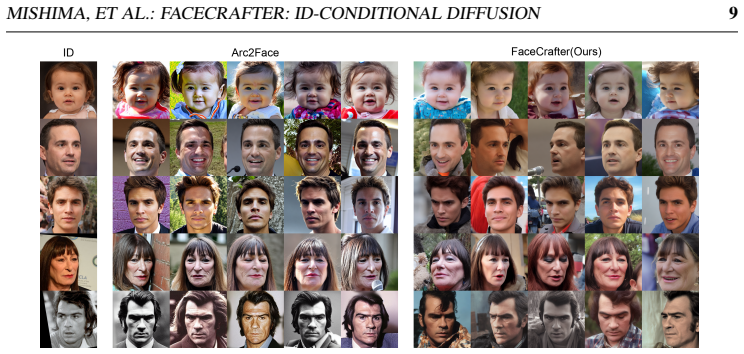
On its own terms, the paper establishes a recipe: take an identity-conditional diffusion foundation model, freeze it, and insert two lightweight control branches into its cross-attention layers—one that encodes facial landmarks for pose and expression, and one that encodes valence/arousal plus an eight-class emotion distribution from a neural affect estimator. The three conditions (identity, landmark, emotion) are combined by summing their cross-attention outputs, and each branch can be switched on or off at inference through scalar coefficients. A two-stage training procedure first pre-trains each control branch separately, then jointly fine-tunes them with intra-batch mixed conditioning and an attention disentanglement loss that penalizes cosine similarity between attention maps belonging to different condition combinations. The paper reports that this yields more accurate pose, expression, and emotion control than the alternative control baselines, with emotion classification accuracy about 25 percentage points higher, while keeping identity similarity high; it further reports that under identity-only conditioning the model exceeds the base identity-conditional foundation model on diversity and realism metrics.
Load-bearing premise
The load-bearing premise is that the emotion-recognition network used to create the emotion condition is also a faithful estimator of human-perceived emotion, because the same network's outputs are used to score emotion accuracy on generated images.
Editorial extensions
If this is right
- If the central claim holds, synthetic face datasets can be populated with controlled pose, expression, and emotion per identity, which would directly address imbalances such as the over-representation of happy and neutral expressions in existing collections.
- At roughly 18 million added parameters, the control mechanism is light enough to be adapted to other diffusion backbones without the heavy cost of duplicated-encoder control methods.
- Independent control of the three attributes means a single identity can be rendered across many poses and emotional states, which is directly useful for avatar creation, data augmentation, and affective-computing benchmarks.
- The improved identity-only diversity suggests the disentanglement loss also cleans the learned identity representation itself, yielding more varied and realistic faces from one identity image.
Reading between the lines
- Editorial inference: the same cross-attention summation and disentanglement objective could in principle be extended to other mutable attributes such as age, hairstyle, or accessories, provided a control feature extractor exists for each; the paper only demonstrates pose, expression, and emotion.
- Editorial inference: because the affect estimator is used for both conditioning and evaluation, the reported emotion accuracy likely measures consistency with that single network; a human-labeled emotion benchmark would be needed to establish control over perceived emotion.
- Editorial inference: the orthogonality loss acts on attention maps rather than on latent embeddings, so the strength of disentanglement may depend on the spatial granularity of the base model's cross-attention blocks.
Editorial analysis
A structured set of objections, weighed in public.
Referee Report
Summary. The paper proposes FaceCrafter, an identity-conditional diffusion model built on Arc2Face that adds two lightweight cross-attention control modules, one for pose/expression via MediaPipe landmarks and one for emotion via EmoNet valence/arousal and 8-class emotion distributions. The training pipeline uses a two-stage procedure with an Attention Disentanglement Loss to encourage orthogonality between identity and non-identity control features, and inference uses classifier-free guidance with separate control weights. Experiments on a 2,000-pair CelebA benchmark and on Synth-500/AgeDB report improved pose, expression, and emotion control accuracy compared with Arc2Face+ControlNet and CapHuman, improved diversity under identity-only conditioning, and comparable identity preservation. The central claims are (i) independent and disentangled control over pose, expression, and emotion with a small parameter overhead, and (ii) superior identity-only generation diversity and realism over Arc2Face.
Significance. If the claims are sound, FaceCrafter would be a practically useful contribution: it demonstrates that fine-grained control over three facial attributes can be achieved with roughly 18M extra parameters instead of 361M for ControlNet-style baselines, and it reports strong diversity gains under identity-only conditioning (e.g., LPIPS 0.552 vs 0.506 and FID 2.112 vs 5.673 on Synth-500). The two-stage training and the attention disentanglement loss are reasonable and are ablated in Table 3. The paper also includes a user study, which is commendable. However, the load-bearing emotion-control claim currently rests on a circular evaluation: the same estimator (EmoNet) is used both as the conditioning signal and as the metric, and the user study does not separately evaluate emotion. In addition, the paper does not provide a direct test of the 'independent' or 'disentangled' control that is central to the title and abstract. These gaps need to be addressed before the main claims can be accepted.
major comments (3)
- [Section 4.2 and Table 1] The emotion-control evaluation is circular. The Emotion Control Module (Section 3.1) takes valence/arousal and 8-class emotion distributions from EmoNet [13] as conditioning, and Table 1 reports V-RMSE, A-RMSE, Dist-RMSE, and Class-ACC computed by running EmoNet on the generated images. This measures how well generated images match a single network's estimates, not how well they express emotions as perceived by humans or as measured by an independent facial-affect model. The concern is amplified by the fact that reference [13] is described as a speech-emotion recognition model; the paper does not describe how it is adapted to facial images or why its image-based outputs are valid affect estimates. The user study does not resolve this, because it asks about 'expression (including emotion)' rather than emotion separately. I request an independent emotion benchmark, human emotion ratings, or at minimum a justification that EmoNet operates as a valid facial-affect estimator.
- [Section 4.2, Tables 1 and 4] The claim of 'independent control' over pose, expression, and emotion is not directly evaluated. The metrics in Table 1 measure whether each generated attribute matches its corresponding target, but they do not measure whether changing one control leaves the others unchanged. For instance, the paper does not report pose/expression RMSE when only the emotion condition is varied, nor does it report emotion metrics when only the landmark condition is varied. The Attention Disentanglement Loss is a plausible mechanism, but no experiment quantifies inter-attribute leakage. The user study also does not test independence. I recommend adding a controlled perturbation experiment that isolates each control channel and reports errors on the non-target attributes.
- [Abstract, Section 4.2, Tables 1 and 4] The abstract's claim that control is achieved 'without compromising identity preservation' is not fully supported by the reported numbers. In Table 1, FaceNet ID-Sim drops from 0.76 with Arc2Face+ControlNet to 0.69 with FaceCrafter (LMK+EMO), and in the user study (Table 4) FaceCrafter's ID-Sim is 30.6% versus 36.9% for Arc2Face+ControlNet. The text describes this as 'slightly lower' and 'comparable', but a 0.07 cosine-similarity drop and a six-point drop in a forced-choice user study are non-negligible. The authors should either temper the claim or provide an explicit analysis of where and why identity information is lost when emotion control is enabled.
minor comments (5)
- [Page 4] There is a typo in the text: 'To ensurre a stable training' should be 'To ensure stable training'.
- [Page 1] The author affiliation 'Institute of Science T okyo' contains a space in 'T okyo'; this should be corrected.
- [Throughout] The name 'Emonet' and 'EmoNet' are used inconsistently; please standardize to 'EmoNet'.
- [Section 3.1] The details of the Landmark and Emotion Control Modules are deferred to the supplementary material, but no supplementary material is available with this manuscript. This makes it impossible to verify the architecture and the exact EmoNet adaptation. Please include the details in the paper or make the supplement available.
- [Section 4.2] The user study reports selection rates from 21 participants, but no statistical significance testing is reported. Given the small sample size and the large differences in pose/expression control, please provide confidence intervals or a significance test.
Circularity Check
Emotion control is a closed EmoNet loop: the same network supplies both the conditioning signal and the evaluation metric, so the reported emotion accuracy is self-consistency with EmoNet rather than independent control of facial emotion.
-
fitted input called prediction
[Section 3.1 (Landmark/Emotion Control Modules) and Section 4.2 (Evaluation Metrics; Table 1)]
"To additionally handle emotions, we introduce an Emotion Control Module that takes Valence, Arousal [49], and 8-class emotion distributions from EmoNet [13] as input, processes them via a DNN, and reshapes the output into a sequence. ... (4) Valence/Arousal(V/A) RMSE: RMSE of Valence/Arousal scores from Emonet to measure emotional consistency; (5) Emotion Dist RMSE/Class ACC: RMSE and classification accuracy of 8-class emotion distributions from Emonet [13] to evaluate categorical emotion similarity."
EmoNet is used twice: its Valence/Arousal and 8-class emotion outputs are the conditioning input of the Emotion Control Module, and the same EmoNet outputs on the generated images are the reported V/A RMSE, Dist-RMSE, and Class-ACC metrics. The target emotion and the measured emotion are therefore the output of one and the same network. The module is trained to render images conditioned on an EmoNet vector, and then those images are scored by the same estimator, which reduces the metric to a fixed-point check: given EmoNet vector v as condition, generate image x, then compare EmoNet(x) with v. High scores can be achieved by fitting EmoNet's latent space without demonstrating control of human-perceived facial emotion.
full rationale
The circularity is localized to the emotion branch, but that branch is one of the three headline attributes (pose, expression, emotion), so it is load-bearing. The pose/expression, identity, and diversity results are not circular: pose and expression are conditioned on MediaPipe landmarks but evaluated with FLAME parameters from EMOCA v2, identity is measured with FaceNet, and diversity uses LPIPS/FID, all independent of the conditioning extractors. By contrast, the emotion condition and emotion evaluation are both provided by EmoNet, and no independent facial-affect benchmark or emotion-specific human labels are reported. The self-citations to EmoPortraits/FEED are dataset references and are not load-bearing in a circular way. Because only the emotion-control prediction reduces to self-consistency with a single estimator, the overall circularity is partial rather than complete, giving a score of 6.
Assumptions & free parameters
free parameters (4)
- lambda_AD =
0.0005
- w_ID =
2.5
- w_LMK =
2.0
- w_EMO =
2.0
assumptions (6)
- domain assumption ArcFace embeddings are a sufficient identity representation
- domain assumption MediaPipe facial landmarks are a sufficient pose and expression control signal
- domain assumption EmoNet valence/arousal/8-class outputs are a valid emotion representation
- domain assumption FLAME/EMOCA parameters accurately capture pose and expression
- standard math Standard diffusion training objective (Eq. 4) and classifier-free guidance (Eq. 6) are valid
- domain assumption The face mask from segmentation model EHANet applied in Eq. 2 restricts attention to facial regions as intended
Cite this review
Pith. "Pith review of FaceCrafter: Identity-Conditional Diffusion with Disentangled Control over Facial Pose, Expression, and Emotion." pith.science (2026). https://pith.science/paper/T6CGDPTE
@misc{pith2026250515313,
  author       = {Pith},
  title        = {Pith review of: FaceCrafter: Identity-Conditional Diffusion with Disentangled Control over Facial Pose, Expression, and Emotion},
  year         = {2026},
  howpublished = {\url{https://pith.science/paper/T6CGDPTE}},
  note         = {Machine review of arXiv:2505.15313}
}
read the original abstract
Human facial images encode a rich spectrum of information, encompassing both stable identity-related traits and mutable attributes such as pose, expression, and emotion. While recent advances in image generation have enabled high-quality identity-conditional face synthesis, precise control over non-identity attributes remains challenging, and disentangling identity from these mutable factors is particularly difficult. To address these limitations, we propose a novel identity-conditional diffusion model that introduces two lightweight control modules designed to independently manipulate facial pose, expression, and emotion without compromising identity preservation. These modules are embedded within the cross-attention layers of the base diffusion model, enabling precise attribute control with minimal parameter overhead. Furthermore, our tailored training strategy, which leverages cross-attention between the identity feature and each non-identity control feature, encourages identity features to remain orthogonal to control signals, enhancing controllability and diversity. Quantitative and qualitative evaluations, along with perceptual user studies, demonstrate that our method surpasses existing approaches in terms of control accuracy over pose, expression, and emotion, while also improving generative diversity under identity-only conditioning.
Figures


Reference graph
Works this paper leans on
-
[13]
Emonet: A transfer learning framework for multi-corpus speech emotion recognition
Maurice Gerczuk, Shahin Amiriparian, Sandra Ottl, and Björn W Schuller. Emonet: A transfer learning framework for multi-corpus speech emotion recognition. IEEE Transactions on Affective Computing, 14(2):1472–1487, 2021
work page 2021
-
[1]
Emostyle: One-shot facial expression editing using continuous emotion parameters
Bita Azari and Angelica Lim. Emostyle: One-shot facial expression editing using continuous emotion parameters. In Proceedings of the IEEE/CVF Winter Conference on Applications of Computer Vision, pages 6385–6394, 2024
work page 2024
-
[2]
Universal guidance for diffusion models
Arpit Bansal, Hong-Min Chu, Avi Schwarzschild, Soumyadip Sengupta, Micah Gold- blum, Jonas Geiping, and Tom Goldstein. Universal guidance for diffusion models. In Proceedings of the IEEE/CVF Conference on Computer Vision and Pattern Recogni- tion, pages 843–852, 2023
work page 2023
-
[3]
Photoverse: Tuning-free image cus- tomization with text-to-image diffusion models
Li Chen, Mengyi Zhao, Yiheng Liu, Mingxu Ding, Yangyang Song, Shizun Wang, Xu Wang, Hao Yang, Jing Liu, Kang Du, et al. Photoverse: Tuning-free image cus- tomization with text-to-image diffusion models. arXiv preprint arXiv:2309.05793 , 2023
arXiv 2023
-
[4]
Dreamidentity: enhanced editability for efficient face-identity preserved image generation
Zhuowei Chen, Shancheng Fang, Wei Liu, Qian He, Mengqi Huang, and Zhendong Mao. Dreamidentity: enhanced editability for efficient face-identity preserved image generation. In Proceedings of the AAAI Conference on Artificial Intelligence , vol- ume 38, pages 1281–1289, 2024. 2
work page 2024
-
[5]
Stargan: Unified generative adversarial networks for multi-domain image-to- image translation
Yunjey Choi, Minje Choi, Munyoung Kim, Jung-Woo Ha, Sunghun Kim, and Jaegul Choo. Stargan: Unified generative adversarial networks for multi-domain image-to- image translation. In Proceedings of the IEEE conference on computer vision and pattern recognition, pages 8789–8797, 2018
work page 2018
-
[6]
Emoca: Emotion driven monoc- ular face capture and animation
Radek Dan ˇeˇcek, Michael J Black, and Timo Bolkart. Emoca: Emotion driven monoc- ular face capture and animation. In Proceedings of the IEEE/CVF Conference on Com- puter Vision and Pattern Recognition, pages 20311–20322, 2022
work page 2022
-
[7]
Arcface: Additive angular margin loss for deep face recognition
Jiankang Deng, Jia Guo, Niannan Xue, and Stefanos Zafeiriou. Arcface: Additive angular margin loss for deep face recognition. In Proceedings of the IEEE/CVF con- ference on computer vision and pattern recognition, pages 4690–4699, 2019
work page 2019
Show all 66 references
-
[8]
Exprgan: Facial expression edit- ing with controllable expression intensity
Hui Ding, Kumar Sricharan, and Rama Chellappa. Exprgan: Facial expression edit- ing with controllable expression intensity. In Proceedings of the AAAI conference on artificial intelligence, volume 32, 2018. 1
2018
-
[9]
Emoportraits: Emotion-enhanced multimodal one-shot head avatars
Nikita Drobyshev, Antoni Bigata Casademunt, Konstantinos V ougioukas, Zoe Land- graf, Stavros Petridis, and Maja Pantic. Emoportraits: Emotion-enhanced multimodal one-shot head avatars. In Proceedings of the IEEE/CVF Conference on Computer Vi- sion and Pattern Recognition, pag...
2024
-
[10]
Visual speech-aware percep- tual 3d facial expression reconstruction from videos.arXiv preprint arXiv:2207.11094, 2022
Panagiotis P Filntisis, George Retsinas, Foivos Paraperas-Papantoniou, Athanasios Katsamanis, Anastasios Roussos, and Petros Maragos. Visual speech-aware percep- tual 3d facial expression reconstruction from videos.arXiv preprint arXiv:2207.11094, 2022. MISHIMA, ET AL.: FACECR...
2022 arXiv
-
[11]
An image is worth one word: Personalizing text-to- image generation using textual inversion
Rinon Gal, Yuval Alaluf, Yuval Atzmon, Or Patashnik, Amit Haim Bermano, Gal Chechik, and Daniel Cohen-or. An image is worth one word: Personalizing text-to- image generation using textual inversion. In The Eleventh International Conference on Learning Representations, 2023. UR...
2023
-
[12]
Encoder-based domain tuning for fast personalization of text-to-image mod- els
Rinon Gal, Moab Arar, Yuval Atzmon, Amit H Bermano, Gal Chechik, and Daniel Cohen-Or. Encoder-based domain tuning for fast personalization of text-to-image mod- els. ACM Transactions on Graphics (TOG), 42(4):1–13, 2023
2023
-
[14]
Generative adversarial nets
Ian J Goodfellow, Jean Pouget-Abadie, Mehdi Mirza, Bing Xu, David Warde-Farley, Sherjil Ozair, Aaron Courville, and Yoshua Bengio. Generative adversarial nets. Ad- vances in neural information processing systems, 27, 2014
2014
-
[15]
Ganspace: Discovering interpretable gan controls
Erik Härkönen, Aaron Hertzmann, Jaakko Lehtinen, and Sylvain Paris. Ganspace: Discovering interpretable gan controls. Advances in neural information processing systems, 33:9841–9850, 2020
2020
-
[16]
Imagine yourself: Tuning-free personalized image generation
Zecheng He, Bo Sun, Felix Juefei-Xu, Haoyu Ma, Ankit Ramchandani, Vincent Che- ung, Siddharth Shah, Anmol Kalia, Harihar Subramanyam, Alireza Zareian, Li Chen, Ankit Jain, Ning Zhang, Peizhao Zhang, Roshan Sumbaly, Peter Vajda, and Ani- mesh Sinha. Imagine yourself: Tuning-fre...
-
[17]
Gans trained by a two time-scale update rule converge to a local nash equilibrium
Martin Heusel, Hubert Ramsauer, Thomas Unterthiner, Bernhard Nessler, and Sepp Hochreiter. Gans trained by a two time-scale update rule converge to a local nash equilibrium. Advances in neural information processing systems, 30, 2017
2017
-
[18]
Classifier-free diffusion guidance
Jonathan Ho and Tim Salimans. Classifier-free diffusion guidance. In NeurIPS 2021 Workshop on Deep Generative Models and Downstream Applications , 2021. URL https://openreview.net/forum?id=qw8AKxfYbI
2021
-
[19]
Denoising diffusion probabilistic models
Jonathan Ho, Ajay Jain, and Pieter Abbeel. Denoising diffusion probabilistic models. Advances in neural information processing systems, 33:6840–6851, 2020
2020
-
[20]
Pose-guided photorealistic face rotation
Yibo Hu, Xiang Wu, Bing Yu, Ran He, and Zhenan Sun. Pose-guided photorealistic face rotation. In Proceedings of the IEEE conference on computer vision and pattern recognition, pages 8398–8406, 2018
2018
-
[21]
Labeled faces in the wild: A database forstudying face recognition in unconstrained environments
Gary B Huang, Marwan Mattar, Tamara Berg, and Eric Learned-Miller. Labeled faces in the wild: A database forstudying face recognition in unconstrained environments. In Workshop on faces in’Real-Life’Images: detection, alignment, and recognition, 2008
2008
-
[22]
Beyond face rotation: Global and local perception gan for photorealistic and identity preserving frontal view synthesis
Rui Huang, Shu Zhang, Tianyu Li, and Ran He. Beyond face rotation: Global and local perception gan for photorealistic and identity preserving frontal view synthesis. In Proceedings of the IEEE international conference on computer vision, pages 2439– 2448, 2017. 12 MISHIMA, ET ...
2017
-
[23]
Progressive growing of GANs for improved quality, stability, and variation
Tero Karras, Timo Aila, Samuli Laine, and Jaakko Lehtinen. Progressive growing of GANs for improved quality, stability, and variation. In International Conference on Learning Representations, 2018. URL https://openreview.net/forum? id=Hk99zCeAb
2018
-
[25]
A style-based generator architecture for generative adversarial networks
Tero Karras, Samuli Laine, and Timo Aila. A style-based generator architecture for generative adversarial networks. In Proceedings of the IEEE/CVF conference on com- puter vision and pattern recognition, pages 4401–4410, 2019
2019
-
[26]
Analyzing and improving the image quality of stylegan
Tero Karras, Samuli Laine, Miika Aittala, Janne Hellsten, Jaakko Lehtinen, and Timo Aila. Analyzing and improving the image quality of stylegan. In Proceedings of the IEEE/CVF conference on computer vision and pattern recognition, pages 8110–8119, 2020
2020
-
[27]
Alias-free generative adversarial networks
Tero Karras, Miika Aittala, Samuli Laine, Erik Härkönen, Janne Hellsten, Jaakko Lehtinen, and Timo Aila. Alias-free generative adversarial networks. Advances in neural information processing systems, 34:852–863, 2021
2021
-
[28]
Reliable crowdsourcing and deep locality- preserving learning for expression recognition in the wild
Shan Li, Weihong Deng, and JunPing Du. Reliable crowdsourcing and deep locality- preserving learning for expression recognition in the wild. In Proceedings of the IEEE conference on computer vision and pattern recognition, pages 2852–2861, 2017
2017
-
[29]
Learning a model of facial shape and expression from 4d scans.ACM Trans
Tianye Li, Timo Bolkart, Michael J Black, Hao Li, and Javier Romero. Learning a model of facial shape and expression from 4d scans.ACM Trans. Graph., 36(6):194–1, 2017
2017
-
[30]
Photomaker: Customizing realistic human photos via stacked id embedding
Zhen Li, Mingdeng Cao, Xintao Wang, Zhongang Qi, Ming-Ming Cheng, and Ying Shan. Photomaker: Customizing realistic human photos via stacked id embedding. In Proceedings of the IEEE/CVF conference on computer vision and pattern recognition, pages 8640–8650, 2024
2024
-
[31]
Caphuman: Capture your moments in parallel universes
Chao Liang, Fan Ma, Linchao Zhu, Yingying Deng, and Yi Yang. Caphuman: Capture your moments in parallel universes. In Proceedings of the IEEE/CVF Conference on Computer Vision and Pattern Recognition, pages 6400–6409, 2024
2024
-
[32]
Facial ex- pression editing with continuous emotion labels
Alexandra Lindt, Pablo Barros, Henrique Siqueira, and Stefan Wermter. Facial ex- pression editing with continuous emotion labels. In 2019 14th IEEE International Conference on Automatic Face & Gesture Recognition (FG 2019) , pages 1–8. IEEE, 2019
2019
-
[33]
Ada-adapter: Fast few-shot style personlization of diffusion model with pre-trained image encoder
Jia Liu, Changlin Li, Qirui Sun, Jiahui Ming, Chen Fang, Jue Wang, Bing Zeng, and Shuaicheng Liu. Ada-adapter: Fast few-shot style personlization of diffusion model with pre-trained image encoder. arXiv preprint arXiv:2407.05552, 2024
2024 arXiv
-
[34]
Deep learning face attributes in the wild
Ziwei Liu, Ping Luo, Xiaogang Wang, and Xiaoou Tang. Deep learning face attributes in the wild. In Proceedings of the IEEE international conference on computer vision , pages 3730–3738, 2015. MISHIMA, ET AL.: FACECRAFTER: ID-CONDITIONAL DIFFUSION 13
2015
-
[35]
Decoupled weight decay regularization
Ilya Loshchilov and Frank Hutter. Decoupled weight decay regularization. In International Conference on Learning Representations , 2019. URL https:// openreview.net/forum?id=Bkg6RiCqY7
2019
-
[36]
Mediapipe: A framework for building perception pipelines
Camillo Lugaresi, Jiuqiang Tang, Hadon Nash, Chris McClanahan, Esha Uboweja, Michael Hays, Fan Zhang, Chuo-Ling Chang, Ming Guang Yong, Juhyun Lee, Wan- Teh Chang, Wei Hua, Manfred Georg, and Matthias Grundmann. Mediapipe: A framework for building perception pipelines. CoRR, a...
1906 arXiv
-
[37]
Ehanet: An effective hierarchical aggre- gation network for face parsing
Ling Luo, Dingyu Xue, and Xinglong Feng. Ehanet: An effective hierarchical aggre- gation network for face parsing. Applied Sciences, 10(9):3135, 2020
2020
-
[38]
Affectnet: A database for facial expression, valence, and arousal computing in the wild
Ali Mollahosseini, Behzad Hasani, and Mohammad H Mahoor. Affectnet: A database for facial expression, valence, and arousal computing in the wild. IEEE Transactions on Affective Computing, 10(1):18–31, 2017
2017
-
[39]
Agedb: the first manually collected, in-the-wild age database
Stylianos Moschoglou, Athanasios Papaioannou, Christos Sagonas, Jiankang Deng, Irene Kotsia, and Stefanos Zafeiriou. Agedb: the first manually collected, in-the-wild age database. In proceedings of the IEEE conference on computer vision and pattern recognition workshops, pages...
2017
-
[40]
Mystyle: A personalized generative prior
Yotam Nitzan, Kfir Aberman, Qiurui He, Orly Liba, Michal Yarom, Yossi Gandelsman, Inbar Mosseri, Yael Pritch, and Daniel Cohen-Or. Mystyle: A personalized generative prior. ACM Transactions on Graphics (TOG), 41(6):1–10, 2022
2022
-
[41]
Arc2face: A foundation model for id-consistent human faces
Foivos Paraperas Papantoniou, Alexandros Lattas, Stylianos Moschoglou, Jiankang Deng, Bernhard Kainz, and Stefanos Zafeiriou. Arc2face: A foundation model for id-consistent human faces. In European Conference on Computer Vision, pages 241–
-
[42]
Styleclip: Text-driven manipulation of stylegan imagery
Or Patashnik, Zongze Wu, Eli Shechtman, Daniel Cohen-Or, and Dani Lischinski. Styleclip: Text-driven manipulation of stylegan imagery. In Proceedings of the IEEE/CVF international conference on computer vision, pages 2085–2094, 2021
2021
-
[43]
Portraitbooth: A versatile portrait model for fast identity-preserved personalization
Xu Peng, Junwei Zhu, Boyuan Jiang, Ying Tai, Donghao Luo, Jiangning Zhang, Wei Lin, Taisong Jin, Chengjie Wang, and Rongrong Ji. Portraitbooth: A versatile portrait model for fast identity-preserved personalization. In Proceedings of the IEEE/CVF Conference on Computer Vision ...
2024
-
[44]
Ganimation: Anatomically-aware facial animation from a single im- age
Albert Pumarola, Antonio Agudo, Aleix M Martinez, Alberto Sanfeliu, and Francesc Moreno-Noguer. Ganimation: Anatomically-aware facial animation from a single im- age. In Proceedings of the European conference on computer vision (ECCV) , pages 818–833, 2018
2018
-
[45]
Learning transferable visual models from natural language supervision
Alec Radford, Jong Wook Kim, Chris Hallacy, Aditya Ramesh, Gabriel Goh, Sandhini Agarwal, Girish Sastry, Amanda Askell, Pamela Mishkin, Jack Clark, et al. Learning transferable visual models from natural language supervision. In International confer- ence on machine learning, ...
2021
-
[46]
High-resolution image synthesis with latent diffusion models
Robin Rombach, Andreas Blattmann, Dominik Lorenz, Patrick Esser, and Björn Om- mer. High-resolution image synthesis with latent diffusion models. In Proceedings of the IEEE/CVF conference on computer vision and pattern recognition , pages 10684– 10695, 2022
2022
-
[47]
Dreambooth: Fine tuning text-to-image diffusion models for subject-driven generation
Nataniel Ruiz, Yuanzhen Li, Varun Jampani, Yael Pritch, Michael Rubinstein, and Kfir Aberman. Dreambooth: Fine tuning text-to-image diffusion models for subject-driven generation. In Proceedings of the IEEE/CVF conference on computer vision and pat- tern recognition, pages 225...
2023
-
[48]
Hyperdreambooth: Hypernetworks for fast personalization of text-to-image models
Nataniel Ruiz, Yuanzhen Li, Varun Jampani, Wei Wei, Tingbo Hou, Yael Pritch, Neal Wadhwa, Michael Rubinstein, and Kfir Aberman. Hyperdreambooth: Hypernetworks for fast personalization of text-to-image models. In Proceedings of the IEEE/CVF conference on computer vision and pat...
2024
-
[49]
A circumplex model of affect
James A Russell. A circumplex model of affect. Journal of personality and social psychology, 39(6):1161, 1980
1980
-
[50]
Facenet: A unified embed- ding for face recognition and clustering
Florian Schroff, Dmitry Kalenichenko, and James Philbin. Facenet: A unified embed- ding for face recognition and clustering. In Proceedings of the IEEE conference on computer vision and pattern recognition, pages 815–823, 2015
2015
-
[51]
M. Seitzer. pytorch-fid: Fid score for pytorch. https://github.com/ mseitzer/pytorch-fid, 2020. Version 0.3.0, August 2020
2020
-
[52]
Interpreting the latent space of gans for semantic face editing
Yujun Shen, Jinjin Gu, Xiaoou Tang, and Bolei Zhou. Interpreting the latent space of gans for semantic face editing. In Proceedings of the IEEE/CVF conference on computer vision and pattern recognition, pages 9243–9252, 2020
2020
-
[53]
This person does not exist
Synth-500. This person does not exist. https://thispersondoesnotexist. com/, 2019. Accessed: 2025-05-01
2019
-
[54]
Facial expression translation using landmark guided gans
Hao Tang and Nicu Sebe. Facial expression translation using landmark guided gans. IEEE Transactions on Affective Computing, 13(4):1986–1997, 2022
1986
-
[55]
Face0: Instan- taneously conditioning a text-to-image model on a face
Dani Valevski, Danny Lumen, Yossi Matias, and Yaniv Leviathan. Face0: Instan- taneously conditioning a text-to-image model on a face. In SIGGRAPH Asia 2023 Conference Papers, pages 1–10, 2023
2023
-
[56]
Mead: A large-scale audio-visual dataset for emotional talking-face generation
Kaisiyuan Wang, Qianyi Wu, Linsen Song, Zhuoqian Yang, Wayne Wu, Chen Qian, Ran He, Yu Qiao, and Chen Change Loy. Mead: A large-scale audio-visual dataset for emotional talking-face generation. In ECCV, August 2020
2020
-
[57]
Instantid: Zero-shot identity-preserving generation in seconds
Qixun Wang, Xu Bai, Haofan Wang, Zekui Qin, Anthony Chen, Huaxia Li, Xu Tang, and Yao Hu. Instantid: Zero-shot identity-preserving generation in seconds. arXiv preprint arXiv:2401.07519, 2024
2024 arXiv
-
[58]
Tedigan: Text-guided di- verse face image generation and manipulation
Weihao Xia, Yujiu Yang, Jing-Hao Xue, and Baoyuan Wu. Tedigan: Text-guided di- verse face image generation and manipulation. In Proceedings of the IEEE/CVF con- ference on computer vision and pattern recognition, pages 2256–2265, 2021. MISHIMA, ET AL.: FACECRAFTER: ID-CONDITIO...
2021
-
[59]
Fastcomposer: Tuning-free multi-subject image generation with localized attention
Guangxuan Xiao, Tianwei Yin, William T Freeman, Frédo Durand, and Song Han. Fastcomposer: Tuning-free multi-subject image generation with localized attention. International Journal of Computer Vision, pages 1–20, 2024
2024
-
[60]
Facestudio: Put your face everywhere in seconds
Yuxuan Yan, Chi Zhang, Rui Wang, Yichao Zhou, Gege Zhang, Pei Cheng, Gang Yu, and Bin Fu. Facestudio: Put your face everywhere in seconds. arXiv preprint arXiv:2312.02663, 2023
2023 arXiv
-
[61]
H. Ye, J. Zhang, S. Liu, X. Han, and W. Yang. Ip-adapter: Text compatible im- age prompt adapter for text-to-image diffusion models. https://github.com/ tencent-ailab/IP-Adapter, 2024. GitHub repository
2024
-
[62]
Ip-adapter: Text com- patible image prompt adapter for text-to-image diffusion models
Hu Ye, Jun Zhang, Sibo Liu, Xiao Han, and Wei Yang. Ip-adapter: Text com- patible image prompt adapter for text-to-image diffusion models. arXiv preprint arXiv:2308.06721, 2023
2023 arXiv
-
[63]
Adding conditional control to text- to-image diffusion models
Lvmin Zhang, Anyi Rao, and Maneesh Agrawala. Adding conditional control to text- to-image diffusion models. In Proceedings of the IEEE/CVF international conference on computer vision, pages 3836–3847, 2023
2023
-
[64]
The unreasonable effectiveness of deep features as a perceptual metric
Richard Zhang, Phillip Isola, Alexei A Efros, Eli Shechtman, and Oliver Wang. The unreasonable effectiveness of deep features as a perceptual metric. In Proceedings of the IEEE conference on computer vision and pattern recognition , pages 586–595, 2018
2018
-
[65]
Flashface: Human image personaliza- tion with high-fidelity identity preservation
Shilong Zhang, Lianghua Huang, Xi Chen, Yifei Zhang, Zhi-Fan Wu, Yutong Feng, Wei Wang, Yujun Shen, Yu Liu, and Ping Luo. Flashface: Human image personaliza- tion with high-fidelity identity preservation. arXiv preprint arXiv:2403.17008, 2024
2024
-
[66]
Shihao Zhao, Dongdong Chen, Yen-Chun Chen, Jianmin Bao, Shaozhe Hao, Lu Yuan, and Kwan-Yee K. Wong. Uni-controlnet: All-in-one control to text-to-image diffusion models. Advances in Neural Information Processing Systems, 2023
2023
-
[67]
Enhancing detail preservation for customized text-to-image generation: A regularization-free approach
Yufan Zhou, Ruiyi Zhang, Tong Sun, and Jinhui Xu. Enhancing detail preservation for customized text-to-image generation: A regularization-free approach. arXiv preprint arXiv:2305.13579, 2023
2023 arXiv
Reviewed August 7, 2026 · model on record in the stance chip above.
Discussion (0). Sign in to comment.