REVIEW 4 major objections 5 minor 57 references
The effects of expansion and turbulence on the interplanetary evolution of a magnetic cloud
T0 review · 4 major / 5 minor · reviewed 2026-08-07 · deepseek-v4-flash
Pith's one-line read Spherical expansion alone, with no shock or ambient field, drives the radial growth of magnetic clouds.
desk verdict A genuinely new combination—flux rope plus expansion plus turbulence—with a clean epsilon_0 classification, but the quantitative alpha_R/epsilon_0 anti-correlation is partly contaminated by the switch-on transient. read the letter →
The pith
A machine-rendered reading of the paper's core claim, the machinery that carries it, and where it could break.
The reading
What carries the argument
The load-bearing setup is the expanding box model, a semi-Lagrangian numerical treatment that follows a plasma parcel moving radially at constant speed while the transverse domain expands as $a(t)=R(t)/R_0$ and the radial size stays fixed; spherical expansion enters as anisotropic geometric stretching of gradients and as linear friction terms in the ideal MHD equations. The organizing dimensionless parameter is $\epsilon_0 = t_A/t_\mathrm{exp} = (L_\mathrm{FR}/R_0)(U_0/c_A^0)$, the ratio of the flux rope's internal Alfvén crossing time to the propagation/expansion time. Around $\epsilon_0^* = (4/\pi)(B_{\theta,0}/B_{z,0}) = 2/\pi$ for the chosen twist, magnetic-tension communication across the cross-section either keeps the aspect ratio saturating near one ($\epsilon_0 < \epsilon_0^*$) or lets it grow without bound ($\epsilon_0 > \epsilon_0^*$). A second parameter, the plasma $\beta$ $\beta_0 = 2 P_\mathrm{bg}/B_\mathrm{FR}^2$, sets the overall size isotropically.
What would settle it
A multi-distance in-situ catalog of shockless magnetic clouds, binned by estimated $\epsilon_0$, could settle it: the organizing role of $\epsilon_0$ predicts that the radial-size scaling exponent $\alpha_R$ and the local expansion parameter $\zeta$ both decrease as $\epsilon_0$ increases from 0.2 to 3, and that clouds above the critical $\epsilon_0^* = 2/\pi$ keep an increasing aspect ratio rather than saturating near one. If those trends are absent in the data, the claim that $t_A/t_\mathrm{exp}$ controls radial expansion is wrong.
Extended reading notes
Core claim
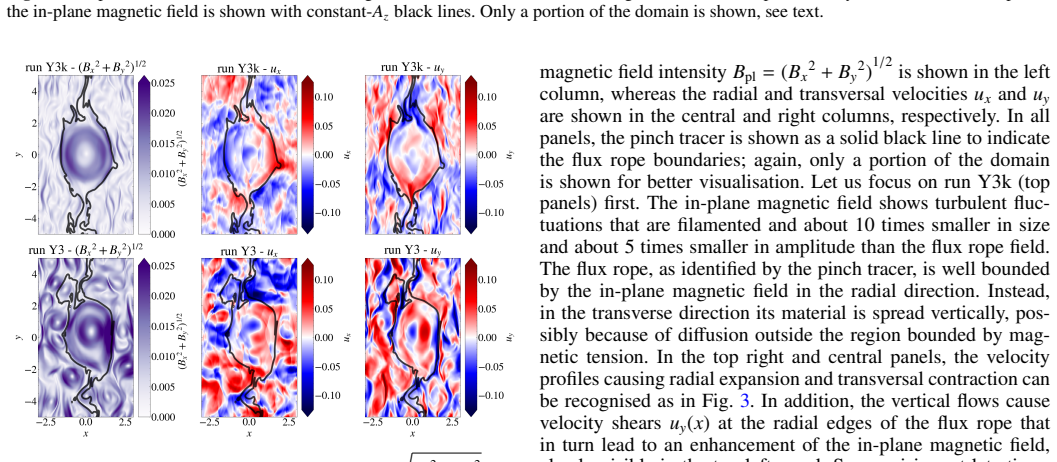
The paper argues that the anisotropic stretching of a spherically expanding solar wind is by itself sufficient to break the static equilibrium of a cylindrical flux rope and generate the radial expansion observed in magnetic clouds. In the expanding-frame simulations, the radial direction is pushed outward by magnetic pressure while the transverse direction is pulled inward by magnetic tension; the result is a front-to-back (head-tail) radial velocity profile and a radial size increase, with transverse growth less than the kinematic expectation. The dimensionless ratio $\epsilon_0 = t_A/t_\mathrm{exp}$, with $t_A$ the internal Alfvén crossing time and $t_\mathrm{exp}$ the expansion/propagation time, determines how strongly the structure resists transverse stretching and how much its radial extent grows, while the plasma $\beta$ controls the overall size. Adding turbulent fluctuations perturbs the transverse structure and can transport axial field outward, but the radial velocity profile and radial size increase remain coherent.
Load-bearing premise
The results assume a static, unperturbed flux rope that suddenly starts expanding at 30 solar radii, so whatever internal dynamics the cloud developed earlier, and any interaction with the ambient magnetic field or a sheath, are absent.
Editorial extensions
If this is right
- Magnetic clouds with small $\epsilon_0$ (slow propagation relative to internal Alfvén speed) should show the strongest radial expansion and an aspect ratio that levels off, while fast clouds should stay closer to the kinematic, mostly transverse expansion.
- The radial head-tail velocity profile and radial size growth should survive in the presence of turbulence; only the transverse structure is significantly eroded, so single radial cuts through the cloud still look like expanding flux ropes.
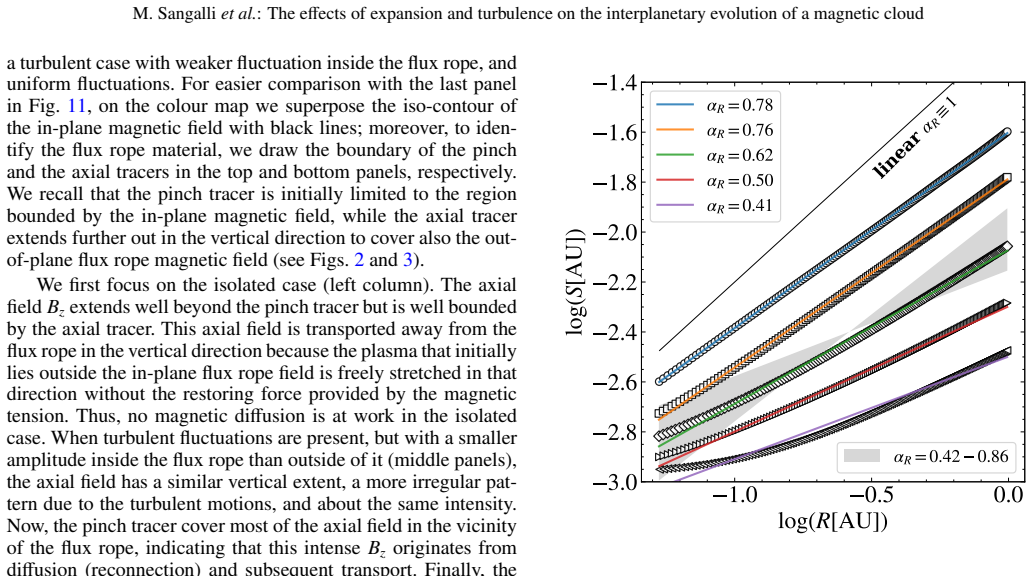
- Estimates of the local expansion parameter $\zeta$ and the global radial-size exponent $\alpha_R$ should both decrease as $\epsilon_0$ increases, and $\alpha_R$ should stay below unity for the parameter range studied.
- When the internal Alfvén time is much shorter than the expansion time, the decay exponent of the peak magnetic field, $\alpha_B/2$, is a workable proxy for the radial-size exponent $\alpha_R$.
Reading between the lines
- One consequence the authors leave implicit: $\epsilon_0$ could serve as a classification axis for in-situ magnetic-cloud catalogs, separating slowly expanding, well-connected clouds from fast, kinematically dominated ones, and this could be tested with existing multi-event datasets.
- Because the mechanism is geometric, it should act on any magnetic structure in spherical expansion, not just this particular equilibrium; a direct test would be to repeat the runs with a force-free flux rope and check that the radial head-tail profile still emerges.
- The abrupt switch-on at 30 solar radii is an idealization that likely overestimates the transient imbalance phase; a run that starts closer to the Sun or ramps the expansion gradually would show whether the 1 AU radial sizes and $\alpha_R$ exponents shift upward toward the observed upper range.
- The turbulence results suggest a sharpening prediction: for $\epsilon_T = t_\mathrm{NL}/t_\mathrm{exp}$ near unity, turbulent eddies should be able to diffuse the axial field out to distances comparable to the cloud size, while for much smaller $\epsilon_T$ they cannot, and this could be checked by measuring magnetic coherence length versus cloud speed in situ.
Editorial analysis
A structured set of objections, weighed in public.
Referee Report
Summary. This paper uses expanding-box MHD simulations of a 2.5D cylindrical magnetic flux rope carried by a spherically expanding, unmagnetised solar wind to isolate the internal dynamics of a magnetic cloud. Starting from a static, pressure-balanced equilibrium at 30 R_sun, the authors find that the anisotropic spherical expansion alone perturbs the equilibrium, producing a radial head-tail velocity profile and a radial size increase, while magnetic tension resists transverse stretching. The non-dimensional expansion rate epsilon_0 = t_A/t_exp is proposed as the controlling parameter for radial growth and transverse resistance, the ambient plasma beta controls the overall size, and superposed turbulence is shown to disturb the transverse structure while leaving radial expansion approximately coherent. The results are compared with statistical 1 AU observations and with dimensionless estimates of the radial scaling exponent alpha_R and expansion parameter zeta.
Significance. If the central mechanism is correct, the paper provides a clean and useful organizing parameter, epsilon_0, for magnetic-cloud radial expansion and demonstrates numerically that spherical geometry alone can generate the observed radial expansion without sheath, shock, or ambient-field interaction. The study has clear strengths: a systematic parameter scan in epsilon_0 and beta_0, a quantitative force decomposition in Section 3.2, high-resolution turbulence runs, and an unusually candid list of limitations in Section 6.2. The qualitative picture is well supported by the reported fields, velocity maps, and size evolutions. However, the quantitative validation of the epsilon_0-dependence is not yet robust: the alpha_R fits include an initialisation transient for the runs that set the trend, and the zeta anti-correlation contains an explicit 1/epsilon_0 definitional factor. The quantitative claims therefore need a transient-free re-analysis before they can be regarded as established predictions.
major comments (4)
- [5.2, Fig. 15] The claimed anti-correlation between alpha_R and epsilon_0 is not yet established, because the fitting window a>2 includes the switch-on transient for exactly the runs that determine the trend. The paper itself states in Section 5.2 that for runs A4-A6 'we still get a transitional phase ... which leads to a systematic underestimation of alpha_R', and because epsilon_0 is varied by changing the propagation speed (Table 1), larger epsilon_0 also means less travel time to 1 AU, so the transient occupies a larger fraction of the sampled evolution. Please re-fit alpha_R using only the quasi-steady phase for each run, report the asymptotic late-time slope separately, and show that the anti-correlation survives this removal of the transient.
- [Eq. (25), Section 5.2] The reported zeta values are not independent evidence for the epsilon_0-dependence of the local expansion: Eq. (25) defines zeta with an explicit 1/epsilon_0 prefactor, so even a physical velocity slope Delta u_x/Delta x that is independent of epsilon_0 would produce an anti-correlation between zeta and epsilon_0. The paper acknowledges this in one sentence, but the subsequent conclusion that zeta is 'anti-correlated to epsilon_0 similarly to alpha_R' continues to rely on the definitional trend. Please quantify the separate contributions by reporting, for example, epsilon_0 * zeta = a Delta u_x/Delta x as a function of epsilon_0, and base the physical interpretation on the scaling of the velocity slope itself.
- [Sections 2.2 and 6.2] The abrupt switch-on of expansion at R0 = 30 R_sun from an exact static equilibrium is acknowledged in Section 6.2 as 'probably not very realistic' and as overestimating the duration of the dynamically imbalanced phase. This idealisation is load-bearing for all quantitative outputs: it biases the 1 AU radial sizes, the fitted alpha_R values, and the zeta estimates, and it weakens the comparison with observations in Table 2. A transient-free analysis, for example by initialising with a self-similar expansion profile or by explicitly demonstrating that the fitted exponents are stable when the transient interval is excluded, is needed before the reported exponents can be attributed to the long-term expansion mechanism rather than to the initialisation.
- [Section 5.1, Table 2] The statement that the comparison with the Salman et al. (2020a) Cat-III averages shows 'quite good agreement' overstates the validation. For all three representative runs the 1 AU values of <B>, <n>, and L_FR lie below the observed means, and <beta> = 0.25-0.30 falls outside the observed 0.1 +/- 0.1 range; only the expansion speed V_exp is consistent with the quoted dispersion. Please either quantify the agreement with uncertainties or explicitly present Table 2 as a consistency check in the lower-end parameter limit, rather than as validation of the central scaling claims.
minor comments (5)
- [Section 5.2] There is a typo in 'The values of zetaestimated from runs A2-A6'; it should read 'zeta estimated'. In addition, the reported alpha_R and zeta values are given without uncertainties, which makes the comparison with observed ranges such as alpha_R = 0.81 +/- 0.19 difficult to assess.
- [Section 2.1, Eq. (22)] The notation T_x and T_y in Eq. (22) is introduced without a formal definition; please define these as the magnetic tension terms and clarify which components of the tension are retained in the two coordinate projections.
- [Table 1] The table headers use superscripts a-d that are not explained in the caption; please add an explicit note that the superscripts refer to the equations listed below the table.
- [Appendix B] The dissipative terms are explicitly not derived from the MHD dissipative terms in the expanding frame, but this is stated only in the appendix. Since the turbulent spectral slopes in Section 4.1 may be affected by the dissipation model, this caveat should also appear in the main text where the spectra are interpreted.
- [Sections 6.1 and 5.1] Section 6.1 says that the simulations were 'validated' with 'quite good agreement', which is stronger than the nuanced discussion in Section 5.1; please harmonise the wording so the conclusions match the quantitative caveats.
Circularity Check
Partial definitional circularity in the ζ–ε0 anti-correlation; core expanding-box results are independent.
-
self definitional
[Section 5.2, Eq. (25) and following text]
"ζ= ∆ux ∆x a ε0 ,(25) ... We find ζ=0.85 to 0.49 for runs A2 to A6 (ε0=0.2 to 3.2), anti-correlated to ε0 similarly to αR. ... We note that an intrinsic anti-correlation exists between ζ and ε0 by definition in Eq. (25), but the same reasoning as Sect. 3.4 holds: the radial expansion velocity scales more weakly with ε0 than does the available time."
The expansion parameter ζ in Eq. (25) is constructed with an explicit multiplicative 1/ε0 factor. At a fixed observation distance a, any velocity-gradient term Δu_x/Δx that is independent of ε0, or grows more slowly than linearly, yields ζ decreasing with ε0; hence the reported anti-correlation of ζ with ε0 in Fig. 16 is partly an identity. The paper acknowledges this, and the residual content is the separate dynamical statement that Δu_x/Δx grows only as ~ε0^{1/2} (Sect. 3.4). Because the central validation narrative also invokes α_R (a direct fit to σ_x(a)) and the geometric ε0* = 2/π estimate, the definitional component is partial rather than total.
full rationale
The core derivation is self-contained: an exact static MHD flux-rope equilibrium (Eqs. 13, 14, A.1–A.5) is placed into the expanding-box MHD equations (Eqs. 5), whose anisotropic stretching terms are the only perturbation. The resulting radial push and transverse pull are diagnosed directly from force balances (Figs. 4, 5), and the dependence on ε0 is checked by varying ε0 across runs A2–A6 (Table 1). These are genuine simulation outputs, not fits to the target quantities. The critical rate ε0* = 2/π follows from the quarter-circle tension-communication estimate (Eq. 23), not from fitting. Self-citations (Papini et al. 2019, 2021 for the code and turbulence setup; Dong et al. 2014 for EBM variants) are methodological and are not load-bearing for the physical conclusions. The one partially circular element is the ζ–ε0 anti-correlation: Eq. (25) contains an explicit 1/ε0 factor, so part of the reported trend is definitional, and the authors explicitly note this. The α_R–ε0 anti-correlation is a genuine fit, though the paper flags that the a>2 window still contains the switch-on transient for runs A4–A6, and Section 6.2 concedes that starting from an unperturbed flux rope at R0 = 30 R☉ overestimates the imbalance phase. Those limitations affect robustness but are not circularity. Overall, partial definitional circularity in one supporting estimate; the main mechanism and parameter study remain independent.
Assumptions & free parameters
free parameters (6)
- Non-dimensional expansion rate epsilon_0 =
0.2, 0.4, 0.8, 1.6, 3.2 (runs A2-A6; AR=1.0)
- Ambient plasma beta beta_0 =
0.6, 1.0, 2.0, 4.0 (runs B3, A3, C3, D3)
- Twist ratio B_theta,0/B_z,0 =
0.5
- Initial turbulent amplitude delta_B/B_FR =
0.5 (runs Y3, Y3k, Y3h, Z3)
- Dissipation coefficients mu, eta, kappa =
7.5e-5 to 2.0e-4 (scaled as a^-1 in turbulent runs)
- alpha_R fitting window lower bound a_min =
2
assumptions (5)
- domain assumption Expanding box model (EBM) with anisotropic gradients and frictional terms correctly represents the internal dynamics of a parcel of plasma in a spherically expanding radial flow.
- domain assumption The solar wind flow is spherical, uniform and non-magnetised, and the magnetic cloud propagates at constant radial speed U0.
- domain assumption Local cylindrical symmetry: the flux rope curvature radius is much larger than its radial size, so partial_z = 0 and the dynamics is 2.5D.
- domain assumption The initial configuration is a static, stationary, axially symmetric equilibrium (Eq. 13) with uniform density.
- ad hoc to paper Dissipative terms act on rescaled fields with the same form as non-expanding MHD; this is not formally derived from MHD dissipative terms.
Cite this review
Pith. "Pith review of The effects of expansion and turbulence on the interplanetary evolution of a magnetic cloud." pith.science (2026). https://pith.science/paper/KELQYETY
@misc{pith2026250515527,
  author       = {Pith},
  title        = {Pith review of: The effects of expansion and turbulence on the interplanetary evolution of a magnetic cloud},
  year         = {2026},
  howpublished = {\url{https://pith.science/paper/KELQYETY}},
  note         = {Machine review of arXiv:2505.15527}
}
read the original abstract
Coronal mass ejections (CMEs) represent the most extreme solar products, showing complex and dynamic structures when detected in situ. They are often preceded by a shock and carry a magnetic cloud organised as a flux rope, surrounded and permeated by turbulent fluctuations, and whose radial size expands during propagation. We investigate the internal dynamics of the 2D section of a cylindrical flux rope propagating at constant velocity in the spherically expanding solar wind, employing the expanding box model, which allows for high spatial resolution. Our setting is simplified, with uniform and non-magnetised solar wind, to which we superpose turbulent fluctuations. We find that the spherically expanding geometry alone perturbs the flux rope equilibrium, producing a radial head-tail velocity profile and a radial size increase. The ratio between the expansion and Alfv\'en timescales, associated respectively to propagation and internal crossing time, controls the resistance to transverse stretching and the increase of the flux rope radial extent; the plasma beta controls the overall size of the structure. Turbulent fluctuations mainly affect the flux rope transverse structure, spreading its axial field at distances comparable to its size; on the contrary, dynamics along the radial direction remains coherent and the increase in radial size is still consistently observed. We validate our results by comparison with statistical observations and dimensionless estimates, such as the expansion parameter and the radial size scaling exponent, suggesting that the ratio between internal and propagation timescales might help in better classifying different kinds of radial expansions for flux ropes.
Figures


Figures from the paper (13 more)





Reference graph
Works this paper leans on
-
[1]
Ala-Lahti, M., Ruohotie, J., Good, S., Kilpua, E. K. J., & Lugaz, N. 2020, Journal of Geophysical Research (Space Physics), 125, e2020JA028002
work page 2020
-
[2]
Borovsky, J. E., Denton, M. H., & Smith, C. W. 2019, Journal of Geophysical Research (Space Physics), 124, 2406
work page 2019
- [3]
-
[4]
& Carbone, V
Bruno, R. & Carbone, V . 2013, Living Reviews in Solar Physics, 10, 2
2013
-
[5]
Burlaga, L. F. 1988, J. Geophys. Res., 93, 7217 Démoulin, P. 2010, in American Institute of Physics Conference Series, V ol. 1216, Twelfth International Solar Wind Conference, ed. M. Maksimovic, K. Issautier, N. Meyer-Vernet, M. Moncuquet, & F. Pantellini, 329–334 Démoulin, P. & Dasso, S. 2009, A&A, 498, 551 Démoulin, P., Nakwacki, M. S., Dasso, S., & Man...
work page 1988
- [6]
- [7]
-
[8]
Goldstein, M. L., Roberts, D. A., & Matthaeus, W. H. 1995, ARA&A, 33, 283
work page 1995
Show all 57 references
-
[9]
W., Ala-Lahti, M., Palmerio, E., Kilpua, E
Good, S. W., Ala-Lahti, M., Palmerio, E., Kilpua, E. K. J., & Osmane, A. 2020, ApJ, 893, 110
2020
-
[10]
W., Kilpua, E
Good, S. W., Kilpua, E. K. J., LaMoury, A. T., et al. 2019, Journal of Geophysical Research (Space Physics), 124, 4960
2019
-
[11]
W., Rantala, O
Good, S. W., Rantala, O. K., Jylhä, A. S. M., et al. 2023, ApJ, 956, L30
2023
-
[12]
2010, in Astrophysics and Space Science Proceedings, V ol
Gopalswamy, N., Akiyama, S., Yashiro, S., & Mäkelä, P. 2010, in Astrophysics and Space Science Proceedings, V ol. 19, Magnetic Coupling between the In- terior and Atmosphere of the Sun, ed. S. S. Hasan & R. J. Rutten, 289–307
2010
-
[13]
T., Hildner, E., MacQueen, R
Gosling, J. T., Hildner, E., MacQueen, R. M., et al. 1975, Sol. Phys., 40, 439
1975
-
[14]
T., McComas, D
Gosling, J. T., McComas, D. J., Phillips, J. L., & Bame, S. J. 1991, J. Geo- phys. Res., 96, 7831
1991
-
[15]
& Velli, M
Grappin, R. & Velli, M. 1996, J. Geophys. Res., 101, 425
1996
-
[16]
1993, Phys
Grappin, R., Velli, M., & Mangeney, A. 1993, Phys. Rev. Lett., 70, 2190
1993
-
[17]
M., Démoulin, P., Dasso, S., Ruiz, M
Gulisano, A. M., Démoulin, P., Dasso, S., Ruiz, M. E., & Marsch, E. 2010, A&A, 509, A39
2010
-
[18]
& Koskinen, H
Huttunen, K. & Koskinen, H. 2004, Annales Geophysicae, 22, 1729
2004
-
[19]
K., Russell, C
Jian, L. K., Russell, C. T., Luhmann, J. G., Skoug, R. M., & Steinberg, J. T. 2008, Sol. Phys., 250, 375
2008
-
[20]
2005, Geo- phys
Kataoka, R., Watari, S., Shimada, N., Shimazu, H., & Marubashi, K. 2005, Geo- phys. Res. Lett., 32, L12103
2005
-
[21]
F., Scarf, F
Kennel, C. F., Scarf, F. L., Coroniti, F. V ., Smith, E. J., & Gurnett, D. A. 1982, J. Geophys. Res., 87, 17
1982
-
[22]
Kilpua, E., Koskinen, H. E. J., & Pulkkinen, T. I. 2017, Living Reviews in Solar Physics, 14, 5
2017
-
[23]
Kilpua, E. K. J., Fontaine, D., Good, S. W., et al. 2020, Annales Geophysicae, 38, 999
2020
-
[24]
Klein, L. W. & Burlaga, L. F. 1982, J. Geophys. Res., 87, 613
1982
-
[25]
& Rust, D
Kumar, A. & Rust, D. M. 1996, J. Geophys. Res., 101, 15667
1996
-
[26]
J., Smith, C
Leamon, R. J., Smith, C. W., & Ness, N. F. 1998, Geophys. Res. Lett., 25, 2505
1998
-
[27]
J., Möstl, C., et al
Leitner, M., Farrugia, C. J., Möstl, C., et al. 2007, Journal of Geophysical Re- search (Space Physics), 112, A06113
2007
-
[28]
P., Berdichevsky, D
Lepping, R. P., Berdichevsky, D. B., Szabo, A., Arqueros, C., & Lazarus, A. J. 2003, Sol. Phys., 212, 425
2003
-
[29]
P., Wu, C
Lepping, R. P., Wu, C. C., Berdichevsky, D. B., & Ferguson, T. 2008, Annales Geophysicae, 26, 1919
2008
-
[30]
D., & Belcher, J
Liu, Y ., Richardson, J. D., & Belcher, J. W. 2005, Planet. Space Sci., 53, 3
2005
-
[31]
J., Winslow, R
Lugaz, N., Farrugia, C. J., Winslow, R. M., et al. 2018, ApJ, 864, L7
2018
-
[32]
M., Winslow, R
Lugaz, N., Salman, T. M., Winslow, R. M., et al. 2020, ApJ, 899, 119
2020
-
[33]
Manchester, W., Kilpua, E. K. J., Liu, Y . D., et al. 2017, Space Sci. Rev., 212, 1159
2017
-
[34]
K., Kojima, M., Gopalswamy, N., Kondo, T., & Smith, Z
Manoharan, P. K., Kojima, M., Gopalswamy, N., Kondo, T., & Smith, Z. 2000, ApJ, 530, 1061 Márquez Rodríguez, R., Sorriso-Valvo, L., & Yordanova, E. 2023, Sol. Phys., 298, 54
2000
-
[35]
2018, ApJ, 853, 153
Montagud-Camps, V ., Grappin, R., & Verdini, A. 2018, ApJ, 853, 153
2018
-
[36]
Odstrcil, D., Riley, P., & Zhao, X. P. 2004, Journal of Geophysical Research (Space Physics), 109, A02116
2004
-
[37]
2021, ApJ, 917, L12
Papini, E., Cicone, A., Franci, L., et al. 2021, ApJ, 917, L12
2021
-
[38]
2019, ApJ, 870, 52
Papini, E., Franci, L., Landi, S., et al. 2019, ApJ, 870, 52
2019
-
[39]
2010, A&A, 522, A100
Patsourakos, S., V ourlidas, A., & Kliem, B. 2010, A&A, 522, A100
2010
-
[40]
2024, A&A, 686, A116
Pezzi, O., Trotta, D., Benella, S., et al. 2024, A&A, 686, A116
2024
-
[41]
& Poedts, S
Pomoell, J. & Poedts, S. 2018, Journal of Space Weather and Space Climate, 8, A35
2018
-
[42]
F., Velli, M., Einaudi, G., & Dahlburg, R
Rappazzo, A. F., Velli, M., Einaudi, G., & Dahlburg, R. B. 2005, ApJ, 633, 474
2005
-
[43]
2020, Journal of Geophysical Re- search (Space Physics), 125, e28150
Regnault, F., Janvier, M., Démoulin, P., et al. 2020, Journal of Geophysical Re- search (Space Physics), 125, e28150
2020
-
[44]
Richardson, I. G. & Cane, H. V . 1995, J. Geophys. Res., 100, 23397
1995
-
[45]
Richardson, I. G. & Cane, H. V . 2012, Journal of Space Weather and Space Climate, 2, A01
2012
-
[46]
Ruzmaikin, A., Feynman, J., & Smith, E. J. 1997, J. Geophys. Res., 102, 19753
1997
-
[47]
2015, ApJ, 809, 158
Sachdeva, N., Subramanian, P., Colaninno, R., & V ourlidas, A. 2015, ApJ, 809, 158
2015
-
[48]
M., Nieves-Chinchilla, T., Jian, L
Salman, T. M., Nieves-Chinchilla, T., Jian, L. K., et al. 2024, ApJ, 966, 118
2024
-
[49]
R., J., Howard, R
Sheeley, N. R., J., Howard, R. A., Michels, D. J., et al. 1985, J. Geophys. Res., 90, 163
1985
-
[50]
P., & Telloni, D
Sorriso-Valvo, L., Yordanova, E., Dimmock, A. P., & Telloni, D. 2021, ApJ, 919, L30 St. Cyr, O. C., Plunkett, S. P., Michels, D. J., et al. 2000, J. Geophys. Res., 105, 18169
2021
-
[51]
& V ourlidas, A
Subramanian, P. & V ourlidas, A. 2007, A&A, 467, 685 Vršnak, B., Amerstorfer, T., Dumbovi´c, M., et al. 2019, ApJ, 877, 77
2007
-
[52]
Wang, C., Du, D., & Richardson, J. D. 2005, Journal of Geophysical Research (Space Physics), 110, A10107
2005
-
[53]
F., Cliver, E
Webb, D. F., Cliver, E. W., Crooker, N. U., Cry, O. C. S., & Thompson, B. J. 2000, J. Geophys. Res., 105, 7491
2000
-
[54]
Webb, D. F. & Howard, T. A. 2012, Living Reviews in Solar Physics, 9, 3
2012
-
[55]
Wray, A. A. 1990, NASA Ames Research Center, California, Report No. MS, 202
1990
-
[56]
G., Webb, D
Zhang, J., Richardson, I. G., Webb, D. F., et al. 2007, Journal of Geophysical Research (Space Physics), 112, A10102
2007
-
[57]
ˆ∇2 ˆu+ 1 3 ˆ∇ ˆ∇· ˆu # (B.2a) ∂t ˆB diss =η ˆ∇2 ˆB(B.2b) ∂t ˆϕ diss =η ˆ∇2 ˆϕ(B.2c) ∂t ˆT diss =−(γ−1)
Zhuang, B., Lugaz, N., Al-Haddad, N., et al. 2023, ApJ, 952, 7 Article number, page 18 of 19 M. Sangalliet al.: The effects of expansion and turbulence on the interplanetary evolution of a magnetic cloud Appendix A: Initial equilibrium condition The local radial profilesf(r ′)...
2005
Reviewed August 7, 2026 · model on record in the stance chip above.
Discussion (0). Continue with ORCID to comment.