REVIEW 3 major objections 6 minor 62 references
PlantDreamer: Achieving Realistic 3D Plant Models with Diffusion-Guided Gaussian Splatting
T0 review · 3 major / 6 minor · reviewed 2026-08-07 · deepseek-v4-flash
Pith's one-line read PlantDreamer anchors 3D Gaussian splats to a fixed point cloud and uses a per-species LoRA to make synthetic plants more realistic than text-to-3D models.
desk verdict Useful plant-specific 3DGS pipeline, but the headline claim is supported by a confounded PSNR comparison where PlantDreamer keeps the test geometry. read the letter →
The pith
A machine-rendered reading of the paper's core claim, the machinery that carries it, and where it could break.
The reading
What carries the argument
The load-bearing mechanism is the depth ControlNet, which renders depth maps from a point cloud that is kept fixed for the whole optimization and feeds them as conditioning into the diffusion denoiser, so every SDS update is told where the plant's surface actually is. A LoRA trained on 30 images per species redirects the diffusion prior toward real leaf textures, and a culling rule deletes Gaussians whose volume exceeds the mean plus a threshold times the standard deviation, preventing large blobs from flattening fine detail. Together they constrain the 3DGS scene to the input geometry while letting the diffusion model fill in texture and small structure.
What would settle it
Take a real plant point cloud, delete one clearly visible leaf or branch from the initialisation, run PlantDreamer, and check whether the deleted structure reappears in the rendered output. The paper's Section 3.3 implies it should not, and its Table 4 shows that noisy SfM clouds (which omit or distort structure) drop PSNR from 16.12 dB to 10.72 dB.
Extended reading notes
Core claim
The central claim is that combining a geometry anchor (depth ControlNet conditioned on depth maps of a static initial point cloud), species-specific texture adaptation (LoRA trained on 30 real images), and Gaussian culling yields 3D Gaussian Splatting plant models with greater realism than available text-to-3D models. On real plant captures, PlantDreamer reaches an average masked PSNR of 16.12 dB against 11.01 dB for GaussianDreamer, and it scores comparably or better on T3Bench quality/alignment across bean and mint, while producing coherent multi-view structure. The same pipeline converts legacy point clouds into dense, textured 3DGS scenes.
Load-bearing premise
The final 3D model is anchored to the initial point cloud for the entire training run, so the generated plant can never contain geometry that the initial point cloud does not already have; if that input is incomplete or inaccurate, PlantDreamer cannot recover the missing structure.
Editorial extensions
If this is right
- For any species with a hand-built L-system and a 30-image LoRA, PlantDreamer can generate unlimited synthetic 3D plants with consistent geometry and realistic texture, without real captures.
- Legacy plant point clouds from SfM, MVS, or older 3DGS reconstructions can be upgraded to dense, textured 3DGS scenes that render faster and more realistically, though the ablation shows that noisy initial clouds degrade quality sharply.
- The masked PSNR gap (16.12 vs 11.01 dB) and the T3Bench scores indicate the pipeline is a strong candidate for generating training data for downstream 3D phenotyping models.
- The Gaussian culling algorithm is a simple add-on that could improve other 3DGS optimization pipelines, not just plant generation.
Reading between the lines
- If the static-anchor constraint is the main cause of both robustness and fragility, then allowing the anchor to be updated with the learned geometry (e.g., progressively re-rendering depth from the current splats) could extend PlantDreamer to plants whose initial point clouds are incomplete, at the cost of losing the strict geometry guarantee.
- The same recipe — depth ControlNet plus domain LoRA plus culling — should transfer to other structured objects with strong prior geometry, such as animals, fungi, or manufactured parts, if a rule-based or scanned prior point cloud is available.
- The paper's ablation suggests initial point colour acts as a controllable shading prior, so users could deliberately colour the point cloud to obtain different lighting or senescence looks without retraining.
- Since the one-time per-species cost is just a LoRA on 30 images and an L-system grammar, the approach could scale to many crop species, turning text-to-3D into a practical data-generation tool for agriculture.
Editorial analysis
A structured set of objections, weighed in public.
Referee Report
Summary. The paper introduces PlantDreamer, a pipeline for generating or refining 3D plant models represented as 3D Gaussian Splatting scenes, guided by a depth ControlNet, a species-specific LoRA texture adapter, and a Gaussian culling algorithm. The method supports both synthetic initialization from L-system meshes and enhancement of real point clouds. The authors evaluate against Latent-NeRF, Magic3D, Fantasia3D, and GaussianDreamer using T3Bench scores and a masked PSNR metric on captured real-plant images for bean, mint, and kale. The central claim is that PlantDreamer achieves greater realism than available text-to-3D models, supported primarily by masked PSNR results (PlantDreamer 16.12 dB vs GaussianDreamer 11.01 dB) and mixed T3Bench scores.
Significance. If validated, the approach could reduce the data scarcity bottleneck in 3D plant phenotyping by generating high-fidelity synthetic plants and upgrading legacy point clouds to dense 3DGS representations. The combination of diffusion-based texture guidance with explicit geometric anchoring is a plausible and practical design, and the authors promise to release code and datasets. However, the significance depends on whether the superiority claims survive a fair, statistically sound comparison with standard text-to-3D baselines; the current evidence is partly confounded and does not consistently favor PlantDreamer on the native synthetic evaluation.
major comments (3)
- [Table 2, Section 5.2] The masked PSNR comparison is not a fair text-to-3D evaluation. PlantDreamer's depth ControlNet is conditioned on depth maps rendered from a static point cloud that was reconstructed from the same 300 captured images used to compute PSNR (Sections 3.3 and 4.1). This gives PlantDreamer privileged information about the test geometry and effectively measures how well the initial reconstruction is preserved, whereas GaussianDreamer freely optimizes its Gaussians and can deviate from the initialization, being penalized for any geometric divergence. The headline claim of 'greater levels of realism than available text-to-3D models' in the abstract therefore rests on a confounded, asymmetric comparison rather than on the synthetic T3Bench results, which show PlantDreamer is not consistently superior (e.g., kale quality 38.97 vs GaussianDreamer's 50.92 in Table 1).
- [Table 2, Section 4] The real-plant evaluation uses very small samples (12 bean, 3 kale, 6 mint plants) and reports only averaged PSNR and T3Bench scores without error bars, confidence intervals, or significance tests. With such small and morphologically variable samples, the reported differences in Table 2 could be within natural variation, especially since the kale and mint subsets are tiny. The paper would need at least per-instance variances or a statistical test to support the strong claim of superiority.
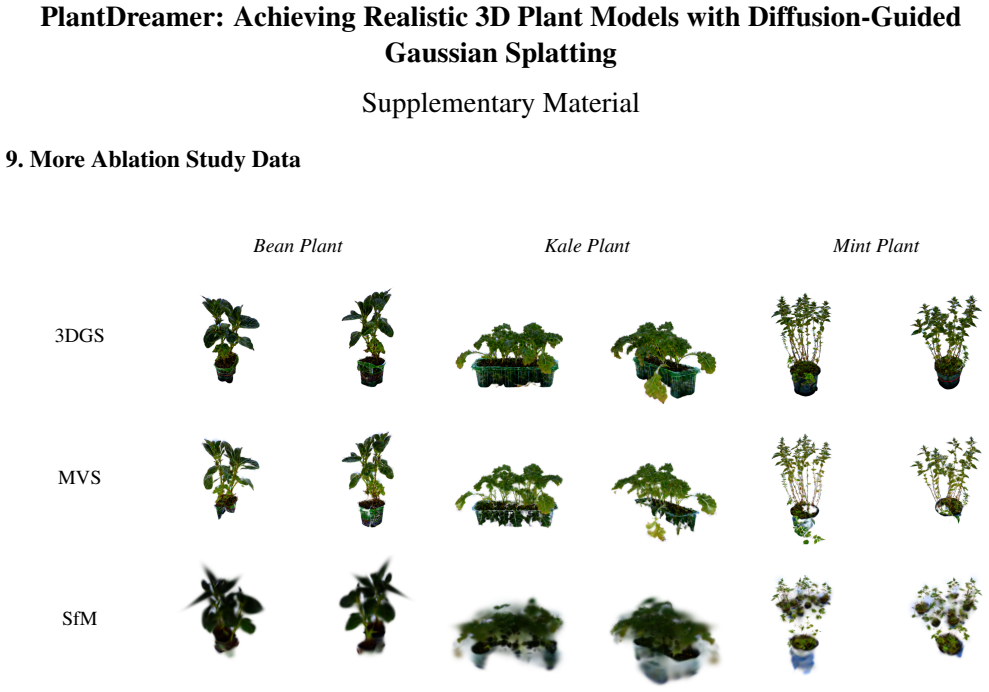
- [Section 3.3, Table 4] The method's dependence on a static initial point cloud limits its ability to correct or synthesize geometry. As the authors state, 'the model remains anchored to its initial geometry,' and the ControlNet penalizes deviations. The ablation in Table 4 demonstrates this dependency dramatically: replacing the 3DGS-derived point cloud with MVS or SfM reconstructions drops masked PSNR from 16.12 dB to 8.71 dB and 10.72 dB, respectively. This indicates that PlantDreamer cannot recover missing or inaccurate structure, so its utility for 'upgrading legacy point cloud datasets' or as a text-to-3D generator is heavily constrained by input quality, a point that should be emphasized and appropriately qualified in the abstract and conclusions.
minor comments (6)
- [Section 3.4] The section heading contains a typo: 'Initisalisaion' should be 'Initialisation'.
- [Table 1] Several entries in Table 1 lack clear separators between the Quality and Alignment values (e.g., '36.0450.0' and '28.1775.0'), making the table hard to read; these should be properly spaced or formatted.
- [Section 4.3] The sentence 'we included our large Gaussian culling algorithm with a threshold value of 3 to ensure a fair comparison' indicates that GaussianDreamer was run with a modified pipeline. This is not the standard GaussianDreamer implementation, and the choice of threshold is not justified for the baseline; the authors should report results for both the original and the modified baseline, or explain why the modification is neutral.
- [Section 5.1] There is a typo: 'T3Bench evalutes models' should be 'evaluates'.
- [Section 3.3] Equation (6) introduces notation ε̂_{ϕ′} but does not fully define ϕ′ and its relationship to the ControlNet parameters C and LoRA weights L; the notation should be clarified.
- [Supplementary Material, Figure 8] The figure caption repeats 'Figure 8' twice; the duplicate should be removed.
Circularity Check
The real-plant PSNR comparison is partially circular: PlantDreamer's geometric prior is reconstructed from the same images used as the PSNR ground truth, and the method is designed to preserve that prior.
-
fitted input called prediction
[Sections 3.3, 4.1, 5.2; Tables 2 and 4]
"Initial point clouds were produced using the original 3DGS model [28], which were trained on the captured images and then converted into dense point clouds using the 3DGS-to-PC framework [48]. ... we preserve the original point cloud geometry throughout the training loop and render each depth map from this static reference. ... Since we captured real images of the initialised plant, we could directly compare the rendered 3DGS outputs to the corresponding images."
The masked-PSNR ground truth is exactly the captured-image set used to build the input point cloud (Section 4.1). PlantDreamer conditions its diffusion on depth maps rendered from that same point cloud and preserves that geometry for the whole training loop (Section 3.3). Table 2's 16.12 dB vs 11.01 dB margin over GaussianDreamer is therefore partly a measure of how well PlantDreamer keeps the initial 3DGS reconstruction of the evaluation images, not of how well a text prompt generates a novel plant. The paper's own ablation (Table 4) confirms the metric is dominated by the input prior: substituting MVS or SfM point clouds drops PSNR to 8.71/10.72 dB. The structural component of the realism score is anchored to its own reference by construction.
full rationale
PlantDreamer is an empirical pipeline paper rather than a mathematical derivation, and most of its machinery is externally validated: T3Bench uses CLIP, ImageReward, and GPT-4, which are independent of the fitted point clouds; the LoRA and ControlNet components are standard prior work; and the self-citations ([48], [49]) are methodological tools rather than load-bearing uniqueness arguments. No equation in the paper collapses its output into its input, and no parameter is directly fitted to the headline numbers. The single material circularity is the real-plant realism evaluation: the PSNR reference images are the same images from which the input point cloud was reconstructed, and PlantDreamer is explicitly designed to preserve that point cloud's geometry via static depth conditioning. Thus Table 2 partially reports fidelity to the input prior rather than text-to-3D generation ability, and Table 4 shows the score is largely inherited from the initial reconstruction quality. T3Bench results are mixed and provide independent content, so the circularity is partial, not total.
Assumptions & free parameters
free parameters (6)
- Gaussian culling threshold C =
3
- SDS noise weighting schedule =
0.2-0.98, 0.12-0.35, 0.12-0.25, 0.075-0.15
- Point cloud downsampling target =
approximately 100,000 points
- LoRA training set size =
30 images per species
- Optimizer learning rates =
0.00005 for position, 0.0125 for spherical harmonics
- Depth map mask erosion and dilation parameters =
unspecified
assumptions (6)
- domain assumption Score distillation sampling provides a valid gradient signal for optimizing a 3DGS scene from a 2D diffusion prior.
- domain assumption Depth ControlNet conditioning on depth maps rendered from a static point cloud preserves geometry while allowing texture updates.
- ad hoc to paper The volume-based Gaussian culling rule removes only artifact Gaussians and does not remove useful detail.
- domain assumption L-system meshes designed from visual observation approximate the real species' geometry well enough for initialization.
- domain assumption T3Bench scores (CLIP, ImageReward, GPT-4) are valid measures of 3D quality and text alignment for plants.
- domain assumption Masked PSNR between rendered images and captured images is a valid proxy for realism.
Cite this review
Pith. "Pith review of PlantDreamer: Achieving Realistic 3D Plant Models with Diffusion-Guided Gaussian Splatting." pith.science (2026). https://pith.science/paper/VTKFFCDJ
@misc{pith2026250515528,
  author       = {Pith},
  title        = {Pith review of: PlantDreamer: Achieving Realistic 3D Plant Models with Diffusion-Guided Gaussian Splatting},
  year         = {2026},
  howpublished = {\url{https://pith.science/paper/VTKFFCDJ}},
  note         = {Machine review of arXiv:2505.15528}
}
read the original abstract
Recent years have seen substantial improvements in the ability to generate synthetic 3D objects using AI. However, generating complex 3D objects, such as plants, remains a considerable challenge. Current generative 3D models struggle with plant generation compared to general objects, limiting their usability in plant analysis tools, which require fine detail and accurate geometry. We introduce PlantDreamer, a novel approach to 3D synthetic plant generation, which can achieve greater levels of realism for complex plant geometry and textures than available text-to-3D models. To achieve this, our new generation pipeline leverages a depth ControlNet, fine-tuned Low-Rank Adaptation and an adaptable Gaussian culling algorithm, which directly improve textural realism and geometric integrity of generated 3D plant models. Additionally, PlantDreamer enables both purely synthetic plant generation, by leveraging L-System-generated meshes, and the enhancement of real-world plant point clouds by converting them into 3D Gaussian Splats. We evaluate our approach by comparing its outputs with state-of-the-art text-to-3D models, demonstrating that PlantDreamer outperforms existing methods in producing high-fidelity synthetic plants. Our results indicate that our approach not only advances synthetic plant generation, but also facilitates the upgrading of legacy point cloud datasets, making it a valuable tool for 3D phenotyping applications.
Figures


Figures from the paper (5 more)




Reference graph
Works this paper leans on
-
[1]
A realistic syn- thetic mushroom scenes dataset
Dafni Anagnostopoulou, George Retsinas, Niki Efthymiou, Panagiotis Filntisis, and Petros Maragos. A realistic syn- thetic mushroom scenes dataset. InProceedings of the IEEE/CVF Conference on Computer Vision and Pattern Recognition, pages 6281–6288, 2023. 2
work page 2023
-
[2]
Evaluating Neural Radiance Fields (NeRFs) for 3D Plant Geometry Reconstruction in Field Conditions
Muhammad Arbab Arshad, Talukder Jubery, James Afful, Anushrut Jignasu, Aditya Balu, Baskar Ganapathysubrama- nian, Soumik Sarkar, and Adarsh Krishnamurthy. Evaluat- ing nerfs for 3d plant geometry reconstruction in field condi- tions.arXiv preprint arXiv:2402.10344, 2024. 2
work page Pith review arXiv 2024
-
[3]
Frans P Boogaard, Eldert J van Henten, and Gert Koot- stra. The added value of 3d point clouds for digital plant phenotyping–a case study on internode length measurements in cucumber.biosystems engineering, 234:1–12, 2023. 2
work page 2023
-
[4]
TexFusion: Synthesizing 3D Textures with Text-Guided Image Diffusion Models
Tianshi Cao, Karsten Kreis, Sanja Fidler, Nicholas Sharp, and Kangxue Yin. Texfusion: Synthesizing 3d textures with text-guided image diffusion models.arXiv preprint arXiv:2310.13772, 2023. 3
work page Pith review arXiv 2023
-
[5]
Yukang Cao, Yan-Pei Cao, Kai Han, Ying Shan, and Kwan- Yee K. Wong. Dreamavatar: Text-and-shape guided 3d hu- man avatar generation via diffusion models. InProceedings of the IEEE/CVF Conference on Computer Vision and Pat- tern Recognition (CVPR), pages 958–968, 2024. 3
work page 2024
-
[6]
Fan- tasia3d: Disentangling geometry and appearance for high- quality text-to-3d content creation
Rui Chen, Yongwei Chen, Ningxin Jiao, and Kui Jia. Fan- tasia3d: Disentangling geometry and appearance for high- quality text-to-3d content creation. InProceedings of the IEEE/CVF international conference on computer vision, pages 22246–22256, 2023. 1, 2, 6
work page 2023
-
[7]
Control3D: Towards Controllable Text-to-3D Generation
Yang Chen, Yingwei Pan, Yehao Li, Ting Yao, and Tao Mei. Control3d: Towards controllable text-to-3d generation. arXiv preprint arXiv:2311.05461, 2023. 3
work page Pith review arXiv 2023
-
[8]
Text-to-3d using gaussian splatting
Zilong Chen, Feng Wang, Yikai Wang, and Huaping Liu. Text-to-3d using gaussian splatting. InProceedings of the IEEE/CVF Conference on Computer Vision and Pattern Recognition (CVPR), pages 21401–21412, 2024. 1, 2
work page 2024
Show all 62 references
-
[9]
Michels, Soren Pirk, Chia- Chun Fu, and Wojciech Palubicki
Mikolaj Cieslak, Umabharathi Govindarajan, Alejandro Gar- cia, Anuradha Chandrashekar, Torsten Hadrich, Aleksander Mendoza-Drosik, Dominik L. Michels, Soren Pirk, Chia- Chun Fu, and Wojciech Palubicki. Generating diverse agri- cultural data for vision-based farming application...
2024
-
[10]
Blender Foundation, Stichting Blender Foundation, Amsterdam, 2018
Blender Online Community.Blender - a 3D modelling and rendering package. Blender Foundation, Stichting Blender Foundation, Amsterdam, 2018. 5
2018
-
[11]
Rose-x: an annotated data set for evaluation of 3d plant organ segmentation methods.Plant methods, 16: 1–14, 2020
Helin Dutagaci, Pejman Rasti, Gilles Galopin, and David Rousseau. Rose-x: an annotated data set for evaluation of 3d plant organ segmentation methods.Plant methods, 16: 1–14, 2020. 2
2020
-
[12]
Bashar Elnashef, Sagi Filin, and Ran Nisim Lati. Tensor- based classification and segmentation of three-dimensional point clouds for organ-level plant phenotyping and growth analysis.Computers and electronics in agriculture, 156:51– 61, 2019. 1
2019
-
[13]
Easydcp: An afford- able, high-throughput tool to measure plant phenotypic traits in 3d.Methods in Ecology and Evolution, 12(9):1679–1686,
Alexander Feldman, Haozhou Wang, Yuya Fukano, Yoichiro Kato, Seishi Ninomiya, and Wei Guo. Easydcp: An afford- able, high-throughput tool to measure plant phenotypic traits in 3d.Methods in Ecology and Evolution, 12(9):1679–1686,
-
[14]
Lidar platform for acquisition of 3d plant phenotyping database.Plants, 11(17):2199, 2022
Manuel G Forero, Harold F Murcia, Dehyro M ´endez, and Juan Betancourt-Lozano. Lidar platform for acquisition of 3d plant phenotyping database.Plants, 11(17):2199, 2022. 2
2022
-
[15]
Generative adversarial nets.Advances in neural information processing systems, 27, 2014
Ian Goodfellow, Jean Pouget-Abadie, Mehdi Mirza, Bing Xu, David Warde-Farley, Sherjil Ozair, Aaron Courville, and Yoshua Bengio. Generative adversarial nets.Advances in neural information processing systems, 27, 2014. 2
2014
-
[16]
Xiao Han, Yukang Cao, Kai Han, Xiatian Zhu, Jiankang Deng, Yi-Zhe Song, Tao Xiang, and Kwan-Yee K. Wong. Headsculpt: Crafting 3d head avatars with text.arXiv preprint arXiv:2306.03038, 2023. 3
2023 arXiv
-
[17]
Domain targeted synthetic plant style transfer using stable diffusion lora and controlnet
Zane KJ Hartley, Rob J Lind, Michael P Pound, and An- drew P French. Domain targeted synthetic plant style transfer using stable diffusion lora and controlnet. InProceedings of the IEEE/CVF Conference on Computer Vision and Pattern Recognition, pages 5375–5383, 2024. 2
2024
-
[18]
T3 bench: Benchmarking current progress in text-to-3d gener- ation.arXiv preprint arXiv:2310.02977, 2023
Yuze He, Yushi Bai, Matthieu Lin, Wang Zhao, Yubin Hu, Jenny Sheng, Ran Yi, Juanzi Li, and Yong-Jin Liu. T3 bench: Benchmarking current progress in text-to-3d gener- ation.arXiv preprint arXiv:2310.02977, 2023. 2, 6
2023 arXiv
-
[19]
Synthset: Generative diffusion model for se- mantic segmentation in precision agriculture.arXiv preprint arXiv:2411.03505, 2024
Andrew Heschl, Mauricio Murillo, Keyhan Najafian, and Farhad Maleki. Synthset: Generative diffusion model for se- mantic segmentation in precision agriculture.arXiv preprint arXiv:2411.03505, 2024. 2
2024 arXiv
-
[20]
Denoising dif- fusion probabilistic models.Advances in neural information processing systems, 33:6840–6851, 2020
Jonathan Ho, Ajay Jain, and Pieter Abbeel. Denoising dif- fusion probabilistic models.Advances in neural information processing systems, 33:6840–6851, 2020. 2
2020
-
[21]
Text2room: Extracting textured 3d meshes from 2d text-to-image models
Lukas H ¨ollein, Ang Cao, Andrew Owens, Justin Johnson, and Matthias Nießner. Text2room: Extracting textured 3d meshes from 2d text-to-image models. InProceedings of the IEEE/CVF International Conference on Computer Vi- sion, pages 7909–7920, 2023. 3
2023
-
[22]
Lora: Low-rank adaptation of large language models.arXiv preprint arXiv:2106.09685, 2021
Edward J Hu, Yelong Shen, Phillip Wallis, Zeyuan Allen- Zhu, Yuanzhi Li, Shean Wang, Lu Wang, and Weizhu Chen. Lora: Low-rank adaptation of large language models.arXiv preprint arXiv:2106.09685, 2021. 2, 4
2021 arXiv
-
[23]
High-fidelity 3d reconstruction of plants using neural radiance fields.Computers and Electronics in Agri- culture, 220:108848, 2024
Kewei Hu, Wei Ying, Yaoqiang Pan, Hanwen Kang, and Chao Chen. High-fidelity 3d reconstruction of plants using neural radiance fields.Computers and Electronics in Agri- culture, 220:108848, 2024. 2
2024
-
[24]
Structure from motion photogrammetry in forestry: A review.Current Forestry Reports, 5:155–168, 2019
Jakob Iglhaut, Carlos Cabo, Stefano Puliti, Livia Piermat- tei, James O’Connor, and Jacqueline Rosette. Structure from motion photogrammetry in forestry: A review.Current Forestry Reports, 5:155–168, 2019. 5
2019
-
[25]
Avatar- craft: Transforming text into neural human avatars with pa- rameterized shape and pose control
Ruixiang Jiang, Can Wang, Jingbo Zhang, Menglei Chai, Mingming He, Dongdong Chen, and Jing Liao. Avatar- craft: Transforming text into neural human avatars with pa- rameterized shape and pose control. InProceedings of the IEEE/CVF International Conference on Computer Vision, p...
2023
-
[26]
Plant geometry reconstruction from field data using neural radiance fields
Anushrut Jignasu, Ethan Herron, Talukder Zaki Jubery, James Afful, Aditya Balu, Baskar Ganapathysubramanian, Soumik Sarkar, and Adarsh Krishnamurthy. Plant geometry reconstruction from field data using neural radiance fields. In 2nd AAAI Workshop on AI for Agriculture and Food...
-
[27]
Shap-e: Generat- ing conditional 3d implicit functions.arXiv preprint arXiv:2305.02463, 2023
Heewoo Jun and Alex Nichol. Shap-e: Generat- ing conditional 3d implicit functions.arXiv preprint arXiv:2305.02463, 2023. 2, 4
2023 arXiv
-
[28]
3d gaussian splatting for real-time radiance field rendering.ACM Transactions on Graphics (ToG), 42(4):1–14, 2023
Bernhard Kerbl, Georgios Kopanas, Thomas Leimk ¨uhler, and George Drettakis. 3d gaussian splatting for real-time radiance field rendering.ACM Transactions on Graphics (ToG), 42(4):1–14, 2023. 2, 5
2023
-
[29]
Synthetic data at scale: a development model to efficiently leverage machine learning in agriculture.Frontiers in Plant Science, 15:1360113, 2024
Jonathan Klein, Rebekah Waller, S ¨oren Pirk, Wojtek Pałubicki, Mark Tester, and Dominik L Michels. Synthetic data at scale: a development model to efficiently leverage machine learning in agriculture.Frontiers in Plant Science, 15:1360113, 2024. 2
2024
-
[30]
Generative ai meets 3d: A survey on text-to-3d in aigc era.arXiv preprint arXiv:2305.06131, 2024
Chenghao Li, Chaoning Zhang, Joseph Cho, Atish Wagh- wase, Lik-Hang Lee, Francois Rameau, Yang Yang, Sung- Ho Bae, and Choong Seon Hong. Generative ai meets 3d: A survey on text-to-3d in aigc era.arXiv preprint arXiv:2305.06131, 2024. 2
2024 arXiv
-
[31]
Mvcontrol: Adding conditional control to multi-view diffu- sion for controllable text-to-3d generation.arXiv preprint arXiv:2311.14494, 2023
Zhiqi Li, Yiming Chen, Lingzhe Zhao, and Peidong Liu. Mvcontrol: Adding conditional control to multi-view diffu- sion for controllable text-to-3d generation.arXiv preprint arXiv:2311.14494, 2023. 3
2023 arXiv
-
[32]
Luciddreamer: Towards high- fidelity text-to-3d generation via interval score matching
Yixun Liang, Xin Yang, Jiantao Lin, Haodong Li, Xiaogang Xu, and Yingcong Chen. Luciddreamer: Towards high- fidelity text-to-3d generation via interval score matching. InProceedings of the IEEE/CVF Conference on Computer Vision and Pattern Recognition (CVPR), pages 6517–6526,
-
[33]
Magic3d: High-resolution text-to-3d content creation
Chen-Hsuan Lin, Jun Gao, Luming Tang, Towaki Takikawa, Xiaohui Zeng, Xun Huang, Karsten Kreis, Sanja Fidler, Ming-Yu Liu, and Tsung-Yi Lin. Magic3d: High-resolution text-to-3d content creation. InProceedings of the IEEE/CVF conference on computer vision and pattern recognition...
2023
-
[34]
Lu Lou, Yonghuai Liu, Minglan Shen, Jiwan Han, Fiona Corke, and John H. Doonan. Estimation of branch angle from 3d point cloud of plants. In2015 International Confer- ence on 3D Vision, pages 554–561, 2015. 1
2015
-
[35]
Latent-nerf for shape-guided generation of 3d shapes and textures
Gal Metzer, Elad Richardson, Or Patashnik, Raja Giryes, and Daniel Cohen-Or. Latent-nerf for shape-guided generation of 3d shapes and textures. InProceedings of the IEEE/CVF conference on computer vision and pattern recognition, pages 12663–12673, 2023. 1, 2, 5
2023
-
[36]
Deep learning in image-based plant phe- notyping.Annual Review of Plant Biology, 75, 2024
Katherine M Murphy, Ella Ludwig, Jorge Gutierrez, and Malia A Gehan. Deep learning in image-based plant phe- notyping.Annual Review of Plant Biology, 75, 2024. 1
2024
-
[37]
Splanting: 3d plant capture with gaussian splatting
Tommy Ojo, Thai La, Andrew Morton, and Ian Stavness. Splanting: 3d plant capture with gaussian splatting. InSIG- GRAPH Asia 2024 Technical Communications, New York, NY , USA, 2024. Association for Computing Machinery. 2
2024
-
[38]
Barron, and Ben Milden- hall
Ben Poole, Ajay Jain, Jonathan T. Barron, and Ben Milden- hall. Dreamfusion: Text-to-3d using 2d diffusion.arXiv preprint arXiv:2209.14988, 2022. 1, 2
2022 arXiv
-
[39]
Graphical applications of l- systems
Przemyslaw Prusinkiewicz. Graphical applications of l- systems. InProceedings of graphics interface, pages 247– 253, 1986. 2
1986
-
[40]
Texture: Text-guided texturing of 3d shapes
Elad Richardson, Gal Metzer, Yuval Alaluf, Raja Giryes, and Daniel Cohen-Or. Texture: Text-guided texturing of 3d shapes. InACM SIGGRAPH 2023 conference proceedings, pages 1–11, 2023. 3
2023
-
[41]
High-resolution image synthesis with latent diffusion models
Robin Rombach, Andreas Blattmann, Dominik Lorenz, Patrick Esser, and Bj ¨orn Ommer. High-resolution image synthesis with latent diffusion models. InProceedings of the IEEE/CVF conference on computer vision and pattern recognition, pages 10684–10695, 2022. 3
2022
-
[42]
Academic press, 1980
Grzegorz Rozenberg and Arto Salomaa.The mathematical theory of L systems. Academic press, 1980. 2
1980
-
[43]
Peanutnerf: 3d radiance field for peanuts
Farah Saeed, Jin Sun, Peggy Ozias-Akins, Ye Juliet Chu, and Changying Charlie Li. Peanutnerf: 3d radiance field for peanuts. InProceedings of the IEEE/CVF Conference on Computer Vision and Pattern Recognition, pages 6253– 6262, 2023. 2
2023
-
[44]
Structure-from-motion revisited
Johannes Lutz Sch ¨onberger and Jan-Michael Frahm. Structure-from-motion revisited. InConference on Com- puter Vision and Pattern Recognition (CVPR), 2016. 5
2016
-
[45]
Pheno4d: A spatio-temporal dataset of maize and tomato plant point clouds for phenotyping and ad- vanced plant analysis.PLOS ONE, 16(8):1–18, 2021
David Schunck, Federico Magistri, Radu Alexandru Rosu, Andr´e Cornelißen, Nived Chebrolu, Stefan Paulus, Jens L´eon, Sven Behnke, Cyrill Stachniss, Heiner Kuhlmann, and Lasse Klingbeil. Pheno4d: A spatio-temporal dataset of maize and tomato plant point clouds for phenotyping a...
2021
-
[46]
A comparison and evalua- tion of multi-view stereo reconstruction algorithms
Steven M Seitz, Brian Curless, James Diebel, Daniel Scharstein, and Richard Szeliski. A comparison and evalua- tion of multi-view stereo reconstruction algorithms. In2006 IEEE computer society conference on computer vision and pattern recognition (CVPR’06), pages 519–528. IEEE...
2006
-
[47]
Let 2d diffusion model know 3d- consistency for robust text-to-3d generation.arXiv preprint arXiv:2303.07937, 2024
Junyoung Seo, Wooseok Jang, Min-Seop Kwak, Hyeonsu Kim, Jaehoon Ko, Junho Kim, Jin-Hwa Kim, Jiyoung Lee, and Seungryong Kim. Let 2d diffusion model know 3d- consistency for robust text-to-3d generation.arXiv preprint arXiv:2303.07937, 2024. 3
2024 arXiv
-
[48]
3dgs-to-pc: Con- vert a 3d gaussian splatting scene into a dense point cloud or mesh.arXiv preprint arXiv:2501.07478, 2025
Lewis A G Stuart and Michael P Pound. 3dgs-to-pc: Con- vert a 3d gaussian splatting scene into a dense point cloud or mesh.arXiv preprint arXiv:2501.07478, 2025. 5
2025 arXiv
-
[49]
High-fidelity wheat plant reconstruction using 3d gaussian splatting and neural radiance fields.GigaScience, In Press,
Lewis A G Stuart, Darren M Wells, Jonathan A Atkinson, Simon Castle-Green, Jack Walker, and Michael P Pound. High-fidelity wheat plant reconstruction using 3d gaussian splatting and neural radiance fields.GigaScience, In Press,
-
[50]
Soybean-mvs: Annotated three-dimensional model dataset of whole growth period soybeans for 3d plant organ segmentation.Agriculture, 13(7), 2023
Yongzhe Sun, Zhixin Zhang, Kai Sun, Shuai Li, Jianglin Yu, Linxiao Miao, Zhanguo Zhang, Yang Li, Hongjie Zhao, Zhenbang Hu, Dawei Xin, Qingshan Chen, and Rongsheng Zhu. Soybean-mvs: Annotated three-dimensional model dataset of whole growth period soybeans for 3d plant organ se...
2023
-
[51]
3dphenomvs: A low-cost 3d tomato pheno- typing pipeline using 3d reconstruction point cloud based on multiview images.Agronomy, 12(8):1865, 2022
Yinghua Wang, Songtao Hu, He Ren, Wanneng Yang, and Ruifang Zhai. 3dphenomvs: A low-cost 3d tomato pheno- typing pipeline using 3d reconstruction point cloud based on multiview images.Agronomy, 12(8):1865, 2022. 2
2022
-
[52]
Prolificdreamer: High-fidelity and diverse text-to-3d generation with variational score distilla- tion.Advances in Neural Information Processing Systems, 36:8406–8441, 2023
Zhengyi Wang, Cheng Lu, Yikai Wang, Fan Bao, Chongxuan Li, Hang Su, and Jun Zhu. Prolificdreamer: High-fidelity and diverse text-to-3d generation with variational score distilla- tion.Advances in Neural Information Processing Systems, 36:8406–8441, 2023. 1, 2
2023
-
[53]
A synthetic datasets based instance segmentation network for high-throughput soybean pods phenotype investigation.Ex- pert systems with applications, 192:116403, 2022
Si Yang, Lihua Zheng, Huijun Yang, Man Zhang, Tingting Wu, Shi Sun, Federico Tomasetto, and Minjuan Wang. A synthetic datasets based instance segmentation network for high-throughput soybean pods phenotype investigation.Ex- pert systems with applications, 192:116403, 2022. 2
2022
-
[54]
Crop phenomics and high-throughput phe- notyping: past decades, current challenges, and future per- spectives.Molecular plant, 13(2):187–214, 2020
Wanneng Yang, Hui Feng, Xuehai Zhang, Jian Zhang, John H Doonan, William David Batchelor, Lizhong Xiong, and Jianbing Yan. Crop phenomics and high-throughput phe- notyping: past decades, current challenges, and future per- spectives.Molecular plant, 13(2):187–214, 2020. 1, 2
2020
-
[55]
Gaussian- dreamer: Fast generation from text to 3d gaussian splatting with point cloud priors.arXiv preprint arXiv:2310.08529,
Taoran Yi, Jiemin Fang, Guanjun Wu, Lingxi Xie, Xiaopeng Zhang, Wenyu Liu, Qi Tian, and Xinggang Wang. Gaussian- dreamer: Fast generation from text to 3d gaussian splatting with point cloud priors.arXiv preprint arXiv:2310.08529,
-
[56]
Adding conditional control to text-to-image diffusion models
Lvmin Zhang, Anyi Rao, and Maneesh Agrawala. Adding conditional control to text-to-image diffusion models. In Proceedings of the IEEE/CVF International Conference on Computer Vision, pages 3836–3847, 2023. 2, 4
2023
-
[57]
Open3D: A modern library for 3D data processing.arXiv:1801.09847,
Qian-Yi Zhou, Jaesik Park, and Vladlen Koltun. Open3D: A modern library for 3D data processing.arXiv:1801.09847,
-
[58]
Headstudio: Text to animatable head avatars with 3d gaussian splatting.arXiv preprint arXiv:2402.06149, 2024
Zhenglin Zhou, Fan Ma, Hehe Fan, Zongxin Yang, and Yi Yang. Headstudio: Text to animatable head avatars with 3d gaussian splatting.arXiv preprint arXiv:2402.06149, 2024. 3
2024 arXiv
-
[59]
Crops3d: a diverse 3d crop dataset for realis- tic perception and segmentation toward agricultural applica- tions.Scientific Data, 11(1):1438, 2024
Jianzhong Zhu, Ruifang Zhai, He Ren, Kai Xie, Aobo Du, Xinwei He, Chenxi Cui, Yinghua Wang, Junli Ye, Jiashi Wang, et al. Crops3d: a diverse 3d crop dataset for realis- tic perception and segmentation toward agricultural applica- tions.Scientific Data, 11(1):1438, 2024. 2
2024
-
[60]
Machine learning ap- proaches to improve three basic plant phenotyping tasks us- ing three-dimensional point clouds.Plant physiology, 181 (4):1425–1440, 2019
Illia Ziamtsov and Saket Navlakha. Machine learning ap- proaches to improve three basic plant phenotyping tasks us- ing three-dimensional point clouds.Plant physiology, 181 (4):1425–1440, 2019. 1 PlantDreamer: Achieving Realistic 3D Plant Models with Diffusion-Guided Gaussian ...
2019
-
[61]
More Ablation Study Data Bean Plant Kale Plant Mint Plant 3DGS MVS SfM Figure 6. Comparison of 3D plant models for kale, mint and bean after being initialised by 3DGS, MVS and SfM reconstructed point clouds Bean Plant Kale Plant Mint Plant Black White Noise Figure 7. Compariso...
-
[62]
Figure 8
More Real Initialised Model Renders Real Bean Plant Kale Plant Mint Plant Ground Truth GaussianDreamer PlantDreamer Figure 8. Figure 8. Comparison of 3D bean, kale and mint from GaussianDreamer and PlantDreamer models compared to a set of ground truth images
Reviewed August 7, 2026 · model on record in the stance chip above.
Discussion (0). Sign in to comment.