REVIEW 4 major objections 5 minor 2 cited by
Moonbeam: A MIDI Foundation Model Using Both Absolute and Relative Music Attributes
T0 review · 4 major / 5 minor · reviewed 2026-08-07 · deepseek-v4-flash
Pith's one-line read Moonbeam, a transformer pretrained on 81.6K hours of MIDI, encodes notes with absolute and relative musical attributes in five dimensions, and beats larger pretrained music models on most classification benchmarks.
desk verdict Solid architecture paper undercut by an unresolved PiJAMA30 pretraining-overlap question. read the letter →
The pith
A machine-rendered reading of the paper's core claim, the machinery that carries it, and where it could break.
The reading
What carries the argument
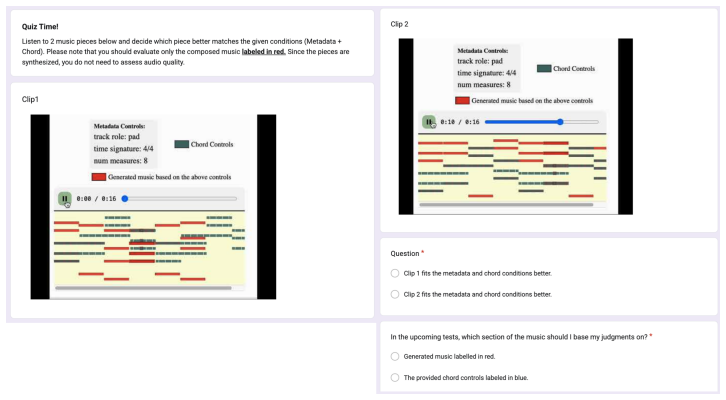
The load-bearing machinery has three parts. First, the tokenizer: each note event becomes the compound token $x = (o, d, oct, p, i, v)$ — absolute onset, duration, octave, pitch class, instrument, velocity — with all attributes except the instrument encoded by the continuous sinusoidal Fundamental Music Embedding (FME), which preserves relative musical information in the embedding space and extrapolates to unseen inputs without extra trainable parameters. Second, Multidimensional Relative Attention (MRA): an extension of RoPE in which the attention heads are partitioned into $G = 6$ groups and each group is rotated by the value of one musical attribute (onset, duration, octave, pitch class, velocity; the instrument group reuses onset), so the query-key dot product encodes the relative difference along each axis, parameter-free. Third, a GRU sub-decoder that sequentially samples the six sub-tokens of each event, capturing dependencies such as a high pitch making a bass instrument unlikely. For finetuning, classification appends a $\langle cls\rangle$ token and swaps the GRU for a linear head with LoRA, while conditional generation prepends metadata and chord-control sequences to the input so that, with absolute onsets and MRA, the model can attend to the entire control sequence, including future control events, giving it full anticipatory capability for music infilling.
What would settle it
Match the PiJAMA30 test pieces against the pretraining files listed in Table 5 by MIDI file identity or near-duplicate sequence comparison, then re-evaluate (or retrain) Moonbeam with all PiJAMA pieces removed from the corpus. If PiJAMA30 accuracy falls from 0.679 toward Clamp2's 0.440, the reported margin is substantially memorization; if the margin holds under this holdout, the architectural claim survives this attack.
Extended reading notes
Core claim
On the paper's own terms, the discovery is that Moonbeam is the first autoregressive transformer foundation model pretrained at scale on diverse MIDI — 81.6K hours and 18 billion tokens covering piano performance, scores, guitar, bass, drums, saxophone, and multitrack music — and that its gains come from jointly preserving absolute and relative musical information. Each event is a six-part compound token (absolute onset, duration, octave, pitch class, instrument, velocity), embedded with the continuous Fundamental Music Embedding so relative information survives in the embedding space and unseen values (microtones, long durations, large onsets) can be handled without new lookup entries. Multidimensional Relative Attention partitions the attention heads into six groups and rotates each group by one musical attribute in the manner of RoPE, so the attention score between two events encodes their differences in onset, duration, octave, pitch, and velocity with no extra trainable parameters. The paper argues this is why Moonbeam (M) surpasses Clamp2, M3, and MusicBERT on most of the PiJAMA30, Pianist8, Emopia, and GPM30 benchmarks (M3 retains the best Emopia score by about two points), and why its finetuned generation model, using absolute onsets for full anticipatory music infilling, earns significantly higher expert ratings than the CoMMU transformer baseline.
Load-bearing premise
The load-bearing premise is that the downstream benchmarks measure generalization rather than memorization: the pretraining table (Appendix A, Table 5) includes the PiJAMA dataset, while the player-classification benchmark PiJAMA30 (Section 5.2) is drawn from PiJAMA, and the paper never states that the PiJAMA30 test pieces were left out of pretraining; the separate private test set described in Appendix A serves the perplexity evaluation, not this downstream split.
Editorial extensions
If this is right
- A single backbone pretrained on MIDI can be finetuned into both a music classifier and a controllable generator, so the covered task families no longer require bespoke per-task tokenizers.
- Because MRA adds no parameters, the relative-information advantage seen in earlier small music models carries to the 309M and 839M scales; in the paper's ablation, replacing MRA with standard attention raises test perplexity from 2.423 to 2.512, and removing FME raises it to 4.216.
- Absolute onset values plus MRA give the generation model full anticipatory capability, so a control sequence can bracket a gap in time and the model can fill it while attending to both past and future control events, without an extra encoder or interleaved control tokens.
- The expert listening test (p-values from about $10^{-12}$ to $10^{-17}$) indicates the generation advantage is perceptually real to trained listeners on chord fit, metadata fit, coherence, and overall enjoyment, even though objective pitch and velocity accuracy slightly favour the baseline.
Reading between the lines
- The decisive control the paper does not run is removing PiJAMA entirely from the pretraining corpus before measuring PiJAMA30; the reported margin over Clamp2 (0.679 vs. 0.440) is only convincing as an architectural effect once that overlap is ruled out.
- The contrast between the objective metrics (the baseline is at or near ceiling at the widest tolerance, with pitch accuracy 0.993 and velocity accuracy 1.000, versus Moonbeam's 0.952 and 0.968) and the subjective ratings (Moonbeam clearly ahead) suggests that current 'condition adherence' metrics do not capture what expert listeners value; a follow-up study separating adherence from coherence in t
- Because FME is a continuous embedding, the tokenizer is not locked to the autoregressive GRU decoder; it could also feed diffusion or masked generative models for symbolic music, which the paper does not test.
- MRA's recipe of rotating head groups by per-axis coordinates transfers to other sequential domains with known geometry, such as video (time plus spatial axes) or robotics (time plus joint angles); the paper names robotics as a prospect but gives no evidence, so this remains a conjecture.
Editorial analysis
A structured set of objections, weighed in public.
Referee Report
Summary. Moonbeam is an autoregressive transformer-based symbolic music foundation model. The paper introduces a tokenizer that combines standard embeddings for instruments with the Fundamental Music Embedding (FME) for onset, duration, octave, pitch class, and velocity; Multidimensional Relative Attention (MRA), which extends RoPE to five musical axes by partitioning attention heads into groups; and a GRU sub-decoder for predicting the six sub-events of each compound token. Models of 309M and 839M parameters are pretrained on 81.6K hours of MIDI (18.06B tokens). The paper reports ablations on the small model and fine-tunes on player, emotion, and composer classification (PiJAMA30, Pianist8, Emopia, GPM30) as well as on conditional generation and music infilling using CoMMU. The main claims are that Moonbeam outperforms MusicBERT, Clamp2, and M3 on most classification tasks, and that the finetuned generation model outperforms a REMI-like transformer baseline in listening tests.
Significance. If the results are validated, this is a substantial contribution: MRA is a clean, parameter-free extension of RoPE to multi-dimensional musical positions; the FME-based tokenizer handles a wide range of MIDI formats; the paper releases code, weights, and samples; and the training-data disclosure (Table 5) is more detailed than in most comparable work. The ablation design is sensible and the MRA math in Appendix F is straightforward. However, the PiJAMA30 train/test overlap is a serious correctness risk for the headline classification claim, and the absence of variance or significance measures weakens the 'outperforms in most cases' statement. The generation result also depends heavily on the subjective listening test, whose protocol is only partially described. These issues are fixable within the scope of the manuscript, but they need to be addressed before the empirical claims can be accepted.
major comments (4)
- [Appendix A, Table 5; Section 5.2, Table 2] PiJAMA (217.1 h, 40.62M tokens) is listed in Moonbeam (M)'s pretraining corpus, and Table 2 evaluates on PiJAMA30, a benchmark derived from PiJAMA. The paper never states that the PiJAMA30 test pieces were excluded from pretraining; the private test set described in Appendix A is used only for pretraining perplexity, not for downstream classification. Since the largest classification margin in the paper appears on PiJAMA30 (Moonbeam (M) 0.679 vs MusicBERT 0.550 and Clamp2 0.440), this is a load-bearing data-leakage risk. Moonbeam (S), trained only on LakhMIDI, reaching 0.649 is a useful partial control, but it does not resolve the status of the Moonbeam (M) number. Please verify exclusion of all PiJAMA30 test pieces from pretraining, retrain without PiJAMA, or explicitly report the LakhMIDI-only result as the supported one.
- [Section 5.2, Tables 1-3] All experimental tables report a single run with no standard errors, confidence intervals, or significance tests. Several reported differences are small: on Emopia, Moonbeam (M) scores 0.693 vs M3's 0.715; on GPM30, Moonbeam (M) scores 0.648 vs MusicBERT's 0.630; on Pianist8, Moonbeam (S) and MusicBERT both score 0.811 accuracy. Without repeated seeds or a statistical test, the abstract claim that the model 'outperforms other large-scale pretrained music models in most cases' is not fully supported. Please add multiple seeds with error bars, or at minimum identify which differences exceed run-to-run variability.
- [Section 5.3, Tables 3-4] The objective controllability metrics in Table 3 show the baseline [24] exceeding Moonbeam on pitch and velocity accuracy (e.g., velocity accuracy at tolerance 0 is 0.862 for Moonbeam vs 0.997 for the baseline), while the subjective listening test in Table 4 strongly favors Moonbeam. As written, the generation claim rests entirely on the human evaluation, but the paper does not report inter-rater reliability, the exact randomization or blinding procedure, or whether the same conditions and samples were used for all raters. Please clarify the listening-test protocol, or soften the generation claim to reflect that objective condition-following is not better than the baseline.
- [Section 3.2.1 and Appendix F] The head-group assignment for MRA is internally inconsistent. In Section 3.2.1, G = 6 is said to come from the five music attributes plus the instrument attribute, but the piecewise definition of v_g(t) assigns g = 1 or g = 5 to onset, g = 2 to duration, g = 3 to octave, g = 4 to pitch class, and g = 6 to velocity, leaving no distinct group for instrument. Appendix F then states that the extra group is associated with the instrument and is assigned the onset value as its position. This makes the exact construction ambiguous and hampers reproducibility of the core architectural contribution. Please clarify which groups use which position decomposition and how the instrument attribute is represented in MRA.
minor comments (5)
- [Various] There are several typos: 'pretaining' in Appendix A, 'decompostion' in Section 3.2.1, 'the the lack' in Section 4.2, and 'Envirommental' in Appendix C. These should be corrected.
- [Table 1] The model names in Table 1 are rendered without spaces or delimiters (e.g., 'Moonbeamw/o FME', 'Moonbeamattn. variant'), which makes the table hard to read.
- [Section 4.2 and Appendix H] Section 4.2 states that models are compared at the piece level, while Appendix H.2 describes the preliminary PiJAMA30 experiment as clip-wise classification. Please clarify the relationship between the two evaluation protocols and why Table 8 is not part of the main results.
- [Table 3] The baseline row in Table 3 reports 'N/A' for test perplexity because the baseline uses a different tokenizer. A sentence explaining that perplexity is not comparable across tokenizers would help avoid misinterpretation.
- [Abstract and Section 6] The Github repository is mentioned in the abstract and conclusion, but no URL is given in the manuscript text; please include the link.
Circularity Check
No significant circularity: the FME self-citation is backed by in-paper ablations, MRA is derived from RoPE, and the benchmark claims are external comparisons; the unresolved PiJAMA30 overlap is a data-leakage risk, not a circular derivation.
full rationale
The claimed derivation chain is modular, and each load-bearing module is tested in this paper rather than assumed from a self-citation. The tokenizer adopts FME from the authors' prior work [17] (Section 3.1: 'we extend the tokenization method introduced in [17]'), but Section 5.1 Table 1 directly compares Moonbeam with FME (test PPL 2.423) against Moonbeam w/o FME with standard embeddings (test PPL 4.216), so the contribution of the self-cited component is independently verified by the paper's own controlled ablation. MRA is derived in Section 3.2.1 and Appendix F from RoPE (Equations 1-3) by grouping attention heads along onset, duration, octave, pitch-class, and velocity axes; no fitted parameter is renamed as a prediction. The downstream classification claims (Section 5.2, Table 2) are comparisons against external baselines Clamp2, M3, MusicBERT, and CRNN, and the generation claims (Section 5.3, Table 4) are human listening tests against an external baseline; none of these quantities is constructed from a fitted parameter. The paper does cite its own prior work for the PiJAMA dataset [43] and the GAPS dataset [51], but these are data resources rather than derived results. A separate concern, which is a data-contamination risk rather than circularity, is that Appendix A Table 5 lists PiJAMA (217.1 h) in Moonbeam(M)'s pretraining corpus while Section 5.2 evaluates on PiJAMA30, a subset of PiJAMA, and the paper never states that PiJAMA30 test pieces were excluded; similarly, Section 4.1 evaluates the LakhMIDI-trained Moonbeam(S) on 'one randomly selected 5% test set of the Lakh Dataset' that may not have been excluded from training. These issues could inflate specific numbers but do not make the derivation equivalent to its inputs by construction, so the circularity score remains low.
Assumptions & free parameters
free parameters (3)
- MRA theta base values (per-dimension) =
onset=199999, duration=1031, octave=19, pitch=20, velocity=131
- Time quantization interval and max timeshift/duration thresholds =
10ms; max 10240ms (S) / 40960ms (M)
- Sliding window lengths for classification =
1200 (PiJAMA30), 900 (Pianist8), 130 (Emopia), 1200 (GPM30)
assumptions (4)
- standard math Rotary position embeddings preserve relative positions under inner products
- domain assumption Relative musical attributes (onset, duration, octave, pitch class, velocity) are the relevant inductive biases for symbolic music modeling
- ad hoc to paper The instrument attribute can be encoded in a continuous rotary space by using onset as its position
- domain assumption Absolute onset inputs avoid the need for the model to learn arithmetic over timeshifts
Cite this review
Pith. "Pith review of Moonbeam: A MIDI Foundation Model Using Both Absolute and Relative Music Attributes." pith.science (2026). https://pith.science/paper/K6F35A2S
@misc{pith2026250515559,
  author       = {Pith},
  title        = {Pith review of: Moonbeam: A MIDI Foundation Model Using Both Absolute and Relative Music Attributes},
  year         = {2026},
  howpublished = {\url{https://pith.science/paper/K6F35A2S}},
  note         = {Machine review of arXiv:2505.15559}
}
read the original abstract
Moonbeam is a transformer-based foundation model for symbolic music, pretrained on a large and diverse collection of MIDI data totaling 81.6K hours of music and 18 billion tokens. Moonbeam incorporates music-domain inductive biases by capturing both absolute and relative musical attributes through the introduction of a novel domain-knowledge-inspired tokenization method and Multidimensional Relative Attention (MRA), which captures relative music information without additional trainable parameters. Leveraging the pretrained Moonbeam, we propose 2 finetuning architectures with full anticipatory capabilities, targeting 2 categories of downstream tasks: symbolic music understanding and conditional music generation (including music infilling). Our model outperforms other large-scale pretrained music models in most cases in terms of accuracy and F1 score across 3 downstream music classification tasks on 4 datasets. Moreover, our finetuned conditional music generation model outperforms a strong transformer baseline with a REMI-like tokenizer. We open-source the code, pretrained model, and generated samples on Github.
Figures


Figures from the paper (2 more)

Forward citations
Cited by 2 Pith papers
-
Equivariant Music Transformer
Adding an equivariance regularizer to an autoregressive music transformer makes pitch-transposed and time-shifted inputs produce correspondingly shifted outputs while slightly improving next-token prediction.
-
Amadeus: Autoregressive Model with Bidirectional Attribute Modelling for Symbolic Music
Amadeus generates symbolic music by autoregressively predicting note-level latents and decoding their attributes in parallel with a masked discrete diffusion model, yielding faster and more controllable generation tha...
Reference graph
Works this paper leans on
-
[24]
Commu: Dataset for combinatorial music generation,
H. Lee, T. Kim, H. Kang, M. Ki, H. Hwang, K. Park, S. Han, and S. J. Kim, “Commu: Dataset for combinatorial music generation,” in Advances in Neural Information Processing Systems 35: Annual Conference on Neural Information Processing Systems 2022, NeurIPS 2022, New Orleans, LA, USA, November 28 - December 9, 2022
work page 2022
-
[1]
Chatmusician: Understanding and generating music intrinsically with LLM,
R. Yuan, H. Lin, Y . Wang, Z. Tian, S. Wu, T. Shen, G. Zhang, Y . Wu, C. Liu, Z. Zhou, L. Xue, Z. Ma, Q. Liu, T. Zheng, Y . Li, Y . Ma, Y . Liang, X. Chi, R. Liu, Z. Wang, C. Lin, Q. Liu, T. Jiang, W. Huang, W. Chen, J. Fu, E. Benetos, G. Xia, R. B. Dannenberg, W. Xue, S. Kang, and Y . Guo, “Chatmusician: Understanding and generating music intrinsically w...
work page 2024
-
[2]
Mupt: A generative symbolic music pretrained transformer,
X. Qu, Y . Bai, Y . Ma, Z. Zhou, K. M. Lo, J. Liu, R. Yuan, L. Min, X. Liu, T. Zhang, X. Du, S. Guo, Y . Liang, Y . Li, S. Wu, J. Zhou, T. Zheng, Z. Ma, F. Han, W. Xue, G. Xia, E. Benetos, X. Yue, C. Lin, X. Tan, S. W. Huang, W. Chen, J. Fu, and G. Zhang, “Mupt: A generative symbolic music pretrained transformer,” inThe Thirteenth International Conference...
work page 2025
-
[3]
BERT: pre-training of deep bidirectional transformers for language understanding,
J. Devlin, M. Chang, K. Lee, and K. Toutanova, “BERT: pre-training of deep bidirectional transformers for language understanding,” in Proceedings of the 2019 Conference of the North American Chapter of the Association for Computational Linguistics: Human Language Tech- nologies, NAACL-HLT 2019, Minneapolis, MN, USA, June 2-7, 2019, Volume 1 (Long and Shor...
work page 2019
-
[4]
Clamp: Contrastive language-music pre-training for cross-modal symbolic music information retrieval,
S. Wu, D. Yu, X. Tan, and M. Sun, “Clamp: Contrastive language-music pre-training for cross-modal symbolic music information retrieval,” inProceedings of the 24th International Society for Music Information Retrieval Conference, ISMIR 2023, Milan, Italy, November 5-9, 2023, pp. 157–165
work page 2023
-
[5]
CLaMP 2: Multimodal music information retrieval across 101 languages using large language models,
S. Wu, Y . Wang, R. Yuan, G. Zhancheng, X. Tan, G. Zhang, M. Zhou, J. Chen, X. Mu, Y . Gao, Y . Dong, J. Liu, X. Li, F. Yu, and M. Sun, “CLaMP 2: Multimodal music information retrieval across 101 languages using large language models,” in Findings of the Association for Computational Linguistics: NAACL 2025. Albuquerque, New Mexico: Association for Comput...
work page 2025
-
[6]
Musicbert: Symbolic music understanding with large-scale pre-training,
M. Zeng, X. Tan, R. Wang, Z. Ju, T. Qin, and T. Liu, “Musicbert: Symbolic music understanding with large-scale pre-training,” in Findings of the Association for Computational Linguistics: ACL/IJCNLP 2021, Online Event, August 1-6, 2021, ser. Findings of ACL, vol. ACL/IJCNLP
work page 2021
-
[7]
Pop music transformer: Beat-based modeling and generation of expressive pop piano compositions,
Y .-S. Huang and Y .-H. Yang, “Pop music transformer: Beat-based modeling and generation of expressive pop piano compositions,” in Proceedings of the 28th ACM International Conference on Multimedia, 2020, pp. 1180–1188
work page 2020
Show all 61 references
-
[8]
Compound word transformer: Learning to compose full- song music over dynamic directed hypergraphs,
W. Hsiao, J. Liu, Y . Yeh, and Y . Yang, “Compound word transformer: Learning to compose full- song music over dynamic directed hypergraphs,” in Thirty-Fifth AAAI Conference on Artificial Intelligence, AAAI 2021, Virtual Event, February 2-9, 2021, pp. 178–186
2021
-
[9]
Popmag: Pop music accompaniment generation,
Y . Ren, J. He, X. Tan, T. Qin, Z. Zhao, and T. Liu, “Popmag: Pop music accompaniment generation,” in MM ’20: The 28th ACM International Conference on Multimedia, Virtual Event / Seattle, WA, USA, October 12-16, 2020. ACM, 2020, pp. 1198–1206
2020
-
[10]
Multitrack music transformer,
H. Dong, K. Chen, S. Dubnov, J. J. McAuley, and T. Berg-Kirkpatrick, “Multitrack music transformer,” in IEEE International Conference on Acoustics, Speech and Signal Processing ICASSP 2023, Rhodes Island, Greece, June 4-10, 2023, pp. 1–5
2023
-
[11]
MidiBERT-Piano: Large-scale Pre-training for Symbolic Music Classification Tasks,
Y . Chou, I. Chen, J. Ching, C. Chang, and Y . Yang, “MidiBERT-Piano: Large-scale Pre-training for Symbolic Music Classification Tasks,” Journal of Creative Music Systems, vol. 8, no. 1, 2024
2024
-
[12]
This time with feeling: learning expressive musical performance,
S. Oore, I. Simon, S. Dieleman, D. Eck, and K. Simonyan, “This time with feeling: learning expressive musical performance,”Neural Comput. Appl., vol. 32, no. 4, pp. 955–967, 2020
2020
-
[13]
Music transformer: Generating music with long-term structure,
C. A. Huang, A. Vaswani, J. Uszkoreit, I. Simon, C. Hawthorne, N. Shazeer, A. M. Dai, M. D. Hoffman, M. Dinculescu, and D. Eck, “Music transformer: Generating music with long-term structure,” in 7th International Conference on Learning Representations, ICLR 2019, New Orleans, ...
2019
-
[14]
Anticipatory music transformer,
J. Thickstun, D. L. W. Hall, C. Donahue, and P. Liang, “Anticipatory music transformer,”Trans. Mach. Learn. Res., vol. 2024, 2024. 10
2024
-
[15]
Symphony generation with permutation invariant language model,
J. Liu, Y . Dong, Z. Cheng, X. Zhang, X. Li, F. Yu, and M. Sun, “Symphony generation with permutation invariant language model,” in Proceedings of the 23rd International Society for Music Information Retrieval Conference, ISMIR 2022, Bengaluru, India, December 4-8, 2022, pp. 551–558
2022
-
[16]
Byte pair encoding for symbolic music,
N. Fradet, N. Gutowski, F. Chhel, and J. Briot, “Byte pair encoding for symbolic music,” in Proceedings of the 2023 Conference on Empirical Methods in Natural Language Processing, EMNLP 2023, Singapore, December 6-10, 2023. Association for Computational Linguistics, 2023, pp. ...
2023
-
[17]
A domain-knowledge-inspired music embedding space and a novel attention mechanism for symbolic music modeling,
Z. Guo, J. Kang, and D. Herremans, “A domain-knowledge-inspired music embedding space and a novel attention mechanism for symbolic music modeling,” in Thirty-Seventh AAAI Conference on Artificial Intelligence, AAAI 2023, Washington, DC, USA, February 7-14, 2023, pp. 5070–5077
2023
-
[18]
Learning transposition-invariant interval features from symbolic music and audio,
S. Lattner, M. Grachten, and G. Widmer, “Learning transposition-invariant interval features from symbolic music and audio,” in Proceedings of the 19th International Society for Music Information Retrieval Conference, ISMIR 2018, Paris, France, September 23-27, 2018
2018
-
[19]
A predictive model for music based on learned interval representations,
——, “A predictive model for music based on learned interval representations,” inProceedings of the 19th International Society for Music Information Retrieval Conference, ISMIR 2018, Paris, France, September 23-27, 2018, pp. 26–33
2018
-
[20]
Relative positional encoding for transformers with linear complexity,
A. Liutkus, O. Cífka, S. Wu, U. Simsekli, Y . Yang, and G. Richard, “Relative positional encoding for transformers with linear complexity,” in Proceedings of the 38th International Conference on Machine Learning, ICML 2021, 18-24 July 2021, Virtual Event, ser. Proceedings of M...
2021
-
[21]
Self-attention with relative position representations,
P. Shaw, J. Uszkoreit, and A. Vaswani, “Self-attention with relative position representations,” in Proceedings of the 2018 Conference of the North American Chapter of the Association for Computational Linguistics: Human Language Technologies, NAACL-HLT, New Orleans, Louisiana,...
2018
-
[22]
Roformer: Enhanced transformer with rotary position embedding,
J. Su, M. H. M. Ahmed, Y . Lu, S. Pan, W. Bo, and Y . Liu, “Roformer: Enhanced transformer with rotary position embedding,” Neurocomputing, vol. 568, p. 127063, 2024
2024
-
[23]
Musiac: An extensible generative framework for music infilling applications with multi-level control,
R. Guo, I. Simpson, C. Kiefer, T. Magnusson, and D. Herremans, “Musiac: An extensible generative framework for music infilling applications with multi-level control,” in Artificial Intelligence in Music, Sound, Art and Design - 11th International Conference, EvoMUSART 2022, He...
2022
-
[25]
Impact of time and note duration tokenizations on deep learning symbolic music modeling,
N. Fradet, N. Gutowski, F. Chhel, and J. Briot, “Impact of time and note duration tokenizations on deep learning symbolic music modeling,” in Proceedings of the 24th International Society for Music Information Retrieval Conference, ISMIR 2023, Milan, Italy, November 5-9, 2023,...
2023
-
[26]
FIGARO: controllable music generation using learned and expert features,
D. von Rütte, L. Biggio, Y . Kilcher, and T. Hofmann, “FIGARO: controllable music generation using learned and expert features,” in The Eleventh International Conference on Learning Representations, ICLR 2023, Kigali, Rwanda, May 1-5, 2023
2023
-
[27]
Nested music transformer: Sequentially decoding com- pound tokens in symbolic music and audio generation,
J. Ryu, H. Dong, J. Jung, and D. Jeong, “Nested music transformer: Sequentially decoding com- pound tokens in symbolic music and audio generation,” inProceedings of the 25th International Society for Music Information Retrieval Conference, ISMIR 2024, San Francisco, California...
2024
-
[28]
Attention is all you need,
A. Vaswani, N. Shazeer, N. Parmar, J. Uszkoreit, L. Jones, A. N. Gomez, L. Kaiser, and I. Polosukhin, “Attention is all you need,” in Advances in Neural Information Processing Systems 30: Annual Conference on Neural Information Processing Systems 2017, December 4-9, 2017, Long...
2017
-
[29]
Llama: Open and efficient foundation language model,
H. Touvron, T. Lavril, G. Izacard, X. Martinet, M. Lachaux, T. Lacroix, B. Rozière, N. Goyal, E. Hambro, F. Azhar, A. Rodriguez, A. Joulin, E. Grave, and G. Lample, “Llama: Open and efficient foundation language model,” CoRR, vol. abs/2302.13971, 2023. [Online]. Available: htt...
-
[30]
Language models are unsupervised multitask learners,
A. Radford, J. Wu, R. Child, D. Luan, D. Amodei, and I. Sutskever, “Language models are unsupervised multitask learners,” 2019, openAI Blog. [Online]. Available: https://cdn.openai. com/better-language-models/language_models_are_unsupervised_multitask_learners.pdf
2019
-
[31]
Transformer- xl: Attentive language models beyond a fixed-length context,
Z. Dai, Z. Yang, Y . Yang, J. G. Carbonell, Q. V . Le, and R. Salakhutdinov, “Transformer- xl: Attentive language models beyond a fixed-length context,” in Proceedings of the 57th Conference of the Association for Computational Linguistics, ACL 2019, Florence, Italy, July 28- ...
2019
-
[32]
Transformers are rnns: Fast autoregres- sive transformers with linear attention,
A. Katharopoulos, A. Vyas, N. Pappas, and F. Fleuret, “Transformers are rnns: Fast autoregres- sive transformers with linear attention,” in Proceedings of the 37th International Conference on Machine Learning, ICML 2020, 13-18 July 2020, Virtual Event, ser. Proceedings of Mach...
2020
-
[33]
Lakhnes: Improving multi-instrumental music generation with cross-domain pre-training,
C. Donahue, H. H. Mao, Y . E. Li, G. W. Cottrell, and J. McAuley, “Lakhnes: Improving multi-instrumental music generation with cross-domain pre-training,” in ISMIR, 2019
2019
-
[34]
MIDI-GPT: A controllable generative model for computer-assisted multitrack music composition,
P. Pasquier, J. Ens, N. Fradet, P. Triana, D. Rizzotti, J. Rolland, and M. Safi, “MIDI-GPT: A controllable generative model for computer-assisted multitrack music composition,” inAAAI-25, Sponsored by the Association for the Advancement of Artificial Intelligence, February 25 ...
2025
-
[35]
The gigamidi dataset with features for expressive music performance detection,
K. J. M. Lee, J. Ens, S. Adkins, P. Sarmento, M. Barthet, and P. Pasquier, “The gigamidi dataset with features for expressive music performance detection,” Trans. Int. Soc. Music. Inf. Retr., vol. 8, no. 1, 2025
2025
-
[36]
Learning-based methods for comparing sequences, with applications to audio-to-midi alignment and matching,
C. Raffel, “Learning-based methods for comparing sequences, with applications to audio-to-midi alignment and matching,” Ph.D. dissertation, Columbia University, USA, 2016
2016
-
[37]
Aria-MIDI: A dataset of piano MIDI files for symbolic music modeling,
L. Bradshaw and S. Colton, “Aria-MIDI: A dataset of piano MIDI files for symbolic music modeling,” in The Thirteenth International Conference on Learning Representations, 2025
2025
-
[38]
Mustango: Toward controllable text-to-music generation,
J. Melechovský, Z. Guo, D. Ghosal, N. Majumder, D. Herremans, and S. Poria, “Mustango: Toward controllable text-to-music generation,” inProceedings of the 2024 Conference of the North American Chapter of the Association for Computational Linguistics: Human Language Technologie...
2024
-
[39]
GQA: training generalized multi-query transformer models from multi-head checkpoints,
J. Ainslie, J. Lee-Thorp, M. de Jong, Y . Zemlyanskiy, F. Lebrón, and S. Sanghai, “GQA: training generalized multi-query transformer models from multi-head checkpoints,” in Proceedings of the 2023 Conference on Empirical Methods in Natural Language Processing, EMNLP 2023, Sing...
2023
-
[40]
MMM : Exploring conditional multi-track music generation with the transformer,
J. Ens and P. Pasquier, “MMM : Exploring conditional multi-track music generation with the transformer,” CoRR, vol. abs/2008.06048, 2020. [Online]. Available: https: //arxiv.org/abs/2008.06048
2008 arXiv
-
[41]
Lora: Low-rank adaptation of large language models,
E. J. Hu, Y . Shen, P. Wallis, Z. Allen-Zhu, Y . Li, S. Wang, L. Wang, and W. Chen, “Lora: Low-rank adaptation of large language models,” in The Tenth International Conference on Learning Representations, ICLR 2022, Virtual Event, April 25-29, 2022
2022
-
[42]
Mixed precision training,
P. Micikevicius, S. Narang, J. Alben, G. F. Diamos, E. Elsen, D. García, B. Ginsburg, M. Hous- ton, O. Kuchaiev, G. Venkatesh, and H. Wu, “Mixed precision training,” in6th International Conference on Learning Representations, ICLR 2018, Vancouver, BC, Canada, April 30 - May 3,...
2018
-
[43]
Pijama: Piano jazz with automatic MIDI annotations,
D. Edwards, S. Dixon, and E. Benetos, “Pijama: Piano jazz with automatic MIDI annotations,” Trans. Int. Soc. Music. Inf. Retr., vol. 6, no. 1, pp. 89–102, 2023
2023
-
[44]
EMOPIA: A multi-modal pop piano dataset for emotion recognition and emotion-based music generation,
H. Hung, J. Ching, S. Doh, N. Kim, J. Nam, and Y . Yang, “EMOPIA: A multi-modal pop piano dataset for emotion recognition and emotion-based music generation,” in Proceedings of the 22nd International Society for Music Information Retrieval Conference, ISMIR 2021, Online, Novem...
2021
-
[45]
Giantmidi-piano: A large-scale MIDI dataset for classical piano music,
Q. Kong, B. Li, J. Chen, and Y . Wang, “Giantmidi-piano: A large-scale MIDI dataset for classical piano music,” Trans. Int. Soc. Music. Inf. Retr., vol. 5, no. 1, pp. 87–98, 2022
2022
-
[46]
ASAP: a dataset of aligned scores and performances for piano transcription,
F. Foscarin, A. McLeod, P. Rigaux, F. Jacquemard, and M. Sakai, “ASAP: a dataset of aligned scores and performances for piano transcription,” in Proceedings of the 21th International Society for Music Information Retrieval Conference, ISMIR 2020, Montreal, Canada, October 11-1...
2020
-
[47]
ATEPP: A dataset of automatically transcribed expressive piano performance,
H. Zhang, J. Tang, S. R. Rafee, S. Dixon, G. Fazekas, and G. A. Wiggins, “ATEPP: A dataset of automatically transcribed expressive piano performance,” inProceedings of the 23rd Inter- national Society for Music Information Retrieval Conference, ISMIR 2022, Bengaluru, India, De...
2022
-
[48]
Dadagp: A dataset of tokenized guitarpro songs for sequence models,
P. Sarmento, A. Kumar, C. J. Carr, Z. Zukowski, M. Barthet, and Y . Yang, “Dadagp: A dataset of tokenized guitarpro songs for sequence models,” in Proceedings of the 22nd International Society for Music Information Retrieval Conference, ISMIR 2021, Online, November 7-12, 2021,...
2021
-
[49]
Filobass: A dataset and corpus based study of jazz basslines,
X. Riley and S. Dixon, “Filobass: A dataset and corpus based study of jazz basslines,” in Proceedings of the 24th International Society for Music Information Retrieval Conference, ISMIR 2023, Milan, Italy, November 5-9, 2023, pp. 500–507
2023
-
[50]
Filosax: A dataset of annotated jazz saxophone recordings,
D. Foster and S. Dixon, “Filosax: A dataset of annotated jazz saxophone recordings,” in Proceedings of the 22nd International Society for Music Information Retrieval Conference, ISMIR 2021, Online, November 7-12, 2021, pp. 205–212
2021
-
[51]
GAPS: A large and diverse classical guitar dataset and benchmark transcription model,
X. Riley, Z. Guo, A. C. Edwards, and S. Dixon, “GAPS: A large and diverse classical guitar dataset and benchmark transcription model,” in Proceedings of the 25th International Society for Music Information Retrieval Conference, ISMIR 2024, San Francisco, California, USA and On...
2024
-
[52]
Learning to groove with inverse sequence transformations,
J. Gillick, A. Roberts, J. Engel, D. Eck, and D. Bamman, “Learning to groove with inverse sequence transformations,” in International Conference on Machine Learning (ICML), 2019
2019
-
[53]
Guitarset: A dataset for guitar transcription,
Q. Xi, R. M. Bittner, J. Pauwels, X. Ye, and J. P. Bello, “Guitarset: A dataset for guitar transcription,” in Proceedings of the 19th International Society for Music Information Retrieval Conference, ISMIR 2018, Paris, France, September 23-27, 2018, pp. 453–460
2018
-
[54]
Enabling factorized piano music modeling and generation with the MAESTRO dataset,
C. Hawthorne, A. Stasyuk, A. Roberts, I. Simon, C.-Z. A. Huang, S. Dieleman, E. Elsen, J. Engel, and D. Eck, “Enabling factorized piano music modeling and generation with the MAESTRO dataset,” in International Conference on Learning Representations, 2019
2019
-
[55]
MAPS - a piano database for multipitch estimation and automatic transcription of music,
V . Emiya, N. Bertin, B. David, and R. Badeau, “MAPS - a piano database for multipitch estimation and automatic transcription of music,” INRIA, France, Research Report, Jul. 2010
2010
-
[56]
Building the metamidi dataset: Linking symbolic and audio musical data,
J. Ens and P. Pasquier, “Building the metamidi dataset: Linking symbolic and audio musical data,” in Proceedings of the 22nd International Society for Music Information Retrieval Conference, ISMIR 2021, Online, November 7-12, 2021, pp. 182–188
2021
-
[57]
Learning features of music from scratch,
J. Thickstun, Z. Harchaoui, and S. M. Kakade, “Learning features of music from scratch,” in 5th International Conference on Learning Representations, ICLR 2017, Toulon, France, April 24-26, 2017, Conference Track Proceedings, 2017
2017
-
[58]
Supra: Digitizing the stanford university piano roll archive
Z. Shi, C. S. Sapp, K. Arul, J. McBride, and J. O. Smith, “Supra: Digitizing the stanford university piano roll archive.” in Proceedings of the 20th International Society for Music Information Retrieval, Delft, The Netherlands, 2019, pp. 517–523
2019
-
[59]
Creating a multitrack classical music performance dataset for multimodal music analysis: Challenges, insights, and applications,
B. Li, X. Liu, K. Dinesh, Z. Duan, and G. Sharma, “Creating a multitrack classical music performance dataset for multimodal music analysis: Challenges, insights, and applications,” IEEE Transactions on Multimedia, vol. 21, no. 2, pp. 522–535, 2019
2019
-
[60]
compres- sion
M. Pfleiderer, K. Frieler, J. Abeßer, W.-G. Zaddach, and B. Burkhart, Eds.,Inside the Jazzomat - New Perspectives for Jazz Research. Schott Campus, 2017. Appendix A Training and Test Data used for Pretraining A summary of the training data used for pretaining can be found in T...
2017
-
[2021]
Association for Computational Linguistics, 2021, pp. 791–800
2021
Reviewed August 7, 2026 · model on record in the stance chip above.
Discussion (0). Continue with ORCID to comment.