REVIEW 3 major objections 5 minor 25 references
TinyDrive: Multiscale Visual Question Answering with Selective Token Routing for Autonomous Driving
T0 review · 3 major / 5 minor · reviewed 2026-08-07 · deepseek-v4-flash
Pith's one-line read TinyDrive, a 16M-31.8M parameter vision-language model, claims state-of-the-art BLEU-4 and METEOR scores on the DriveLM benchmark, beating models with up to 769M parameters.
desk verdict A compact driving VLM with a plausible efficiency story, but the SOTA claim is not supported by the under-specified evaluation and is contradicted by the paper's own Table 4. read the letter →
The pith
A machine-rendered reading of the paper's core claim, the machinery that carries it, and where it could break.
The reading
What carries the argument
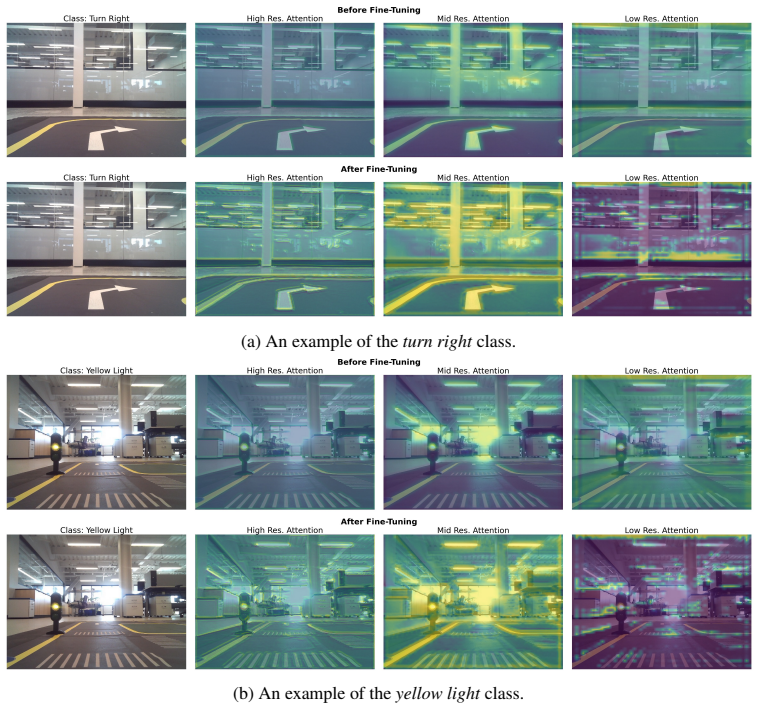
The two mechanisms that carry the argument are (1) a multiscale CNN vision encoder with scale injection, cross-scale gating, and a Local-Global Block that fuses high, mid, and low resolution features into a compact 144-dimensional embedding for six views, and (2) a dual-level prioritization: the token routing mechanism scores each text token by a weighted combination of embedding magnitude, a position weight that upweights middle tokens, and a padding mask, keeping only the top $K=64$ tokens; the sequence priority buffer scores each whole sequence by a weighted sum of normalized loss, uncertainty (inverse confidence), and diversity (cosine dissimilarity to other sequences), then samples from the buffer with importance-weight bias correction.
What would settle it
Run MiniDrive384, EM-VLM4ADBase, and TinyDrivev12 on the same DriveLM split with identical prompts, decoding parameters, and metric computation; if MiniDrive384's BLEU-4 or METEOR meets or exceeds TinyDrive's reported 55.82 or 50.56, the paper's state-of-the-art claim is false.
Extended reading notes
Core claim
The paper's central claim is that a deliberately tiny VLM can reach state-of-the-art language understanding on a driving VQA benchmark. On the DriveLM-nuScenes dataset, TinyDrivev12 (31.8M params) reports BLEU-4 55.82 and METEOR 50.56, a relative improvement of 11.1% and 35.4% over MiniDrive384, while using 76.8% fewer parameters; TinyDrivev11 (16M) also beats all compared baselines on BLEU-4 and METEOR. The authors attribute this to the combination of a multiscale CNN vision encoder and selective token/sequence prioritization rather than to larger language model capacity.
Load-bearing premise
The load-bearing premise is that the baseline scores cited from MiniDrive and EM-VLM4AD were obtained under the same evaluation protocol as TinyDrive's scores; the paper does not report the DriveLM split, prompt template, decoding settings, or metric computation used for either side.
Editorial extensions
If this is right
- If the reported comparisons hold, TinyDrivev11 (16M parameters, 4.27B FLOPs) and TinyDrivev12 (31.8M parameters, 6.50B FLOPs) both outperform MiniDrive224/384 and EM-VLM4ADBase/Large on BLEU-4 and METEOR on DriveLM.
- Averaged over BLEU-4, METEOR, ROUGE-L, and CIDEr, TinyDrivev12 achieves 44.73 versus 41.11 for MiniDrive384 and 38.75 for EM-VLM4ADBase.
- The reported 99% FLOP reduction relative to EM-VLM4ADBase suggests that the dual-level prioritization scheme can make training and inference substantially cheaper without sacrificing the metrics that matter for driving QA.
- Because T5-tiny and T5-mini are the language backbones, the approach demonstrates that a very small text model plus a carefully engineered vision encoder and selective token processing can support competitive driving VQA.
Reading between the lines
- The claimed state-of-the-art scores depend on the baseline numbers being produced under the same evaluation protocol; the paper does not specify which DriveLM split, prompt template, decoding settings, or metric computation was used, so the headline comparison is the first thing to verify.
- The token routing mechanism scores text tokens only by their own embedding properties, not by their relevance to the visual input; as the paper's Section 5 notes, extending the score to condition on visual content is a natural next step.
- The sequence priority buffer, with its uncertainty and diversity terms, is a general training-prioritization idea that could transfer to other multimodal fine-tuning tasks beyond driving VQA.
- If the efficiency claims replicate, the strongest implication is that parameter count is not a reliable proxy for VQA quality in driving domains; architecture and training-data selection may matter more.
Editorial analysis
A structured set of objections, weighed in public.
Referee Report
Summary. The paper presents TinyDrive, a lightweight VLM for multi-view VQA in autonomous driving. It combines a multiscale CNN vision encoder with scale injection, cross-scale gating, and a local-global block, plus a dual-level prioritization scheme that routes top-K text tokens and reweights training sequences. The authors first evaluate two TinyDrive variants on a custom Rosmaster dataset and then compare against EM-VLM4AD and MiniDrive on DriveLM-nuScenes, claiming state-of-the-art BLEU-4 and METEOR with substantially fewer parameters.
Significance. If the reported results were reproducible under the official DriveLM protocol, TinyDrive would be a meaningful efficiency contribution: its parameter count (16M/31.8M) is an order of magnitude below the cited baselines, and the architecture is described in sufficient detail to be reimplemented. The authors are also candid in Section 5 about the limitation that token routing ignores cross-modal relevance. However, the paper's central SOTA claim is currently not assessable because the experimental comparison is under-specified and internally inconsistent. I do not see a circularity problem in using model-derived scores for prioritization; that is a standard active-learning loop.
major comments (3)
- [§4.2, Table 4] The manuscript does not specify which DriveLM-nuScenes split is used for evaluation, what prompt template is provided to TinyDrive and to the baselines, what decoding algorithm is used, or how the BLEU-4, METEOR, ROUGE-L, and CIDEr scores are computed. Since the headline SOTA claim rests entirely on Table 4, this omission is load-bearing. In addition, Table 4 itself contradicts the prose: TinyDrive v12 is worse than MiniDrive384 on ROUGE-L (69.50 vs. 73.50) and CIDEr (3.02 vs. 3.32), so the statement in §4.2 that TinyDrive shows 'superior performance on all metrics' is inaccurate. The authors should adopt the official DriveLM evaluation protocol on a named split, report all comparison conditions (prompts, decoding, metric computation), and include error bars; without this, the comparison cannot be verified.
- [§4.2, Table 5] The vision encoder used for DriveLM is listed with 'Fine-Tuning (vision)' set to N/A, yet this encoder was previously trained on the 165-image indoor Rosmaster dataset described in §4.1. The paper does not explain how the encoder is adapted to six-view outdoor nuScenes images, whether the Rosmaster-trained weights are used as initialization, or what visual features are fed to the T5 model. This gap makes the transfer results hard to interpret. Please clarify the initialization and any domain adaptation, and report an ablation using a randomly initialized or generic pretrained encoder.
- [§4.2, Figure 1] The 'average' metric used in Figure 1 and in the §4.2 discussion is computed by averaging BLEU-4, METEOR, ROUGE-L, and CIDEr, which have different scales and ranges (CIDEr is around 3 while the other metrics range roughly 40-70). This aggregation is therefore dominated by the first three metrics and is not a principled summary. The efficiency claim should be supported by a metric-by-metric comparison rather than an unweighted average of disparate scales.
minor comments (5)
- [Tables 2 and 4] The column header 'BLUE-4' should be 'BLEU-4'.
- [§3.3, Eq. (12)] Equation (12) uses lowercase 'l' in the condition 'L/4 ≤ l ≤ 3L/4' while the token index is denoted as ℓ elsewhere; please make the notation consistent.
- [Throughout] There are several typographical errors, including 'mutiscale' in the Introduction and 'Rosmater' in Table 5; a careful proofread is needed.
- [§4.1] The paper reports 100% accuracy on the Rosmaster vision-encoder validation but states only that 10% of the 2,344 images were used for validation; it would help to give the exact number of images in each split and to clarify the relationship between the 2,344 frames and the 165 selected frames.
- [Appendix B.1] The exact Hugging Face identifiers for 'T5-tiny' and 'T5-mini' should be given, since these are not standard T5 sizes and affect reproducibility.
Circularity Check
No significant circularity: TinyDrive's architecture and training scores are design choices evaluated on an external benchmark, not predictions derived from their own definitions.
full rationale
No circular step is present in TinyDrive's derivation chain. The paper proposes an architecture and training scheme: a multiscale CNN vision encoder, a token routing score (Eq. 11), and a sequence priority score (Eq. 13), then evaluates the resulting model on the public DriveLM benchmark. These scoring functions are design choices, not quantities fitted to the benchmark and then renamed as predictions; the model's BLEU-4, METEOR, ROUGE-L, and CIDEr scores are obtained by training and inference, not by construction from the scoring definitions. The 100% Rosmaster accuracy is reported on the same custom dataset used to train the vision encoder's classification head, but it is not used as evidence for the central SOTA claim, which rests on the external DriveLM comparison. The self-citation [8] in the introduction is a routine reference to prior work and is not load-bearing. The main weakness of the paper is that the DriveLM evaluation protocol (split, prompt template, decoding, metric computation) is under-specified, making the SOTA comparison hard to reproduce; that is a correctness and reproducibility concern, not a circularity one. No equation in the paper reduces to its own input, and no fitted parameter is relabeled as a prediction.
Assumptions & free parameters
free parameters (8)
- alpha (prioritization exponent) =
0.6
- beta (correction exponent) =
0.4
- lambda_l (loss weight) =
0.5
- lambda_u (uncertainty weight) =
0.3
- lambda_d (diversity weight) =
0.2
- lambda_m (magnitude weight) =
1.0
- lambda_p (position weight) =
1.0
- K (top text tokens) =
64
assumptions (4)
- domain assumption Pretrained T5 can be fine-tuned to answer driving questions accurately
- ad hoc to paper Multiscale CNN features capture both fine-grained and contextual visual information needed for VQA
- ad hoc to paper Token score based on embedding magnitude, position, and padding mask reflects token informativeness
- ad hoc to paper Sequence priority based on loss, uncertainty, and diversity identifies training examples that improve the model
invented entities (3)
-
Local-Global Block (LGB)
-
Scale Injection Mechanism (SIM)
-
Cross-Scale Gating Mechanism (CSGM)
Cite this review
Pith. "Pith review of TinyDrive: Multiscale Visual Question Answering with Selective Token Routing for Autonomous Driving." pith.science (2026). https://pith.science/paper/CW2KH2GY
@misc{pith2026250515564,
  author       = {Pith},
  title        = {Pith review of: TinyDrive: Multiscale Visual Question Answering with Selective Token Routing for Autonomous Driving},
  year         = {2026},
  howpublished = {\url{https://pith.science/paper/CW2KH2GY}},
  note         = {Machine review of arXiv:2505.15564}
}
read the original abstract
Vision Language Models (VLMs) employed for visual question-answering (VQA) in autonomous driving often require substantial computational resources that pose a challenge for their deployment in resource-constrained vehicles. To address this challenge, we introduce TinyDrive, a lightweight yet effective VLM for multi-view VQA in driving scenarios. Our model comprises two key components including a multiscale vision encoder and a dual-level prioritization mechanism for tokens and sequences. The multiscale encoder facilitates the processing of multi-view images at diverse resolutions through scale injection and cross-scale gating to generate enhanced visual representations. At the token level, we design a token routing mechanism that dynamically selects and process the most informative tokens based on learned importance scores. At the sequence level, we propose integrating normalized loss, uncertainty estimates, and a diversity metric to formulate sequence scores that rank and preserve samples within a sequence priority buffer. Samples with higher scores are more frequently selected for training. TinyDrive is first evaluated on our custom-curated VQA dataset, and it is subsequently tested on the public DriveLM benchmark, where it achieves state-of-the-art language understanding performance. Notably, it achieves relative improvements of 11.1% and 35.4% in BLEU-4 and METEOR scores, respectively, despite having a significantly smaller parameter count.
Figures


Figures from the paper (2 more)

Reference graph
Works this paper leans on
-
[1]
Meteor: An automatic metric for mt evaluation with improved correlation with human judgments
Satanjeev Banerjee and Alon Lavie. Meteor: An automatic metric for mt evaluation with improved correlation with human judgments. InProceedings of the acl workshop on intrinsic and extrinsic evaluation measures for machine translation and/or summarization, pages 65–72, 2005
2005
-
[2]
Driving with llms: Fusing object-level vector modality for explainable autonomous driving
Long Chen, Oleg Sinavski, Jan Hünermann, Alice Karnsund, Andrew James Willmott, Danny Birch, Daniel Maund, and Jamie Shotton. Driving with llms: Fusing object-level vector modality for explainable autonomous driving. In2024 IEEE International Conference on Robotics and Automation (ICRA), pages 14093–14100. IEEE, 2024
2024
-
[3]
Bert: Pre-training of deep bidirectional transformers for language understanding
Jacob Devlin, Ming-Wei Chang, Kenton Lee, and Kristina Toutanova. Bert: Pre-training of deep bidirectional transformers for language understanding. InProceedings of the 2019 conference of the North American chapter of the association for computational linguistics: human language technologies, volume 1 (long and short papers), pages 4171–4186, 2019
2019
-
[4]
Xiaohan Ding, Yiyuan Zhang, Yixiao Ge, Sijie Zhao, Lin Song, Xiangyu Yue, and Ying Shan. Unireplknet: A universal perception large-kernel convnet for audio video point cloud time-series and image recognition. InProceedings of the IEEE/CVF Conference on Computer Vision and Pattern Recognition, pages 5513–5524, 2024
work page 2024
-
[5]
Alexey Dosovitskiy, Lucas Beyer, Alexander Kolesnikov, Dirk Weissenborn, Xiaohua Zhai, Thomas Unterthiner, Mostafa Dehghani, Matthias Minderer, Georg Heigold, Sylvain Gelly, et al. An image is worth 16x16 words: Transformers for image recognition at scale.arXiv preprint arXiv:2010.11929, 2020
arXiv 2010
-
[6]
Akshay Gopalkrishnan, Ross Greer, and Mohan Trivedi. Multi-frame, lightweight & effi- cient vision-language models for question answering in autonomous driving.arXiv preprint arXiv:2403.19838, 2024
arXiv 2024
-
[7]
Yanchen Guan, Haicheng Liao, Zhenning Li, Jia Hu, Runze Yuan, Yunjian Li, Guohui Zhang, and Chengzhong Xu. World models for autonomous driving: An initial survey.IEEE Transac- tions on Intelligent Vehicles, 2024
work page 2024
-
[8]
Hossein Hassani, Soodeh Nikan, and Abdallah Shami. Traffic navigation via reinforcement learning with episodic-guided prioritized experience replay.Engineering Applications of Artificial Intelligence, 137:109147, 2024
work page 2024
Show all 25 references
-
[9]
Lora: Low-rank adaptation of large language models.ICLR, 1(2):3, 2022
Edward J Hu, Yelong Shen, Phillip Wallis, Zeyuan Allen-Zhu, Yuanzhi Li, Shean Wang, Lu Wang, Weizhu Chen, et al. Lora: Low-rank adaptation of large language models.ICLR, 1(2):3, 2022
2022
-
[10]
Blip-2: Bootstrapping language-image pre-training with frozen image encoders and large language models
Junnan Li, Dongxu Li, Silvio Savarese, and Steven Hoi. Blip-2: Bootstrapping language-image pre-training with frozen image encoders and large language models. InInternational conference on machine learning, pages 19730–19742. PMLR, 2023
2023
-
[11]
Rouge: A package for automatic evaluation of summaries
Chin-Yew Lin. Rouge: A package for automatic evaluation of summaries. InText summarization branches out, pages 74–81, 2004
2004
-
[12]
Gpt-driver: Learning to drive with gpt.arXiv preprint arXiv:2310.01415, 2023
Jiageng Mao, Yuxi Qian, Junjie Ye, Hang Zhao, and Yue Wang. Gpt-driver: Learning to drive with gpt.arXiv preprint arXiv:2310.01415, 2023
2023 arXiv
-
[13]
Bleu: a method for automatic evaluation of machine translation
Kishore Papineni, Salim Roukos, Todd Ward, and Wei-Jing Zhu. Bleu: a method for automatic evaluation of machine translation. InProceedings of the 40th annual meeting of the Association for Computational Linguistics, pages 311–318, 2002
2002
-
[14]
Learning transferable visual models from natural language supervision
Alec Radford, Jong Wook Kim, Chris Hallacy, Aditya Ramesh, Gabriel Goh, Sandhini Agarwal, Girish Sastry, Amanda Askell, Pamela Mishkin, Jack Clark, et al. Learning transferable visual models from natural language supervision. InInternational conference on machine learning, pag...
2021
-
[15]
Exploring the limits of transfer learning with a unified text-to-text transformer.Journal of machine learning research, 21(140):1–67, 2020
Colin Raffel, Noam Shazeer, Adam Roberts, Katherine Lee, Sharan Narang, Michael Matena, Yanqi Zhou, Wei Li, and Peter J Liu. Exploring the limits of transfer learning with a unified text-to-text transformer.Journal of machine learning research, 21(140):1–67, 2020
2020
-
[16]
Languagempc: Large language models as decision makers for autonomous driving
H Sha, Y Mu, Y Jiang, L Chen, C Xu, P Luo, SE Li, M Tomizuka, W Zhan, and M Ding. Languagempc: Large language models as decision makers for autonomous driving. arxiv 2023. arXiv preprint arXiv:2310.03026, 2023. 10
2023 arXiv
-
[17]
Drivelm: Driving with graph visual question answering
Chonghao Sima, Katrin Renz, Kashyap Chitta, Li Chen, Hanxue Zhang, Chengen Xie, Jens Beißwenger, Ping Luo, Andreas Geiger, and Hongyang Li. Drivelm: Driving with graph visual question answering. InEuropean Conference on Computer Vision, pages 256–274. Springer, 2024
2024
-
[18]
Llama: Open and efficient foundation language models.arXiv preprint arXiv:2302.13971, 2023
Hugo Touvron, Thibaut Lavril, Gautier Izacard, Xavier Martinet, Marie-Anne Lachaux, Timo- thée Lacroix, Baptiste Rozière, Naman Goyal, Eric Hambro, Faisal Azhar, et al. Llama: Open and efficient foundation language models.arXiv preprint arXiv:2302.13971, 2023
2023 arXiv
-
[19]
Labelimg.https://github.com/tzutalin/labelImg, 2015
Tzutalin. Labelimg.https://github.com/tzutalin/labelImg, 2015. Git code
2015
-
[20]
Cider: Consensus-based image description evaluation
Ramakrishna Vedantam, C Lawrence Zitnick, and Devi Parikh. Cider: Consensus-based image description evaluation. InProceedings of the IEEE conference on computer vision and pattern recognition, pages 4566–4575, 2015
2015
-
[21]
Drivemlm: Aligning multi-modal large language models with behavioral planning states for autonomous driving.arXiv preprint arXiv:2312.09245, 2023
Wenhai Wang, Jiangwei Xie, ChuanYang Hu, Haoming Zou, Jianan Fan, Wenwen Tong, Yang Wen, Silei Wu, Hanming Deng, Zhiqi Li, et al. Drivemlm: Aligning multi-modal large language models with behavioral planning states for autonomous driving.arXiv preprint arXiv:2312.09245, 2023
2023
-
[22]
Chain-of-thought prompting elicits reasoning in large language models
Jason Wei, Xuezhi Wang, Dale Schuurmans, Maarten Bosma, Fei Xia, Ed Chi, Quoc V Le, Denny Zhou, et al. Chain-of-thought prompting elicits reasoning in large language models. Advances in neural information processing systems, 35:24824–24837, 2022
2022
-
[23]
Drivegpt4: Interpretable end-to-end autonomous driving via large language model.IEEE Robotics and Automation Letters, 2024
Zhenhua Xu, Yujia Zhang, Enze Xie, Zhen Zhao, Yong Guo, Kwan-Yee K Wong, Zhenguo Li, and Hengshuang Zhao. Drivegpt4: Interpretable end-to-end autonomous driving via large language model.IEEE Robotics and Automation Letters, 2024
2024
-
[24]
Minidrive: More efficient vision-language models with multi-level 2d features as text tokens for autonomous driving
Enming Zhang, Xingyuan Dai, Yisheng Lv, and Qinghai Miao. Minidrive: More efficient vision-language models with multi-level 2d features as text tokens for autonomous driving. arXiv preprint arXiv:2409.07267, 2024
2024 arXiv
-
[25]
Vision language models in autonomous driving: A survey and outlook.IEEE Transactions on Intelligent Vehicles, 2024
Xingcheng Zhou, Mingyu Liu, Ekim Yurtsever, Bare Luka Zagar, Walter Zimmer, Hu Cao, and Alois C Knoll. Vision language models in autonomous driving: A survey and outlook.IEEE Transactions on Intelligent Vehicles, 2024. A Rosmaster Dataset Rosmaster dataset was collected using ...
2024
Reviewed August 7, 2026 · model on record in the stance chip above.
Discussion (0). Sign in to comment.