REVIEW 3 major objections 4 minor 25 references
Permutons from Demazure Products
T0 review · 3 major / 4 minor · reviewed 2026-08-07 · deepseek-v4-flash
Pith's one-line read Demazure-product random permutations converge to explicit permutons, with Tracy–Widom height fluctuations.
desk verdict Load-bearing TASEP-coupling gap in Section 4.2 keeps a strong, likely-correct paper from being fully rigorous; worth peer review with a demand for a formal bijection. read the letter →
The pith
A machine-rendered reading of the paper's core claim, the machinery that carries it, and where it could break.
The reading
What carries the argument
The load-bearing object is the Demazure product on $S_n$, whose local generators $\tau_i$ put entries $i$ and $i+1$ in decreasing order. Chan and Pflueger's formulation of this product as matrix multiplication in the min-plus tropical semiring gives the height-function identity $H_{u\star v}(x,y)=\min_\gamma(H_u(\gamma,y)+H_v(x,\gamma))$, which the paper upgrades to a Demazure product on permutons. The second mechanism is a direct coupling: filling an order-convex pipe-dream shape column by column, with crossings resolved, reproduces the dynamics of the totally asymmetric simple exclusion process with geometric jumps under step initial data, so the height function at $(x,y)$ is controlled by the position of a single TASEP particle after $n(\psi(x)-\phi(y))$ steps. The explicit limit comes from solving $c_p(x-y+h,\psi(x)-\phi(y))=h$ for $h$, with $c_p$ the hydrodynamic speed of that TASEP; the same integrable fluctuations produce the $n^{-2/3}$ Tracy–Widom GUE statement.
What would settle it
Take the staircase shape with $p=1/2$ and the point $(x,y)=(0.8,0.55)$, which lies in $K_{\phi,\psi}$; simulate the random pipe dream many times. Under the paper's claim the empirical height $H_{u_n}(0.8,0.55)$ must converge to $h_p^{\phi,\psi}(0.8,0.55)$ with deviations of order $n^{-2/3}$ whose scaled distribution is Tracy–Widom GUE; a systematic discrepancy in the limit value, or a fluctuation histogram that is not $F_2$ after the stated rescaling, would falsify the central theorem.
Extended reading notes
Core claim
The paper's central discovery is that the Demazure product, the one-step 'sort these two adjacent entries' operation of the 0-Hecke monoid, has a limit theory governed by a single min-plus identity. For permutations $u,v$, the height function satisfies $H_{u\star v}(x,y)=\min_{0\le\gamma\le1}(H_u(\gamma,y)+H_v(x,\gamma))$, and this identity extends to permutons, making the Demazure product an associative operation on limit shapes. Reading a random pipe dream column by column turns it into the totally asymmetric simple exclusion process with geometric jumps and step initial data; the limiting height $h_p^{\phi,\psi}$ is the value $h$ at which the TASEP hydrodynamic speed balances the displacement equation $c_p(x-y+h,\psi(x)-\phi(y))=h$, and the same TASEP asymptotics yield Tracy–Widom GUE fluctuations of order $n^{-2/3}$. The paper then uses the permuton product to derive explicit limiting densities for bubble-sort-type operators, recovering and refining DiFranco's support-only description of standard bubble-sort permutons, and to prove that the Demazure product of two independent uniform random permutations converges to the anti-diagonal line segment.
Load-bearing premise
The formulas rest on the claim that reading a random pipe dream column by column reproduces exactly the particle positions of the totally asymmetric simple exclusion process with geometric jumps; if that correspondence fails in any corner case, the explicit height formula and the Tracy–Widom fluctuation law do not follow.
Editorial extensions
If this is right
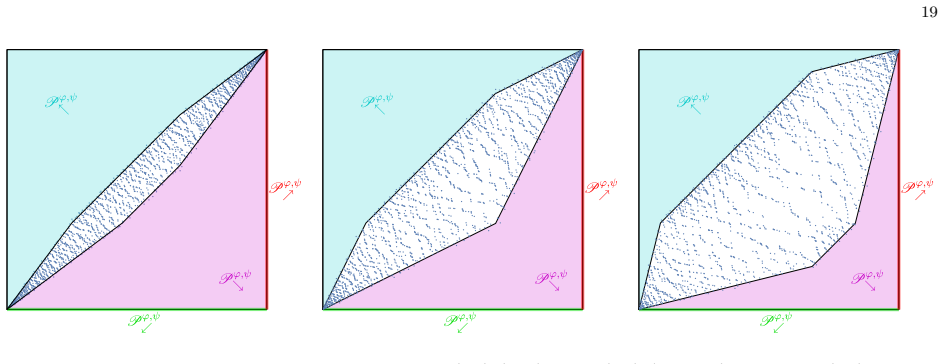
- The staircase Grothendieck-permuton theorem is the special case $\phi(z)=0$, $\psi(z)=z$, and the same theorem produces new explicit families: peridot permutons for rectangles, Polyphemus permutons for trapezoids, and assembled permutons for decomposable non-order-convex shapes.
- For every sequence of order-convex shapes whose scaled boundaries converge to $\phi,\psi$, the random pipe-dream permutation converges almost surely to the permuton with height $h_p^{\phi,\psi}$; inside $K_{\phi,\psi}$ the rescaled height fluctuations converge to the Tracy–Widom GUE distribution.
- Applying $\tau_{w(S)}$ to a uniformly random permutation gives the permuton $\upsilon\star\zeta^D_1$, and for Coxeter words with linear boundaries the limit is exactly $\nu_{\alpha,\beta}$, a full density description of the standard bubble-sort permutons.
- The Demazure product of two independent uniform random $n$-permutations has expected inversion number $\binom{n}{2}(1-o(1))$, and every pattern except the decreasing one has vanishing density in the limit; the permuton product of two uniform permutons is the anti-diagonal line segment.
- Because the permuton Demazure product is associative and compatible with weak convergence, limits for shapes cut into finitely many order-convex pieces can be assembled by starring the piecewise limits, as illustrated by the Platyhelminthes and pointy-peanut permutons.
Reading between the lines
- The min-plus form of the height function suggests that permuton height functions form a closed algebra under a tropical convolution; one could test whether the Legendre–Fenchel transform of $H_{\mu\star\nu}$ decomposes as a sum, which would give a variational proof of the product rule and a dual method for computing limits.
- The Dory memory model is a quantitative corollary of the rectangle-shape limit: the forgotten relevance factors, plotted against forgetting time, should converge to $\nu_{\beta(1-\beta),\beta}$, so the permuton gives explicit predictions for the empirical distribution of forgotten facts that a simulation of the exact process can check.
- The paper's doppelgänger coincidence between rectangle and parallelogram limits hints that the uniform permuton's Demazure product may depend only on a projection of the second factor; checking whether $\upsilon\star\zeta$ is unchanged by certain shape deformations would explain when such coincidences occur.
- The visible stripes in the plots likely come from the singular curves in the limiting permuton support; a local-limit analysis near those curves would predict the stripe spacing, and direct sampling at moderate $n$ could confirm the predicted local density profile.
Editorial analysis
A structured set of objections, weighed in public.
Referee Report
Summary. The paper introduces a Demazure product on permutons, defined through the min-plus tropical formula H_{μ⋆ν}(x,y)=min_γ (H_μ(γ,y)+H_ν(x,γ)), and uses it to study two families of random permutations. The first family comes from Demazure products of random subwords of words associated with arbitrary order-convex shapes, viewed as random pipe dreams. The main results, Theorems 1.1 and 1.2, assert that the height functions of these permutations converge to an explicit limiting permuton height function h_p^{φ,ψ} and that the fluctuations inside a certain region converge to the Tracy–Widom GUE distribution with n^{-2/3} scaling, by reducing the pipe dream evolution to the TASEP with geometric jumps. The second family applies deterministic bubble-sort-type operators to random initial permutations; Theorems 1.4–1.6 give limiting permutons in terms of the new Demazure product, recovering and extending DiFranco's bubble-sort curve. The paper also proves Theorem 3.2, the continuity of the permuton Demazure product under weak convergence, and uses it to show that the inversion count of the Demazure product of two independent uniform permutations is binom(n,2)(1-o(1)).
Significance. If the results are correct, this is a substantial contribution to the interface of algebraic combinatorics and integrable probability. The paper generalizes the Grothendieck permutons of Morales–Panova–Petrov–Yeliussizov from staircase shapes to all order-convex shapes, provides a direct TASEP route that bypasses the stochastic six-vertex model, and produces several explicit new families of permutons (peridot, Polyphemus, Platyhelminthes, pointy peanut). The min-plus formulation of the Demazure product on permutons is elegant and likely to be useful beyond this paper, as evidenced by the clean proof of the inversion-count result. The explicit verification of the limit formulas in the parallelogram and rectangle cases of Sections 5.1 and 5.2 is a genuine strength, as is the demonstrable use of external integrable asymptotics (Theorem 4.1) in a new setting. The main caveat is that the bridge from random pipe dreams to the TASEP, which underpins both the scaling limit and the KPZ fluctuation statement, is only sketched; the paper would be fully convincing once that coupling is supplied rigorously.
major comments (3)
- [§4.2, paragraphs after Eq. (13)] The column-by-column evolution of the states ι(v_j) is asserted to be equidistributed with the k-particle TASEP with geometric jumps, but no formal bijection is given. The pipe dream has independent tiles shared by all letters in a column, whereas the TASEP transition uses independent geometric variables G_i(t) for each particle at each time; the text does not prove that the joint law after processing columns T+1 through T′ equals the TASEP kernel, including the right-to-left order inside a column (the word ω_j lists contents b_j, b_j−1, …, a_j) and the reflecting wall at n+1−a_j. This coupling is the sole bridge to Theorem 4.1, so it is load-bearing for Theorems 1.1 and 1.2. A complete inductive construction or a direct bijection between pipe-dream tile configurations and the geometric jump variables should be written out.
- [§4.2, Eqs. (14)–(16)] The proof of Theorem 1.1 concludes from the fixed-h limits in (14) being 0 or 1 that H_{u_n}(x,y) converges to h_p(x,y) with probability 1. As written, the threshold argument gives convergence in probability for each fixed (x,y), not almost-sure convergence; an almost-sure statement would require a Borel–Cantelli estimate or an explicit joint coupling across n. The theorem statement and the following sentence 'Equivalently, (π_{u_n}) converges weakly to ζ_D^p' also do not specify whether the convergence is almost sure or in probability. This should be clarified and the proof adjusted accordingly.
- [§4.2, first paragraph] The assertion that '(x−y+H_w(x,y))n is equal to the number of particles in ι(w) occupying positions at or to the right of n−k′+1' is stated as a straightforward computation, but it is a key translation between permutation height functions and TASEP particle counts. A short derivation of this identity, including the handling of the floors in x=k′/n and y=(n−k)/n, would make the reduction self-contained and easier to verify in corner cases.
minor comments (4)
- [§6.2, first sentence] 'In Theorem 1.7, we noted...' refers to Remark 1.7, not a theorem; the cross-reference should be corrected.
- [§5.1 and §5.2, height function formulas] The displayed formulas for H_{ρ_{α,β}}(x,y) and H_{κ_β}(x,y) write h_1(x,y) in the integrand, but the variable of minimization is γ and the subsequent computations use h_1(x,γ); these are typos that should be corrected to h_1(x,γ).
- [§4.4, last paragraph] 'one can in principal compute' should read 'one can in principle compute'.
- [Remark 4.3 and §5.1] The rotation operator for permutons is denoted inconsistently: it appears as bµ in Remark 4.3 and as dν or dρ in Section 5.1. Please unify the notation.
Circularity Check
No significant circularity: the new permuton limits are derived from external min-plus and TASEP theorems; no fitted parameter is relabeled as a prediction, and the only self-citation is a non-load-bearing remark.
full rationale
The derivation chain is self-contained in the sense required by the circularity analysis. Theorem 1.1 and Theorem 1.2 are proved by (i) the external min-plus formulation of the Demazure product (Theorem 3.1, credited to Chan and Pflueger and to Pflueger), and (ii) the external TASEP asymptotics (Theorem 4.1, credited to Morales, Panova, Petrov, and Yeliussizov). The paper's own pipe-dream-to-TASEP dictionary in Section 4.2 relates the number of particles to the height function by the definition of iota(w) and by a direct counting computation; it does not define the TASEP particle count in terms of the limiting height function. The limiting formula h_p^{phi,psi} is obtained by solving the TASEP characteristic equation (15), not by fitting a constant to the pipe-dream data, and the Tracy-Widom statement is imported from the cited TASEP result, not from a fitted fluctuation parameter. The Demazure product on permutons, equation (11), is defined by the same min-plus convolution that Theorem 3.1 proves for finite permutations, and Proposition 3.2 verifies well-definedness by uniform convergence of height functions; this is a theorem, not an assumption of the conclusion. The only self-citation, [10], appears in Remark 1.3 as a pointer to related work and is not used in any proof. The asserted but not fully formalized coupling in Section 4.2 is a correctness risk that a referee should check, but it is not circular: the paper never assumes the pipe-dream permuton limit to derive the TASEP asymptotics, and no parameter is fitted and then renamed as a prediction. Therefore no circular step is exhibited, and the appropriate score is 0.
Assumptions & free parameters
assumptions (4)
- standard math Theorem 3.1 (Chan-Pflueger): H_{u⋆v}(x,y) = min_{0≤γ≤1} (H_u(γ,y) + H_v(x,γ)) for all u,v in S_n.
- standard math Theorem 4.1, the TASEP hydrodynamic limit and Tracy-Widom fluctuation theorem from [22, Theorem 3.7].
- standard math Pointwise convergence of height functions characterizes weak convergence of permutons, and height functions are √2-Lipschitz.
- domain assumption The pipe dream crossing-resolution procedure computes the Demazure product of the corresponding subword.
Cite this review
Pith. "Pith review of Permutons from Demazure Products." pith.science (2026). https://pith.science/paper/ORTB6K3Q
@misc{pith2026250515630,
  author       = {Pith},
  title        = {Pith review of: Permutons from Demazure Products},
  year         = {2026},
  howpublished = {\url{https://pith.science/paper/ORTB6K3Q}},
  note         = {Machine review of arXiv:2505.15630}
}
abstract
We construct and analyze several new families of permutons arising from random processes involving the Demazure product on the symmetric group. First, we consider Demazure products associated to random pipe dreams, generalizing the Grothendieck permutons introduced by Morales, Panova, Petrov, and Yeliussizov by replacing staircase shapes with arbitrary order-convex shapes. Using the totally asymmetric simple exclusion process (TASEP) with geometric jumps, we prove precise scaling limit and fluctuation results for the associated height functions, showing that these models belong to the Kardar--Parisi--Zhang (KPZ) universality class. We then consider permutons obtained by applying deterministic sequences of bubble-sort operators to random initial permutations. We again provide precise descriptions of the limiting permutons. In a special case, we deduce the exact forms of the standard bubble-sort permutons, the supports of which were computed by DiFranco. A crucial tool in our analysis is a formulation, due to Chan and Pflueger, of the Demazure product as matrix multiplication in the min-plus tropical semiring. This allows us to define a Demazure product on the set of permutons. We discuss further applications of this product. For instance, we show that the number of inversions of the Demazure product of two independent uniformly random permutations of size $n$ is $\binom{n}{2}(1-o(1))$.
Figures


Figures from the paper (12 more)




Reference graph
Works this paper leans on
-
[22]
A. H. Morales, G. Panova, L. Petrov, and D. Yeliussizov. Grothendieck shenanigans: permutons from pipe dreams via integrable probability.Preprint:arXiv:2407.21653
-
[1]
N. Alon, D. Elboim, and A. Sly. On a random model of forgetting.Ann. Appl. Probab.,34(2024), 2190–2207
work page 2024
- [2]
-
[3]
N. Bergeron and S. Billey. RC-graphs and Schubert polynomials.Experiment. Math.,2(1993), 257–269
work page 1993
-
[4]
E. Bisi, F. D. Cunden, S. Gibbons, and D. Romik. The oriented swap process and last passage percolation. Random Structures Algorithms,60(2022), 690–715. 28
work page 2022
-
[5]
J. Borga. Local convergence for permutations and local limits for uniformρ-avoiding permutations with|ρ|= 3. Probab. Theory Related Fields,176(2020), 449–531
work page 2020
-
[6]
A. Borodin and P. Ferrari. Anisotropic growth of random surfaces in 2+1 dimensions.Comm. Math. Phys.,325 (2014), 603–684
work page 2014
-
[7]
A. Bufetov, V. Gorin, and D. Romik. Absorbing time asymptotics in the oriented swap process.Ann. Appl. Probab.,32(2022), 753–763
work page 2022
Show all 25 references
-
[8]
Chan and N
M. Chan and N. Pflueger. Relative Richardson varieties.Math. Proc. Cambridge Philos. Soc.,175(2023), 161– 186
2023
-
[9]
I. Corwin. The Kardar–Parisi–Zhang equation and universality class.Random Matrices Theory Appl.,1(2012)
2012
-
[10]
C. Defant. Random combinatorial billiards and stoned exclusion processes.Preprint:arXiv:2406.07858
-
[11]
Demazure
M. Demazure. D´ esingularisation des vari´ et´ es de Schubert g´ en´ eralis´ ees.Ann. Sci. Ec. Norm. Sup´ er.,7(1974), 53–88
1974
-
[12]
DiFranco
M. DiFranco. A rigorous derivation of the bubble sort curve. https://linesthatconnect.github.io/assets/bubble- sort-derivation/bubble-sort-curve.pdf. (2024)
2024
-
[13]
Draief, J
M. Draief, J. Mairesse, and N. O’Connell. Queues, stores, and tableaux.J. Appl. Probab.,42(2005), 1145–1167
2005
-
[14]
Dieker and J
A.B. Dieker and J. Warren. Determinantal transition kernels for some interacting particles on the line.Ann. Inst. H. Poincar´ e Probab. Statist.,44(2008), 1162–1172
2008
-
[15]
Fomin and A
S. Fomin and A. N. Kirillov. Grothendieck polynomials and the Yang–Baxter equation.Proceedings of the 6th International Conference on Formal Power Series and Algebraic Combinatorics. Discrete Math. Theor. Comput. Sci.,24(1994)
1994
-
[16]
Hamaker, O
Z. Hamaker, O. Pechenik, and A. Weigandt. Gr¨ obner geometry of Schubert polynomials through ice.Adv. Math., 398(2022)
2022
-
[17]
Hoppen, Y
C. Hoppen, Y. Kohayakawa, C.G. Moreira, B. R´ ath, and R.M. Sampaio. Limits of permutation sequences.J. Combin. Theory Ser. B,103(2013), 93–113
2013
-
[18]
Knizel, L
A. Knizel, L. Petrov, and A. Saenz. Generalizations of TASEP in discrete and continuous inhomogeneous space. Comm. Math. Phys.,372(2019), 797–864
2019
-
[19]
Knutson and E
A. Knutson and E. Miller. Gr¨ obner geometry of Schubert polynomials.Ann. Math.,161(2005), 1245–1318
2005
-
[20]
Knutson and E
A. Knutson and E. Miller. Subword complexes in Coxeter groups.Adv. Math.,184(2004), 161–176
2004
-
[21]
T. Li, S. Oh, E. Richmond, G. Yan, and K. You. Demazure product of permutations and hopping.Electron. J. Combin.,31(2024)
2024
-
[23]
Pflueger
N. Pflueger. An extended Demazure product on integer permutations via min-plus matrix multiplication. Preprint:arXiv:2206.14227
-
[24]
Vershik and S
A. Vershik and S. Kerov. The characters of the infinite symmetric group and probability properties of the Robinson–Shensted–Knuth algorithm.SIAM Journal on Algebraic Discrete Methods,7(1986), 116–124
1986
-
[25]
L. Zhang. Shift-invariance of the colored TASEP and finishing times of the oriented swap process.Adv. Math., 415(2023). Department of Mathematics, Harvard University, Cambridge, MA 02138, USA Email address:colindefant@gmail.com
2023
Reviewed August 7, 2026 · model on record in the stance chip above.
Discussion (0). Continue with ORCID to comment.