REVIEW 4 major objections 5 minor 28 references
Distributionally Robust Planning of Hydrogen-Electrical Microgrids for Sea Islands
T0 review · 4 major / 5 minor · reviewed 2026-08-07 · deepseek-v4-flash
Pith's one-line read A primal-based decomposition algorithm with strong cutting planes solves distributionally robust hydrogen-electrical island microgrid planning without complete recourse, cutting runtime by up to 95%.
desk verdict The maritime hydrogen DDU-DRO model is a real modeling contribution, but the second stage sheds load for free, so the cost and resilience comparisons don't measure what they claim. read the letter →
The pith
A machine-rendered reading of the paper's core claim, the machinery that carries it, and where it could break.
The reading
What carries the argument
The load-bearing mechanism is the neutralization reformulation of Proposition 1, which replaces the decision-dependent sample space $\Omega(\lambda)$ with a fixed sample space $\Omega$ and uses a Hadamard projection $\xi\circ(k_2\lambda)$ to zero out components forbidden by the first-stage decisions, preserving DDU while making the model tractable. Feasibility is handled by Proposition 3: a first-stage decision is almost surely feasible exactly when $\max_{P\in\mathcal P(\lambda)}\mathbb E_P[\tilde Q(\lambda,\xi)]=0$, which is inserted as a strong feasibility cutting plane in the master problem. Around these, the paper builds a column-generation pricing loop that solves the worst-case expected value problem from the primal side, with a positive-probability scenario filter to keep only scenarios with strictly positive mass and an initialization procedure based on extreme rays of the dual. This combination is what lets C&CG-DRO run without complete recourse.
What would settle it
Set any positive penalty on $p_{ls,j,t}$ and $q_{ls,j,t}$ in objective (66), re-solve, and compare first-stage decisions and value of lost load; if the dual multipliers of caps (75)–(77) are nonzero at the optimum, the zero-cost shedding assumption is binding and changes plans.
Extended reading notes
Core claim
The paper's central claim is that sea-island hydrogen-electrical microgrid planning can be modeled and solved as a two-stage DDU-DRO: first-stage investment in generation, storage, vessels, and reinforcements, then second-stage worst-case expected operating cost over an ambiguity set whose moments and sample space shift with those investments. The methodological claim is that the complete-recourse assumption is not merely unrealistic but fundamental for island systems, so the paper makes almost-sure feasibility an explicit part of the master problem via strong cutting planes. Its algorithm, C&CG-DRO, transforms the decision-dependent sample space to a fixed one, generates worst-case scenarios by column generation, filters scenarios with zero probability, and terminates with an optimality gap below tolerance; in experiments it converges in 5–8 iterations and cuts runtime by up to 95% compared to the basic C&CG algorithm. Planning results show that considering all wind-contingency levels and adding selective grid hardening and hydrogen buffering reduces worst-case expected value of lost load.
Load-bearing premise
The load-bearing premise is that shedding load up to the caps in constraints (75)–(77) costs nothing at operating time; if real island operators pay for lost load, the optimizer's plans understate true costs.
Editorial extensions
If this is right
- If correct, distributionally robust island microgrid planning can be solved without assuming complete recourse, so plans hedge against genuinely infeasible scenarios.
- The algorithm's convergence in 5–8 iterations with up to 95% runtime reduction makes DDU-DRO tractable on desktop hardware for small island clusters.
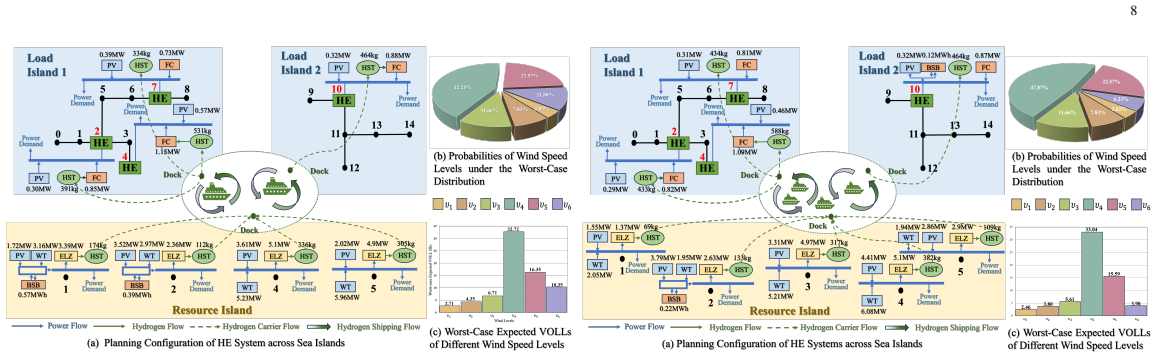
- Planning under full wind-contingency levels cuts worst-case expected VOLL by 12% overall and 61% at the most severe level compared to normal-only planning.
- Selective grid hardening plus hydrogen buffering achieves a 13.4% CAPEX reduction over the full-contingency plan while lowering worst-case expected VOLL to $60.98k, a further 5.4% reduction.
Reading between the lines
- Editorial inference: the model grants zero-cost load shedding up to cap constraints, so the stated operating costs likely understate true scarcity cost; re-solving with a positive shedding penalty would probably shift investment toward more storage or transport redundancy.
- The neutralization-and-projection treatment of the decision-dependent sample space is not specific to hydrogen islands; the same two-stage DDU-DRO machinery could apply to wildfire-, flood-, or attack-driven infrastructure planning where feasibility depends on hardening decisions.
- The reported runtime gains are measured on synthetic systems up to 15 buses; extrapolating the 95% speedup to real island chains with more islands or finer wind levels remains untested.
Editorial analysis
A structured set of objections, weighed in public.
Referee Report
Summary. The paper proposes a two-stage distributionally robust optimization (DRO) model for planning hydrogen-electrical microgrids on sea islands. The model couples capacity investment with a cycle-based maritime hydrogen transport network, incorporates multiple wind-driven uncertainty sources, and treats some uncertainties as decision-dependent (DDU). A primal-based column-and-constraint generation algorithm (C&CG-DRO) with strong cutting planes is developed to handle the lack of complete recourse. Numerical experiments on a three-island testbed and on synthetic 5-, 10-, and 15-bus systems claim that the proposed framework yields cost-effective and resilient plans and that C&CG-DRO reduces runtime by up to 95% relative to a basic C&CG approach.
Significance. If the model and algorithm were correct, the paper would address a practically relevant and underexplored problem: joint planning of island hydrogen-electrical systems under decision-dependent and distributional uncertainty without complete recourse. The modeling scope is broad, the maritime transport formulation is detailed, and the computational study is extensive. The paper also ships a concrete algorithmic comparison with explicit iteration and runtime numbers, which is a strength. However, the central objective omits the cost of load shedding, and a key equivalence result in the algorithm rests on an impossible condition. These issues affect the validity of the reported planning results and of the claimed algorithmic guarantees, so the current version cannot be accepted as is.
major comments (4)
- [§III-C, Eq. (66) with constraints (74)–(77)] The load-shedding variables p_ls and q_ls appear only in constraints (74)–(77) and not in the second-stage objective (66), whose components (67)–(69) contain only O&M costs. As a result, the recourse problem can shed load up to the caps in (75) and (77) at zero marginal cost, effectively using shedding as a free feasibility valve whenever generation or hydrogen delivery is insufficient. This biases the first-stage investment toward low-CAPEX configurations that shed more, and the cost figures and case rankings in Section V-B do not represent the total economic cost claimed in the abstract. The post-optimization VOLL metric (105)–(106) is not part of the DRO objective, the master-problem cuts, or the convergence criterion. The model should include a VOLL penalty in (66) using the same coefficient O_ls as in (106), or impose explicit reliability constraints that give shedding an equivalent economic cost; the numerical studies must then be redone.
- [§IV-C, Proposition 5 and Remark 1] The epsilon-separation condition stated in Proposition 5, namely ωi,j − εijgij ≥ ωi,j + ϵ for any g and (i,j) ∈ B, is impossible as written: for g=0 it requires ωi,j ≥ ωi,j + ϵ, and for g=1 it requires −εij ≥ ϵ when εij > 0. Therefore the claimed equivalence between MMP and MMPe is not established, and Remark 1's assertion that this condition always holds in realistic systems is incorrect under the stated inequality. The condition should be corrected, and either a valid proof or a precise sufficient condition for the equivalence should be provided.
- [§IV-A, Proposition 1] The neutralization reformulation (86)–(89) is the foundation of the entire C&CG-DRO algorithm, yet it is stated without proof and attributed to the unreviewed preprint [28]. Since the paper presents this reformulation as part of its methodological contribution and builds the decomposition on it, the authors should provide a self-contained proof or clearly delineate which components are taken from [28] and state the exact assumptions under which the equivalence between DDU−DRO and DDAS−DRO holds.
- [§IV-D, Proposition 4] The finite-convergence result for the column-generation procedure assumes that Q(λ,ξ) is always feasible for any λ ∈ Λ, i.e., complete recourse. This is precisely the assumption the paper claims to relax in Section IV-C. The paper does not analyze how the CG convergence guarantee interacts with the feasibility-cutting-plane loop (97) in the implemented C&CG-DRO algorithm. Without such an analysis, the reported iteration counts and runtime improvements in Table I lack a rigorous theoretical basis. Please state which convergence result applies to the actual algorithm and prove it for the feasibility-constrained setting.
minor comments (5)
- [Throughout] The manuscript contains several typographical errors, including 'develpoed', 'uncertaintiess', 'receptively', and 'discount rage'; these should be corrected.
- [§III-C, Eq. (78)] The quantifier '∀m ∈ V' in constraint (78) should read '∀v ∈ V'.
- [§II-A, Eq. (52)] The notation for the nominal wind power output δ is used with sub- and superscripts in an inconsistent way; please unify the notation for the availability factor and its deviations.
- [§IV-E, Eq. (104)] The initialization subproblem PSPIA uses dual variables (π′,κ′) from the Farkas lemma, but the derivation of the dual problem and the Farkas argument are omitted; a brief derivation would improve reproducibility.
- [§V-C, Table I] The text says the basic-C&CG method is 'with strong cutting planes' in one place and simply 'basic-C&CG' in Table I; please clarify whether the comparison is between the same cutting-plane mechanism with and without the CG enhancements, or between a more standard C&CG and the proposed method.
Circularity Check
Central algorithmic machinery is inherited from the authors' own preprints [26] and [28]; the DDU-DRO model and case study provide independent content, so circularity is partial rather than definitional.
-
self citation load bearing
[Section IV-A, Proposition 1 (neutralization reformulation)]
"we adopt a neutralization reformulation approach that transforms sample space from the original DDU structure Ω(λ) into a tractable decision independent uncertainty (DIU) representation Ω [28]. Proposition 1. Formulation DDU−DRO is equivalent to the following DDAS−DRO with DIU-based sample space:"
The equivalence in Proposition 1 is the load-bearing tractability step: it replaces the non-convex decision-dependent sample space Ω(λ) with a decision-independent Ω plus the Hadamard projection in (89). The paper gives no proof and attributes the result to [28], an arXiv preprint co-authored by B. Zeng. Because the article's algorithmic contribution is presented as developing a C&CG algorithm for this DDU-DRO, the central solution method rests on the authors' own prior equivalence result rather than on a derivation contained in this paper. The reduction is to a self-citation rather than to an independent, verifiable theorem established in the present work.
-
self citation load bearing
[Section IV, first paragraph and revised MMP formulation (95)-(98)]
"To efficiently address this issue, we develop strong cutting planes [26], which can be directly embedded into a classical C&CG framework [27]. ... Hence, we introduce strong cutting planes, as shown in the revised MMP formulation below."
The paper's headline algorithmic contribution is its handling of the missing complete recourse property, but the strong feasibility cutting planes in (97) and the primal-based decomposition/CG framework are inherited from [26], a co-authored preprint. The authors state Proposition 3 and then 'introduce' the cuts without re-deriving the underlying machinery in this paper. The claimed algorithmic novelty ('we develop strong cutting planes [26]') therefore reduces to a citation to the authors' own prior work, with the present enhancements (PPSF and initialization) being incremental additions rather than the source of the strong-cut mechanism.
full rationale
The paper does not exhibit a definitional or fitted-input circularity: the planning model, the maritime-hydrogen transport constraints, the DDU ambiguity set, and the synthetic case study are self-contained, and the numerical comparison is against the same authors' basic-C&CG on a constructed testbed rather than a fitted prediction. The main circularity concern is the inherited algorithmic core. Proposition 1 (neutralization reformulation) is asserted by citation to [28], and the strong cutting planes for missing recourse are attributed to [26]; both preprints have Bo Zeng as a co-author and are not re-derived here. These are load-bearing because the paper's central claim is the efficient solution of a DDU-DRO without complete recourse. However, the DDU-DRO application to sea-island hydrogen-electrical microgrids, including the cycle-based vessel transport model and the resilience case analysis, is independent content beyond the cited algorithm, so the circularity is partial rather than total. The zero-cost load-shedding issue in constraints (74)-(77) versus objective (66) is a modeling deficiency, not a circular reduction, and therefore does not contribute to the circularity score.
Assumptions & free parameters
free parameters (3)
- Wind-level probability bounds upsilon_u and upsilonbar_u =
Not given (input data)
- Line and vessel failure expectation bounds omega_ij, omegabar_ij, phi_v, epsilon_ij =
Not given (input data)
- Load-shedding caps P^u_ls,j,t and Q^u_ls,j,t =
Not given (input data)
assumptions (4)
- ad hoc to paper Neutralization reformulation (Proposition 1) exactly preserves the DDU-DRO model
- ad hoc to paper Epsilon-separation condition in Proposition 5 is satisfied in realistic systems (Remark 1)
- domain assumption Linearized Distflow equations (11)-(16) adequately represent island distribution networks
- domain assumption Discretization of wind speed into six levels captures the relevant uncertainty, including contingencies
Cite this review
Pith. "Pith review of Distributionally Robust Planning of Hydrogen-Electrical Microgrids for Sea Islands." pith.science (2026). https://pith.science/paper/EV6OEFVR
@misc{pith2026250515733,
  author       = {Pith},
  title        = {Pith review of: Distributionally Robust Planning of Hydrogen-Electrical Microgrids for Sea Islands},
  year         = {2026},
  howpublished = {\url{https://pith.science/paper/EV6OEFVR}},
  note         = {Machine review of arXiv:2505.15733}
}
read the original abstract
This paper presents a distributionally robust planning method for hydrogen-electrical microgrids over islands, where the cross-island energy exchange is supported by a maritime hydrogen transport network. This planning problem is complicated due to heterogeneous off-shore wind-driven uncertainties (i.e., renewable power, transport availability, demand fluctuations, and grid faulting), a subset of which exhibit endogenous uncertainty, as they can be affected by proactive measures (e.g., grid hardening) or infrastructure investment. To capture these features, a two-stage distributionally robust optimization (DRO) model is developed considering decision-dependent uncertainty (DDU), which encompasses variation of the underlying distributional ambiguity due to the change of the first stage decisions. Notably, the complete recourse property is missing, which is often neglected in existing DRO studies. Nevertheless, different from the case for land-based microgrids, this issue is critical and fundamental for sea island systems due to their particular physical and logistical requirements. To address these issues, we develop a C&CG algorithm that is customized with strong cutting planes to handle DRO with a varying DDU ambiguity set and feasibility requirements. Numerical results demonstrate the cost-effectiveness and resilience of the proposed planning framework, along with the nontrivial improvements of the algorithm in both solution accuracy and computational efficiency.
Figures


Figures from the paper (1 more)

Reference graph
Works this paper leans on
-
[26]
Z. Lu and B. Zeng, “Two-stage distributionally robust optimization: Intuitive understanding and algorithm development from the primal perspective,” arXiv preprint arXiv:2412.20708, 2024
arXiv 2024
-
[28]
Two-stage robust optimization with decision dependent uncertainty,
B. Zeng and W. Wang, “Two-stage robust optimization with decision dependent uncertainty,” arXiv preprint arXiv:2203.16484 , 2022
arXiv 2022
-
[1]
Stochastic optimization for power system configuration with renewable energy in remote areas,
L. Kuznia, B. Zeng, G. Centeno, and Z. Miao, “Stochastic optimization for power system configuration with renewable energy in remote areas,” Ann. Oper. Res., vol. 210, pp. 411–432, 2013
work page 2013
-
[2]
H. Li, Z. Ren, A. Trivedi, P. P. Verma, D. Srinivasan, and W. Li, “A non- cooperative game-based approach for microgrid planning considering existing interconnected and clustered microgrids on an island,” IEEE Trans. Sustain. Energy, vol. 13, no. 4, pp. 2064–2078, 2022
work page 2022
-
[3]
Capacity and control strategy design of isolated micro-grid with high renewable penetration,
A. Zhou, R. Yan, and T. K. Saha, “Capacity and control strategy design of isolated micro-grid with high renewable penetration,” IEEE Trans. Sustain. Energy, vol. 11, no. 3, pp. 1173–1184, 2019
work page 2019
-
[4]
Y . Li, Z. Yang, G. Li, D. Zhao, and W. Tian, “Optimal scheduling of an isolated microgrid with battery storage considering load and renewable generation uncertainties,” IEEE Trans. Ind. Electron. , vol. 66, no. 2, pp. 1565–1575, 2018
work page 2018
-
[5]
Towards next-generation smart ports: A case study on seaport microgrids customized for islands,
M. Sadiq, C.-L. Su, Y . Terriche, C. A. Aragon, S. W. Ali, L. Buzna, and G. Parise, “Towards next-generation smart ports: A case study on seaport microgrids customized for islands,” IEEE Trans. Ind. Appl. , 2024
work page 2024
-
[6]
F. Teng, X. Zhang, T. Li, Q. Shan, C. P. Chen, and Y . Li, “Distributed resilient energy management for seaport microgrid against stealthy attacks with limited security defense resource,” IEEE Trans. Cybern. , 2025
work page 2025
Show all 28 references
-
[7]
Isolated micro-grids with renewable hybrid generation: The case of lenc ¸´ois island,
L. A. de Souza Ribeiro, O. R. Saavedra, S. L. De Lima, and J. de Matos, “Isolated micro-grids with renewable hybrid generation: The case of lenc ¸´ois island,” IEEE Trans. Sustain. Energy, vol. 2, no. 1, pp. 1–11, 2010
2010
-
[8]
Optimal planning of isolated power systems with near 100% of renewable energy,
A. R. Silva and A. Estanqueiro, “Optimal planning of isolated power systems with near 100% of renewable energy,” IEEE Trans. Power Syst. , vol. 35, no. 2, pp. 1274–1283, 2019
2019
-
[9]
Day-ahead energy management for pelagic island microgrid groups considering non-integer-hour energy transmis- sion,
Q. Sui, F. Wei, C. Wu, X. Lin, and Z. Li, “Day-ahead energy management for pelagic island microgrid groups considering non-integer-hour energy transmis- sion,” IEEE Trans. Smart Grid , vol. 11, no. 6, pp. 5249–5259, 2020
2020
-
[10]
Hybrid policy-based reinforcement learning of adaptive energy management for the energy transmission-constrained island group,
L. Yang, X. Li, M. Sun, and C. Sun, “Hybrid policy-based reinforcement learning of adaptive energy management for the energy transmission-constrained island group,” IEEE Trans. Ind. Inform. , vol. 19, no. 11, pp. 10 751–10 762, 2023
2023
-
[11]
Real-time load and ancillary support for a remote island power system using electric boats,
K. Mahmud, M. S. Rahman, J. Ravishankar, M. J. Hossain, and J. M. Guerrero, “Real-time load and ancillary support for a remote island power system using electric boats,” IEEE Trans. Ind. Inform. , vol. 16, no. 3, pp. 1516–1528, 2019
2019
-
[12]
Optimization strategy of energy management system in pelagic islands considering hydrogen- power conversion characteristic,
F. Wang, B. Zhou, H. Yin, Z. Zhou, R. Li, M. Zhu, and X. Ai, “Optimization strategy of energy management system in pelagic islands considering hydrogen- power conversion characteristic,” in 2023 5th Asia Energy and Electrical Engineering Symposium (AEEES) . IEEE, 2023, pp. 1704–1710
2023
-
[13]
Optimal scheduling of mobile energy storage capable of variable speed energy transmission,
Q. Sui, J. Zhang, L. Sun, J. Liang, F. Wei, and X. Lin, “Optimal scheduling of mobile energy storage capable of variable speed energy transmission,” IEEE Trans. Smart Grid , vol. 15, no. 3, pp. 2710–2722, 2023
2023
-
[14]
A distributionally robust resilience enhancement strategy for distribution networks considering decision-dependent contingencies,
Y . Li, S. Lei, W. Sun, C. Hu, and Y . Hou, “A distributionally robust resilience enhancement strategy for distribution networks considering decision-dependent contingencies,” IEEE Trans. Smart Grid , vol. 15, no. 2, pp. 1450–1465, 2023
2023
-
[15]
Decision- dependent uncertainty-aware distribution system planning under wildfire risk,
F. Pianc ´o, A. Moreira, B. Fanzeres, R. Jiang, C. Zhao, and M. Heleno, “Decision- dependent uncertainty-aware distribution system planning under wildfire risk,” IEEE Trans. Power Syst. , 2025
2025
-
[16]
Sizing renewable gener- ation and energy storage in stand-alone microgrids considering distributionally robust shortfall risk,
R. Xie, W. Wei, M. Shahidehpour, Q. Wu, and S. Mei, “Sizing renewable gener- ation and energy storage in stand-alone microgrids considering distributionally robust shortfall risk,” IEEE Trans. Power Syst. , vol. 37, no. 5, pp. 4054–4066, 2022
2022
-
[17]
Distributionally robust energy management for islanded microgrids with variable moment information: An misocp approach,
A. Zhou, M. Yang, T. Wu, and L. Yang, “Distributionally robust energy management for islanded microgrids with variable moment information: An misocp approach,” IEEE Trans. Smart Grid , vol. 14, no. 5, pp. 3668–3680, 2023
2023
-
[18]
Data-driven distributionally robust op- timization using the wasserstein metric: Performance guarantees and tractable reformulations,
P. Mohajerin Esfahani and D. Kuhn, “Data-driven distributionally robust op- timization using the wasserstein metric: Performance guarantees and tractable reformulations,” Math. Program., vol. 171, no. 1, pp. 115–166, 2018
2018
-
[19]
Data-driven risk-averse stochastic optimization with wasserstein metric,
C. Zhao and Y . Guan, “Data-driven risk-averse stochastic optimization with wasserstein metric,” Oper. Res. Lett., vol. 46, no. 2, pp. 262–267, 2018
2018
-
[20]
Conic programming reformulations of two- stage distributionally robust linear programs over wasserstein balls,
G. A. Hanasusanto and D. Kuhn, “Conic programming reformulations of two- stage distributionally robust linear programs over wasserstein balls,” Oper. Res., vol. 66, no. 3, pp. 849–869, 2018
2018
-
[21]
Decomposition algorithms for two- stage distributionally robust mixed binary programs,
M. Bansal, K.-L. Huang, and S. Mehrotra, “Decomposition algorithms for two- stage distributionally robust mixed binary programs,” SIAM J. Optim. , vol. 28, no. 3, pp. 2360–2383, 2018
2018
-
[22]
Decomposi- tion methods for wasserstein-based data-driven distributionally robust problems,
C. A. Gamboa, D. M. Valladao, A. Street, and T. Homem-de Mello, “Decomposi- tion methods for wasserstein-based data-driven distributionally robust problems,” Oper. Res. Lett., vol. 49, no. 5, pp. 696–702, 2021
2021
-
[23]
Distributionally robust energy and reserve dispatch with distributed predictions of renewable energy,
K. Qu, Y . Chen, and C. Zhao, “Distributionally robust energy and reserve dispatch with distributed predictions of renewable energy,” IEEE Trans. Power Syst., 2025
2025
-
[24]
Robust microgrid dispatch with real-time energy sharing and endogenous uncertainty,
M. Yang, R. Xie, Y . Zhang, and Y . Chen, “Robust microgrid dispatch with real-time energy sharing and endogenous uncertainty,” IEEE Trans. Smart Grid, 2025
2025
-
[25]
Distributionally robust two-stage stochastic programming,
D. Duque, S. Mehrotra, and D. P. Morton, “Distributionally robust two-stage stochastic programming,” SIAM J. Optim. , vol. 32, no. 3, pp. 1499–1522, 2022
2022
-
[27]
Solving two-stage robust optimization problems using a column-and-constraint generation method,
B. Zeng and L. Zhao, “Solving two-stage robust optimization problems using a column-and-constraint generation method,” Oper. Res. Lett. , vol. 41, no. 5, pp. 457–461, 2013
2013
Reviewed August 7, 2026 · model on record in the stance chip above.
Discussion (0). Continue with ORCID to comment.