REVIEW 2 major objections 5 minor 58 references
A partition function framework for estimating logical error curves in stabilizer codes
T0 review · 2 major / 5 minor · reviewed 2026-08-07 · deepseek-v4-flash
Pith's one-line read A ratio of partition functions exactly measures the success rate of maximum-likelihood decoding in stabilizer codes, letting logical error curves be estimated from far fewer samples than by counting decoder failures.
desk verdict The decoding-probability / order-probability distinction is real and worth stealing; a stickier-than-stated tie-breaking ambiguity in the MP definition should be fixed but doesn't sink the paper. read the letter →
The pith
A machine-rendered reading of the paper's core claim, the machinery that carries it, and where it could break.
The reading
What carries the argument
The load-bearing object is the ratio of partition functions, $Z_T(C^*_{\vec{s}}(T))/\sum_{C} Z_T(C_{\vec{s}})$, evaluated on the disordered statistical-mechanics model associated to the stabilizer code. For each syndrome, each logical equivalence class carries a partition function, and the Nishimori temperature $T_{\rm Nish}$ (the temperature set by the physical error rates so that partition functions equal class probabilities) is where a maximum partition function decoder becomes a maximum-likelihood decoder. The decoding probability averages, over all error realizations, the weight at $T_{\rm Nish}$ of the class that maximizes $Z_T$ at temperature $T$; the order probability averages the weight at $T$ of the class containing the actual error. At $T=0$ the first counts classes by their number of most-probable errors (dMP) while the second samples errors proportional to that count (MP). Numerically the framework uses the FKT/Pfaffian exact computation of Random Bond Ising Model partition functions for the toric code, with Wang-Landau sampling as a zero-temperature cross-check.
What would settle it
Compare the decoding probability at $T_{\rm Nish}$ against the actual success rate of a brute-force ML decoder on a small toric code (say distance 3 or 4) by enumerating all errors and syndromes exactly; any systematic disagreement between the two curves beyond statistical error would falsify Proposition 2. A less direct test is to search a model with a reentrant phase boundary for a vertical maximum-partition-function decodability boundary, which Corollary 1 says is possible but the toric code example does not exhibit.
Extended reading notes
Core claim
If correct, the paper's central discovery is that the success rate of a maximum partition function decoder at temperature $T$ is exactly the decoding probability at $T$ (Proposition 2), while the success rate of a probabilistic partition function decoder at $T$ is exactly the order probability at $T$ (Proposition 3). At the Nishimori temperature, where error-class probabilities equal partition functions, the maximum partition function decoder is the ML decoder, so the decoding probability is the exact logical success rate of ML decoding. At zero temperature the two decoders reduce respectively to dMP and plain MP decoding (Proposition 1). A consequence is that the order probability, previously used to locate thresholds, actually measures a suboptimal probabilistic decoder, and the gap between the two probabilities quantifies how much accounting for degeneracy among maximum-probability errors improves a decoder.
Load-bearing premise
The central claim depends on the statistical-mechanics mapping that makes an error class's probability equal to its partition function at the Nishimori temperature; if that mapping fails for a code or noise model, the decoding probability is no longer the ML success rate.
Editorial extensions
If this is right
- Logical error curves for ML decoding in the toric code can be read directly from decoding-probability samples at $T_{\rm Nish}$, with roughly 75% fewer samples than failure counting for the same confidence interval.
- The order probability does not measure optimal decoding; it measures a probabilistic partition function decoder that at zero temperature is MP decoding, so earlier threshold estimates based on order probability are thresholds of a suboptimal decoder.
- At zero temperature the gap between decoding probability and order probability is exactly the gain from dMP over MP decoding, that is, the gain from resolving degeneracy among maximum-probability errors; weak ensembling approximates dMP and inherits this gain.
- In the toric code under bitflip noise the maximum partition function decodability boundary is also reentrant, and a maximum-Z decoder fails to stay optimal away from the Nishimori line; the paper's Corollary 1 gives conditions under which a decodability boundary could be vertical even with a reentrant phase boundary.
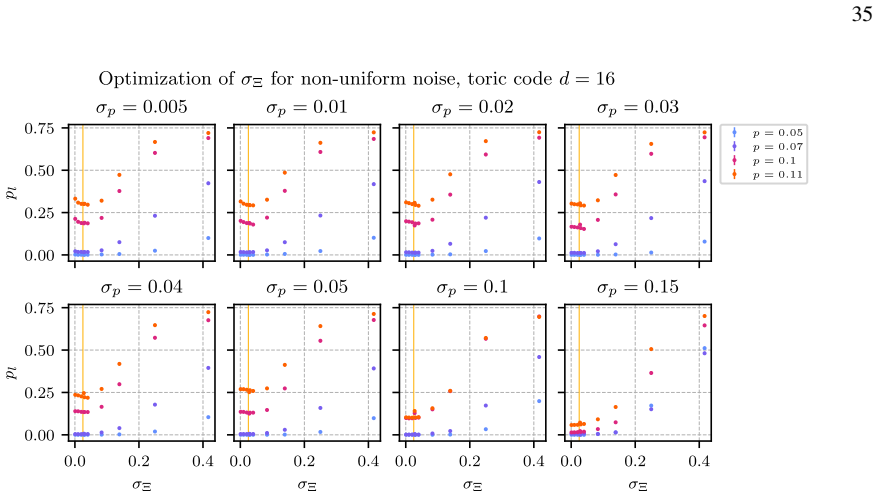
- Under non-uniform bitflip noise the ground-state degeneracy is lifted so dMP equals MP, yet ML still outperforms both, and ensembling remains useful only when its perturbations are strong enough to sample less probable errors.
Reading between the lines
- Outside this paper: the ratio framework should transfer beyond Pfaffian-computable models, so tensor-network partition-function approximants could yield ML logical error curves for surface codes under circuit-level noise, where no exact ML decoder is available.
- The sample-efficiency gain grows as the failure rate drops, so decoding-probability estimation may make low-noise logical error rates accessible that would require impractically many Monte Carlo samples by failure counting; a testable prediction is a variance comparison at $p$ well below threshold.
- The distinction between decodability and phase boundary suggests a search over statistical-mechanics models with reentrant phase boundaries for one where the maximum-partition-function decodability boundary is vertical, using the condition in Corollary 1 as the numerical check.
- The parity-dependent bias of MWPM decoders quantified here implies that benchmark comparisons between fast decoders and ML should be performed on even-distance codes, where degeneracy and bias effects are strongest.
Editorial analysis
A structured set of objections, weighed in public.
Referee Report
Summary. The paper introduces two partition-function-based estimators for stabilizer-code logical error rates: the "decoding probability" and the "order probability." It proves that these estimators exactly equal the success rates of two families of decoders: maximum partition function decoders and probabilistic partition function decoders. At the Nishimori temperature the maximum partition function decoder is maximum likelihood (ML), while at zero temperature the two families are respectively identified with degeneracy-enhanced maximum probability (dMP) decoding and maximum probability (MP) decoding. The framework is applied numerically to the toric code under bitflip noise using FKT and Wang-Landau partition function computations, with cross-validation between methods, a demonstration of roughly 75% sample savings over failure counting, and an analysis of MWPM bias, ensembling, parity effects, and non-uniform noise.
Significance. If correct, the paper provides a unified and decoder-independent route to full logical error curves rather than only thresholds, and it clarifies that the order probability used in earlier work is not the ML success rate but rather the success rate of a suboptimal probabilistic decoder. The main propositions are simple and their proofs are transparent, and the numerical section is carefully cross-validated: FKT at T=0.1TNish is checked against Wang-Landau at T=0, and ratio-based estimates are checked against direct decoder-failure counting within error bars. The public availability of the code is a further strength. The principal caveat is a definitional ambiguity about tie-breaking in the MP and dMP identifications, which is load-bearing for the advertised interpretation of the zero-temperature results.
major comments (2)
- [Section II A, Eqs. (10)-(11); Proposition 1.3, Eq. (23)] The claim that the order probability at T=0 measures the success rate of MP decoding is only true for an MP decoder that selects a maximum-probability error uniformly at random among all such errors and then returns the logical class of that selected error. As written, Eq. (10) defines C_s^MP as an argmax set, and Eq. (11) is not well defined when more than one class attains the same maximum individual-error probability; different tie-breaking rules give different success rates. Proposition 1.3 in effect introduces the uniform tie-breaking rule, but that rule is not part of the MP definition in Section II A. Please amend the definition and Eq. (11), and qualify the abstract and Section III statements accordingly.
- [Section II A, Eq. (12); Definition 1; Proposition 1.2] A closely related issue affects the dMP identification. Eq. (12) defines C_s^dMP as an argmax over classes of n_max(C_s,L|s), while Definition 1 at T=0 chooses uniformly among all classes in {C_s^max(0)}. If multiple classes tie for the largest n_max, these two prescriptions are not the same decoder unless dMP is also defined with uniform tie-breaking. Please state explicitly whether Proposition 1.2 refers to an arbitrary tie-breaking dMP decoder or to the particular uniformly randomized version used in Definition 1, and align Eq. (12)-(13) with that convention.
minor comments (5)
- [Acknowledgments] The acknowledgments contain a typo: "We than Steven Simon" should be "We thank Steven Simon."
- [References [41] and [45]] Reference [41] and reference [45] appear to be the same paper by Stace and Barrett; please merge the duplicate.
- [Fig. 10 caption] The word "ensemling" in the caption of Fig. 10 should be "ensembling."
- [Appendix D] In Appendix D the phrase "minumum-weight perfect matching" should be "minimum-weight perfect matching."
- [Section V A, Fig. 7] The discussion of weak ensembling bias is clear, but the text would benefit from an explicit statement that the uniform sampling assumed by the order-probability benchmark is not achieved by the weak-ensembling procedure; currently this point is made only indirectly through Fig. 7.
Circularity Check
Minor definitional circularity: the T=0 order-probability/MP identification requires an unstated uniform tie-break; the rest of the framework is self-contained.
-
self definitional
[Section III A, Proposition 1.3 and proof; cf. Section II A, Eqs. (10)-(11)]
"C^MP_s = arg max_L max_{e in C_s,L} P(e) (10) ... P^MP_success = sum_s P(s)P(C^MP_s | s) (11). ... a probabilistic partition function decoder at zero temperature returns a correction belonging to a class ~C_s with probability P_decoder(~C_s)= n_max(~C_s)/sum_C n_max(C), which is equivalent to returning a maximum probability error e, with equal probability for each such error."
Eq. (23) is simply Definition 2 at T=0; it is not derived from Section II's MP definition. The earlier definition selects 'the logical class C^MP_s = arg max_L max_{e in C_s,L} P(e)' and Eq. (11) defines the success probability as P(C^MP_s | s) for that single class. When several classes share the maximum error probability, the probabilistic decoder instead returns each class with probability proportional to n_max(C), which is uniform over individual maximum-probability errors. That is a different, randomized tie-breaking convention. The proposition's 'equivalent to returning a maximum probability error e, with equal probability for each such error' supplies the missing convention, making the equality to the order probability true by construction rather than as a consequence of Eq. (11).
full rationale
The rest of the paper is not circular. Proposition 2 and Proposition 3 are transparent identities: the decoders in Definitions 1-2 and the estimators in Definitions 3-4 are built from the same {C_max_s(T)} sets and the same partition-function ratios, so the equalities follow by unpacking definitions rather than by fitting. The statistical-mechanics identification Z_TNish(C)=P(C), Eqs. (14)-(18), is imported from [1,2] as an external mapping, and the numerical logical-error curves are cross-checked by two independent partition-function implementations (FKT at T=0.1 T_Nish versus Wang-Landau at T=0) and against external MWPM/PyMatching benchmarks. No parameter is fitted to produce the decoding-probability or order-probability curves themselves; the ensembling perturbation widths are optimized for a separate matching-decoder comparison and do not enter the central identities. The one genuine caveat is the tie-break ambiguity in Proposition 1.3: identifying the order probability with MP success requires an unstated uniform-over-maximum-errors tie-break, so that particular claim is partly definitional. Since this is a localized, repairable convention issue rather than a hidden input driving the numerical claims, the overall circularity is minor.
Assumptions & free parameters
free parameters (3)
- sigma_xi (ensembling perturbation width, uniform noise) =
10^-6
- sigma_Xi (ensembling perturbation width, non-uniform noise) =
0.025
- T_approx (finite-temperature stand-in for zero temperature) =
0.1 T_Nish
assumptions (6)
- domain assumption Error class probabilities equal partition functions at the Nishimori temperature (Eqs. 14-18)
- domain assumption The physical noise is a product of independent single-qubit Pauli errors with known probabilities pi(gi)
- standard math The Pfaffian method correctly gives the RBIM partition function on the torus via 2Z = Pf(K++)+Pf(K+-)+Pf(K-+)+Pf(K--)
- standard math Wang-Landau density-of-states estimates converge to the true density of states with the chosen flatness and update-factor parameters
- domain assumption T=0.1 T_Nish with 4096 bits of precision approximates the zero temperature limit for FKT
- domain assumption Weak ensembling with sigma_xi=10^-6 samples only among minimum-weight matchings
Cite this review
Pith. "Pith review of A partition function framework for estimating logical error curves in stabilizer codes." pith.science (2026). https://pith.science/paper/LZOS6MLW
@misc{pith2026250515758,
  author       = {Pith},
  title        = {Pith review of: A partition function framework for estimating logical error curves in stabilizer codes},
  year         = {2026},
  howpublished = {\url{https://pith.science/paper/LZOS6MLW}},
  note         = {Machine review of arXiv:2505.15758}
}
read the original abstract
Based on the mapping between stabilizer quantum error correcting codes and disordered statistical mechanics models, we define a ratio of partition functions that measures the success probability for maximum partition function decoding, which at the Nishimori temperature corresponds to maximum likelihood (ML) decoding. We show that this ratio differs from the similarly defined order probability and describe the decoding strategy whose success rate is described by the order probability. We refer to the latter as a probabilistic partition function decoding and show that it is the strategy that at zero temperature corresponds to maximum probability (MP) decoding. Based on the difference between the two decoders, we discuss the possibility of a maximum partition function decodability boundary outside the order-disorder phase boundary. At zero temperature, the difference between the two ratios measures to what degree MP decoding can be improved by accounting for degeneracy among maximum probability errors, through methods such as ensembling. We consider in detail the example of the toric code under bitflip noise, which maps to the Random Bond Ising Model. We demonstrate that estimation of logical performance through decoding probability and order probability is more sample efficient than estimation by counting failures of the corresponding decoders, especially in the regime of low noise. We consider both uniform noise and noise where qubits are given individual error rates. The latter noise model lifts the degeneracy among maximum probability errors, but we show that ensembling remains useful as long as it also samples less probable errors. We also consider, in less detail, the color code under bitflip and depolarizing noise.
Figures


Figures from the paper (18 more)


Reference graph
Works this paper leans on
-
[11]
J. Behrends and B. B ´eri, Statistical mechanical mapping and maximum-likelihood thresholds for the surface code under generic single-qubit coherent errors (2024), arXiv:2410.22436 [quant-ph]
arXiv 2024
-
[1]
A maximum partition function decoder at T = TNish is an ML decoder
-
[2]
A maximum partition function decoder at T = 0 is a dMP decoder
-
[3]
We prove each of the three statements in turn
A probabilistic partition function decoder at T = 0 is an MP decoder Proof. We prove each of the three statements in turn
-
[4]
The proof of this statement immediately follows from P(C⃗s)= ZTNish(C⃗s)
-
[5]
Writing the partition function as ZT(C⃗s) =∑E gC⃗s(E)e−E/T , with gC⃗s(E) the density of states for the class C⃗s, we denote by Emin(C⃗s) the lowest energy E such that gC⃗s(E) ≠ 0, and denote by Emin(⃗s) = minC⃗s Emin(C⃗s) the lowest energy among all error classes consistent with the syndrome ⃗s. Normalizing by the lowest energy Boltzmann weight, lim T →0...
-
[6]
Finally, a probabilistic partition function decoder at zero temperature returns a correction belonging to ˜C⃗s with a probability Pdecoder( ˜C⃗s)= nmax( ˜C⃗s) ∑C⃗s nmax(C⃗s) , (23) which is equivalent to returning a maximum probability error e, with equal probability for each such error. B. The decoding probability and the order probability We next introd...
work page 2020
-
[7]
Dennis, A
E. Dennis, A. Kitaev, A. Landahl, and J. Preskill, Topological quantum memory, Journal of Mathematical Physics 43, 4452 (2002)
2002
Show all 58 references
-
[8]
C. T. Chubb and S. T. Flammia, Statistical mechanical models for quantum codes with correlated noise, Annales de l’Institut Henri Poincar´e D 8, 269 (2021)
2021
-
[9]
Rispler, D
M. Rispler, D. V odola, M. M¨uller, and S. Kim, The random coupled-plaquette gauge model and the surface code under circuit-level noise (2024), arXiv:2412.14004 [quant-ph]
2024 arXiv
-
[10]
Piveteau, C
C. Piveteau, C. T. Chubb, and J. M. Renes, Tensor Network Decoding Beyond 2D, PRX Quantum 5, 040303 (2024), arXiv:2310.10722 [quant-ph]
2024 arXiv
-
[12]
Behrends and B
J. Behrends and B. B ´eri, The surface code beyond Pauli channels: Logical noise coherence, information- theoretic measures, and errorfield-double phenomenology (2025), arXiv:2412.21055 [quant-ph]
2025
-
[13]
V odola, M
D. V odola, M. Rispler, S. Kim, and M. M ¨uller, Fundamental thresholds of realistic quantum error correction circuits from classical spin models, Quantum 6, 618 (2022), arXiv:2104.04847 [quant-ph]
2022 arXiv
-
[14]
F. Venn, J. Behrends, and B. B ´eri, Coherent-Error Threshold for Surface Codes from Majorana Delocalization, Physical Review Letters 131, 060603 (2023)
2023
-
[15]
Y . Xiao, B. Srivastava, and M. Granath, Exact results on finite size corrections for surface codes tailored to biased noise, Quantum 8, 1468 (2024), arXiv:2401.04008 [quant-ph]
2024 arXiv
-
[16]
C. Wang, J. Harrington, and J. Preskill, Confinement-Higgs transition in a disordered gauge theory and the accuracy threshold for quantum memory, Annals of Physics 303, 31 (2003)
2003
-
[17]
C. K. Thomas and H. G. Katzgraber, Simplest model to study reentrance in physical systems, Physical Review E 84, 040101 (2011)
2011
-
[18]
Bombin, R
H. Bombin, R. S. Andrist, M. Ohzeki, H. G. Katzgraber, and M. A. Martin-Delgado, Strong Resilience of Topological Codes to Depolarization, Physical Review X2, 021004 (2012)
2012
-
[19]
R. S. Andrist, H. Bombin, H. G. Katzgraber, and M. A. Martin-Delgado, Optimal error correction in topological subsystem codes, Physical Review A 85, 050302 (2012)
2012
-
[20]
H. Song, J. Sch ¨onmeier-Kromer, K. Liu, O. Viyuela, L. Pollet, and M. A. Martin-Delgado, Optimal Thresholds for Fracton Codes and Random Spin Models with Subsystem Symmetry, Physical Review Letters 129, 230502 (2022)
2022
-
[21]
H. G. Katzgraber, H. Bombin, R. S. Andrist, and M. A. Martin-Delgado, Topological color codes on Union Jack lattices: A stable implementation of the whole Clifford group, Physical Review A 81, 012319 (2010)
2010
-
[22]
Bravyi, M
S. Bravyi, M. Suchara, and A. Vargo, Efficient Algorithms for Maximum Likelihood Decoding in the Surface Code, Physical Review A 90, 032326 (2014), arXiv:1405.4883 [quant-ph]
2014 arXiv
-
[23]
A. S. Maan and A. Paler, Testing the Accuracy of Surface Code Decoders, in 2023 IEEE International Confer- ence on Rebooting Computing (ICRC) (2023) pp. 1–5
2023
-
[24]
Shutty, M
N. Shutty, M. Newman, and B. Villalonga, Efficient near-optimal decoding of the surface code through ensem- bling (2024), arXiv:2401.12434 [quant-ph]
2024 arXiv
-
[25]
Nishimori, Geometry-Induced Phase Transition in the ±J Ising Model, Journal of the Physical Society of Japan 55, 3305 (1986), publisher: The Physical Society of Japan
H. Nishimori, Geometry-Induced Phase Transition in the ±J Ising Model, Journal of the Physical Society of Japan 55, 3305 (1986), publisher: The Physical Society of Japan
1986
-
[26]
Arute, K
F. Arute, K. Arya, R. Babbush, D. Bacon, J. C. Bardin, R. Barends, R. Biswas, S. Boixo, F. G. S. L. Brandao, D. A. Buell, B. Burkett, Y . Chen, Z. Chen, B. Chiaro, R. Collins, W. Courtney, A. Dunsworth, E. Farhi, B. Foxen, A. Fowler, C. Gidney, M. Giustina, R. Graff, K. Guerin...
2019
-
[27]
Higgott and C
O. Higgott and C. Gidney, Sparse Blossom: correcting a million errors per core second with minimum-weight matching, Quantum 9, 1600 (2025)
2025
-
[28]
M. A. Nielsen and I. L. Chuang, Quantum Computation and Quantum Information: 10th Anniversary Edition (Cambridge University Press, 2010)
2010
-
[29]
C. K. Thomas and A. A. Middleton, Exact algorithm for sampling the two-dimensional Ising spin glass, Physical Review E 80, 046708 (2009)
2009
-
[30]
Wang and D
F. Wang and D. P. Landau, Efficient, multiple-range random walk algorithm to calculate the density of states, Physical Review Letters 86, 2050 (2001)
2001
-
[31]
C. T. Chubb, General tensor network decoding of 2D Pauli codes (2021), arXiv:2101.04125 [quant-ph]
2021 arXiv
-
[32]
Sriram, N
A. Sriram, N. O’Dea, Y . Li, T. Rakovszky, and V . Khemani, Non-Uniform Noise Rates and Griffiths Phases in Topological Quantum Error Correction (2024), arXiv:2409.03325 [quant-ph]
2024
-
[33]
L. P. Pryadko, On maximum-likelihood decoding with circuit-level errors, Quantum 4, 304 (2020), arXiv:1909.06732 [quant-ph]
2020 arXiv
-
[34]
C. K. Thomas and A. A. Middleton, Numerically exact correlations and sampling in the two-dimensional Ising spin glass, Physical Review E 87, 043303 (2013)
2013
-
[35]
Picco, A
M. Picco, A. Honecker, and P. Pujol, Strong disorder fixed points in the two-dimensional random-bond Ising model, Journal of Statistical Mechanics: Theory and Experiment 2006, P09006 (2006)
2006
-
[36]
Colmenarez, S
L. Colmenarez, S. Kim, and M. M ¨uller, Fundamental thresholds for computational and erasure errors via the coherent information (2024), arXiv:2412.16727 [quant-ph]
2024
-
[37]
Colmenarez, Z.-M
L. Colmenarez, Z.-M. Huang, S. Diehl, and M. M ¨uller, Accurate optimal quantum error correction thresholds from coherent information, Physical Review Research 6, L042014 (2024)
2024
-
[38]
Niwa and J
R. Niwa and J. Y . Lee, Coherent information for Calderbank-Shor-Steane codes under decoherence, Physical Review A 111, 10.1103/physreva.111.032402 (2025)
2025 doi
-
[39]
V ogel, Y
T. V ogel, Y . W. Li, T. W¨ust, and D. P. Landau, Generic, hierarchical framework for massively parallel Wang- Landau sampling, Physical Review Letters 110, 210603 (2013)
2013
-
[40]
Kasteleyn, The statistics of dimers on a lattice, Physica 27, 1209 (1961)
P. Kasteleyn, The statistics of dimers on a lattice, Physica 27, 1209 (1961)
1961
-
[41]
H. N. V . Temperley and M. E. Fisher, Dimer problem in statistical mechanics-an exact result, Philosophical Magazine 6, 1061 (1961)
1961
-
[42]
V ogel, Y
T. V ogel, Y . Wai Li, and D. P Landau, A practical guide to replica-exchange Wang—Landau simulations, Journal of Physics: Conference Series 1012, 012003 (2018)
2018
-
[43]
Wichette, H
L. Wichette, H. Hohenfeld, E. Mounzer, and L. Grans-Samuelsson, github repository: qec pf fkt (2025)
2025
-
[44]
Wichette, H
L. Wichette, H. Hohenfeld, E. Mounzer, and L. Grans-Samuelsson, github repository: qec pf wang landau (2025)
2025
-
[45]
Wichette, H
L. Wichette, H. Hohenfeld, E. Mounzer, and L. Grans-Samuelsson, github repository: qec pf post processing (2025)
2025
-
[46]
Efron, Better bootstrap confidence intervals, Journal of the American Statistical Association 82, 171 (1987)
B. Efron, Better bootstrap confidence intervals, Journal of the American Statistical Association 82, 171 (1987)
1987
-
[47]
T. M. Stace and S. D. Barrett, Error correction and degeneracy in surface codes suffering loss, Phys. Rev. A 81, 022317 (2010)
2010
-
[48]
Wu and L
Y . Wu and L. Zhong, Fusion Blossom: Fast MWPM Decoders for QEC , in2023 IEEE International Conference on Quantum Computing and Engineering (QCE) (IEEE Computer Society, Los Alamitos, CA, USA, 2023) pp. 928–938
2023
-
[49]
Wichette, H
L. Wichette, H. Hohenfeld, E. Mounzer, and L. Grans-Samuelsson, github repository: qec pf ensembling mwpm (2025)
2025
-
[50]
Duclos-Cianci and D
G. Duclos-Cianci and D. Poulin, Fast decoders for topological quantum codes, Physical review letters 104, 050504 (2010)
2010
-
[51]
T. M. Stace and S. D. Barrett, Error correction and degeneracy in surface codes suffering loss, Physical Review A 81, 022317 (2010), publisher: American Physical Society
2010
-
[52]
M. E. Beverland, B. J. Brown, M. J. Kastoryano, and Q. Marolleau, The role of entropy in topological quantum error correction, Journal of Statistical Mechanics: Theory and Experiment 2019, 073404 (2019)
2019
-
[53]
Higgott, Pymatching: A python package for decoding quantum codes with minimum-weight perfect match- ing, ACM Transactions on Quantum Computing 3, 10.1145/3505637 (2022)
O. Higgott, Pymatching: A python package for decoding quantum codes with minimum-weight perfect match- ing, ACM Transactions on Quantum Computing 3, 10.1145/3505637 (2022)
2022 doi
-
[54]
Gidney, Stim: a fast stabilizer circuit simulator, Quantum 5, 497 (2021)
C. Gidney, Stim: a fast stabilizer circuit simulator, Quantum 5, 497 (2021)
2021
-
[55]
Edmonds, Paths, trees, and flowers, Canadian Journal of mathematics 17, 449 (1965)
J. Edmonds, Paths, trees, and flowers, Canadian Journal of mathematics 17, 449 (1965). 38
1965
-
[56]
Kolmogorov, Blossom V: a new implementation of a minimum cost perfect matching algorithm, Mathematical Programming Computation 1, 43 (2009)
V . Kolmogorov, Blossom V: a new implementation of a minimum cost perfect matching algorithm, Mathematical Programming Computation 1, 43 (2009)
2009
-
[57]
Dezs ˝o, A
B. Dezs ˝o, A. J ¨uttner, and P. Kov´acs, LEMON–an open source C++ graph template library, Electronic notes in theoretical computer science 264, 23 (2011)
2011
-
[58]
D. R. Jones, C. D. Perttunen, and B. E. Stuckman, Lipschitzian optimization without the Lipschitz constant, Journal of optimization Theory and Applications 79, 157 (1993)
1993
Reviewed August 7, 2026 · model on record in the stance chip above.
Discussion (0). Sign in to comment.