REVIEW 4 major objections 5 minor 106 references
Revisiting Varying Speed of Light in Cosmology: Insights from the Friedmann-Lema\^itre-Robertson-Walker Metric
T0 review · 4 major / 5 minor · reviewed 2026-08-15 · deepseek-v4-flash
Pith's one-line read The paper argues that a varying speed of light in the FLRW metric is not a dynamical field but a coordinate artifact carried by the lapse function, which imposes a constraint on the scale factor instead of having its own equation of motion.
desk verdict The paper's only new derivation is invalid because it drops the √-g measure in the variation; the gauge interpretation is standard and was already in the author's earlier work. read the letter →
The pith
A machine-rendered reading of the paper's core claim, the machinery that carries it, and where it could break.
The reading
What carries the argument
The central machinery is the lapse function, defined in the paper as $N \equiv \tilde c/c$, which sets the rate at which proper time advances relative to coordinate time across spatial hypersurfaces. The argument runs by writing the Einstein-Hilbert action for the VSL metric, using the fixed-$\tilde\kappa$ relation Eq. (9) and the conservation equation Eq. (24) to eliminate apparent $\tilde c$ dependence from the matter sector, then varying the action with respect to $\tilde c$. The resulting Euler-Lagrange equation produces the scale-factor constraint Eq. (34), which is what carries the claim that $\tilde c$ is non-dynamical and should be interpreted through the lapse function rather than as a new field.
What would settle it
Recompute the Euler-Lagrange equation for $\tilde c$ from Eq. (31) with $\sqrt{-g} = \tilde c a^3$ and with the $\tilde c$-dependent measure kept; if the result is the vacuum Friedmann constraint $\dot a^2/a^2 + k\tilde c^2/a^2 = \Lambda \tilde c^2/3$ rather than $\ddot a/a + 3(\dot a/a)^2 = 0$, then the conclusion that $\tilde c$ is non-dynamical does not follow from this action.
Extended reading notes
Core claim
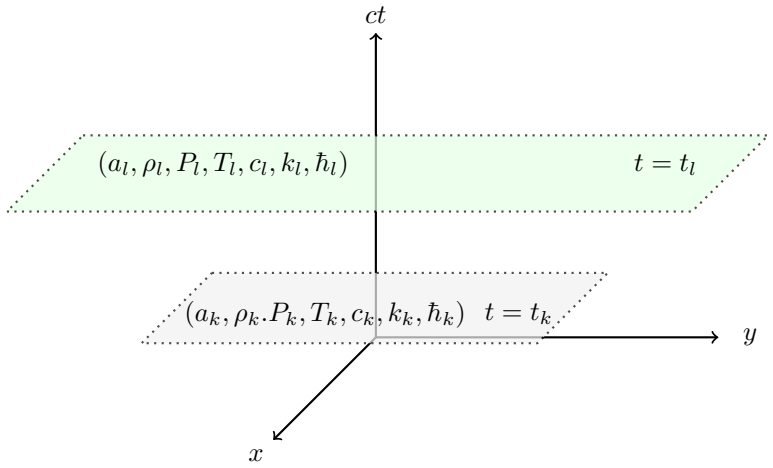
The paper claims that in the line element $ds^2 = -\tilde c(t)^2 dt^2 + a(t)^2 dl^2_{3D}$, the time-dependent speed of light $\tilde c(t)$ plays exactly the role of the lapse function $N(t)$ in the ADM foliation, rescaling coordinate time relative to proper time. Varying the Einstein-Hilbert action, while holding the Einstein gravitational constant $\tilde \kappa = 8\pi \tilde G/\tilde c^4$ fixed, leads to an Euler-Lagrange equation for $\tilde c$ that does not determine $\tilde c$; instead it yields the constraint $\ddot a/a + 3(\dot a/a)^2 = 0$, whose solution is $a(t) = (c_1 + c_2 t)^{1/4}$. The paper concludes that a varying speed of light is not an independent degree of freedom but a manifestation of the freedom to choose the temporal coordinate, and that VSL models should be understood as a coordinate-dependent feature of cosmic time rather than a modification of physical laws.
Load-bearing premise
The derivation's load-bearing step is treating $\sqrt{-g}$ as independent of $\tilde c$ when varying the action, even though the metric gives $\sqrt{-g} = \tilde c a^3$; if that dependence is included, the constraint equation for $\tilde c$ changes.
Editorial extensions
If this is right
- The Hubble radius $\tilde c(a)/H(a)$ in the model equals the standard-model value $c_0/H^{(GR)}(a)$, so luminosity distances and angular diameter distances built from it are unchanged when the redshift is defined in the same way.
- The past evolution of the Hubble parameter differs from standard cosmology by a factor $\tilde c^2/\tilde c_0^2$, which the paper says could reconcile local and distance-inferred values of $H_0$ without introducing a new field.
- The Hubble tension and time-dilation measurements become probes of the temporal gauge: if observations favor a nonzero parameter $b$ in $\tilde c = \tilde c_0 a^{b/4}$, the standard gauge choice $b = 0$ would be disfavored.
- Because no new dynamical field appears, the framework remains general relativity with a nontrivial temporal coordinate choice, avoiding the stability and symmetry issues that plague scalar-field VSL models.
Reading between the lines
- A testable consequence the paper leaves implicit: if $\tilde c$ is pure gauge, any VSL model can be rewritten with a constant $c$ by a time reparametrization, so physical observables must be gauge-invariant and distance-redshift data alone cannot prefer VSL over standard cosmology.
- The derivation's handling of $\sqrt{-g}$ is the natural place to probe the claim; carrying the full variation with $\sqrt{-g} = \tilde c a^3$ kept intact would either confirm the constraint or turn it into the first Friedmann equation, which would decide whether the non-dynamical conclusion survives.
- The same lapse logic could be applied to other seeming drifts of constants in cosmological fits, since the model already requires $\tilde G \propto \tilde c^4$ to keep the Einstein gravitational constant fixed.
Signed reviews
Editorial analysis
A structured set of objections, weighed in public.
Referee Report
Summary. The paper argues that a time-dependent speed of light c̃(t) in the FLRW metric is not an independent physical degree of freedom but reflects a coordinate choice, specifically the lapse function. The central claim is supported by an action-principle calculation in Section VI, where the Euler-Lagrange equation for c̃ is said to yield a constraint on the scale factor, a(t) = (c1 + c2 t)^(1/4), rather than a dynamical equation for c̃. The paper further proposes that this reframing offers a new interpretation of cosmological observables, including the Hubble tension. It also derives modified Friedmann equations (Eqs. 25-29) and notes that the Hubble radius in this model is identical to the standard model's (Eq. 30).
Significance. If the central claim were correct, it would constitute a clean no-go argument against treating VSL as new physics in FLRW backgrounds and would clarify the gauge nature of c̃. The paper has some positive features: the derivation of the modified Friedmann equations is systematic, and the explicit observation in Eq. (30) that the Hubble radius coincides with the standard model is a useful check. However, the load-bearing variational calculation in Section VI is invalid, and the proposed observational test of a gauge parameter is logically inconsistent. The main conclusion that c̃ has no dynamics is therefore not established by the manuscript, and the advertised connection to the Hubble tension is contradicted by the paper's own equations.
major comments (4)
- [Section VI, Eq. (34)] The Euler-Lagrange equation is computed by varying only the Ricci scalar R, while the action in Eq. (33) is ∫ R√-g d⁴x with √-g = c̃ a³ for the metric in Eq. (4). Since the measure depends explicitly on c̃, the correct variation of the action with respect to c̃ must include δ√-g; this yields the Hamiltonian (Friedmann) constraint, not the equation ä/a + 3(ȧ/a)² = 0 reported in Eq. (34). Consequently, the derived solution a(t) = (c1 + c2 t)^(1/4) and the conclusion that c̃ is non-dynamical are not established.
- [Section VI, Eqs. (31)-(32)] The claim that the perfect-fluid Lagrangian is independent of c̃ is based on Eq. (24), but the matter action is ∫ ρ_i(1+ω_i)c̃² √-g d⁴x = ∫ ρ_i0(1+ω_i)c̃0² a^(-3(1+ω_i)) c̃ a³ d⁴x, which depends on c̃ through the volume element. Dropping this c̃-dependence changes the equation of motion and invalidates the subsequent constraint derivation.
- [Section V.C, Eq. (30)] Equation (30) shows that the Hubble radius in the meVSL model is identical to the standard model value, and the text correctly states that luminosity and angular diameter distances, being integrals over the Hubble radius, are unchanged. This directly contradicts the abstract's and conclusion's claim that the framework offers a new interpretation of observational tensions such as the Hubble tension: if the background distance observables are unchanged, the model cannot resolve the tension by modifying the expansion history.
- [Section VI, Eq. (35) and Conclusion] The identification of c̃ with the lapse function via N ≡ c̃/c in Eq. (35) is a definition, not a derived result. Moreover, the conclusion proposes to test the gauge parameter b by cosmological observations, while simultaneously asserting that c̃ is a coordinate/gauge choice with no physical content. If c̃ is pure gauge, b is unobservable; if b is observable, c̃ is not pure gauge. The manuscript does not resolve this contradiction and instead relies on it for its advertised testability.
minor comments (5)
- [Introduction, last paragraph] The text says 'we conclude with a discussion of our findings and their broader implications in Section 6', but the conclusions appear in Section VII, not Section VI; the cross-reference should be corrected.
- [Section III, Eq. (4)] The notation alternates between c̃ and c without always making clear whether c denotes the constant present-day value or the speed of light in a given frame; a consistent definition at first use would improve readability.
- [Section III, Eq. (5)] The meVSL relation c̃1 = (a1/a2)^(b/4) c̃2 is stated as a special case f(a)=a^(1-b/4), but the intermediate steps connecting f(a) to the exponent b/4 are not shown, making the equation hard to follow.
- [Abstract and Section I] The terms 'dynamical', 'independent degree of freedom', and 'gauge' are used without precise definitions; the paper would benefit from stating explicitly, e.g., whether the lapse is a Lagrange multiplier in the ADM formalism and what exactly counts as a dynamical field.
- [References] A large fraction of the references are to the author's own previous work; while self-citations are legitimate, the paper would be stronger if it cited independent derivations or critical discussions of the meVSL framework.
Circularity Check
The central claim that VSL is a coordinate effect is built into the paper's own definitions, while the action-principle proof in Section VI does not vary the full action; the proposed test of the gauge parameter b is a test of an input by construction.
-
self definitional
[Section VI, Eq. (35) and following paragraph; metric Eq. (4)]
"In meVSL model, the lapse function accounts for the variation of c̃. We can define the lapse function N≡ c̃/c as ... ≡ c̃[t]dt ≡ N[t]c[t]dt. (35) ... The ability to represent the variation of c̃ through the lapse function implies that the change in c̃ is not merely a physical dynamical process but depends on the definition of the time variable we choose. Therefore, c̃ is more likely to be determined by the choice of coordinates (lapse function) rather than being an independent variable."
The lapse N is introduced by the definition N≡c̃/c, so the statement that c̃ can be represented through the lapse function is true by definition rather than being a result of the action principle. The metric in Eq. (4) already places c̃ in g00, so reading c̃ as a lapse/coordinate effect is an input of the chosen parametrization. Since the only independent derivation, Eq. (34), is not the variation of the full action (the measure √−g∝c̃a³ is held fixed there), the central conclusion that c̃ is a non-dynamical coordinate gauge rests on this definitional identification.
-
fitted input called prediction
[Section VII, Conclusion; compare Eq. (30)]
"As a gauge choice, we may arbitrarily set the form of the varying speed of light as c̃ = c̃0 a^{b/4}. By comparing this parametrization with cosmological observations such as time dilation measurements from Type Ia supernovae and other probes, we can test whether the value of b deviates from zero."
The parameter b is introduced as an arbitrary gauge choice, and Eq. (30) of the same paper states that the Hubble radius c̃(a)/H(a)=c̃0/H^{(GR)}(a) is identical to that of SMC, so luminosity and angular-diameter distances are unchanged. Thus no such observable can select b; proposing to test whether b deviates from zero is testing an input parametrization rather than a prediction of the model. If b is a genuine gauge parameter, b≠0 and b=0 are physically equivalent by construction.
full rationale
The paper's advertised first-principles derivation is not self-contained. In Section VI, Eq. (33) defines the action as S=∫(1/(2κ0))R√−g, but Eq. (34) computes d/dt(∂R/∂˙c̃)−∂R/∂c̃=0, i.e., it varies the Ricci scalar while treating √−g as inert. For the metric of Eq. (4), √−g=c̃a³, so δ√−g/δc̃≠0, and the matter term ρ_i(1+ω_i)c̃²√−g also depends on c̃ through the measure; Eq. (32) drops that measure. The claimed constraint a(t)=(c1+c2t)^{1/4} is therefore an artifact of a selected variation rather than a consequence of the full action; the correct variational equation would be the Friedmann constraint, Eq. (25). This is a correctness defect rather than a circularity by itself, but it removes the independent support for the central claim. Once that support is removed, the nonzero circular content is visible: the conclusion that VSL is a coordinate effect is carried by the definition N≡c̃/c in Eq. (35), and the concluding proposal to observationally test the gauge parameter b contradicts the paper's own Eq. (30), which makes all Hubble-radius observables identical to SMC. The heavy reliance on the author's prior meVSL papers, Refs. [1–5], is mostly contextual and does not by itself add circularity beyond the definitional issues identified above.
Assumptions & free parameters
free parameters (1)
- b
assumptions (4)
- domain assumption FLRW metric with g_{00} = -c̃² and Weyl postulate (cosmic time equals proper time for comoving observers)
- ad hoc to paper The Einstein gravitational constant κ̃ ≡ 8πG̃/c̃⁴ is time-independent (Eq. 9)
- domain assumption Energy-momentum conservation ∇_μT^{μν}=0 and the resulting scaling ρ_i c̃² ∝ a^{-3(1+ω_i)} (Eq. 24)
- ad hoc to paper The action contains the perfect-fluid Lagrangian L_i = ρ_i(1+ω_i)c̃² and the EH term; c̃ is varied independently of a(t)
invented entities (1)
-
c̃(t), a time-dependent speed of light in FLRW
Cite this review
Pith. "Pith review of Revisiting Varying Speed of Light in Cosmology: Insights from the Friedmann-Lema\^itre-Robertson-Walker Metric." pith.science (2026). https://pith.science/paper/GDZ6GBIM
@misc{pith2026250515838,
  author       = {Pith},
  title        = {Pith review of: Revisiting Varying Speed of Light in Cosmology: Insights from the Friedmann-Lema\^itre-Robertson-Walker Metric},
  year         = {2026},
  howpublished = {\url{https://pith.science/paper/GDZ6GBIM}},
  note         = {Machine review of arXiv:2505.15838}
}
abstract
In the Friedmann-Lema\^itre-Robertson-Walker metric, a varying speed of light (VSL) reflects a change in the clock rate across hypersurfaces, described by the lapse function. This variation is not a dynamical field evolution but a consequence of coordinate choice, as the cosmic time coincides with the proper time of comoving observers due to the Weyl postulate. From an action principle including $\tilde c$, we derive that $\tilde c$ does not have its dynamics but imposes a constraint on the scale factor $a(t)$, indicating that it is not an independent degree of freedom. This insight reframes the VSL concept as a manifestation of gauge freedom in general relativity, wherein physical laws remain invariant under smooth coordinate transformations. Here, gauge refers to the freedom of choosing the temporal coordinate (\textit{e.g.}, setting the lapse $N(t) \neq 1$), which determines how the speed of light appears in the cosmological equations. Recognizing $\tilde c$ as a coordinate-dependent quantity offers a new interpretation of cosmological time and observational tensions, such as the Hubble tension, without invoking new physical fields. This redefinition opens a novel theoretical pathway in interpreting cosmic expansion within a consistent relativistic framework.
Figures

Reference graph
Works this paper leans on
-
[5]
S. Lee, Class. Quant. Grav. 42, no.2, 025026 (2025) doi:10.1088/1361-6382/ada2d5 [arXiv:2412.19049 [gr-qc]]
arXiv 2025
-
[1]
Lee, JCAP 08, 054 (2021) doi:10.1088/1475-7516/2021/08/054 [arXiv:2011.09274 [astro- ph.CO]]
S. Lee, JCAP 08, 054 (2021) doi:10.1088/1475-7516/2021/08/054 [arXiv:2011.09274 [astro- ph.CO]]. 17
arXiv 2021
- [87]
- [89]
-
[103]
Lee, Universe 10, no.6, 268 (2024) doi:10.3390/universe10060268 [arXiv:2101.09862 [astro- ph.CO]]
S. Lee, Universe 10, no.6, 268 (2024) doi:10.3390/universe10060268 [arXiv:2101.09862 [astro- ph.CO]]
arXiv 2024
-
[106]
Cosmic distance duality as a probe of minimally extended varying speed of light
S. Lee, [arXiv:2108.06043 [astro-ph.CO]]. 24
-
[2]
S. Lee, Found. Phys. 53, 40 (2023) doi:10.1007/s10701-023-00682-1 [arXiv:2303.13772 [physics.gen-ph]]
arXiv 2023
-
[3]
S. Lee, Particles 7, no.2, 309-326 (2024) doi:10.3390/particles7020019 [arXiv:2406.02556 [physics.gen-ph]]
arXiv 2024
Show all 106 references
-
[4]
Lee, Phys
S. Lee, Phys. Dark Univ. 42, 101286 (2023) doi:10.1016/j.dark.2023.101286 [arXiv:2212.03728 [astro-ph.CO]]
2023
-
[6]
P. P. Avelino and C. J. A. P. Martins, Phys. Lett. B 459 (1999), 468-472 doi:10.1016/S0370- 2693(99)00694-2 [arXiv:astro-ph/9906117 [astro-ph]]
1999 arXiv
-
[7]
J. A. Belinchon, Int. J. Theor. Phys. 39, 1669-1686 (2000) doi:10.1023/A:1003644614145 [arXiv:gr-qc/9907003 [gr-qc]]
2000 arXiv
-
[8]
P. P. Avelino, C. J. A. P. Martins and G. Rocha, Phys. Lett. B 483 (2000), 210 doi:10.1016/S0370-2693(00)00567-0 [arXiv:astro-ph/0001292 [astro-ph]]
2000 arXiv
-
[9]
Szydlowski and A
M. Szydlowski and A. Krawiec, Phys. Rev. D 68, 063511 (2003) doi:10.1103/PhysRevD.68.063511 [arXiv:gr-qc/0212068 [gr-qc]]
2003 arXiv
-
[10]
Magueijo, Rept
J. Magueijo, Rept. Prog. Phys. 66, 2025 (2003) doi:10.1088/0034-4885/66/11/R04 [arXiv:astro-ph/0305457 [astro-ph]]
2003 arXiv
-
[11]
Shojaie and M
H. Shojaie and M. Farhoudi, Can. J. Phys. 85, 1395-1408 (2007) doi:10.1139/P07-132 [arXiv:gr-qc/0406027 [gr-qc]]
2007 arXiv
-
[12]
Shojaie and M
H. Shojaie and M. Farhoudi, Can. J. Phys. 84, 933-944 (2006) doi:10.1139/P06-070 [arXiv:gr- qc/0407096 [gr-qc]]
2006
-
[13]
Balcerzak and M
A. Balcerzak and M. P. Dabrowski, Phys. Lett. B 728, 15-18 (2014) doi:10.1016/j.physletb.2013.11.029 [arXiv:1310.7231 [astro-ph.CO]]
2014 arXiv
-
[14]
Balcerzak and M
A. Balcerzak and M. P. Dabrowski, JCAP 06, 035 (2014) doi:10.1088/1475- 7516/2014/06/035 [arXiv:1406.0150 [astro-ph.CO]]
2014 arXiv
- [15]
-
[16]
E. T. Hanımeli, B. Lamine, A. Blanchard and I. Tutusaus, Phys. Rev. D 101, no.6, 063513 (2020) doi:10.1103/PhysRevD.101.063513 [arXiv:1910.08325 [astro-ph.CO]]
2020 arXiv
-
[17]
Skara and L
F. Skara and L. Perivolaropoulos, Phys. Rev. D 101, no.6, 063521 (2020) doi:10.1103/PhysRevD.101.063521 [arXiv:1911.10609 [astro-ph.CO]]. 18
2020 arXiv
-
[18]
Bhattacharjee and P
S. Bhattacharjee and P. K. Sahoo, Eur. Phys. J. Plus 135, no.1, 86 (2020) doi:10.1140/epjp/s13360-020-00116-1 [arXiv:2001.06569 [gr-qc]]
2020 arXiv
-
[19]
R. P. Gupta, doi:10.1093/mnras/staa2472 [arXiv:2009.08878 [astro-ph.CO]]
2009 arXiv
-
[20]
R. R. Cuzinatto, R. P. Gupta, R. F. L. Holanda, J. F. Jesus and S. H. Pereira, Mon. Not. Roy. Astron. Soc.515, no.4, 5981-5992 (2022) doi:10.1093/mnras/stac2039 [arXiv:2204.10764 [gr-qc]]
2022 arXiv
-
[21]
R. R. Cuzinatto, R. F. L. Holanda and S. H. Pereira, Mon. Not. Roy. Astron. Soc. 519, 633-640 (2023) doi:10.1093/mnras/stac3267 [arXiv:2202.01371 [gr-qc]]
2023 arXiv
-
[22]
R. R. Cuzinatto, R. P. Gupta and P. J. Pompeia, Symmetry 15, no.3, 709 (2023) doi:10.3390/sym15030709 [arXiv:2204.00119 [gr-qc]]
2023 arXiv
-
[23]
Bileska, Class
M. Bileska, Class. Quant. Grav. 41, no.18, 183001 (2024) doi:10.1088/1361-6382/ad68f0
2024 doi
-
[24]
S. R. Coleman and S. L. Glashow, Phys. Lett. B 405, 249-252 (1997) doi:10.1016/S0370- 2693(97)00638-2 [arXiv:hep-ph/9703240 [hep-ph]]
1997 arXiv
-
[25]
Albrecht and J
A. Albrecht and J. Magueijo, Phys. Rev. D 59, 043516 (1999) doi:10.1103/PhysRevD.59.043516 [arXiv:astro-ph/9811018 [astro-ph]]
1999 arXiv
-
[26]
J. D. Barrow and J. Magueijo, Phys. Lett. B 443, 104-110 (1998) doi:10.1016/S0370- 2693(98)01294-5 [arXiv:astro-ph/9811072 [astro-ph]]
1998 arXiv
-
[27]
J. D. Barrow, Phys. Rev. D 59, 043515 (1999) doi:10.1103/PhysRevD.59.043515
1999 doi
-
[28]
B. A. Bassett, S. Liberati, C. Molina-Paris and M. Visser, Phys. Rev. D 62, 103518 (2000) doi:10.1103/PhysRevD.62.103518 [arXiv:astro-ph/0001441 [astro-ph]]
2000 arXiv
-
[29]
Jacobson and D
T. Jacobson and D. Mattingly, Phys. Rev. D 64, 024028 (2001) doi:10.1103/PhysRevD.64.024028 [arXiv:gr-qc/0007031 [gr-qc]]
2001 arXiv
-
[30]
Magueijo, Phys
J. Magueijo, Phys. Rev. D 62, 103521 (2000) doi:10.1103/PhysRevD.62.103521 [arXiv:gr- qc/0007036 [gr-qc]]
2000
-
[31]
M. A. Clayton and J. W. Moffat, Phys. Lett. B 460, 263-270 (1999) doi:10.1016/S0370- 2693(99)00774-1 [arXiv:astro-ph/9812481 [astro-ph]]
1999 arXiv
-
[32]
I. T. Drummond, [arXiv:gr-qc/9908058 [gr-qc]]
-
[33]
M. A. Clayton and J. W. Moffat, Phys. Lett. B 477, 269-275 (2000) doi:10.1016/S0370- 2693(00)00192-1 [arXiv:gr-qc/9910112 [gr-qc]]
2000 arXiv
-
[34]
Liberati, B
S. Liberati, B. A. Bassett, C. Molina-Paris and M. Visser, Nucl. Phys. B Proc. Suppl. 88, 259-262 (2000) doi:10.1016/S0920-5632(00)00780-5 [arXiv:astro-ph/0001481 [astro-ph]]. 19
2000 arXiv
-
[35]
M. A. Clayton and J. W. Moffat, Int. J. Mod. Phys. D 11, 187-206 (2002) doi:10.1142/S0218271802001457 [arXiv:gr-qc/0003070 [gr-qc]]
2002 arXiv
-
[36]
I. T. Drummond, Phys. Rev. D 63, 043503 (2001) doi:10.1103/PhysRevD.63.043503 [arXiv:astro-ph/0008234 [astro-ph]]
2001 arXiv
-
[37]
Amelino-Camelia, J
G. Amelino-Camelia, J. R. Ellis, N. E. Mavromatos and D. V. Nanopoulos, Int. J. Mod. Phys. A 12, 607-624 (1997) doi:10.1142/S0217751X97000566 [arXiv:hep-th/9605211 [hep-th]]
1997 arXiv
-
[38]
Amelino-Camelia, J
G. Amelino-Camelia, J. R. Ellis, N. E. Mavromatos, D. V. Nanopoulos and S. Sarkar, Nature 393, 763-765 (1998) doi:10.1038/31647 [arXiv:astro-ph/9712103 [astro-ph]]
1998 arXiv
-
[39]
J. R. Ellis, K. Farakos, N. E. Mavromatos, V. A. Mitsou and D. V. Nanopoulos, Astrophys. J. 535, 139-151 (2000) doi:10.1086/308825 [arXiv:astro-ph/9907340 [astro-ph]]
2000 arXiv
-
[40]
Amelino-Camelia and T
G. Amelino-Camelia and T. Piran, Phys. Rev. D 64, 036005 (2001) doi:10.1103/PhysRevD.64.036005 [arXiv:astro-ph/0008107 [astro-ph]]
2001 arXiv
-
[41]
Amelino-Camelia, Phys
G. Amelino-Camelia, Phys. Lett. B 510, 255-263 (2001) doi:10.1016/S0370-2693(01)00506-8 [arXiv:hep-th/0012238 [hep-th]]
2001 arXiv
-
[42]
J. R. Ellis, N. E. Mavromatos and D. V. Nanopoulos, Phys. Rev. D 63, 124025 (2001) doi:10.1103/PhysRevD.63.124025 [arXiv:hep-th/0012216 [hep-th]]
2001 arXiv
-
[43]
Kowalski-Glikman, Phys
J. Kowalski-Glikman, Phys. Lett. A 286, 391-394 (2001) doi:10.1016/S0375-9601(01)00465-0 [arXiv:hep-th/0102098 [hep-th]]
2001 arXiv
-
[44]
N. R. Bruno, G. Amelino-Camelia and J. Kowalski-Glikman, Phys. Lett. B 522, 133-138 (2001) doi:10.1016/S0370-2693(01)01264-3 [arXiv:hep-th/0107039 [hep-th]]
2001 arXiv
-
[45]
Magueijo and L
J. Magueijo and L. Smolin, Phys. Rev. Lett. 88, 190403 (2002) doi:10.1103/PhysRevLett.88.190403 [arXiv:hep-th/0112090 [hep-th]]
2002 arXiv
-
[46]
Amelino-Camelia, Int
G. Amelino-Camelia, Int. J. Mod. Phys. D 11, 1643 (2002) doi:10.1142/S021827180200302X [arXiv:gr-qc/0210063 [gr-qc]]
2002 arXiv
-
[47]
Magueijo and L
J. Magueijo and L. Pogosian, Phys. Rev. D 67, 043518 (2003) doi:10.1103/PhysRevD.67.043518 [arXiv:astro-ph/0211337 [astro-ph]]
2003 arXiv
-
[48]
J. W. Moffat, Int. J. Mod. Phys. D 2, 351-366 (1993) doi:10.1142/S0218271893000246 [arXiv:gr-qc/9211020 [gr-qc]]
1993 arXiv
-
[49]
S. N. Manida, [arXiv:gr-qc/9905046 [gr-qc]]
-
[50]
J. D. Barrow and J. Magueijo, Astrophys. J. Lett. 532, L87 (2000) doi:10.1086/312572 [arXiv:astro-ph/9907354 [astro-ph]]. 20
2000 arXiv
-
[51]
S. S. Stepanov, Phys. Rev. D 62, 023507 (2000) doi:10.1103/PhysRevD.62.023507 [arXiv:astro-ph/9909311 [astro-ph]]
2000 arXiv
-
[52]
Magueijo, Phys
J. Magueijo, Phys. Rev. D 63, 043502 (2001) doi:10.1103/PhysRevD.63.043502 [arXiv:astro- ph/0010591 [astro-ph]]
2001
-
[53]
J. W. Moffat, [arXiv:hep-th/0208122 [hep-th]]
- [54]
-
[55]
Randall and R
L. Randall and R. Sundrum, Phys. Rev. Lett. 83, 3370-3373 (1999) doi:10.1103/PhysRevLett.83.3370 [arXiv:hep-ph/9905221 [hep-ph]]
1999 arXiv
-
[56]
Randall and R
L. Randall and R. Sundrum, Phys. Rev. Lett. 83, 4690-4693 (1999) doi:10.1103/PhysRevLett.83.4690 [arXiv:hep-th/9906064 [hep-th]]
1999 arXiv
-
[57]
Kiritsis, JHEP 10, 010 (1999) doi:10.1088/1126-6708/1999/10/010 [arXiv:hep-th/9906206 [hep-th]]
E. Kiritsis, JHEP 10, 010 (1999) doi:10.1088/1126-6708/1999/10/010 [arXiv:hep-th/9906206 [hep-th]]
1999 arXiv
-
[58]
D. J. H. Chung and K. Freese, Phys. Rev. D 62, 063513 (2000) doi:10.1103/PhysRevD.62.063513 [arXiv:hep-ph/9910235 [hep-ph]]
2000 arXiv
-
[59]
S. H. S. Alexander, JHEP 11, 017 (2000) doi:10.1088/1126-6708/2000/11/017 [arXiv:hep- th/9912037 [hep-th]]
2000
-
[60]
Ishihara, Phys
H. Ishihara, Phys. Rev. Lett. 86, 381-384 (2001) doi:10.1103/PhysRevLett.86.381 [arXiv:gr- qc/0007070 [gr-qc]]
2001
-
[61]
Csaki, J
C. Csaki, J. Erlich and C. Grojean, Nucl. Phys. B 604, 312-342 (2001) doi:10.1016/S0550- 3213(01)00175-4 [arXiv:hep-th/0012143 [hep-th]]
2001 arXiv
-
[62]
Youm, Phys
D. Youm, Phys. Rev. D 63, 125011 (2001) doi:10.1103/PhysRevD.63.125011 [arXiv:hep- th/0101228 [hep-th]]
2001
-
[63]
Youm, Phys
D. Youm, Phys. Rev. D 64, 085011 (2001) doi:10.1103/PhysRevD.64.085011 [arXiv:hep- th/0102194 [hep-th]]
2001
-
[64]
Grojean, F
C. Grojean, F. Quevedo, G. Tasinato and I. Zavala, JHEP 08, 005 (2001) doi:10.1088/1126- 6708/2001/08/005 [arXiv:hep-th/0106120 [hep-th]]
2001 arXiv
- [65]
-
[66]
I. T. Drummond and S. J. Hathrell, Phys. Rev. D 22, 343 (1980) doi:10.1103/PhysRevD.22.343
1980 doi
-
[67]
Novello and S
M. Novello and S. D. Jorda, Mod. Phys. Lett. A 4, 1809 (1989) doi:10.1142/S0217732389002045 21
1989 doi
- [68]
-
[69]
Scharnhorst, Phys
K. Scharnhorst, Phys. Lett. B 236, no.3, 354-359 (1990) [erratum: Phys. Lett. B787, 204-204 (2018)] doi:10.1016/0370-2693(90)90997-K
1990 doi
-
[70]
G. M. Shore, Nucl. Phys. B 460, 379-396 (1996) doi:10.1016/0550-3213(95)00646-X [arXiv:gr- qc/9504041 [gr-qc]]
1996
-
[71]
Colladay and V
D. Colladay and V. A. Kostelecky, Phys. Rev. D 52, 6224-6230 (1995) doi:10.1103/PhysRevD.52.6224 [arXiv:hep-ph/9510365 [hep-ph]]
1995 arXiv
-
[72]
S. R. Coleman and S. L. Glashow, Phys. Rev. D 59, 116008 (1999) doi:10.1103/PhysRevD.59.116008 [arXiv:hep-ph/9812418 [hep-ph]]
1999 arXiv
-
[73]
Bertolami and C
O. Bertolami and C. S. Carvalho, Phys. Rev. D 61, 103002 (2000) doi:10.1103/PhysRevD.61.103002 [arXiv:gr-qc/9912117 [gr-qc]]
2000 arXiv
-
[74]
G. M. Shore, Nucl. Phys. B 605, 455-466 (2001) doi:10.1016/S0550-3213(01)00137-7 [arXiv:gr-qc/0012063 [gr-qc]]
2001 arXiv
-
[75]
O. W. Greenberg, Phys. Rev. Lett. 89, 231602 (2002) doi:10.1103/PhysRevLett.89.231602 [arXiv:hep-ph/0201258 [hep-ph]]
2002 arXiv
-
[76]
Teyssandier, Annales Fond
P. Teyssandier, Annales Fond. Broglie 29, 173 (2004) [arXiv:gr-qc/0303081 [gr-qc]]
2004 arXiv
-
[77]
G. M. Shore, Contemp. Phys. 44, 503-521 (2003) doi:10.1080/00107510310001617106 [arXiv:gr-qc/0304059 [gr-qc]]
2003 arXiv
-
[78]
Blasone, J
M. Blasone, J. Magueijo and P. Pires-Pacheco, EPL 70, 600 (2005) doi:10.1209/epl/i2005- 10027-1 [arXiv:hep-ph/0307205 [hep-ph]]
2005 arXiv
-
[79]
Alexander, R
S. Alexander, R. Brandenberger and J. Magueijo, Phys. Rev. D 67, 081301 (2003) doi:10.1103/PhysRevD.67.081301 [arXiv:hep-th/0108190 [hep-th]]
2003 arXiv
-
[80]
C. P. Burgess, J. M. Cline, E. Filotas, J. Matias and G. D. Moore, JHEP 03, 043 (2002) doi:10.1088/1126-6708/2002/03/043 [arXiv:hep-ph/0201082 [hep-ph]]
2002 arXiv
-
[81]
Ryder, Introduction to General Relativity (Cambridge University Press, 2009)
L. Ryder, Introduction to General Relativity (Cambridge University Press, 2009)
2009
-
[82]
Leibundgut, Astrophys
B. Leibundgut, Astrophys. J. Lett. 466, L21 (1996) doi:10.1086/310164 [arXiv:astro- ph/9605134 [astro-ph]]
1996
-
[83]
A. G. Riess et al. [Supernova Search Team], Astron. J. 114, 722 (1997) doi:10.1086/118506 [arXiv:astro-ph/9707260 [astro-ph]]
1997 arXiv
-
[84]
R. J. Foley, A. V. Filippenko, D. C. Leonard, A. G. Riess, P. Nugent and S. Perlmutter, Astrophys. J. Lett. 626, L11-L14 (2005) doi:10.1086/431241 [arXiv:astro-ph/0504481 [astro- 22 ph]]
2005 arXiv
-
[85]
Blondin and J
S. Blondin and J. L. Tonry, Astrophys. J. 666, 1024-1047 (2007) doi:10.1086/520494 [arXiv:0709.4488 [astro-ph]]
2007 arXiv
-
[86]
Blondin, T
S. Blondin, T. M. Davis, K. Krisciunas, B. P. Schmidt, J. Sollerman, W. M. Wood-Vasey, A. C. Becker, P. Challis, A. Clocchiatti and G. Damke, et al. Astrophys. J. 682, 724-736 (2008) doi:10.1086/589568 [arXiv:0804.3595 [astro-ph]]
2008 arXiv
-
[88]
R. M. T. White et al. [DES], Mon. Not. Roy. Astron. Soc. 533, no.3, 3365-3378 (2024) doi:10.1093/mnras/stae2008 [arXiv:2406.05050 [astro-ph.CO]]
2024 arXiv
-
[90]
J. P. Norris, R. J. Nemiroff, J. D. Scargle, C. Kouveliotou, G. J. Fishman, C. A. Mee- gan, W. S. Paciesas and J. T. Bonnell, Astrophys. J. 424, 540 (1994) doi:10.1086/173912 [arXiv:astro-ph/9312049 [astro-ph]]
1994 arXiv
-
[91]
R. A. M. J. Wijers and B. Paczynski, Astrophys. J. Lett.437, L107 (1994) doi:10.1086/187694 [arXiv:astro-ph/9406007 [astro-ph]]
1994 arXiv
-
[92]
Band, Astrophys
D. Band, Astrophys. J. Lett. 432, L23 (1994) doi:10.1086/187502 [arXiv:astro-ph/9407007 [astro-ph]]
1994 arXiv
-
[93]
Meszaros and P
A. Meszaros and P. Meszaros, Astrophys. J. 466, 29 (1996) doi:10.1086/177491 [arXiv:astro- ph/9512164 [astro-ph]]
1996
-
[94]
T. T. Lee and V. Petrosian, Astrophys. J. 474, 37 (1997) doi:10.1086/303458 [arXiv:astro- ph/9607127 [astro-ph]]
1997
-
[95]
H. Y. Chang, Astrophys. J. Lett. 557, L85 (2001) doi:10.1086/323331 [arXiv:astro- ph/0106220 [astro-ph]]
2001
-
[96]
D. F. Crawford, [arXiv:0901.4169 [astro-ph.CO]]
-
[97]
F. W. Zhang, Y. Z. Fan, L. Shao and D. M. Wei, Astrophys. J. Lett. 778, L11 (2013) doi:10.1088/2041-8205/778/1/L11 [arXiv:1309.5612 [astro-ph.HE]]
2013 arXiv
-
[98]
Singh and S
A. Singh and S. Desai, JCAP 02, no.02, 010 (2022) doi:10.1088/1475-7516/2022/02/010 [arXiv:2108.00395 [astro-ph.HE]]
2022 arXiv
-
[99]
M. R. S. Hawkins, Astrophys. J. Lett. 553, L97 (2001) doi:10.1086/320683 [arXiv:astro- 23 ph/0105073 [astro-ph]]
2001
-
[100]
D. C. Dai, G. D. Starkman, B. Stojkovic, D. Stojkovic and A. Weltman, Phys. Rev. Lett. 108, 231302 (2012) doi:10.1103/PhysRevLett.108.231302 [arXiv:1204.5191 [astro-ph.CO]]
2012 arXiv
-
[101]
G. F. Lewis and B. J. Brewer, Nature Astron. 7, no.10, 1265-1269 (2023) doi:10.1038/s41550- 023-02029-2 [arXiv:2306.04053 [astro-ph.CO]]
2023 arXiv
-
[102]
Lee, [arXiv:2504.07975 [astro-ph.CO]]
S. Lee, [arXiv:2504.07975 [astro-ph.CO]]
-
[104]
Lee, Mon
S. Lee, Mon. Not. Roy. Astron. Soc. 522, no.3, 3248-3255 (2023) doi:10.1093/mnras/stad1190 [arXiv:2301.06947 [astro-ph.CO]]
2023 arXiv
-
[105]
Lee, Astronomy 3, 100-113 (2024) doi:10.3390/astronomy3020007 [arXiv:2406.05990 [physics.gen-ph]]
S. Lee, Astronomy 3, 100-113 (2024) doi:10.3390/astronomy3020007 [arXiv:2406.05990 [physics.gen-ph]]
2024 arXiv
Reviewed August 15, 2026 · model on record in the stance chip above.
Discussion (0). Continue with ORCID to comment.