REVIEW 3 major objections 5 minor 25 references
Hydrogen 21 cm Constraints on the Photon's Spin Scale
T0 review · 3 major / 5 minor · reviewed 2026-08-07 · deepseek-v4-flash
Pith's one-line read A nonzero photon spin scale would suppress the hydrogen 21cm transition rate by a factor 1 − (1/6)|ρ|²α²/ω², and existing in-beam hyperfine data already bound ρ below 1 meV.
desk verdict A fresh and plausible CSP correction to the 21cm transition, but the 1 meV bound is only as strong as a 10% experimental precision number the paper does not actually establish. read the letter →
The pith
A machine-rendered reading of the paper's core claim, the machinery that carries it, and where it could break.
The reading
What carries the argument
The engine of the calculation is the worldline-formalism CSP interaction Hamiltonian of Eq.~(5), which couples a spin-1/2 fermion to the helicity components of the continuous-spin field $\Psi(\eta,x)$. The essential technical identity is Eq.~(6), converting the regulated $\eta$-space integral into an angular average over $\phi$, with $\eta(\phi)=\epsilon_+(k)e^{i\phi}+\epsilon_-(k)e^{-i\phi}$. The $\rho$ dependence enters only through the spatial overlap factor $\exp(i\rho\,\vec\eta\cdot\vec p/\omega m)$ in Eq.~(10), evaluated in momentum space to give Eq.~(11); expanding that exponential in $|\rho|\alpha/\omega$ produces the $\tfrac{1}{6}$ suppression of the Rabi frequency.
What would settle it
A decisive test would be a cavity measurement of the 21 cm Rabi frequency with better than 10% precision probing its frequency dependence: if the observed deviation from QED does not scale as $\omega^{-2}$ at leading order, the computed matrix element is wrong. Alternatively, detecting a deviation consistent with $1 - \tfrac{1}{6}|\rho|^2\alpha^2/\omega^2$ at two different transition frequencies would confirm the CSP interpretation and pin down $\rho$.
Extended reading notes
Core claim
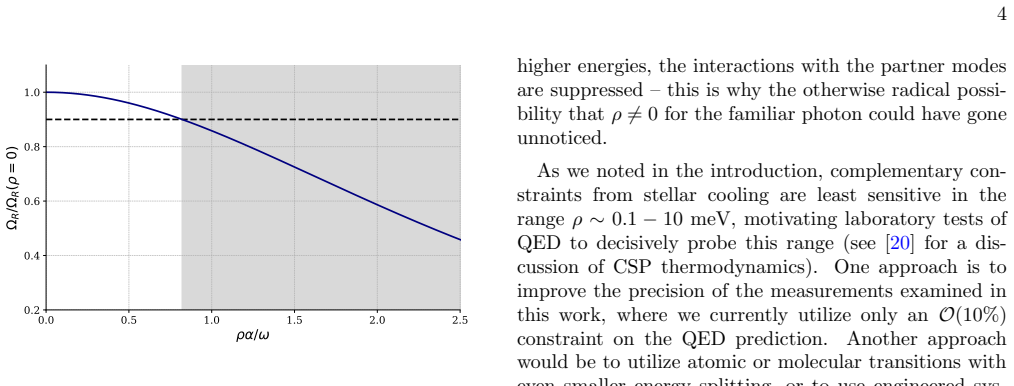
On the paper's own terms, the central claim is that a nonzero photon spin scale $\rho$ changes the hydrogen 21 cm transition amplitude at order $\rho^2\alpha^2/\omega^2$, with the leading-order matrix element $M_{eg} = (ig/m)(B_{\rm osc}/2)\,[1 - \tfrac{1}{6}|\rho|^2\alpha^2/\omega^2]\cos(\omega t)$ plus $O(|\rho|^4\alpha^4/\omega^4)$ corrections. The $\rho$ dependence is isolated in the spatial wave-function overlap factor $\langle \xi_0|\exp(i\rho\,\vec\eta\cdot\vec p/\omega m)|\xi_0\rangle$, whose momentum-space evaluation yields an exponential suppression that expands to the $\tfrac{1}{6}$ correction. Because the correction appears as a frequency-dependent change in the effective electron $g$-factor, it alters measured Rabi frequencies while leaving the photon helicity structure unchanged: only the $h=\pm1$ modes contribute. Applying this formula to the in-beam hydrogen hyperfine measurement of Ref.~[16], and conservatively allowing a 10% deviation in the Rabi frequency, the paper concludes $\rho \lesssim 1$ meV.
Load-bearing premise
The bound rests on assuming that any $\rho$-dependent corrections to the oscillating magnetic field inside the cavity are absorbed into the calibration of $B_{\rm osc}$, so the measured transition rate directly tracks the atomic matrix element correction; the authors explicitly flag this subtlety as needing future study.
Editorial extensions
If this is right
- Any spin-flip transition with small energy splitting $\omega$ carries a fractional CSP correction $\sim \tfrac{1}{6}|\rho|^2\alpha^2/\omega^2$, so lower-energy transitions are sharper probes of $\rho$.
- The reinterpreted in-beam data bound $\rho \lesssim 1$ meV, two orders of magnitude stronger than the earlier limit from the hydrogen $2s$ lifetime.
- The CSP correction acts as a frequency-dependent shift in the apparent electron $g$-factor, so comparing $g$-factor measurements at different frequencies can isolate $\rho$.
- Only the $h=\pm1$ helicity modes are emitted in the 21 cm transition; the partner helicity modes do not change the photon's observable polarization structure at leading order.
Reading between the lines
- The same $\omega^{-2}$ enhancement should apply to other small-splitting spin-flip systems, such as molecular radio-frequency transitions, trapped-electron cyclotron experiments, or engineered artificial atoms; these could probe $\rho$ below 1 meV, exactly where stellar-cooling bounds are weakest.
- If the background-field calibration assumption fails, experiments that vary how the oscillating $B$-field is generated would reveal apparent systematics; comparing the same transition in different cavity geometries would test that assumption.
- A two-frequency ratio test of the same or similar hyperfine transitions would be a clean, calibration-independent null check, since the theory predicts deviations in the ratio $\propto (\omega_1/\omega_2)^{-2}$.
- The result suggests a general search strategy: low-energy precision electromagnetic probes, rather than high-energy colliders, are the natural place to look for a CSP photon, because the deviations grow as the transition energy shrinks.
Editorial analysis
A structured set of objections, weighed in public.
Referee Report
Summary. This letter considers the hypothesis that the photon is a continuous spin particle with nonzero spin scale ρ and computes the leading correction to the hydrogen 21 cm hyperfine transition amplitude using the worldline-based CSP-QED formalism of Refs. [3,8]. The authors find that the Rabi frequency is modified by a factor 1 - (ρ^2 α^2)/(6 ω^2) at leading order in ρα/ω, with no change in the helicity selection rule h = ±1. Reinterpreting the in-beam hydrogen hyperfine spectroscopy of Ref. [16] as bounding the Rabi frequency to within about 10% of QED, they derive ρ ≲ 1 meV, two orders of magnitude stronger than the 2s-lifetime bound of Ref. [6]. The paper closes with a discussion of theoretical limitations and of future low-energy probes.
Significance. If the CSP-QED framework of Refs. [3,8] is correct, the letter identifies an appealing new low-energy observable: the 21 cm spin-flip transition, whose small energy enhances ρ-dependent effects as ρ^2 α^2/ω^2. The theoretical calculation is largely self-contained: it reduces to the QED matrix element in the ρ→0 limit, the spin part is checked to select only the h = ±1 helicity states, and the authors are transparent about the main caveats (background-field absorption and the on-shell restriction of the CSP couplings). A particular strength is that the paper explicitly states these limitations rather than hiding them. The main weakness is that the experimental input, a 10% bound on the absolute Rabi frequency from Ref. [16], is not established, making the headline ρ ≲ 1 meV a projection rather than a demonstrated constraint.
major comments (3)
- [Results (paragraph after Eq. (12))] The bound ρ ≲ 1 meV is obtained from the assumption that the in-beam hyperfine experiment of Ref. [16] constrains the Rabi frequency Ω_R to within about 10% of the QED value. This assumption is not derived from Ref. [16]: that experiment measures the hyperfine line center, a frequency independent of the absolute transition amplitude, while the absolute transition probability that would probe Ω_R is subject to beam-flux, detection-efficiency, and cavity-field-calibration systematics that are not quoted. Please provide a quantitative justification for the 10% figure (for example, a systematics budget from the experiment), or reframe the result as a projected constraint with a stated dependence on the rate accuracy. Without this, Eq. (13) is not supported.
- [Theoretical Framework (paragraph after Eq. (2))] The paper explicitly notes that ρ-dependent corrections to the generation of the background B-field could be of similar order to the atomic matrix-element correction and that such effects would only be 'largely absorbed' by calibration, with future study needed. This caveat is load-bearing: the measured Rabi frequency is proportional to the product of the field amplitude and the atomic matrix element, so a ρ-dependent field calibration would change the relation between the data and Eq. (12). The authors should either model the field-generation correction or identify a calibration scheme that isolates the atomic matrix element; otherwise the quoted limit is conditional on an unverified assumption.
- [Results (Eq. (11))] Equation (11) is the central spatial overlap integral and is asserted without derivation. The claim that ⟨ξ0| exp(iρη·p/(ωm)) |ξ0⟩ equals e^{-|ρ|α/ω}(|ρ|^2α^2 + 3|ρ|αω + 3ω^2)/(3ω^2) is not obvious, and the resulting 1/6 coefficient in Eq. (12) determines the numerical bound. Please provide the momentum-space evaluation, or move it to the Supplementary Material, so that the expansion in ρα/ω can be verified.
minor comments (5)
- [Theoretical Framework (Eq. (7))] The notation 'pψ = ˙ψ = 0' is unclear; please use a subscript for the conjugate momentum (e.g., p_ψ) and define the dot as a τ derivative at O(q).
- [Results (Eq. (11))] The sentence 'in the ρ → ∞ limit the amplitude remains finite' is misleading because the expression in Eq. (11) actually tends to zero; please rephrase to 'vanishes' or 'approaches zero'.
- [Results (Fig. 1)] The horizontal axis label '/ω' is missing the quantity being plotted, presumably ρα/ω; please define the axes and the meaning of the shaded region explicitly in the caption.
- [Results (Eq. (8))] The integration variable is written as dϕη in Eq. (8) but as dϕ elsewhere in the paper; please standardize the notation.
- [Supplementary Material (Eq. (18))] The delta-function notation δ_{h±1} is nonstandard; please use δ_{h,±1} and state that the ± corresponds to the two helicity modes.
Circularity Check
No significant circularity: the 21 cm correction is explicitly computed from the CSP coupling of Refs. [3,8], and the rho <~ 1 meV bound is an external constraint from the ASACUSA in-beam data [16]; heavy self-citation supplies the framework, but no parameter is fitted to the 21 cm data, and the admitted B-field, 10%, and on-shell caveats are robustness limits, not circular inputs.
full rationale
The derivation chain is non-circular at every step. The theory input, the CSP coupling to spin-1/2 fermions (Eq. 5), is imported from the authors' own prior work ([3], [8]; self-citations), but it is a parameter-free construction whose stated assumptions do not include the 21 cm result, and it is externally falsifiable: the 2s-lifetime bound of [6], stellar-cooling estimates, and - in this paper - the predicted 21 cm Rabi-frequency correction compared against the ASACUSA in-beam data of Ref. [16], a non-overlapping group. The central result (Eq. 12) is obtained by explicit computation: Eqs. (8)-(11) and the Supplementary Material evaluate the hydrogenic form factor <xi0|exp(i rho eta.p/omega m)|xi0> = e^{-x}(x^2+3x+3)/3 with x = rho alpha/omega, enforce emission only in h = +/-1 modes, and expand to leading order in rho^2 alpha^2/omega^2. No parameter is fitted to the 21 cm data; rho is the constrained parameter, not an input. The bound rho <~ 1 meV is the standard translation of an experimental precision (the conservatively estimated 10% deviation limit on Omega_R from [16]) through the derived theory curve; that is a re-parametrization of an external input, not a prediction that equals its own input. The paper itself flags three soft spots that I weigh as robustness limitations, not circularity: (i) background B-field generation 'could lead to rho dependent deviations at similar order to those of the atomic transition matrix element,' with only an expectation that they are absorbed and a statement that 'future study of this subtlety is needed'; (ii) the 10% is asserted rather than derived - 'Based on the data in [16], we estimate that Omega_R can deviate by at most 10%'; and (iii) the underlying couplings 'are only strictly valid for on-shell CSP amplitudes' and give 'no unique prediction' for off-shell effects. All three bear on the reliability of the quoted limit, not on equivalence of output to input. Because the theoretical framework is entirely self-cited and load-bearing, the paper sits at the top of the no-significant-circularity band (2/10); no step exhibits the equation-for-equation reduction that would justify a circularity claim.
Assumptions & free parameters
free parameters (2)
- photon spin scale rho =
not fitted; upper bound <~1 meV derived
- maximum allowed Rabi frequency deviation delta_Omega / Omega =
~0.10 (10 percent)
assumptions (7)
- domain assumption The CSP worldline interaction Hamiltonian in Eq. (5) from refs. [3,8] correctly describes on-shell CSP photon coupling to spin-1/2 fermions.
- domain assumption Rho-dependent corrections to the background cavity B-field are absorbed into the calibration of B_osc.
- domain assumption The leading-velocity approximation k dot z roughly equals omega t and k dot p roughly equals omega m is valid for the 21cm transition.
- domain assumption The proton coupling to the CSP photon is negligible relative to the electron coupling.
- domain assumption The eta-space integration identity of Eq. (6) from ref. [3] is valid for on-shell CSP wavefunctions.
- ad hoc to paper The Rabi frequency in the in-beam hyperfine experiments of Ref. [16] deviates from the QED prediction by at most about 10 percent.
- domain assumption The spin Casimir rho is a real non-negative parameter, and CSP theory reproduces QED in the rho to 0 limit.
invented entities (1)
-
Continuous spin photon with nonzero spin scale rho
Cite this review
Pith. "Pith review of Hydrogen 21 cm Constraints on the Photon's Spin Scale." pith.science (2026). https://pith.science/paper/ZVZOTO5B
@misc{pith2026250515890,
  author       = {Pith},
  title        = {Pith review of: Hydrogen 21 cm Constraints on the Photon's Spin Scale},
  year         = {2026},
  howpublished = {\url{https://pith.science/paper/ZVZOTO5B}},
  note         = {Machine review of arXiv:2505.15890}
}
abstract
We explore the fundamental but untested possibility that the photon is a continuous spin particle (CSP) with a small but non-zero spin Casimir $\rho$. When $\rho\neq 0$, the familiar polarization modes of the photon transform non-trivially under Lorentz boosts, leading to deviations from familiar QED. Surprisingly, these deviations are strongest at low energy, but smoothly vanish in the $\rho\rightarrow 0$ limit. In this letter, we compute corrections to the hydrogen 21cm transition rate, which is expected to be particularly sensitive given the small hyperfine energy splitting $\omega$. We find deviations from QED $\propto \rho^2 \alpha^2/\omega^2$ at leading order, suggesting experimental constraints $\rho\lesssim 1$ meV. Building on this work, we expect that a range of other atomic, molecular, or condensed matter systems could be used to provide even more stringent tests of $\rho$ in electromagnetic interactions.
Figures
Reference graph
Works this paper leans on
- [16]
- [6]
-
[1]
E. P. Wigner, Annals of Mathematics 40, 149 (1939)
work page 1939
-
[2]
P. Schuster and N. Toro, Phys. Rev. D91, 025023 (2015), arXiv:1404.0675 [hep-th]. 5
arXiv 2015
-
[3]
P. Schuster, N. Toro, and K. Zhou, JHEP 04, 010 (2023), arXiv:2303.04816 [hep-th]
arXiv 2023
- [4]
- [5]
-
[7]
J. R. Pritchard and A. Loeb, Rept. Prog. Phys. 75, 086901 (2012), arXiv:1109.6012 [astro-ph.CO]
arXiv 2012
Show all 25 references
-
[8]
light shining through a wall
to compute the leading order effect that a non-zero spin scale for the photon would have on the dynamics of the hydrogen 21cm transition. We then used this result to derive a constraint on the photon’s spin scale ρ. In particular, we found that for photons emitted in spin- fli...
- [9]
-
[10]
H. M. Goldenberg, D. Kleppner, and N. F. Ramsey, Phys. Rev. Lett. 5, 361 (1960)
1960
-
[11]
Kleppner, H
D. Kleppner, H. M. Goldenberg, and N. F. Ramsey, Phys. Rev. 126, 603 (1962)
1962
-
[12]
Schuster and N
P. Schuster and N. Toro, Phys. Rev. D 109, 096008 (2024), arXiv:2308.16218 [hep-th]
2024 arXiv
-
[13]
Corradini, C
O. Corradini, C. Schubert, J. P. Edwards, and N. Ah- madiniaz (2015) arXiv:1512.08694 [hep-th]
2015 arXiv
-
[14]
M. J. Strassler, Nucl. Phys. B385, 145 (1992), arXiv:hep- ph/9205205
1992
-
[15]
Brink, S
L. Brink, S. Deser, B. Zumino, P. D. Vecchia, and P. S. Howe, Phys. Lett. B 64, 435 (1976), [Erratum: Phys.Lett.B 68, 488 (1977)]
1976
-
[17]
Diermaier, C
M. Diermaier, C. B. Jepsen, B. Kolbinger, C. Malbrunot, O. Massiczek, C. Sauerzopf, M. C. Simon, J. Zmeskal, and E. Widmann, Nature Commun. 8, 5749 (2017), arXiv:1610.06392 [physics.atom-ph]
2017 arXiv
-
[18]
Hellwig, R
H. Hellwig, R. F. C. Vessot, M. W. Levine, P. W. Zitze- witz, D. W. Allan, and D. J. Glaze, IEEE Transactions on Instrumentation and Measurement 19, 200 (1970)
1970
-
[19]
Essen, R
L. Essen, R. Donaldson, M. Bangham, and E. Hope, Nature 229, 110 (1971)
1971
-
[20]
N. F. Ramsey, Reviews of modern physics 62, 541 (1990)
1990
-
[21]
Schuster, G
P. Schuster, G. Sundaresan, and N. Toro, Phys. Rev. D 111, 056019 (2025), arXiv:2406.14616 [hep-ph]
2025 arXiv
-
[22]
Hanneke, S
D. Hanneke, S. Fogwell, and G. Gabrielse, Phys. Rev. Lett. 100, 120801 (2008), arXiv:0801.1134 [physics.atom- ph]
2008 arXiv
-
[23]
X. Fan, T. G. Myers, B. A. D. Sukra, and G. Gabrielse, Phys. Rev. Lett. 130, 071801 (2023)
2023
-
[24]
Redondo and A
J. Redondo and A. Ringwald, Contemp. Phys. 52, 211 (2011), arXiv:1011.3741 [hep-ph]
2011 arXiv
-
[25]
Kundu, P
S. Kundu, P. Schuster, and N. Toro, (2025), arXiv:2503.03817 [gr-qc]. SUPPLEMENT AR Y MA TERIAL Spin Calculation and Integral inη To calculate the spin-flipping part of the Hamiltonian, we first need to define our non-relativistic spin states. In the limit where v → 0 and in t...
2025 arXiv
Reviewed August 7, 2026 · model on record in the stance chip above.
Discussion (0). Continue with ORCID to comment.