REVIEW 2 major objections 5 minor 9 references
CoT Information: Improved Sample Complexity under Chain-of-Thought Supervision
T0 review · 2 major / 5 minor · reviewed 2026-08-07 · deepseek-v4-flash
Pith's one-line read The paper proves that chain-of-thought supervision is never worse than input-output learning—and can be far better—with the gain set by a new quantity, the CoT information.
desk verdict Genuinely new sample-complexity rates for CoT supervision, correct under exact realizability; the practical robustness story is thinner than the abstract suggests, but the paper deserves a serious referee. read the letter →
The pith
A machine-rendered reading of the paper's core claim, the machinery that carries it, and where it could break.
The reading
What carries the argument
The CoT information $\mathcal{I}_{\mathcal{D},h_\star}^{\mathrm{CoT}}(\varepsilon;\mathcal{H})$ is the minimum, over hypotheses $h$ that disagree with the ground truth $h_\star$ on at least an $\varepsilon$ fraction of inputs, of the negative log probability that $h$ and $h_\star$ produce the same output and the same chain-of-thought on a random input. It quantifies how easily reasoning traces separate hypotheses that differ in end-to-end behavior. The main upper bounds flow from a lemma that converts CoT error into end-to-end error: any proper CoT learner that reaches CoT error $\gamma$ also reaches end-to-end error $\varepsilon$, with $\gamma$ tied to $\mathcal{I}$ by the identity $\mathcal{I} = -\log(1-\gamma)$. Applying this lemma to CoT consistency and CoT-ERM turns standard VC-dimension bounds into sample-complexity bounds with $1/\mathcal{I}$ in place of $1/\varepsilon$. The lower bounds reduce learning to binary and multi-way hypothesis testing (LeCam and Fano methods), relating total-variation and KL distances to the CoT information.
What would settle it
For a concrete CoT hypothesis class and input distribution, compute $\mathcal{I}_{\mathcal{D},h_\star}^{\mathrm{CoT}}(\varepsilon;\mathcal{H})$; if any learning algorithm achieves end-to-end error $\varepsilon$ with fewer than about $\log|\mathcal{H}|/\mathcal{I}_{\mathcal{D},h_\star}^{\mathrm{CoT}}(\varepsilon;\mathcal{H})$ samples, the claim that this measure governs the $\varepsilon$-dependence would be falsified.
Extended reading notes
Core claim
The paper's central claim is that the statistical cost of learning with chain-of-thought supervision is governed by a new measure, the CoT information $\mathcal{I}_{\mathcal{D},h_\star}^{\mathrm{CoT}}(\varepsilon;\mathcal{H})$. For a finite CoT hypothesis class, the CoT consistency rule reaches end-to-end error $\varepsilon$ with $m = (\log|\mathcal{H}| + \log(1/\delta)) / \mathcal{I}_{\mathcal{D},h_\star}^{\mathrm{CoT}}(\varepsilon;\mathcal{H})$, and since the measure is always at least $\varepsilon$, this rate is never worse—and can be much better—than the standard $\log|\mathcal{H}|/\varepsilon$. The $\varepsilon$-dependence of the rate carries over to infinite classes via the VC dimension of the CoT loss class, and information-theoretic lower bounds show that the same $\mathcal{I}$ controls the number of samples any algorithm must see. The paper therefore asserts that CoT information, not just the complexity of the CoT loss class, is the fundamental measure of the value of CoT supervision.
Load-bearing premise
The main rates assume the chain-of-thought traces in the data are exact deterministic outputs of the ground-truth hypothesis in the class, with the paper's own agnostic example showing the guarantee can vanish when that fails.
Editorial extensions
If this is right
- In the realizable setting, CoT supervision is information-theoretically never worse than end-to-end supervision because the CoT information is always at least $\varepsilon$.
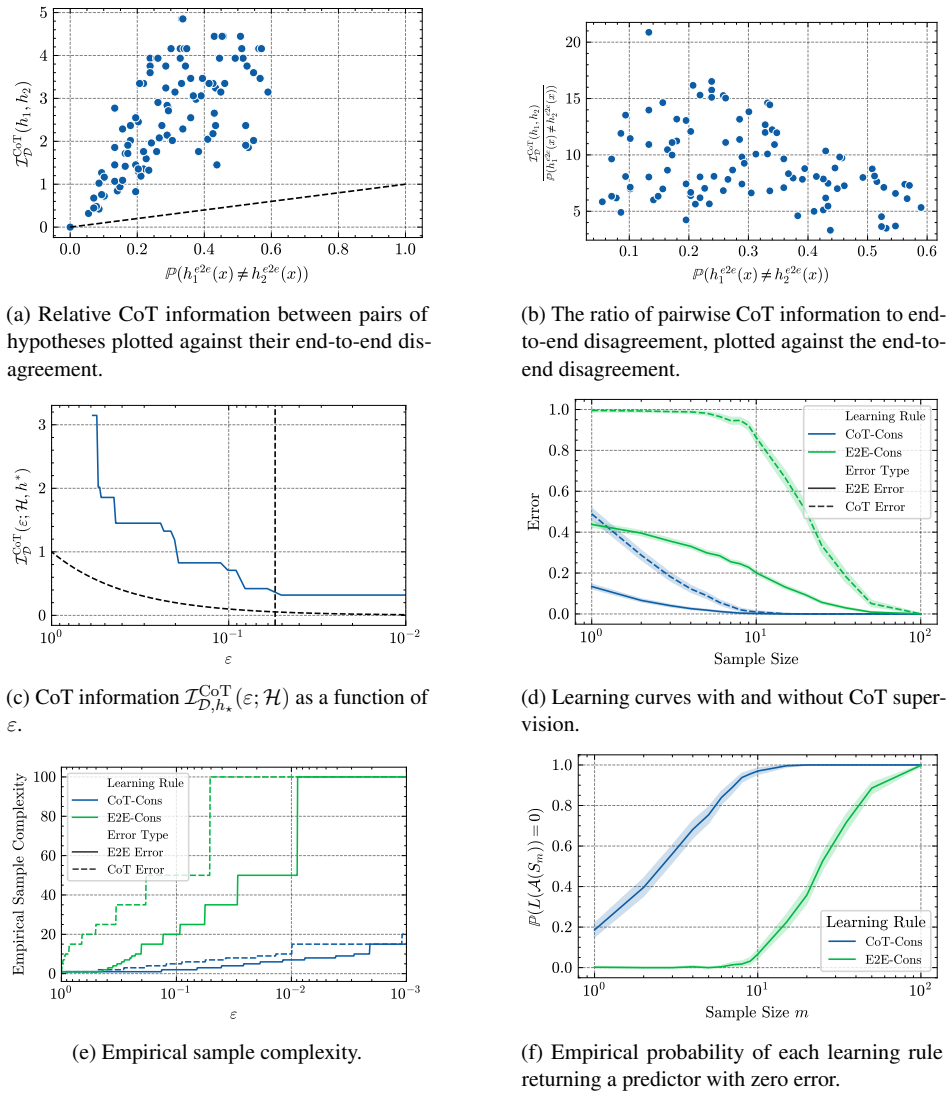
- The speed-up can be dramatic: in the paper's deterministic-finite-automaton simulations the CoT information predicts roughly a 600-fold reduction in samples for zero error, and the experiments match.
- The bound extends to infinite hypothesis classes through the VC dimension of the CoT loss class, so the improvement in $\varepsilon$-dependence is not an artifact of finite hypothesis spaces.
- In the agnostic setting the guarantee depends on an agnostic CoT information measuring how well the data distribution aligns with the class; misaligned CoT annotations can actually destroy the guarantee.
- Noise in the observed traces enters the lower bound through a channel capacity factor, giving a quantitative price for imperfect CoT annotations.
Reading between the lines
- A practical diagnostic that follows implicitly: estimate the CoT information from a trace dataset and use it to decide whether collecting more CoT annotations is worth more than collecting plain input-output pairs.
- The coding-theoretic viewpoint of CoT traces as redundant codewords suggests a testable design principle: maximize the diversity of traces among hypotheses that give different answers, since that is exactly what raises the CoT information.
- The transfer-learning variant of the measure gives a quantitative, testable condition for length generalization in automaton-like reasoning: traces on short inputs should already distinguish hypotheses that behave differently on long inputs.
Editorial analysis
A structured set of objections, weighed in public.
Referee Report
Summary. The paper develops a statistical theory for learning from chain-of-thought (CoT) supervision. It models a CoT hypothesis as a function h: X → Y×Z, defines end-to-end and CoT risks, and introduces the CoT information measure I^CoT_{D,h*}(ε;H) = inf_{h: e2e-error>ε} −log P_D[h_CoT(x)=h*_CoT(x), h_e2e(x)=h*_e2e(x)]. The main results are: Result 1 gives a sample complexity bound (log|H|+log(1/δ))/I^CoT for finite classes under CoT-consistency; Result 2 extends this to infinite classes with VC(LCoT(H)); Result 3 treats the agnostic setting with CoT-ERM at rate VC(LCoT(H))/tilde-I^2; Results 4 and 5 give Le Cam and Fano lower bounds in terms of I; and Section 6 presents simulations on deterministic finite automata and iterated linear thresholds that match the predicted gains. The paper carefully distinguishes realizable and agnostic settings and includes an example showing that CoT-ERM can fail when the CoT component is not realizable.
Significance. If the results hold, the CoT information measure is a valuable new quantity for CoT learning: it is always at least ε, it is monotone in ε and anti-monotone in H, and it appears in both upper bounds and information-theoretic lower bounds. The proofs are based on standard PAC, Le Cam, and Fano arguments and largely appear correct. The paper improves on prior work (notably Joshi et al.) by directly linking CoT risk to end-to-end risk instead of bounding CoT risk and then using the crude inequality R^e2e ≤ R^CoT. The simulations are a strength: they compute I for nontrivial classes and empirically confirm the predicted order-of-magnitude gains. The main caveat, explicitly acknowledged in Sections 4.2 and 7.3, is that the improved rates are proved only for exactly realizable CoT labels; with noisy or out-of-class CoT, CoT-ERM can have zero guarantee and the noisy-channel lower bound (Result 5) has no matching upper bound.
major comments (2)
- [Abstract; Section 4.2; Result 5] The central improvement rates are proved only under exact realizability of the CoT labels (Definition 1). Section 4.2 shows that when the CoT component is not realizable, CoT-ERM can have inf_{h} R^CoT_D(h)=1 while inf_{h} R^e2e_D(h)=0, so the 'never worse' message does not extend to noisy or out-of-class CoT. The paper already acknowledges this in Section 4.2 and Section 7.3, and Result 5 provides only a lower bound under a noisy channel with no matching upper bound. Please make the realizable-setting scope explicit in the abstract and introduction, and state the missing noisy-channel upper bound as an open problem in Section 7.3.
- [Appendix D.2 (proof of Result 5)] The proof states I(h*;S) = E_{h~π}[DKL(P_h^⊗m || \bar P^⊗m)] with \bar P = E_{h~π}P_h. This equality is not correct: the marginal of S under the prior is the mixture E_{h~π}P_h^⊗m, not the product \bar P^⊗m. The desired bound still follows by applying convexity of KL in the second argument to write I(h*;S) ≤ E_{h1,h2~π}[DKL(P_h1^⊗m||P_h2^⊗m)] = m E_{h1,h2~π}[DKL(P_h1||P_h2)], so the theorem remains correct, but the displayed line must be corrected. In addition, the 'in particular' implication that the stated m bound yields failure probability at least 1/2 holds only when log M(ε;H,d^e2e_D) ≥ 2 log 2; please state this condition or retain the exact Fano bound.
minor comments (5)
- [Abstract; Section 3.2] The abstract compares 'd/I' with 'd/ε' informally; I is a function of h*, D, ε, and H, and Result 2 has an additive +1 term and logarithmic factors. Please phrase the comparison as 'up to logarithmic factors' and note that it applies in the realizable setting.
- [Section 6, Figures 3-4] The simulations use a single target hypothesis (e.g., the DFA in Figure 5) and report no error bars or standard errors; reporting averages over multiple targets and providing code would strengthen the empirical claims.
- [Appendix D.1 (proof of Result 4)] The proof introduces h0 without defining it, and the displayed triangle inequality contains repeated and ambiguous terms such as d(A(S),h1) on both sides; please clean up the notation for clarity.
- [Result 5] When any pair of hypotheses has infinite CoT information, sup_π E[I] = ∞ and the displayed implication is vacuous; please add a remark explaining this boundary case and noting that in the fully informative CoT regime (Example 2) one sample can suffice, so a vacuous lower bound is expected.
- [Section 7.3] The paper correctly lists missing agnostic lower bounds as an open problem; the missing upper bound under annotation noise should also be listed there, since Result 5 is only a lower bound.
Circularity Check
Result 4's lower bound restates the definition of CoT information; the upper bound and Fano bound retain independent content.
-
self definitional
[Section 5, Result 4 and proof in Appendix D.1]
"Fix h⋆∈H and ε∈[0,1]. Let ¯h∈ arg min_{h∈∆^{e2e}_D(ε;H,h⋆)} I^{CoT}_D(h⋆,h). Then, by definition, we have that ¯h has end-to-end error at least ε and I^{CoT}_{D,h⋆}(ε;H)=I^{CoT}_D(h⋆,¯h). Thus, the probability that h⋆ and ¯h agree on a random input x with respect to both the CoT and E2E behavior can be expressed as ... = exp(−I^{CoT}_{D,h⋆}(ε;H))."
Definition 3 defines I^{CoT}_{D,h⋆}(ε;H) as the infimum over end-to-end-bad hypotheses of -log P[h and h⋆ agree on both CoT and E2E output]. Therefore the probability that any fixed bad hypothesis agrees with h⋆ on all m i.i.d. samples is exp(-m I) by construction. The first statement of Result 4 is exactly this definitional identity rewritten as a threshold on m, and the later Le Cam expected-error bound substitutes the same identity through TV(P_{h1},P_{h2}) = 1 - exp(-m I). Calling this a lower bound that 'validates' I as the fundamental rate is thus a restatement of the definition rather than an independent confirmation. The Fano-based Result 5 and the realizable upper-bound proof do contain genuine additional arguments, so the circularity is partial.
full rationale
The paper's realizable upper bound (Result 1) is a genuine union-bound argument; it uses Definition 3 as the exponent for the probability that a bad hypothesis is CoT-consistent, but that is a legitimate analytical step. The Fano lower bound (Result 5) is also independent, though it can become vacuous when pairwise CoT information is infinite. The main circularity is in Section 5: Result 4's lower bound is essentially the definition of CoT information exponentiated. Since I is defined as -log P[agreement on CoT and E2E], the statement that m < log(1/δ)/I leaves an indistinguishable bad hypothesis with probability at least δ is a direct restatement of that definition, not a new lower-bound phenomenon. There is no self-citation load-bearing and no fitted-parameter-as-prediction issue; the simulations provide an external check. Overall, the central quantity is partly self-justifying through the matching lower bound, but the upper-bound theorem and the Fano bound give the framework independent content, so the circularity is moderate rather than total.
Assumptions & free parameters
assumptions (6)
- standard math PAC learning and VC dimension uniform convergence bounds are valid for the CoT loss class L_CoT(H).
- standard math Le Cam's method and Fano's inequality are applicable to the CoT observation model.
- domain assumption Each hypothesis h in H is a deterministic map from X to (Y,Z), and the observed CoT is exactly h*_CoT(x) in the realizable upper bounds.
- domain assumption The data distribution over X is fixed and samples are i.i.d.; loss is 0/1.
- domain assumption For the agnostic result, the CoT loss class L_CoT(H) has finite VC dimension and the CoT-ERM rule is proper (returns a hypothesis in H).
- domain assumption The noisy channel Q in Result 5 is memoryless and has bounded capacity factor C_Q.
Cite this review
Pith. "Pith review of CoT Information: Improved Sample Complexity under Chain-of-Thought Supervision." pith.science (2026). https://pith.science/paper/SXJKX4O6
@misc{pith2026250515927,
  author       = {Pith},
  title        = {Pith review of: CoT Information: Improved Sample Complexity under Chain-of-Thought Supervision},
  year         = {2026},
  howpublished = {\url{https://pith.science/paper/SXJKX4O6}},
  note         = {Machine review of arXiv:2505.15927}
}
abstract
Learning complex functions that involve multi-step reasoning poses a significant challenge for standard supervised learning from input-output examples. Chain-of-thought (CoT) supervision, which provides intermediate reasoning steps together with the final output, has emerged as a powerful empirical technique, underpinning much of the recent progress in the reasoning capabilities of large language models. This paper develops a statistical theory of learning under CoT supervision. A key characteristic of the CoT setting, in contrast to standard supervision, is the mismatch between the training objective (CoT risk) and the test objective (end-to-end risk). A central part of our analysis, distinguished from prior work, is explicitly linking those two types of risk to achieve sharper sample complexity bounds. This is achieved via the *CoT information measure* $\mathcal{I}_{\mathcal{D}, h_\star}^{\mathrm{CoT}}(\epsilon; \calH)$, which quantifies the additional discriminative power gained from observing the reasoning process. The main theoretical results demonstrate how CoT supervision can yield significantly faster learning rates compared to standard E2E supervision. Specifically, it is shown that the sample complexity required to achieve a target E2E error $\epsilon$ scales as $d/\mathcal{I}_{\mathcal{D}, h_\star}^{\mathrm{CoT}}(\epsilon; \calH)$, where $d$ is a measure of hypothesis class complexity, which can be much faster than standard $d/\epsilon$ rates. Information-theoretic lower bounds in terms of the CoT information are also obtained. Together, these results suggest that CoT information is a fundamental measure of statistical complexity for learning under chain-of-thought supervision.
Figures


Figures from the paper (4 more)


Reference graph
Works this paper leans on
-
[1]
Some Local Measures of Complexity of Convex Hulls and Generalization Bounds
Angluin, Dana (Oct. 1981). “A Note on the Number of Queries Needed to Identify Regular Languages”. In: Information and Control (cited on page 27). – (Nov. 1, 1987). “Learning Regular Sets from Queries and Counterexamples”. In:Information and Computation (cited on page 27). Angluin, Dana, James Aspnes, Sarah Eisenstat, and Aryeh Kontorovich (2013). “On the...
work page Pith review arXiv 2013
-
[2]
={(s,x )∈S× Σ :δ1(s,x )̸=δ2(s,x )} be the set of state-symbol pairs on which 26 h1 andh2’s transition functions differ. Then, we have 1− P x∼D [ hCoT ⋆ (x) =hCoT(x),h e2e ⋆ (x) =he2e(x) ] ≥ P x∼D [ hCoT ⋆ (x)̸=hCoT(x) ] = P x∼D [∃t∈ [n] :zt̸=z∗ t ] = P x∼D [h⋆ visits any (s,a )∈ ∆(h,h⋆)] Suppose that h⋆’s transition graph is ℓ-connected in the sense that ...
work page 1981
-
[4]
Letx1,...,x m∼D be an i.i.d sample fromD
LetH⊂ (Y×Z )X be a CoT hypothesis class and let D be a distribution onX . Letx1,...,x m∼D be an i.i.d sample fromD. For anyh⋆∈H andε> 0, we have that m< log(1/δ) ICoT D,h⋆(ε;H) implies that with probability at leastδ, there existsh∈H with end-to-end error at leastε which is indistinguishable fromh⋆ on this sample. Proof. Fixh⋆∈H andε∈ [0, 1]. Let ¯h∈ arg ...
work page 1973
-
[8]
2 · ( 1− TV ( P⊗m h1 ,P⊗m h2 )) , where the last inequality follows from the minimum average probability of error in binary hypothesis testing (or, equivalently, the supremum representation of the total variation distance). Now, using 35 the previous calculation of the total variation distance in terms of the CoT information, we have sup h⋆∈H E S∼P⊗m h⋆ [...
work page 2006
-
[9]
Fore = 1/100 and|Y×Z| = 1, 000, the capacity factor is approximatelyCQ≈ 11.39
This corresponds to the fact that it is harder to distinguish between hypotheses when the observations are more noisy. Fore = 1/100 and|Y×Z| = 1, 000, the capacity factor is approximatelyCQ≈ 11.39. Appendix E: Other Topics E.1. Learning with Mixed Supervision In many situations, CoT training examples may be difficult or expensive to obtain, for example, b...
work page 1965
-
[1975]
A formal theory of inductive inference. Part I
Springer (cited on page 27). Solomonoff, Ray J (1964). “A formal theory of inductive inference. Part I”. In: Information and control (cited on page 43). Vapnik, V . (1982). “Estimation of Dependencies Based on Empirical Data”. Springer-Verlag, New York (cited on pages 6, 7). Vaswani, Ashish, Noam Shazeer, Niki Parmar, Jakob Uszkoreit, Llion Jones, Aidan N...
work page 1964
-
[1987]
28th Annual Symposium on Foundations of Computer Science. Los Angeles, CA, USA: IEEE (cited on page 27). Simon, Imre (1975). “Piecewise testable events”. In: Automata Theory and Formal Languages: 2nd GI Conference Kaiserslautern, May 20–23,
work page 1975
-
[2210]
Training Verifiers to Solve Math Word Problems
11416 [cs.LG] (cited on pages 3, 19). Cobbe, Karl et al. (2021). “Training Verifiers to Solve Math Word Problems”. arXiv:2110.14168 [cs.LG] (cited on pages 3, 19). Cover, T. M. and Joy A. Thomas (2006). “Elements of Information Theory”. 2nd ed. Hoboken, N.J: Wiley-Interscience. 748 pp. (cited on page 36). Feng, Guhao, Bohang Zhang, Yuntian Gu, Haotian Ye,...
arXiv 2021
Show all 9 references
-
[2305]
Efficient Learning of Typical Finite Automata from Random Walks
15408 [cs.LG] (cited on page 19). Freund, Yoav, Michael Kearns, Dana Ron, Ronitt Rubinfeld, Robert E. Schapire, and Linda Sellie (1993). “Efficient Learning of Typical Finite Automata from Random Walks”. In:Proceedings of the Twenty-Fifth Annual ACM Symposium on Theory of Comp...
1993 arXiv
Reviewed August 7, 2026 · model on record in the stance chip above.
Discussion (0). Continue with ORCID to comment.