REVIEW 3 major objections 6 minor 19 references
An Approach Towards Identifying Bangladeshi Leaf Diseases through Transfer Learning and XAI
T0 review · 3 major / 6 minor · reviewed 2026-08-07 · deepseek-v4-flash
Pith's one-line read Fine-tuned VGG19 identifies Bangladeshi leaf diseases with 98.90% accuracy.
desk verdict Standard transfer-learning benchmark that is a useful dataset reference, but the headline 98.9% is the best of five runs and the evaluation protocol needs cleanup before those numbers are taken at face value. read the letter →
The pith
A machine-rendered reading of the paper's core claim, the machinery that carries it, and where it could break.
The reading
What carries the argument
The mechanism is transfer learning, reusing convolutional backbones pretrained on a large general image corpus and fine-tuning them on the 21-class Bangladeshi leaf dataset, with a custom head of flatten, dense layers of 1024 and 512 units, dropout, and a softmax output. The argument is carried by the accuracy and F1-scores of VGG19 and Xception, and by the heatmaps from five post-hoc explanation methods that localize the model's attention to leaf regions.
What would settle it
Compute a stratified or deduplicated split of the 12,786 images, grouping by leaf identity or by collection field, retrain VGG19 under the same hyperparameters, and compare test accuracy; if accuracy drops well below 98.90%, the original claim overstates generalization to new leaves.
Extended reading notes
Core claim
On the paper's own terms, the central discovery is that standard pretrained CNN architectures, fine-tuned on a 12,786-image Bangladeshi leaf dataset, separate 21 disease and healthy classes with high fidelity, and that the best model, VGG19, reaches 98.90% accuracy with precision, recall, and F1-score of 0.99. The XAI analysis is claimed to show that the models focus on consistent, disease-relevant regions of the leaf rather than the black background, which the paper presents as evidence that the system is transparent enough for farmers to understand and act on its predictions.
Load-bearing premise
The central assumption is that the randomly split test images are genuinely new, unseen leaves; if images of the same leaf or same field are shared between training and test sets, the reported 98.90% accuracy would measure image memorization rather than the ability to classify a leaf never seen before.
Editorial extensions
If this is right
- A smartphone-based leaf disease screening tool for Bangladeshi farmers is technically feasible using off-the-shelf pretrained networks, without requiring on-site expert diagnosis.
- The 21-class, 12,786-image dataset becomes a benchmark for future automated plant disease detection work focused on Bangladesh.
- The consistent XAI heatmaps across methods suggest the models rely on genuine disease symptoms, so the explanations could be used to build farmer-facing interfaces that show which part of the leaf is diseased.
- If the accuracy holds under stricter evaluation, the approach could be extended to additional Bangladeshi crops and to real-time edge devices.
- The performance gap between the plain CNN (92.17%) and the fine-tuned models (up to 98.90%) quantifies the value of pretrained weights for this domain.
Reading between the lines
- The accuracy claim is vulnerable to train/test leakage because the random split does not group by plant, field, or individual leaf; if the same leaf appears in both sets, the 98.90% value would reflect image memorization rather than generalization, and a field-stratified or deduplicated evaluation would likely lower it.
- The claim that farmers can use the XAI heatmaps is plausible but untested with actual farmers; a usability study with non-expert users would be the natural next test.
- Because all images are background-removed single leaves, the model may be learning a shortcut based on leaf shape or color rather than disease-specific texture; testing on photos of whole plants or natural field conditions would reveal this.
- The near-99% accuracy matches a pattern seen in other leaf-disease datasets, suggesting the classification task may be easier than real-world diagnosis; interpreting the score as a field-ready diagnostic rate would overstate readiness.
Editorial analysis
A structured set of objections, weighed in public.
Referee Report
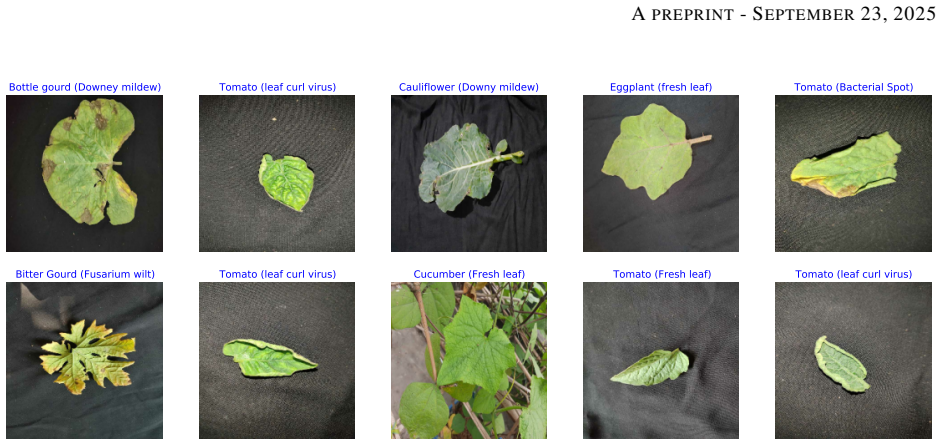
Summary. The paper proposes a deep learning pipeline for classifying 21 leaf disease classes across six Bangladeshi plant species. It uses a publicly available Mendeley dataset of 12,786 images, applies HSV-based background removal and resizing to 128×128, and evaluates a custom CNN plus six transfer learning models (VGG16, VGG19, MobileNetV2, InceptionV3, ResNet50V2, Xception) on an 80:10:10 train/validation/test split. VGG19 is reported as the best model with 98.90% accuracy, followed by Xception at 98.66%. The paper also applies five XAI methods (GradCAM, GradCAM++, LayerCAM, ScoreCAM, FasterScoreCAM) and qualitatively compares the resulting heatmaps, claiming that the combination of high accuracy and explainability provides a transparent tool for farmers.
Significance. If the reported results hold, the paper offers a useful empirical benchmark showing that standard pretrained networks can separate these 21 leaf disease classes nearly perfectly, and it provides a qualitative comparison of five XAI techniques across multiple models. The use of a real field-collected public dataset and the breadth of models/XAI methods are strengths. However, the significance is tempered by the evaluation protocol: the reported numbers are the best of five runs without error bars, there is no evidence that near-duplicate images do not straddle the train/test split, and there is a material inconsistency in the ResNet50V2 accuracy between the table and the text. The XAI analysis is entirely qualitative, with no quantitative evaluation or user study, so the claims about farmer-facing transparency are not directly supported.
major comments (3)
- [§5.1, Table 2] The text states that 'Each model runs five times to ensure robustness, with the optimal results recorded for analysis' (§5.1). This means the reported accuracies, including the headline 98.90% for VGG19, are the maximum over five random-split runs rather than the expected performance. The paper provides no mean, standard deviation, or confidence intervals across the five runs, and the abstract and conclusion present this maximum as 'the' accuracy. This selection protocol inflates the reported numbers relative to a typical run and prevents the reader from assessing stability. Please report the mean and standard deviation (or all five runs) for each model, and rephrase the claims accordingly.
- [§4.1, §3 Dataset] The dataset is described as collected from different agricultural fields (§3), and the split in §4.1 is a simple random 80:10:10 partition without stratification by plant or disease and without removal of near-duplicate images. Because the same leaf or plant may appear in multiple photographs, images of the same object could straddle the training and test sets. In that case, the reported 98.90% accuracy would partly reflect memorization of near-duplicate images rather than generalization to new leaves. The authors should either perform a split that holds out entire plants or fields, or demonstrate (e.g., by similarity analysis) that no near-duplicates cross the split.
- [§5.2, Table 2] There is a material inconsistency in the reported ResNet50V2 result: Table 2 lists an accuracy of 0.97417 (97.42%), while the text states that 'Resnet50V2 also perform well, achieving an accuracy of 98.41%'. The difference of about one percentage point is too large to be a rounding artifact. The VGG16 text value (98.35%) is consistent with Table 2 (0.98356), but the ResNet50V2 discrepancy indicates that the numerical results have not been carefully cross-checked. Please correct the value and verify all other numbers in the table against the text.
minor comments (6)
- [§4.1, Figure 3] The preprocessing description says 'The final phase consists of eliminating the leaf (foreground) utilizing the mask,' but the procedure and Figure 3 indicate the background is removed, not the leaf. The wording should be corrected to 'eliminating the background.'
- [§4.2] The description of the CNN architecture gives filter counts but omits kernel sizes, strides, padding, and dropout rates. Please add these details for reproducibility.
- [§5.2] The phrase 'demonstrate quick convergence, with all models attaining higher accuracy at an early stage' is imprecise; consider 'high accuracy' instead of 'higher accuracy.'
- [Table 1 caption] 'Summary of the reviewd work' should be 'reviewed work'; the same typo appears in the body text.
- [§6] 'GradCAM is a pivotal XAI technique' contains a typo; 'an pivotal' should be 'a pivotal.'
- [General] The paper does not state whether the code, trained models, or exact split indices are publicly available; including them would strengthen reproducibility.
Circularity Check
No significant circularity: accuracy claims are empirical benchmark outputs, and the only self-citation (ref [18]) is background VQA context, not load-bearing.
full rationale
The paper is an empirical benchmark, not a derivation. It takes a public Mendeley leaf dataset, applies standard preprocessing (HSV green masking, resizing to 128x128), trains six ImageNet-pretrained TL models plus a small CNN, and reports held-out test metrics in Table 2. There is no equation in which an output quantity is defined in terms of the quantity it is said to predict, no parameter fitted to a subset and then renamed as a prediction, and no uniqueness result imported from the authors' prior work. The single self-citation, reference [18] (Rafi, Islam, et al.), is cited only to note that GradCAM is used in visual question answering; it does not support the classification accuracy, the model choice, or the dataset. Reference [19] is likewise background on explainable CNNs and has no load-bearing author overlap. The protocol concerns that do exist, namely 'Each model runs five times to ensure robustness, with the optimal results recorded for analysis' (Sec. 5.1) and the unstated stratification/deduplication of the 80:10:10 split (Sec. 4.1), are statistical-selection and leakage risks, not circular reasoning; they do not make the reported accuracy equivalent to an input by construction. Therefore no circular step can be exhibited, and the circularity score is 0.
Assumptions & free parameters
free parameters (4)
- Learning rate =
0.0001
- Training epochs =
30 (60 for CNN)
- HSV green range for background removal =
lower (25,40,40), upper (90,255,255)
- Best-of-five run selection =
max over 5 runs
assumptions (3)
- domain assumption The 12,786-image Mendeley dataset labels are correct and the 80/10/10 split is i.i.d. with no near-duplicate images across splits.
- domain assumption ImageNet pretrained weights transfer useful features to Bangladeshi leaf images.
- ad hoc to paper The best-of-five evaluation protocol gives a fair estimate of model performance.
Cite this review
Pith. "Pith review of An Approach Towards Identifying Bangladeshi Leaf Diseases through Transfer Learning and XAI." pith.science (2026). https://pith.science/paper/T5NMN5LP
@misc{pith2026250516033,
  author       = {Pith},
  title        = {Pith review of: An Approach Towards Identifying Bangladeshi Leaf Diseases through Transfer Learning and XAI},
  year         = {2026},
  howpublished = {\url{https://pith.science/paper/T5NMN5LP}},
  note         = {Machine review of arXiv:2505.16033}
}
read the original abstract
Leaf diseases are harmful conditions that affect the health, appearance and productivity of plants, leading to significant plant loss and negatively impacting farmers' livelihoods. These diseases cause visible symptoms such as lesions, color changes, and texture variations, making it difficult for farmers to manage plant health, especially in large or remote farms where expert knowledge is limited. The main motivation of this study is to provide an efficient and accessible solution for identifying plant leaf diseases in Bangladesh, where agriculture plays a critical role in food security. The objective of our research is to classify 21 distinct leaf diseases across six plants using deep learning models, improving disease detection accuracy while reducing the need for expert involvement. Deep Learning (DL) techniques, including CNN and Transfer Learning (TL) models like VGG16, VGG19, MobileNetV2, InceptionV3, ResNet50V2 and Xception are used. VGG19 and Xception achieve the highest accuracies, with 98.90% and 98.66% respectively. Additionally, Explainable AI (XAI) techniques such as GradCAM, GradCAM++, LayerCAM, ScoreCAM and FasterScoreCAM are used to enhance transparency by highlighting the regions of the models focused on during disease classification. This transparency ensures that farmers can understand the model's predictions and take necessary action. This approach not only improves disease management but also supports farmers in making informed decisions, leading to better plant protection and increased agricultural productivity.
Figures


Figures from the paper (3 more)


Reference graph
Works this paper leans on
-
[1]
J Bruinsma. The resource outlook to 2050: by how much do land, water and crop yields need to increase by 2050? expert meeting on how to feed the world in 2050.http://www. fao. org/wsfs/forum2050/wsfs-background- documents/wsfs-expert-papers/en/, 2009
work page 2009
-
[2]
Syed Mohammad Minhaz Hossain, Kaushik Deb, Pranab Kumar Dhar, and Takeshi Koshiba. Plant leaf disease recognition using depth-wise separable convolution-based models.Symmetry, 13(3):511, 2021
work page 2021
-
[3]
Sasikala Vallabhajosyula, Venkatramaphanikumar Sistla, and Venkata Krishna Kishore Kolli. Transfer learning- based deep ensemble neural network for plant leaf disease detection.Journal of Plant Diseases and Protection, 129(3):545–558, 2022
work page 2022
-
[4]
David Hughes, Marcel Salathé, et al. An open access repository of images on plant health to enable the development of mobile disease diagnostics.arXiv preprint arXiv:1511.08060, 2015
arXiv 2015
-
[5]
Mitali V Shewale and Rohin D Daruwala. High performance deep learning architecture for early detection and classification of plant leaf disease.Journal of Agriculture and Food Research, 14:100675, 2023
work page 2023
-
[6]
Mobeen Ahmad, Muhammad Abdullah, Hyeonjoon Moon, and Dongil Han. Plant disease detection in imbalanced datasets using efficient convolutional neural networks with stepwise transfer learning.IEEE Access, 9:140565– 140580, 2021
work page 2021
-
[7]
Jesmin Akther, Muhammad Harun-Or-Roshid, and Aminul Islam. Comparative analysis of cnn, efficientnet and resnet for grape and potato leaves disease prediction: A deep learning approach. 2024
work page 2024
-
[8]
Mohan Bhandari, Tej Bahadur Shahi, Arjun Neupane, and Kerry Brian Walsh. Botanicx-ai: Identification of tomato leaf diseases using an explanation-driven deep-learning model.Journal of Imaging, 9(2):53, 2023
work page 2023
Show all 19 references
-
[9]
Explainable ai for tomato leaf disease detection: Insights into model interpretability
Tanjim Mahmud, Koushick Barua, Anik Barua, Nanziba Basnin, Sudhakar Das, Mohammad Shahadat Hossain, and Karl Andersson. Explainable ai for tomato leaf disease detection: Insights into model interpretability. In2023 26th International Conference on Computer and Information Tech...
2023
-
[10]
Explainable deep learning model for automatic mulberry leaf disease classification.Frontiers in Plant Science, 14:1175515, 2023
Md Nahiduzzaman, Muhammad EH Chowdhury, Abdus Salam, Emama Nahid, Faruque Ahmed, Nasser Al-Emadi, Mohamed Arselene Ayari, Amith Khandakar, and Julfikar Haider. Explainable deep learning model for automatic mulberry leaf disease classification.Frontiers in Plant Science, 14:117...
2023
-
[11]
Explainable deep learning study for leaf disease classification.Agronomy, 12(5):1035, 2022
Kaihua Wei, Bojian Chen, Jingcheng Zhang, Shanhui Fan, Kaihua Wu, Guangyu Liu, and Dongmei Chen. Explainable deep learning study for leaf disease classification.Agronomy, 12(5):1035, 2022
2022
-
[12]
Ganbayar Batchuluun, Se Hyun Nam, and Kang Ryoung Park. Deep learning-based plant classification and crop disease classification by thermal camera.Journal of King Saud University-Computer and Information Sciences, 34(10):10474–10486, 2022
2022
-
[13]
Plant leaf freshness and disease detection dataset from bangladesh, 2024
Mohammad Rifat Ahmmad Rashid. Plant leaf freshness and disease detection dataset from bangladesh, 2024
2024
-
[14]
Comprehensive smart smartphone image dataset for plant leaf disease detection and freshness assessment from bangladesh vegetable fields.Data in Brief, 56:110775, 2024
Mahamudul Hasan, Raiyan Gani, Mohammad Rifat Ahmmad Rashid, Taslima Khan Tarin, Raka Kamara, Mahbuba Yasmin Mou, and Sheikh Fajlay Rabbi. Comprehensive smart smartphone image dataset for plant leaf disease detection and freshness assessment from bangladesh vegetable fields.Dat...
2024
-
[15]
A study of cnn and transfer learning in medical imaging: Advantages, challenges, future scope.Sustainability, 15(7):5930, 2023
Ahmad Waleed Salehi, Shakir Khan, Gaurav Gupta, Bayan Ibrahimm Alabduallah, Abrar Almjally, Hadeel Alsolai, Tamanna Siddiqui, and Adel Mellit. A study of cnn and transfer learning in medical imaging: Advantages, challenges, future scope.Sustainability, 15(7):5930, 2023
2023
-
[16]
Keras.https://keras.io, 2015
François Chollet et al. Keras.https://keras.io, 2015
2015
-
[17]
Martín Abadi, Ashish Agarwal, Paul Barham, Eugene Brevdo, Zhifeng Chen, Craig Citro, Greg S. Corrado, Andy Davis, Jeffrey Dean, Matthieu Devin, Sanjay Ghemawat, Ian Goodfellow, Andrew Harp, Geoffrey Irving, Michael Isard, Yangqing Jia, Rafal Jozefowicz, Lukasz Kaiser, Manjunat...
2015
-
[18]
A deep learning-based bengali visual question answering system
Mahamudul Hasan Rafi, Shifat Islam, SM Hasan Imtiaz Labib, SM Sajid Hasan, Faisal Muhammad Shah, and Sifat Ahmed. A deep learning-based bengali visual question answering system. In2022 25th International Conference on Computer and Information Technology (ICCIT), pages 114–119....
2022
-
[19]
Fatema Tuj Johora Faria, Mukaffi Bin Moin, Pronay Debnath, Asif Iftekher Fahim, and Faisal Muhammad Shah. Explainable convolutional neural networks for retinal fundus classification and cutting-edge segmentation models for retinal blood vessels from fundus images.arXiv preprin...
2024 arXiv
Reviewed August 7, 2026 · model on record in the stance chip above.
Discussion (0). Continue with ORCID to comment.