REVIEW 3 major objections 6 minor 2 cited by
Logic-of-Thought: Empowering Large Language Models with Logic Programs for Solving Puzzles in Natural Language
T0 review · 3 major / 6 minor · reviewed 2026-08-07 · deepseek-v4-flash
Pith's one-line read A hybrid of LLM translation and answer set solving reaches 100 percent accuracy on seven natural-language puzzle tasks.
desk verdict Believable narrow result on seven puzzles; the generality claim is weaker than it looks because two prompts ship near-complete ASP skeletons. read the letter →
The pith
A machine-rendered reading of the paper's core claim, the machinery that carries it, and where it could break.
The reading
What carries the argument
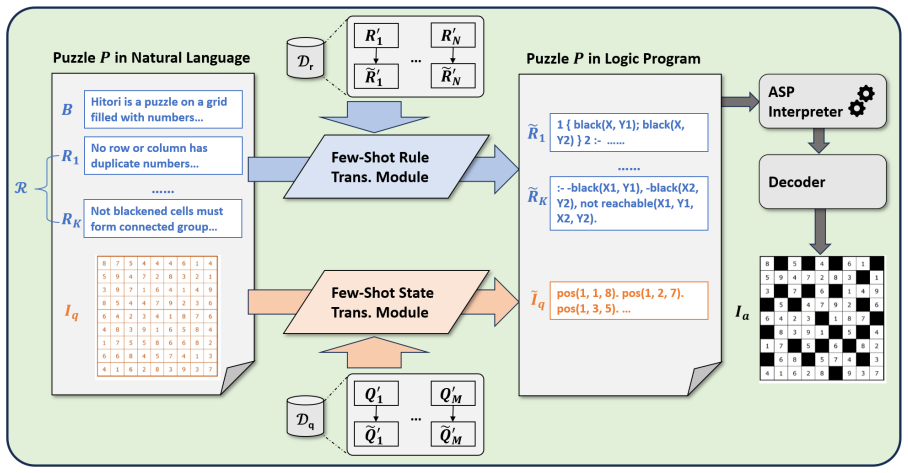
The load-bearing object is the answer set program (ASP), a declarative rule system in which constraints describe what a valid solution looks like rather than how to compute it. Logot generates such a program in two pieces: a rule-translation module turns natural-language rules into ASP constraints under few-shot prompting, and a state-translation module turns the puzzle's initial state into ground facts. A grounding-and-solving engine, Clingo, then searches over the program's answer sets, and a small decoder formats the result back into a grid or action sequence. Because the solver is exact, the framework's accuracy is determined by the faithfulness of the two translations, and the connection to a solver is what converts a language model's approximate reasoning into an exhaustive, error-free search.
What would settle it
Apply the full Logot prompt—minus the per-puzzle few-shot examples and any ASP_RULES skeleton—to a novel puzzle with the same rule complexity; if end-to-end accuracy falls close to plain LLM prompting, the near-perfect results depend on the human-engineered scaffold rather than on the translation-plus-solver design.
Extended reading notes
Core claim
The central discovery is that a hybrid pipeline—LLM translation of natural language into declarative logic, followed by exact answer set solving—achieves what LLM-only prompting cannot on combinatorial puzzles. The pipeline first translates each rule specification with few-shot examples from other puzzles, then translates the question instance into facts, joins them into one answer set program, and runs Clingo to compute a solution. In the paper's evaluation, this yields 100 percent accuracy on Sudoku, Hitori, Fillomino, and all four Blocks World subtasks when GPT-4o is the translator (with 97.5 percent on Goal Recognition), and no reported failure is attributed to the solver or to incorrect logic rules: the errors all come from the state-translation module misreading the initial state. The claim is therefore that, once rules and states are faithfully encoded, the solution is determined by the logic program itself, and the practical frontier is accurate natural-language-to-fact translation.
Load-bearing premise
The load-bearing premise is that human authors can always supply enough few-shot examples and partial logic templates for a new puzzle type so that the LLM's remaining translation task is small; the paper does not test the framework on a puzzle class without this scaffolding.
Editorial extensions
If this is right
- If correct, the approach turns LLM puzzle solving into a translation problem: any puzzle whose rules can be written as ASP constraints can be solved near-perfectly once the state is encoded correctly.
- The same separation should transfer to planning and constraint-satisfaction tasks beyond puzzles, wherever rules and goals can be stated declaratively.
- Because accuracy holds with cheaper models, the pipeline offers a cost-effective route to reliable structured reasoning without relying on the largest commercial models.
- The concentration of errors in state translation identifies a concrete target: automatically checking translated facts against the original state should eliminate most remaining failures.
- The paper's comparison suggests that better prompts or translators improve the system monotonically; solver-level improvements are no longer the limiting factor.
Reading between the lines
- An unstated consequence is that the framework's generality is pinned to the availability of human-authored scaffolding: with no few-shot examples or partial logic skeletons for a new puzzle family, the translation burden on the LLM grows, and the near-perfect scores on the seven tested families should not be assumed out-of-the-box.
- A testable extension would be to add a lightweight verifier that parses the translated ASP state back into natural language and asks the LLM to confirm equivalence; the paper's failure analysis implies this could close most of the residual gap without changing the solver.
- For puzzles with perceptual or probabilistic elements (images, noisy states), the clean split between translation and exact search would blur, so the result is most naturally read as covering discrete, rule-governed puzzle domains.
- The cost numbers suggest an adaptive deployment: start with a cheap model for state translation, run a consistency check, and escalate to a stronger model only for instances that fail, yielding near-perfect accuracy at lower average cost than the paper reports.
Editorial analysis
A structured set of objections, weighed in public.
Referee Report
Summary. The paper proposes Logic-of-Thought (Logot), a hybrid pipeline in which an LLM translates the rules and initial state of a natural-language puzzle instance into an answer set program, and the Clingo solver then computes the solution. The method is evaluated on three grid puzzles (Sudoku, Hitori, Fillomino) and four Blocks World reasoning tasks, with 200 instances per task. The paper reports near-perfect accuracy for Logot with GPT-4o (100% on six of seven tasks) and favorable cost-accuracy tradeoffs relative to standard prompting and chain-of-thought baselines. The authors conclude that the hybrid architecture effectively removes combinatorial search errors and that remaining failures are attributable to the state-translation stage.
Significance. If the results hold, the paper provides a useful demonstration that offloading combinatorial search to an ASP solver while using the LLM only for translation can yield high accuracy on puzzles that pure LLM prompting solves poorly. The code and data are publicly available, which supports reproducibility, and the failure-case discussion is candid about residual state-translation errors. However, the significance of the claimed 'general' LLM-to-ASP rule-translation contribution is substantially weakened by the hand-authored ASP skeletons used in the prompts, and the empirical basis is a single sample of 200 instances per task without error bars or dataset-provenance details. The contribution is therefore better framed as a demonstration of the hybrid pipeline under per-puzzle scaffolding rather than a validated general-purpose rule-translation capability.
major comments (3)
- [Section 3.2 and Appendix B, Figures 12 and 15] The central claim that Logot translates natural-language puzzle rules into executable ASP programs is not actually tested in its general form. In the Sudoku prompt (Figure 12), the LLM is given a nearly complete ASP program containing atom declarations, the choice rule '1 { pos(X,Y,N) : num(N) } 1 :- coord(X,Y).', and the row, column, and box constraints are replaced by ASP_RULES placeholders to be filled in. In the Blocks World - Legality prompt (Figure 15), every section of the ASP program (types, fluents, actions, effects, preconditions, inertia, closed-world assumptions, no-concurrency) is pre-listed with ASP_RULES placeholders. Thus the rule-translation task is closer to filling localized blanks in a hand-authored template than to deriving an executable program from natural-language rules. Furthermore, because the rule text is identical across all 200 instances of a task, a single successful translation is reused for the entire benchmark, so the per-instance evaluation exercises almost entirely the state-translation stage. To support the paper's broader claim, the authors should either provide an ablation that removes such skeletons (e.g., presenting only the natural-language rule text and few-shot examples from other domains) or explicitly restrict the claim of generality to the state-translation and solver-staging components.
- [Section 4.1 and Table 1] The accuracy numbers are reported without confidence intervals, significance tests, or details of how the 200 grid-puzzle instances per task were collected. The text merely says 'we collect 200 instances with corresponding ground-truth solutions' for Sudoku, Hitori, and Fillomino, without specifying the source, difficulty distribution, or verification procedure. With n=200, the difference between, for example, 97.5% (Logot+GPT-4o on BW-GR) and 100% is within sampling error, and the claim of 'near-perfect accuracy on all tasks' would be better supported by reporting variance across multiple random draws or by listing the difficult instances. At minimum, the dataset-construction section should describe how instances were sampled and how ground-truth solutions were verified.
- [Section 4.3] The failure analysis states that 'the few errors stem entirely from the state translation stage,' but this conclusion is based on an unspecified number of examined cases, with only one Sudoku and one Blocks World - Legality example shown. Because the rule-translation prompts for those tasks contain hand-written ASP skeletons, the rule-translation stage is not independently exercised, so the claim that state translation is the sole bottleneck is not established. The paper should quantify the distribution of error types across all failed instances and, for each task, report how many failures were due to state encoding versus rule encoding versus solver/postprocessing. Without such a breakdown, the stated bottleneck is an anecdotal observation rather than a measured one.
minor comments (6)
- [Appendix B heading] The heading 'Blocks Would - Legality' contains a typo; it should read 'Blocks World - Legality'.
- [Figure 16 caption] The caption repeats '% State Encoding' twice in the instruction to the LLM; one occurrence should be '% Query Encoding'.
- [Section 2.3, final paragraph] The phrase 'deep reasonin, and exhaustive search' is missing the final 'g' in 'reasoning'.
- [References] The reference list contains two entries for what appears to be the same 'Program of Thoughts Prompting' paper (Chen et al., 2022 and Chen et al., 2023); the text cites both years, which is confusing and should be corrected or distinguished.
- [Section 4.2] The statement that Logot with GPT-4o achieves 'over 99%' accuracy across all puzzles is only true as an average; on BW-GR the reported accuracy is 97.5%. The wording should be clarified to avoid implying per-task performance above 99%.
- [Figure 6] The figure is referenced but its axes and units are not described in the surrounding text; please add a caption or a sentence explaining what is plotted (e.g., average accuracy vs. total cost per puzzle category).
Circularity Check
No significant circularity: the evaluation is an empirical engineering comparison against external ground truth, not a derivation that reduces to its own inputs.
full rationale
The paper's central claim is empirical: an LLM translates puzzle rules and states into ASP, and Clingo solves the resulting program. There is no fitted parameter that is later renamed a prediction, and no equation or theorem whose conclusion is assumed in its premises. The translation outputs are checked against externally sourced ground truth (200 collected instances per grid puzzle; Blocks World instances from He et al. 2023), so the reported near-perfect accuracy is a measured result rather than a consequence of construction. The few-shot demonstrations are engineering inputs; they do not encode the per-instance answers, and the ASP solver still performs the actual search. The closest concern is that prompts in Figures 12 and 15 provide near-complete ASP skeletons with ASP_RULES placeholders for Sudoku and Blocks World-Legality, making the rule-translation step partially a template-filling exercise. This is a legitimate generality and engineering limitation, acknowledged in the Limitations section as reliance on 'manually annotated few-shot examples,' but it does not make the comparison circular: the skeleton does not supply the instance solutions, and the method's performance against baselines remains an independent empirical finding. Self-citations in the paper (e.g., Li et al. 2013, 2015) are background references for Blocks World and are not load-bearing for the claimed results. No circular step meeting the evidentiary bar is present.
Assumptions & free parameters
free parameters (1)
- manual few-shot examples per puzzle domain =
N rule examples and M state examples (values not swept; prompts show 1 to 3 examples)
assumptions (4)
- domain assumption ASP choice rules and constraints correctly encode puzzle semantics (e.g., the Hitori duplicate-elimination rule is faithfully represented by the generated constraints).
- standard math Clingo's grounding and solving are sound and complete for the generated programs.
- domain assumption Collected puzzle instances have correct ground-truth solutions.
- domain assumption Blocks World benchmark from He et al. (2023) provides reliable labels for the sampled instances.
Cite this review
Pith. "Pith review of Logic-of-Thought: Empowering Large Language Models with Logic Programs for Solving Puzzles in Natural Language." pith.science (2026). https://pith.science/paper/BD5756QC
@misc{pith2026250516114,
  author       = {Pith},
  title        = {Pith review of: Logic-of-Thought: Empowering Large Language Models with Logic Programs for Solving Puzzles in Natural Language},
  year         = {2026},
  howpublished = {\url{https://pith.science/paper/BD5756QC}},
  note         = {Machine review of arXiv:2505.16114}
}
read the original abstract
Solving puzzles in natural language poses a long-standing challenge in AI. While large language models (LLMs) have recently shown impressive capabilities in a variety of tasks, they continue to struggle with complex puzzles that demand precise reasoning and exhaustive search. In this paper, we propose Logic-of-Thought (Logot), a novel framework that bridges LLMs with logic programming to address this problem. Our method leverages LLMs to translate puzzle rules and states into answer set programs (ASPs), the solution of which are then accurately and efficiently inferred by an ASP interpreter. This hybrid approach combines the natural language understanding of LLMs with the precise reasoning capabilities of logic programs. We evaluate our method on various grid puzzles and dynamic puzzles involving actions, demonstrating near-perfect accuracy across all tasks. Our code and data are available at: https://github.com/naiqili/Logic-of-Thought.
Figures


Figures from the paper (13 more)




Forward citations
Cited by 2 Pith papers
-
PuzzleClone: A DSL-Powered Framework for Synthesizing Verifiable Data
A DSL plus SMT solver generates and validates 83,657 logic puzzles, and fine-tuning on them improves a 7B model's scores on several reasoning benchmarks.
-
Intermediate Languages Matter: Formal Languages and LLMs affect Neurosymbolic Reasoning
Formal languages matter as the intermediate representation in neurosymbolic reasoning: first-order logic outperforms logic programming languages (ASP, Pyke) in average accuracy.
Reference graph
Works this paper leans on
-
[1]
Fill each row with the numbers 1 through 9 without repeating any number
-
[2]
Fill each column with the numbers 1 through 9 without repeating any number
-
[3]
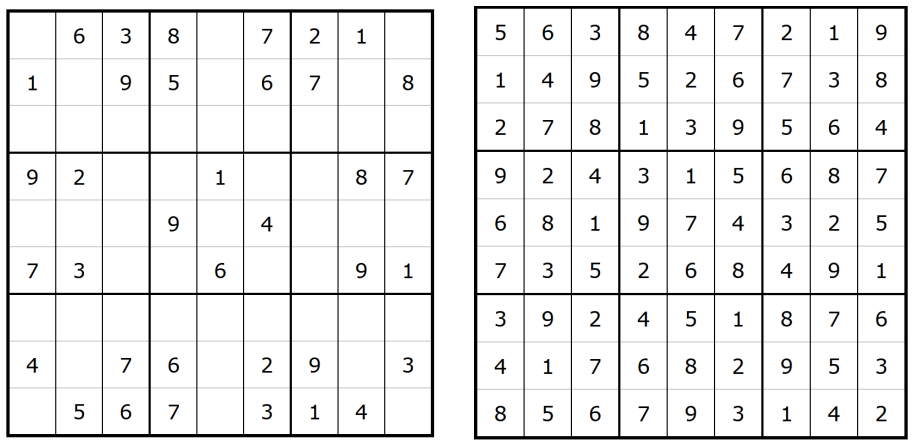
Fill each 3×3 subgrid with the numbers 1 through 9 without repeating any number. Figure 9 presents a question-answer pair of the Sudoku puzzle. Hitori Hitori is a logic-based puzzle game originating from Japan. The name “Hitori” means “alone” or “one person” in Japanese, reflecting the puzzle’s goal of isolating numbers. It is typically played on a square...
-
[4]
A shaded cell is considered "eliminated" and cannot be part of the connected group. Figure 10 presents a question-answer pair of the Hitori puzzle. Fillomino Fillomino is a logic puzzle played on a rectangular grid where some cells may initially contain num- bers. The goal is to divide the grid into regions, or "polyominoes," such that each region contain...
-
[5]
Decide whether a given action is legal in the initial state
A block can only be on one other block or the table. Decide whether a given action is legal in the initial state. Input format: state: A set of facts describing the world. query: An action to evaluate. Output: Format your answer starting with % followed by a line of either True or False. Example: Input state: The red block is on the table. The tan block i...
-
[7]
Eliminate numbers by marking them (usually shaded or blacked out) so that no row or col- umn has duplicate numbers
-
[8]
You cannot shade two adjacent cells (cells sharing an edge) — shaded cells must not touch horizontally or vertically
-
[9]
All unshaded (white) cells must form a sin- gle connected group, meaning you can move from any unshaded cell to any other through neighboring unshaded cells
Show all 19 references
-
[11]
Divide the grid into regions where each region consists of connected cells (horizontally or vertically adjacent)
-
[12]
Each region must contain exactly one number that matches the total number of cells in that region
-
[13]
Regions of the same size must not be orthogo- nally adjacent (they cannot share a side)
-
[14]
Figure 11 presents a question-answer pair of the Fillomino puzzle
Empty cells must be filled with numbers dur- ing solving to satisfy the above conditions. Figure 11 presents a question-answer pair of the Fillomino puzzle. A.2 Task with Actions Blocks Worldis a classic domain in knowledge representation and action reasoning. It involves a se...
2023
-
[15]
All blocks are of equal size
-
[16]
A block can only be moved if it is clear (nothing on top of it)
-
[17]
A block can only be placed on another block if the target block is clear
-
[18]
Blocks may also be placed on the table, which always has space
-
[2022]
InProceedings of the 2022 Conference of the North American Chapter of the Association for Computational Linguistics: Human Language Technologies, pages 2655–2671
Learning to retrieve prompts for in-context learning. InProceedings of the 2022 Conference of the North American Chapter of the Association for Computational Linguistics: Human Language Technologies, pages 2655–2671. Alon Talmor, Jonathan Herzig, Nicholas Lourie, and Jonathan ...
2022 arXiv
-
[2023]
Denny Zhou, Nathanael Schärli, Le Hou, Jason Wei, Nathan Scales, Xuezhi Wang, Dale Schuurmans, Claire Cui, Olivier Bousquet, Quoc V Le, and Ed H
Tree of thoughts: Deliberate problem solving with large language models.Advances in Neural Information Processing Systems, 36:11809–11822. Denny Zhou, Nathanael Schärli, Le Hou, Jason Wei, Nathan Scales, Xuezhi Wang, Dale Schuurmans, Claire Cui, Olivier Bousquet, Quoc V Le, an...
2023
-
[2024]
Itsuki Maeda and Yasuhiro Inoue
Deepseek-v3 technical report.arXiv preprint arXiv:2412.19437. Itsuki Maeda and Yasuhiro Inoue. 2024. Mathematical definition and systematization of puzzle rules.arXiv preprint arXiv:2501.01433. Rui Mao, Guanyi Chen, Xulang Zhang, Frank Guerin, and Erik Cambria. 2024. "GPTEval:...
2024 arXiv
Reviewed August 7, 2026 · model on record in the stance chip above.
Discussion (0). Continue with ORCID to comment.