REVIEW 4 major objections 5 minor 1 cited by
Generative Latent Coding for Ultra-Low Bitrate Image and Video Compression
T0 review · 4 major / 5 minor · reviewed 2026-08-07 · deepseek-v4-flash
Pith's one-line read Compressing images and video inside a generative VQ-VAE latent space, instead of pixel space, achieves the same perceptual quality at far lower bitrates.
desk verdict The video extension is a genuine new contribution and the ablations are honest, but the headline bitrate savings rest on an undisclosed baseline fine-tuning protocol and a self-selected metric family, so the paper deserves review, not blind trust. read the letter →
The pith
A machine-rendered reading of the paper's core claim, the machinery that carries it, and where it could break.
The reading
What carries the argument
The load-bearing object is the generative latent space of a VQ-VAE (a vector-quantized variational autoencoder), whose discrete codebook acts as a variational bottleneck that yields sparse, semantic, perceptually aligned latents. On top of this, the paper's contribution is transform coding in that latent space rather than quantization of the VQ indices themselves: an analysis transform maps latents to codes, scalar quantization with a learned rate scaler provides rate variability, and an entropy model with a hyperprior drives bit allocation. The spatial categorical hyper module replaces the factorized hyperprior with a second discrete codebook of basic semantic elements, and the spatio-temporal categorical hyper module for video aggregates global semantic dynamics into K tokens using attention maps from temporal context. The code-prediction-based loss uses cross-entropy against VQ indices as auxiliary supervision during training only, which the ablation shows is critical to semantic consistency.
What would settle it
Run a large crowdsourced pairwise-preference study on CLIC 2020 images and UVG, MCL-JCV, and HEVC Class B videos comparing GLC reconstructions against MS-ILLM and PLVC at the exact claimed operating points; if viewers rate the higher-bitrate pixel-space outputs as equal or better, or find no perceptible difference, the 45% and 65.3% bitrate-saving claims would fail.
Extended reading notes
Core claim
The central claim is that the generative latent space of a VQ-VAE is the right domain for ultra-low-bitrate compression because it is sparser, more semantic, and better aligned with human perception than the pixel domain. GLC-image and GLC-video therefore encode the input into discrete VQ-VAE latents, apply transform coding (analysis transform, scalar quantization, synthesis transform) to those latents, and decode back to pixels, with the entropy model aided by an improved hyperprior. The improvements are a spatial categorical hyper module for images, a spatio-temporal categorical hyper module for videos that captures global dynamics in a small set of tokens, and a code-prediction-based auxiliary loss that pushes latents to predict their VQ indices, enforcing semantic consistency. The paper reports that this scheme reaches below 0.04 bpp for images with the same FID as MS-ILLM at 45% lower bitrate, and below 0.01 bpp for video with a 65.3% DISTS bitrate saving over PLVC.
Load-bearing premise
The central claim rests on the assumption that DISTS, FID, and KID measure what viewers care about at ultra-low bitrates, and that the pixel-level metrics PSNR, MS-SSIM, and LPIPS do not.
Editorial extensions
If this is right
- Ultra-low-bitrate learned codecs can likely drop pixel-space distortion objectives in favor of latent-space perceptual objectives without hurting realism.
- A single GLC model can cover a range of bitrates through a scaling factor, removing the need to train separate models per rate point.
- For video, temporal redundancy that survives in the latent space can be exploited by conditional coding, opening latent-space inter-frame prediction as an alternative to optical-flow-based motion compensation.
- The hyperprior itself can be made discrete and semantic, so the side information no longer spends bits on low-level noise.
- Because most compute sits in the latent encoder and decoder, further gains can come from stronger generative decoders without re-engineering the entropy coder.
Reading between the lines
- If the latent-space alignment claim generalizes, the same coding principle could apply to feature compression for machine vision, where semantic fidelity matters more than pixel fidelity.
- The headline savings depend on DISTS, FID, and KID as the quality yardsticks; a neutral human preference study at matched bitrates would test whether the claimed advantage survives independent of the chosen metrics.
- A natural extension is to pair latent-space transform coding with a diffusion-based latent decoder, which might raise realism further while inheriting GLC's bit-efficiency.
- The strong result suggests the VQ-VAE auto-encoder, not the entropy coder, is the current bottleneck; improving the latent auto-encoder's capacity and sparsity could directly convert into bitrate savings.
Editorial analysis
A structured set of objections, weighed in public.
Referee Report
Summary. The paper proposes Generative Latent Coding (GLC) for image and video compression at ultra-low bitrates. Instead of coding pixels, the input is first mapped into the latent space of a generative VQ-VAE; a learned transform codec then compresses these latents with entropy coding. GLC-image adds a spatial categorical hyper module, and GLC-video adds a spatio-temporal categorical hyper module that encodes global semantic dynamics into a small set of tokens. Training is staged: first the latent auto-encoder, then the transform codec with a code-prediction auxiliary loss, then joint fine-tuning. The headline claims are a 45% bitrate saving over MS-ILLM at equal FID on CLIC 2020 and a 65.3% DISTS-based bitrate saving over PLVC. The paper also reports ablations supporting each proposed component and a complexity comparison with MS-ILLM.
Significance. If the comparative results hold, the core idea is significant: it extends generative compression from pixel-space transform coding to the latent space of a VQ-VAE, while retaining rate variability in a single model. The ablations in Tables I, II, V, VI, and VII are well structured and consistently show that each module contributes, and the extension from the conference version to video is nontrivial. The main weakness is that the headline quantitative claims rest on a baseline comparison protocol that is not specified and on a metric family that is chosen, in part, after the fact and aligned with the training losses. The paper is therefore a strong candidate for the method, but its central comparative claims need to be made independently verifiable before publication.
major comments (4)
- [Section V-A, Figs. 8 and 13] The baseline comparison protocol is not specified. The text states that for image compression, “as some methods do not release models for ultra-low bitrate, we either retrain or fine-tune their models to suit such low bitrate,” but it does not say which methods were retrained, which were fine-tuned, what target bitrates were used, what training data or schedule was used, or whether official checkpoints were used. For video, the comparison with PLVC is described only as “we compare against ... PLVC.” Because the abstract’s two quantitative claims (45% saving over MS-ILLM and 65.3% saving over PLVC) are comparative, this omission is load-bearing. The authors should provide a complete protocol, preferably with released checkpoints and rate-distortion data points, so that the comparisons can be reproduced.
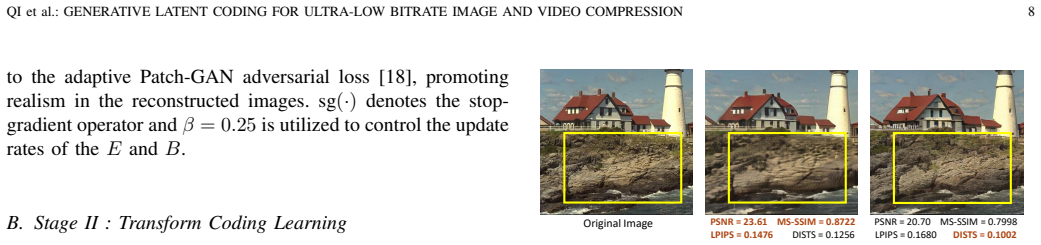
- [Section V-A, Fig. 7] The choice of DISTS, FID, and KID as the headline metrics is justified by a single illustrative example (Fig. 7) and by the assertion that LPIPS and PSNR are less suitable at ultra-low bitrates. This is a correctness-risk concern: the model is trained with perceptual and GAN losses, so the chosen metric family is aligned with the optimization target, and the claimed advantage could shrink or reverse under a different perceptual evaluation. The paper should add a neutral perceptual study (e.g., a formal subjective test) or report results over a pre-specified, full metric family including LPIPS and PSNR with the same rate anchors. Without that, the 45% and 65.3% savings are not shown to be robust.
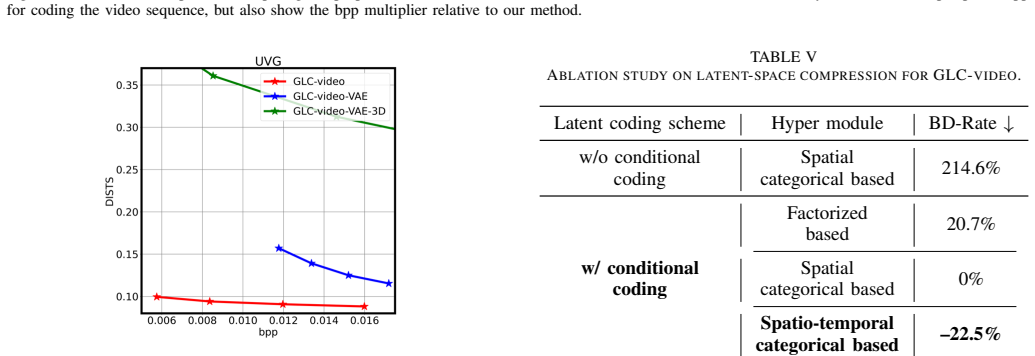
- [Section V-C, Figs. 13 and 15] The rate intervals used for BD-Rate calculations are not reported, and the video comparison appears to extrapolate PLVC. Figure 15 shows PLVC decoded at 0.0162–0.0229 bpp while GLC-video operates at 0.0061–0.0097 bpp, so the 65.3% DISTS saving may be computed over a range where PLVC has no actual decoded operating points. The authors should report the anchor points and the overlap region used for BD-Rate, and should either restrict the claim to the range with measured baseline points or discuss the extrapolation explicitly.
- [Sections III-C2, III-D2, and V-A] Several parameters needed to reproduce the method are not given, and no code or checkpoints are released. In particular, the hyper codebook size N_b in the spatial categorical hyper module, the number of attention groups N_h, and the full loss-weight schedules in the three training stages are not stated. The statement in V-A that OpenImage test set is used for training is also an apparent wording error. Given the dependence of the headline claims on in-house baselines, the missing implementation details and the lack of code make independent verification impossible; the authors should release code/checkpoints or provide a complete specification of all hyperparameters and the baseline adaptation procedure.
minor comments (5)
- [Section V-A] The sentence “we also follow [25] and use OpenImage test set [58] for training” is presumably a wording error; training should use a training split, not a test set. This should be corrected because it affects reproducibility.
- [Section V-A] FID and KID are described as “no-reference perceptual metrics,” but they are distributional metrics computed against a reference set of real-image statistics; they are not no-reference metrics. The terminology should be corrected.
- [Equations (3) and (6)] The reconstruction terms in Equations (3) and (6) are written as ||x_t - \hat{x}_t|| without specifying the norm; the paper should state whether L1 or L2 is used.
- [Figure 15 caption] The caption contains the typo “not onwly”; it should read “not only.”
- [Section IV-A] The codebook loss in Equation (3) omits the squared norms used in the standard VQ loss; if the squared norm is intended, it should be written explicitly for clarity.
Circularity Check
No significant circularity: the performance claims are empirical comparisons against external baselines on external datasets, with no fitted parameter renamed as a prediction.
full rationale
The paper's derivation chain is empirical rather than definitional. GLC-image and GLC-video are trained with rate-distortion objectives and evaluated on external test sets (CLIC 2020, Kodak, UVG, etc.) against external baselines (MS-ILLM, PLVC, DCVC-FM, VTM), so the headline bitrate savings are measurements, not consequences of how the model or metrics are defined. The choice to emphasize DISTS, FID, and KID over LPIPS is an evaluative assumption justified by an illustrative example, and it does align with the perceptual/GAN losses used in training, but the paper does not fit a parameter to the test set or define its target metric in terms of its own output. Self-citations such as [25], [28], and [55] provide architectural antecedents from the same group, but they are not invoked as uniqueness theorems or as the sole justification for the central claims. The undisclosed retraining/fine-tuning protocol for baselines is a comparability and reproducibility concern, not a circularity in the derivation. Therefore no circular step is exhibited, and the appropriate score is 0.
Assumptions & free parameters
free parameters (8)
- rate-distortion weight lambda =
image [0.08, 0.32], video [0.12, 1.6]
- adversarial loss weight w_adv =
0.8
- codebook commitment weight beta =
0.25
- code-prediction cross-entropy weight alpha =
0.5
- code-prediction pixel supervision weight lambda_code =
0.05
- number of spatio-temporal tokens K =
16
- hyper codebook size Nb =
not stated
- latent auto-encoder codebook size and resolution =
16384 codes, f=1/16
assumptions (5)
- domain assumption The VQ-VAE latent space is semantically meaningful, sparse, and aligned with human perception
- domain assumption DISTS, FID, and KID are valid perceptual quality measures for ultra-low bitrate compression, and LPIPS and PSNR are not
- domain assumption Fixed-length coding of hyper codebook indices with log2(Nb) bits is efficient
- domain assumption Retrained or fine-tuned baselines fairly represent the cited methods at ultra-low bitrates
- standard math Background results in learned compression (Ballé et al., hyperprior, DCVC, hybrid entropy model) are correct and applicable
Cite this review
Pith. "Pith review of Generative Latent Coding for Ultra-Low Bitrate Image and Video Compression." pith.science (2026). https://pith.science/paper/THBW3C7V
@misc{pith2026250516177,
  author       = {Pith},
  title        = {Pith review of: Generative Latent Coding for Ultra-Low Bitrate Image and Video Compression},
  year         = {2026},
  howpublished = {\url{https://pith.science/paper/THBW3C7V}},
  note         = {Machine review of arXiv:2505.16177}
}
abstract
Most existing approaches for image and video compression perform transform coding in the pixel space to reduce redundancy. However, due to the misalignment between the pixel-space distortion and human perception, such schemes often face the difficulties in achieving both high-realism and high-fidelity at ultra-low bitrate. To solve this problem, we propose \textbf{G}enerative \textbf{L}atent \textbf{C}oding (\textbf{GLC}) models for image and video compression, termed GLC-image and GLC-Video. The transform coding of GLC is conducted in the latent space of a generative vector-quantized variational auto-encoder (VQ-VAE). Compared to the pixel-space, such a latent space offers greater sparsity, richer semantics and better alignment with human perception, and show its advantages in achieving high-realism and high-fidelity compression. To further enhance performance, we improve the hyper prior by introducing a spatial categorical hyper module in GLC-image and a spatio-temporal categorical hyper module in GLC-video. Additionally, the code-prediction-based loss function is proposed to enhance the semantic consistency. Experiments demonstrate that our scheme shows high visual quality at ultra-low bitrate for both image and video compression. For image compression, GLC-image achieves an impressive bitrate of less than $0.04$ bpp, achieving the same FID as previous SOTA model MS-ILLM while using $45\%$ fewer bitrate on the CLIC 2020 test set. For video compression, GLC-video achieves 65.3\% bitrate saving over PLVC in terms of DISTS.
Figures


Figures from the paper (15 more)






Forward citations
Cited by 1 Pith paper
-
GVCCTurbo: Rate-Compute Quality Scheduling for Codebook Driven Generative Compression
GVCCTurbo reuses cached generator endpoints across codebook correction steps, cutting denoiser evaluations from 20 to 9 and decoding time by roughly 44% at similar LPIPS.
Reference graph
Works this paper leans on
-
[25]
Generative latent coding for ultra-low bitrate image compression,
Z. Jia, J. Li, B. Li, H. Li, and Y . Lu, “Generative latent coding for ultra-low bitrate image compression,” inProceedings of the IEEE/CVF Conference on Computer Vision and Pattern Recognition, 2024, pp. 26 088–26 098
2024
-
[1]
The jpeg still picture compression standard,
G. K. Wallace, “The jpeg still picture compression standard,”Commu- nications of the ACM, vol. 34, no. 4, pp. 30–44, 1991
1991
-
[2]
Overview of the versatile video coding (vvc) standard and its applications,
B. Bross, Y .-K. Wang, Y . Ye, S. Liu, J. Chen, G. J. Sullivan, and J.- R. Ohm, “Overview of the versatile video coding (vvc) standard and its applications,”IEEE Transactions on Circuits and Systems for Video Technology, vol. 31, no. 10, pp. 3736–3764, 2021
2021
-
[3]
Variational image compression with a scale hyperprior,
J. Ball ´e, D. Minnen, S. Singh, S. J. Hwang, and N. Johnston, “Variational image compression with a scale hyperprior,” inInternational Conference on Learning Representations, 2018
2018
-
[4]
Learned image com- pression with discretized gaussian mixture likelihoods and attention modules,
Z. Cheng, H. Sun, M. Takeuchi, and J. Katto, “Learned image com- pression with discretized gaussian mixture likelihoods and attention modules,” inProceedings of the IEEE/CVF conference on computer vision and pattern recognition, 2020, pp. 7939–7948
work page 2020
-
[5]
Causal contextual prediction for learned image compression,
Z. Guo, Z. Zhang, R. Feng, and Z. Chen, “Causal contextual prediction for learned image compression,”IEEE Transactions on Circuits and Systems for Video Technology, vol. 32, no. 4, pp. 2329–2341, 2022
work page 2022
-
[6]
Evc: Towards real-time neural image compression with mask decay,
W. Guo-Hua, J. Li, B. Li, and Y . Lu, “Evc: Towards real-time neural image compression with mask decay,” inThe Eleventh International Conference on Learning Representations, 2022
work page 2022
-
[7]
Learned image compression with mixed transformer-cnn architectures,
J. Liu, H. Sun, and J. Katto, “Learned image compression with mixed transformer-cnn architectures,” inProceedings of the IEEE/CVF Con- ference on Computer Vision and Pattern Recognition, 2023, pp. 14 388– 14 397
work page 2023
Show all 71 references
-
[8]
Fvc: A new framework towards deep video compression in feature space,
Z. Hu, G. Lu, and D. Xu, “Fvc: A new framework towards deep video compression in feature space,” inProceedings of the IEEE/CVF Conference on Computer Vision and Pattern Recognition, 2021, pp. 1502–1511
2021
-
[9]
Deep contextual video compression,
J. Li, B. Li, and Y . Lu, “Deep contextual video compression,”Advances in Neural Information Processing Systems, vol. 34, pp. 18 114–18 125, 2021
2021
-
[10]
Maskcrt: Masked conditional residual transformer for learned video compression,
Y .-H. Chen, H.-S. Xie, C.-W. Chen, Z.-L. Gao, M. Benjak, W.-H. Peng, and J. Ostermann, “Maskcrt: Masked conditional residual transformer for learned video compression,”IEEE Transactions on Circuits and Systems for Video Technology, vol. 34, no. 11, pp. 11 980–11 992, 2024. QI...
2024
-
[11]
Dmvc: Decomposed motion modeling for learned video compression,
K. Lin, C. Jia, X. Zhang, S. Wang, S. Ma, and W. Gao, “Dmvc: Decomposed motion modeling for learned video compression,”IEEE Transactions on Circuits and Systems for Video Technology, vol. 33, no. 7, pp. 3502–3515, 2023
2023
-
[12]
End-to-end optimized image compression,
J. Ball ´e, V . Laparra, and E. P. Simoncelli, “End-to-end optimized image compression,” in5th International Conference on Learning Representa- tions, ICLR 2017, 2017
2017
-
[13]
Improving statistical fidelity for neural image compression with im- plicit local likelihood models,
M. J. Muckley, A. El-Nouby, K. Ullrich, H. J ´egou, and J. Verbeek, “Improving statistical fidelity for neural image compression with im- plicit local likelihood models,” inInternational Conference on Machine Learning, 2023
2023
-
[14]
Perceptual losses for real-time style transfer and super-resolution,
J. Johnson, A. Alahi, and L. Fei-Fei, “Perceptual losses for real-time style transfer and super-resolution,” inComputer Vision–ECCV 2016: 14th European Conference, Amsterdam, The Netherlands, October 11- 14, 2016, Proceedings, Part II 14. Springer, 2016, pp. 694–711
2016
-
[15]
Generative adversarial nets,
I. Goodfellow, J. Pouget-Abadie, M. Mirza, B. Xu, D. Warde-Farley, S. Ozair, A. Courville, and Y . Bengio, “Generative adversarial nets,” Advances in neural information processing systems, vol. 27, 2014
2014
-
[16]
Image quality assessment: Unifying structure and texture similarity,
K. Ding, K. Ma, S. Wang, and E. P. Simoncelli, “Image quality assessment: Unifying structure and texture similarity,”IEEE transactions on pattern analysis and machine intelligence, vol. 44, no. 5, pp. 2567– 2581, 2020
2020
-
[17]
Neural discrete representation learning,
A. Van Den Oord, O. Vinyalset al., “Neural discrete representation learning,”Advances in neural information processing systems, vol. 30, 2017
2017
-
[18]
Taming transformers for high- resolution image synthesis,
P. Esser, R. Rombach, and B. Ommer, “Taming transformers for high- resolution image synthesis,” inProceedings of the IEEE/CVF conference on computer vision and pattern recognition, 2021, pp. 12 873–12 883
2021
-
[19]
Adaptive human-centric video com- pression for humans and machines,
W. Jiang, H. Choi, and F. Racap ´e, “Adaptive human-centric video com- pression for humans and machines,” inProceedings of the IEEE/CVF Conference on Computer Vision and Pattern Recognition, 2023, pp. 1121–1129
2023
-
[20]
Extreme image compression using fine-tuned vqgan models,
Q. Mao, T. Yang, Y . Zhang, S. Pan, M. Wang, S. Wang, and S. Ma, “Extreme image compression using fine-tuned vqgan models,”arXiv preprint arXiv:2307.08265, 2023
2023 arXiv
-
[21]
Towards robust blind face restoration with codebook lookup transformer,
S. Zhou, K. Chan, C. Li, and C. C. Loy, “Towards robust blind face restoration with codebook lookup transformer,”Advances in Neural Information Processing Systems, vol. 35, pp. 30 599–30 611, 2022
2022
-
[22]
Clic 2020: Challenge on learned image compression, 2020,
G. Toderici, L. Theis, N. Johnston, E. Agustsson, F. Mentzer, J. Ball ´e, W. Shi, and R. Timofte, “Clic 2020: Challenge on learned image compression, 2020,” 2020
2020
-
[23]
Perceptual learned video compression with recurrent conditional gan
R. Yang, R. Timofte, and L. Van Gool, “Perceptual learned video compression with recurrent conditional gan.” inIJCAI, 2022, pp. 1537– 1544
2022
-
[24]
Neural video compression with feature modulation,
J. Li, B. Li, and Y . Lu, “Neural video compression with feature modulation,” inIEEE/CVF Conference on Computer Vision and Pattern Recognition, CVPR 2024, Seattle, WA, USA, June 17-21, 2024, 2024
2024
-
[26]
Towards extreme image compression with latent feature guidance and diffusion prior,
Z. Li, Y . Zhou, H. Wei, C. Ge, and J. Jiang, “Towards extreme image compression with latent feature guidance and diffusion prior,”IEEE Transactions on Circuits and Systems for Video Technology, vol. PP, pp. 1–1, 01 2024
2024
-
[27]
Context-adaptive entropy model for end-to-end optimized image compression,
J. Lee, S. Cho, and S.-K. Beack, “Context-adaptive entropy model for end-to-end optimized image compression,” inInternational Conference on Learning Representations, 2018
2018
-
[28]
Neural video compression with diverse contexts,
J. Li, B. Li, and Y . Lu, “Neural video compression with diverse contexts,” inProceedings of the IEEE/CVF Conference on Computer Vision and Pattern Recognition, 2023, pp. 22 616–22 626
2023
-
[29]
A universal optimization framework for learning-based image codec,
J. Zhao, B. Li, J. Li, R. Xiong, and Y . Lu, “A universal optimization framework for learning-based image codec,”ACM Transactions on Multimedia Computing, Communications and Applications, vol. 20, no. 1, pp. 1–19, 2023
2023
-
[30]
Asymmetric gained deep image compression with continuous rate adaptation,
Z. Cui, J. Wang, S. Gao, T. Guo, Y . Feng, and B. Bai, “Asymmetric gained deep image compression with continuous rate adaptation,” in Proceedings of the IEEE/CVF Conference on Computer Vision and Pattern Recognition, 2021, pp. 10 532–10 541
2021
-
[31]
Generative adversarial networks for extreme learned image compres- sion,
E. Agustsson, M. Tschannen, F. Mentzer, R. Timofte, and L. V . Gool, “Generative adversarial networks for extreme learned image compres- sion,” inProceedings of the IEEE/CVF International Conference on Computer Vision, 2019, pp. 221–231
2019
-
[32]
Towards coding for human and machine vision: A scalable image coding approach,
Y . Hu, S. Yang, W. Yang, L.-Y . Duan, and J. Liu, “Towards coding for human and machine vision: A scalable image coding approach,” in 2020 IEEE International Conference on Multimedia and Expo (ICME). IEEE, 2020, pp. 1–6
2020
-
[33]
Text+ sketch: Image compression at ultra low rates,
E. Lei, Y . B. Uslu, H. Hassani, and S. S. Bidokhti, “Text+ sketch: Image compression at ultra low rates,” inICML 2023 Workshop Neural Compression: From Information Theory to Applications, 2023
2023
-
[34]
High- fidelity generative image compression,
F. Mentzer, G. D. Toderici, M. Tschannen, and E. Agustsson, “High- fidelity generative image compression,”Advances in Neural Information Processing Systems, vol. 33, pp. 11 913–11 924, 2020
2020
-
[35]
Po-elic: Perception-oriented efficient learned image coding,
D. He, Z. Yang, H. Yu, T. Xu, J. Luo, Y . Chen, C. Gao, X. Shi, H. Qin, and Y . Wang, “Po-elic: Perception-oriented efficient learned image coding,” inProceedings of the IEEE/CVF Conference on Computer Vision and Pattern Recognition, 2022, pp. 1764–1769
2022
-
[36]
High-fidelity image compression with score-based generative models,
E. Hoogeboom, E. Agustsson, F. Mentzer, L. Versari, G. Toderici, and L. Theis, “High-fidelity image compression with score-based generative models,”arXiv preprint arXiv:2305.18231, 2023
2023 arXiv
-
[37]
Fidelity-controllable extreme image compression with generative adversarial networks,
S. Iwai, T. Miyazaki, Y . Sugaya, and S. Omachi, “Fidelity-controllable extreme image compression with generative adversarial networks,” in 2020 25th International Conference on Pattern Recognition (ICPR). IEEE, 2021, pp. 8235–8242
2020
-
[38]
Multi-realism image compression with a conditional generator,
E. Agustsson, D. Minnen, G. Toderici, and F. Mentzer, “Multi-realism image compression with a conditional generator,” inProceedings of the IEEE/CVF Conference on Computer Vision and Pattern Recognition, 2023, pp. 22 324–22 333
2023
-
[39]
Extremely low bit-rate image compression via invertible image generation,
F. Gao, X. Deng, J. Jing, X. Zou, and M. Xu, “Extremely low bit-rate image compression via invertible image generation,”IEEE Transactions on Circuits and Systems for Video Technology, vol. 34, no. 8, pp. 6993– 7004, 2024
2024
-
[40]
Denoising diffusion probabilistic models,
J. Ho, A. Jain, and P. Abbeel, “Denoising diffusion probabilistic models,” Advances in neural information processing systems, vol. 33, pp. 6840– 6851, 2020
2020
-
[41]
Towards image compression with perfect realism at ultra-low bitrates,
M. Careil, M. J. Muckley, J. Verbeek, and S. Lathuili`ere, “Towards image compression with perfect realism at ultra-low bitrates,” inThe Twelfth International Conference on Learning Representations, 2023
2023
-
[42]
Multiscale structural similarity for image quality assessment,
Z. Wang, E. P. Simoncelli, and A. C. Bovik, “Multiscale structural similarity for image quality assessment,” inThe Thrity-Seventh Asilomar Conference on Signals, Systems & Computers, 2003, vol. 2. Ieee, 2003, pp. 1398–1402
2003
-
[43]
Dvc: An end-to-end deep video compression framework,
G. Lu, W. Ouyang, D. Xu, X. Zhang, C. Cai, and Z. Gao, “Dvc: An end-to-end deep video compression framework,” inProceedings of the IEEE/CVF Conference on Computer Vision and Pattern Recognition, 2019, pp. 11 006–11 015
2019
-
[44]
An end- to-end learning framework for video compression,
G. Lu, X. Zhang, W. Ouyang, L. Chen, Z. Gao, and D. Xu, “An end- to-end learning framework for video compression,”IEEE transactions on pattern analysis and machine intelligence, vol. 43, no. 10, pp. 3292– 3308, 2020
2020
-
[45]
Coarse-to- fine deep video coding with hyperprior-guided mode prediction,
Z. Hu, G. Lu, J. Guo, S. Liu, W. Jiang, and D. Xu, “Coarse-to- fine deep video coding with hyperprior-guided mode prediction,” in Proceedings of the IEEE/CVF Conference on Computer Vision and Pattern Recognition, 2022, pp. 5921–5930
2022
-
[46]
Uncertainty-Aware Deep Video Compression with Ensembles,
W. Ma, J. Li, B. Li, and Y . Lu, “Uncertainty-Aware Deep Video Compression with Ensembles,”IEEE Transactions on Multimedia, 2024
2024
-
[47]
Canf- vc: Conditional augmented normalizing flows for video compression,
Y .-H. Ho, C.-P. Chang, P.-Y . Chen, A. Gnutti, and W.-H. Peng, “Canf- vc: Conditional augmented normalizing flows for video compression,” arXiv preprint arXiv:2207.05315, 2022
2022 arXiv
-
[48]
Motion information propagation for neural video compression,
L. Qi, J. Li, B. Li, H. Li, and Y . Lu, “Motion information propagation for neural video compression,” inProceedings of the IEEE/CVF Conference on Computer Vision and Pattern Recognition, 2023, pp. 6111–6120
2023
-
[49]
Long-term temporal context gathering for neural video compression,
L. Qi, Z. Jia, J. Li, B. Li, H. Li, and Y . Lu, “Long-term temporal context gathering for neural video compression,” inEuropean Conference on Computer Vision. Springer, 2024, pp. 305–322
2024
-
[50]
Spatial decomposition and temporal fusion based inter prediction for learned video compression,
X. Sheng, L. Li, D. Liu, and H. Li, “Spatial decomposition and temporal fusion based inter prediction for learned video compression,”IEEE Transactions on Circuits and Systems for Video Technology, vol. 34, no. 7, pp. 6460–6473, 2024
2024
-
[51]
High visual-fidelity learned video compression,
M. Li, Y . Shi, J. Wang, and Y . Huang, “High visual-fidelity learned video compression,” inProceedings of the 31st ACM International Conference on Multimedia, 2023, pp. 8057–8066
2023
-
[52]
Variational lossy autoencoder,
X. Chen, D. P. Kingma, T. Salimans, Y . Duan, P. Dhariwal, J. Schulman, I. Sutskever, and P. Abbeel, “Variational lossy autoencoder,”arXiv preprint arXiv:1611.02731, 2016
2016 arXiv
-
[53]
Pixel recurrent neural networks,
A. Van Den Oord, N. Kalchbrenner, and K. Kavukcuoglu, “Pixel recurrent neural networks,” inInternational conference on machine learning. PMLR, 2016, pp. 1747–1756
2016
-
[54]
High- resolution image synthesis with latent diffusion models,
R. Rombach, A. Blattmann, D. Lorenz, P. Esser, and B. Ommer, “High- resolution image synthesis with latent diffusion models,” inProceedings of the IEEE/CVF conference on computer vision and pattern recognition, 2022, pp. 10 684–10 695. QI et al.: GENERATIVE LATENT CODING FOR U...
2022
-
[55]
Hybrid spatial-temporal entropy modelling for neural video compression,
J. Li, B. Li, and Y . Lu, “Hybrid spatial-temporal entropy modelling for neural video compression,” inProceedings of the 30th ACM Interna- tional Conference on Multimedia, 2022, pp. 1503–1511
2022
-
[56]
Very deep convolutional networks for large-scale image recognition,
K. Simonyan and A. Zisserman, “Very deep convolutional networks for large-scale image recognition,”arXiv preprint arXiv:1409.1556, 2014
2014 arXiv
-
[57]
Attention is all you need,
A. Vaswani, N. Shazeer, N. Parmar, J. Uszkoreit, L. Jones, A. N. Gomez, Ł. Kaiser, and I. Polosukhin, “Attention is all you need,”Advances in neural information processing systems, vol. 30, 2017
2017
-
[58]
The open images dataset v4: Unified image classification, object detection, and visual relationship detection at scale,
A. Kuznetsova, H. Rom, N. Alldrin, J. Uijlings, I. Krasin, J. Pont-Tuset, S. Kamali, S. Popov, M. Malloci, A. Kolesnikovet al., “The open images dataset v4: Unified image classification, object detection, and visual relationship detection at scale,”International Journal of Com...
1956
-
[59]
Video enhance- ment with task-oriented flow,
T. Xue, B. Chen, J. Wu, D. Wei, and W. T. Freeman, “Video enhance- ment with task-oriented flow,”International Journal of Computer Vision, vol. 127, no. 8, pp. 1106–1125, 2019
2019
-
[60]
Fixing weight decay regularization in adam,
I. Loshchilov and F. Hutter, “Fixing weight decay regularization in adam,” 2018
2018
-
[61]
Kodak Lossless True Color Image Suite, http://r0k.us/graphics/kodak/
-
[62]
Ntire 2017 challenge on single image super-resolution: Dataset and study,
E. Agustsson and R. Timofte, “Ntire 2017 challenge on single image super-resolution: Dataset and study,” inProceedings of the IEEE con- ference on computer vision and pattern recognition workshops, 2017, pp. 126–135
2017
-
[63]
Microsoft coco: Common objects in context,
T.-Y . Lin, M. Maire, S. Belongie, J. Hays, P. Perona, D. Ramanan, P. Doll ´ar, and C. L. Zitnick, “Microsoft coco: Common objects in context,” inComputer Vision–ECCV 2014: 13th European Conference, Zurich, Switzerland, September 6-12, 2014, Proceedings, Part V 13. Springer, 2...
2014
-
[64]
Uvg dataset: 50/120fps 4k sequences for video codec analysis and development,
A. Mercat, M. Viitanen, and J. Vanne, “Uvg dataset: 50/120fps 4k sequences for video codec analysis and development,” inProceedings of the 11th ACM Multimedia Systems Conference, 2020, pp. 297–302
2020
-
[65]
Mcl-jcv: a jnd-based h. 264/avc video quality assessment dataset,
H. Wang, W. Gan, S. Hu, J. Y . Lin, L. Jin, L. Song, P. Wang, I. Katsavounidis, A. Aaron, and C.-C. J. Kuo, “Mcl-jcv: a jnd-based h. 264/avc video quality assessment dataset,” in2016 IEEE international conference on image processing (ICIP). IEEE, 2016, pp. 1509–1513
2016
-
[66]
Overview of the high efficiency video coding (hevc) standard,
G. J. Sullivan, J.-R. Ohm, W.-J. Han, and T. Wiegand, “Overview of the high efficiency video coding (hevc) standard,”IEEE Transactions on circuits and systems for video technology, vol. 22, no. 12, pp. 1649– 1668, 2012
2012
-
[67]
Gans trained by a two time-scale update rule converge to a local nash equilibrium,
M. Heusel, H. Ramsauer, T. Unterthiner, B. Nessler, and S. Hochreiter, “Gans trained by a two time-scale update rule converge to a local nash equilibrium,”Advances in neural information processing systems, vol. 30, 2017
2017
-
[68]
Demysti- fying mmd gans,
M. Bi ´nkowski, D. J. Sutherland, M. Arbel, and A. Gretton, “Demysti- fying mmd gans,”arXiv preprint arXiv:1801.01401, 2018
2018 arXiv
-
[69]
Calculation of average psnr differences between rd- curves,
G. Bjontegaard, “Calculation of average psnr differences between rd- curves,”ITU SG16 Doc. VCEG-M33, 2001
2001
-
[70]
Visualizing data using t-sne
L. Van der Maaten and G. Hinton, “Visualizing data using t-sne.”Journal of machine learning research, vol. 9, no. 11, 2008
2008
-
[71]
Cogvideox: Text-to-video diffusion models with an expert transformer,
Z. Yang, J. Teng, W. Zheng, M. Ding, S. Huang, J. Xu, Y . Yang, W. Hong, X. Zhang, G. Fenget al., “Cogvideox: Text-to-video diffusion models with an expert transformer,”arXiv preprint arXiv:2408.06072, 2024. Linfeng Qireceived the B.S. degree in electronic information engineer...
2024 arXiv
Reviewed August 7, 2026 · model on record in the stance chip above.
Discussion (0). Sign in to comment.