REVIEW 4 major objections 5 minor 1 cited by
Large Language Models based ASR Error Correction for Child Conversations
T0 review · 4 major / 5 minor · reviewed 2026-08-07 · deepseek-v4-flash
Pith's one-line read Fine-tuned large language models lower word error rates on children's conversational ASR for zero-shot Whisper and CTC-based WavLM outputs, but not for fine-tuned Whisper outputs.
desk verdict Solid, useful empirical study on LLM correction for child ASR; the headline findings are plausible but need significance testing and an ablation of the three-word fallback before they are fully established. read the letter →
The pith
A machine-rendered reading of the paper's core claim, the machinery that carries it, and where it could break.
The reading
What carries the argument
The load-bearing mechanism is the HyPoradise-style prompt: the LLM receives the top ASR hypothesis plus the remaining N-best hypotheses (5-best), labeled by speaker ('Child' or 'Adult'), and is fine-tuned to output a corrected transcript. LLaMA 3.1-8B is the model that carries the positive results. For context experiments, the prompt additionally includes one or three previous utterances with speaker tags; the LLM is trained on ground-truth previous utterances and evaluated on ASR-inferred ones. WER after Whisper normalization is the evaluation metric, and outputs longer than the best hypothesis by more than three words are discarded to guard against hallucination.
What would settle it
An experiment that trains the context-augmented model on the same kind of noisy ASR-inferred previous utterances used at test time and finds WER equal to or better than the no-context baseline would overturn the paper's claim that conversational context is unhelpful.
Extended reading notes
Core claim
The paper's central claim is that an instruction-tuned LLM can reduce WER on child-adult conversational speech, but only for certain ASR regimes. With LLaMA 3.1-8B, zero-shot Whisper outputs improve on both the MyST and ADOS-Mod3 datasets (for example, from 40.77 to 37.09 overall WER for Whisper-large-v3-turbo on ADOS-Mod3), and fine-tuned WavLM CTC outputs improve substantially (from 66.33 to 50.58 overall). The same LLM leaves fine-tuned Whisper WER essentially unchanged or slightly worse (32.11 to 32.92). The authors attribute the WavLM gains to correction of spelling errors produced by character-level CTC decoding, and the absence of Whisper gains to shared autoregressive decoding biases between Whisper and the LLM. A further claim is that injecting conversational context with one or three previous utterances raises WER across all conditions, which they attribute to error propagation from imperfect previous transcriptions.
Load-bearing premise
The conclusion that conversational context does not help rests on an experiment where the model learns from clean earlier sentences but is tested on error-filled earlier sentences; the mismatch itself, not the context, may be what hurts.
Editorial extensions
If this is right
- LLM post-editing can serve as a lightweight improvement layer over zero-shot speech foundation models on child speech, avoiding the need to fine-tune the ASR model.
- The benefit is size-dependent: LLaMA 3.1-8B helps consistently, while LLaMA 3.2-1B gives little or negative improvement, so model scale is a practical constraint for this application.
- CTC-based ASR models that produce character-level spelling errors are the clearest targets for LLM correction; autoregressive ASR models such as Whisper resist post-correction under this prompt design.
- The current way of adding conversational context backfires; any future context-aware error correction needs to handle the noise in the ASR-inferred history rather than assuming clean context.
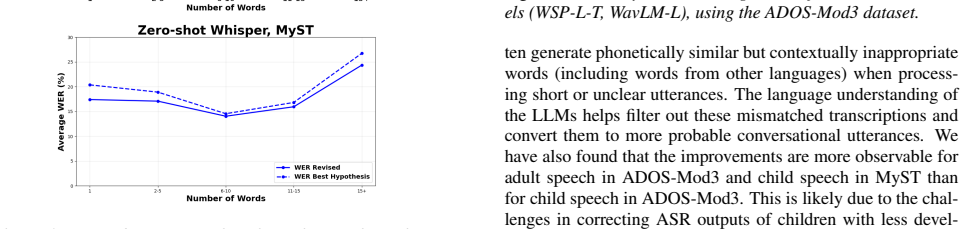
- The largest gains are on single-word utterances, so a selective correction strategy could apply the LLM only where it is most likely to help.
Reading between the lines
- A fairer test of conversational context would train the LLM on the same noisy ASR-inferred previous utterances used at inference; the paper's reported degradation may shrink or reverse under matched conditions.
- The single-word-utterance gains suggest confidence-based or length-based gating could concentrate LLM correction on short utterances and avoid risking longer, already-good transcripts.
- The same post-editing recipe may transfer to other child-inclusive applications, such as classroom dialogue analysis or automated scoring of clinical assessments, where even a few WER points can change downstream language features.
- Because the LLM and Whisper share autoregressive decoding, the null result on fine-tuned Whisper might be overturned by prompting the LLM with diverse N-best hypotheses or by conditioning on acoustic embeddings; this is untested by the paper.
Editorial analysis
A structured set of objections, weighed in public.
Referee Report
Summary. The manuscript studies LLM-based ASR error correction for child-adult conversations. Building on the HyPoradise framework, the authors feed 5-best hypotheses from Whisper (zero-shot and fine-tuned) and WavLM (fine-tuned) ASR systems into LLaMA 3.1-8B and LLaMA 3.2-1B models, with prompts either without or with previous conversational context. Experiments on the MyST and ADOS-Mod3 datasets report mean WER. The main findings are that the 8B model consistently reduces WER for zero-shot Whisper outputs (e.g., WSP-L-T ADOS overall 40.77 to 37.09) and for fine-tuned WavLM outputs (ADOS overall 66.33 to 50.58), while the 1B model gives smaller or negative gains; fine-tuned Whisper outputs are not improved; and adding context degrades performance. The paper also analyzes gains by utterance length.
Significance. If the results are statistically robust, this is a useful empirical contribution to an underexplored application area. The cross-dataset (MyST, ADOS-Mod3) and cross-ASR (Whisper variants, WavLM) design is a strength, and the honest reporting of negative results for fine-tuned Whisper and for context is valuable. The method and prompts are described clearly enough for approximate reproduction. However, the central positive claim currently rests on single-point WER differences without uncertainty quantification, and a hand-set fallback rule that directly shapes the improvements is never ablated. The paper is therefore not yet at the standard required to establish that LLM-based error correction consistently improves child ASR.
major comments (4)
- [Section 3.1, Tables 1–3] No statistical validation is reported. All conclusions rest on single-point WER differences. For example, in Table 1, WSP-S with 1B on ADOS overall is 47.19 versus a 46.67 baseline (a degradation), while WSP-S with 8B gives 43.96; in Table 2, WSP-L-T fine-tuned with 8B gives 32.92 versus a 32.11 baseline. Without confidence intervals or paired significance tests, differences of this magnitude are not distinguishable from noise. Please add bootstrap confidence intervals over speakers or sessions and paired tests on utterance-level errors (e.g., bootstrap or McNemar), with a multiple-comparison correction across the many ASR/LLM/dataset conditions.
- [Section 3.4] The three-word fallback rule is never ablated. The sentence 'we set the ASR output as the best hypothesis whenever the generated output exceeds the best ASR hypothesis by more than three words' defines a post-processing step that caps the downside of LLM outputs and directly inflates the reported improvements, yet no results are shown without it or with other thresholds. Please report WER with the rule disabled (threshold 0 or infinity) and a small sweep of thresholds (e.g., 1, 2, 3, 5) for at least the main zero-shot Whisper and fine-tuned WavLM conditions, and define precisely what 'exceeds' means (length difference in words, edit distance, or something else).
- [Section 2.1.2, Table 3] The context experiment is confounded by train/test mismatch. Training uses ground-truth previous utterances while testing uses ASR-inferred previous utterances, so the observed WER increase could be due to distribution shift rather than to conversational context per se. To support the conclusion that context is unhelpful, please add a condition where the LLM is trained on ASR-inferred previous utterances (or where the test uses ground-truth previous utterances) to factor out the mismatch.
- [Table 2, Table 3] There appears to be a possible data-entry error in Table 2 for the WavLM-L 8B row: the ADOS Adult WER and the MyST WER are both 16.45. Please verify these numbers; the same value in two columns is suspicious. In addition, Table 3 lists WavLM-L (Yes) Adult WERs of 34.73 and 35.02 with context, which is dramatically higher than the 16.45 reported in Table 2 for the no-context 8B condition; if the 16.45 is correct, the context effect would be implausibly large, and if it is a typo, the current tables misrepresent the results.
minor comments (5)
- [Section 4.3, Table 3] The claim that 'using the context of 3 utterances yields higher error rates than using the context of a single utterance' is contradicted by the zero-shot WSP-L-T condition in Table 3, where 1 context gives 38.06 and 3 contexts give 37.79. Please qualify this statement or correct it.
- [Section 3.2] There is a typo: 'CINC' should be 'CHIC' (the Chicago site of ADOS-Mod3).
- [Section 4.4] The sentence about WavLM improvements 'as discussed in Section 4.1' appears to refer to the spelling-error discussion in Section 4.2; please fix the cross-reference.
- [Tables 1–3] The ASR rows labeled 'Unused' should be renamed, e.g., 'No LLM' or 'Baseline', to make clear that these are the WERs without LLM correction.
- [Section 3.4] The statement that 'different temperatures yielding similar ASR correction outputs' would be more convincing with quantitative evidence; please report the actual WERs for the temperature sweep or remove the claim.
Circularity Check
No significant circularity; the LLM error-correction results rest on held-out evaluation, not on construction or self-citation.
full rationale
This paper is an empirical benchmark study, not a formal derivation, and its central claims are supported by standard supervised evaluation: the LLM is trained on ASR N-best hypotheses with ground-truth references and evaluated on held-out test sets (MICH for ADOS-Mod3 and the official test split for MyST). The reported WER reductions are not equal by construction to the training signal; the test outputs come from ASR models and LLM prompts not seen during training. The three-word fallback rule in Section 3.4 is a decoding safeguard that caps possible degradation by reverting to the ASR best hypothesis when the LLM output is much longer; it does not force the observed improvements, since the LLM can still alter outputs within the threshold and can also worsen WER, as shown for the 1B model on WSP-S (46.67 to 47.19). The context experiment in Section 2.1.2 uses ground-truth previous utterances for training and ASR-inferred previous utterances for testing; this is a train/test distribution mismatch that weakens the claim that context is unhelpful, but it is not circular. The paper cites prior work by overlapping authors, notably [23] for dialog context modeling, [9] for child ASR error rates, and [26] for the ADOS dataset, but these citations are motivational or data-attribution references; they are not load-bearing for the paper's main empirical conclusions, which are independently evaluated against held-out data and external ASR/LLM models. No equation or construction reduces a prediction to its input, and no fitted parameter is renamed as a prediction. The unablated three-word fallback threshold and the absence of statistical significance testing are real correctness and rigor concerns, but they are not circularity.
Assumptions & free parameters
free parameters (2)
- three_word_fallback_threshold =
3
- n_best_hypotheses =
5
assumptions (3)
- domain assumption Supervised fine-tuning of an LLM on (N-best hypotheses, reference transcript) pairs generalizes to held-out ASR outputs from the same models.
- domain assumption WER computed with the Whisper normalizer is a valid measure of transcription quality.
- ad hoc to paper LLM outputs longer than the best ASR hypothesis by more than three words are hallucinations and can be safely discarded.
Cite this review
Pith. "Pith review of Large Language Models based ASR Error Correction for Child Conversations." pith.science (2026). https://pith.science/paper/APWCBGW5
@misc{pith2026250516212,
  author       = {Pith},
  title        = {Pith review of: Large Language Models based ASR Error Correction for Child Conversations},
  year         = {2026},
  howpublished = {\url{https://pith.science/paper/APWCBGW5}},
  note         = {Machine review of arXiv:2505.16212}
}
read the original abstract
Automatic Speech Recognition (ASR) has recently shown remarkable progress, but accurately transcribing children's speech remains a significant challenge. Recent developments in Large Language Models (LLMs) have shown promise in improving ASR transcriptions. However, their applications in child speech including conversational scenarios are underexplored. In this study, we explore the use of LLMs in correcting ASR errors for conversational child speech. We demonstrate the promises and challenges of LLMs through experiments on two children's conversational speech datasets with both zero-shot and fine-tuned ASR outputs. We find that while LLMs are helpful in correcting zero-shot ASR outputs and fine-tuned CTC-based ASR outputs, it remains challenging for LLMs to improve ASR performance when incorporating contextual information or when using fine-tuned autoregressive ASR (e.g., Whisper) outputs.
Figures


Figures from the paper (1 more)
Forward citations
Cited by 1 Pith paper
-
Joint ASR and Speaker Role Tagging with Serialized Output Training
Fine-tuning Whisper with serialized output training and role-specific tokens produces role-aware transcripts in one pass, cutting multi-talker word error rate by 10 to 40 percent versus a WavLM CTC baseline.
Reference graph
Works this paper leans on
-
[1]
SFMs can be categorized into two cat- egories
Introduction Automatic Speech Recognition (ASR) has made substantial ad- vances in recent years, driven by Speech Foundation Models (SFM) [1], trained with advanced deep learning architectures, such as transformers [2] and conformers [3], while leveraging extensive training data. SFMs can be categorized into two cat- egories. The first is end-to-end super...
arXiv 2025
-
[2]
Methods 2.1. LLM Prompt Design Our approach to LLM-based error correction for child-adult conversations builds upon the benchmark framework estab- lished by HyPoradise [20], which uses N-best hypotheses from ASR for LLMs as illustrated in Figure 1. While HyPoradise fo- cused on general ASR error correction, we specifically adapted their methodology for co...
-
[3]
Experiments 3.1. Evaluation We report mean Word Error Rate (WER) across all utterances. Before calculating WER for each utterance, we pass the ground truth transcript and ASR outputs to the Whisper normalizer. 3.2. Dataset We consider two child conversational datasets: My Science Tu- tor (MyST) Children’s speech corpus [25] and ADOS-Mod3 corpus of Autism ...
work page 2000
-
[4]
Results and Discussion 4.1. Can LLMs Improvezero-shotChild ASR Results? Table 1 shows the LLM error correction results for the zero-shot Whisper ASR outputs. We see consistent reductions in WERs across all three ASR models for each dataset when LLaMA 3.1- 8B model is used. The improvements are less substantial when the LLaMA 3.2-1B model is applied. Inter...
-
[5]
Conclusion This paper has investigated the use of LLMs for ASR error correction in child conversations, making several key findings. First, larger LLMs consistently improve zero-shot ASR perfor- mance across different Whisper models, while smaller LLMs show limited benefits. Second, for fine-tuned ASR systems, LLMs substantially improve CTC-based self-sup...
-
[6]
Acknowledgment This work was supported by SIMONSFOUNDATION(SFI-AR- HUMAN-00004115-03, 655054)
-
[7]
On the opportunities and risks of foundation models,
R. Bommasani, D. A. Hudson, E. Adeli, R. Altman, S. Arora, S. von Arx, M. S. Bernstein, J. Bohg, A. Bosselut, E. Brunskill et al., “On the opportunities and risks of foundation models,” arXiv preprint arXiv:2108.07258, 2021
arXiv 2021
-
[8]
L. u. kaiser, and i. polosukhin,“attention is all you need,
A. Vaswani, N. Shazeer, N. Parmar, J. Uszkoreit, L. Jones, and A. N. Gomez, “L. u. kaiser, and i. polosukhin,“attention is all you need,”,”Advances in neural information processing systems, vol. 30, pp. 5998–6008, 2017
work page 2017
Show all 33 references
-
[9]
Conformer: Convolution-augmented transformer for speech recognition,
A. Gulati, J. Qin, C.-C. Chiu, N. Parmar, Y . Zhang, J. Yu, W. Han, S. Wang, Z. Zhang, Y . Wu, and R. Pang, “Conformer: Convolution-augmented transformer for speech recognition,” in Interspeech 2020, 2020, pp. 5036–5040
2020
-
[10]
Robust speech recognition via large-scale weak su- pervision,
A. Radford, J. W. Kim, T. Xu, G. Brockman, C. McLeavey, and I. Sutskever, “Robust speech recognition via large-scale weak su- pervision,” inProceedings of the 40th International Conference on Machine Learning, 2023, pp. 28 492–28 518
2023
-
[11]
Fast conformer with linearly scalable attention for efficient speech recognition,
D. Rekesh, N. R. Koluguri, S. Kriman, S. Majumdar, V . Noroozi, H. Huang, O. Hrinchuk, K. Puvvada, A. Kumar, J. Balamet al., “Fast conformer with linearly scalable attention for efficient speech recognition,” in2023 IEEE Automatic Speech Recognition and Understanding Workshop ...
2023
-
[12]
wav2vec 2.0: A framework for self-supervised learning of speech repre- sentations,
A. Baevski, Y . Zhou, A. Mohamed, and M. Auli, “wav2vec 2.0: A framework for self-supervised learning of speech repre- sentations,”Advances in neural information processing systems, vol. 33, pp. 12 449–12 460, 2020
2020
-
[13]
Hubert: Self-supervised speech represen- tation learning by masked prediction of hidden units,
W.-N. Hsu, B. Bolte, Y .-H. H. Tsai, K. Lakhotia, R. Salakhutdi- nov, and A. Mohamed, “Hubert: Self-supervised speech represen- tation learning by masked prediction of hidden units,”IEEE/ACM transactions on audio, speech, and language processing, vol. 29, pp. 3451–3460, 2021
2021
-
[14]
Wavlm: Large-scale self- supervised pre-training for full stack speech processing,
S. Chen, C. Wang, Z. Chen, Y . Wu, S. Liu, Z. Chen, J. Li, N. Kanda, T. Yoshioka, X. Xiaoet al., “Wavlm: Large-scale self- supervised pre-training for full stack speech processing,”IEEE Journal of Selected Topics in Signal Processing, vol. 16, no. 6, pp. 1505–1518, 2022
2022
-
[15]
End-to-end neural systems for automatic children speech recognition: An empirical study,
P. Gurunath Shivakumar and S. Narayanan, “End-to-end neural systems for automatic children speech recognition: An empirical study,”Computer Speech & Language, vol. 72, p. 101289, 2022. [Online]. Available: https://www.sciencedirect. com/science/article/pii/S0885230821000905
2022
-
[16]
Benchmarking chil- dren’s asr with supervised and self-supervised speech foundation models,
R. Fan, N. Balaji Shankar, and A. Alwan, “Benchmarking chil- dren’s asr with supervised and self-supervised speech foundation models,” inInterspeech 2024, 2024, pp. 5173–5177
2024
-
[17]
Acoustics of chil- drenˆaC™s speech: Developmental changes of temporal and spec- tral parameters,
S. Lee, A. Potamianos, and S. S. Narayanan, “Acoustics of chil- drenˆaC™s speech: Developmental changes of temporal and spec- tral parameters,”Journal of the Acoustical Society of America, vol. 105, no. 3, pp. 1455–1468, mar 1999, selected Research Ar- ticle
1999
-
[18]
Developmental acous- tic study of american english diphthongs,
S. Lee, A. Potamianos, and S. Narayanan, “Developmental acous- tic study of american english diphthongs,”The Journal of the Acoustical Society of America, vol. 136, no. 4, pp. 1880–1894, 2014
2014
-
[19]
Robust recognition of chil- dren’s speech,
A. Potamianos and S. Narayanan, “Robust recognition of chil- dren’s speech,”IEEE Transactions on Speech and Audio Process- ing, vol. 11, no. 6, pp. 603–616, 2003
2003
-
[20]
Automatic speech recognition tuned for child speech in the classroom,
R. Southwell, W. Ward, V . A. Trinh, C. Clevenger, C. Clevenger, E. Watts, J. Reitman, S. D’Mello, and J. Whitehill, “Automatic speech recognition tuned for child speech in the classroom,” in ICASSP 2024 - 2024 IEEE International Conference on Acous- tics, Speech and Signal Pr...
2024
-
[21]
A survey of large language models,
W. X. Zhao, K. Zhou, J. Li, T. Tang, X. Wang, Y . Hou, Y . Min, B. Zhang, J. Zhang, Z. Donget al., “A survey of large language models,”arXiv preprint arXiv:2303.18223, 2023
2023 arXiv
-
[22]
Prompt- ing large language models with speech recognition abilities,
Y . Fathullah, C. Wu, E. Lakomkin, J. Jia, Y . Shangguan, K. Li, J. Guo, W. Xiong, J. Mahadeokar, O. Kalinliet al., “Prompt- ing large language models with speech recognition abilities,” in ICASSP 2024-2024 IEEE International Conference on Acous- tics, Speech and Signal Proces...
2024
-
[23]
An embarrassingly simple approach for llm with strong asr capacity,
Z. Ma, G. Yang, Y . Yang, Z. Gao, J. Wang, Z. Du, F. Yu, Q. Chen, S. Zheng, S. Zhanget al., “An embarrassingly simple approach for llm with strong asr capacity,”arXiv preprint arXiv:2402.08846, 2024
2024 arXiv
-
[24]
Connecting speech encoder and large language model for asr,
W. Yu, C. Tang, G. Sun, X. Chen, T. Tan, W. Li, L. Lu, Z. Ma, and C. Zhang, “Connecting speech encoder and large language model for asr,” inICASSP 2024 - 2024 IEEE International Conference on Acoustics, Speech and Signal Processing (ICASSP), 2024, pp. 12 637–12 641
2024
-
[25]
Applying llms for rescoring n-best asr hypotheses of casual conversations: Effects of domain adaptation and context carry-over,
A. Ogawa, N. Kamo, K. Matsuura, T. Ashihara, T. Moriya, T. Kano, N. Tawara, and M. Delcroix, “Applying llms for rescoring n-best asr hypotheses of casual conversations: Effects of domain adaptation and context carry-over,”arXiv preprint arXiv:2406.18972, 2024
2024 arXiv
-
[26]
Hyporadise: An open baseline for generative speech recognition with large language models,
C. Chen, Y . Hu, C.-H. H. Yang, S. M. Siniscalchi, P.-Y . Chen, and E.-S. Chng, “Hyporadise: An open baseline for generative speech recognition with large language models,”Advances in Neural In- formation Processing Systems, vol. 36, 2024
2024
-
[27]
Can gener- ative large language models perform asr error correction?
R. Ma, M. Qian, P. Manakul, M. Gales, and K. Knill, “Can gener- ative large language models perform asr error correction?”arXiv preprint arXiv:2307.04172, 2023
2023 arXiv
-
[28]
The llama 3 herd of models,
A. Dubey, A. Jauhri, A. Pandey, A. Kadian, A. Al-Dahle, A. Let- man, A. Mathur, A. Schelten, A. Yang, A. Fanet al., “The llama 3 herd of models,”arXiv preprint arXiv:2407.21783, 2024
2024 arXiv
-
[29]
Leveraging linguistic context in dyadic interactions to improve automatic speech recognition for children,
M. Kumar, S. H. Kim, C. Lord, T. Lyon, and S. Narayanan, “Leveraging linguistic context in dyadic interactions to improve automatic speech recognition for children,”Computer, Speech and Language, vol. 63, 2020
2020
-
[30]
Superb: Speech processing universal performance benchmark,
S.-w. Yang, P.-H. Chi, Y .-S. Chuang, C.-I. J. Lai, K. Lakho- tia, Y . Y . Lin, A. T. Liu, J. Shi, X. Chang, G.-T. Linet al., “Superb: Speech processing universal performance benchmark,” arXiv preprint arXiv:2105.01051, 2021
2021 arXiv
-
[31]
My science tutor (myst)–a large corpus of children’s conversational speech,
S. Pradhan, R. Cole, and W. Ward, “My science tutor (myst)–a large corpus of children’s conversational speech,” inProceedings of the 2024 Joint International Conference on Computational Lin- guistics, Language Resources and Evaluation (LREC-COLING 2024), 2024, pp. 12 040–12 045
2024
-
[32]
Interpersonal synchrony across vocal and lexical modalities in interactions involving children with autism spectrum disorder,
R. Lahiri, M. Nasir, M. Kumar, S. H. Kim, S. Bishop, C. Lord, and S. Narayanan, “Interpersonal synchrony across vocal and lexical modalities in interactions involving children with autism spectrum disorder,”JASA express letters, vol. 2, no. 9, 2022
2022
-
[33]
My science tutor: A conversational multimedia virtual tutor for elementary school science,
W. Ward, R. Cole, D. Bolanos, C. Buchenroth-Martin, E. Svirsky, S. V . Vuuren, T. Weston, J. Zheng, and L. Becker, “My science tutor: A conversational multimedia virtual tutor for elementary school science,”ACM Transactions on Speech and Language Pro- cessing (TSLP), vol. 7, n...
2011
Reviewed August 7, 2026 · model on record in the stance chip above.
Discussion (0). Continue with ORCID to comment.