REVIEW 3 major objections 4 minor 26 references
Die Separation for Mitigation of Phonon Bursts in Superconducting Circuits
T0 review · 3 major / 4 minor · reviewed 2026-08-07 · deepseek-v4-flash
Pith's one-line read Separating a superconducting chip into distinct dies with a small gap blocks phonon bursts from propagating between dies, containing cosmic-ray-induced errors in a single die.
desk verdict A credible packaging-level test of die separation for phonon-burst containment, with an overclaimed 'conclusive' verdict that needs a calibration or control. read the letter →
The pith
A machine-rendered reading of the paper's core claim, the machinery that carries it, and where it could break.
The reading
What carries the argument
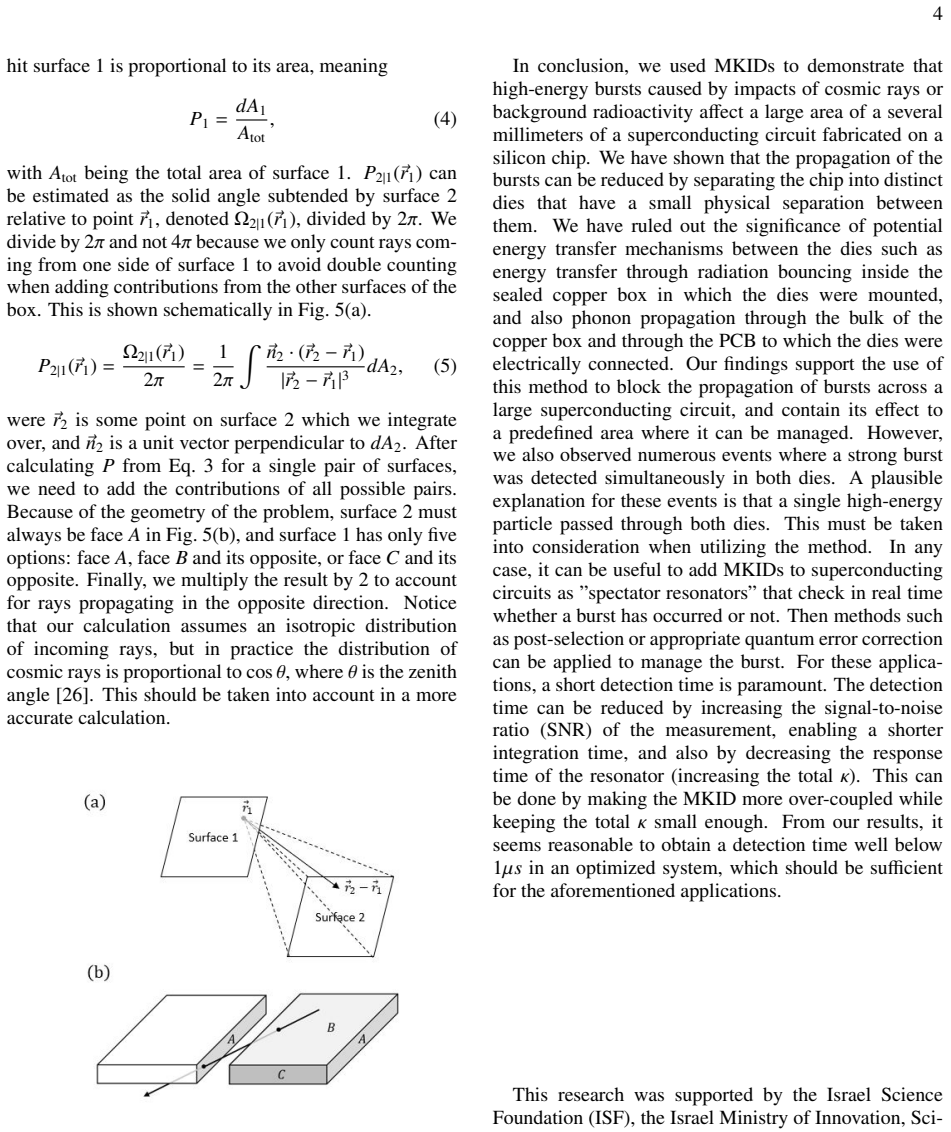
The operating detector is a microwave kinetic inductance detector (MKID), a $\lambda/4$ superconducting transmission-line resonator with resonance frequency $\omega_0 = 1/\sqrt{C(L_g + L_k)}$; a burst breaks Cooper pairs and raises the kinetic inductance $L_k$, shifting $\omega_0$ downward and changing the measured $S_{21}$ phase. The separator is the physical die gap itself: two silicon dies held at their corners with roughly $0.2\text{ mm}$ between them, wired to the readout through aluminum wirebonds, so the die circuits have no direct galvanic connection. The comparison model is a ray-geometry calculation (Eqs. 3-5) that gives the expected probability a random cosmic ray intersects both dies, which is used to decide whether simultaneous two-die events are leakage or direct traversal.
What would settle it
Inject known-energy phonon bursts at controlled positions on one die while monitoring both dies; if any injection produces a trigger on the far die's MKIDs, or fails to trigger at least one same-die MKID, the blocking claim is contradicted. Alternatively, measure the cross-die coincidence fraction with much larger statistics and compare to the ray-geometry model: a statistically significant excess over the predicted 4.0% would indicate an unblocked transfer channel.
Extended reading notes
Core claim
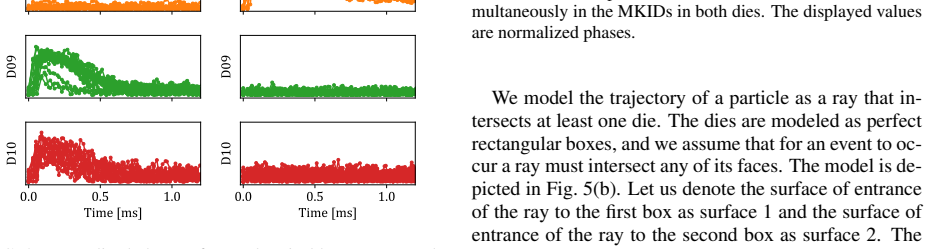
The central claim is that separating a superconducting circuit into distinct dies with a roughly 0.2 mm physical gap and no galvanic connection blocks the propagation of pair-breaking phonon bursts, so a burst is contained within the die it strikes. The authors demonstrate this with two silicon dies, each carrying four kinetic-inductance detectors driven and read out simultaneously; of 352 bursts recorded, the typical signature is a pair of detections in the two MKIDs on one die, with none on the other die. They rule out transfer through the copper mounting base, the common circuit ground, and radiation re-emitted inside the sealed box. Ten events were detected in all four MKIDs simultaneously; the authors model particle trajectories as random rays and compute an expected double-die fraction of 4.0%, close to the measured 2.8%, supporting the interpretation that these rare events come from a single cosmic particle traversing both dies rather than from phonons crossing the gap. The conclusion is that die separation is a viable containment strategy for burst-induced correlated errors in multi-die superconducting processors.
Load-bearing premise
The blocking claim rests on the assumption that a phonon burst anywhere on a die is always large enough to trigger the monitored kinetic-inductance detectors on that die, so no weak burst crossing the gap is missed.
Editorial extensions
If this is right
- A multi-die processor built with high-proximity capacitive interconnects can exchange quantum information between dies while preventing phonon-burst errors from spreading, so burst-induced errors are localized to a single die.
- Adding MKIDs as spectator resonators to each die gives real-time burst detection, allowing post-selection or targeted quantum error correction at a detection time estimated below $1\,\mu\text{s}$ in an optimized system.
- The measured 2.8% simultaneous two-die bursts imply that direct particle traversal remains a residual correlated-error channel; any protocol using die separation must account for it.
- The results rule out the copper mounting base, the PCB common ground, and re-emitted radiation as significant cross-die burst pathways for this geometry.
Reading between the lines
- A natural extension, not tested in the paper, is varying the gap width and die thickness to see whether the two-die coincidence fraction follows the geometric ray model; a mismatch would indicate an additional transfer channel.
- The method is orthogonal to quasiparticle and phonon traps, so a combined strategy could block cross-die bursts and also shorten in-die recovery; the paper does not test this combination.
- Because per-die detection sensitivity is not calibrated against a known source, a controlled injection measurement would be the cleanest way to bound missed weak bursts and sharpen the blocker's claimed efficiency.
- Scaling to many dies turns the residual risk into shallow-angle particles that traverse several dies; staggering or tilting dies could reduce that fraction beyond the two-die result.
Signed reviews
Editorial analysis
A structured set of objections, weighed in public.
Referee Report
Summary. The paper reports an experiment using microwave kinetic inductance detectors (MKIDs) on two separate silicon dies, mounted adjacently with a ~0.2 mm gap and no galvanic connection, to test whether die separation blocks phonon bursts induced by cosmic rays or background radioactivity. The authors observe that most detected bursts appear on only one die (in both monitored MKIDs of that die), and interpret the absence of cross-die bursts as evidence that phonon propagation is stopped by the physical gap. They also observe 10 simultaneous events in all four monitored MKIDs (2.8% of 352 bursts) and argue, based on a geometric model of straight-line particle trajectories, that the expected rate of a single particle traversing both dies is 4.0%, supporting the interpretation that these are direct particle hits rather than phonon leakage. The paper concludes that die separation contains burst effects to a single die and is a viable mitigation for correlated errors in multi-die quantum processors.
Significance. If the central claim is correct, the work offers a simple, practical mitigation for correlated quasiparticle-burst errors that threaten quantum error correction in multi-die superconducting processors. The geometric double-hit estimate is a genuine, parameter-free prediction (aside from the trigger threshold) and the lack of observed steady cross-die bursts is suggestive. The experiment uses a real device with continuous simultaneous readout, and the paper is honest about the existence of simultaneous events. However, the strength of the conclusion rests on a null result whose validity depends on unverified detection efficiency, and the statistical support for the geometric match is not quantified. These gaps are load-bearing and require additional measurements or analysis before the blocking claim can be considered conclusive.
major comments (3)
- [Experimental setup and Fig. 3 (paragraph beginning 'Due to technical limitations')] The claim that 'the propagation of bursts is effectively stopped by the physical separation' rests on the absence of cross-die triggers, but only D04/D05 and D09/D10 were monitored, while D1, D6, D8 (and dead D7) were not read out. The paper's assertion that 'a particle impact anywhere on a die should be detectable in all four MKIDs on the same die' is an assumption, not a calibration. Without a control experiment on a monolithic chip, a calibrated energy source, or full MKID coverage, the null result cannot distinguish true phonon blocking from a weak cross-die burst falling below the threshold of the two monitored MKIDs on the far die. This is the central load-bearing point of the paper.
- [Probability calculation (paragraph 'We model the trajectory of a particle...' and the sentence 'of the total 352…] The agreement between the observed 2.8% (10/352) and the predicted 4.0% is presented as support for the direct-traversal interpretation, but no statistical uncertainty is given. With Poisson counting statistics, the 95% confidence interval for 10 events spans roughly 5-18 events, i.e., 1.4%-5.1%, which comfortably includes 4.0%. The match is therefore not statistically constraining at the claimed level of precision, and the conclusion that these events are 'likely from a single cosmic particle' should be stated with appropriate uncertainty or with a quantitative likelihood comparison.
- [Conclusion (paragraph beginning 'We have ruled out the significance...')] The statement that 'We have ruled out the significance of potential energy transfer mechanisms between the dies such as energy transfer through radiation bouncing inside the sealed copper box... and phonon propagation through the bulk of the copper box and through the PCB' is too strong for the data presented. The experiment does not separately test each channel; it only observes no above-threshold coincident events. To rule out these mechanisms, one would need a measurement with known injected energy on one die and a calibrated sensitivity on the other, or a monolithic control chip. As it stands, the absence of coincidences is consistent with blocking but also with detection inefficiency, so the 'ruled out' language overstates the claim.
minor comments (4)
- [Fig. 3 and Fig. 4 captions] The figure captions contain corrupted character sequences (e.g., '/uni00000017/uni0000008b/uni0000008f...') that should be repaired before publication.
- [Throughout] There are typographical errors, including 'after loading' (should be 'After loading'), 'ge varnish' (should be 'GE varnish'), and 'were r2 is' (should be 'where r2 is').
- [Trigger threshold description] The trigger threshold is described only as 'a predefined threshold value, which we determined from the signal fluctuations.' A quantitative statement (e.g., threshold in units of standard deviation of the noise) would help readers assess the sensitivity and the likelihood of missing weak events.
- [Relation to Ref. [6]] The paper cites Ref. [6] (Moshel et al., Applied Physics Letters 2024) from the same group but does not explicitly state what is new in this work relative to that prior study; a brief statement of the advance would be helpful.
Circularity Check
No circularity: the burst-blocking claim rests on a parameter-free geometric rate estimate and direct MKID coincidence observations, not on self-referential fitting or a self-citation chain.
full rationale
The paper's central derivation is the geometric estimate of the double-die event fraction. Equations (3)-(5) integrate ray intersections over the faces of two rectangular boxes with no fitted parameters, giving an expected 4.0% double-die rate that is then compared to the observed 10/352 = 2.8%. This is an independent, falsifiable prediction, not an output derived from the blocking hypothesis. The blocking conclusion itself is based on the empirical absence of cross-die phonon-burst coincidences between the monitored MKID pairs (D04/D05 vs. D09/D10), while the simultaneous four-MKID events are interpreted as direct particle traversals and checked against the geometric rate. The only assumption that could weaken the inference is the statement that 'a particle impact anywhere on a die should be detectable in all four MKIDs on the same die' and the associated trigger-threshold sensitivity; this is a completeness-of-detection assumption rather than a circular definition, and the paper's admitted limitation that only two MKIDs per die were measured is a correctness/sensitivity concern, not a self-referential one. The authors' prior work (Ref. [6]) is cited only as background on burst characterization and is not load-bearing for the separation claim. No fitted input is relabeled as a prediction, and no uniqueness theorem or ansatz is imported from the authors' own prior work. The derivation chain is therefore self-contained with respect to the central claim, and no circular step can be exhibited from the paper's text.
Assumptions & free parameters
free parameters (1)
- Event trigger threshold =
not specified
assumptions (4)
- domain assumption A particle impact anywhere on a die should be detectable in all four MKIDs on the same die due to burst energy propagation via substrate phonons.
- domain assumption Phonons do not transfer across the 0.2 mm physical gap between dies.
- domain assumption Cosmic-ray flux is isotropic for the probability model.
- standard math The S21 response model (Eq. 2) and kinetic inductance relation (Eq. 1) accurately describe MKID response.
Cite this review
Pith. "Pith review of Die Separation for Mitigation of Phonon Bursts in Superconducting Circuits." pith.science (2026). https://pith.science/paper/RCEV46DT
@misc{pith2026250516272,
  author       = {Pith},
  title        = {Pith review of: Die Separation for Mitigation of Phonon Bursts in Superconducting Circuits},
  year         = {2026},
  howpublished = {\url{https://pith.science/paper/RCEV46DT}},
  note         = {Machine review of arXiv:2505.16272}
}
read the original abstract
Cosmic rays and background radioactive decay can deposit significant energy into superconducting quantum circuits on planar chips. This energy converts into pair-breaking phonons that travel across the substrate and generate quasiparticles, leading to correlated energy and phase errors in nearby qubits. To mitigate this, we fabricated two separate dies and placed them adjacently without a galvanic connection between them. This blocks phonon propagation from one die to the other. Using microwave kinetic inductance detectors on both dies, we successfully detected high-energy bursts and conclusively demonstrated the blocking effect. However, we also observed simultaneous events in both dies, likely from a single cosmic particle traversing both dies.
Figures


Figures from the paper (2 more)
Reference graph
Works this paper leans on
- [1]
-
[2]
P. M. Harrington, M. Li, M. Hays, W. Van De Pontseele, 1 D. Mayer, H. D. Pinckney, F. Contipelli, M. Gingras, B. M. Niedzielski, H. Stickler, et al. , arXiv preprint arXiv:2402.03208 (2024)
arXiv 2024
-
[3]
Gr ¨unhaupt, N
L. Gr ¨unhaupt, N. Maleeva, S. T. Skacel, M. Calvo, F. Levy-Bertrand, A. V . Ustinov, H. Rotzinger, A. Mon- fardini, G. Catelani, and I. M. Pop, Physical review letters 121, 117001 (2018)
2018
-
[4]
J. M. Martinis, npj Quantum Information 7, 90 (2021)
work page 2021
-
[5]
L. Swenson, A. Cruciani, A. Benoit, M. Roesch, C. Yung, A. Bideaud, and A. Monfardini, Applied Physics Letters 96, 263511 (2010)
work page 2010
- [6]
- [7]
- [8]
Show all 26 references
-
[9]
Thorbeck, A
T. Thorbeck, A. Eddins, I. Lauer, D. T. McClure, and M. Carroll, PRX Quantum 4, 020356 (2023)
2023
-
[10]
Bertoldo, M
E. Bertoldo, M. Mart ´ınez, B. Nedyalkov, and P. Forn- D´ıaz, arXiv preprint arXiv:2303.04938 (2023)
2023 arXiv
-
[11]
Cardani, F
L. Cardani, F. Valenti, N. Casali, G. Catelani, T. Char- pentier, M. Clemenza, I. Colantoni, A. Cruciani, G. D’Imperio, L. Gironi, et al. , Nature communications 12, 2733 (2021)
2021
-
[12]
Hosseinkhani, R.-P
A. Hosseinkhani, R.-P. Riwar, R. Schoelkopf, L. Glaz- man, and G. Catelani, Physical review applied 8, 064028 (2017)
2017
-
[13]
Nsanzineza and B
I. Nsanzineza and B. Plourde, Physical review letters 113, 117002 (2014)
2014
-
[14]
Henriques, F
F. Henriques, F. Valenti, T. Charpentier, M. Lagoin, C. Gouriou, M. Mart ´ınez, L. Cardani, M. Vignati, L. Gr ¨unhaupt, D. Gusenkova, et al., Applied physics let- ters 115 (2019)
2019
-
[15]
V . Iaia, J. Ku, A. Ballard, C. Larson, E. Yelton, C. Liu, S. Patel, R. McDermott, and B. Plourde, Nature Commu- nications 13, 6425 (2022)
2022
-
[16]
Bargerbos, L
A. Bargerbos, L. J. Splittho ff, M. Pita-Vidal, J. J. Wes- dorp, Y . Liu, P. Krogstrup, L. P. Kouwenhoven, C. K. An- dersen, and L. Gr ¨unhaupt, Physical Review Applied 19, 024014 (2023)
2023
-
[17]
McEwen, K
M. McEwen, K. C. Miao, J. Atalaya, A. Bilmes, A. Crook, J. Bovaird, J. M. Kreikebaum, N. Zobrist, E. Je ffrey, B. Ying, et al. , Physical Review Letters 133, 240601 (2024)
2024
-
[18]
J. L. Orrell and B. Loer, Physical Review Applied 16, 024025 (2021)
2021
-
[19]
A. Gold, J. Paquette, A. Stockklauser, M. J. Reagor, M. S. Alam, A. Bestwick, N. Didier, A. Nersisyan, F. Oruc, A. Razavi, et al., npj Quantum Information 7, 142 (2021)
2021
-
[20]
Conner, A
C. Conner, A. Bienfait, H.-S. Chang, M.-H. Chou, ´E. Du- mur, J. Grebel, G. Peairs, R. Povey, H. Yan, Y . Zhong, et al., Applied Physics Letters 118 (2021)
2021
-
[21]
Zmuidzinas, Annu
J. Zmuidzinas, Annu. Rev. Condens. Matter Phys. 3, 169 (2012)
2012
-
[22]
B. A. Mazin, Microwave kinetic inductance detectors (California Institute of Technology, 2005)
2005
-
[23]
Gao, The physics of superconducting microwave res- onators (California Institute of Technology, 2008)
J. Gao, The physics of superconducting microwave res- onators (California Institute of Technology, 2008)
2008
-
[24]
Huang, B
S. Huang, B. Lienhard, G. Calusine, A. Veps ¨al¨ainen, J. Braum¨uller, D. K. Kim, A. J. Melville, B. M. Niedziel- ski, J. L. Yoder, B. Kannan, et al. , PRX Quantum 2, 020306 (2021)
2021
-
[25]
Probst, F
S. Probst, F. Song, P. A. Bushev, A. V . Ustinov, and M. Weides, Review of Scientific Instruments 86 (2015)
2015
-
[26]
P. K. Grieder, Cosmic rays at Earth (Elsevier, 2001)
2001
Reviewed August 7, 2026 · model on record in the stance chip above.
Discussion (0). Continue with ORCID to comment.