REVIEW 3 major objections 4 minor 119 references
Jet Substructure Probe on Scalar Leptoquark Models via Top Polarization
T0 review · 3 major / 4 minor · reviewed 2026-08-07 · deepseek-v4-flash
Pith's one-line read This paper claims that scalar leptoquarks decaying to a top quark and a neutrino can be discovered at the HL-LHC in boosted-top-plus-missing-energy events (up to 5.4σ), and that top polarization can then separate the S3 and R2 models at…
desk verdict Solid, transparent MC study with a plausible 5-sigma discovery reach, but the 3-sigma model-discrimination claim rests on an explicitly unvalidated subjet b-tagging assumption. read the letter →
The pith
A machine-rendered reading of the paper's core claim, the machinery that carries it, and where it could break.
The reading
What carries the argument
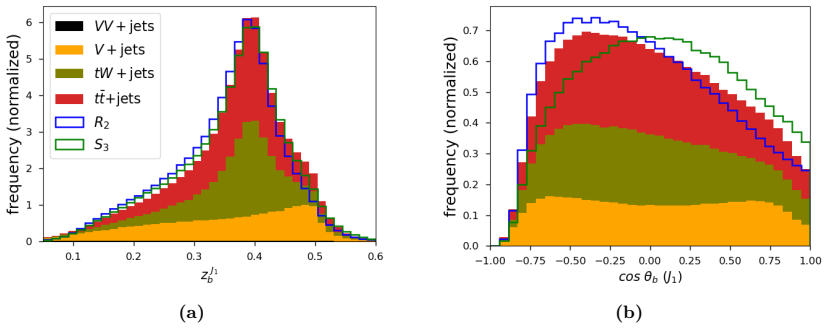
The machinery is a chain of jet substructure tools applied to the hadronically decaying boosted top quark: fixed-radius or dynamic-radius anti-$k_t$ clustering to form the large-radius jets, Soft Drop grooming to remove soft wide-angle radiation, $N$-subjettiness ($\tau_3/\tau_2$) to identify the three subjets expected inside a top jet, and an impact-parameter-significance $b$-tagging method to pick out which subjet came from the bottom quark. The polarization-sensitive variables are built from that tagged subjet: the energy fraction $z_b = E_b/E_t$ and the cosine of the angle between the $b$-subjet and the top-jet boost direction in the top rest frame, $\cos\theta_b$. The identity that carries the argument is the link between leptoquark chirality and top polarization: $S_3$ decays produce left-handed tops while $R_2$ decays produce right-handed tops, so the bottom quark tends to align with the boost in $S_3$ and against it in $R_2$, shifting both $z_b$ and $\cos\theta_b$ and also changing which jet radius best captures the top jet.
What would settle it
Point the LHC's jet-tagging calibration at boosted top jets: reconstruct the bottom subjet inside large-radius jets in events where one top decays to leptons and the other to jets, so the lepton side fixes the top direction, and compare the tagging efficiency against the narrow-jet curve used in the paper. If real subjet tagging falls below that curve, the $\cos\theta_b$ and $z_b$ distributions would smear and the claimed $3.23\sigma$ model separation would not hold; conversely, a 3000 fb$^{-1}$ run that sees no excess in the two-large-radius-jets plus missing-energy channel at 1250 GeV would contradict the claimed $5.39\sigma$ discovery.
Extended reading notes
Core claim
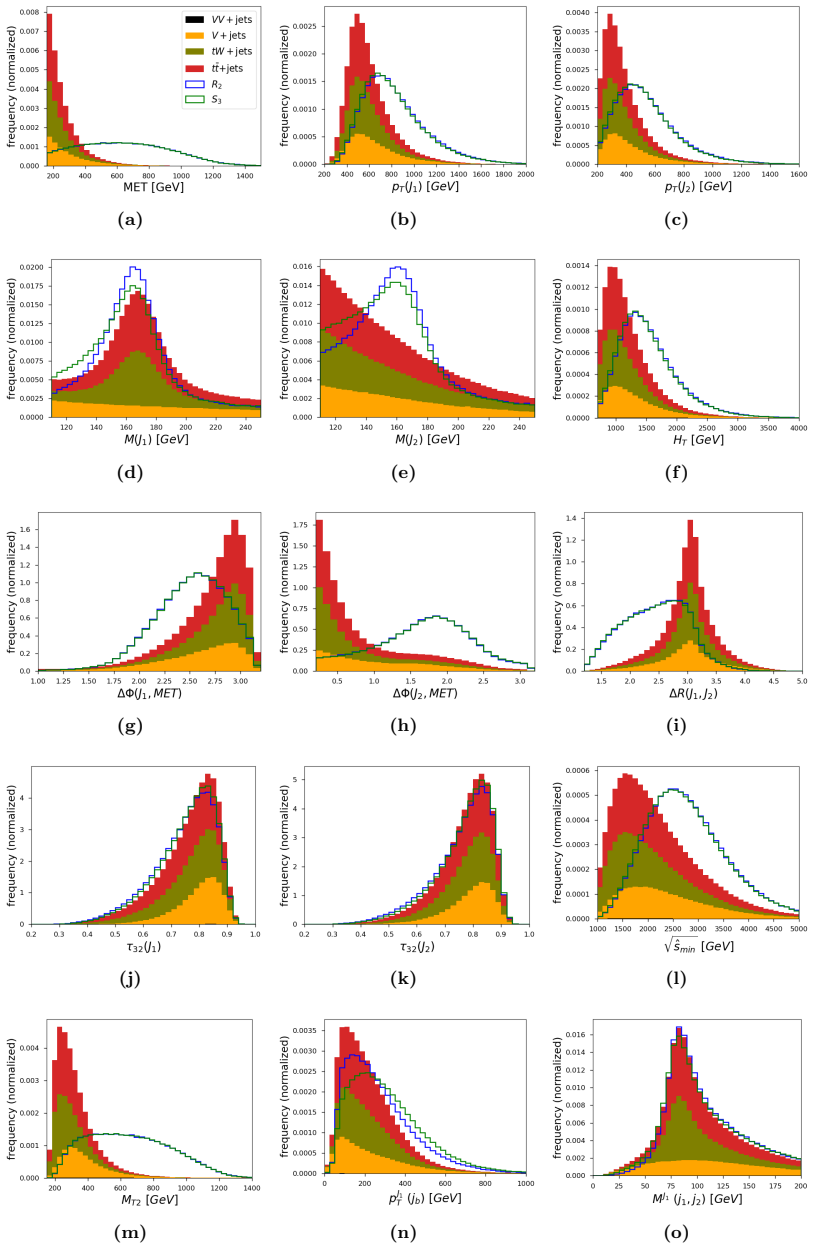
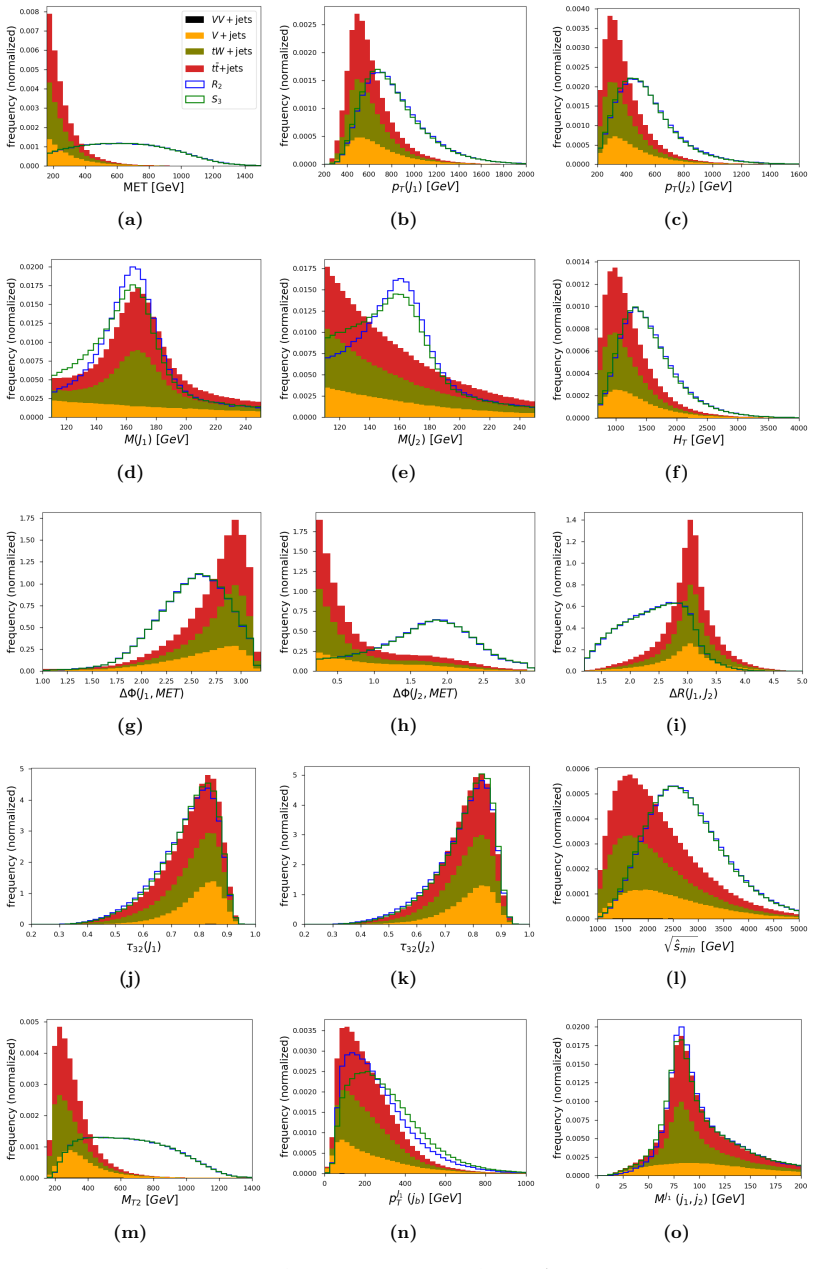
The paper establishes the two-large-radius-jets plus missing transverse momentum final state as a viable channel for discovering third-generation scalar leptoquarks, and shows that the same final state can measure the chirality of the leptoquark-top-neutrino coupling through top polarization. For a 1250 GeV leptoquark at 14 TeV with 3000 fb$^{-1}$, the optimized analysis reaches $5.39\sigma$ for $S_3$ (using dynamic-radius clustering with $R_0=0.6$) and $4.83\sigma$ for $R_2$ (using fixed-radius clustering with $R=1.2$). The two models have identical production cross sections and identical decay products, so they can only be separated through observables sensitive to the top-quark chirality: the energy fraction carried by the tagged $b$-subjet, the cosine of the $b$-subjet angle in the top rest frame, and a BDT classifier score that combines substructure variables. A $CL_s$-type profile likelihood test on these variables gives model-exclusion significances of up to $3.23\sigma$ for the combined BDT score, compared with at most about $0.7\sigma$ for $z_b$ and $1.4\sigma$ for $\cos\theta_b$ in the same signal regions.
Load-bearing premise
The whole measurement assumes that the detector can identify the bottom quark inside a fast-moving top-quark jet as reliably as it identifies isolated bottom quarks; if that is not true, the polarization signal weakens.
Editorial extensions
If this is right
- At 3000 fb$^{-1}$ and 14 TeV, a 1250 GeV $S_3$ leptoquark would be discovered at $5.39\sigma$ with dynamic-radius clustering and an $R_2$ leptoquark at $4.83\sigma$ with fixed-radius clustering, in the all-hadronic two-large-radius-jets plus missing-energy channel.
- The optimal jet radius itself is a chirality indicator: a smaller radius ($R_0 = 0.6$) is best for $S_3$, while a larger radius ($R = 1.2$) is best for $R_2$, because the two chiralities put the $W$ decay products in different places relative to the bottom quark.
- The combined BDT classifier score outperforms both single polarization variables in model discrimination, reaching up to $3.23\sigma$ exclusion of $R_2$ in favor of $S_3$, versus $1.4\sigma$ for $\cos\theta_b$ and $0.69\sigma$ for $z_b$.
- The dynamic-radius anti-$k_t$ algorithm is competitive with fixed-radius clustering, giving the best $S_3$ significance while keeping the effective jet size small for QCD-like backgrounds.
- The same substructure-tagging and polarization-reconstruction pipeline applies to any search with boosted tops and missing energy, turning a discovery channel into a measurement of top-quark chirality.
Reading between the lines
- A natural next step is to map the discrimination power as a function of leptoquark mass; the robustness of the $3.23\sigma$ separation at lower masses is not guaranteed, because softer boosts will degrade both the substructure reconstruction and the $b$-subjet tag.
- Since $S_3$ and $R_2$ have identical cross sections and final states, the BDT score that separates them is effectively a chirality meter for the top quark, and the same combined-variable strategy could be reused to measure polarization in any boosted-top search.
- The quoted significances rest on a probabilistic, parton-matched $b$-subjet tagger; a dedicated subjet-level tagging calibration in a full detector simulation could move the numbers in either direction, so the $5.4\sigma$ and $3.2\sigma$ values are best read as the search's potential rather than a final forecast.
Editorial analysis
A structured set of objections, weighed in public.
Referee Report
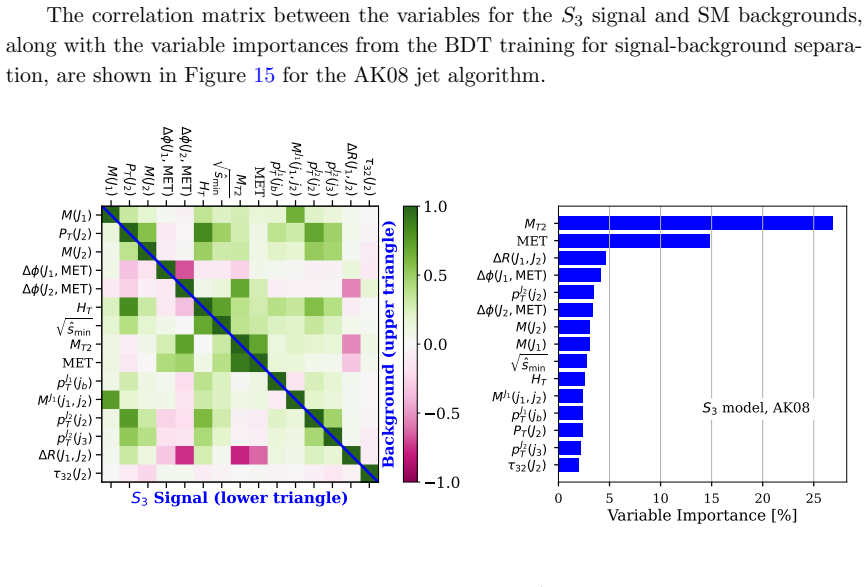
Summary. The paper studies pair production of the third-generation scalar leptoquarks S3 and R2 at the 14 TeV HL-LHC, focusing on the final state with two large-radius top jets and large missing transverse momentum. Using MadGraph5_aMC@NLO + Pythia8 + Delphes simulations, the authors apply soft-drop grooming, N-subjettiness, a custom b-subjet tagging method, and boosted decision trees to separate signal from SM backgrounds. They report signal significances up to 5.39σ (S3, DRAK06) and 4.83σ (R2, AK12), and use polarization-sensitive variables (cos θb, Eb/Et, and a BDT classifier score) with a likelihood-ratio test to distinguish the two models, achieving an exclusion significance of up to 3.23σ (S3 vs R2, DRAK06).
Significance. If the results hold, the paper provides a valuable, ready-to-use search strategy for third-generation scalar leptoquarks in a difficult boosted-top plus MET channel, and a concrete method to measure top-quark polarization from jet substructure to discriminate chiral coupling structures. The analysis is carefully documented: event generation and detector simulation use standard, public tools; NLO cross sections with scale and PDF uncertainties are tabulated; BDT training uses train/test separation; and the fixed-radius versus dynamic-radius comparison is systematic. The paper does not suffer from circularity: the polarization formulas (Eqs. 5.5 and 5.6) are standard theory, the chiral structure of the two models is an input, and no fitted parameter is recycled into a derived claim. The main caveats are that the quoted significances are statistical only, and the b-subjet tagging assumption is not independently validated; both are addressed in the major comments.
major comments (3)
- [§3.4, §5.2, Table 7] The b-subjet tagging method applies narrow-jet b-tagging efficiencies and mistag rates (Table 2) to subjets inside large-R jets, and the text explicitly states that no detailed b-subjet tagging analysis was performed ("we did not really perform a detailed analysis of the b-subjet tagging"). The model-discrimination result in Table 7 (CL_R2|S3 = 3.23σ for DRAK06 via the BDT classifier score) depends directly on correctly identifying the b-subjet among the three subjets of the boosted top jet. If subjet tagging underperforms relative to narrow-jet tagging, the polarization-sensitive variables (cos θb, Eb/Et) degrade and the separation power could fall below the quoted significance. Please validate the assumption with a dedicated subjet-tagging performance study, or at minimum provide a robustness scan that varies the b-tagging efficiency and mistag rate over a plausible range and quantifies the impact on the exclusion significance.
- [§4.5, §6, Eq. (4.3), Tables 6 and 7] The quoted signal significances and model-discrimination significances are computed with Eq. (4.3) using only statistical uncertainties. No systematic uncertainties from jet energy scale, b-tagging efficiency and mistag rates, background normalization, parton distribution functions, renormalization/factorization scales, or pileup are included. At the HL-LHC luminosity of 3000 fb^-1, systematic uncertainties typically dominate over statistical ones in boosted-top analyses, so the 5.39σ and 3.23σ values should be presented explicitly as statistical-only projections, ideally accompanied by a first estimate of the dominant systematic uncertainties or a discussion of which systematics would most affect the discrimination claim.
- [§6, §4.2, Table 3] The jet radius parameter (R for anti-kt, R0 for dynamic radius) is optimized separately for the two signal models (Table 3: R=0.8 for S3, R=1.2 for R2; R0=0.6 for S3, R0=0.8 for R2), and the BDT score threshold is chosen to maximize the signal significance. With eight jet configurations (AK08, AK10, AK12, AK15, DRAK05, DRAK06, DRAK08, DRAK10) and a continuous BDT threshold, the reported significances are the maximum of a scan and should be corrected for the trials factor (look-elsewhere effect), or the paper should explicitly state that the optimization is part of the analysis and quote the envelope of the scan rather than a single optimal value.
minor comments (4)
- [§5.1, Eq. (5.3)] Equation (5.3) is described as a 'CLs-based profile likelihood estimator,' but the formula is a standard likelihood-ratio test statistic Q = -2 ln(L1/L2) interpreted as a Gaussian significance; no nuisance parameters are profiled and no CLs modification (which divides by the background-only p-value) is applied. Please align the terminology with the actual statistic.
- [§3.3, §4.4] The N-subjettiness ratio τ32 is used extensively but the text does not explicitly define it as τ3/τ2 for each jet; consider adding a sentence in §3.3 after Eq. (3.4) to define the ratio and its role.
- [§4.2, §4.3] The event-selection list in §4.3 is clear, but the optimization of the selection thresholds (MET>160 GeV, HT>700 GeV, jet pT>200 GeV) is not discussed; a brief justification or sensitivity check for these choices would improve reproducibility.
- [Table 1, §5.2.3] There are a few typographical artifacts: 'T able' in the Table 1 caption and 'V ariables' in the §5.2 heading. Also, in §5.2.3 the BDT classifier for model discrimination is mentioned to use 'only the second set of variables' from Table 5, but the exact feature list (e.g., whether polarization variables are included) is not fully specified; please list the features explicitly.
Circularity Check
No significant circularity: the analysis is self-contained and its predictions do not reduce to fitted inputs or self-citations.
full rationale
The central claims—signal significances of 4.83 sigma (R2) and 5.39 sigma (S3), and model-discrimination significances up to 3.23 sigma—are obtained from Monte Carlo event generation (MadGraph5 aMC@NLO + Pythia8 + Delphes), externally normalized NLO cross sections, standard significance formulae, and Poisson profile-likelihood comparisons. No equation in the paper reduces to a fitted value; the polarization formulas in Eqs. (5.5) and (5.6) are standard spin-analyzing-power results, and the opposite chiral structures of the S3 and R2 couplings are model inputs, not outputs of the analysis. The b-subjet tagging procedure (Section 3.4) admittedly extrapolates narrow-jet b-tagging efficiencies from Table 2 to subjets inside large-R jets by quoting the paper's statement: 'we did not really perform a detailed analysis of the b-subjet tagging; instead, we have taken a similar approach as implemented in the Delphes b-tagging module.' This is a detector-performance assumption and a source of systematic uncertainty, but it is not a circular step because the tagging efficiency is neither fitted to the signal-region yields nor defined in terms of the final significance; it is an external input applied probabilistically. The paper cites prior work by overlapping authors (Refs. [28], [42], [55]) for the earlier 1-sigma discrimination result, the profile-likelihood procedure, and the dynamic-radius jet algorithm, respectively, but none of these citations supplies a load-bearing premise that forces the present conclusions: the current analysis introduces a new b-subjet tagging method within Delphes, trains separate BDTs for signal-background separation and for S3-versus-R2 classification, and evaluates the discriminator in a signal region selected by an independent BDT score. The model discrimination is not equivalent to the choice of input couplings; it is a genuinely simulated observable-level comparison. The only significant caveat is the unvalidated subjet-tagging assumption, which affects the realism of the exclusion significances but does not constitute circular reasoning.
Assumptions & free parameters
free parameters (3)
- Jet radius R (anti-kt fixed radius) =
1.2 (R2), 0.8 (S3)
- Dynamic radius initial R0 =
0.8 (R2), 0.6 (S3)
- BDT score threshold (signal region) =
Optimized per model (not quoted numerically)
assumptions (4)
- domain assumption Each leptoquark decays with 100% branching ratio to a top quark and a neutrino (BR(LQ -> t nu) = 1).
- domain assumption The SM backgrounds listed in Section 4.1 are the only relevant backgrounds; QCD multijet production is not simulated.
- domain assumption Delphes fast simulation with the b-tagging parametrization of Table 2 adequately models the detector response for subjets.
- domain assumption Top-quark polarization information survives reconstruction, so reconstructed cos theta_b and z_b retain the parton-level chiral asymmetry.
Cite this review
Pith. "Pith review of Jet Substructure Probe on Scalar Leptoquark Models via Top Polarization." pith.science (2026). https://pith.science/paper/D5Z2LRXI
@misc{pith2026250516328,
  author       = {Pith},
  title        = {Pith review of: Jet Substructure Probe on Scalar Leptoquark Models via Top Polarization},
  year         = {2026},
  howpublished = {\url{https://pith.science/paper/D5Z2LRXI}},
  note         = {Machine review of arXiv:2505.16328}
}
abstract
The study of leptoquarks and their couplings to fermions with different chiralities provides a powerful tool for distinguishing among different leptoquark models. As a case study, we focus on two specific third-generation scalar leptoquark models, $S_3$ and $R_2$, which differ in their electroweak quantum numbers and chiral structures of couplings to the top quark, leading to distinct top-quark polarization states. To enhance the efficacy of the analysis, we employ jet substructure techniques like Soft Drop, $N$-subjettiness, and our custom $b$-tagging method, along with other event variables. The analysis has been performed using both fixed radius and dynamic radius jet clustering algorithms. A multivariate analysis using a boosted decision tree (BDT) is performed to isolate signal from the Standard Model background. For a leptoquark mass of 1250 GeV, the analysis achieves a signal significance of up to $5.3\,\sigma$ at the 14 TeV HL-LHC. Furthermore, a $CL_s$-based profile likelihood estimator is applied to polarization-sensitive variables to discriminate between the two models. To enhance separation between the two models, an additional BDT classifier score is obtained by training a BDT network to distinguish between the $S_3$ and $R_2$ models. In the chosen signal region, the BDT classifier score provides a separation score of up to $3.2\,\sigma$, outperforming traditional variables such as $E_b/E_t$ and $\cos\theta_b$.
Figures


Figures from the paper (15 more)






Reference graph
Works this paper leans on
- [28]
-
[1]
J. C. Pati and A. Salam, Unified Lepton-Hadron Symmetry and a Gauge Theory of the Basic Interactions, Phys. Rev. D 8 (1973) 1240
1973
-
[2]
Georgi and S
H. Georgi and S. L. Glashow, Unity of All Elementary Particle Forces , Phys. Rev. Lett. 32 (1974) 438
1974
-
[3]
J. C. Pati and A. Salam, Lepton Number as the Fourth Color , Phys. Rev. D 10 (1974) 275
1974
-
[4]
Langacker, Grand Unified Theories and Proton Decay , Phys
P. Langacker, Grand Unified Theories and Proton Decay , Phys. Rept. 72 (1981) 185
1981
-
[5]
Wudka, COMPOSITE LEPTOQUARKS , Phys
J. Wudka, COMPOSITE LEPTOQUARKS , Phys. Lett. B 167 (1986) 337. – 36 –
1986
-
[6]
I. de Medeiros Varzielas and G. Hiller, Clues for flavor from rare lepton and quark decays , JHEP 06 (2015) 072 [ 1503.01084]
arXiv 2015
-
[7]
LHCb collaboration, Measurement of lepton universality parameters in B+ → K +ℓ+ℓ− and B0 → K ∗0ℓ+ℓ− decays, 2212.09153
Show all 119 references
-
[8]
LHCb collaboration, Test of lepton universality in b → sℓ+ℓ− decays, 2212.09152
-
[9]
BaBar collaboration, Evidence for an excess of ¯B → D(∗)τ − ¯ντ decays, Phys. Rev. Lett. 109 (2012) 101802 [ 1205.5442]
2012 arXiv
-
[10]
LHCb collaboration, Measurement of the ratio of branching fractions B( ¯B0 → D∗+τ − ¯ντ )/B( ¯B0 → D∗+µ− ¯νµ), Phys. Rev. Lett. 115 (2015) 111803 [ 1506.08614]
2015
-
[11]
Muon g-2collaboration, Final Report of the Muon E821 Anomalous Magnetic Moment Measurement at BNL , Phys. Rev. D 73 (2006) 072003 [ hep-ex/0602035]
2006 arXiv
-
[12]
Muon g-2collaboration, Measurement of the Positive Muon Anomalous Magnetic Moment to 0.46 ppm , Phys. Rev. Lett. 126 (2021) 141801 [ 2104.03281]
2021
-
[13]
Ghosh, S
N. Ghosh, S. K. Rai and T. Samui, Collider signatures of a scalar leptoquark and vectorlike lepton in light of muon anomaly , Phys. Rev. D 107 (2023) 035028 [ 2206.11718]
2023 arXiv
-
[14]
Ghosh, S
N. Ghosh, S. K. Rai and T. Samui, Search for a leptoquark and vector-like lepton in a muon collider, Nucl. Phys. B 1004 (2024) 116564 [ 2309.07583]
2024 arXiv
-
[15]
Crivellin, S
A. Crivellin, S. Iguro and T. Kitahara, Correlating the B anomalies to K → πν ¯ν and B → Kν ¯ν via leptoquarks, 2505.05552
-
[16]
Y. Cai, J. Herrero-Garc ´ ıa, M. A. Schmidt, A. Vicente and R. R. Volkas,From the trees to the forest: a review of radiative neutrino mass models , Front. in Phys. 5 (2017) 63 [1706.08524]
2017 arXiv
-
[17]
Zhang, Radiative neutrino masses, lepton flavor mixing and muon g − 2 in a leptoquark model, JHEP 07 (2021) 069 [ 2105.08670]
D. Zhang, Radiative neutrino masses, lepton flavor mixing and muon g − 2 in a leptoquark model, JHEP 07 (2021) 069 [ 2105.08670]
2021 arXiv
-
[18]
Dorˇ sner, S
I. Dorˇ sner, S. Fajfer and N. Koˇ snik,Leptoquark mechanism of neutrino masses within the grand unification framework, Eur. Phys. J. C 77 (2017) 417 [ 1701.08322]
2017 arXiv
-
[19]
Gu and U
P.-H. Gu and U. Sarkar, Common Origin of Baryon Asymmetry and Proton Decay , Mod. Phys. Lett. A 28 (2013) 1350159 [ 1110.4581]
2013 arXiv
-
[20]
Hati and U
C. Hati and U. Sarkar, B − L violating nucleon decays as a probe of leptoquarks and implications for baryogenesis, Nucl. Phys. B 954 (2020) 114985 [ 1805.06081]
2020 arXiv
-
[21]
Choi, Y.-J
S.-M. Choi, Y.-J. Kang, H. M. Lee and T.-G. Ro, Lepto-Quark Portal Dark Matter , JHEP 10 (2018) 104 [ 1807.06547]
2018 arXiv
-
[22]
Mandal, Fermionic dark matter in leptoquark portal , Eur
R. Mandal, Fermionic dark matter in leptoquark portal , Eur. Phys. J. C 78 (2018) 726 [1808.07844]
2018 arXiv
-
[23]
D’Eramo, N
F. D’Eramo, N. Koˇ snik, F. Pobbe, A. Smolkoviˇ c and O. Sumensari,Leptoquarks and real singlets: A richer scalar sector behind the origin of dark matter , Phys. Rev. D 104 (2021) 015035 [2012.05743]
2021 arXiv
-
[24]
Gripaios, A
B. Gripaios, A. Papaefstathiou, K. Sakurai and B. Webber, Searching for third-generation composite leptoquarks at the LHC , JHEP 01 (2011) 156 [ 1010.3962]
2011 arXiv
-
[25]
Chandak, T
K. Chandak, T. Mandal and S. Mitra, Hunting for scalar leptoquarks with boosted tops and light leptons , Phys. Rev. D 100 (2019) 075019 [ 1907.11194]. – 37 –
2019 arXiv
-
[26]
Bhaskar, T
A. Bhaskar, T. Mandal, S. Mitra and M. Sharma, Improving third-generation leptoquark searches with combined signals and boosted top quarks , Phys. Rev. D 104 (2021) 075037 [2106.07605]
2021 arXiv
-
[27]
Belanger et al., Leptoquark manoeuvres in the dark: a simultaneous solution of the dark matter problem and the RD(∗) anomalies, JHEP 02 (2022) 042 [ 2111.08027]
G. Belanger et al., Leptoquark manoeuvres in the dark: a simultaneous solution of the dark matter problem and the RD(∗) anomalies, JHEP 02 (2022) 042 [ 2111.08027]
2022 arXiv
-
[29]
ATLAS collaboration, Search for pairs of scalar leptoquarks decaying into quarks and electrons or muons in √s = 13 TeV pp collisions with the ATLAS detector , JHEP 10 (2020) 112 [ 2006.05872]
2020 arXiv
-
[30]
ATLAS collaboration, Combination of searches for pair-produced leptoquarks at s=13 TeV with the ATLAS detector , Phys. Lett. B 854 (2024) 138736 [ 2401.11928]
2024 arXiv
-
[31]
ATLAS collaboration, Search for pair production of third-generation scalar leptoquarks decaying into a top quark and a τ -lepton in pp collisions at √s = 13 TeV with the ATLAS detector, JHEP 06 (2021) 179 [ 2101.11582]
2021 arXiv
-
[32]
CMS collaboration, Search for pair production of second-generation leptoquarks at √s = 13 TeV, Phys. Rev. D 99 (2019) 032014 [ 1808.05082]
2019 arXiv
-
[33]
CMS collaboration, Search for pair production of scalar and vector leptoquarks decaying to muons and bottom quarks in proton-proton collisions at s=13 TeV , Phys. Rev. D 109 (2024) 112003 [ 2402.08668]
2024 arXiv
-
[34]
CMS collaboration, Search for singly and pair-produced leptoquarks coupling to third-generation fermions in proton-proton collisions at s=13 TeV , Phys. Lett. B 819 (2021) 136446 [ 2012.04178]
2021 arXiv
-
[35]
CMS collaboration, Searches for physics beyond the standard model with the MT2 variable in hadronic final states with and without disappearing tracks in proton-proton collisions at√s = 13 TeV, Eur. Phys. J. C 80 (2020) 3 [ 1909.03460]
2020 arXiv
-
[36]
CMS collaboration, Search for pair production of first-generation scalar leptoquarks at√s = 13 TeV, Phys. Rev. D 99 (2019) 052002 [ 1811.01197]
2019 arXiv
-
[37]
ATLAS collaboration, Search for pair production of third-generation leptoquarks decaying into a bottom quark and a τ -lepton with the ATLAS detector , Eur. Phys. J. C 83 (2023) 1075 [2303.01294]
2023 arXiv
-
[38]
ATLAS collaboration, Searches for third-generation scalar leptoquarks in √s = 13 TeV pp collisions with the ATLAS detector , JHEP 06 (2019) 144 [ 1902.08103]
2019 arXiv
-
[39]
ATLAS collaboration, Search for a scalar partner of the top quark in the all-hadronic t¯t plus missing transverse momentum final state at √s = 13 TeV with the ATLAS detector , Eur. Phys. J. C 80 (2020) 737 [ 2004.14060]
2020 arXiv
-
[40]
S. De, V. Rentala and W. Shepherd, Measuring the polarization of boosted, hadronic W bosons with jet substructure observables , 2008.04318
2008 arXiv
-
[41]
Dey and T
A. Dey and T. Samui, Polarization study of a boosted W boson decaying hadronically at the LHC with jet substructures and a multivariate analysis , Eur. Phys. J. C 83 (2023) 1002 [2110.02773]. – 38 –
2023 arXiv
-
[42]
S. De, A. Dey and T. Samui, Jet substructure analysis for distinguishing left- and right-handed couplings of heavy neutrino in W’ decay at the HL-LHC , Phys. Rev. D 111 (2025) 075017 [ 2411.14910]
2025 arXiv
-
[43]
Guest, J
D. Guest, J. Collado, P. Baldi, S.-C. Hsu, G. Urban and D. Whiteson, Jet Flavor Classification in High-Energy Physics with Deep Neural Networks , Phys. Rev. D 94 (2016) 112002 [1607.08633]
2016 arXiv
-
[44]
CMS collaboration, Identification of heavy, energetic, hadronically decaying particles using machine-learning techniques, JINST 15 (2020) P06005 [ 2004.08262]
2020 arXiv
-
[45]
ATLAS collaboration, Fast b-tagging at the high-level trigger of the ATLAS experiment in LHC Run 3 , JINST 18 (2023) P11006 [ 2306.09738]
2023 arXiv
-
[46]
ATLAS collaboration, Search for New Phenomena in Two-Body Invariant Mass Distributions Using Unsupervised Machine Learning for Anomaly Detection at s=13 TeV with the ATLAS Detector , Phys. Rev. Lett. 132 (2024) 081801 [ 2307.01612]
2024 arXiv
-
[47]
ATLAS collaboration, A neural network clustering algorithm for the ATLAS silicon pixel detector, JINST 9 (2014) P09009 [ 1406.7690]
2014 arXiv
-
[48]
CMS collaboration, Identification of hadronic tau lepton decays using a deep neural network, JINST 17 (2022) P07023 [ 2201.08458]
2022 arXiv
-
[49]
Butter et al., The Machine Learning landscape of top taggers , SciPost Phys
A. Butter et al., The Machine Learning landscape of top taggers , SciPost Phys. 7 (2019) 014 [1902.09914]
2019 arXiv
-
[50]
ATLAS collaboration, ATLAS flavour-tagging algorithms for the LHC Run 2 pp collision dataset, Eur. Phys. J. C 83 (2023) 681 [ 2211.16345]
2023 arXiv
-
[51]
E. Bols, J. Kieseler, M. Verzetti, M. Stoye and A. Stakia, Jet Flavour Classification Using DeepJet, JINST 15 (2020) P12012 [ 2008.10519]
2020 arXiv
-
[52]
H. Qu, C. Li and S. Qian, Particle Transformer for Jet Tagging , 2202.03772
-
[53]
Bhattacharya, M
S. Bhattacharya, M. Guchait and A. H. Vijay, Boosted top quark tagging and polarization measurement using machine learning , Phys. Rev. D 105 (2022) 042005 [ 2010.11778]
2022 arXiv
- [54]
-
[55]
Mukhopadhyaya, T
B. Mukhopadhyaya, T. Samui and R. K. Singh, Dynamic radius jet clustering algorithm , JHEP 04 (2023) 019 [ 2301.13074]
2023 arXiv
-
[56]
CMS collaboration, Identification of b-Quark Jets with the CMS Experiment , JINST 8 (2013) P04013 [ 1211.4462]
2013 arXiv
-
[57]
ATLAS collaboration, Performance of b-Jet Identification in the ATLAS Experiment , JINST 11 (2016) P04008 [ 1512.01094]
2016 arXiv
-
[58]
CMS collaboration, Identification of heavy-flavour jets with the CMS detector in pp collisions at 13 TeV , JINST 13 (2018) P05011 [ 1712.07158]
2018 arXiv
-
[59]
ATLAS collaboration, Measurements of b-jet tagging efficiency with the ATLAS detector using tt events at √s = 13 TeV, JHEP 08 (2018) 089 [ 1805.01845]
2018 arXiv
-
[60]
ATLAS collaboration, ATLAS b-jet identification performance and efficiency measurement with t¯t events in pp collisions at √s = 13 TeV, Eur. Phys. J. C 79 (2019) 970 [1907.05120]. – 39 –
2019 arXiv
-
[61]
Buchmuller, R
W. Buchmuller, R. Ruckl and D. Wyler, Leptoquarks in Lepton - Quark Collisions , Phys. Lett. B 191 (1987) 442
1987
-
[62]
V. A. Mitsou, N. C. Benekos, I. Panagoulias and T. D. Papadopoulou, Prospects for scalar leptoquark discovery at the LHC , Czech. J. Phys. 55 (2005) B659 [ hep-ph/0411189]
2005 arXiv
-
[63]
Dorˇ sner, S
I. Dorˇ sner, S. Fajfer, A. Greljo, J. F. Kamenik and N. Koˇ snik,Physics of leptoquarks in precision experiments and at particle colliders , Phys. Rept. 641 (2016) 1 [ 1603.04993]
2016 arXiv
-
[64]
J. L. Hewett and T. G. Rizzo, Much ado about leptoquarks: A Comprehensive analysis , Phys. Rev. D 56 (1997) 5709 [ hep-ph/9703337]
1997 arXiv
-
[65]
Mandal, S
T. Mandal, S. Mitra and S. Seth, Pair Production of Scalar Leptoquarks at the LHC to NLO Parton Shower Accuracy , Phys. Rev. D 93 (2016) 035018 [ 1506.07369]
2016 arXiv
-
[66]
Kramer, T
M. Kramer, T. Plehn, M. Spira and P. M. Zerwas, Pair production of scalar leptoquarks at the CERN LHC , Phys. Rev. D 71 (2005) 057503 [ hep-ph/0411038]
2005 arXiv
-
[67]
Ghosh, P
A. Ghosh, P. Konar and R. Roshan, Top-philic dark matter in a hybrid KSVZ axion framework, JHEP 12 (2022) 167 [ 2207.00487]
2022 arXiv
-
[68]
Ghosh and P
A. Ghosh and P. Konar, Precision prediction of a democratic up-family philic KSVZ axion model at the LHC , Phys. Dark Univ. 47 (2025) 101746 [ 2305.08662]
2025 arXiv
-
[69]
Ghosh, P
A. Ghosh, P. Konar and S. Show, Collider fingerprints of freeze-in production of dark matter amidst the fast expansion phase of Universe , 2411.09464
-
[70]
Ghosh and P
A. Ghosh and P. Konar, Unveiling desert region in inert doublet model assisted by Peccei-Quinn symmetry, JHEP 09 (2024) 104 [ 2407.01415]
2024 arXiv
-
[71]
Ghosh, P
A. Ghosh, P. Konar and S. Seth, Precise probing of the inert Higgs-doublet model at the LHC, Phys. Rev. D 105 (2022) 115038 [ 2111.15236]
2022 arXiv
-
[72]
Cacciari, G
M. Cacciari, G. P. Salam and G. Soyez, The anti- kt jet clustering algorithm , JHEP 04 (2008) 063 [ 0802.1189]
2008 arXiv
-
[73]
A. J. Larkoski, S. Marzani, G. Soyez and J. Thaler, Soft Drop, JHEP 05 (2014) 146 [1402.2657]
2014 arXiv
-
[74]
Thaler and K
J. Thaler and K. Van Tilburg, Identifying Boosted Objects with N-subjettiness , JHEP 03 (2011) 015 [ 1011.2268]
2011 arXiv
-
[75]
Thaler and K
J. Thaler and K. Van Tilburg, Maximizing Boosted Top Identification by Minimizing N-subjettiness, JHEP 02 (2012) 093 [ 1108.2701]
2012 arXiv
-
[76]
DELPHES 3collaboration, DELPHES 3, A modular framework for fast simulation of a generic collider experiment , JHEP 02 (2014) 057 [ 1307.6346]
2014 arXiv
-
[77]
Krohn, J
D. Krohn, J. Thaler and L.-T. Wang, Jets with Variable R , JHEP 06 (2009) 059 [0903.0392]
2009 arXiv
-
[78]
Mackey, B
L. Mackey, B. Nachman, A. Schwartzman and C. Stansbury, Fuzzy Jets, JHEP 06 (2016) 010 [1509.02216]
2016 arXiv
-
[79]
Mondal, G
S. Mondal, G. Barone and A. Schmidt, PAIReD jet: A multi-pronged resonance tagging strategy across all Lorentz boosts , JHEP 09 (2024) 128 [ 2311.11011]
2024 arXiv
-
[80]
A. J. Larkoski, D. Rathjens, J. Veatch and J. W. Walker, Jet clustering with a scale-invariant filtered tree: A new algorithm for the substructure era , Phys. Rev. D 108 (2023) 016005 [ 2302.08609]. – 40 –
2023 arXiv
-
[81]
D. Ba, A. S. Dogra, R. Gambhir, A. Tasissa and J. Thaler, SHAPER: can you hear the shape of a jet? , JHEP 06 (2023) 195 [ 2302.12266]
2023 arXiv
-
[82]
A. J. Larkoski, G. P. Salam and J. Thaler, Energy Correlation Functions for Jet Substructure, JHEP 06 (2013) 108 [ 1305.0007]
2013 arXiv
-
[83]
ATLAS collaboration, Measurement of jet-substructure observables in top quark, W boson and light jet production in proton-proton collisions at √s = 13 TeV with the ATLAS detector, JHEP 08 (2019) 033 [ 1903.02942]
2019 arXiv
-
[84]
J. M. Butterworth, A. R. Davison, M. Rubin and G. P. Salam, Jet substructure as a new Higgs search channel at the LHC , Phys. Rev. Lett. 100 (2008) 242001 [ 0802.2470]
2008 arXiv
-
[85]
Dasgupta, A
M. Dasgupta, A. Fregoso, S. Marzani and G. P. Salam, Towards an understanding of jet substructure, JHEP 09 (2013) 029 [ 1307.0007]
2013 arXiv
-
[86]
Krohn, J
D. Krohn, J. Thaler and L.-T. Wang, Jet Trimming, JHEP 02 (2010) 084 [ 0912.1342]
2010 arXiv
-
[87]
S. D. Ellis, C. K. Vermilion and J. R. Walsh, Techniques for improved heavy particle searches with jet substructure , Phys. Rev. D 80 (2009) 051501 [ 0903.5081]
2009 arXiv
-
[88]
S. D. Ellis, C. K. Vermilion and J. R. Walsh, Recombination Algorithms and Jet Substructure: Pruning as a Tool for Heavy Particle Searches , Phys. Rev. D 81 (2010) 094023 [0912.0033]
2010 arXiv
-
[89]
Mehtar-Tani, A
Y. Mehtar-Tani, A. Soto-Ontoso and K. Tywoniuk, Dynamical grooming of QCD jets , Phys. Rev. D 101 (2020) 034004 [ 1911.00375]
2020 arXiv
-
[90]
Mehtar-Tani, A
Y. Mehtar-Tani, A. Soto-Ontoso and K. Tywoniuk, Tagging boosted hadronic objects with dynamical grooming, Phys. Rev. D 102 (2020) 114013 [ 2005.07584]
2020 arXiv
-
[91]
C. F. Berger, T. Kucs and G. F. Sterman, Event shape / energy flow correlations , Phys. Rev. D 68 (2003) 014012 [ hep-ph/0303051]
2003 arXiv
-
[92]
L. G. Almeida, S. J. Lee, G. Perez, G. F. Sterman, I. Sung and J. Virzi, Substructure of high-pT Jets at the LHC , Phys. Rev. D 79 (2009) 074017 [ 0807.0234]
2009 arXiv
-
[93]
S. D. Ellis, C. K. Vermilion, J. R. Walsh, A. Hornig and C. Lee, Jet Shapes and Jet Algorithms in SCET , JHEP 11 (2010) 101 [ 1001.0014]
2010 arXiv
-
[94]
A. J. Larkoski, J. Thaler and W. J. Waalewijn, Gaining (Mutual) Information about Quark/Gluon Discrimination , JHEP 11 (2014) 129 [ 1408.3122]
2014 arXiv
-
[95]
P. Gras, S. H¨ oche, D. Kar, A. Larkoski, L. L¨ onnblad, S. Pl¨ atzer et al.,Systematics of quark/gluon tagging , JHEP 07 (2017) 091 [ 1704.03878]
2017 arXiv
-
[96]
A. K. Nayak, S. K. Rai and T. Samui, Improving Heavy Dijet Resonance Searches Using Jet Substructure at the LHC , Eur. Phys. J. C 81 (2021) 130 [ 1912.03511]
2021 arXiv
-
[97]
Lloyd, Least squares quantization in PCM , IEEE Trans
S. Lloyd, Least squares quantization in PCM , IEEE Trans. Info. Theor. 28 (1982) 129
1982
-
[98]
I. W. Stewart, F. J. Tackmann, J. Thaler, C. K. Vermilion and T. F. Wilkason, XCone: N-jettiness as an Exclusive Cone Jet Algorithm , JHEP 11 (2015) 072 [ 1508.01516]
2015 arXiv
-
[99]
Alwall, R
J. Alwall, R. Frederix, S. Frixione, V. Hirschi, F. Maltoni, O. Mattelaer et al., The automated computation of tree-level and next-to-leading order differential cross sections, and their matching to parton shower simulations , JHEP 07 (2014) 079 [ 1405.0301]
2014 arXiv
-
[100]
NNPDF collaboration, Parton distributions for the LHC Run II , JHEP 04 (2015) 040 [1410.8849]. – 41 –
2015 arXiv
-
[101]
M. L. Mangano, M. Moretti, F. Piccinini and M. Treccani, Matching matrix elements and shower evolution for top-quark production in hadronic collisions , JHEP 01 (2007) 013 [hep-ph/0611129]
2007 arXiv
-
[102]
Hoeche, F
S. Hoeche, F. Krauss, N. Lavesson, L. Lonnblad, M. Mangano, A. Schalicke et al., Matching parton showers and matrix elements , in HERA and the LHC: A Workshop on the Implications of HERA for LHC Physics: CERN - DESY Workshop 2004/2005 (Midterm Meeting, CERN, 11-13 October 2004...
2004 arXiv
-
[103]
Muselli, M
C. Muselli, M. Bonvini, S. Forte, S. Marzani and G. Ridolfi, Top Quark Pair Production beyond NNLO, JHEP 08 (2015) 076 [ 1505.02006]
2015 arXiv
-
[104]
Kidonakis, Theoretical results for electroweak-boson and single-top production , PoS DIS2015 (2015) 170 [ 1506.04072]
N. Kidonakis, Theoretical results for electroweak-boson and single-top production , PoS DIS2015 (2015) 170 [ 1506.04072]
2015 arXiv
-
[105]
Catani, L
S. Catani, L. Cieri, G. Ferrera, D. de Florian and M. Grazzini, Vector boson production at hadron colliders: a fully exclusive QCD calculation at NNLO , Phys. Rev. Lett. 103 (2009) 082001 [0903.2120]
2009 arXiv
-
[106]
Balossini, G
G. Balossini, G. Montagna, C. M. Carloni Calame, M. Moretti, O. Nicrosini, F. Piccinini et al., Combination of electroweak and QCD corrections to single W production at the Fermilab Tevatron and the CERN LHC , JHEP 01 (2010) 013 [ 0907.0276]
2010 arXiv
-
[107]
J. M. Campbell, R. K. Ellis and C. Williams, Vector boson pair production at the LHC , JHEP 07 (2011) 018 [ 1105.0020]
2011 arXiv
-
[108]
Sjostrand, L
T. Sjostrand, L. Lonnblad and S. Mrenna, PYTHIA 6.2: Physics and manual , hep-ph/0108264
-
[109]
Sj¨ ostrand, S
T. Sj¨ ostrand, S. Ask, J. R. Christiansen, R. Corke, N. Desai, P. Ilten et al., An introduction to PYTHIA 8.2 , Comput. Phys. Commun. 191 (2015) 159 [ 1410.3012]
2015 arXiv
-
[110]
Konar, K
P. Konar, K. Kong and K. T. Matchev, √ ˆsmin : A Global inclusive variable for determining the mass scale of new physics in events with missing energy at hadron colliders , JHEP 03 (2009) 085 [ 0812.1042]
2009 arXiv
-
[111]
Konar, K
P. Konar, K. Kong, K. T. Matchev and M. Park, RECO level √smin and subsystem √smin: Improved global inclusive variables for measuring the new physics mass scale in ET events at hadron colliders , JHEP 06 (2011) 041 [ 1006.0653]
2011 arXiv
-
[112]
C. G. Lester and D. J. Summers, Measuring masses of semiinvisibly decaying particles pair produced at hadron colliders, Phys. Lett. B 463 (1999) 99 [ hep-ph/9906349]
1999 arXiv
-
[113]
Konar, K
P. Konar, K. Kong, K. T. Matchev and M. Park, Superpartner Mass Measurement Technique using 1D Orthogonal Decompositions of the Cambridge Transverse Mass Variable MT 2, Phys. Rev. Lett. 105 (2010) 051802 [ 0910.3679]
2010 arXiv
-
[114]
Konar, K
P. Konar, K. Kong, K. T. Matchev and M. Park, Dark Matter Particle Spectroscopy at the LHC: Generalizing M(T2) to Asymmetric Event Topologies , JHEP 04 (2010) 086 [0911.4126]
2010 arXiv
-
[115]
A. J. Barr, T. J. Khoo, P. Konar, K. Kong, C. G. Lester, K. T. Matchev et al., Guide to transverse projections and mass-constraining variables , Phys. Rev. D 84 (2011) 095031 [1105.2977]
2011 arXiv
-
[116]
Cowan, K
G. Cowan, K. Cranmer, E. Gross and O. Vitells, Asymptotic formulae for likelihood-based tests of new physics , Eur. Phys. J. C 71 (2011) 1554 [ 1007.1727]. – 42 –
2011 arXiv
-
[117]
Jezabek and J
M. Jezabek and J. H. Kuhn, Lepton Spectra from Heavy Quark Decay , Nucl. Phys. B 320 (1989) 20
1989
-
[118]
Jezabek and J
M. Jezabek and J. H. Kuhn, V-A tests through leptons from polarized top quarks , Phys. Lett. B 329 (1994) 317 [ hep-ph/9403366]
1994 arXiv
-
[119]
Godbole, M
R. Godbole, M. Guchait, C. K. Khosa, J. Lahiri, S. Sharma and A. H. Vijay, Boosted Top quark polarization, Phys. Rev. D 100 (2019) 056010 [ 1902.08096]. – 43 –
2019 arXiv
Reviewed August 7, 2026 · model on record in the stance chip above.
Discussion (0). Sign in to comment.