REVIEW 4 major objections 3 minor 1 cited by
Neuromorphic-based metaheuristics: A new generation of low power, low latency and small footprint optimization algorithms
T0 review · 4 major / 3 minor · reviewed 2026-08-07 · deepseek-v4-flash
Pith's one-line read Metaheuristics can be rebuilt as spiking neural networks, yielding optimizers that run at milliwatt power and millisecond latency.
desk verdict A useful survey/position paper on neuromorphic metaheuristics, but the 'Nheuristics' framing overclaims and the Boltzmann-sampling foundation is asserted for mechanisms that violate it. read the letter →
The pith
A machine-rendered reading of the paper's core claim, the machinery that carries it, and where it could break.
The reading
What carries the argument
The load-bearing mechanism is the Markov-chain equivalence: a recurrent network of spiking neurons with state $x(t)$ (a binary vector of which neurons fired in a time window) is treated as a finite Markov chain whose stationary distribution is $p(x) = (1/Z) \exp(-E(x)/T)$, with $E(x) = \sum_{i,j} w_{ij} x_i x_j - \sum_i b_i x_i$. This converts stochastic spiking into sampling over the solution space, so a spiking network can implement simulated annealing, tabu-like search, and population search. Constraint handling is carried by winner-take-all subnetworks that force one-hot choices, and the fine-scale timing of spikes gives a self-resetting tabu effect: a fired neuron stays active for a brief refractory window and then resets regardless of the energy change, letting the network cross energy barriers faster than a classical Boltzmann machine. The paper organizes all designs along four dimensions—neuron model, information encoding, SNN architecture, and learning rule—and treats those as the design space for building a Nheuristic.
What would settle it
Run a QUBO or TSP instance on a low-precision neuromorphic chip (for example, Loihi2's 8-bit weights) and compare the empirical distribution of sampled network states against the Boltzmann distribution defined by the problem's energy function, alongside solution quality against a CPU simulated-annealing baseline with matched runtime. If the stationary distribution drifts away from the intended low-energy concentrations as precision drops or network size grows, or if the reported millisecond and milliwatt advantages require off-chip computation of the objective function, then the Markov-chain foundation for Nheuristics fails and the gains reduce to case-specific engineering results.
Extended reading notes
Core claim
The paper's central claim is that metaheuristics are not merely compatible with neuromorphic computing; they are a natural fit for it. Spiking neural networks encode candidate solutions in firing states, the objective function can be computed by synaptic matrix-vector operations inside the network, and stochastic or chaotic firing supplies the randomness that metaheuristics need for exploration. The theoretical bridge is that a recurrent spiking network can be modelled as a Markov chain whose stationary distribution is a Boltzmann distribution over network states, so tuning synaptic weights and biases to encode the problem's cost function makes low-cost solutions the most probable sampled states. On this basis the paper classifies existing work: recurrent stochastic networks for quadratic unconstrained binary optimization (QUBO), winner-take-all subnetworks for the traveling salesman problem and constraint satisfaction, gradient-descent recurrent networks for convex quadratic programming, swarms of spiking oscillators for particle swarm search, and cellular spiking populations for evolutionary algorithms. The promised payoff is a generation of optimizers that solve these problems in milliseconds at milliwatt power and with a footprint small enough for embedded and IoT devices.
Load-bearing premise
The entire framework assumes that a recurrent spiking network can be treated as a Markov chain whose stationary distribution concentrates on low-cost, high-quality solutions, and that this sampling behavior survives the sparse, low-precision, event-driven hardware that gives Nheuristics their efficiency.
Editorial extensions
If this is right
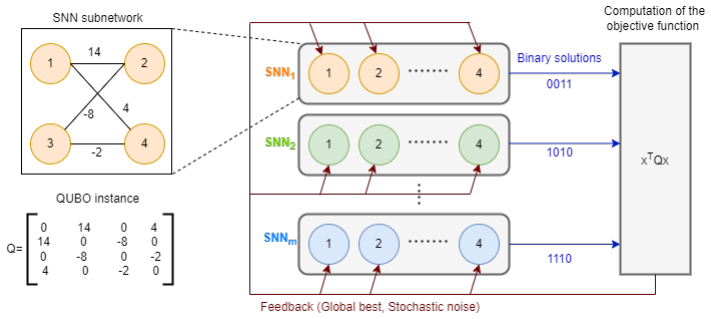
- If the Markov-chain bridge holds, stochastic spiking networks become samplers that can implement simulated annealing and tabu-style search with neuron-level parallelism, so QUBO, SAT, TSP, and constraint-satisfaction instances can be solved on-chip without shuttling data to a CPU.
- Objective-function evaluation can be moved into the network (for example, matrix-vector products for QUBO), removing the off-chip communication bottleneck that dominates power consumption and latency.
- Population-based metaheuristics such as particle swarm optimization, ant colony optimization, and evolutionary algorithms can be built as swarms or cellular populations of spiking networks; reported implementations include speedups of 10x to 20x for collaborating QUBO solvers and a Loihi2 simulated-annealing solver that uses 37 times less power than a CPU baseline.
- Emerging devices such as memristors, ferroelectric transistors, and resistive RAM can realize these solvers with built-in stochasticity and in-memory computation, pointing toward milliwatt optimizers for edge devices.
- The four-part design framework gives a common vocabulary for comparing Nheuristics across neuron models, encodings, architectures, and learning rules, and it exposes open gaps: large-scale problems, complex objective functions, hardware co-design, and multi-objective or uncertainty-aware optimization.
Reading between the lines
- Beyond the paper: if the sampling equivalence is robust, the same argument should transfer to other NP-hard problems formulable as Ising or QUBO models, such as max-cut, graph coloring, scheduling, and graph partitioning, giving neuromorphic hardware a broad combinatorial-optimization role rather than a set of bespoke solvers.
- Beyond the paper: a testable consequence is that time-based encoding (time-to-first-spike or inter-spike interval) rather than rate encoding will determine whether Nheuristics scale to large problems, since the paper flags rate coding's quantization error and energy cost as a limiting factor.
- Beyond the paper: the paradigm could invert the usual hardware-software relation, making SNN-to-hardware mapping a first-class optimization problem and motivating co-design of neuromorphic chips around families of Nheuristics rather than around neural-network inference.
- Beyond the paper: if low-precision hardware degrades the stationary distribution, hybrid neuromorphic-digital solvers that split objective evaluation between CPU and spiking network may be the practical route to retain both solution quality and energy savings, an option the paper lists but does not develop.
Editorial analysis
A structured set of objections, weighed in public.
Referee Report
Summary. The manuscript is a survey/position paper on neuromorphic-based metaheuristics ('Nheuristics'). It argues that metaheuristics--greedy, local search, evolutionary, and swarm-intelligence--can be modeled as spiking neural networks and implemented on neuromorphic hardware, yielding optimization algorithms with low power, low latency, and small footprint. It proposes a unified design framework built on four components (neuron model, information encoding, SNN architecture, learning rule), classifies existing work by problem type (QUBO, SAT, TSP, CSP, continuous optimization) and implementation platform, and discusses hardware, simulators, energy models, and future directions.
Significance. Provided the sampling-equivalence assumption is fixed, the paper would be a useful organizational contribution: it brings together a scattered literature, offers a common vocabulary for designing Nheuristics, and identifies the main optimization targets and hardware constraints. The hardware and simulator tables are practical reference material. The paper does not provide new benchmarks, formal proofs, or reproducible code, so its value lies in synthesis rather than in new results. The strength of the survey is its taxonomy; its weakness is that the core efficiency thesis and the Markov-chain foundation are asserted with limited evidence.
major comments (4)
- [Section 4 and Section 6.4] The Markov-chain foundation is not established for the designs presented. Section 4 states that 'Markov chains can be utilized to generate Nheuristics' and Section 6.4 gives the TSP/CSP network the Boltzmann stationary distribution p({x1,...,xN}) = (1/Z) exp(-E/T). Immediately afterward, however, the text describes a refractory mechanism in which xi is clamped to 1 for tau ticks and then 'automatically resets to 0, regardless of the energy difference caused by this transition.' That transition kernel is not the Glauber kernel of E, so the stationary distribution need not concentrate on low-energy solutions. The cited sampling results [29,30,150] apply to specific stochastic spiking models; the paper does not show that they cover the tabu/refractory kernel, nor does it analyze the effect of low-precision weights (e.g., 8-bit on Loihi2, Section 5.1) on the stationary distribution. Until this gap is addressed, the TSP/CSP results in Section 6.4 remain case-specific engineering demonstrations rather than instances of a general sampling-based paradigm.
- [Section 4.5] The computational-complexity subsection contains definitional errors that make the proposed framework unusable. It states that 'the number od synapses of a SNN is bounded by O(N^2) where N is the number of synapses,' which is circular; N should be the number of neurons. It then claims that along the longest path 'the number of synapses will equal the number of neurons,' but a path with L neurons has L-1 synapses. Moreover, recurrent SNNs contain cycles, so a 'longest path from an input neuron to an output neuron' is not well-defined in general. The run-time definition therefore needs to be reworked before the complexity framework can support the survey's claims.
- [Section 5.1 and Table 1] The hardware classification is internally inconsistent. Section 5.1.1 lists SpiNNaker as a CPU-based digital system; Section 5.1.3 lists BrainScaleS and NeuroGrid as hybrid analog/digital platforms; yet Table 1 lists 'BrainScaleS, Neurogrid' under Analog architecture and 'SpiNNaker, BrainScaleS-2' under Hybrid architecture. Similar inconsistencies affect DYNAP-SEL and BrainScaleS across the text and the table. Since classification is one of the paper's stated contributions, these contradictions must be resolved.
- [Abstract and Section 6.2] The central performance thesis is not backed by comparative evidence. The abstract and title promise 'low power, low latency and small footprint,' but Section 6.2 reports only a single Loihi2 SA vs CPU comparison (37x less power, 1 ms for 1000 variables) and one absolute power figure (50 mW on TrueNorth); Table 4 contains no columns for power, latency, footprint, or solution quality. No systematic comparison across the surveyed platforms is provided, and the few numbers are drawn from heterogeneous experimental settings. Either a quantitative comparison table should be added, or the thesis should be framed as a research hypothesis rather than an established property.
minor comments (3)
- [Throughout] The text contains numerous typos and formatting artifacts, including 'number od synapses' (Section 4.5), 'illutrative' (Table 4 caption), 'Spinakker' (Table 4 row for [155]), 'V on Neumann' spacing, and 'An optimization problem consists to find'. These should be corrected.
- [References] Reference [171] is listed as 'arXiv preprint arXiv: (2025)' with no identifier, making it impossible to retrieve; [167] and [168] are workshop/preprint references, and the 'first' claims attached to [168] and [171] should be verified or softened.
- [Table 3] Table 3 lists 'Spiking Jelly' while the text uses 'SpikingJelly'; this and the inconsistent naming of simulators should be harmonized.
Circularity Check
No circularity: this is a survey/framework paper whose theoretical bridge cites external Markov-chain sampling results, and the author's self-citations are illustrative rather than load-bearing.
full rationale
The paper is a position/survey article: it proposes a design framework (neuron model, encoding, architecture, learning rule) for 'Nheuristics' and classifies existing implementations. There is no fitted parameter later relabeled as a prediction, and no central result is defined as its own input. The theoretical bridge in Section 4 ('Markov chains can be utilized to generate Nheuristics') rests on external experimental and theoretical work [29][30], not on the author's own results; Section 6.4's Boltzmann formula p = (1/z) exp(-E/T) is likewise imported from the external neural-sampling literature. The author's own works [168] (NEVA) and [171] (Neuroptimisation) are cited to illustrate evolutionary and population-based Nheuristics and to support 'first' claims, but the core claim—that SNNs can express metaheuristics with low power, low latency and small footprint—is independently supported by many non-self-cited implementations on TrueNorth, Loihi2, SpiNNaker, DYNAP, RRAM, and FeFET, so the self-citations are not load-bearing. A correctness limitation exists but is not circular: Section 6.4's refractory reset, which occurs 'regardless of the energy difference caused by this transition,' alters the transition kernel relative to the cited Glauber/Boltzmann sampler, so the stationary-distribution argument may not apply to the implemented WTA/tabu dynamics; that is a validity gap, not a self-referential reduction.
Assumptions & free parameters
assumptions (3)
- domain assumption Neuromorphic computing is Turing-complete, so SNNs can implement any algorithm, including metaheuristics.
- domain assumption Recurrent SNN dynamics can be modeled as a Markov chain whose stationary distribution favors low-energy solutions.
- domain assumption Efficiency results from specific neuromorphic chips generalize to the class of Nheuristics.
Cite this review
Pith. "Pith review of Neuromorphic-based metaheuristics: A new generation of low power, low latency and small footprint optimization algorithms." pith.science (2026). https://pith.science/paper/6O7NO7T7
@misc{pith2026250516362,
  author       = {Pith},
  title        = {Pith review of: Neuromorphic-based metaheuristics: A new generation of low power, low latency and small footprint optimization algorithms},
  year         = {2026},
  howpublished = {\url{https://pith.science/paper/6O7NO7T7}},
  note         = {Machine review of arXiv:2505.16362}
}
read the original abstract
Neuromorphic computing (NC) introduces a novel algorithmic paradigm representing a major shift from traditional digital computing of Von Neumann architectures. NC emulates or simulates the neural dynamics of brains in the form of Spiking Neural Networks (SNNs). Much of the research in NC has concentrated on machine learning applications and neuroscience simulations. This paper investigates the modelling and implementation of optimization algorithms and particularly metaheuristics using the NC paradigm as an alternative to Von Neumann architectures, leading to breakthroughs in solving optimization problems. Neuromorphic-based metaheuristics (Nheuristics) are supposed to be characterized by low power, low latency and small footprint. Since NC systems are fundamentally different from conventional Von Neumann computers, several challenges are posed to the design and implementation of Nheuristics. A guideline based on a classification and critical analysis is conducted on the different families of metaheuristics and optimization problems they address. We also discuss future directions that need to be addressed to expand both the development and application of Nheuristics.
Figures


Figures from the paper (11 more)




Forward citations
Cited by 1 Pith paper
-
NeurOptimisation: The Spiking Way to Evolve
NeurOptimiser uses populations of spiking neurons to run heuristic search, solving BBOB benchmark functions up to 40 dimensions with estimated low power consumption.
Reference graph
Works this paper leans on
-
[1]
Davari, R
B. Davari, R. Dennard, G. Shahidi, Cmos scaling for high performance and low power-the next ten years, Proceedings of the IEEE 83 (4) (1995) 595–606
1995
-
[2]
Leiserson, et al., There is a plenty of room at the top: What will drive computer performance after moore’s law?, Science 368 (6495) (2020)
C. Leiserson, et al., There is a plenty of room at the top: What will drive computer performance after moore’s law?, Science 368 (6495) (2020)
2020
-
[3]
Thompson, K
N. Thompson, K. Greenewald, K. Lee, G. Manso, Deep learning’s diminishing returns: The cost of improvement is becoming unsustainable, IEEE Spectrum 58 (10) (2021) 50–55
2021
-
[4]
A. V . Wynsberghe, Sustainable ai: Ai for sustainability and the sustainability of ai, AI and Ethics 1 (3) (2021) 213–218
2021
-
[5]
de Vries, The growing energy footprint of artificial intelligence, Joule 7 (10) (2023) 2191–2194
A. de Vries, The growing energy footprint of artificial intelligence, Joule 7 (10) (2023) 2191–2194
2023
-
[6]
Mehonic, A
A. Mehonic, A. Kenyon, Brain-inspired computing needs a master plan, Nature 604 (7905) (2022) 255–260
2022
-
[7]
Mead, Neuromorphic electronic systems, Proceedings of the IEEE 78 (10) (1990) 1629–1636
C. Mead, Neuromorphic electronic systems, Proceedings of the IEEE 78 (10) (1990) 1629–1636
1990
-
[8]
Mead, How we created neuromorphic engineering, Nat Electron 3 (2020) 434–435
C. Mead, How we created neuromorphic engineering, Nat Electron 3 (2020) 434–435
2020
Show all 178 references
-
[9]
Schuman, B
C. Schuman, B. Kay, T. Potok, et al., Neuromorphic computing is turing-complete, arXiv preprint arXiv:2104.13983 (2021)
2021 arXiv
-
[10]
P. Date, B. Kay, C. Schuman, R. Patton, T. Potok, Computational complexity of neuromorphic algorithms, in: Int. Conf. on Neuromorphic Systems, 2021, pp. 1–7
2021
-
[11]
Aimone, et al., A review of non-cognitive applications for neuromorphic computing, Neuromorphic Computing and Engineering 2 (3) (2022) 032003
J. Aimone, et al., A review of non-cognitive applications for neuromorphic computing, Neuromorphic Computing and Engineering 2 (3) (2022) 032003
2022
-
[12]
Nilsson, O
M. Nilsson, O. Schel ´en, A. Lindgren, U. Bodin, C. Paniagua, J. Delsing, F. Sandin, Integration of neuromorphic ai in event-driven distributed digitized systems: Concepts and research directions, Frontiers in Neuroscience 17 (2023)
2023
-
[13]
Maass, Networks of spiking neurons: the third generation of neural network models, Neural networks 10 (9) (1997) 1659–1671
W. Maass, Networks of spiking neurons: the third generation of neural network models, Neural networks 10 (9) (1997) 1659–1671
1997
-
[14]
Schuman, et al., A survey of neuromorphic computing and neural networks in hardware, arXiv preprint arXiv:1705.06963 (2017)
C. Schuman, et al., A survey of neuromorphic computing and neural networks in hardware, arXiv preprint arXiv:1705.06963 (2017)
2017 arXiv
-
[15]
Nunes, M
J. Nunes, M. Carvalho, D. Carneiro, J. Cardoso, Spiking neural networks: A survey, IEEE Access 10 (2022) 60738–60764
2022
-
[16]
Herculano-Houzel, Scaling of brain metabolism with a fixed energy budget per neuron: implications for neuronal activity, plasticity and evolution, PloS one 6 (3) (2011) e17514
S. Herculano-Houzel, Scaling of brain metabolism with a fixed energy budget per neuron: implications for neuronal activity, plasticity and evolution, PloS one 6 (3) (2011) e17514
2011
-
[17]
Shoham, D
S. Shoham, D. O’Connor, R. Segev, How silent is the brain: is there a darker problem in neuroscience?, Journal of Comparative Physiology A 192 (2006) 777–784. 28
2006
-
[18]
Quian, G
Q. Quian, G. Kreiman, Measuring sparseness in the brain: comment on bowers (2009). (2010)
2009
-
[19]
Rolls, G
E. Rolls, G. Deco, The noisy brain: stochastic dynamics as a principle of brain function, Oxford university press, 2010
2010
-
[20]
Talbi, Metaheuristics: from design to implementation, Wiley, 2009
E.-G. Talbi, Metaheuristics: from design to implementation, Wiley, 2009
2009
-
[21]
v. y. p. J. Del Ser et al., journal =Swarm and Evolutionary Computation, Bio-inspired computation: Where we stand and what’s next
-
[22]
Storn, K
R. Storn, K. V . Price, Di fferential evolution: A simple and e fficient heuristic for global optimization over continuous spaces, Journal of Global Optimization 11 (4) (1997) 341–359
1997
-
[23]
Eberhart, Y
R. Eberhart, Y . Shi, J. Kennedy, Swarm intelligence, Elsevier, 2001
2001
-
[24]
Stork, A
J. Stork, A. E. Eiben, T. Bartz-Beielstein, A new taxonomy of global optimization algorithms, Natural Computing (2020) 1–24
2020
-
[25]
Glover, G
F. Glover, G. Kochenberger, Y . Du, Applications and computational advances for solving the qubo model, in: The quadratic unconstrained binary optimization problem: theory, algorithms, and applications, 2022, pp. 39–56
2022
-
[26]
Glover, G
F. Glover, G. Kochenberger, R. Hennig, Y . Du, Quantum bridge analytics i: a tutorial on formulating and using qubo models, Annals of Operations Research 314 (1) (2022) 141–183
2022
-
[27]
Lucas, Ising formulations of many np problems, Frontiers in Physics (2014) 5–21
A. Lucas, Ising formulations of many np problems, Frontiers in Physics (2014) 5–21
2014
-
[28]
Mohseni, P
N. Mohseni, P. McMahon, T. Byrnes, Ising machines as hardware solvers of combinatorial optimization problems, Nature Reviews Physics 4 (6) (2022) 363–379
2022
-
[29]
Berkes, G
P. Berkes, G. Orb ´an, M. Lengyel, J. Fiser, Spontaneous cortical activity reveals hallmarks of an optimal internal model of the environment, Science 331 (6013) (2011) 83–87
2011
-
[30]
Buesing, J
L. Buesing, J. Bill, B. Nessler, W. Maass, Neural dynamics as sampling: a model for stochastic computation in recurrent networks of spiking neurons, PLoS computational biology 7 (11) (2011)
2011
-
[31]
E. M. Izhikevich, Simple model of spiking neurons, IEEE Transactions on Neural Networks 14 (6) (2003) 1569–1572
2003
-
[32]
Shrestha, H
A. Shrestha, H. Fang, Z. Mei, D. Rider, Q. Wu, Q. Qiu, A survey on neuromorphic computing: Models and hardware, IEEE Circuits and Systems Magazine 22 (2) (2022) 6–35
2022
-
[33]
Abbott, Lapicque’s introduction of the integrate-and-fire model neuron, Brain research bulletin 50 (5-6) (1999) 303–304
L. Abbott, Lapicque’s introduction of the integrate-and-fire model neuron, Brain research bulletin 50 (5-6) (1999) 303–304
1999
-
[34]
Gerstner, W
W. Gerstner, W. Kistler, Spiking neuron models: single neurons, populations, plasticity, Cambridge University Press, 2002
2002
-
[35]
Brette, W
R. Brette, W. Gerstner, Adaptive exponential integrate-and-fire model as an e ffective description of neuronal activity, Journal of neurophys- iology 94 (5) (2005) 3637–3642
2005
-
[36]
Burkitt, A review of the integrate-and-fire neuron model: I
A. Burkitt, A review of the integrate-and-fire neuron model: I. homogeneous synaptic input, Biological cybernetics 95 (2006) 1–19
2006
-
[37]
Lecar, Morris-lecar model, Scholarpedia 2 (10) (2007) 1333
H. Lecar, Morris-lecar model, Scholarpedia 2 (10) (2007) 1333
2007
-
[38]
M. Alom, B. V . Essen, A. Moody, D. Widemann, T. Taha, Quadratic unconstrained binary optimization (qubo) on neuromorphic computing system, in: Int. Joint conf. on Neural Networks (IJCNN), 2017, pp. 3922–3929
2017
-
[39]
Y . Kang, M. Ishii, J. Park, et al., Solving max-cut problem using spiking boltzmann machine based on neuromorphic hardware with phase change memory, Advanced Science 11 (46) (2024) 2406433
2024
-
[40]
Y . Fang, Z. Wang, J. Gomez, S. Datta, A. Khan, A. Raychowdhury, A swarm optimization solver based on ferroelectric spiking neural networks, Frontiers in neuroscience 13 (2019) 458889
2019
-
[41]
Zenke, et al., Visualizing a joint future of neuroscience and neuromorphic engineering, Neuron 109 (4) (2021) 571–575
F. Zenke, et al., Visualizing a joint future of neuroscience and neuromorphic engineering, Neuron 109 (4) (2021) 571–575
2021
-
[42]
D. Auge, J. Hille, E. Mueller, A. Knoll, A survey of encoding techniques for signal processing in spiking neural networks, Neural Processing Letters 53 (6) (2021) 4693–4710
2021
-
[43]
Butts, C
D. Butts, C. Weng, J. Jin, C. Yeh, N. Lesica, J.-M. Alonso, G. Stanley, Temporal precision in the neural code and the timescales of natural vision, Nature 449 (7158) (2007) 92–95
2007
-
[44]
Panzeri, N
S. Panzeri, N. Brunel, N. Logothetis, C. Kayser, Sensory neural codes using multiplexed temporal scales, Trends in neurosciences 33 (3) (2010) 111–120
2010
-
[45]
W. Guo, M. Fouda, A. Eltawil, K. Salama, Neural coding in spiking neural networks: A comparative study for robust neuromorphic systems, Frontiers in Neuroscience 15 (2021)
2021
-
[46]
Thorpe, D
S. Thorpe, D. Fize, C. Marlot, Speed of processing in the human visual system, Nature 381 (6582) (1996) 520–522
1996
-
[47]
Rueckauer, S.-C
B. Rueckauer, S.-C. Liu, Conversion of analog to spiking neural networks using sparse temporal coding, in: IEEE Int. Symposium on circuits and systems (ISCAS), 2018, pp. 1–5
2018
-
[48]
Kumar, S
A. Kumar, S. Rotter, A. Aertsen, Spiking activity propagation in neuronal networks: reconciling di fferent perspectives on neural coding, Nature reviews neuroscience 11 (9) (2010) 615–627
2010
-
[49]
Forno, V
E. Forno, V . Fra, R. Pignari, E. Macii, G. Urgese, Spike encoding techniques for iot time-varying signals benchmarked on a neuromorphic classification task, Frontiers in Neuroscience 16 (2022)
2022
-
[50]
Schuman, C
C. Schuman, C. Rizzo, J. McDonald-Carmack, N. Skuda, J. Plank, Evaluating encoding and decoding approaches for spiking neuromorphic systems, in: Int. Conf. on Neuromorphic Systems, 2022, pp. 1–9
2022
-
[51]
Kiselev, Rate coding vs
M. Kiselev, Rate coding vs. temporal coding-is optimum between?, in: 2016 Int. joint Conf. on Neural Networks (IJCNN), 2016, pp. 1355–1359
2016
-
[52]
Z. Pan, J. Wu, M. Zhang, H. Li, Y . Chua, Neural population coding for e ffective temporal classification, in: Int. Joint Conf. on Neural Networks (IJCNN), 2019, pp. 1–8
2019
-
[53]
Schuman, J
C. Schuman, J. Plank, G. Bruer, J. Anantharaj, Non-traditional input encoding schemes for spiking neuromorphic systems, in: Int. Joint Conf. on Neural Networks (IJCNN), 2019, pp. 1–10
2019
-
[54]
Heeger, et al., Poisson model of spike generation, Handout, University of Standford 5 (1-13) (2000) 76
D. Heeger, et al., Poisson model of spike generation, Handout, University of Standford 5 (1-13) (2000) 76
2000
-
[55]
S. Oh, S. Lee, S. Woo, D. Kwon, et al., Spiking neural networks with time-to-first-spike coding using tft-type synaptic device model, IEEE Access 9 (2021) 78098–78107
2021
-
[56]
Thorpe, J
S. Thorpe, J. Gautrais, Rank order coding, in: Computational Neuroscience: Trends in Research, Springer, 1998, pp. 113–118
1998
-
[57]
Singer, Neuronal synchrony: a versatile code for the definition of relations?, Neuron 24 (1) (1999) 49–65
W. Singer, Neuronal synchrony: a versatile code for the definition of relations?, Neuron 24 (1) (1999) 49–65
1999
-
[58]
A. M. Zador, Impact of synaptic unreliability on the information transmitted by spiking neurons., Journal of neurophysiology 79 (3) (1998)
1998
-
[59]
Eliasmith, C
C. Eliasmith, C. Anderson, Neural engineering: Computation, representation, and dynamics in neurobiological systems, MIT press, 2003. 29
2003
-
[60]
S. Park, S. Kim, H. Choe, S. Yoon, Fast and e fficient information transmission with burst spikes in deep spiking neural networks, in: 56th Annual Design Automation Conference, 2019, pp. 1–6
2019
-
[61]
Q. Chen, Q. Qiu, Real-time anomaly detection for streaming data using burst code on a neurosynaptic processor, in: Design, Automation & Test in Europe Conference & Exhibition (DATE), 2017, pp. 205–207
2017
-
[62]
B. Kay, P. Date, C. Schuman, Neuromorphic graph algorithms: Extracting longest shortest paths and minimum spanning trees
-
[63]
G. Bi, M. Poo, Distributed synaptic modification in neural networks induced by patterned stimulation, Nature 401 (6755) (1999) 792–796
1999
-
[64]
Maass, On the computational power of winner-take-all, Neural computation 12 (11) (2000) 2519–2535
W. Maass, On the computational power of winner-take-all, Neural computation 12 (11) (2000) 2519–2535
2000
-
[65]
Amari, M
S.-I. Amari, M. Arbib, Competition and cooperation in neural nets, Systems neuroscience (1977) 119–165
1977
-
[66]
Salzman, W
D. Salzman, W. Newsome, Neural mechanisms for forming a perceptual decision, Science 264 (5156) (1994) 231–237
1994
-
[67]
Kwisthout, N
J. Kwisthout, N. Donselaar, On the computational power and complexity of spiking neural networks, in: Annual Neuro-Inspired Computa- tional Elements Workshop, 2020, pp. 1–7
2020
-
[68]
Furber, P
S. Furber, P. Bogdan, Spinnaker-a spiking neural network architecture, Now publishers, 2020
2020
-
[69]
Painkras, L
E. Painkras, L. Plana, J. Garside, et al., Spinnaker: A 1-w 18-core system-on-chip for massively-parallel neural network simulation, IEEE Journal of Solid-State Circuits 48 (8) (2013) 1943–1953
2013
-
[70]
DeBole, et al., Truenorth: Accelerating from zero to 64 million neurons in 10 years, Computer 52 (5) (2019) 20–29
M. DeBole, et al., Truenorth: Accelerating from zero to 64 million neurons in 10 years, Computer 52 (5) (2019) 20–29
2019
-
[71]
Akopyan, J
F. Akopyan, J. Sawada, A. Cassidy, R. Alvarez-Icaza, J. Arthur, P. Merolla, N. Imam, Y . Nakamura, P. Datta, G.-J. Nam, Truenorth: Design and tool flow of a 65 mw 1 million neuron programmable neurosynaptic chip, IEEE Transactions on Computer-Aided Design of Integrated Circuit...
2015
-
[72]
Davies, N
M. Davies, N. Srinivasa, T.-H. Lin, et al., Loihi: A neuromorphic manycore processor with on-chip learning, IEEE Micro 38 (1) (2018) 82–99
2018
-
[73]
Frenkel, M
C. Frenkel, M. Lefebvre, J.-D. Legat, D. Bol, A 0.086-mm mm212.7-pj/sop 64k-synapse 256-neuron online-learning digital spiking neuro- morphic processor in 28-nm cmos, IEEE Transactions on Biomedical Circuits and Systems 13 (1) (2018) 145–158
2018
-
[74]
J. Pei, L. Deng, S. Song, M. Zhao, et al., Towards artificial general intelligence with hybrid tianjic chip architecture, Nature 572 (7767) (2019) 106–111
2019
-
[75]
Orchard, P
G. Orchard, P. Frady, D. Rubin, S. Sanborn, S. Shrestha, F. Sommer, M. Davies, E fficient neuromorphic signal processing with loihi 2, in: IEEE Workshop on Signal Processing Systems (SiPS), 2021, pp. 254–259
2021
-
[76]
Javanshir, T
A. Javanshir, T. Nguyen, P. Mahmud, A. Kouzani, Advancements in algorithms and neuromorphic hardware for spiking neural networks, Neural Computation 34 (6) (2022) 1289–1328
2022
-
[77]
Gr ¨ubl, S
A. Gr ¨ubl, S. Billaudelle, B. Cramer, V . Karasenko, J. Schemmel, Verification and design methods for the brainscales neuromorphic hardware system, Journal of Signal Processing Systems 92 (2020) 1277–1292
2020
-
[78]
Benjamin, P
B. Benjamin, P. Gao, et al., Neurogrid: A mixed-analog-digital multichip system for large-scale neural simulations, Proceedings of the IEEE 102 (5) (2014) 699–716
2014
-
[79]
Panda, D
S. Panda, D. Sekhar, C. Dora, Recent trends in application of memristor in neuromorphic computing: A review, Current Nanoscience 20 (4) (2024) 495–509
2024
-
[80]
Mu, H.-H
B. Mu, H.-H. Hsu, C.-C. Kuo, S.-T. Han, Y . Zhou, Organic small molecule-based rram for data storage and neuromorphic computing, Journal of Materials Chemistry C 8 (37) (2020) 12714–12738
2020
-
[81]
P. Yao, H. Wu, B. Gao, J. Tang, Q. Zhang, W. Zhang, J. Yang, H. Qian, Fully hardware-implemented memristor convolutional neural network, Nature 577 (7792) (2020) 641–646
2020
-
[82]
C. Li, D. Belkin, Y . Li, P. Yan, G. Hu, N. Ge, H. Jiang, E. Montgomery, P. Lin, Z. Wang, et al., Efficient and self-adaptive in-situ learning in multilayer memristor neural networks, Nature communications 9 (1) (2018) 2385
2018
-
[83]
Hamilton, S
T. Hamilton, S. Afshar, A. van Schaik, J. Tapson, Stochastic electronics: A neuro-inspired design paradigm for integrated circuits, Proceed- ings of the IEEE 102 (5) (2014) 843–859
2014
-
[84]
Misra, L
S. Misra, L. Bland, S. Cardwell, et al., Probabilistic neural computing with stochastic devices, Advanced Materials 35 (37) (2023) 2204569
2023
-
[85]
Alawad, M
M. Alawad, M. Lin, Survey of stochastic-based computation paradigms, IEEE Transactions on Emerging Topics in Computing 7 (1) (2016) 98–114
2016
-
[86]
Mostafa, L
H. Mostafa, L. M ¨uller, G. Indiveri, Rhythmic inhibition allows neural networks to search for maximally consistent states, Neural computation 27 (12) (2015) 2510–2547
2015
-
[87]
Torrejon, M
J. Torrejon, M. Riou, F. Araujo, et al., Neuromorphic computing with nanoscale spintronic oscillators, Nature 547 (7664) (2017) 428–431
2017
-
[88]
K. Y . D., Fick, M. Henry, Y . Lee, D. Blaauw, D. Sylvester, 16.3 a 23mb/s 23pj/b fully synthesized true-random-number generator in 28nm and 65nm cmos, in: IEEE International Solid-State Circuits Conference Digest of Technical Papers (ISSCC), 2014, pp. 280–281
2014
-
[89]
H. Lin, C. Wang, Q. Deng, C. Xu, Z. Deng, C. Zhou, Review on chaotic dynamics of memristive neuron and neural network, Nonlinear Dynamics 106 (1) (2021) 959–973
2021
-
[90]
Pfeil, J
T. Pfeil, J. Jordan, T. Tetzla ff, A. Gr ¨ubl, J. Schemmel, M. Diesmann, K. Meier, E ffect of heterogeneity on decorrelation mechanisms in spiking neural networks: a neuromorphic-hardware study, Physical Review X 6 (2) (2016) 021023
2016
-
[91]
Al-Shedivat, R
M. Al-Shedivat, R. Naous, G. Cauwenberghs, K. Salama, Memristors empower spiking neurons with stochasticity, IEEE journal on Emerg- ing and selected topics in circuits and systems 5 (2) (2015) 242–253
2015
-
[92]
Maass, To spike or not to spike: that is the question, Proceedings of the IEEE 103 (12) (2015) 2219–2224
W. Maass, To spike or not to spike: that is the question, Proceedings of the IEEE 103 (12) (2015) 2219–2224
2015
-
[93]
Branco, K
T. Branco, K. Staras, The probability of neurotransmitter release: variability and feedback control at single synapses, Nature Reviews Neuroscience 10 (5) (2009) 373–383
2009
-
[94]
H. Bos, D. Muir, Sub-mw neuromorphic snn audio processing applications with rockpool and xylo, in: Embedded Artificial Intelligence, 2023, pp. 69–78
2023
-
[95]
M. Yao, O. Richter, G. Zhao, N. Qiao, et al., Spike-based dynamic computing with asynchronous sensing-computing neuromorphic chip, Nature Communications 15 (1) (2024) 4464
2024
-
[96]
Huynh, L
P. Huynh, L. Varshika, A. Paul, M. Isik, A. Balaji, A. Das, Implementing spiking neural networks on neuromorphic architectures: A review, arXiv preprint arXiv:2202.08897 (2022). 30
2022 arXiv
-
[97]
Bouvier, A
M. Bouvier, A. Valentian, T. Mesquida, F. Rummens, M. Reyboz, E. Vianello, E. Beigne, Spiking neural networks hardware implementations and challenges: A survey, ACM Journal on Emerging Technologies in Computing Systems (JETC) 15 (2) (2019) 1–35
2019
-
[98]
Schuman, S
C. Schuman, S. Kulkarni, M. Parsa, P. Mitchell, P. Date, B. Kay, Opportunities for neuromorphic computing algorithms and applications, Nature Computational Science 2 (1) (2022) 10–19
2022
-
[99]
O. Jin, Q. Xing, Y . Li, S. Deng, S. He, G. Pan, Mapping very large scale spiking neuron network to neuromorphic hardware, in: 28th ACM Int. Conf. on Architectural Support for Programming Languages and Operating Systems, 2023, pp. 419–432
2023
-
[100]
Rajendran, A
B. Rajendran, A. Sebastian, M. Schmuker, N. Srinivasa, E. Eleftheriou, Low-power neuromorphic hardware for signal processing applica- tions: A review of architectural and system-level design approaches, IEEE Signal Processing Magazine 36 (6) (2019) 97–110
2019
-
[101]
Sivilotti, Wiring considerations in analog VLSI systems, with application to field-programmable networks, California Institute of Tech- nology, 1991
M. Sivilotti, Wiring considerations in analog VLSI systems, with application to field-programmable networks, California Institute of Tech- nology, 1991
1991
-
[102]
Stuijt, M
J. Stuijt, M. Sifalakis, A. Yousefzadeh, F. Corradi, µbrain: An event-driven and fully synthesizable architecture for spiking neural networks, Frontiers in neuroscience 15 (2021) 664208
2021
-
[103]
Moradi, N
S. Moradi, N. Qiao, F. Stefanini, G. Indiveri, A scalable multicore architecture with heterogeneous memory structures for dynamic neuro- morphic asynchronous processors (dynaps), IEEE Transactions on Biomedical Circuits and Systems 12 (1) (2017) 106–122
2017
-
[104]
Schemmel, A
J. Schemmel, A. Gr ¨ubl, S. Hartmann, et al., Live demonstration: A scaled-down version of the brainscales wafer-scale neuromorphic system, in: IEEE Int. Symposium on Circuits and Systems (ISCAS), 2012, pp. 702–702
2012
-
[105]
Furber, F
S. Furber, F. Galluppi, S. Temple, L. Plana, The spinnaker project, Proceedings of the IEEE 102 (5) (2014) 652–665
2014
-
[106]
Balaji, A
A. Balaji, A. Das, Y . Wu, K. Huynh, F. Dell’Anna, G. Indiveri, J. Krichmar, N. Dutt, S. Schaafsma, F. Catthoor, Mapping spiking neural networks to neuromorphic hardware, IEEE Transactions on Very Large Scale Integration (VLSI) Systems 28 (1) (2019) 76–86
2019
-
[107]
S. Song, H. Chong, A. Balaji, A. Das, J. Shackleford, N. Kandasamy, Dfsynthesizer: Dataflow-based synthesis of spiking neural networks to neuromorphic hardware, ACM Transactions on Embedded Computing Systems (TECS) 21 (3) (2022) 1–35
2022
-
[108]
Galluppi, S
F. Galluppi, S. Davies, A. Rast, T. Sharp, L. Plana, S. Furber, A hierachical configuration system for a massively parallel neural hardware platform, in: 9th conference on Computing Frontiers, 2012, pp. 183–192
2012
-
[109]
A. Das, Y . Wu, K. Huynh, F. Dell’Anna, F. Catthoor, S. Schaafsma, Mapping of local and global synapses on spiking neuromorphic hardware, in: Design, Automation & Test in Europe Conference & Exhibition (DATE), 2018, pp. 1217–1222
2018
-
[110]
Y . Ji, Y . Zhang, S. Li, P. Chi, C. Jiang, P. Qu, Y . Xie, W. Chen, Neutrams: Neural network transformation and co-design under neuromorphic hardware constraints, in: 49th Annual IEEE/ACM International Symposium on Microarchitecture (MICRO), 2016, pp. 1–13
2016
-
[111]
Kulkarni, M
S. Kulkarni, M. Parsa, P. Mitchell, C. Schuman, Benchmarking the performance of neuromorphic and spiking neural network simulators, Neurocomputing 447 (2021) 145–160
2021
-
[112]
N. T. Carnevale, M. L. Hines, The NEURON Book, Cambridge Univ. Press, 2010
2010
-
[113]
Diesmann, M.-O
M. Diesmann, M.-O. Gewaltig, Nest: An environment for neural systems simulations, Forschung und wisschenschaftliches Rechnen, Beitr¨age zum Heinz-Billing-Preis 58 (2001) 43–70
2001
-
[114]
Stimberg, R
M. Stimberg, R. Brette, D. Goodman, Brian 2, an intuitive and e fficient neural simulator, elife 8 (2019)
2019
-
[115]
Hazan, D
H. Hazan, D. Saunders, H. Khan, et al., Bindsnet: A machine learning-oriented spiking neural networks library in python, Frontiers in neuroinformatics 12 (2018) 89
2018
-
[116]
Niedermeier, K
L. Niedermeier, K. Chen, J. Xing, A., et al., Carlsim 6: an open source library for large-scale, biologically detailed spiking neural network simulation, in: Int. Joint Conf. on Neural Networks (IJCNN), 2022, pp. 1–10
2022
-
[117]
Bekolay, J
T. Bekolay, J. Bergstra, E. Hunsberger, et al., Nengo: a python tool for building large-scale functional brain models, Frontiers in neuroinfor- matics 7 (2014) 48
2014
-
[118]
Knight, A
J. Knight, A. Komissarov, T. Nowotny, Pygenn: a python library for gpu-enhanced neural networks, Frontiers in Neuroinformatics 15 (2021) 659005
2021
-
[119]
Davison, D
A. Davison, D. Br ¨uderle, J. Eppler, J. Kremkow, E. Muller, D. Pecevski, L. Perrinet, P. Yger, Pynn: a common interface for neuronal network simulators, Frontiers in neuroinformatics 2 (2009) 388
2009
-
[120]
W. Fang, Y . Chen, J. Ding, Z. Yu, et al., Spikingjelly: An open-source machine learning infrastructure platform for spike-based intelligence, Science Advances 9 (40) (2023) eadi1480
2023
-
[121]
Maass, Lower bounds for the computational power of networks of spiking neurons, Neural computation 8 (1) (1996) 1–40
W. Maass, Lower bounds for the computational power of networks of spiking neurons, Neural computation 8 (1) (1996) 1–40
1996
-
[122]
Parekh, C
O. Parekh, C. Phillips, C. James, J. Aimone, Constant-depth and subcubic-size threshold circuits for matrix multiplication, in: Proceedings of the 30th on Symposium on Parallelism in Algorithms and Architectures, 2018, pp. 67–76
2018
-
[123]
Smith, W
D. Smith, W. Severa, et al., Solving a steady-state pde using spiking networks and neuromorphic hardware, in: International Conference on Neuromorphic Systems, 2020, pp. 1–8
2020
-
[124]
Verzi, F
S. Verzi, F. Rothganger, et al., Computing with spikes: The advantage of fine-grained timing, Neural computation 30 (10) (2018) 2660–2690
2018
-
[125]
Maass, Fast sigmoidal networks via spiking neurons, Neural computation 9 (2) (1997) 279–304
W. Maass, Fast sigmoidal networks via spiking neurons, Neural computation 9 (2) (1997) 279–304
1997
-
[126]
Iannella, A
N. Iannella, A. Back, A spiking neural network architecture for nonlinear function approximation, Neural networks 14 (6-7) (2001) 933–939
2001
-
[127]
Pierro, P
A. Pierro, P. Stratmann, G. Guerra, S. Risbud, T. Shea, A. Mangalore, A. Wild, Solving qubo on the loihi 2 neuromorphic processor, arXiv preprint arXiv:2408.03076 (2024)
2024 arXiv
-
[128]
Barchid, J
S. Barchid, J. Mennesson, J. Eshraghian, C. Dj ´eraba, M. Bennamoun, Spiking neural networks for frame-based and event-based single object localization, Neurocomputing 559 (2023) 126805
2023
-
[129]
Lemaire, L
E. Lemaire, L. Cordone, A. Castagnetti, P.-E. Novac, J. Courtois, p. y. B. Miramond, booktitle=Int. Conf. on Neural Information Processing, An analytical estimation of spiking neural networks energy efficiency
-
[130]
Ostrau, C
C. Ostrau, C. Klarhorst, M. Thies, U. R ¨uckert, Benchmarking neuromorphic hardware and its energy expenditure, Frontiers in neuroscience 16 (2022) 873935
2022
-
[131]
Schuman, K
C. Schuman, K. Hamilton, T. Mintz, M. Adnan, B. Ku, S. Lim, G. Rose, Shortest path and neighborhood subgraph extraction on a spiking memristive neuromorphic implementation, in: 7th Annual Neuro-inspired Computational Elements Workshop, 2019, pp. 1–6
2019
-
[132]
B. Kay, C. Schuman, J. O’connor, P. Date, T. Potok, Neuromorphic graph algorithms: Cycle detection, odd cycle detection, and max flow, in: International Conference on Neuromorphic Systems, 2021, pp. 1–7. 31
2021
-
[133]
O’Keefe, J
J. O’Keefe, J. Dostrovsky, The hippocampus as a spatial map: preliminary evidence from unit activity in the freely-moving rat., Brain research (1971)
1971
-
[134]
Dragoi, S
G. Dragoi, S. Tonegawa, Distinct preplay of multiple novel spatial experiences in the rat, Proceedings of the National Academy of Sciences 110 (22) (2013) 9100–9105
2013
-
[135]
Ponulak, J
F. Ponulak, J. Hopfield, Rapid, parallel path planning by propagating wavefronts of spiking neural activity, Frontiers in computational neuroscience 7 (2013) 98
2013
-
[136]
Y . Chao, P. Augenstein, A. Roennau, R. Dillmann, Z. Xiong, Brain inspired path planning algorithms for drones, Frontiers in Neurorobotics 17 (2023) 1111861
2023
-
[137]
S. Koul, T. Horiuchi, Waypoint path planning with synaptic-dependent spike latency, IEEE Transactions on Circuits and Systems I: Regular Papers 66 (4) (2019) 1544–1557
2019
-
[138]
H. Ruan, Y . Chang, W. Wu, Z. Huang, Y . Deng, L. Li, H. Luo, S. He, D. Guo, Gsnn: a neuromorphic computing model for the flexible path planning in various constraint environments, IEEE Transactions on Automation Science and Engineering 22 (2024) 1081–1099
2024
-
[139]
Zennir, M
M. Zennir, M. Benmohammed, D. Martinez, Robust path planning by propagating rhythmic spiking activity in a hippocampal network model, Biologically inspired cognitive architectures 20 (2017) 47–58
2017
-
[140]
Hopfield, D
J. Hopfield, D. Tank, Computing with neural circuits: A model, Science 233 (4764) (1986) 625–633
1986
-
[141]
M. Mniszewski, Graph partitioning as quadratic unconstrained binary optimization (qubo) on spiking neuromorphic hardware, in: Proceed- ings of the International Conference on Neuromorphic Systems, 2019, pp. 1–5
2019
-
[142]
Henke, E
K. Henke, E. Pelofske, G. Hahn, G. Kenyon, Sampling binary sparse coding qubo models using a spiking neuromorphic processor, in: Proceedings of the 2023 International Conference on Neuromorphic Systems, 2023, pp. 1–5
2023
-
[143]
X. Yin, Y . Qian, A. Vardar, M. G¨unther, F. M¨uller, N. Laleni, Z. Zhao, Z. Jiang, Z. Shi, et al., Ferroelectric compute-in-memory annealer for combinatorial optimization problems, Nature Communications 15 (1) (2024) 2419
2024
-
[144]
F. Cai, S. Kumar, T. V . Vaerenbergh, et al., Power-e fficient combinatorial optimization using intrinsic noise in memristor hopfield neural networks, Nature Electronics 3 (7) (2020) 409–418
2020
-
[145]
K. Yang, Q. Duan, Y . Wang, T. Zhang, Y . Yang, R. Huang, Transiently chaotic simulated annealing based on intrinsic nonlinearity of memristors for efficient solution of optimization problems, Science advances 6 (33) (2020)
2020
-
[146]
J. Shin, Y . Jeong, M. Zidan, Q. Wang, W. Lu, Hardware acceleration of simulated annealing of spin glass by rram crossbar array, in: IEEE International Electron Devices Meeting (IEDM), 2018, pp. 3–3
2018
-
[147]
Mahmoodi, H
M. Mahmoodi, H. Kim, Z. Fahimi, H. Nili, L. Sedov, V . Polishchuk, D. Strukov, An analog neuro-optimizer with adaptable annealing based on 64× 64 0t1r crossbar circuit, in: 2019 IEEE International Electron Devices Meeting (IEDM), 2019, pp. 14–7
2019
-
[148]
Yakopcic, N
C. Yakopcic, N. Rahman, T. Atahary, T. Taha, S. Douglass, Solving constraint satisfaction problems using the loihi spiking neuromorphic processor, in: 2020 Design, Automation & Test in Europe Conference & Exhibition (DATE), 2020, pp. 1079–1084
2020
-
[149]
Glover, Tabu search: A tutorial, Interfaces 20 (4) (1990) 74–94
F. Glover, Tabu search: A tutorial, Interfaces 20 (4) (1990) 74–94
1990
-
[150]
Habenschuss, Z
S. Habenschuss, Z. Jonke, W. Maass, Stochastic computations in cortical microcircuit models, PLoS computational biology 9 (11) (2013) e1003311
2013
-
[151]
Jonke, S
Z. Jonke, S. Habenschuss, W. Maass, Solving constraint satisfaction problems with networks of spiking neurons, Frontiers in neuroscience 10 (2016) 118
2016
-
[152]
Jolivet, A
R. Jolivet, A. Rauch, H.-R. L ¨uscher, W. Gerstner, Predicting spike timing of neocortical pyramidal neurons by simple threshold models, Journal of computational neuroscience 21 (2006) 35–49
2006
-
[153]
Davies, A
M. Davies, A. Wild, G. Orchard, Y . Sandamirskaya, G. Guerra, P. Joshi, P. Plank, S. Risbud, Advancing neuromorphic computing with loihi: A survey of results and outlook, Proceedings of the IEEE 109 (5) (2021) 911–934
2021
-
[154]
Aarts, J
E. Aarts, J. Korst, Simulated annealing and Boltzmann machines: a stochastic approach to combinatorial optimization and neural computing, John Wiley & Sons, Inc., 1989
1989
-
[155]
A. G. G. Fonseca, S. Furber, Using stochastic spiking neural networks on spinnaker to solve constraint satisfaction problems, Frontiers in Neuroscience 11 (2017) 714
2017
-
[156]
Guerra, Stochastic processes for neuromorphic hardware, PhD, University of Manchester, UK, 2020
G. Guerra, Stochastic processes for neuromorphic hardware, PhD, University of Manchester, UK, 2020
2020
-
[157]
Liang, G
D. Liang, G. Indiveri, A neuromorphic computational primitive for robust context-dependent decision making and context-dependent stochastic computation, IEEE Transactions on Circuits and Systems II: Express Briefs 66 (5) (2019) 843–847
2019
-
[158]
Hong, L.-C
M.-C. Hong, L.-C. Cho, C.-S. Lin, et al., In-memory annealing unit (imau): Energy-e fficient (2000 tops /w) combinatorial optimizer for solving travelling salesman problem, in: IEEE International Electron Devices Meeting (IEDM), 2021
2000
-
[159]
Binas, G
J. Binas, G. Indiveri, M. Pfei ffer, Spiking analog vlsi neuron assemblies as constraint satisfaction problem solvers, in: IEEE International Symposium on Circuits and Systems (ISCAS), 2016, pp. 2094–2097
2016
-
[160]
Corder, J
K. Corder, J. Monaco, M. Vindiola, Solving vertex cover via ising model on a neuromorphic processor, in: IEEE International Symposium on Circuits and Systems (ISCAS), IEEE, 2018, pp. 1–5
2018
-
[161]
Zhang, Q
T. Zhang, Q. Tao, B. Liu, A. Grimaldi, et al., A review of ising machines implemented in conventional and emerging technologies, IEEE Transactions on Nanotechnology (2024)
2024
-
[162]
P. Tang, T. Lin, M. Davies, Sparse coding by spiking neural networks: Convergence theory and computational results, arXiv preprint arXiv:1705.05475 (2017)
2017 arXiv
-
[163]
Mangalore, G
A. Mangalore, G. Fonseca, S. Risbud, P. Stratmann, A. Wild, Neuromorphic quadratic programming for efficient and scalable model predic- tive control: Towards advancing speed and energy efficiency in robotic control, IEEE Robotics & Automation Magazine (2024)
2024
-
[164]
Y . Fang, A. S. Lele, Solving quadratic unconstrained binary optimization with collaborative spiking neural networks, in: IEEE International Conference on Rebooting Computing (ICRC), 2022, pp. 84–88
2022
-
[165]
A. Lele, M. Chang, S. Spetalnick, B. Crafton, A. Raychowdhury, Y . Fang, Neuromorphic swarm on rram compute-in-memory processor for solving qubo problem, in: 60th ACM/IEEE Design Automation Conference (DAC), 2023, pp. 1–6
2023
-
[166]
Sasaki, H
T. Sasaki, H. Nakano, Swarm intelligence algorithm based on spiking neural-oscillator networks, coupling interactions and search perfor- mances, Nonlinear Theory and Its Applications, IEICE 14 (2) (2023) 267–291. 32
2023
-
[167]
Yamanaka, T
Y . Yamanaka, T. Tsubone, Analysis of an optimizer based on piecewise-rotational chaotic system, Nonlinear Theory and Its Applications 7 (4) (2013) 557–575
2013
-
[168]
Talbi, N
E.-G. Talbi, N. Bouvier, Neva - a neuromorphic evolutionary algorithm, in: OLA’2025 Int. Conf. on Optimization and Learning, Dubai, UAE, 2025
2025
-
[169]
M ¨uhlenbein, Parallel genetic algorithms in combinatorial optimization, in: Computer science and operations research, Elsevier, 1992, pp
H. M ¨uhlenbein, Parallel genetic algorithms in combinatorial optimization, in: Computer science and operations research, Elsevier, 1992, pp. 441–453
1992
-
[170]
Talbi, P
E.-G. Talbi, P. Bessiere, A parallel genetic algorithm for the graph partitioning problem, in: 5th International Conference on Supercomputing, 1991, pp. 312–320
1991
-
[171]
Cruz, E.-G
J. Cruz, E.-G. Talbi, Neuroptimisation: The spiking way to evolve, arXiv preprint arXiv: (2025)
2025
-
[172]
Ste ffen, R
L. Ste ffen, R. da Silva, S. Ulbrich, J. Tieck, A. Roennau, R. Dillmann, Networks of place cells for representing 3d environments and path planning, in: 8th IEEE RAS /EMBS International Conference for Biomedical Robotics and Biomechatronics (BioRob), 2020, pp. 1158– 1165
2020
-
[173]
Kudithipudi, C
D. Kudithipudi, C. Schuman, C. Vineyard, T. Pandit, et al., Neuromorphic computing at scale, Nature 637 (8047) (2025) 801–812
2025
-
[174]
Talbi, Metaheuristics for variable-size mixed optimization problems: A unified taxonomy and survey, Swarm and Evolutionary Com- putation 89 (2024) 101642
E.-G. Talbi, Metaheuristics for variable-size mixed optimization problems: A unified taxonomy and survey, Swarm and Evolutionary Com- putation 89 (2024) 101642
2024
-
[175]
Talbi, M
E.-G. Talbi, M. Basseur, A. Nebro, E. Alba, Multi-objective optimization using metaheuristics: non-standard algorithms, International Transactions in Operational Research 19 (1-2) (2012) 283–305
2012
-
[176]
A. Juan, P. Keenan, R. Mart ´ı, S. McGarraghy, J. Panadero, P. Carroll, D. Oliva, A review of the role of heuristics in stochastic optimisation: From metaheuristics to learnheuristics, Annals of Operations Research 320 (2) (2023) 831–861
2023
-
[177]
Zaman, S
F. Zaman, S. Nazari, M. Gholami, Function approximation by hardware spiking neural network, Journal of Computational Electronics 14 (2015) 707–716
2015
-
[178]
Vetter, E
J. Vetter, E. DeBenedictis, T. Conte, Architectures for the post-moore era, IEEE Micro 37 (2017). 33
2017
Reviewed August 7, 2026 · model on record in the stance chip above.
Discussion (0). Continue with ORCID to comment.