REVIEW 3 major objections 4 minor 1 cited by
HOFT: Householder Orthogonal Fine-tuning
T0 review · 3 major / 4 minor · reviewed 2026-08-07 · deepseek-v4-flash
Pith's one-line read This paper argues that a single orthogonal matrix cannot express every adapted weight matrix with the same hyperspherical energy, and that two—one on each side—are required.
desk verdict Genuinely new two-sided orthogonal PEFT, but the paper's central theoretical claim about hyperspherical energy preservation is wrong as stated; the method itself is plausible and worth refereeing. read the letter →
The pith
A machine-rendered reading of the paper's core claim, the machinery that carries it, and where it could break.
The reading
What carries the argument
The central object is the CWY transform, a fast way to multiply a chain of Householder reflections into a single orthogonal matrix: for a matrix U with linearly independent columns, the accumulated product equals I − U S⁻¹ Uᵀ, where S is the upper triangular part of UᵀU with its diagonal halved. HOFT uses this on both U and V to form Q_U and Q_V, and approximates S⁻¹ by the first two terms of its Neumann series, D⁻¹ − D⁻¹AD⁻¹, avoiding costly matrix inverses and yielding time complexity O(mn + (m+n)(r² + 2r)). The paired-vector initialization, (u₁,u₁,...,u_k,u_k), makes HOFT randomly initializable at the identity, a property the paper notes is absent in OFT and BOFT.
What would settle it
Take a random matrix M with distinct singular values and a nontrivial orthogonal factor Q_V that mixes columns; compute the column-wise hyperspherical energy of Eq. (7) before and after right multiplication. If the energies differ materially, the stated invariance fails, and the energy-preservation framing is not the mechanism that guarantees reachability; the reachability claim itself can be checked independently by SVD reconstruction with Q_U = ÛUᵀ and Q_V = V V̂ᵀ.
Extended reading notes
Core claim
The central claim, argued in Section 3.1, is that a single orthogonal matrix Q applied as cM = QM cannot express every adapted matrix cM whose singular values match M, because choosing Q = ÛUᵀ fixes the left singular vectors but leaves the right singular vectors V̂ unconstrained. To reach any such cM one must use two orthogonal matrices, cM = Q_U M Q_V, setting Q_U = ÛUᵀ and Q_V = V V̂ᵀ. HOFT realizes this two-sided construction by storing Householder vectors in the columns of U and V and accumulating them into orthogonal matrices via the CWY transform; the paper also gives a Procrustes-style bound showing one-sided adaptation can incur error up to 2√m‖M‖_F. SHOFT inserts a learned scaling vector between the two orthogonal factors, so it no longer preserves hyperspherical energy exactly and can adjust singular-value magnitudes.
Load-bearing premise
The load-bearing premise is that preserving hyperspherical energy—the sum of inverse distances between column vectors of the weight matrix—is the same as preserving singular values, and that multiplying by an orthogonal matrix on the right leaves that energy unchanged.
Editorial extensions
If this is right
- One-sided orthogonal fine-tuning methods such as OFT, COFT, and BOFT cannot reach every adapted matrix with unchanged singular values, so their expressivity is strictly limited compared with HOFT.
- HOFT and SHOFT can be randomly initialized at the identity by pairing identical Householder vectors, which OFT and BOFT cannot do.
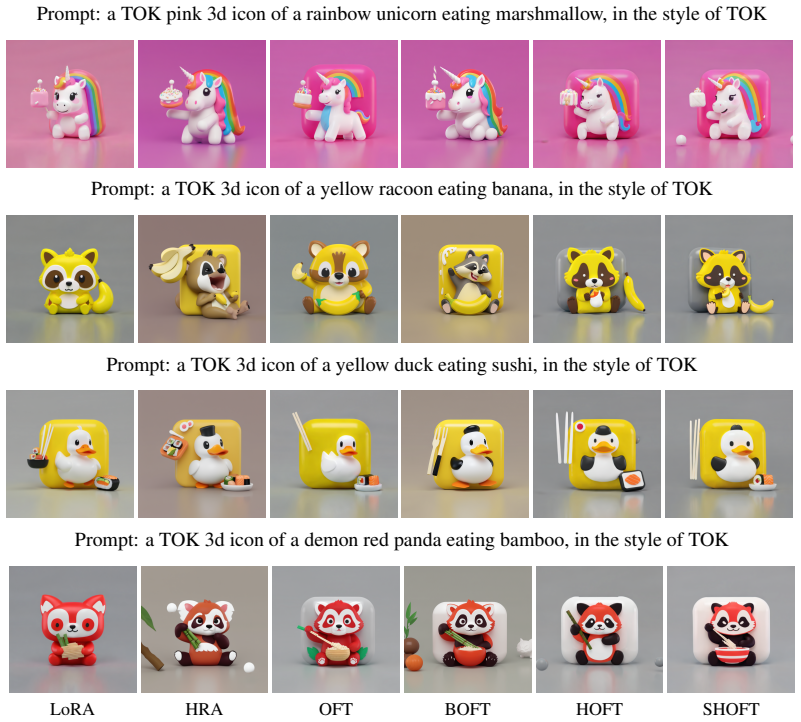
- The two-sided construction is cheap enough for practical use: HOFT is about 72.5% faster than DoRA on commonsense reasoning and about 72.1% faster than OFT on subject-driven generation, with peak memory between LoRA and DoRA.
- SHOFT's additional scaling vector is the only extra component, and SHOFT reaches the best MATH accuracy among all compared methods, which the paper attributes to the scaling transformation adjusting singular-value magnitudes.
- Quantized HOFT and SHOFT maintain the benefits of their non-quantized counterparts, outperforming QLoRA and QDoRA on most quantized mathematical reasoning benchmarks.
Reading between the lines
- The reachability argument is sound for matrices with identical singular values, but the paper's further identification of 'same hyperspherical energy' with 'same singular values' is not implied by the SVD construction: right multiplication by Q_V mixes columns, so the column-wise energy of Eq. (7) is not generally invariant. A sympathetic reading is to treat the energy-preservation framing as moti
- The one-sided Procrustes bound suggests a practical diagnostic: if validation error with one-sided orthogonal adaptation exceeds that of two-sided adaptation at matched parameter counts, the expressivity gap is likely the cause; the paper does not run this controlled comparison.
- Weight decay independence of the CWY product, shown in Appendix B, implies that in SHOFT the scaling vector is the only place weight decay can act, which could allow separate control of geometry and magnitude during training.
Editorial analysis
A structured set of objections, weighed in public.
Referee Report
Summary. The paper proposes Householder Orthogonal Fine-tuning (HOFT), a parameter-efficient fine-tuning method that multiplies a frozen weight matrix M on the left and right by learned orthogonal matrices QU and QV obtained by accumulating Householder reflections via the CWY transform with an approximate inverse, and a scaled variant SHOFT that adds a per-row magnitude vector. The authors claim that two orthogonal matrices are necessary for full expressivity in orthogonal fine-tuning, by arguing that any matrix with the same 'hyperspherical energy' as M can be written as QU M QV. They evaluate HOFT and SHOFT on commonsense reasoning, machine translation, subject-driven generation, mathematical reasoning, and quantized settings, reporting competitive or better results than LoRA, DoRA, OFT, BOFT, and HRA.
Significance. If the theoretical framing were correct and the empirical comparisons sound, the contribution would be useful: it is an efficient two-sided orthogonal PEFT method with O(r(m+n)) parameters, parallelizable Householder accumulation, and a scaled variant, evaluated across a broad set of tasks and model families. The SVD reachability statement underlying the two-sided construction is mathematically true and, when properly formulated, gives a clear motivation for using both left and right orthogonal factors. The breadth of the experiments (four task areas, several model families, and quantized models) is a strength, as is the explicit analysis of the inverse approximation error. However, the paper does not ship code, reports no error bars, and its central 'hyperspherical energy preservation' claim is contradicted by the paper's own definition and measurements, so the current version requires major revision.
major comments (3)
- [Section 3.1, Section 3.3, Eq. (7)] The central theoretical claim that the two-sided product QU M QV preserves hyperspherical energy is incorrect under the paper's own definition. Eq. (7) defines HE(W) as a sum over inverse pairwise distances between columns of W. Left multiplication by an orthogonal matrix QU is an isometry of the column space and preserves these distances, but right multiplication by QV mixes columns, so ||(M QV)_i - (M QV)_j|| is not generally equal to ||M_i - M_j||. The SVD argument in Section 3.1 establishes a different, true statement: any matrix with the same singular values as M can be written as QU M QV. Equal singular values do not imply equal HE under Eq. (7). Indeed, Figure 5 in Appendix B.1 shows |HE(M) - HE(QU M QV)| growing rapidly with rank, which is direct evidence against the preservation claim. Please reformulate the theory in terms of singular-value preservation (or define a different, right-multiplication-invariant notion of energy), and revise the abstract, Introduction, Section 3.3, and the proof of Eq. (1) in Appendix C accordingly.
- [Table 3 and Table 8] The machine translation comparison for LLaMA3.1-8B French is confounded by a learning-rate mismatch: OFT and BOFT use LR = 3e-3 (Table 8) while HOFT uses 3e-4 and LoRA/DoRA use 1e-4. The collapsed BLEU scores for OFT (21.5) and BOFT (22.1) versus LoRA (46.8) are therefore likely an artifact of an ill-tuned learning rate rather than evidence about the methods. Please retune OFT and BOFT (or use a common, properly tuned schedule) and re-run the comparison, or restrict the claim that HOFT/SHOFT 'produce superior results' over orthogonal baselines.
- [Section 4, Tables 2, 5, 6] All numbers are reported from a single run with no error bars, confidence intervals, or significance tests, and many HOFT/SHOFT advantages are under one accuracy point (e.g., Table 2 LLaMA3.1-8B average: HOFT 87.4 vs LoRA 87.0; Table 5 GSM8K: HOFT 56.6 vs HRA 56.3). The claim that HOFT and SHOFT 'consistently match or outperform' the baselines is not strongly supported without an estimate of run-to-run variability. Please report multiple seeds or significance tests, at least for the main tables, and moderate the wording of the conclusions.
minor comments (4)
- [Appendix C, Eq. (1)] The proof computes ||bQV - I||_F^2 = 2m - 2Tr(bQV) and obtains 4m, but bQV is an n×n orthogonal matrix, so the correct expression is 2n - 2Tr(bQV) and the final bound should be 2√n ||M||_F, not 2√m ||M||_F. This is a typo only if m = n, but it should be fixed for the general rectangular case.
- [Theorem 1] The statement of Theorem 1 says the result holds for an arbitrary vector τ with τ_i ≠ 0, but the two-step computation of S (upper triangular part of U^T U, diagonal halved) implicitly assumes τ_i = u_i^T u_i / 2. For other τ, the expression is false; please state the required relation between τ and U.
- [Appendix B.1, Figure 1] In the sentence defining the error in Figure 1, the normalization is written as √n but the matrices are m×m; it should be √m (or the notation should be clarified).
- [Appendix E.2] The sentence 'We will include the complete experimental protocol, hyperparameter settings, and detailed results in the revised manuscript' is out of place in a submitted manuscript and should be removed or replaced by the actual details.
Circularity Check
No significant circularity: HOFT's central two-sided reachability claim is self-contained SVD linear algebra, and its empirical evaluations use held-out benchmarks with external baselines.
full rationale
The paper's central theoretical claim, in Sections 3.1 and 3.3, is that pre- and post-multiplying a matrix M by orthogonal matrices QU and QV can express any adapted matrix cM with the same singular values as M. This is established by a direct SVD construction: if M = U Sigma V^T and cM = bU Sigma bV^T, then setting QU = bU U^T and QV = V bV^T gives QU M QV = cM. This is a self-contained linear-algebra existence result, not a quantity fitted to data and then relabeled as a prediction. No fitted parameters are disguised as predictions, and no load-bearing self-citation appears: the cited orthogonal fine-tuning works (OFT, BOFT, HRA) are external prior work, not the present authors' own results. The paper does make an incorrect identification when it equates 'preserving hyperspherical energy' with bSigma = Sigma in Section 3.1: under the paper's own definition in Eq. 7, hyperspherical energy is a function of column distances, and right multiplication by QV need not preserve those distances. However, this is a mathematical correctness issue about the energy-preservation framing, not a circularity in the derivation chain; the reachability statement about singular-value-preserving matrices remains an independent, verifiable theorem. Empirical claims are tested on standard held-out benchmarks (common sense reasoning, machine translation, subject-driven generation, mathematical reasoning) against external baselines, so the results are not forced by construction. The paper's derivation is therefore self-contained with respect to its inputs, and the appropriate circularity score is 0.
Assumptions & free parameters
free parameters (1)
- Householder rank r =
16, 8, 2, and 4 across tasks
assumptions (4)
- standard math Every real matrix M has an SVD M = U Σ V^T
- domain assumption Orthogonal adaptation preserves pre-trained knowledge and improves generalization via hyperspherical energy
- ad hoc to paper Same singular values imply same hyperspherical energy, so energy preservation reduces to keeping Σ unchanged
- domain assumption The two-term Neumann approximation produces matrices close enough to orthogonal for training
Cite this review
Pith. "Pith review of HOFT: Householder Orthogonal Fine-tuning." pith.science (2026). https://pith.science/paper/M33BKTXF
@misc{pith2026250516531,
  author       = {Pith},
  title        = {Pith review of: HOFT: Householder Orthogonal Fine-tuning},
  year         = {2026},
  howpublished = {\url{https://pith.science/paper/M33BKTXF}},
  note         = {Machine review of arXiv:2505.16531}
}
read the original abstract
Adaptation of foundation models using low-rank methods is a widespread approach. Another way to adapt these models is to employ orthogonal fine-tuning methods, which are less time and memory efficient despite their good generalization properties. In this work, we propose Householder Orthogonal Fine-tuning (HOFT), a novel orthogonal fine-tuning method that aims to alleviate time and space complexity. Moreover, some theoretical properties of the orthogonal fine-tuning paradigm are explored. From this exploration, Scaled Householder Orthogonal Fine-tuning (SHOFT) is proposed. Both HOFT and SHOFT are evaluated in downstream tasks, namely commonsense reasoning, machine translation, subject-driven generation and mathematical reasoning. Compared with state-of-the-art adaptation methods, HOFT and SHOFT show comparable or better results.
Figures


Figures from the paper (5 more)



Forward citations
Cited by 1 Pith paper
-
Deep Delta Learning
Replacing additive residual connections with a gated rank-1 delta update that interpolates identity, projection, and reflection slightly improves language modeling and downstream averages in reported 124M/353M runs.
Reference graph
Works this paper leans on
-
[1]
Phi-4 technical report.arXiv preprint arXiv:2412.08905, 2024
Marah Abdin, Jyoti Aneja, Harkirat Behl, Sébastien Bubeck, Ronen Eldan, Suriya Gunasekar, Michael Harrison, Russell J Hewett, Mojan Javaheripi, Piero Kauffmann, et al. Phi-4 technical report.arXiv preprint arXiv:2412.08905, 2024
arXiv 2024
-
[2]
Intrinsic dimensionality explains the effectiveness of language model fine-tuning
Armen Aghajanyan, Sonal Gupta, and Luke Zettlemoyer. Intrinsic dimensionality explains the effectiveness of language model fine-tuning. In Chengqing Zong, Fei Xia, Wenjie Li, and Roberto Navigli, editors,Proceedings of the 59th Annual Meeting of the Associ- ation for Computational Linguistics and the 11th International Joint Conference on Nat- ural Langua...
-
[3]
Rotrnn: Modelling long sequences with rotations.arXiv preprint arXiv:2407.07239, 2024
Kai Biegun, Rares Dolga, Jake Cunningham, and David Barber. Rotrnn: Modelling long sequences with rotations.arXiv preprint arXiv:2407.07239, 2024
arXiv 2024
-
[4]
Piqa: Reasoning about phys- ical commonsense in natural language
Yonatan Bisk, Rowan Zellers, Jianfeng Gao, Yejin Choi, et al. Piqa: Reasoning about phys- ical commonsense in natural language. InProceedings of the AAAI conference on artificial intelligence, volume 34, pages 7432–7439, 2020
2020
-
[5]
Thibaut Boissin, Franck Mamalet, Thomas Fel, Agustin Martin Picard, Thomas Massena, and Mathieu Serrurier. An adaptive orthogonal convolution scheme for efficient and flexible cnn architectures.arXiv preprint arXiv:2501.07930, 2025
arXiv 2025
-
[6]
Oran Brigham.The Fast Fourier Transform and Its Applications
E. Oran Brigham.The Fast Fourier Transform and Its Applications. Prentice Hall, Englewood Cliffs, NJ, 2 edition, 1974. ISBN 978-0133075052
work page 1974
-
[7]
Emerging properties in self-supervised vision transformers
Mathilde Caron, Hugo Touvron, Ishan Misra, Hervé Jégou, Julien Mairal, Piotr Bojanowski, and Armand Joulin. Emerging properties in self-supervised vision transformers. InProceedings of the IEEE/CVF international conference on computer vision, pages 9650–9660, 2021
2021
-
[8]
Boolq: Exploring the surprising difficulty of natural yes/no questions
Christopher Clark, Kenton Lee, Ming-Wei Chang, Tom Kwiatkowski, Michael Collins, and Kristina Toutanova. Boolq: Exploring the surprising difficulty of natural yes/no questions. In Proceedings of NAACL-HLT, pages 2924–2936, 2019
work page 2019
Show all 57 references
-
[9]
Think you have solved question answering? try arc, the ai2 reasoning challenge.arXiv preprint arXiv:1803.05457, 2018
Peter Clark, Isaac Cowhey, Oren Etzioni, Tushar Khot, Ashish Sabharwal, Carissa Schoenick, and Oyvind Tafjord. Think you have solved question answering? try arc, the ai2 reasoning challenge.arXiv preprint arXiv:1803.05457, 2018
2018 arXiv
-
[10]
Training verifiers to solve math word problems.arXiv preprint arXiv:2110.14168, 2021
Karl Cobbe, Vineet Kosaraju, Mohammad Bavarian, Mark Chen, Heewoo Jun, Lukasz Kaiser, Matthias Plappert, Jerry Tworek, Jacob Hilton, Reiichiro Nakano, et al. Training verifiers to solve math word problems.arXiv preprint arXiv:2110.14168, 2021
-
[11]
No language left behind: Scaling human-centered machine translation.arXiv preprint arXiv:2207.04672, 2022
Marta R Costa-Jussà, James Cross, Onur Çelebi, Maha Elbayad, Kenneth Heafield, Kevin Heffernan, Elahe Kalbassi, Janice Lam, Daniel Licht, Jean Maillard, et al. No language left behind: Scaling human-centered machine translation.arXiv preprint arXiv:2207.04672, 2022. 10
2022 arXiv
-
[12]
Qlora: Efficient finetuning of quantized llms.NeurIPS, 2024
Tim Dettmers, Artidoro Pagnoni, Ari Holtzman, and Luke Zettlemoyer. Qlora: Efficient finetuning of quantized llms.NeurIPS, 2024
2024
-
[13]
O-vit: Orthogonal vision transformer
Yanhong Fei, Yingjie Liu, Xian Wei, and Mingsong Chen. O-vit: Orthogonal vision transformer. arXiv preprint arXiv:2201.12133, 2022
2022 arXiv
-
[14]
Golub and Charles F
Gene H. Golub and Charles F. Van Loan.Matrix Computations. Johns Hopkins University Press, Baltimore, MD, 4th edition, 2013. ISBN 978-1421407944
2013
-
[15]
Gower and Garmt B
John C. Gower and Garmt B. Dijksterhuis.Procrustes Problems, volume 30 ofOxford Statistical Science Series. Oxford University Press, Oxford, UK, 2004. ISBN 9780198510581. doi: 10.1093/acprof:oso/9780198510581.001.0001
2004
-
[16]
The llama 3 herd of models.arXiv preprint arXiv:2407.21783, 2024
Aaron Grattafiori, Abhimanyu Dubey, Abhinav Jauhri, Abhinav Pandey, Abhishek Kadian, Ahmad Al-Dahle, Aiesha Letman, Akhil Mathur, Alan Schelten, Alex Vaughan, et al. The llama 3 herd of models.arXiv preprint arXiv:2407.21783, 2024
2024 arXiv
-
[17]
To- wards a unified view of parameter-efficient transfer learning.arXiv preprint arXiv:2110.04366, 2021
Junxian He, Chunting Zhou, Xuezhe Ma, Taylor Berg-Kirkpatrick, and Graham Neubig. To- wards a unified view of parameter-efficient transfer learning.arXiv preprint arXiv:2110.04366, 2021
2021 arXiv
-
[18]
Parameter-efficient transfer learning for nlp
Neil Houlsby, Andrei Giurgiu, Stanislaw Jastrzebski, Bruna Morrone, Quentin De Laroussilhe, Andrea Gesmundo, Mona Attariyan, and Sylvain Gelly. Parameter-efficient transfer learning for nlp. InInternational conference on machine learning, pages 2790–2799. PMLR, 2019
2019
-
[19]
Lora: Low-rank adaptation of large language models.ICLR, 1 (2):3, 2022
Edward J Hu, Yelong Shen, Phillip Wallis, Zeyuan Allen-Zhu, Yuanzhi Li, Shean Wang, Lu Wang, Weizhu Chen, et al. Lora: Low-rank adaptation of large language models.ICLR, 1 (2):3, 2022
2022
-
[20]
Fedpara: Low-rank hadamard product for communication-efficient federated learning
Nam Hyeon-Woo, Moon Ye-Bin, and Tae-Hyun Oh. Fedpara: Low-rank hadamard product for communication-efficient federated learning. InInternational Conference on Learning Representations, 2022
2022
-
[21]
Quintana-Ortí, Robert van de Geijn, and Field G
Thierry Joffrain, Tze Meng Low, Enrique S. Quintana-Ortí, Robert van de Geijn, and Field G. Van Zee. Accumulating householder transformations, revisited.ACM Trans. Math. Softw., 32(2):169–179, June 2006. ISSN 0098-3500. doi: 10.1145/1141885.1141886. URL https: //doi.org/10.114...
2006
-
[22]
Kshitij Khare and Christopher V . Stewart. Random Orthogonal Matrices and the Cayley Transform.Bernoulli, 26(2):807–825, 2019
2019
-
[23]
Kopiczko, Tijmen Blankevoort, and Yuki M
Dawid J. Kopiczko, Tijmen Blankevoort, and Yuki M. Asano. Vera: Vector-based random matrix adaptation.ICLR, 2024
2024
-
[24]
Vb-lora: Extreme parameter efficient fine-tuning with vector banks.NeurIPS, 2024
Yang Li, Shaobo Han, and Shihao Ji. Vb-lora: Extreme parameter efficient fine-tuning with vector banks.NeurIPS, 2024
2024
-
[25]
Cwy parametrization: a solution for parallelized optimization of orthogonal and stiefel matrices
Valerii Likhosherstov, Jared Davis, Krzysztof Choromanski, and Adrian Weller. Cwy parametrization: a solution for parallelized optimization of orthogonal and stiefel matrices. In International Conference on Artificial Intelligence and Statistics, pages 55–63. PMLR, 2021
2021
-
[26]
Regularizing neural networks via minimizing hyperspherical energy.Conference on Computer Vision and Pattern Recognition, 2020
Rongmei Lin, Weiyang Liu, Zhen Liu, Chen Feng, Zhiding Yu, James M Rehg, Li Xiong, and Le Song. Regularizing neural networks via minimizing hyperspherical energy.Conference on Computer Vision and Pattern Recognition, 2020
2020
-
[27]
Dora: Weight-decomposed low-rank adaptation
Shih-Yang Liu, Chien-Yi Wang, Hongxu Yin, Pavlo Molchanov, Yu-Chiang Frank Wang, Kwang-Ting Cheng, and Min-Hung Chen. Dora: Weight-decomposed low-rank adaptation. In Forty-first International Conference on Machine Learning, 2024
2024
-
[28]
Learning towards minimum hyperspherical energy.NeurIPS, 2018
Weiyang Liu, Rongmei Lin, Zhen Liu, Lixin Liu, Zhiding Yu, Bo Dai, and Le Song. Learning towards minimum hyperspherical energy.NeurIPS, 2018
2018
-
[29]
Parameter-efficient orthogonal finetuning via butterfly factorization.International Conference on Learning Representations, 2024
Weiyang Liu, Zeju Qiu, Yao Feng, Yuliang Xiu, Yuxuan Xue, Longhui Yu, Haiwen Feng, Zhen Liu, Juyeon Heo, Songyou Peng, et al. Parameter-efficient orthogonal finetuning via butterfly factorization.International Conference on Learning Representations, 2024. 11
2024
-
[30]
Pissa: Principal singular values and singular vectors adaptation of large language models.Advances in Neural Information Processing Systems, 37:121038–121072, 2024
Fanxu Meng, Zhaohui Wang, and Muhan Zhang. Pissa: Principal singular values and singular vectors adaptation of large language models.Advances in Neural Information Processing Systems, 37:121038–121072, 2024
2024
-
[31]
Can a suit of armor conduct electricity? a new dataset for open book question answering
Todor Mihaylov, Peter Clark, Tushar Khot, and Ashish Sabharwal. Can a suit of armor conduct electricity? a new dataset for open book question answering. InProceedings of the 2018 Conference on Empirical Methods in Natural Language Processing, pages 2381–2391, 2018
2018
-
[32]
Orca-math: Unlocking the potential of slms in grade school math.arXiv preprint arXiv:2402.14830, 2024
Arindam Mitra, Hamed Khanpour, Corby Rosset, and Ahmed Awadallah. Orca-math: Unlocking the potential of slms in grade school math.arXiv preprint arXiv:2402.14830, 2024
2024 arXiv
-
[33]
Bleu: a method for automatic evaluation of machine translation
Kishore Papineni, Salim Roukos, Todd Ward, and Wei-Jing Zhu. Bleu: a method for automatic evaluation of machine translation. InProceedings of the 40th Annual Meeting on Association for Computational Linguistics, ACL ’02, page 311–318, USA, 2002. Association for Computational L...
2002
-
[34]
Sdxl: Improving latent diffusion models for high-resolution image synthesis
Dustin Podell, Zion English, Kyle Lacey, Andreas Blattmann, Tim Dockhorn, Jonas Müller, Joe Penna, and Robin Rombach. Sdxl: Improving latent diffusion models for high-resolution image synthesis. InThe Twelfth International Conference on Learning Representations, 2023
2023
-
[35]
A call for clarity in reporting BLEU scores
Matt Post. A call for clarity in reporting BLEU scores. InProceedings of the Third Conference on Machine Translation: Research Papers, pages 186–191, Brussels, Belgium, October 2018. Association for Computational Linguistics. doi: 10.18653/v1/W18-6319. URL https:// aclantholog...
2018 doi
-
[36]
Controlling text-to-image diffusion by orthogonal finetuning
Zeju Qiu, Weiyang Liu, Haiwen Feng, Yuxuan Xue, Yao Feng, Zhen Liu, Dan Zhang, Adrian Weller, and Bernhard Schölkopf. Controlling text-to-image diffusion by orthogonal finetuning. Advances in Neural Information Processing Systems, 36:79320–79362, 2023
2023
-
[37]
Learning transferable visual models from natural language supervision
Alec Radford, Jong Wook Kim, Chris Hallacy, Aditya Ramesh, Gabriel Goh, Sandhini Agarwal, Girish Sastry, Amanda Askell, Pamela Mishkin, Jack Clark, et al. Learning transferable visual models from natural language supervision. InInternational conference on machine learning, pag...
2021
-
[38]
COMET: A neural framework for MT evaluation
Ricardo Rei, Craig Stewart, Ana C Farinha, and Alon Lavie. COMET: A neural framework for MT evaluation. InProceedings of the 2020 Conference on Empirical Methods in Natural Language Processing (EMNLP), pages 2685–2702, Online, November 2020. Association for Computational Lingu...
2020 doi
-
[39]
Ricardo Rei, José G. C. de Souza, Duarte Alves, Chrysoula Zerva, Ana C Farinha, Taisiya Glushkova, Alon Lavie, Luisa Coheur, and André F. T. Martins. COMET-22: Unbabel-IST 2022 submission for the metrics shared task. In Philipp Koehn, Loïc Barrault, Ond ˇrej Bojar, Fethi Bouga...
2022
-
[40]
High- resolution image synthesis with latent diffusion models
Robin Rombach, Andreas Blattmann, Dominik Lorenz, Patrick Esser, and Björn Ommer. High- resolution image synthesis with latent diffusion models. InProceedings of the IEEE/CVF conference on computer vision and pattern recognition, pages 10684–10695, 2022
2022
-
[41]
Dreambooth: Fine tuning text-to-image diffusion models for subject-driven generation
Nataniel Ruiz, Yuanzhen Li, Varun Jampani, Yael Pritch, Michael Rubinstein, and Kfir Aberman. Dreambooth: Fine tuning text-to-image diffusion models for subject-driven generation. In Proceedings of the IEEE/CVF conference on computer vision and pattern recognition, pages 22500...
2023
-
[42]
Winogrande: An adversarial winograd schema challenge at scale.Communications of the ACM, 64(9):99–106, 2021
Keisuke Sakaguchi, Ronan Le Bras, Chandra Bhagavatula, and Yejin Choi. Winogrande: An adversarial winograd schema challenge at scale.Communications of the ACM, 64(9):99–106, 2021
2021
-
[43]
Social iqa: Commonsense reasoning about social interactions
Maarten Sap, Hannah Rashkin, Derek Chen, Ronan Le Bras, and Yejin Choi. Social iqa: Commonsense reasoning about social interactions. InProceedings of the 2019 Conference on Empirical Methods in Natural Language Processing and the 9th International Joint Conference on Natural L...
2019
-
[44]
Elrt: Efficient low-rank training for compact convolutional neural networks.arXiv preprint arXiv:2401.10341, 2024
Yang Sui, Miao Yin, Yu Gong, Jinqi Xiao, Huy Phan, and Bo Yuan. Elrt: Efficient low-rank training for compact convolutional neural networks.arXiv preprint arXiv:2401.10341, 2024
2024 arXiv
-
[45]
Llama 2: Open foundation and fine-tuned chat models.arXiv preprint arXiv:2307.09288, 2023
Hugo Touvron, Louis Martin, Kevin Stone, Peter Albert, Amjad Almahairi, Yasmine Babaei, Nikolay Bashlykov, Soumya Batra, Prajjwal Bhargava, Shruti Bhosale, et al. Llama 2: Open foundation and fine-tuned chat models.arXiv preprint arXiv:2307.09288, 2023
2023 arXiv
-
[46]
Dylora: Parameter- efficient tuning of pre-trained models using dynamic search-free low-rank adaptation
Mojtaba Valipour, Mehdi Rezagholizadeh, Ivan Kobyzev, and Ali Ghodsi. Dylora: Parameter- efficient tuning of pre-trained models using dynamic search-free low-rank adaptation. In Proceedings of the 17th Conference of the European Chapter of the Association for Computa- tional L...
2023
-
[47]
Covost 2 and massively multilingual speech-to-text translation.arXiv preprint arXiv:2007.10310, 2020
Changhan Wang, Anne Wu, and Juan Pino. Covost 2 and massively multilingual speech-to-text translation.arXiv preprint arXiv:2007.10310, 2020
2007 arXiv
-
[48]
Towards better orthogonality regularization with disentangled norm in training deep cnns.arXiv preprint arXiv:2306.09939, 2023
Changhao Wu, Shenan Zhang, Fangsong Long, Ziliang Yin, and Tuo Leng. Towards better orthogonality regularization with disentangled norm in training deep cnns.arXiv preprint arXiv:2306.09939, 2023
2023 arXiv
-
[49]
Qa-lora: Quantization-aware low-rank adaptation of large language models
Yuhui Xu, Lingxi Xie, Xiaotao Gu, Xin Chen, Heng Chang, Hengheng Zhang, Zhengsu Chen, Xiaopeng Zhang, and Qi Tian. Qa-lora: Quantization-aware low-rank adaptation of large language models. InICLR, 2024
2024
-
[50]
An Yang, Baosong Yang, Beichen Zhang, Binyuan Hui, Bo Zheng, Bowen Yu, Chengyuan Li, Dayiheng Liu, Fei Huang, Haoran Wei, et al. Qwen2. 5 technical report.arXiv preprint arXiv:2412.15115, 2024
2024 arXiv
-
[51]
Navigating text-to-image customization: From lycoris fine-tuning to model evaluation
Shih-Ying Yeh, Yu-Guan Hsieh, Zhidong Gao, Bernard BW Yang, Giyeong Oh, and Yanmin Gong. Navigating text-to-image customization: From lycoris fine-tuning to model evaluation. InThe Twelfth International Conference on Learning Representations, 2023
2023
-
[52]
Metamath: Bootstrap your own mathematical questions for large language models
Longhui Yu, Weisen Jiang, Han Shi, YU Jincheng, Zhengying Liu, Yu Zhang, James Kwok, Zhenguo Li, Adrian Weller, and Weiyang Liu. Metamath: Bootstrap your own mathematical questions for large language models. InThe Twelfth International Conference on Learning Representations, 2023
2023
-
[53]
Bridging the gap between low-rank and orthogonal adaptation via householder reflection adaptation.NeurIPS, 2024
Shen Yuan, Haotian Liu, and Hongteng Xu. Bridging the gap between low-rank and orthogonal adaptation via householder reflection adaptation.NeurIPS, 2024
2024
-
[54]
Hellaswag: Can a machine really finish your sentence? InProceedings of the 57th Annual Meeting of the Association for Computational Linguistics, pages 4791–4800, 2019
Rowan Zellers, Ari Holtzman, Yonatan Bisk, Ali Farhadi, and Yejin Choi. Hellaswag: Can a machine really finish your sentence? InProceedings of the 57th Annual Meeting of the Association for Computational Linguistics, pages 4791–4800, 2019
2019
-
[55]
Adaptive budget allocation for parameter-efficient fine-tuning
Qingru Zhang, Minshuo Chen, Alexander Bukharin, Pengcheng He, Yu Cheng, Weizhu Chen, and Tuo Zhao. Adaptive budget allocation for parameter-efficient fine-tuning. In11th Interna- tional Conference on Learning Representations, ICLR 2023, 2023
2023
-
[56]
Efros, Eli Shechtman, and Oliver Wang
Richard Zhang, Phillip Isola, Alexei A. Efros, Eli Shechtman, and Oliver Wang. The unreason- able effectiveness of deep features as a perceptual metric. InProceedings of the 31st IEEE/CVF Conference on Computer Vision and Pattern Recognition (CVPR 2018), pages 586–595, Salt La...
2018
-
[2021]
doi: 10.18653/v1/2021.acl-long.568
Association for Computational Linguistics. doi: 10.18653/v1/2021.acl-long.568. URL https://aclanthology.org/2021.acl-long.568/
2021 doi
Reviewed August 7, 2026 · model on record in the stance chip above.
Discussion (0). Sign in to comment.