REVIEW 3 major objections 5 minor 82 references
Single Domain Generalization for Few-Shot Counting via Universal Representation Matching
T0 review · 3 major / 5 minor · reviewed 2026-08-07 · deepseek-v4-flash
Pith's one-line read Distilling CLIP prototypes lets few-shot counters cross domains
desk verdict A genuinely new setting and a plausible CLIP-distillation method, but hyperparameters tuned on the target test set undermine the DG claim until fixed. read the letter →
The pith
A machine-rendered reading of the paper's core claim, the machinery that carries it, and where it could break.
The reading
What carries the argument
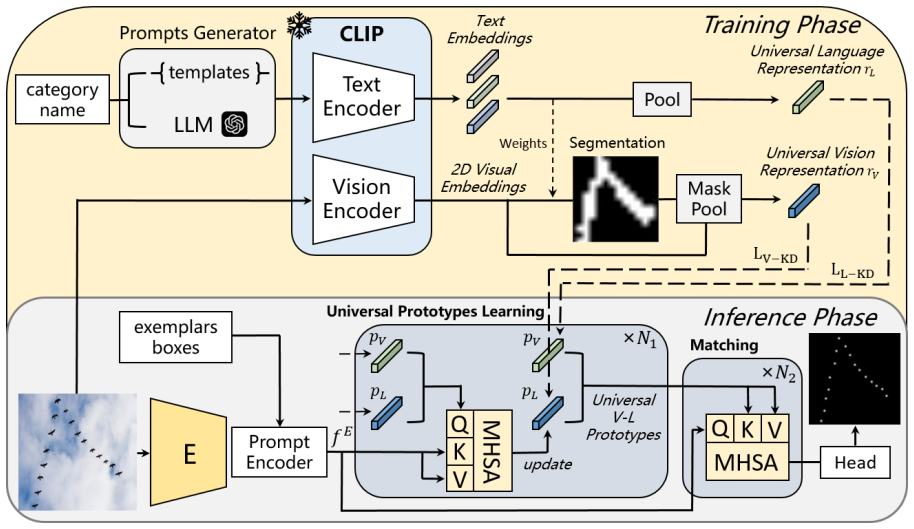
The load-bearing object is the pair of universal vision-language prototypes $p_v, p_l \in \mathbb{R}^{n\times d}$, learnable embeddings that are iteratively updated by cross-attention layers against the encoded image feature while being pulled toward CLIP's representations by feature-mimicry losses. The vision teacher is a MaskCLIP-style dense mask pooled into region-level embeddings $r_v$; the language teacher is the mean $r_l$ of CLIP text embeddings for hand-written and LLM-generated descriptive prompts of the category. Distillation runs only during training; at inference the prototypes are matched against the image feature through cross-attention to produce the correlation map, so the deployed model adds no parameters or latency relative to standard extract-then-match counters.
What would settle it
Audit CLIP's training data for near-duplicates of FSC-147 and FSCD-LVIS test images, or train URM with a CLIP teacher whose pretraining data provably excludes those categories; if cross-domain MAE collapses to the vanilla baseline, the universal-representation claim is not supported.
Extended reading notes
Core claim
The paper's central claim is that the bottleneck in few-shot counting under domain shift is the prototypes, not the matching module: representations learned from a single narrow source distribution carry that narrowness into the correlation construction. URM therefore initializes visual and language prototypes as learnable embeddings, refines them through cross-attention with the encoded image, and simultaneously distills into them the class-aware visual representations from MaskCLIP and the averaged text embeddings of LLM-generated category prompts from CLIP's frozen encoders. Matching then runs cross-attention between the concatenated prototypes and the image feature to build the correlation map, which a regression head converts into a density map whose integral is the count. Cross-dataset experiments show MAE improving from 25.11 to 21.87 (FSC-147 to FSCD-LVIS) and from 22.07 to 21.17 (FSCD-LVIS to FSC-147) over the strongest prior single-domain generalization method, and in-domain test MAE of 10.15 on FSC-147, with 8.32 when combined with the DAVE post-processing.
Load-bearing premise
The result depends on CLIP's pretraining corpus not having substantially covered the target domains; if CLIP already saw the FSC-147 or FSCD-LVIS images or their object categories, the reported generalization gains would partly reflect memorized knowledge rather than a universal representation.
Editorial extensions
If this is right
- A single narrow source domain is enough for class-agnostic counting generalization when prototypes are anchored in a large-scale vision-language space, making sub-domain division and whitening unnecessary.
- Because distillation happens only during training, the deployed URM counter has the same inference speed and parameter count as standard extract-then-match models.
- Language-only distillation already recovers most of the cross-domain gain, and combining vision and language at a weight of $\alpha = 0.9$ performs best, indicating the text-aligned space carries much of the transferable signal.
- The same prototype-anchoring improves zero-shot counting with no annotated exemplars, with MAE 23.54 on FSC-147 to FSCD-LVIS and 27.49 in the reverse direction.
- In-domain accuracy also improves (FSC-147 test MAE 10.15, and 8.32 when combined with DAVE), so robustness does not come at the cost of source-domain performance.
Reading between the lines
- If the overlap concern is controlled, the distillation recipe transfers to other dense prediction tasks such as detection and segmentation, where narrow source distributions similarly limit prototype-based matching.
- The paper's t-SNE evidence that distilled prototypes form open-set boundaries could be quantified with a separation metric on held-out categories, turning a qualitative motivation into a testable hypothesis.
- Because language-only distillation is already strong, a variant that relies solely on LLM-generated category descriptions might work even where CLIP's image tower is unavailable or misaligned with the target visual domain.
- The teacher-choice ablation hints that counting MAE may scale with the teacher's open-vocabulary segmentation quality rather than its ImageNet accuracy, a relation the paper does not explore.
Editorial analysis
A structured set of objections, weighed in public.
Referee Report
Summary. The paper proposes URM, a few-shot counting model for single-domain generalization. The method builds on the standard extract-then-match pipeline: a ResNet-50 backbone with frozen ImageNet weights extracts features, a prompt encoder encodes exemplar boxes, and learnable vision/language prototypes are updated with cross-attention layers and used to construct a correlation map for density regression. The main novelty is distilling CLIP representations into the prototypes during training: a MaskCLIP-derived masked pooling feature is used for the vision prototype, and text embeddings of LLM-generated prompts are used for the language prototype. The authors train only on the source dataset and freeze CLIP during training. They evaluate on cross-domain FSC-147 ↔ FSCD-LVIS (few-shot and zero-shot) and on the in-domain FSC-147 benchmark, reporting substantial improvements over prior methods in the cross-domain setting and claiming state-of-the-art in-domain performance.
Significance. If the claims were fully supported, the paper would make a meaningful contribution: it introduces a new setting (single-domain generalization for few-shot counting), proposes a practical way to inject frozen CLIP knowledge into a lightweight student, and releases code. The extensive ablations over distillation weight, layer counts, and CLIP variants are useful, and the idea of distilling both visual and language sides of CLIP into learnable prototypes is a concrete, reproducible design. However, the central generalization claim is currently supported by an evaluation protocol that tunes hyperparameters on the target test set, and the in-domain state-of-the-art claim is directly contradicted by Table 6. The pretraining overlap between CLIP and the target datasets is not audited, which further weakens the 'unseen domain' claim. The method itself is coherent and could be valuable, but the evidence as presented does not yet establish the headline conclusion.
major comments (3)
- [§4.1, §4.3, Tables 3–4] The single-domain generalization claim is undermined by hyperparameter selection on the target test set. Section 4.1 defines each cross-domain setting as training on one dataset's full train split and evaluating on the other dataset's entire test split, without a held-out validation split for the cross-domain regime. The ablations in Tables 3 and 4 then select alpha and the layer counts N1, N2 by minimizing MAE on the FSC-147→FSCD-LVIS few-shot test setting, and the final configuration (alpha=0.9, N1=N2=3) is the one that scores best on that test set. The same test set is then used in the headline comparison of Table 1. Since the paper does not report that these hyperparameters were fixed a priori or chosen on a source-only validation set, the reported improvement over MPCount is consistent with target-test-informed model selection rather than single-domain generalization. Please re-run the ablation selection on a source-validation split, or explicitly argue why target-test-tuning does not affect the DG claim, or report results for hyperparameters chosen without target labels.
- [Abstract, §4.4, Table 6] The abstract's claim that URM achieves state-of-the-art in-domain performance 'without compromising in domain performance' is contradicted by Table 6: on the FSC-147 test set, URM alone reports MAE 10.15, while DAVE reports MAE 8.66. The 'surpassing' statement is only true for URM+DAVE, which is a hybrid method, not URM itself. The sentence in Section 4.4 stating 'URM outperforms state-of-the-art few-shot counting models in terms of in-domain performance' is likewise only accurate for the URM+DAVE row. Please correct the abstract and Section 4.4 to distinguish URM alone from URM+DAVE, and temper the claim accordingly.
- [§3.1, §4.1] The claim that the target domain is 'unseen' is not established because the frozen CLIP teacher may have been pretrained on images or object categories from the target datasets FSC-147 and FSCD-LVIS. FSC-147 is drawn from the internet and FSCD-LVIS is derived from LVIS/COCO, both of which are plausible components of web-scale image-text pretraining corpora. If CLIP already saw those images or their object categories, the reported generalization gains could partly reflect the teacher's memorized or category-aligned knowledge rather than a universal, domain-invariant representation. Please audit and report the overlap between the target test images/categories and CLIP's training data, or provide a comparison using a teacher with verified exclusion of the target distribution, or at minimum discuss this limitation explicitly.
minor comments (5)
- [§4.3, after Table 3] The text says 'when alpha=0 or alpha=1, where only vision or language knowledge is introduced respectively', but from Eq. (5), alpha=0 gives language-only distillation and alpha=1 gives vision-only distillation; the mapping is reversed.
- [Abstract, §4.4] The phrase 'without compromising in domain performance' should be revised to refer specifically to URM+DAVE, since URM alone is 1.49 MAE worse than DAVE on the FSC-147 test set.
- [Tables 1–6] No error bars or repeated-run statistics are reported for any table. Given the hyperparameter-sensitivity shown in Tables 3–4, reporting at least three seeds with mean and standard deviation would materially strengthen the claims.
- [Appendix, Table 9] The table header mixes 'MSE' with the RMSE-style values used elsewhere; please use consistent terminology and units (e.g., MAE and RMSE) throughout the appendix.
- [Eq. (2), Eq. (3)] The norm in the feature-mimicry losses is not defined; please specify it as the L2 norm or another explicit norm.
Circularity Check
Partial circularity: the cross-domain hyperparameters (alpha, N1, N2) are selected by minimizing MAE on the target test set, so the headline single-domain-generalization result is partly target-informed; the CLIP distillation mechanism itself is not circular.
-
fitted input called prediction
[Section 4.1 (Experimental setting), Section 4.3 (Ablation of distillation weight / number of layers), Tables 3-4, and Table 1]
"The distillation weight α in Equation (5) is set to 0.9. The number of cross attention layers is N1 = N2 = 3. ... we conduct an ablation study on the weight to fully understand its impact. As shown in Table 3 ... Setting α = 0.9 yields the best performance ... The results in Table 4 show that N1 = N2 = 3 achieves the best performance. ... the full training dataset of one is regarded as the source domain, while other entire test dataset is regarded as the target domain."
The cross-domain protocol defines the target as the other dataset's entire test split. The alpha and N1/N2 ablations are reported on the FSC-147→FSCD-LVIS few-shot test setting, and the values that minimize MAE/RMSE on that test set (alpha=0.9, N1=N2=3) are then fixed and used for the Table 1 state-of-the-art comparison on the same target test set. Thus the headline 'generalization' number is not a source-only prediction: target test labels influenced model selection. The reported margin over MPCount is partly an artifact of target-test-informed hyperparameter choice. This is a fitted-input-called-prediction pattern, though it does not infect the distillation loss itself.
full rationale
The paper is an empirical combination of a frozen external CLIP teacher and a learned few-shot counting student; Equations (2)-(5) do not assume the claimed generalization result, so there is no equation-level circularity. The main concern is protocol-level: the cross-domain setting uses the target's entire test split, and the ablation studies in Tables 3 and 4 select alpha and N1/N2 by minimizing MAE on the FSC-147→FSCD-LVIS few-shot test setting. Those selected values are then reported as the implementation and used for the Table 1 headline comparison on the same test set, making the headline result partly target-informed. I do not count the CLIP pretraining overlap concern as circularity: it is a data-leakage risk, not a derivation reducing to its inputs. The minor author self-citation [5] (DearKD) is used only to justify feature mimicry and is not load-bearing. The in-domain discrepancy with DAVE in Table 6 is an accuracy inconsistency rather than a circular step. Overall, one fitted-input/called-prediction issue warrants a partial circularity score.
Assumptions & free parameters
free parameters (3)
- alpha (distillation weight) =
0.9
- N1 (prototype learning layers) =
3
- N2 (matching layers) =
3
assumptions (4)
- domain assumption CLIP's pretrained representation is domain-invariant and universal
- ad hoc to paper Feature mimicry distillation transfers CLIP knowledge to the small prototypes
- domain assumption LLM-generated and hand-written prompts capture the discriminative characteristics of arbitrary categories
- domain assumption The ResNet50 backbone features used for counting are sufficient even when frozen
invented entities (2)
-
Universal vision prototype (p_v)
-
Universal language prototype (p_l)
Cite this review
Pith. "Pith review of Single Domain Generalization for Few-Shot Counting via Universal Representation Matching." pith.science (2026). https://pith.science/paper/2LZY5LBS
@misc{pith2026250516778,
  author       = {Pith},
  title        = {Pith review of: Single Domain Generalization for Few-Shot Counting via Universal Representation Matching},
  year         = {2026},
  howpublished = {\url{https://pith.science/paper/2LZY5LBS}},
  note         = {Machine review of arXiv:2505.16778}
}
read the original abstract
Few-shot counting estimates the number of target objects in an image using only a few annotated exemplars. However, domain shift severely hinders existing methods to generalize to unseen scenarios. This falls into the realm of single domain generalization that remains unexplored in few-shot counting. To solve this problem, we begin by analyzing the main limitations of current methods, which typically follow a standard pipeline that extract the object prototypes from exemplars and then match them with image feature to construct the correlation map. We argue that existing methods overlook the significance of learning highly generalized prototypes. Building on this insight, we propose the first single domain generalization few-shot counting model, Universal Representation Matching, termed URM. Our primary contribution is the discovery that incorporating universal vision-language representations distilled from a large scale pretrained vision-language model into the correlation construction process substantially improves robustness to domain shifts without compromising in domain performance. As a result, URM achieves state-of-the-art performance on both in domain and the newly introduced domain generalization setting.
Figures


Figures from the paper (2 more)


Reference graph
Works this paper leans on
-
[1]
Gpt-4 technical report
OpenAI Josh Achiam, Steven Adler, Sandhini Agarwal, and et al. Gpt-4 technical report. 2023. 2, 5, 8
2023
-
[2]
Open-world text-specified object count- ing.arXiv preprint arXiv:2306.01851, 2023
Niki Amini-Naieni, Kiana Amini-Naieni, Tengda Han, and Andrew Zisserman. Open-world text-specified object count- ing.arXiv preprint arXiv:2306.01851, 2023. 3
arXiv 2023
-
[3]
Introducing the next generation of claude
anthropic. Introducing the next generation of claude. 2024. 8
2024
-
[4]
Explicit invariant feature induced cross-domain crowd counting
Yiqing Cai, Lianggangxu Chen, Haoyue Guan, Shaohui Lin, Changhong Lu, Changbo Wang, and Gaoqi He. Explicit invariant feature induced cross-domain crowd counting. In AAAI Conference on Artificial Intelligence, 2023. 3
work page 2023
-
[5]
Xianing Chen, Qiong Cao, Yujie Zhong, Jing Zhang, Shenghua Gao, and Dacheng Tao. Dearkd: Data-efficient early knowledge distillation for vision transformers.2022 IEEE/CVF Conference on Computer Vision and Pattern Recognition (CVPR), pages 12042–12052, 2022. 3
work page 2022
-
[6]
Xi Chen, Shuang Li, Ser Nam Lim, Antonio Torralba, and Hengshuang Zhao. Open-vocabulary panoptic segmentation with embedding modulation.2023 IEEE/CVF International Conference on Computer Vision (ICCV), pages 1141–1150,
work page 2023
-
[7]
Transfer clip for generalizable image denoising.ArXiv, abs/2403.15132,
Junting Cheng, Dong Liang, and Shan Tan. Transfer clip for generalizable image denoising.ArXiv, abs/2403.15132,
-
[8]
Mehdi Cherti, Romain Beaumont, Ross Wightman, Mitchell Wortsman, Gabriel Ilharco, Cade Gordon, Christoph Schuh- mann, Ludwig Schmidt, and Jenia Jitsev. Reproducible scaling laws for contrastive language-image learning.2023 IEEE/CVF Conference on Computer Vision and Pattern Recognition (CVPR), pages 2818–2829, 2022. 8
work page 2023
Show all 82 references
-
[9]
Sungha Choi, Sanghun Jung, Huiwon Yun, Joanne Taery Kim, Seungryong Kim, and Jaegul Choo. Robustnet: Im- proving domain generalization in urban-scene segmentation via instance selective whitening.2021 IEEE/CVF Confer- ence on Computer Vision and Pattern Recognition (CVPR), pag...
2021
-
[10]
A low-shot object counting network with iterative proto- type adaptation.2023 IEEE/CVF International Conference on Computer Vision (ICCV), 2022
Nikola Djukic, Alan Luke, Vitjan Zavrtanik, and Matej Kris- tan. A low-shot object counting network with iterative proto- type adaptation.2023 IEEE/CVF International Conference on Computer Vision (ICCV), 2022. 2, 3, 4, 6, 7, 8
2023
-
[11]
An image is worth 16x16 words: Transformers for image recognition at scale.ArXiv, abs/2010.11929, 2020
Alexey Dosovitskiy, Lucas Beyer, Alexander Kolesnikov, Dirk Weissenborn, Xiaohua Zhai, Thomas Unterthiner, Mostafa Dehghani, Matthias Minderer, Georg Heigold, Syl- vain Gelly, Jakob Uszkoreit, and Neil Houlsby. An image is worth 16x16 words: Transformers for image recognition ...
2010 arXiv
-
[12]
Domain- general crowd counting in unseen scenarios.ArXiv, abs/2212.02573, 2022
Zhipeng Du, Jiankang Deng, and Miaojing Shi. Domain- general crowd counting in unseen scenarios.ArXiv, abs/2212.02573, 2022. 3, 6
2022 arXiv
-
[13]
Domain- adaptive crowd counting via high-quality image translation and density reconstruction.IEEE Transactions on Neural Networks and Learning Systems, 34:4803–4815, 2019
Junyuan Gao, Tao Han, Yuan Yuan, and Qi Wang. Domain- adaptive crowd counting via high-quality image translation and density reconstruction.IEEE Transactions on Neural Networks and Learning Systems, 34:4803–4815, 2019. 3
2019
-
[14]
Yu, Stephen J
Jianping Gou, B. Yu, Stephen J. Maybank, and Dacheng Tao. Knowledge distillation: A survey.International Journal of Computer Vision, 129:1789 – 1819, 2020. 3
2020
-
[15]
Girshick
Agrim Gupta, Piotr Doll ´ar, and Ross B. Girshick. Lvis: A dataset for large vocabulary instance segmentation.2019 IEEE/CVF Conference on Computer Vision and Pattern Recognition (CVPR), pages 5351–5359, 2019. 6
2019
-
[16]
Hinton, Oriol Vinyals, and Jeffrey Dean
Geoffrey E. Hinton, Oriol Vinyals, and Jeffrey Dean. Distilling the knowledge in a neural network.ArXiv, abs/1503.02531, 2015. 3
2015 arXiv
-
[17]
Hobley and Victor Adrian Prisacariu
Michael A. Hobley and Victor Adrian Prisacariu. Learning to count anything: Reference-less class-agnostic counting with weak supervision.ArXiv, abs/2205.10203, 2022. 2
2022 arXiv
-
[18]
Froster: Frozen clip is a strong teacher for open-vocabulary action recognition.ArXiv, abs/2402.03241, 2024
Xiaohui Huang, Hao Zhou, Kun Yao, and Kai Han. Froster: Frozen clip is a strong teacher for open-vocabulary action recognition.ArXiv, abs/2402.03241, 2024. 2
2024 arXiv
-
[19]
Point, segment and count: A gen- eralized framework for object counting.2024 IEEE/CVF Conference on Computer Vision and Pattern Recognition (CVPR), pages 17067–17076, 2023
Zhizhong Huang, Mingliang Dai, Yi Zhang, Junping Zhang, and Hongming Shan. Point, segment and count: A gen- eralized framework for object counting.2024 IEEE/CVF Conference on Computer Vision and Pattern Recognition (CVPR), pages 17067–17076, 2023. 8
2024
-
[20]
T-rex2: Towards generic object detec- tion via text-visual prompt synergy
Qing Jiang, Feng Li, Zhaoyang Zeng, Tianhe Ren, Shilong Liu, and Lei Zhang. T-rex2: Towards generic object detec- tion via text-visual prompt synergy. InEuropean Conference on Computer Vision, pages 38–57. Springer, 2024. 3
2024
-
[21]
Clip- count: Towards text-guided zero-shot object counting
Ruixiang Jiang, Lingbo Liu, and Changwen Chen. Clip- count: Towards text-guided zero-shot object counting. In Proceedings of the 31st ACM International Conference on Multimedia, pages 4535–4545, 2023. 3
2023
-
[22]
Vlcounter: Text-aware visual representation for zero- shot object counting
Seunggu Kang, WonJun Moon, Euiyeon Kim, and Jae-Pil Heo. Vlcounter: Text-aware visual representation for zero- shot object counting. InAAAI Conference on Artificial Intel- ligence, 2023. 3
2023
-
[23]
Berg, Wan-Yen Lo, Piotr Doll ´ar, and Ross B
Alexander Kirillov, Eric Mintun, Nikhila Ravi, Hanzi Mao, Chloe Rolland, Laura Gustafson, Tete Xiao, Spencer White- head, Alexander C. Berg, Wan-Yen Lo, Piotr Doll ´ar, and Ross B. Girshick. Segment anything.2023 IEEE/CVF In- ternational Conference on Computer Vision (ICCV), p...
2023
-
[24]
Wouter M. Kouw. An introduction to domain adaptation and transfer learning.ArXiv, abs/1812.11806, 2018. 1
2018 arXiv
-
[25]
Clearclip: Decom- posing clip representations for dense vision-language infer- ence.ArXiv, abs/2407.12442, 2024
Mengcheng Lan, Chaofeng Chen, Yiping Ke, Xinjiang Wang, Litong Feng, and Wayne Zhang. Clearclip: Decom- posing clip representations for dense vision-language infer- ence.ArXiv, abs/2407.12442, 2024. 2
2024 arXiv
-
[26]
What matters when building vision-language models? ArXiv, abs/2405.02246, 2024
Hugo Laurenc ¸on, L´eo Tronchon, Matthieu Cord, and Victor Sanh. What matters when building vision-language models? ArXiv, abs/2405.02246, 2024. 8
2024 arXiv
-
[27]
Hospedales
Da Li, Yongxin Yang, Yi-Zhe Song, and Timothy M. Hospedales. Learning to generalize: Meta-learning for do- main generalization. InAAAI Conference on Artificial Intel- ligence, 2017. 3
2017
-
[28]
Promptkd: Unsuper- vised prompt distillation for vision-language models.ArXiv, abs/2403.02781, 2024
Zheng Li, Xiang Li, Xinyi Fu, Xing Zhang, Weiqiang Wang, Shuo Chen, and Jian Yang. Promptkd: Unsuper- vised prompt distillation for vision-language models.ArXiv, abs/2403.02781, 2024. 2
2024 arXiv
-
[29]
Locating and counting heads in crowds with a depth prior.IEEE Transactions on Pattern Analysis and Machine Intelligence, 44:9056–9072, 2021
Dongze Lian, Xianing Chen, Jing Li, Weixin Luo, and Shenghua Gao. Locating and counting heads in crowds with a depth prior.IEEE Transactions on Pattern Analysis and Machine Intelligence, 44:9056–9072, 2021. 2
2021
-
[30]
Crowdclip: Unsupervised crowd counting via vision-language model.2023 IEEE/CVF Conference on Computer Vision and Pattern Recognition (CVPR), pages 2893–2903, 2023
Dingkang Liang, Jiahao Xie, Zhikang Zou, Xiaoqing Ye, Wei Xu, and Xiang Bai. Crowdclip: Unsupervised crowd counting via vision-language model.2023 IEEE/CVF Conference on Computer Vision and Pattern Recognition (CVPR), pages 2893–2903, 2023. 3
2023
-
[31]
Object counting: You only need to look at one.ArXiv, abs/2112.05993, 2021
Hui Lin, Xiaopeng Hong, and Yabin Wang. Object counting: You only need to look at one.ArXiv, abs/2112.05993, 2021. 2
2021 arXiv
-
[32]
Countr: Transformer-based generalised visual count- ing.ArXiv, abs/2208.13721, 2022
Chang Liu, Yujie Zhong, Andrew Zisserman, and Weidi Xie. Countr: Transformer-based generalised visual count- ing.ArXiv, abs/2208.13721, 2022. 2, 3, 6, 8
2022 arXiv
-
[33]
Zhao, Qiu Qiang, and Pan Li
Shikun Liu, Tianchun Li, Yongbin Feng, Nhan Tran, H. Zhao, Qiu Qiang, and Pan Li. Structural re-weighting im- proves graph domain adaptation. InInternational Confer- ence on Machine Learning, 2023. 1
2023
-
[34]
Towards unsupervised crowd counting via regression-detection bi-knowledge trans- fer.Proceedings of the 28th ACM International Conference on Multimedia, 2020
Yuting Liu, Zheng Wang, Miaojing Shi, Shin’ichi Satoh, Qijun Zhao, and Hongyu Yang. Towards unsupervised crowd counting via regression-detection bi-knowledge trans- fer.Proceedings of the 28th ACM International Conference on Multimedia, 2020. 3
2020
-
[35]
Milone, and Enzo Ferrante
Lucas Mansilla, Rodrigo Echeveste, Diego H. Milone, and Enzo Ferrante. Domain generalization via gradient surgery. 2021 IEEE/CVF International Conference on Computer Vi- sion (ICCV), pages 6610–6618, 2021. 6, 7
2021
-
[36]
Few-shot object counting and de- tection.ArXiv, abs/2207.10988, 2022
Thanh Thoi Nguyen, Chau Khoa Pham, Khoi Duc Minh Nguyen, and Minh Hoai. Few-shot object counting and de- tection.ArXiv, abs/2207.10988, 2022. 1, 2, 6
2022 arXiv
-
[37]
Utkarsh Ojha, Yuheng Li, and Yong Jae Lee. Towards uni- versal fake image detectors that generalize across generative models.2023 IEEE/CVF Conference on Computer Vision and Pattern Recognition (CVPR), pages 24480–24489, 2023. 2
2023
-
[38]
Teaching clip to count to ten.2023 IEEE/CVF International Conference on Com- puter Vision (ICCV), pages 3147–3157, 2023
Roni Paiss, Ariel Ephrat, Omer Tov, Shiran Zada, Inbar Mosseri, Michal Irani, and Tali Dekel. Teaching clip to count to ten.2023 IEEE/CVF International Conference on Com- puter Vision (ICCV), pages 3147–3157, 2023. 3
2023
-
[39]
Two at once: Enhancing learning and generalization capacities via ibn-net
Xingang Pan, Ping Luo, Jianping Shi, and Xiaoou Tang. Two at once: Enhancing learning and generalization capacities via ibn-net. InEuropean Conference on Computer Vision,
-
[40]
Switchable whitening for deep representa- tion learning.2019 IEEE/CVF International Conference on Computer Vision (ICCV), pages 1863–1871, 2019
Xingang Pan, Xiaohang Zhan, Jianping Shi, Xiaoou Tang, and Ping Luo. Switchable whitening for deep representa- tion learning.2019 IEEE/CVF International Conference on Computer Vision (ICCV), pages 1863–1871, 2019. 3
2019
-
[41]
Dave - a detect-and-verify paradigm for low-shot counting
Jer Pelhan, Alan Luke, Vitjan Zavrtanik, and Matej Kristan. Dave - a detect-and-verify paradigm for low-shot counting. ArXiv, abs/2404.16622, 2024. 1, 3, 6, 8
2024 arXiv
-
[42]
Gary Chan
Zhuoxuan Peng and S.-H. Gary Chan. Single domain gener- alization for crowd counting.ArXiv, abs/2403.09124, 2024. 3, 6, 1
2024 arXiv
-
[43]
Sarah Pratt, Rosanne Liu, and Ali Farhadi. What does a platypus look like? generating customized prompts for zero- shot image classification.2023 IEEE/CVF International Conference on Computer Vision (ICCV), pages 15645– 15655, 2022. 2, 5, 8
2023
-
[44]
Learning transferable visual models from natural language supervision
Alec Radford, Jong Wook Kim, Chris Hallacy, Aditya Ramesh, Gabriel Goh, Sandhini Agarwal, Girish Sastry, Amanda Askell, Pamela Mishkin, Jack Clark, Gretchen Krueger, and Ilya Sutskever. Learning transferable visual models from natural language supervision. InInternational Conf...
2021
-
[45]
Exemplar free class agnostic counting
Viresh Ranjan and Minh Hoai. Exemplar free class agnostic counting. InAsian Conference on Computer Vision, 2022. 2
2022
-
[46]
Vicinal counting networks
Viresh Ranjan and Minh Hoai. Vicinal counting networks. 2022 IEEE/CVF Conference on Computer Vision and Pat- tern Recognition Workshops (CVPRW), pages 4220–4229,
2022
-
[47]
Learning to count everything.2021 IEEE/CVF Confer- ence on Computer Vision and Pattern Recognition (CVPR), pages 3393–3402, 2021
Viresh Ranjan, Udbhav Sharma, Thua Nguyen, and Minh Hoai. Learning to count everything.2021 IEEE/CVF Confer- ence on Computer Vision and Pattern Recognition (CVPR), pages 3393–3402, 2021. 1, 2, 3, 6, 8
2021
-
[48]
Khan, and Fahad Shah- baz Khan
Hanoona Abdul Rasheed, Muhammad Maaz, Muham- mad Uzair Khattak, Salman H. Khan, and Fahad Shah- baz Khan. Bridging the gap between object and image- level representations for open-vocabulary detection.ArXiv, abs/2207.03482, 2022. 2
2022 arXiv
-
[49]
Girshick, and Jian Sun
Shaoqing Ren, Kaiming He, Ross B. Girshick, and Jian Sun. Faster r-cnn: Towards real-time object detection with region proposal networks.IEEE Transactions on Pattern Analysis and Machine Intelligence, 39:1137–1149, 2015. 4
2015
-
[50]
Grounding dino 1.5: Advance the” edge” of open-set object detection.arXiv preprint arXiv:2405.10300, 2024
Tianhe Ren, Qing Jiang, Shilong Liu, Zhaoyang Zeng, Wen- long Liu, Han Gao, Hongjie Huang, Zhengyu Ma, Xiaoke Jiang, Yihao Chen, et al. Grounding dino 1.5: Advance the” edge” of open-set object detection.arXiv preprint arXiv:2405.10300, 2024. 3
2024 arXiv
-
[51]
Edadet: Open-vocabulary object detection using early dense alignment.2023 IEEE/CVF In- ternational Conference on Computer Vision (ICCV), pages 15678–15688, 2023
Cheng Shi and Sibei Yang. Edadet: Open-vocabulary object detection using early dense alignment.2023 IEEE/CVF In- ternational Conference on Computer Vision (ICCV), pages 15678–15688, 2023. 3
2023
-
[52]
Min Shi, Hao Lu, Chen Feng, Chengxin Liu, and ZHIGUO CAO. Represent, compare, and learn: A similarity-aware framework for class-agnostic counting.2022 IEEE/CVF Conference on Computer Vision and Pattern Recognition (CVPR), pages 9519–9528, 2022. 2, 3, 6, 8
2022
-
[53]
Eva-clip: Improved training techniques for clip at scale.ArXiv, abs/2303.15389, 2023
Quan Sun, Yuxin Fang, Ledell Yu Wu, Xinlong Wang, and Yue Cao. Eva-clip: Improved training techniques for clip at scale.ArXiv, abs/2303.15389, 2023. 8
2023 arXiv
-
[54]
Training data-efficient image transformers & distillation through at- tention
Hugo Touvron, Matthieu Cord, Matthijs Douze, Francisco Massa, Alexandre Sablayrolles, and Herv’e J’egou. Training data-efficient image transformers & distillation through at- tention. InInternational Conference on Machine Learning,
-
[55]
Aayushi Tyagi, Chirag Mohapatra, Prasenjit Das, Govind Kumar Makharia, Lalita Mehra, A. P. Prathosh, Mausam, and Iit Delhi. Degpr: Deep guided posterior regularization for multi-class cell detection and counting. 2023 IEEE/CVF Conference on Computer Vision and Pattern Recognit...
2023
-
[56]
Adversarial discriminative domain adaptation.2017 IEEE Conference on Computer Vision and Pattern Recogni- tion (CVPR), pages 2962–2971, 2017
Eric Tzeng, Judy Hoffman, Kate Saenko, and Trevor Dar- rell. Adversarial discriminative domain adaptation.2017 IEEE Conference on Computer Vision and Pattern Recogni- tion (CVPR), pages 2962–2971, 2017. 2
2017
-
[57]
Laurens van der Maaten and Geoffrey E. Hinton. Visualizing data using t-sne.Journal of Machine Learning Research, 9: 2579–2605, 2008. 4
2008
-
[58]
Shazeer, Niki Parmar, Jakob Uszkoreit, Llion Jones, Aidan N
Ashish Vaswani, Noam M. Shazeer, Niki Parmar, Jakob Uszkoreit, Llion Jones, Aidan N. Gomez, Lukasz Kaiser, and Illia Polosukhin. Attention is all you need. InNeural Infor- mation Processing Systems, 2017. 4
2017
-
[59]
Language-guided zero- shot object counting.2024 IEEE International Conference on Multimedia and Expo Workshops (ICMEW), pages 1–6,
Mingjie Wang, Song Yuan, Zhuohang Li, Longlong Zhu, Eric Buys, and Minglun Gong. Language-guided zero- shot object counting.2024 IEEE International Conference on Multimedia and Expo Workshops (ICMEW), pages 1–6,
2024
-
[60]
Learn- ing from synthetic data for crowd counting in the wild
Qi Wang, Junyu Gao, Wei Lin, and Yuan Yuan. Learn- ing from synthetic data for crowd counting in the wild. 2019 IEEE/CVF Conference on Computer Vision and Pat- tern Recognition (CVPR), pages 8190–8199, 2019. 1, 3
2019
-
[61]
Detection, track- ing, and counting meets drones in crowds: A benchmark
Longyin Wen, Dawei Du, Pengfei Zhu, Qinghua Hu, Qi- long Wang, Liefeng Bo, and Siwei Lyu. Detection, track- ing, and counting meets drones in crowds: A benchmark. 2021 IEEE/CVF Conference on Computer Vision and Pat- tern Recognition (CVPR), pages 7808–7817, 2021. 2
2021
-
[62]
Qiangqiang Wu, Jia Wan, and Antoni B. Chan. Dynamic mo- mentum adaptation for zero-shot cross-domain crowd count- ing.Proceedings of the 29th ACM International Conference on Multimedia, 2021. 3
2021
-
[63]
Le, Vu Nguyen, Viresh Ranjan, and Dim- itris Samaras
Jingyi Xu, Hieu M. Le, Vu Nguyen, Viresh Ranjan, and Dim- itris Samaras. Zero-shot object counting.2023 IEEE/CVF Conference on Computer Vision and Pattern Recognition (CVPR), pages 15548–15557, 2023. 3
2023
-
[64]
Clip-kd: An empirical study of clip model distillation.2024 IEEE/CVF Conference on Computer Vision and Pattern Recognition (CVPR), pages 15952–15962, 2023
Chuanguang Yang, Zhulin An, Libo Huang, Junyu Bi, Xin- qiang Yu, Hansheng Yang, Boyu Diao, and Yongjun Xu. Clip-kd: An empirical study of clip model distillation.2024 IEEE/CVF Conference on Computer Vision and Pattern Recognition (CVPR), pages 15952–15962, 2023. 3, 5
2024
-
[65]
Detclipv3: To- wards versatile generative open-vocabulary object detection
Lewei Yao, Renjie Pi, Jianhua Han, Xiaodan Liang, Hang Xu, Wei Zhang, Zhenguo Li, and Dan Xu. Detclipv3: To- wards versatile generative open-vocabulary object detection. InProceedings of the IEEE/CVF Conference on Computer Vision and Pattern Recognition, pages 27391–27401, 2024. 3
2024
-
[66]
Lu, Lei Cui, and Xinyi Le
Zhiyuan You, Yujun Shen, Kai Yang, Wenhan Luo, X. Lu, Lei Cui, and Xinyi Le. Few-shot object counting with similarity-aware feature enhancement.2023 IEEE/CVF Win- ter Conference on Applications of Computer Vision (WACV), pages 6304–6313, 2022. 1, 2, 3, 8
2023
-
[67]
Turning a clip model into a scene text de- tector.2023 IEEE/CVF Conference on Computer Vision and Pattern Recognition (CVPR), pages 6978–6988, 2023
Wenwen Yu, Yuliang Liu, Wei Hua, Deqiang Jiang, Bo Ren, and Xiang Bai. Turning a clip model into a scene text de- tector.2023 IEEE/CVF Conference on Computer Vision and Pattern Recognition (CVPR), pages 6978–6988, 2023. 2
2023
-
[68]
A segmentation-based approach for polyp counting in the wild
Vitjan Zavrtanik, Martin V odopivec, and Matej Kristan. A segmentation-based approach for polyp counting in the wild. Eng. Appl. Artif. Intell., 88, 2020. 2
2020
-
[69]
Sigmoid loss for language image pre-training
Xiaohua Zhai, Basil Mustafa, Alexander Kolesnikov, and Lucas Beyer. Sigmoid loss for language image pre-training. 2023 IEEE/CVF International Conference on Computer Vi- sion (ICCV), pages 11941–11952, 2023. 8
2023
-
[70]
Single-image crowd counting via multi-column convolutional neural network.2016 IEEE Conference on Computer Vision and Pattern Recognition (CVPR), pages 589–597, 2016
Yingying Zhang, Desen Zhou, Siqin Chen, Shenghua Gao, and Yi Ma. Single-image crowd counting via multi-column convolutional neural network.2016 IEEE Conference on Computer Vision and Pattern Recognition (CVPR), pages 589–597, 2016. 2
2016
-
[71]
Why are visually-grounded language models bad at image classi- fication?ArXiv, abs/2405.18415, 2024
Yuhui Zhang, Alyssa Unell, Xiaohan Wang, Dhruba Ghosh, Yuchang Su, Ludwig Schmidt, and Serena Yeung-Levy. Why are visually-grounded language models bad at image classi- fication?ArXiv, abs/2405.18415, 2024. 8
2024 arXiv
-
[72]
Decoupled knowledge distillation.2022 IEEE/CVF Conference on Computer Vision and Pattern Recognition (CVPR), pages 11943–11952, 2022
Borui Zhao, Quan Cui, Renjie Song, Yiyu Qiu, and Jiajun Liang. Decoupled knowledge distillation.2022 IEEE/CVF Conference on Computer Vision and Pattern Recognition (CVPR), pages 11943–11952, 2022. 3
2022
-
[73]
Extract free dense labels from clip
Chong Zhou, Chen Change Loy, and Bo Dai. Extract free dense labels from clip. InEuropean Conference on Com- puter Vision, 2021. 2, 3, 5, 1
2021
-
[74]
Domain generalization: A survey.IEEE Transactions on Pattern Analysis and Machine Intelligence, 45:4396–4415, 2021
Kaiyang Zhou, Ziwei Liu, Yu Qiao, Tao Xiang, and Chen Change Loy. Domain generalization: A survey.IEEE Transactions on Pattern Analysis and Machine Intelligence, 45:4396–4415, 2021. 2
2021
-
[75]
Fine-grained fragment diffusion for cross do- main crowd counting.Proceedings of the 30th ACM Inter- national Conference on Multimedia, 2022
Huilin Zhu, Jingling Yuan, Zhengwei Yang, Xian Zhong, and Zheng Wang. Fine-grained fragment diffusion for cross do- main crowd counting.Proceedings of the 30th ACM Inter- national Conference on Multimedia, 2022. 1, 3
2022
-
[76]
Daot: Domain- agnostically aligned optimal transport for domain-adaptive crowd counting.Proceedings of the 31st ACM International Conference on Multimedia, 2023
Huilin Zhu, Jingling Yuan, Xian Zhong, Zhengwei Yang, Zheng Wang, and Shengfeng He. Daot: Domain- agnostically aligned optimal transport for domain-adaptive crowd counting.Proceedings of the 31st ACM International Conference on Multimedia, 2023. 3, 1
2023
-
[77]
Zero-shot ob- ject counting with good exemplars.ArXiv, abs/2407.04948,
Huilin Zhu, Jingling Yuan, Zhengwei Yang, Yu Guo, Zheng Wang, Xian Zhong, and Shengfeng He. Zero-shot ob- ject counting with good exemplars.ArXiv, abs/2407.04948,
-
[79]
URM learns universal knowledge through distillation only during the training phase, making it as efficient as other methods during inference
More Analysis Comparison with prototypes generated by CLIP . URM learns universal knowledge through distillation only during the training phase, making it as efficient as other methods during inference. In this section, we further com- pare our method with generating prototype...
-
[80]
Results of Domain Adaptation Methods In this section, we further conduct experiments on domain adaptation methods. The results are shown is Table 10 and are provided only for reference as a part of data from tar- Source→Target A→B B→A Metric MAE RMSE MAE RMSE SE CycleGAN [60] ...
-
[81]
Then, we perform an ablation study on the prompts for language representa- tion in Table 12
Details of the Prompt Generator In this section, we first detail the hand-written templates and prompts for LLMs we used in Table 11. Then, we perform an ablation study on the prompts for language representa- tion in Table 12. Although using the naive template only achieves sa...
-
[82]
We show that the method yields com- pelling open set segmentation results and is robust to data augmentation
Visualization The visualization results obtained by MaskCLIP [73] are shown in Figure 5. We show that the method yields com- pelling open set segmentation results and is robust to data augmentation. Templates A photo of a{category name}. A photo of{number} {category name}. A b...
-
[2024]
27.32 43.28 URM-V 26.54 42.82 Table 8.Comparison with generating visual prototypes by us- ing CLIP vision encoder directly
3 Single Domain Generalization for Few-Shot Counting via Universal Representation Matching Supplementary Material Method MAE RMSE CLIP Enc. 27.32 43.28 URM-V 26.54 42.82 Table 8.Comparison with generating visual prototypes by us- ing CLIP vision encoder directly. Metric MAE MS...
Reviewed August 7, 2026 · model on record in the stance chip above.
Discussion (0). Sign in to comment.