REVIEW 3 major objections 5 minor 31 references
Strategically Linked Decisions in Long-Term Planning and Reinforcement Learning
T0 review · 3 major / 5 minor · reviewed 2026-08-07 · deepseek-v4-flash
Pith's one-line read A strategic link score quantifies when decisions exist only to enable later decisions.
desk verdict A clean, simple measure of strategic dependence between decisions; the GridWorld and Shortcuts results are convincing, but the traffic 'road closure' experiment does not actually instantiate the score as defined. read the letter →
The pith
A machine-rendered reading of the paper's core claim, the machinery that carries it, and where it could break.
The reading
What carries the argument
The central object is the strategic link score of Equation (2): for a planner $P^{\dagger}$, the score between a set-up decision $(s,a)$ and a pay-off decision $(\tilde s,\tilde a)$ is $\pi^{\dagger}(a|s) - \pi^{\dagger:\{\pi(\tilde a|\tilde s)=0\}}(a|s)$, the drop in the set-up action's probability when the pay-off action is constrained to have probability zero. This object carries the argument by turning the counterfactual question "what would the planner do if the follow-up were unavailable" into a single number. Higher-order applications build on it: scoring all pairs along a high-probability trajectory yields planning-level explanations; grouping recommendations whose pairwise scores are large yields strategy-aware recommendation sets; and measuring pre-intervention versus post-intervention flow rates in a continuous-action traffic setting yields the same score, with continuous decisions handled by constraining a region of pay-off decisions instead of a single point.
What would settle it
Set the simulated drivers in UXsim to follow a known optimal routing policy and close the arterial road past J10; the optimal policy yields a peak strategic link at J1. If the measured pre/post intervention flow differences do not match the link scores computed by directly constraining the optimal policy, then the road closure is not implementing the abstract pay-off constraint and the traffic-based horizon estimate does not measure Equation (2).
Extended reading notes
Core claim
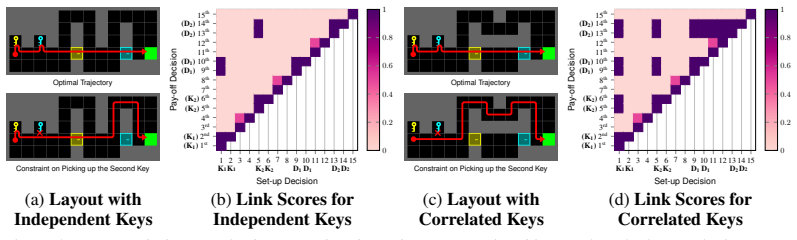
The central claim is that the strategic link score $S^{\dagger}_{(s,a)\to(\tilde s,\tilde a)} = \pi^{\dagger}(a|s) - \pi^{\dagger:\{\pi(\tilde a|\tilde s)=0\}}(a|s)$ measures how much a decision is made as a setup for a later decision. The paper calls $(s,a)$ the set-up decision and $(\tilde s,\tilde a)$ the pay-off decision, and interprets the difference in the planner's action probabilities as the drop in the set-up's likelihood once the pay-off is unavailable. A key demonstration is that two planners can produce exactly the same optimal policy while carrying completely different strategic links, so link scores expose the planning process rather than just the policy. The paper then shows the score works across three applications: explaining agents by scoring pairs along a likely trajectory, improving worst-case recommendation safety by grouping strategically linked changes, and measuring the planning horizon of emergent driver behavior through road-closure interventions in a traffic simulator.
Load-bearing premise
The traffic experiment treats closing the arterial road past J10 as equivalent to imposing the policy constraint that the pay-off decision at J10 is unavailable to a single emergent planner, while a real road closure also changes the road network's transition dynamics and each driver's alternatives, so the measured flow-rate difference is not automatically the strategic link score defined by Equation (2).
Editorial extensions
If this is right
- Explanations become planning-level: a user can see not only what a policy does, but which actions exist purely to unlock later actions, including dependencies that are invisible from the policy alone.
- Recommendation systems become safer under partial adoption: strategically linked changes are presented as a single all-or-nothing group, avoiding the worst case where one change is adopted alone and performance drops, while independent recommendations can still be chosen individually.
- The planning horizon of an unobservable agent can be estimated from interventions alone: the time distance between strongly linked decisions, measured through road closures or analogous prohibitions, characterizes how far ahead the agent plans.
- Demonstrations are sufficient to recover strategic structure: inverse reinforcement learning infers a reward function that supports counterfactual policies, and the resulting link scores remain accurate even when the reward function itself becomes unidentifiable, because uniformly random policies imply no strategic links.
- The score applies beyond reward-based RL, so emergent, multi-agent, or otherwise opaque planning systems can be analyzed as long as one can intervene to remove a follow-up decision.
Reading between the lines
- Beyond the paper, pairwise link scores from demonstrations will inherit the assumptions of the planner used during inverse RL; the same demonstrations could support different strategic-link conclusions under a different planner model, so explanations should be reported together with the assumed counterfactual planner.
- The paper's own limitation suggests a natural extension: strategies that are redundant across multiple pay-offs, such as 'A is taken to enable either B or C', are missed by pairwise constraints, and defining joint constraints over sets of pay-off decisions would capture such higher-order structure.
- Negative link scores, such as the one measured at J1 in the traffic experiment, point to feedback-mediated strategies—actions taken to avoid congestion caused by the very route the pay-off decision depends on, suggesting the score could detect indirect environment-mediated dependencies in emergent multi-agent behavior.
- Because the score is an interventional quantity, applying it to real systems requires interventions that block only the pay-off decision rather than changing the environment's dynamics; when that separation fails, the measured quantity is not the strategic link score as defined.
Signed reviews
Editorial analysis
A structured set of objections, weighed in public.
Referee Report
Summary. The paper introduces a formal quantity called the strategic link score, defined in Eq. (2) as the drop in the probability of a set-up decision (s,a) when a pay-off decision (s̃,ã) is made unavailable through the policy constraint π(ã|s̃)=0. The score is meant to capture whether an early action is taken mainly to enable a later action. The authors illustrate the definition with a toy MDP, then present three applications: planning-level explanations of soft-optimal RL agents in GridWorld, strategy-aware safe recommendations in a procedurally generated Shortcuts environment, and measurement of the planning horizon of drivers in a UXsim traffic simulation through road closures. The paper also studies how well the scores can be recovered from demonstrations via maximum entropy IRL.
Significance. If the central definition holds, the strategic link score is a simple and broadly applicable tool for planning-level analysis, and the first two applications are convincing demonstrations: the toy example cleanly separates two planners with identical policies but different strategic dependencies, the GridWorld experiments show that Eq. (2) produces interpretable explanations, and the Shortcuts experiments show that strategy-aware grouping can improve both average and worst-case recommendation outcomes. The IRL experiments are also a useful practical check. However, the third application does not implement Eq. (2): the traffic intervention changes the environment dynamics rather than constraining a fixed planner's policy, and the continuous-action treatment is internally inconsistent with Section 4. The planning-horizon conclusion is therefore not established by the formal definition.
major comments (3)
- [Section 5.3] The traffic experiment does not implement Eq. (2). The strategic link score in Eq. (2) compares two policies of the same planner in the same environment E: the unconstrained policy π† and the policy planned under the constraint π(ã|s̃)=0. In Figures 9 and 10, the post-intervention routing policy is instead measured after physically closing the arterial road past J10, which changes the transition dynamics, travel times, congestion, and information available to drivers. Even though the closure removes the J10 arterial action, it does so by altering the environment, so the pre/post flow differences in Figure 10c conflate the counterfactual policy drop with direct dynamics effects such as spillback and forced diversions. Consequently, the claim that the strongest link at J9 reveals the drivers' effective planning horizon is not a consequence of the proposed score, and the negative link at J1 is not shown to be a strategic avoidance rather than a congestion response. This identification is load-bearing for the third application; the authors should either implement a genuine policy-constraint intervention or substantially reframe the traffic analysis as an environment-intervention study that is outside Eq. (2).
- [Section 4 and Section 5.3] The continuous-action treatment is internally inconsistent. Section 4 states that for continuous states and actions a point constraint such as π(ã|s̃)=0 'would practically have no impact' and therefore requires constraining a region S̃×Ã, yet Section 5.3 defines S†_{JX→J10}=π†(JX)-π†:{π(J10)=0}(JX) with a point constraint and reports that the J10 score is one 'by definition.' A measure-zero constraint on a continuous action distribution is not equivalent to the road closure used in the simulation. The paper should either specify the region constraint used in the traffic example (for example, constraining π(J10) to a low-flow interval, as suggested in Section 4) or justify why the point constraint is well-defined for this emergent policy; as written, the traffic scores are not an instance of the formal definition.
- [Section 5.2 and Appendix A.2] The strategy-aware recommendation algorithm depends on a significance threshold, set in Appendix A.2 to 'halfway between 0 and 1/5,' and the safety and effectiveness comparison in Figure 7 depends on the groups produced by that threshold. The paper gives a rationale for the 1/5 bound but no sensitivity analysis, so it is unclear how robust the claimed advantage of Strategy-Aware over Pick-and-Choose and All-or-Nothing is to the threshold choice. Please add a sensitivity study or replace the heuristic threshold with a more principled criterion.
minor comments (5)
- [Section 5.1] There is a typo in 'maximum entorpy IRL (Ziebart et al., 2008)' in Section 5.1, Approach 2; it should be 'maximum entropy.'
- [Appendix A.1] The appendix says that when constraining a decision the reward is set to r(i,j,{f'k},a)←∞, but the main text and the intended constraint require −∞; this sign error should be corrected.
- [Figure 4 caption] The caption refers to 'the second layout (Figure 4a)' when describing the correlated-keys layout; it should refer to Figure 4c.
- [Section 2] The sentence 'explainability in RL, which can be address at state, policy, or planning levels' contains a grammatical error; 'address' should be 'addressed.'
- [General] The paper does not include a reproducibility statement or a link to the code and data used for the simulations; adding these would make the experimental results easier to verify, especially for the UXsim traffic experiment.
Circularity Check
No circularity: the strategic link score is a definition, and each application evaluates it against independent environment structure or ground-truth rewards; self-citations are contextual only.
full rationale
The paper's central quantity, S in Equation (2), is introduced as a definition rather than as a fitted or predicted value: it is the difference between the unconstrained policy probability and the policy probability under an explicit constraint. The GridWorld and Shortcuts experiments compute this quantity from a specified soft-optimal planner or from a reward recovered by maximum-entropy IRL, then compare the resulting links against known environment structure such as key-door dependencies, so the conclusions are not baked into the inputs. The IRL validation compares link scores derived from inferred rewards with link scores computed from the true reward, reporting error rather than assuming agreement, which is an external check. The traffic application measures the score as the difference between pre- and post-intervention routing policies, which operationalizes the definition; the physical road closure also changes environment dynamics, a possible validity limitation that the paper partially acknowledges in its Limitations paragraph, but this does not make the derivation circular because no target conclusion is imposed by construction. Related-work citations to prior papers by the authors are contextual and are not used to justify the definition or the main results. No step in the claimed derivation reduces to its own input.
Assumptions & free parameters
free parameters (4)
- significance threshold for strategic link grouping =
0.1 (half of 1/5)
- arterial free flow speed =
20 * sqrt(J/(J+1))
- preparation action cost C =
0.1
- inverse temperature beta =
100
assumptions (4)
- standard math Soft value iteration converges to the unique soft-optimal policy for the given reward and temperature.
- domain assumption The emergent routing behavior of the traffic simulator can be represented as a stationary policy π†(JX) equal to the frequency of drivers taking the arterial road, with these frequencies behaving like action probabilities under a single planner.
- ad hoc to paper Closing the arterial road at J10 is equivalent to imposing the constraint π(J10)=0 on that policy while leaving all other environment dynamics and rewards fixed.
- domain assumption Demonstrations are generated by a soft-optimal planner with known transition dynamics, so MaxEnt IRL recovers a reward whose implied counterfactual policies reproduce the true strategic link scores.
Cite this review
Pith. "Pith review of Strategically Linked Decisions in Long-Term Planning and Reinforcement Learning." pith.science (2026). https://pith.science/paper/7JD7JGVN
@misc{pith2026250516833,
  author       = {Pith},
  title        = {Pith review of: Strategically Linked Decisions in Long-Term Planning and Reinforcement Learning},
  year         = {2026},
  howpublished = {\url{https://pith.science/paper/7JD7JGVN}},
  note         = {Machine review of arXiv:2505.16833}
}
read the original abstract
Long-term planning, as in reinforcement learning (RL), involves finding strategies: actions that collectively work toward a goal rather than individually optimizing their immediate outcomes. As part of a strategy, some actions are taken at the expense of short-term benefit to enable future actions with even greater returns. These actions are only advantageous if followed up by the actions they facilitate, consequently, they would not have been taken if those follow-ups were not available. In this paper, we quantify such dependencies between planned actions with strategic link scores: the drop in the likelihood of one decision under the constraint that a follow-up decision is no longer available. We demonstrate the utility of strategic link scores through three practical applications: (i) explaining black-box RL agents by identifying strategically linked pairs among decisions they make, (ii) improving the worst-case performance of decision support systems by distinguishing whether recommended actions can be adopted as standalone improvements or whether they are strategically linked hence requiring a commitment to a broader strategy to be effective, and (iii) characterizing the planning processes of non-RL agents purely through interventions aimed at measuring strategic link scores - as an example, we consider a realistic traffic simulator and analyze through road closures the effective planning horizon of the emergent routing behavior of many drivers.
Figures


Figures from the paper (8 more)


Reference graph
Works this paper leans on
-
[1]
Abbeel, P. and A. Y. Ng, ``Apprenticeship learning via inverse reinforcement learning,'' in International Conference on Machine Learning, 2004
work page 2004
-
[2]
Amir, D. and O. Amir, `` HIGHLIGHTS : Summarizing agent behavior to people,'' in International Conference on Autonomous Agents and Multiagent Systems, 2018
work page 2018
-
[3]
Chen, Z., F. Silvestri, G. Tolomei, J. Wang, H. Zhu, and H. Ahn, ``Explain the explainer: Interpreting model-agnostic counterfactual explanations of a deep reinforcement learning agent,'' IEEE Transactions on Artificial Intelligence, vol. 5, no. 4, pp. 1443--1457, 2022
work page 2022
-
[4]
Cruz, F., R. Dazeley, P. Vamplew, and I. Moreira, ``Explainable robotic systems: Understanding goal-driven actions in a reinforcement learning scenario,'' Neural Computing and Applications, vol. 35, no. 25, pp. 18\,113--18\,130, 2023
work page 2023
-
[5]
Ehsan, U., B. Harrison, L. Chan, and M. O. Riedl, ``Rationalization: A neural machine translation approach to generating natural language explanations,'' in AAAI/ACM Conference on AI, Ethics, and Society, 2018
work page 2018
-
[6]
Erwig, M., A. Fern, M. Murali, and A. Koul, ``Explaining deep adaptive programs via reward decomposition,'' in IJCAI/ECAI Workshop on Explainable Artificial Intelligence, 2018
work page 2018
- [7]
-
[8]
Greydanus, S., A. Koul, J. Dodge, and A. Fern, ``Visualizing and understanding Atari agents,'' in International Conference on Machine Learning, 2018
work page 2018
Show all 31 references
-
[9]
Haarnoja, T., H. Tang, P. Abbeel, and S. Levine, ``Reinforcement learning with deep energy-based policies,'' in International Conference on Machine Learning, 2017
2017
-
[10]
Udluft, and T
Hein, D., S. Udluft, and T. A. Runkler, ``Interpretable policies for reinforcement learning by genetic programming,'' Engineering Applications of Artificial Intelligence, vol. 76, pp. 158--169, 2018
2018
-
[11]
Demmler, S
Huber, T., M. Demmler, S. Mertes, M. L. Olson, and E. Andr \'e , ``Ganterfactual-rl: Understanding reinforcement learning agents' strategies through visual counterfactual explanations,'' arXiv preprint arXiv:2302.12689, 2023
2023 arXiv
-
[12]
Iyer, R., Y. Li, H. Li, M. Lewis, R. Sundar, and K. Sycara, ``Transparency and explanation in deep reinforcement learning neural networks,'' in AAAI/ACM Conference on AI, Ethics, and Society, 2018
2018
-
[13]
Juozapaitis, Z., A. Koul, A. Fern, M. Erwig, and F. Doshi-Velez, ``Explainable reinforcement learning via reward decomposition,'' in IJCAI/ECAI Workshop on Explainable Artificial Intelligence, 2019
2019
-
[14]
Poupart, and J
Khan, O., P. Poupart, and J. Black, ``Minimal sufficient explanations for factored markov decision processes,'' in International Conference on Automated Planning and Scheduling, 2009
2009
-
[15]
Trichelair, and R
Laroche, R., P. Trichelair, and R. T. Des Combes, ``Safe policy improvement with baseline bootstrapping,'' in International Conference on Machine Learning, 2019
2019
-
[16]
Schulte, W
Liu, G., O. Schulte, W. Zhu, and Q. Li, ``Toward interpretable deep reinforcement learning with linear model U -trees,'' in Joint European Conference on Machine Learning and Knowledge Discovery in Databases, 2018
2018
-
[17]
Miller, L
Madumal, P., T. Miller, L. Sonenberg, and F. Vetere, ``Explainable reinforcement learning through a causal lens,'' in Proceedings of the AAAI conference on artificial intelligence, vol. 34, no. 03, 2020, pp. 2493--2500
2020
-
[18]
Olson, M. L., R. Khanna, L. Neal, F. Li, and W.-K. Wong, ``Counterfactual state explanations for reinforcement learning agents via generative deep learning,'' Artificial Intelligence, vol. 295, p. 103455, 2021
2021
-
[19]
Seo, T., `` UXsim : lightweight mesoscopic traffic flow simulator in pure Python ,'' Journal of Open Source Software, 2025
2025
-
[20]
Benac, S
Sharma, A., L. Benac, S. Parbhoo, and F. Doshi-Velez, ``Decision-point guided safe policy improvement,'' arXiv preprint arXiv:2410.09361, 2024
2024 arXiv
-
[21]
Xiong, and R
Shu, T., C. Xiong, and R. Socher, ``Hierarchical and interpretable skill acquisition in multi-task reinforcement learning,'' in International Conference on Learning Representations, 2018
2018
-
[22]
Gombolay, T
Silva, A., M. Gombolay, T. Killian, I. Jimenez, and S.-H. Son, ``Optimization methods for interpretable differentiable decision trees applied to reinforcement learning,'' in International Conference on Artificial Intelligence and Statistics, 2020
2020
-
[23]
H \"u y \"u k, D
Sun, H., A. H \"u y \"u k, D. Jarrett, and M. van der Schaar, ``Accountability in offline reinforcement learning: Explaining decisions with a corpus of examples,'' Conference on Neural Information Processing Systems, 2023
2023
-
[24]
Topin, N. and M. Veloso, ``Generation of policy-level explanations for reinforcement learning,'' in AAAI Conference on Artificial Intelligence, 2019
2019
-
[25]
van Diggelen, K
van der Waa, J., J. van Diggelen, K. van den Bosch, and M. Neerincx, ``Contrastive explanations for reinforcement learning in terms of expected consequences,'' arXiv preprint arXiv:1807.08706, 2018
2018 arXiv
-
[26]
Murali, R
Verma, A., V. Murali, R. Singh, P. Kohli, and S. Chaudhuri, ``Programmatically interpretable reinforcement learning,'' in International Conference on Machine Learning, 2018
2018
-
[27]
Wu, J., H. Wu, Z. Qiu, J. Wang, and M. Long, ``Supported policy optimization for offline reinforcement learning,'' Conference on Neural Information Processing Systems, 2022
2022
-
[28]
Parbhoo, W
Yao, J., S. Parbhoo, W. Pan, and F. Doshi-Velez, ``Policy optimization with sparse global contrastive explanations,'' arXiv preprint arXiv:2207.06269, 2022
2022 arXiv
-
[29]
Russell, and S
Yau, H., C. Russell, and S. Hadfield, ``What did you think would happen? explaining agent behaviour through intended outcomes,'' in Conference on Neural Information Processing Systems, 2020
2020
-
[30]
Ziebart, B. D., A. L. Maas, J. A. Bagnell, A. K. Dey et al., ``Maximum entropy inverse reinforcement learning.'' in AAAI Conference on Artificial Intelligence, 2008
2008
-
[31]
write newline
" write newline "" initialize.prev.this.status FUNCTION begin.bib " write newline preamble empty 'skip preamble write newline if " thebibliography " number.label int.to.str * " " * write newline " [1] #1 " write newline " [1] #1 " write newline " url@samestyle " write newline ...
Reviewed August 7, 2026 · model on record in the stance chip above.
Discussion (0). Continue with ORCID to comment.