REVIEW 2 major objections 5 minor 2 cited by
The Double Tidal Disruption Event AT 2022dbl Implies That at Least Some "Standard" Optical TDEs are Partial Disruptions
T0 review · 2 major / 5 minor · reviewed 2026-08-07 · deepseek-v4-flash
Pith's one-line read AT 2022dbl is two consecutive disruptions of the same star on a ~700-day orbit around a supermassive black hole, making it the first robust case of a partial disruption masquerading as a standard optical-UV tidal disruption event.
desk verdict A strong, honest observational paper that establishes AT 2022dbl as the first credible repeating standard optical-UV TDE, though the chance-coincidence statistic needs a correction for the trials factor. read the letter →
The pith
A machine-rendered reading of the paper's core claim, the machinery that carries it, and where it could break.
The reading
What carries the argument
The central mechanism is the repeated partial disruption of a surviving stellar core on a bound, highly eccentric orbit around a supermassive black hole. The argument's load-bearing pieces are: (1) the chance-coincidence calculation that two unrelated TDEs in the same quiescent Balmer-strong host within 700 days is rare, estimated at 0.037% to 0.368% depending on the assumed global TDE rate; (2) the near-identical H$\alpha$ line properties across both flares, with no observed correlation between H$\alpha$ properties and black-hole mass across a comparison sample, implying the lines carry information about the star or its orbit rather than the black hole alone; and (3) hydrodynamical simulations showing that a 3$\,M_\odot$ evolved star on a 700-day bound orbit with pericenter near the tidal radius produces repeated, similar mass fallback rates consistent with both flares. The fallback scalings $t^{-5/3}$ for full disruption versus $t^{-9/4}$ for partial disruption carry the physical distinction.
What would settle it
Recompute the chance-coincidence probability using the actual distribution of host-galaxy Lick H$\delta_A$ indices among all roughly 50 discovered optical-UV TDEs rather than scaling the 15-event comparison sample; if the two-flare probability exceeds about one percent, the same-star identification loses its statistical grounding. A complementary observation is to watch for a third AT 2022dbl flare in early 2026: a third similar flare confirms the star survived both earlier passages, while no third flare would favor the first-partial/second-full scenario and would leave the repeated-partial model in question.
Extended reading notes
Core claim
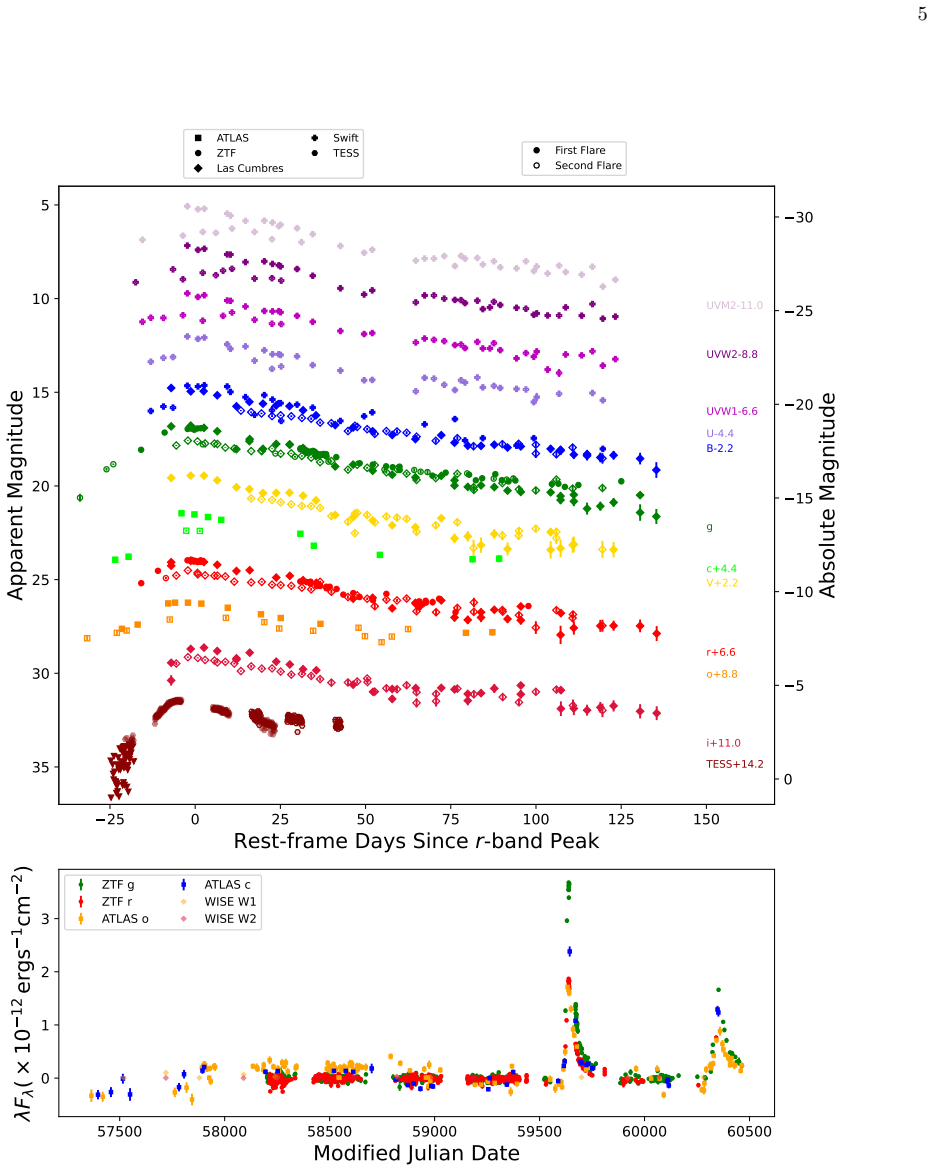
On the paper's own terms, AT 2022dbl is the first robust example of an otherwise normal optical-ultraviolet TDE that repeats: a nearly identical flare appeared about 700 days after the first, with matching spectra, similar light-curve shape, and typical TDE luminosity and temperature. The paper systematically excludes gravitational lensing (the required intervening lens mass is ~$10^{13}\,M_\odot$), two unrelated TDEs (chance probability 0.037% to 0.368%, or 0.12% for a recent global rate estimate), a single disruption around a binary black hole, and emission from the less-bound debris tail, leaving repeated partial disruption of the same star as the explanation. At least the first flare must be partial, because the star survived to produce the second; whether the second flare also left a surviving core is undetermined. The star is on a ~700-day bound orbit, plausibly captured through the Hills mechanism, and the first flare's post-peak decline is steeper than the canonical $t^{-5/3}$ full-disruption rate, consistent with the $t^{-9/4}$ partial-disruption fallback scaling.
Load-bearing premise
The whole same-star conclusion rests on the estimate that two unrelated TDEs in this galaxy within 700 days is a roughly one-in-a-thousand coincidence; that estimate assumes the small sample of TDE host galaxies used for the rate enhancement is representative of all discovered TDEs and that the global TDE rate lies between $10^{-5}$ and $10^{-4}$ per galaxy per year.
Editorial extensions
If this is right
- If at least some standard optical-UV TDEs are partial disruptions, the prevalent assumption that all such events are full disruptions is wrong, so emission models built on full-disruption fallback need revision.
- The 'missing energy problem' in optical-UV TDEs may be less severe, because a single star can radiate over multiple passages, and super-Eddington accretion could channel much of the released energy into outflows rather than radiation.
- A post-peak decline steeper than $t^{-5/3}$ may be a practical diagnostic of partial disruption, and the first flare of AT 2022dbl shows such a steeper decline.
- Rates and host-galaxy preferences of optical-UV TDEs need reassessment, because repeating partial disruptions contribute to the observed sample in ways that single-pass full-disruption models do not capture.
- A third flare from AT 2022dbl, predicted for roughly early 2026 if the star survived both passages, would distinguish between two partial disruptions and a first partial followed by a full disruption of the star.
Reading between the lines
- If partial disruptions are common in the optical-UV class, the per-galaxy TDE rate is biased low, because a single star can flare multiple times and short-baseline surveys would either count repeats as separate events or miss long-period returns entirely.
- The near-identical H$\alpha$ properties across the two flares suggest that TDE line diagnostics are set mainly by the surviving stellar core and its orbit rather than by the black hole alone; the same logic could be applied to archival multi-flare light curves to identify new repeating candidates.
- A Hills-mechanism capture with a ~700-day period implies a population of tightly bound, strongly eccentric stars around low-mass supermassive black holes; if such stars are common, some apparently single TDEs may be first flares that will repeat on timescales of years to decades, making long-term monitoring of TDE hosts a direct route to more detections.
- A systematic search of survey light curves for second flares from previously classified optical-UV TDE hosts, using color and spectral similarity as filters, could measure the partial-disruption fraction directly rather than relying on single-object chance-coincidence arguments.
Editorial analysis
A structured set of objections, weighed in public.
Referee Report
Summary. The paper presents multi-wavelength observations of AT 2022dbl, an otherwise 'standard' optical-UV tidal disruption event (TDE) that shows a second, nearly identical flare about 700 days after the first. The authors use photometry, spectroscopy, radio observations, host-galaxy SED fitting, analytical TDE models, and illustrative hydrodynamical simulations to argue that the two flares are not two lensed images, are very unlikely to be two unrelated TDEs, and are not explained by a SMBH binary or by return of the less-bound debris tail. They conclude that AT 2022dbl is the repeated partial disruption of the same star by the same SMBH, with at least the first flare partial, and they discuss the implication that at least some (possibly all) standard optical-UV TDEs are partial disruptions.
Significance. If the interpretation is correct, AT 2022dbl would be the first robust case in which a spectroscopically and photometrically normal optical-UV TDE is shown to be a repeating partial disruption. This has the potential to revise standard assumptions about the emission mechanism and rates of the optical-UV TDE class. The paper is strong in using a direct logical inference from repetition rather than relying on model-dependent fits: the MOSFiT impact-parameter posterior is not used as proof of partiality, and the phantom simulations are explicitly labeled as illustrative rather than fits. The prediction of a third flare in early 2026 is a concrete, falsifiable consequence. The main quantitative support for the same-star conclusion is the chance-coincidence calculation in Section 5.2.2, and that calculation needs clarification before the conclusion is fully secure.
major comments (2)
- [Section 5.2.2, Figure 14] The reported chance-coincidence probabilities (0.037-0.368%, and 0.12% at the Yao et al. rate) are numerically equal to 2 R_enh R_global (700/365.25) for the host's HδA bin, i.e., the conditional probability that a single already-observed TDE in such a galaxy has another TDE within ±700 days. The text states that this number is then multiplied by the total number of discovered TDEs in that galaxy bin, but the arithmetic does not reflect such a multiplication. If the intended quantity is the chance that any of the ~50 discovered TDEs in this bin is part of an unrelated pair, the quoted values must be multiplied by N_bin, which is at least about 3 under the stated assumption that the 50 events are distributed like the French et al. sample; this raises the Yao-rate estimate to roughly 0.4% and the high-rate estimate above 1%. The paragraph should state explicitly whether the quoted number is per-object or survey-wide and should show the intermediate quantities. As written, the quantitative exclusion of two unrelated TDEs is internally inconsistent.
- [Section 5.2.2 and Figure 14] The argument that the nearly identical Hα properties of the two flares cannot be explained by two unrelated disruptions rests on the absence of correlations between Hα width/luminosity and black hole mass in a comparison sample of roughly ten objects. This is a weak null result, and it should be presented as suggestive rather than as an independent quantitative constraint. The paper should temper the wording in the abstract and Section 6 ('ruling out' two unrelated disruptions) unless the rate calculation is clarified and the resulting probability is robustly below the percent level.
minor comments (5)
- [Section 4.1.1 and Table 5] The power-law decline fit for the first flare fixes t0 = -33.7 days before peak, stated to be the fallback time from the MOSFiT fit, but the MOSFiT best-fit t0 for the first flare in Table 5 is -11.94^+1.87_-2.11 days. This discrepancy should be explained or corrected.
- [Table 2] The AMI-LA epoch listed as MJD 69677 appears to be a typo; it should likely be MJD 59677 based on the surrounding epochs.
- [Section 5.2.2] The sentence 'the probability that the two flares of AT 2022dbl are of unrelated TDEs is 0.12%' should be rephrased as the probability of two independent TDEs occurring within the stated window under the assumed rate model, since it is a null-hypothesis probability rather than a posterior probability.
- [Section 5.2.2] The boundaries of the three HδA bins are described only as 'equally spaced between 1.3 and 6 Å'; please give the explicit bin ranges so that the bin assignment of the AT 2022dbl host (HδA = 2.20 Å) can be checked.
- [Figure 7] The efficiency values ε used to overlay the bolometric luminosity on the simulated fallback rates are stated in the figure only; please define them in the caption or text so that the reader does not mistake the overlay for a fit.
Circularity Check
No significant circularity: the same-star and partial-disruption conclusions follow from the observed repetition plus ruled-out alternatives, not from fitted parameters or self-citation chains.
full rationale
The paper's central derivation is observational: two nearly identical flares in the same host, a 711-day peak separation, exclusion of lensing by color evolution and by the implausible lens mass, and a host-based estimate of the chance of two unrelated TDEs. The conclusion that at least the first flare was a partial disruption follows logically from the conclusion that the same star was disrupted twice: a star that survives to produce a second flare cannot have been fully destroyed in the first flare. The MOSFiT b-parameter posteriors are not used as proof of partiality; the paper states that the first-flare posterior 'spreads both below and above 1' and is consistent with both full and partial disruption. The hydrodynamical phantom runs are explicitly labeled 'not fits to the data' and 'illustrative cases', so their consistency is not a fitted-input-called-prediction. Theoretical citations for steeper partial-disruption fallback rates (Coughlin & Nixon 2019; Bandopadhyay et al. 2024) are parameter-free published calculations used only as consistency checks, not as the load-bearing step for the same-star conclusion. The Hills-mechanism section is explicitly presented as a possible dynamical scenario, not as evidence for repetition. Host-galaxy rate enhancement is taken from external samples (French et al. 2016, 2020; Arcavi et al. 2014). The main caveats are statistical robustness issues rather than circularity: the §5.2.2 coincidence probability depends on the assumed global TDE rate and on how the 50 discovered TDEs are distributed across HδA bins, and the quoted arithmetic's multiplication by per-bin occupancy is not transparent; the Hα-similarity comparison rests on a small sample. These concerns affect the strength of the chance-coincidence exclusion, but no derived quantity is equivalent by construction to an input, and no load-bearing claim reduces to a self-citation.
Assumptions & free parameters
free parameters (5)
- MOSFiT model parameters (MBH, m*, b, efficiency, Rph0, lph, Tnu, t0, nH, sigma) =
Flare 1: log MBH=6.698, m*=0.103 Msun, b=0.984; Flare 2: log MBH=6.629, m*=0.37 Msun, b=1.157 (Table 5)
- Illustrative hydrodynamical simulation parameters =
MBH=1e6 Msun; M*=3 Msun TAMS and 1 Msun ZAMS; P=700 d; Rp ~ Rt and Rp ~ Rt/1.4
- Overlay efficiency in Figure 7 =
epsilon = 1e-2 (3 Msun case) and 3e-4 (1 Msun case)
- Assumed number of discovered optical-UV TDEs =
50
- H-delta-A binning for host rate enhancement =
3 bins, equal spacing 1.3 to 6 Angstrom
assumptions (8)
- domain assumption Bolometric luminosity traces the mass fallback rate in shape.
- domain assumption H-alpha emission properties in TDEs are governed by stellar or orbital properties rather than primarily by the SMBH.
- domain assumption The global optical TDE rate is in the range 1e-5 to 1e-4 per galaxy per year.
- standard math Standard point-mass gravitational lensing equations and Lambda-CDM cosmology.
- standard math Keplerian energy-period relation for a star on a bound orbit.
- domain assumption The host galaxy's black hole mass follows the MBH-sigma relation of Kormendy and Ho 2013.
- domain assumption Stars in the galactic nucleus follow a Bahcall-Wolf density profile for the relaxation-time estimate.
- ad hoc to paper The first flare's fallback time t0 = 33.7 days from the MOSFiT fit is fixed for the power-law decline fit.
Cite this review
Pith. "Pith review of The Double Tidal Disruption Event AT 2022dbl Implies That at Least Some "Standard" Optical TDEs are Partial Disruptions." pith.science (2026). https://pith.science/paper/LRA3N2HD
@misc{pith2026250516867,
  author       = {Pith},
  title        = {Pith review of: The Double Tidal Disruption Event AT 2022dbl Implies That at Least Some "Standard" Optical TDEs are Partial Disruptions},
  year         = {2026},
  howpublished = {\url{https://pith.science/paper/LRA3N2HD}},
  note         = {Machine review of arXiv:2505.16867}
}
read the original abstract
Flares produced following the tidal disruption of stars by supermassive black holes can reveal the properties of the otherwise dormant majority of black holes and the physics of accretion. In the past decade, a class of optical-ultraviolet tidal disruption flares has been discovered whose emission properties do not match theoretical predictions. This has led to extensive efforts to model the dynamics and emission mechanisms of optical-ultraviolet tidal disruptions in order to establish them as probes of supermassive black holes. Here we present the optical-ultraviolet tidal disruption event AT 2022dbl, which showed a nearly identical repetition 700 days after the first flare. Ruling out gravitational lensing and two chance unrelated disruptions, we conclude that at least the first flare represents the partial disruption of a star, possibly captured through the Hills mechanism. Since both flares are typical of the optical-ultraviolet class of tidal disruptions in terms of their radiated energy, temperature, luminosity, and spectral features, it follows that either the entire class are partial rather than full stellar disruptions, contrary to the prevalent assumption, or that some members of the class are partial disruptions, having nearly the same observational characteristics as full disruptions. Whichever option is true, these findings could require revised models for the emission mechanisms of optical-ultraviolet tidal disruption flares and a reassessment of their expected rates.
Figures


Figures from the paper (12 more)


Forward citations
Cited by 2 Pith papers
-
IGR J12580+0134: A Possible Repeated Partial Tidal Disruption Event Inferred from Late-Time Radio Re-brightenin
IGR J12580+0134 is proposed as a repeating partial tidal disruption event candidate, with two radio flares separated by ~1513 days and a possible third rebrightening.
-
Lost and Found - A gallery of overlooked optical nuclear transients from the ZTF archive
Archival ZTF data reveal 19 nuclear transients, including two repeated tidal-disruption-event candidates, one >5-year outburst, and three extreme nuclear transients.
Reference graph
Works this paper leans on
-
[1]
Abolfathi , B., Aguado , D. S., Aguilar , G., et al. 2018, , 235, 42, 10.3847/1538-4365/aa9e8a
-
[2]
S., Ahumada , R., Almeida , A., et al
Aguado , D. S., Ahumada , R., Almeida , A., et al. 2019, , 240, 23, 10.3847/1538-4365/aaf651
-
[3]
Alard , C., & Lupton , R. H. 1998, , 503, 325, 10.1086/305984
doi:10.1086/305984 1998
-
[4]
D., Berger , E., Guillochon , J., Zauderer , B
Alexander , K. D., Berger , E., Guillochon , J., Zauderer , B. A., & Williams , P. K. G. 2016, , 819, L25, 10.3847/2041-8205/819/2/L25
-
[5]
2022, , 937, 75, 10.3847/1538-4357/ac90c0
Arcavi , I. 2022, , 937, 75, 10.3847/1538-4357/ac90c0
-
[6]
2022, Transient Name Server AstroNote, 47, 1
Arcavi , I., Dgany , Y., Makrygianni , L., & Pellegrino , C. 2022, Transient Name Server AstroNote, 47, 1
2022
-
[7]
2014, , 793, 38, 10.1088/0004-637X/793/1/38
Arcavi , I., Gal-Yam , A., Sullivan , M., et al. 2014, , 793, 38, 10.1088/0004-637X/793/1/38
-
[8]
Bahcall , J. N., & Wolf , R. A. 1977, , 216, 883, 10.1086/155534
doi:10.1086/155534 1977
Show all 149 references
-
[9]
R., Nixon , C
Bandopadhyay , A., Coughlin , E. R., Nixon , C. J., & Pasham , D. R. 2024, , 974, 80, 10.3847/1538-4357/ad6a5a
2024 doi
-
[10]
2013, , 772, 78, 10.1088/0004-637X/772/1/78
Barniol Duran , R., Nakar , E., & Piran , T. 2013, , 772, 78, 10.1088/0004-637X/772/1/78
2013 doi
-
[11]
2015, HOTPANTS: High Order Transform of PSF ANd Template Subtraction , Astrophysics Source Code Library, record ascl:1504.004
Becker , A. 2015, HOTPANTS: High Order Transform of PSF ANd Template Subtraction , Astrophysics Source Code Library, record ascl:1504.004. 1504.004
2015
-
[12]
C., Kulkarni , S
Bellm , E. C., Kulkarni , S. R., Barlow , T., et al. 2019, , 131, 068003, 10.1088/1538-3873/ab0c2a
2019 doi
-
[13]
2017, , 844, 46, 10.3847/1538-4357/aa7579
Blagorodnova , N., Gezari , S., Hung , T., et al. 2017, , 844, 46, 10.3847/1538-4357/aa7579
2017 doi
-
[14]
B., Kulkarni , S
Blagorodnova , N., Cenko , S. B., Kulkarni , S. R., et al. 2019, , 873, 92, 10.3847/1538-4357/ab04b0
2019 doi
-
[15]
Bowen , I. S. 1928, , 67, 1, 10.1086/143091
1928 doi
-
[16]
Brinchmann , J., Charlot , S., White , S. D. M., et al. 2004, , 351, 1151, 10.1111/j.1365-2966.2004.07881.x
2004
-
[17]
M., Baliber , N., Bianco , F
Brown , T. M., Baliber , N., Bianco , F. B., et al. 2013, , 125, 1031, 10.1086/673168
2013 doi
-
[18]
N., Hill , J
Burrows , D. N., Hill , J. E., Nousek , J. A., et al. 2005, , 120, 165, 10.1007/s11214-005-5097-2
2005 doi
-
[19]
G., et al
Cannizzaro , G., Wevers , T., Jonker , P. G., et al. 2021, , 504, 792, 10.1093/mnras/stab851
2021 doi
- [20]
-
[21]
D., et al
Cendes , Y., Berger , E., Alexander , K. D., et al. 2022, , 938, 28, 10.3847/1538-4357/ac88d0
2022 doi
-
[22]
2023, , 673, A95, 10.1051/0004-6361/202245065
Charalampopoulos , P., Pursiainen , M., Leloudas , G., et al. 2023, , 673, A95, 10.1051/0004-6361/202245065
2023 doi
-
[23]
B., et al
Charalampopoulos , P., Leloudas , G., Malesani , D. B., et al. 2022, , 659, A34, 10.1051/0004-6361/202142122
2022 doi
-
[24]
Chen , X., Madau , P., Sesana , A., & Liu , F. K. 2009, , 697, L149, 10.1088/0004-637X/697/2/L149
2009 doi
-
[25]
Chevalier, R. A. 1998, , 499, 810, 10.1086/305676
1998 doi
-
[26]
R., & Armitage , P
Coughlin , E. R., & Armitage , P. J. 2018, , 474, 3857, 10.1093/mnras/stx3039
2018 doi
-
[27]
R., Armitage , P
Coughlin , E. R., Armitage , P. J., Nixon , C., & Begelman , M. C. 2017, , 465, 3840, 10.1093/mnras/stw2913
2017 doi
-
[28]
R., & Nixon , C
Coughlin , E. R., & Nixon , C. J. 2019, , 883, L17, 10.3847/2041-8213/ab412d
2019 doi
- [29]
-
[30]
R., & Nixon , C
Cufari , M., Coughlin , E. R., & Nixon , C. J. 2022, , 929, L20, 10.3847/2041-8213/ac6021
2022 doi
-
[31]
J., & Coughlin , E
Cufari , M., Nixon , C. J., & Coughlin , E. R. 2023, , 520, L38, 10.1093/mnrasl/slad001
2023 doi
-
[32]
M., Wright , E
Cutri , R. M., Wright , E. L., Conrow , T., et al. 2021, VizieR Online Data Catalog, II/328
2021
-
[33]
C., Roth , N., Ramirez-Ruiz , E., & Miller , M
Dai , L., McKinney , J. C., Roth , N., Ramirez-Ruiz , E., & Miller , M. C. 2018, , 859, L20, 10.3847/2041-8213/aab429
2018 doi
-
[34]
R., Kasen , D., & Quataert , E
Darbha , S., Coughlin , E. R., Kasen , D., & Quataert , E. 2018, , 477, 4009, 10.1093/mnras/sty822
2018 doi
-
[35]
1991, , 181, 313, 10.1007/BF00639097
Demircan , O., & Kahraman , G. 1991, , 181, 313, 10.1007/BF00639097
1991 doi
- [36]
-
[37]
2024, , 969, 104, 10.3847/1538-4357/ad4a72
Faris , S., Arcavi , I., Makrygianni , L., et al. 2024, , 969, 104, 10.3847/1538-4357/ad4a72
2024 doi
-
[38]
M., Vallely , P
Fausnaugh , M. M., Vallely , P. J., Kochanek , C. S., et al. 2021, , 908, 51, 10.3847/1538-4357/abcd42
2021 doi
-
[39]
D., Arcavi , I., & Zabludoff , A
French , K. D., Arcavi , I., & Zabludoff , A. 2016, , 818, L21, 10.3847/2041-8205/818/1/L21
2016 doi
-
[40]
2017, , 835, 176, 10.3847/1538-4357/835/2/176
---. 2017, , 835, 176, 10.3847/1538-4357/835/2/176
2017 doi
-
[41]
D., Wevers , T., Law-Smith , J., Graur , O., & Zabludoff , A
French , K. D., Wevers , T., Law-Smith , J., Graur , O., & Zabludoff , A. I. 2020, , 216, 32, 10.1007/s11214-020-00657-y
2020 doi
-
[42]
D., & Zabludoff , A
French , K. D., & Zabludoff , A. I. 2018, , 868, 99, 10.3847/1538-4357/aaea64
2018 doi
-
[43]
2004, , 611, 1005, 10.1086/422091
Gehrels , N., Chincarini , G., Giommi , P., et al. 2004, , 611, 1005, 10.1086/422091
2004 doi
-
[44]
2021, , 59, 21, 10.1146/annurev-astro-111720-030029
Gezari , S. 2021, , 59, 21, 10.1146/annurev-astro-111720-030029
2021 doi
-
[45]
2012, , 485, 217, 10.1038/nature10990
Gezari , S., Chornock , R., Rest , A., et al. 2012, , 485, 217, 10.1038/nature10990
2012 doi
-
[46]
G., Springel , V., Ohlmann , S
Goicovic , F. G., Springel , V., Ohlmann , S. T., & Pakmor , R. 2019, , 487, 981, 10.1093/mnras/stz1368
2019 doi
-
[47]
Golightly , E. C. A., Nixon , C. J., & Coughlin , E. R. 2019, , 882, L26, 10.3847/2041-8213/ab380d
2019 doi
-
[48]
2014, , 783, 23, 10.1088/0004-637X/783/1/23
Guillochon , J., Manukian , H., & Ramirez-Ruiz , E. 2014, , 783, 23, 10.1088/0004-637X/783/1/23
2014 doi
-
[49]
A., et al
Guillochon , J., Nicholl , M., Villar , V. A., et al. 2018, , 236, 6, 10.3847/1538-4365/aab761
2018 doi
-
[50]
2013, , 767, 25, 10.1088/0004-637X/767/1/25
Guillochon , J., & Ramirez-Ruiz , E. 2013, , 767, 25, 10.1088/0004-637X/767/1/25
2013 doi
-
[51]
2024, , 966, 160, 10.3847/1538-4357/ad2f9f
Guolo , M., Gezari , S., Yao , Y., et al. 2024, , 966, 160, 10.3847/1538-4357/ad2f9f
2024 doi
-
[52]
2023, , 942, 9, 10.3847/1538-4357/aca283
Hammerstein , E., van Velzen , S., Gezari , S., et al. 2023, , 942, 9, 10.3847/1538-4357/aca283
2023 doi
-
[53]
2018, , 855, 129, 10.3847/1538-4357/aab0a5
Hayasaki , K., Zhong , S., Li , S., Berczik , P., & Spurzem , R. 2018, , 855, 129, 10.3847/1538-4357/aab0a5
2018 doi
-
[54]
A., Templeton , M., Terrell , D., et al
Henden , A. A., Templeton , M., Terrell , D., et al. 2016, VizieR Online Data Catalog, II/336
2016
-
[55]
C., et al
Hickish, J., Razavi-Ghods, N., Perrott, Y. C., et al. 2018, , 475, 5677, 10.1093/mnras/sty074
2018 doi
-
[56]
Hills , J. G. 1988, , 331, 687, 10.1038/331687a0
1988 doi
- [57]
-
[58]
Holoien , T. W. S., Prieto , J. L., Bersier , D., et al. 2014, , 445, 3263, 10.1093/mnras/stu1922
2014 doi
-
[59]
Holoien , T. W. S., Kochanek , C. S., Prieto , J. L., et al. 2016, , 455, 2918, 10.1093/mnras/stv2486
2016 doi
-
[60]
B., & Arcavi , I
Horesh , A., Cenko , S. B., & Arcavi , I. 2021 a , Nature Astronomy, 5, 491, 10.1038/s41550-021-01300-8
2021 doi
-
[61]
2021 b , , 920, L5, 10.3847/2041-8213/ac25fe
Horesh , A., Sfaradi , I., Fender , R., et al. 2021 b , , 920, L5, 10.3847/2041-8213/ac25fe
2021 doi
- [62]
-
[63]
2017, , 842, 29, 10.3847/1538-4357/aa7337
Hung , T., Gezari , S., Blagorodnova , N., et al. 2017, , 842, 29, 10.3847/1538-4357/aa7337
2017 doi
-
[64]
H., Chester , T., Cutri , R., et al
Jarrett , T. H., Chester , T., Cutri , R., et al. 2000, , 119, 2498, 10.1086/301330
2000 doi
-
[65]
2016, , 830, 125, 10.3847/0004-637X/830/2/125
Jiang , Y.-F., Guillochon , J., & Loeb , A. 2016, , 830, 125, 10.3847/0004-637X/830/2/125
2016 doi
-
[66]
M., White , S
Kauffmann , G., Heckman , T. M., White , S. D. M., et al. 2003, , 341, 33, 10.1046/j.1365-8711.2003.06291.x
2003
-
[67]
Kormendy , J., & Ho , L. C. 2013, , 51, 511, 10.1146/annurev-astro-082708-101811
2013 doi
- [68]
-
[69]
2020, , 904, 68, 10.3847/1538-4357/abc0f6
Krolik , J., Piran , T., & Ryu , T. 2020, , 904, 68, 10.3847/1538-4357/abc0f6
2020 doi
-
[70]
H., Townes , C
Lacy , J. H., Townes , C. H., & Hollenbach , D. J. 1982, , 262, 120, 10.1086/160402
1982 doi
-
[71]
C., & Smith, R
Lam, M. C., & Smith, R. J. 2022, ASPIRED: A Python-based spectral data reduction toolkit , 0.4.6, Zenodo, 10.5281/zenodo.6903357
2022 doi
-
[72]
C., Smith , R
Lam , M. C., Smith , R. J., Arcavi , I., et al. 2023, , 166, 13, 10.3847/1538-3881/acd75c
2023 doi
-
[73]
D., Conroy , C., van Dokkum , P
Leja , J., Johnson , B. D., Conroy , C., van Dokkum , P. G., & Byler , N. 2017, , 837, 170, 10.3847/1538-4357/aa5ffe
2017 doi
-
[74]
2019, , 887, 218, 10.3847/1538-4357/ab5792
Leloudas , G., Dai , L., Arcavi , I., et al. 2019, , 887, 218, 10.3847/1538-4357/ab5792
2019 doi
-
[75]
Lidov , M. L. 1962, , 9, 719, 10.1016/0032-0633(62)90129-0
1962 doi
-
[76]
2024, , 971, L26, 10.3847/2041-8213/ad638e
Lin , Z., Jiang , N., Wang , T., et al. 2024, , 971, L26, 10.3847/2041-8213/ad638e
2024 doi
-
[77]
2024, , 527, 4317, 10.1093/mnras/stad3470
Linial , I., & Quataert , E. 2024, , 527, 4317, 10.1093/mnras/stad3470
2024 doi
- [78]
-
[80]
2011, , 731, 53, 10.1088/0004-637X/731/1/53
Mainzer , A., Bauer , J., Grav , T., et al. 2011, , 731, 53, 10.1088/0004-637X/731/1/53
2011 doi
-
[81]
M., et al
Mainzer , A., Bauer , J., Cutri , R. M., et al. 2014, , 792, 30, 10.1088/0004-637X/792/1/30
2014 doi
-
[82]
2023, , 953, 32, 10.3847/1538-4357/ace1ee
Makrygianni , L., Trakhtenbrot , B., Arcavi , I., et al. 2023, , 953, 32, 10.3847/1538-4357/ace1ee
2023 doi
-
[83]
J., Ma , C.-P., Gebhardt , K., et al
McConnell , N. J., Ma , C.-P., Gebhardt , K., et al. 2011, , 480, 215, 10.1038/nature10636
2011 doi
-
[84]
C., & Ramirez-Ruiz , E
Melchor , D., Mockler , B., Naoz , S., Rose , S. C., & Ramirez-Ruiz , E. 2024, , 960, 39, 10.3847/1538-4357/acfee0
2024 doi
-
[85]
2000, in Astronomical Society of the Pacific Conference Series, Vol
Merritt , D. 2000, in Astronomical Society of the Pacific Conference Series, Vol. 197, Dynamics of Galaxies: from the Early Universe to the Present, ed. F. Combes , G. A. Mamon , & V. Charmandaris , 221, 10.48550/arXiv.astro-ph/9910546
-
[86]
2013, Dynamics and Evolution of Galactic Nuclei
Merritt , D. 2013, Dynamics and Evolution of Galactic Nuclei
2013
-
[87]
2019, , 872, 151, 10.3847/1538-4357/ab010f
Mockler , B., Guillochon , J., & Ramirez-Ruiz , E. 2019, , 872, 151, 10.3847/1538-4357/ab010f
2019 doi
-
[88]
2021, , 906, 101, 10.3847/1538-4357/abc955
Mockler , B., & Ramirez-Ruiz , E. 2021, , 906, 101, 10.3847/1538-4357/abc955
2021 doi
-
[89]
2014, HEAsoft: Unified Release of FTOOLS and XANADU , Astrophysics Source Code Library, record ascl:1408.004
Nasa High Energy Astrophysics Science Archive Research Center (Heasarc) . 2014, HEAsoft: Unified Release of FTOOLS and XANADU , Astrophysics Source Code Library, record ascl:1408.004
2014
-
[90]
Netzer , H., Elitzur , M., & Ferland , G. J. 1985, , 299, 752, 10.1086/163741
1985 doi
-
[91]
2018, Research Notes of the American Astronomical Society, 2, 230, 10.3847/2515-5172/aaf799
Nicholl , M. 2018, Research Notes of the American Astronomical Society, 2, 230, 10.3847/2515-5172/aaf799
2018 doi
-
[92]
2022, , 515, 5604, 10.1093/mnras/stac2206
Nicholl , M., Lanning , D., Ramsden , P., et al. 2022, , 515, 5604, 10.1093/mnras/stac2206
2022 doi
-
[93]
K., Berger , E., et al
Nicholl , M., Blanchard , P. K., Berger , E., et al. 2019, , 488, 1878, 10.1093/mnras/stz1837
2019 doi
-
[94]
R., et al
Nicholl , M., Wevers , T., Oates , S. R., et al. 2020, , 499, 482, 10.1093/mnras/staa2824
2020 doi
-
[95]
Norman , S. M. J., Nixon , C. J., & Coughlin , E. R. 2021, , 923, 184, 10.3847/1538-4357/ac2ee8
2021 doi
-
[96]
G., et al
Onori , F., Cannizzaro , G., Jonker , P. G., et al. 2019, , 489, 1463, 10.1093/mnras/stz2053
2019 doi
-
[97]
2011, , 192, 3, 10.1088/0067-0049/192/1/3
Paxton , B., Bildsten , L., Dotter , A., et al. 2011, , 192, 3, 10.1088/0067-0049/192/1/3
2011 doi
-
[98]
V., Shappee , B
Payne , A. V., Shappee , B. J., Hinkle , J. T., et al. 2021, , 910, 125, 10.3847/1538-4357/abe38d
2021 doi
-
[99]
C., Scaife, A
Perrott, Y. C., Scaife, A. M. M., Green, D. A., et al. 2013, , 429, 3330, 10.1093/mnras/sts589
2013 doi
-
[100]
Peters , P. C. 1964, Physical Review, 136, 1224, 10.1103/PhysRev.136.B1224
1964 doi
-
[101]
Phinney , E. S. 1989, in The Center of the Galaxy, ed. M. Morris , Vol. 136, 543
1989
-
[102]
M., & Shiokawa , H
Piran , T., Svirski , G., Krolik , J., Cheng , R. M., & Shiokawa , H. 2015, , 806, 164, 10.1088/0004-637X/806/2/164
2015 doi
-
[103]
J., Wurster , J., Tricco , T
Price , D. J., Wurster , J., Tricco , T. S., et al. 2018, , 35, e031, 10.1017/pasa.2018.25
2018 doi
-
[104]
X., Hennawi, J
Prochaska, J. X., Hennawi, J. F., Westfall, K. B., et al. 2020, Journal of Open Source Software, 5, 2308, 10.21105/joss.02308
2020 doi
-
[105]
Quinlan , G. D. 1996, , 1, 35, 10.1016/S1384-1076(96)00003-6
1996 doi
-
[106]
Ramsden , P., Lanning , D., Nicholl , M., & McGee , S. L. 2022, , 515, 1146, 10.1093/mnras/stac1810
2022 doi
-
[107]
Rees , M. J. 1988, , 333, 523, 10.1038/333523a0
1988 doi
-
[108]
2016, , 458, 1712, 10.1093/mnras/stw355
Ricarte , A., Natarajan , P., Dai , L., & Coppi , P. 2016, , 458, 1712, 10.1093/mnras/stw355
2016 doi
-
[109]
R., Winn , J
Ricker , G. R., Winn , J. N., Vanderspek , R., et al. 2015, Journal of Astronomical Telescopes, Instruments, and Systems, 1, 014003, 10.1117/1.JATIS.1.1.014003
2015 doi
-
[110]
Roming , P. W. A., Kennedy , T. E., Mason , K. O., et al. 2005, , 120, 95, 10.1007/s11214-005-5095-4
2005 doi
-
[111]
2016, , 827, 3, 10.3847/0004-637X/827/1/3
Roth , N., Kasen , D., Guillochon , J., & Ramirez-Ruiz , E. 2016, , 827, 3, 10.3847/0004-637X/827/1/3
2016 doi
-
[112]
2020 a , , 904, 73, 10.3847/1538-4357/abbf4d
Ryu , T., Krolik , J., & Piran , T. 2020 a , , 904, 73, 10.3847/1538-4357/abbf4d
2020 doi
-
[113]
Ryu , T., Krolik , J., Piran , T., & Noble , S. C. 2020 b , , 904, 100, 10.3847/1538-4357/abb3ce
2020 doi
-
[114]
J., Brown , T., Haynes , R., & Dubberley , M
Sand , D. J., Brown , T., Haynes , R., & Dubberley , M. 2011, in American Astronomical Society Meeting Abstracts, Vol. 218, American Astronomical Society Meeting Abstracts \#218, 132.03
2011
-
[115]
Saxton , R., Komossa , S., Auchettl , K., & Jonker , P. G. 2021, Correction to: X-Ray Properties of TDEs , Space Science Reviews, Volume 217, Issue 1, article id.18, 10.1007/s11214-020-00759-7
2021 doi
-
[116]
Schneider , P., Ehlers , J., & Falco , E. E. 1992, Gravitational Lenses , 10.1007/978-3-662-03758-4
1992 doi
-
[117]
2012, in American Astronomical Society Meeting Abstracts, Vol
Seibert , M., Wyder , T., Neill , J., et al. 2012, in American Astronomical Society Meeting Abstracts, Vol. 219, American Astronomical Society Meeting Abstracts \#219, 340.01
2012
-
[118]
2022, , 933, 176, 10.3847/1538-4357/ac74bc
Sfaradi , I., Horesh , A., Fender , R., et al. 2022, , 933, 176, 10.3847/1538-4357/ac74bc
2022 doi
-
[119]
2024, , 527, 7672, 10.1093/mnras/stad3717
Sfaradi , I., Beniamini , P., Horesh , A., et al. 2024, , 527, 7672, 10.1093/mnras/stad3717
2024 doi
-
[120]
J., Prieto , J
Shappee , B. J., Prieto , J. L., Grupe , D., et al. 2014, , 788, 48, 10.1088/0004-637X/788/1/48
2014 doi
- [121]
- [122]
-
[123]
Speagle , J. S. 2020, , 493, 3132, 10.1093/mnras/staa278
2020 doi
-
[124]
Stanek , K. Z. 2022, Transient Name Server Discovery Report, 2022-1433, 1
2022
-
[125]
K., Ackley , K., et al
Steeghs , D., Galloway , D. K., Ackley , K., et al. 2022, , 511, 2405, 10.1093/mnras/stac013
2022 doi
-
[126]
R., Stone , N
Steinberg , E., Coughlin , E. R., Stone , N. C., & Metzger , B. D. 2019, , 485, L146, 10.1093/mnrasl/slz048
2019 doi
-
[127]
C., Kesden , M., Cheng , R
Stone , N. C., Kesden , M., Cheng , R. M., & van Velzen , S. 2019, General Relativity and Gravitation, 51, 30, 10.1007/s10714-019-2510-9
2019 doi
-
[128]
C., Vasiliev , E., Kesden , M., et al
Stone , N. C., Vasiliev , E., Kesden , M., et al. 2020, , 216, 35, 10.1007/s11214-020-00651-4
2020 doi
- [129]
-
[130]
L., Denneau , L., Heinze , A
Tonry , J. L., Denneau , L., Heinze , A. N., et al. 2018, , 130, 064505, 10.1088/1538-3873/aabadf
2018 doi
-
[131]
2019, Nature Astronomy, 3, 242, 10.1038/s41550-018-0661-3
Trakhtenbrot , B., Arcavi , I., Ricci , C., et al. 2019, Nature Astronomy, 3, 242, 10.1038/s41550-018-0661-3
2019 doi
-
[132]
A., Heckman , T
Tremonti , C. A., Heckman , T. M., Kauffmann , G., et al. 2004, , 613, 898, 10.1086/423264
2004 doi
-
[133]
A., Stritzinger , M
Valenti , S., Howell , D. A., Stritzinger , M. D., et al. 2016, , 459, 3939, 10.1093/mnras/stw870
2016 doi
-
[134]
2018, , 852, 72, 10.3847/1538-4357/aa998e
van Velzen , S. 2018, , 852, 72, 10.3847/1538-4357/aa998e
2018 doi
-
[135]
van Velzen , S., Holoien , T. W. S., Onori , F., Hung , T., & Arcavi , I. 2020, , 216, 124, 10.1007/s11214-020-00753-z
2020 doi
-
[136]
R., Gezari , S., et al
van Velzen , S., Farrar , G. R., Gezari , S., et al. 2011, , 741, 73, 10.1088/0004-637X/741/2/73
2011 doi
-
[137]
2021, , 908, 4, 10.3847/1538-4357/abc258
van Velzen , S., Gezari , S., Hammerstein , E., et al. 2021, , 908, 4, 10.3847/1538-4357/abc258
2021 doi
-
[138]
Veitch-Michaelis, J., & Lam, M. C. 2021, Rascal, 0.3.0, Zenodo, 10.5281/zenodo.4124170
2021 doi
-
[139]
Veitch Michaelis , J., & Lam , M. C. 2020, in Astronomical Society of the Pacific Conference Series, Vol. 527, Astronomical Data Analysis Software and Systems XXIX, ed. R. Pizzo , E. R. Deul , J. D. Mol , J. de Plaa , & H. Verkouter , 627. 1912.05883
2020 arXiv
-
[140]
M., Franckowiak , A., van Velzen , S., et al
Veres , P. M., Franckowiak , A., van Velzen , S., et al. 2024, arXiv e-prints, arXiv:2408.17419, 10.48550/arXiv.2408.17419
2024 doi
-
[141]
2011, , 738, L8, 10.1088/2041-8205/738/1/L8
Wegg , C., & Nate Bode , J. 2011, , 738, L8, 10.1088/2041-8205/738/1/L8
2011 doi
-
[142]
G., Levan , A
Wen , S., Jonker , P. G., Levan , A. J., et al. 2024, , 970, 116, 10.3847/1538-4357/ad4da3
2024 doi
-
[143]
R., van Velzen , S., et al
Wevers , T., Pasham , D. R., van Velzen , S., et al. 2019, , 488, 4816, 10.1093/mnras/stz1976
2019 doi
-
[144]
R., Pasham , D
Wevers , T., Coughlin , E. R., Pasham , D. R., et al. 2023, , 942, L33, 10.3847/2041-8213/ac9f36
2023 doi
-
[145]
2024, Transient Name Server AstroNote, 43, 1
Yao , Y., Chornock , R., LeBaron , N., et al. 2024, Transient Name Server AstroNote, 43, 1
2024
-
[146]
2023, , 955, L6, 10.3847/2041-8213/acf216
Yao , Y., Ravi , V., Gezari , S., et al. 2023, , 955, L6, 10.3847/2041-8213/acf216
2023 doi
-
[147]
Zwart, J. T. L., Barker, R. W., Biddulph, P., et al. 2008, , 391, 1545, 10.1111/j.1365-2966.2008.13953.x
2008
-
[148]
, " * write output.state after.block = add.period write newline
ENTRY address archivePrefix author booktitle chapter doi edition editor eprint howpublished institution journal key month number organization pages publisher school series title misctitle type volume year version url label extra.label sort.label short.list INTEGERS output.stat...
-
[149]
write newline
" write newline "" before.all 'output.state := FUNCTION format.url url empty "" new.block "" url * "" * if FUNCTION format.eprint eprint empty "" archivePrefix empty "" archivePrefix "arXiv" = new.block " " eprint * " " * new.block " " eprint * " " * if if if FUNCTION format.d...
-
[150]
k+>9lJʬ Kq F/j ygOǯ^ Wǁ7 ?4>ݠ1 4 5 ? WO#V<Ê;* [
thebibliography [1] 20pt to REFERENCES 6pt =0pt -12pt 10pt plus 3pt =0pt =0pt =1pt plus 1pt =0pt =0pt -12pt =13pt plus 1pt =20pt =13pt plus 1pt \@M =10000 =-1.0em =0pt =0pt 0pt =0pt =1.0em @enumiv\@empty 10000 10000 `\.\@m \@noitemerr \@latex@warning Empty `thebibliography' en...
2021
Reviewed August 7, 2026 · model on record in the stance chip above.
Discussion (0). Sign in to comment.