REVIEW 3 major objections 5 minor 96 references
The ZTF archive still hides 19 missed nuclear flares around black holes, including repeated and ultra-bright events.
Reviewed by Pith at T0; open to challenge. T0 means a machine referee read the full paper against a public rubric. the ladder, T0–T4 →
T0 review · deepseek-v4-flash
2026-08-03 20:34 UTC pith:56MX7I7B
load-bearing objection A useful, honest archival catalog with several genuinely new nuclear transients; the qualitative AGN-variability cut is the main soft spot but the paper deserves a serious referee. the 3 major comments →
Lost and Found - A gallery of overlooked optical nuclear transients from the ZTF archive
The pith
A machine-rendered reading of the paper's core claim, the machinery that carries it, and where it could break.
Core claim
The paper claims that a substantial population of optical nuclear transients has been overlooked in existing ZTF data, and that these overlooked events are not mildly unusual examples of known classes but extreme or repeated outbursts that strain current models. It reports 19 events, including two newly identified repeated nuclear transients, one transient still active after more than five years, and three flares in active galaxies with absolute g-band magnitudes brighter than -24. It also demonstrates that a seemingly repeating source is actually two independent supernovae in the same galaxy, exposing a failure mode of position-based transient association. The paper's bottom line is that ar
What carries the argument
The central object is a deliberately high-recall early TDE detection pipeline built for the ZTF alert stream, which fits a physical model to the rising part of each lightcurve and then applies a machine-learning classifier, followed by human inspection of flagged but otherwise unclassified objects. That pipeline supplies the candidate events; the interpretation then rests on three supporting tools: a qualitative host-activity classification, a phenomenological Gaussian-rise/power-law-decay fit, and a Bayesian physical TDE fallback model. The load-bearing comparison is between the fitted physical parameters of these archive candidates and those of previously confirmed TDEs; the authors find t
Load-bearing premise
The classification of a flare as a genuine nuclear transient rather than ordinary AGN variability rests largely on qualitative judgment: flares in active hosts are kept only if they are 'clearly in excess' of past variability, and no quantitative stochastic-process significance test is applied.
What would settle it
Fit a damped random walk to the historical lightcurve of each active-host flare and compute the probability of the observed flare under that model; if most flares are consistent with DRW variability, the ANT/TDE candidacy of those events would weaken considerably. Alternatively, spectroscopic or photometric detection of a predicted third peak in AT2023adr or ZTF23abjvojy at the extrapolated epoch would strengthen the partial-disruption interpretation.
If this is right
- Roughly half of the transients occurred in galaxies with previous nuclear activity, so future TDE searches should not exclude AGN hosts.
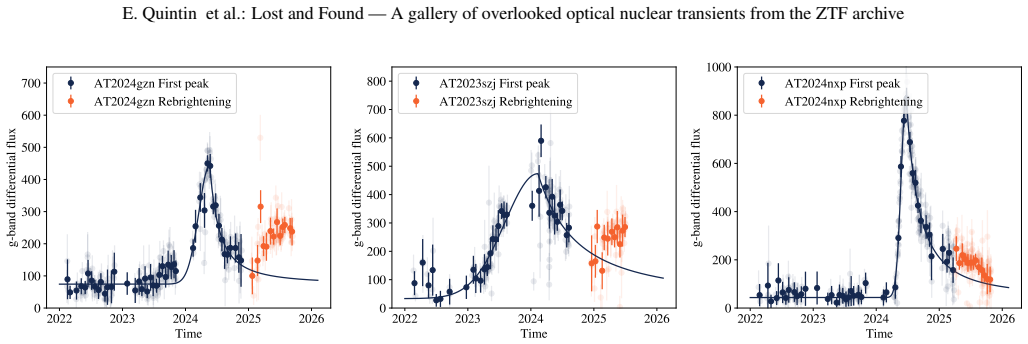
- Repeated nuclear transients are a non-negligible population: they constitute about 10% of this sample, and the updated inventory of known optical repeated transients now includes 25 entries.
- Hard cutoffs on duration or amplitude in classifiers would reject objects like the >5-year transient and the extremely faint TDE candidate, so such cutoffs should be avoided.
- Extreme nuclear transients brighter than -24 exist in active galaxies, and at least one shows post-flare dimming consistent with a depleted accretion flow.
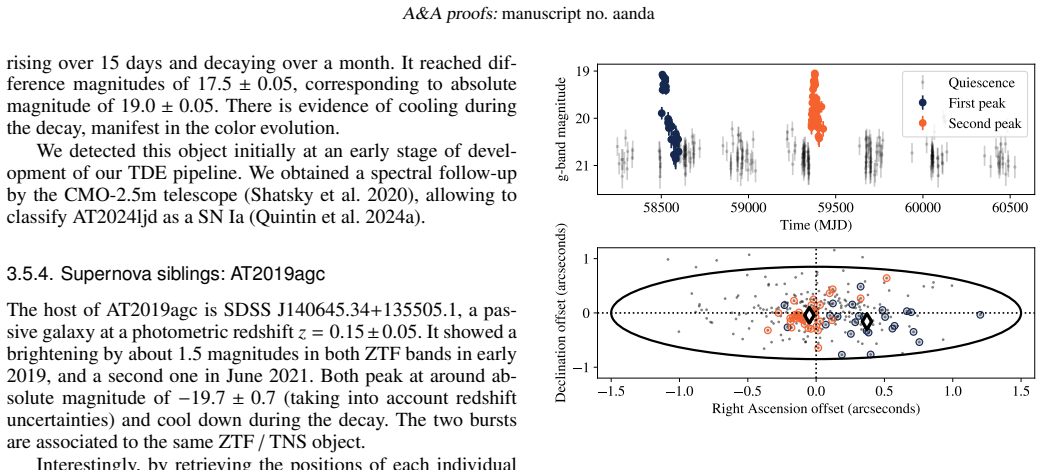
- Reported repeated transients should be checked for positional consistency: the two peaks in AT2019agc come from different locations, meaning a single catalog entry can masquerade as a repeating event.
Where Pith is reading between the lines
- If the roughly 10% repetition fraction holds in an unbiased sample, partial-disruption TDE models must accommodate a large survival fraction; the absence of any three-peak optical TDE suggests that predicting a third peak from a two-peak interval is unreliable, a cautionary testable expectation for LSST-era monitoring.
- The long-lived transient class represented by AT2020ukj hints at a continuum between TDEs and turn-on AGNs; one testable extension is to monitor such objects for the late appearance of broad emission lines or quasi-periodic X-ray eruptions, as seen in the similar source Ansky.
- The paper's qualitative distinction between an AGN flare and a true nuclear transient in active hosts could be made quantitative by fitting a damped random walk to each historical lightcurve and computing the excursion probability of the flare; this is a natural extension the authors mention but leave to future work.
- The detection of infrared echoes in many of the candidates suggests that mid-infrared variability could serve as an auxiliary photometric discriminator for nuclear transients with ambiguous optical classification.
Editorial analysis
A structured set of objections, weighed in public.
Referee Report
Summary. The paper presents 19 optical nuclear transients found during development of the Fink/ZTF early-TDE detection module and in archival ZTF data. The sample is divided into 9 TDE candidates in passive hosts, 8 ANT candidates in active hosts, and 2 in hosts with uncertain activity, plus 4 supernova candidates (including one impostor repeated event that is actually two SNe). For each object the authors provide ZTF forced photometry, WISE/CRTS archival context, a phenomenological light-curve fit, and for most objects a physical fit with the Redback tde_fallback model. They highlight two newly identified repeated nuclear transients, one long-lived (>5 yr) transient in a passive galaxy, and three likely Extreme Nuclear Transients. They use the sample to argue that current classifiers miss a small but non-negligible fraction of nuclear transients and to make recommendations for LSST-era detection systems.
Significance. If the sample is taken at face value, the paper demonstrates that archival searches can recover overlooked nuclear transients, including physically interesting outliers such as repeated partial-TDE candidates and very long-duration events. The quantitative value is as a curated catalog with multi-wavelength context and honest uncertainty reporting. Strengths include the systematic use of CRTS+WISE+ZTF archival data, the public physical modeling code, the up-to-date inventory of repeated optical nuclear transients in Table 2, and the positional analysis of AT2019agc that exposes a limitation of current transient association. The main fragility is that the active/passive host classification—which underpins the headline TDE/ANT split—is partly qualitative, and the ENT claims depend on poorly constrained photometric redshifts. These issues are acknowledged in the text but still affect the central claims as stated.
major comments (3)
- [Sec. 3.2 and Sec. 4.3] The classification of the 8 active-host flares as ANTs rests on the qualitative statement that each flare is 'clearly in excess' of prior AGN variability (e.g., Secs. 3.2.1–3.2.8). No statistical test against a stochastic AGN model (e.g., damped random walk) is performed, although the authors note in Sec. 4.3 that the selection is 'mostly qualitative' and suggest DRW modeling as future work. Because the central inventory claim—9 TDEs, 8 ANTs, 2 uncertain—depends directly on this separation, I ask for a quantitative significance measure, such as a DRW-based p-value or predictive posterior for each active-host flare, or alternatively a reclassification of these objects as 'unclassified nuclear transients in active hosts' until such a test is available.
- [Sec. 3.2.4 / Table 1] The ENT classification of AT2024nxp (and to a lesser extent AT2022yhf and AT2023rav) is strongly redshift dependent. For AT2024nxp the photometric redshift is z=1.7±0.8, giving an absolute magnitude range of roughly -24 to -27, and the paper itself notes that the redshift estimates span 0.6–2.5. The claim of 'three new ENT candidates' should be accompanied by a full propagation of the photo-z posterior into the absolute-magnitude distribution, and the ENT label should be made conditional on that distribution rather than on single point estimates. At minimum, the abstract and conclusions should state the redshift sensitivity of these candidates.
- [Sec. 3.4 / Fig. 7] The statement that the posterior parameter distributions are 'highly consistent' with the Nicholl et al. (2022) TDE sample is used as supporting evidence that the selected objects are TDE-like. However, the sample was selected by a classifier built to find TDE-like rising light curves, so a degree of consistency is expected by construction. The comparison also mixes two fitting codes (Redback vs MOSFiT) and omits AT2020actc and AT2023rav because their fits did not converge. I recommend either adding a null-model comparison (e.g., fitting SLSN or AGN-flare models to the same objects and comparing Bayesian evidence) or explicitly stating the circularity and presenting the parameter comparison only as a descriptive check, not as independent confirmation.
minor comments (5)
- [Sec. 5 (Conclusions)] Several bullet points contain typos such as 'A T2020ukj' and 'A T2023adr'; these should be 'AT2020ukj' and 'AT2023adr'.
- [Table A.2] The table lists 'AT2020act' twice with slightly different parameter values, and also uses 'AT2020aex' for AT2020aexc. Please correct the naming and verify the duplicated rows.
- [Sec. 3.5.4] The positional KS-test is significant in RA but not in Dec for the g band (p=8.3e-10 vs p=0.2). The text says 'safely (>6σ)' based primarily on RA; please state the combined evidence more carefully, e.g., using a 2D test or a joint probability, rather than quoting the strongest 1D p-value alone.
- [Sec. 2.4] The late-time plateau or negative host component is described as added 'where needed' to Eq. (1). For reproducibility, state how the need was assessed (e.g., residual significance) and whether the parameters of the added component are reported anywhere. The AT2020pno discussion uses reduced chi-square values; a brief description of the model-selection criterion would be useful.
- [Appendix B / Fig. B.4] The caption notes that the CRTS counterpart to AT2023jag is a blend of two central sources, which explains the magnitude offset. This caveat should also appear in the main text for AT2023jag, since it affects the interpretation of the historical light curve.
Circularity Check
Supporting TDE-parameter consistency check is partly by construction (priors taken from the same comparison sample); the central discovery inventory remains independent.
specific steps
-
fitted input called prediction
[Section 2.5 (physically-motivated fitting) and Section 3.4 (physical parameters analysis)]
"The priors for the parameters were chosen following the analysis of Nicholl et al. (2022), that provides a systematic modeling of a sample of TDE lightcurves. ... We find that the two distributions are highly consistent with each other, supporting the conclusion that our classifier has identified a sample of objects hosting similar events."
The consistency check is not independent: the tde_fallback priors were taken from the same Nicholl et al. (2022) 32-TDE sample that is later used as the comparison distribution, with only the stellar-mass prior changed. Bayesian posteriors fitted on limited photometry are therefore pulled toward that prior space, so the reported 'highly consistent' distributions are partly inherited from the fit setup rather than demonstrated by the new data. This makes the Sec. 3.4 statement 'supporting the conclusion that our classifier has identified a sample of objects hosting similar events' partially circular. The central claim of the paper — the inventory of 19 overlooked nuclear transients — does not depend on this consistency check, so the circularity is partial and confined to a supporting argume
full rationale
Most of this paper is an observational gallery: candidate selection, host-galaxy activity assessment, lightcurve fitting, and the repeated-transient inventory are based on archival ZTF/CRTS/WISE photometry, spectra, and external literature, with no derivation step equivalent to its input by construction. The clearest circularity concern is the parameter-distribution comparison in Sec. 3.4: the Bayesian priors for the physical model were chosen following Nicholl et al. (2022), and then the same Nicholl et al. sample is used as the comparison set to claim that the classifier found objects hosting similar events. This is a partially constructed consistency, not an independent validation, but it is a supporting remark rather than the load-bearing discovery claim. The paper also explicitly acknowledges the qualitative character of the active-host flare selection and suggests DRW modeling as future work (Sec. 4.3), which is a stated limitation rather than a hidden circular step. Because the central inventory and its individual object classifications stand on independent data, score 4 is appropriate rather than a higher score.
Axiom & Free-Parameter Ledger
free parameters (4)
- Per-object phenomenological fit parameters (F_host^g, F_peak^g, t_peak, tau_rise, tau_decay) =
e.g., AT2020ukj tau_rise=68.5±8.8 d, tau_decay=4984.9±497.2 d; see Table A.1
- tde_fallback physical parameters (M_BH, M_star, t_visc, beta*, eta, R_ph0, L*_photo, t0) =
Table A.2 (e.g., log M_BH=5.75 for AT2020ukj)
- Late-time plateau components =
constant or linear plateau added per object where needed
- t_visc prior upper bound for AT2020ukj =
increased by 10x from default
axioms (7)
- domain assumption Gaussian-rise + t^-5/3 power-law decay (Eq. 1) describes the optical TDE lightcurves in this sample.
- domain assumption tde_fallback (Mockler et al. 2019) is a valid generative model for these lightcurves, including for partial-disruption candidates despite the model assuming full disruption.
- domain assumption Host-galaxy activity can be classified from WISE W1-W2>0.8, Gaia DR3 class, and historical variability when spectroscopy is absent.
- domain assumption Photometric redshifts are accurate enough to place absolute magnitudes and distinguish TDE/SN/ENT classes.
- domain assumption The Fink early-TDE classifier recall (76%) and visual inspection identify a representative set of missed nuclear transients.
- ad hoc to paper A late-time plateau or negative host component can be added to Eq. (1) without changing the interpretation of the core burst.
- ad hoc to paper For AT2020ukj the default tvisc prior is not applicable; expanding it by an order of magnitude yields a valid posterior.
read the original abstract
Tidal disruption events (TDEs) correspond to the destruction of a star by the tidal forces around a black hole, leading to outbursts which can last from months to years. These transients are rare, and increasing the current sample is paramount to understand them. As part of the Fink alert broker, we have developed an early detection system for TDEs for the Zwicky Transient Facility (ZTF) data. In this paper, we report on the optical transients we found either during the development of this tool, or when applying the classifier to the existing archive. We use this sample to anticipate what improvements to the TDE detection systems will need to be implemented for future surveys. For all the transients, we present optical and infrared archival photometry from ZTF, WISE, and Catalina, and assess the previous nuclear activity of the host. We fit the ZTF lightcurves with both a phenomenological and a physically-motivated model. We report on a total of 19 optical nuclear transients, out of which nine are in passive galaxies, eight in active galaxies, and two for which the activity of the host is uncertain. Two transients are newly discovered repeated TDE candidates, and we compare them to the current sample of repeated optical nuclear transients. One transient is exceptionally long-lived (over 5 years), in an until-now passive galaxy. Three of the TDE-like flares in active galaxies have absolute g-band magnitudes brighter than -24, making them new Extreme Nuclear Transient (ENT) candidates. One seemingly repeated object was revealed to be two independent supernovae in the same galaxy. This sample shows both the potential of our detection system for future discovery, and the relevance of archival searches to reveal overlooked transients. It also raises several points of concern and avenues of improvement for current and future classifiers.
Figures



Reference graph
Works this paper leans on
-
[1]
Abbott, R., Abe, H., Acernese, F., et al. 2023, Open data from the third observing run of LIGO, Virgo, KAGRA and GEO, arXiv:2302.03676 [gr-qc] Adrián-Martínez, S., Ageron, M., Aharonian, F., et al. 2016, Journal of Physics G Nuclear Physics, 43, 084001, aDS Bibcode: 2016JPhG...43h4001A
Pith/arXiv arXiv 2023
-
[2]
1993, Annual Review of Astronomy and Astrophysics, 31, 473, aDS Bibcode: 1993ARA&A..31..473A
Antonucci, R. 1993, Annual Review of Astronomy and Astrophysics, 31, 473, aDS Bibcode: 1993ARA&A..31..473A
1993
-
[3]
D., et al
Ashton, G., Hübner, M., Lasky, P. D., et al. 2019, The Astrophysical Journal Supplement Series, 241, 27 Astropy Collaboration, Price-Whelan, A. M., Lim, P. L., et al. 2022, The Astro- physical Journal, 935, 167, aDS Bibcode: 2022ApJ...935..167A Astropy Collaboration, Price-Whelan, A. M., Sip ˝ocz, B. M., et al. 2018, The Astronomical Journal, 156, 123, aD...
2019
-
[4]
A., Phillips, M
Baldwin, J. A., Phillips, M. M., & Terlevich, R. 1981, Publications of the Astro- nomical Society of the Pacific, 93, 5, aDS Bibcode: 1981PASP...93....5B
1981
-
[5]
2025, SNCosmo
Barbary, K., Bailey, S., Barentsen, G., et al. 2025, SNCosmo
2025
-
[6]
Bellm, E. 2014, in The Third Hot-wiring the Transient Universe Work- shop, eprint: arXiv:1410.8185, 27–33, conference Name: The Third Hot- wiring the Transient Universe Workshop Pages: 27-33 ADS Bibcode: 2014htu..conf...27B
Pith/arXiv arXiv 2014
-
[7]
2017, The Astrophysical Journal Supple- ment Series, 230, 24, aDS Bibcode: 2017ApJS..230...24B
Bianchi, L., Shiao, B., & Thilker, D. 2017, The Astrophysical Journal Supple- ment Series, 230, 24, aDS Bibcode: 2017ApJS..230...24B
2017
-
[8]
2015, Astronomy & Astrophysics, 581, A17
Campana, S., Mainetti, D., Colpi, M., et al. 2015, Astronomy & Astrophysics, 581, A17
2015
-
[9]
H., & Saban, D
Chan, C.-H., Piran, T., Krolik, J. H., & Saban, D. 2019, The Astrophysical Jour- nal, 881, 113, publisher: The American Astronomical Society
2019
-
[10]
2024, The Astrophysical Journal, 977, 80
Chen, J.-H., Dai, L., Liu, S.-F., & Ou, J.-W. 2024, The Astrophysical Journal, 977, 80
2024
-
[11]
G., et al
Collaboration, D., Abdul-Karim, M., Adame, A. G., et al. 2025, Data Release 1 of the Dark Energy Spectroscopic Instrument
2025
-
[12]
J., Cotton, W
Condon, J. J., Cotton, W. D., Greisen, E. W., et al. 1998, The Astronomical Jour- nal, 115, 1693
1998
-
[13]
V ., Hoof, A
Dalen, J. V ., Hoof, A. V ., Shlentsova, A., Fraser, M., & Yaron, O. 2024, Transient Name Server Classification Report, 2024-1012, 1
2024
-
[14]
2024, arXiv e-prints, arXiv:2406.01434
Dhawan, S., Mortsell, E., Johansson, J., et al. 2024, arXiv e-prints, arXiv:2406.01434
arXiv 2024
-
[15]
J., Djorgovski, S
Drake, A. J., Djorgovski, S. G., Mahabal, A., et al. 2009, The Astrophysical Journal, 696, 870
2009
-
[16]
Duncan, K. J. 2022, Monthly Notices of the Royal Astronomical Society, 512, 3662
2022
-
[17]
A., Page, K
Evans, P. A., Page, K. L., Beardmore, A. P., et al. 2023, Monthly Notices of the Royal Astronomical Society, 518, 174, publisher: OUP ADS Bibcode: 2023MNRAS.518..174E
2023
-
[18]
J., et al
Frederick, S., Gezari, S., Graham, M. J., et al. 2021, The Astrophysical Journal, 920, 56
2021
-
[19]
2025, arXiv e-prints, arXiv:2501.16311
Frohmaier, C., Vincenzi, M., Sullivan, M., et al. 2025, arXiv e-prints, arXiv:2501.16311
Pith/arXiv arXiv 2025
-
[20]
2024, The Astrophysical Journal Supplement Series, 271, 54 Gaia Collaboration, Bailer-Jones, C
Fu, Y ., Wu, X.-B., Li, Y ., et al. 2024, The Astrophysical Journal Supplement Series, 271, 54 Gaia Collaboration, Bailer-Jones, C. A. L., & al. 2022, Astronomy & Astro- physics Gaia Collaboration, Bailer-Jones, C. A. L., Teyssier, D., et al. 2023, Astronomy and Astrophysics, 674, A41, aDS Bibcode: 2023A&A...674A..41G
2024
-
[21]
2021, Annual Review of Astronomy and Astrophysics, 59, 21, aDS Bibcode: 2021ARA&A..59...21G
Gezari, S. 2021, Annual Review of Astronomy and Astrophysics, 59, 21, aDS Bibcode: 2021ARA&A..59...21G
2021
-
[22]
M., Brasseur, C
Ginsburg, A., Sip˝ocz, B. M., Brasseur, C. E., et al. 2019, The Astronomical Jour- nal, 157, 98, aDS Bibcode: 2019AJ....157...98G Article number, page 16 of 25 E. Quintin et al.: Lost and Found — A gallery of overlooked optical nuclear transients from the ZTF archive
2019
-
[23]
Gomez, S. & Gezari, S. 2023, The Search for Thermonuclear Transients from the Tidal Disruption of a White Dwarf by an Intermediate Mass Black Hole, arXiv:2302.14070 [astro-ph]
Pith/arXiv arXiv 2023
-
[24]
Graham, M. J., McKernan, B., Ford, K. E. S., et al. 2025, An Extremely Lumi- nous Flare Recorded from a Supermassive Black Hole, arXiv:2511.02178
arXiv 2025
-
[25]
L., Fremling, C., Perley, D
Graham, M. L., Fremling, C., Perley, D. A., et al. 2022, MNRAS, 511, 241
2022
-
[26]
A., et al
Guillochon, J., Nicholl, M., Villar, V . A., et al. 2018, The Astrophysical Journal Supplement Series, 236, 6, publisher: American Astronomical Society
2018
-
[27]
2007, A&A, 466, 11
Guy, J., Astier, P., Baumont, S., et al. 2007, A&A, 466, 11
2007
-
[28]
v., Gezari, S., et al
Hammerstein, E., Velzen, S. v., Gezari, S., et al. 2022, The Astrophysical Journal, 942, 9, publisher: The American Astronomical Society
2022
-
[29]
Harris, C. R., Millman, K. J., van der Walt, S. J., et al. 2020, Nature, 585, 357, number: 7825 Publisher: Nature Publishing Group Hernández-García, L., Chakraborty, J., Sánchez-Sáez, P., et al. 2025a, Nature Astronomy, 1 Hernández-García, L., Sánchez-Sáez, P., Chakraborty, J., et al. 2025b, NICER observations reveal doubled timescales in Ansky’s quasi-pe...
arXiv 2020
-
[30]
T., Holoien, T
Hinkle, J. T., Holoien, T. W.-S., Auchettl, K., et al. 2021, Monthly Notices of the Royal Astronomical Society, 500, 1673
2021
-
[31]
Hinkle, J. T., Shappee, B. J., Auchettl, K., et al. 2024, arXiv e-prints, arXiv:2405.08855
arXiv 2024
-
[32]
Ho, A. Y . Q., Perley, D. A., Gal-Yam, A., et al. 2023, The Astrophysical Journal, 949, 120
2023
-
[33]
Hunter, J. D. 2007, Computing in Science & Engineering, 9, 90, conference Name: Computing in Science & Engineering
2007
-
[34]
Ishida, E. E. O. 2019, Nature Astronomy, 3, 680 Ivezi´c, Z., Kahn, S. M., Tyson, J. A., et al. 2019, The Astrophysical Journal, 873, 111, aDS Bibcode: 2019ApJ...873..111I
2019
-
[35]
2017, Nature Astronomy, 1, 865
Kankare, E., Kotak, R., Mattila, S., et al. 2017, Nature Astronomy, 1, 865
2017
-
[36]
2008, The Astrophysical Journal, 678, L13
Komossa, S., Zhou, H., Wang, T., et al. 2008, The Astrophysical Journal, 678, L13
2008
-
[37]
A., Liodakis, I., Koljonen, K
Langis, D. A., Liodakis, I., Koljonen, K. I. I., et al. 2025, Repeating Flares, X-ray Outbursts and Delayed Infrared Emission: A Comprehensive Compilation of Optical Tidal Disruption Events
2025
-
[38]
2024, The Astrophysical Journal, 971, L26
Lin, Z., Jiang, N., Wang, T., et al. 2024, The Astrophysical Journal, 971, L26
2024
-
[39]
2025, The Astrophysical Journal, 979, 40 Llamas Lanza, M., Karpov, S., Russeil, E., et al
Liu, C., Yarza, R., & Ramirez-Ruiz, E. 2025, The Astrophysical Journal, 979, 40 Llamas Lanza, M., Karpov, S., Russeil, E., et al. 2025, Early Identification of Optical Tidal Disruption Events: A science module for the Fink broker, arXiv:2507.17499 Llamas Lanza, M., Quintin, E., Russeil, E., et al. 2024, Transient Name Server AstroNote, 178, 1, aDS Bibcode...
arXiv 2025
-
[40]
R., Sainz de Murieta, A., Collett, T
Magee, M. R., Sainz de Murieta, A., Collett, T. E., & Enzi, W. 2023, Monthly Notices of the Royal Astronomical Society, 525, 542
2023
-
[41]
2011, The Astrophysical Journal, 731, 53
Mainzer, A., Bauer, J., Grav, T., et al. 2011, The Astrophysical Journal, 731, 53
2011
-
[42]
Semenikhin, T. A. 2024, Superluminous supernova search with PineForest, arXiv:2410.21077
Pith/arXiv arXiv 2024
-
[43]
Makrygianni, L., Arcavi, I., Newsome, M., et al. 2025, The Double Tidal Disrup- tion Event AT 2022dbl Implies That at Least Some "Standard" Optical TDEs are Partial Disruptions, arXiv:2505.16867
Pith/arXiv arXiv 2025
-
[44]
Makrygianni, L., Trakhtenbrot, B., Arcavi, I., et al. 2023, AT 2021loi: A Bowen Fluorescence Flare with a Rebrightening Episode, Occurring in a Previously- Known AGN, arXiv:2305.01694
Pith/arXiv arXiv 2023
-
[45]
V ., Pruzhinskaya, M
Malanchev, K., Kornilov, M. V ., Pruzhinskaya, M. V ., et al. 2023, Publications of the Astronomical Society of the Pacific, 135, 024503
2023
-
[46]
V ., Pruzhinskaya, M
Malanchev, K., Kornilov, M. V ., Pruzhinskaya, M. V ., et al. 2023, PASP, 135, 024503
2023
-
[47]
2023, Monthly Notices of the Royal Astronomical Society, 520, 4209, publisher: OUP ADS Bibcode: 2023MN- RAS.520.4209M
Malyali, A., Liu, Z., Merloni, A., et al. 2023, Monthly Notices of the Royal Astronomical Society, 520, 4209, publisher: OUP ADS Bibcode: 2023MN- RAS.520.4209M
2023
-
[48]
2021, Astronomy & Astrophysics, 647, A9
Malyali, A., Rau, A., Merloni, A., et al. 2021, Astronomy & Astrophysics, 647, A9
2021
-
[49]
Masci, F. J., Laher, R. R., Rusholme, B., et al. 2023, arXiv e-prints, arXiv:2305.16279
Pith/arXiv arXiv 2023
-
[50]
J., Laher, R
Masci, F. J., Laher, R. R., Rusholme, B., et al. 2018, Publications of the As- tronomical Society of the Pacific, 131, 018003, publisher: The Astronomical Society of the Pacific
2018
-
[51]
Masci, F. J., Laher, R. R., Rusholme, B., et al. 2019, The Zwicky Transient Fa- cility: Data Processing, Products, and Archive, arXiv:1902.01872
Pith/arXiv arXiv 2019
-
[52]
Masterson, M., De, K., Panagiotou, C., et al. 2024, A New Population of Mid- Infrared-Selected Tidal Disruption Events: Implications for Tidal Disruption Event Rates and Host Galaxy Properties, arXiv:2401.01403 [astro-ph]
Pith/arXiv arXiv 2024
-
[53]
McKernan, B., Ford, K. E. S., Cantiello, M., et al. 2022, Monthly Notices of the Royal Astronomical Society, 514, 4102
2022
-
[54]
Merloni, A., Dwelly, T., Salvato, M., et al. 2015, Monthly Notices of the Royal Astronomical Society, 452, 69 Milán Veres, P., Franckowiak, A., van Velzen, S., et al. 2024, arXiv e-prints, arXiv:2408.17419
arXiv 2015
-
[55]
D., Giustini, M., et al
Miniutti, G., Saxton, R. D., Giustini, M., et al. 2019, Nature, 573, 381, aDS Bibcode: 2019Natur.573..381M
2019
-
[56]
2019, The Astrophysical Jour- nal, 872, 151
Mockler, B., Guillochon, J., & Ramirez-Ruiz, E. 2019, The Astrophysical Jour- nal, 872, 151
2019
-
[57]
2022, arXiv:2202.10143 [astro-ph], arXiv: 2202.10143
Modiano, D., Wijnands, R., Parikh, A., et al. 2022, arXiv:2202.10143 [astro-ph], arXiv: 2202.10143
Pith/arXiv arXiv 2022
-
[58]
Moriya, T. J., Sorokina, E. I., & Chevalier, R. A. 2018, Space Science Reviews, 214, 59, arXiv:1803.01875 [astro-ph]
Pith/arXiv arXiv 2018
-
[59]
2024, Monthly Notices of the Royal Astronomical Society, 527, 2452, aDS Bibcode: 2024MN- RAS.527.2452M
Mummery, A., van Velzen, S., Nathan, E., et al. 2024, Monthly Notices of the Royal Astronomical Society, 527, 2452, aDS Bibcode: 2024MN- RAS.527.2452M
2024
-
[60]
Murphy, T., Chatterjee, S., Kaplan, D. L., et al. 2013, Publications of the Astro- nomical Society of Australia, 30, e006 Möller, A., Peloton, J., Ishida, E. E. O., et al. 2021, Monthly Notices of the Royal Astronomical Society, 501, 3272, arXiv:2009.10185 [astro-ph]
Pith/arXiv arXiv 2013
-
[61]
2022, arXiv:2201.02649 [astro-ph], arXiv: 2201.02649
Nicholl, M., Lanning, D., Ramsden, P., et al. 2022, arXiv:2201.02649 [astro-ph], arXiv: 2201.02649
Pith/arXiv arXiv 2022
-
[62]
S., Stalin, C
Paliya, V . S., Stalin, C. S., Domínguez, A., & Saikia, D. J. 2024, Monthly Notices of the Royal Astronomical Society, 527, 7055
2024
-
[63]
2025, Astron- omy & Astrophysics, 696, A153
Pavez-Herrera, M., Sánchez-Sáez, P., Hernández-García, L., et al. 2025, Astron- omy & Astrophysics, 696, A153
2025
-
[64]
V ., Shappee, B
Payne, A. V ., Shappee, B. J., Hinkle, J. T., et al. 2021, The Astrophysical Journal, 910, 125, publisher: American Astronomical Society
2021
-
[65]
2024, Transient Name Server As- troNote, 250, 1
Pessi, P., Lunnan, R., Sollerman, J., et al. 2024, Transient Name Server As- troNote, 250, 1
2024
-
[66]
J., Lunnan, R., Sollerman, J., et al
Pessi, P. J., Lunnan, R., Sollerman, J., et al. 2025, Astronomy & Astrophysics, 695, A142
2025
-
[67]
V ., Ishida, E
Pruzhinskaya, M. V ., Ishida, E. E. O., Novinskaya, A. K., et al. 2023, A&A, 672, A111
2023
-
[68]
2021, The Astrophysical Journal Supplement Series, 256, 5
Reichherzer, P., Schüssler, F., Lefranc, V ., et al. 2021, The Astrophysical Journal Supplement Series, 256, 5
2021
-
[69]
& Trakhtenbrot, B
Ricci, C. & Trakhtenbrot, B. 2023, Nature Astronomy, 7, 1282, number: 11 Pub- lisher: Nature Publishing Group
2023
-
[70]
L., Wright, J., & Maddox, L
Richardson, D., Jenkins, III, R. L., Wright, J., & Maddox, L. 2014, AJ, 147, 118
2014
-
[71]
M., Vincenzi, M., Hounsell, R., et al
Rose, B. M., Vincenzi, M., Hounsell, R., et al. 2025, The Astrophysical Journal, 988, 65
2025
-
[72]
Russeil, E., Malanchev, K. L., Aleo, P. D., et al. 2023, Rainbow: a colorful ap- proach on multi-passband light curve estimation, arXiv:2310.02916 [astro-ph, physics:physics]
Pith/arXiv arXiv 2023
-
[73]
& Quintin, E
Russeil, E. & Quintin, E. 2025, Transient Name Server AstroNote, 202, 1
2025
-
[74]
L., et al
Russeil, E., Quintin, E., Lanza, M. L., et al. 2024, Transient Name Server As- troNote, 379, 1, aDS Bibcode: 2024TNSAN.379....1R
2024
-
[75]
Sarin, N., Hübner, M., Omand, C. M. B., et al. 2024, Monthly Notices of the Royal Astronomical Society, 531, 1203
2024
-
[76]
Schlafly, E. F. & Finkbeiner, D. P. 2011, ApJ, 737, 103
2011
-
[77]
2020, ApJ, 896, L13
Scolnic, D., Smith, M., Massiah, A., et al. 2020, ApJ, 896, L13
2020
-
[78]
2020, in Ground-Based Astronomy in Russia
Shatsky, N., Belinski, A., Dodin, A., et al. 2020, in Ground-Based Astronomy in Russia. 21st Century, ed. I. I. Romanyuk, I. A. Yakunin, A. F. Valeev, & D. O. Kudryavtsev, 127–132
2020
-
[79]
J., Sundelius, B., & Byrd, G
Sillanpaa, A., Haarala, S., Valtonen, M. J., Sundelius, B., & Byrd, G. G. 1988, The Astrophysical Journal, 325, 628
1988
-
[80]
J., Ravi, V ., Yao, Y ., et al
Somalwar, J. J., Ravi, V ., Yao, Y ., et al. 2023, The first systematically identified repeating partial tidal disruption event, arXiv:2310.03782 null
Pith/arXiv arXiv 2023
discussion (0)
Sign in with ORCID, Apple, or X to comment. Anyone can read and Pith papers without signing in.