REVIEW 4 major objections 6 minor 42 references
FlashBack: Consistency Model-Accelerated Shared Autonomy
T0 review · 4 major / 6 minor · reviewed 2026-08-07 · deepseek-v4-flash
Pith's one-line read A distilled consistency model turns shared autonomy into a one-step denoising problem, cutting inference to about one millisecond while matching or beating the 24-step DDPM copilot.
desk verdict Genuinely new combination of consistency models and shared autonomy with promising real-robot results, but the central noise-manifold assumption on user actions is never tested and the evaluation leans on a single same-group baseline. read the letter →
The pith
A machine-rendered reading of the paper's core claim, the machinery that carries it, and where it could break.
The reading
What carries the argument
The load-bearing object is the consistency-model student $f(a_t,t,o_t)$, trained so that adjacent states on the probability-flow ODE trajectory are mapped to the same clean action. During distillation the teacher produces the neighboring state $\hat a_{t-1}$ with one numerical solver step, and the student minimizes the consistency loss $\mathcal{L}_{\mathrm{CSA}}(\theta)=\mathrm{MSE}(f(a_t,t,o_t),\,f(\hat a_{t-1},t-1,o_{t-1}))$. A concurrently trained forward model $\Phi(s,a)\mapsto\hat s_n$ supplies a short-term intent condition based on the predicted next state, and the EDM noise schedule with its preconditioning coefficients defines the discrete ODE steps. This machinery is what collapses dozens of denoising iterations into one forward pass while keeping the nearest-expert guarantee of ODE-based sampling.
What would settle it
Record a large set of raw human teleoperation actions from a task with separate expert demonstrations, then statistically test whether those actions are draws from $\mathcal{N}(a,\sigma_t)$ at the selected noise level, for example with a two-sample test or by measuring the one-step denoiser's reconstruction error as $t$ varies; if real user actions are distinguishable from the noisy-expert distribution, or if reconstructing them requires a $t$ far from the assumed $\alpha T$, then the core premise fails.
Extended reading notes
Core claim
On the paper's own terms, the central discovery is that a consistency-model denoiser $f(a_t,t,o_t)\mapsto\hat a_0$, distilled from an EDM teacher, can replace the entire reverse-diffusion chain of a shared-autonomy copilot. At inference the user's action $a_u$ is treated as a noisy sample $a_u\sim\mathcal{N}(a,\sigma_t)$ at a user-chosen ODE step $t=\alpha T$, and CSA maps it directly to the clean expert action $\hat a_0$ with one function evaluation. The paper reports that this one-step copilot matches the DDPM baseline on Lunar Lander, outperforms it on Peg Insertion and Charger Plug Insertion, achieves about 1 ms inference, and, in a real-robot user study with ten participants, raises peg-insertion success from 66.7% to 83.3% while shortening average completion time from 28.4 s to 24.1 s.
Load-bearing premise
The entire one-step pipeline assumes that the user's action at inference is exactly a Gaussian-perturbed expert action at the chosen ODE timestep, so real human inputs that are biased, lagged, or otherwise structured rather than purely noisy may be denoised to the wrong expert action.
Editorial extensions
If this is right
- If the central claim holds, shared-autonomy copilots can run at robot control rates: CSA needs one function evaluation at about 1 ms, whereas the DDPM baseline needs 24 evaluations and 13–18 ms.
- Goal-excluded assistance becomes practical: CSA needs only expert demonstrations, not a known goal set, a reward function, or query-level access to the user, so it can be applied where the space of user goals is not defined.
- The CSA† variant's success rate stays flat beyond the optimal diffusion ratio, which means users can choose a conservative assistance level without finely tuning the fidelity-conformity tradeoff per task.
- The DDPM baseline completed no Charger Plug Insertion episodes across ten noise schedules, while CSA succeeded with a single hyperparameter setting, implying that consistency distillation removes a major source of per-task tuning sensitivity.
- In the real-robot study, assistance raised human success from 66.7% to 83.3% and reduced average completion time from 28.4 s to 24.1 s, which is what matters for deploying copilots in high-precision teleoperation.
Reading between the lines
- Editorial extension: because inference costs about 1 ms, CSA could be embedded in a closed loop that adjusts the assistance strength $\alpha$ online per action, modulating correction as user skill or task phase changes; the paper names this direction but does not implement it.
- Editorial extension: the nearest-expert property of ODE-based denoising suggests CSA can act as a safety filter that snaps arbitrary user commands onto the learned expert manifold; a testable consequence is that intervention magnitude should track task-progress metrics, which the paper does not report.
- Editorial extension: the assumption $a_u\sim\mathcal{N}(a,\sigma_t)$ is only tested through surrogate pilots, so an important next experiment is to measure whether real teleoperation inputs are statistically consistent with that Gaussian assumption; real human actions may carry structured bias or tremor that surrogates do not.
- Editorial extension: because the method is goal-excluded and demonstration-only, the same distillation recipe transfers to other shared-control settings with expert trajectories, such as assistive exoskeletons or teleoperated surgery, though those applications are not evaluated here.
Editorial analysis
A structured set of objections, weighed in public.
Referee Report
Summary. The paper proposes Consistency Shared Autonomy (CSA), a shared-autonomy framework that distills an EDM teacher into a consistency model for one-step denoising of user actions. The method assumes the user's action a_u is a sample from N(a, sigma_t) for a selected ODE step t, then uses a CM denoiser to map a_u to a clean expert action a_0. A variant CSA† additionally conditions on a forward-model prediction of the next state. Experiments compare CSA/CSA† against a DDPM-based partial-diffusion baseline on surrogate pilots in Lunar Lander, Peg Insertion, and Charger Plug Insertion, and report a real-robot peg-insertion human study with CSA† and no assistance. The paper claims real-time inference (~1 ms), matching or exceeding DDPM, and robust assistance across tasks.
Significance. If the central distributional assumption holds, CSA is a potentially significant contribution: it addresses the real-time bottleneck of diffusion-based shared autonomy while preserving user intent without explicit goal inference. The paper is clearly written, provides code, and includes a real-robot human study, which is a strength. However, the evaluation does not yet substantiate the headline claim that CSA matches or exceeds DDPM on real human input, because the only DDPM comparison is on synthetic surrogates that are designed to stay close to the expert-action manifold.
major comments (4)
- [Section 3.2 and Section 4.3] The assumption au ∼ N(a, σt) is load-bearing but never tested on real users. All four surrogate pilots in Section 4.3 are deterministic or Gaussian corruptions of expert actions, so they remain on or near the expert noise manifold by construction. The human study in Section 4.4 does not log user actions au or otherwise check whether VR teleoperation inputs satisfy this noise model. Without such evidence, the claim that CSA 'flashes back' real user actions to the nearest expert—and hence that the real-robot results in Table 3 support the method—is not established. Please provide a quantitative analysis of logged real actions (e.g., their distribution relative to N(a, σt) for the deployed α, or a comparison of denoising quality on real vs surrogate inputs).
- [Section 4.4, Table 3] The human study omits the DDPM baseline, so the paper's central comparison to Yoneda et al. [1] rests entirely on synthetic surrogate experiments. Moreover, no statistical significance testing is reported anywhere: Table 3 gives success rates without variance or tests, and several Table 1 entries have overlapping standard errors (e.g., Laggy Lunar Lander: DDPM 75.67±9.30 vs CSA 87.67±5.89). Please add significance tests (paired tests for the human study, bootstrapped confidence intervals or similar for simulations) and, if feasible, include the DDPM baseline in the human study to support the cross-method claim.
- [Section 3.1/3.2, Fig. 4, Section 6] There is a train/inference mismatch in CSA†: during training cond2 is computed from the expert next state sn (Fig. 4), but at inference it is computed from the forward-model prediction Φ(s, au) of the user's possibly flawed action. If au is off-manifold, both the denoiser input and the conditioning variable are out of distribution, which may explain the degradation noted in Section 6 for ϵ ≥ 0.5. The paper should quantify this distribution shift (e.g., compare cond2 obtained from expert next states vs forward-model predictions on holdout trajectories) and ablate the effect of the mismatch, since CSA† is the variant used in the real-robot study.
- [Section 2 and Appendix 7.2] The claimed 'nearest expert' guarantee is derived for the EDM teacher denoiser (Eq. 9), not for the distilled consistency-model student; the student is only trained to match the teacher via Eq. (4). The paper should make this distinction explicit and either provide an approximation-error argument or empirical validation that the student inherits the property, otherwise the introduction's assertion that CSA 'ensures proximity to nearest expert actions' is not directly supported.
minor comments (6)
- [Abstract and Title] The title 'FlashBack' is never explained in the text, and the abstract contains a grammatical error: 'inference speeds significantly than what is possible' should read 'significantly faster than.'
- [Section 2 and Tables 1-3] Section 2 claims 'microsecond-scale generation,' but the reported inference times in Tables 1-3 are about 1 ms; please reconcile the claimed time scale with the measured values.
- [Section 3.2] The text says 'CM noiser' and 'Hune solver'; these should be 'denoiser' and 'Heun solver.' The spelling also appears in the Figure 4 caption.
- [Appendix 7.3, Table 4] The surrogate flaw parameters ϵ are selected after inspecting the no-copilot performance curves in Fig. 10; please state explicitly that the selection uses only surrogate performance, and report sensitivity of the main comparisons to neighboring ϵ values.
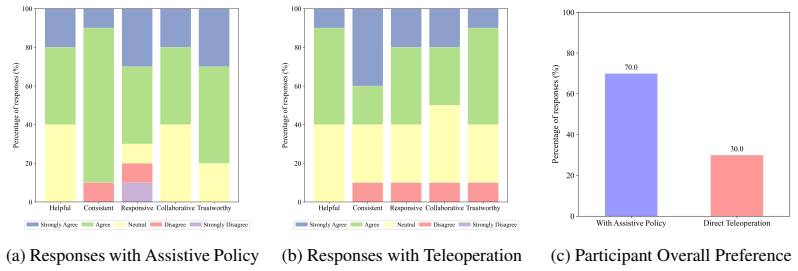
- [Appendix 7.6, Fig. 11] The qualitative survey results are presented as bar charts without sample sizes, response distributions, or significance tests; please add the number of responses per item and indicate whether the Likert differences are statistically meaningful.
- [References] Reference [1] has an extra comma in the author list ('L. Sun, , G. Yang'); this should be corrected.
Circularity Check
No significant circularity: the derivation is standard consistency-model distillation over an EDM teacher, with the user-action noise model stated as an explicit assumption rather than derived from the conclusion.
full rationale
The paper's derivation chain is self-contained and does not reduce any predicted quantity to its own input. CSA trains a consistency-model student with the standard objective (Eq. 4) that minimizes the distance between one-step denoiser outputs at adjacent ODE steps; this is the usual CM distillation loss and does not presuppose the reported performance. The 'nearest expert' guarantee in Appendix 7.2 is a closed-form property of the denoising score-matching loss (Eq. 9) and is explicitly adopted from the EDM appendix [18], an external mathematical result, not a self-citation. The central modeling assumption in Section 3.2—'we assume au ∼ N(a, σt)'—is stated as an assumption, and Section 6 concedes that CSA† degrades for large surrogate noise because outputs 'may stray from rational human behavior.' The Section 4.3 surrogate pilots are corrupted expert actions and hence lie on or near the assumed noise manifold, which is a mild evaluation selection bias, not a circular derivation: the denoiser is trained on clean expert transitions, not fitted to the surrogate test data. Self-citations (e.g., Yoneda et al. [1]) are to prior published, externally falsifiable work used as baseline and motivation, and they do not enforce the paper's conclusion. No load-bearing step is equivalent by construction to its inputs.
Assumptions & free parameters
free parameters (2)
- Assistance ratio alpha (or timestep t) =
Not reported per task; appears as a swept hyperparameter
- Surrogate flaw parameters epsilon =
e.g., 0.45 (noised) for Lunar Lander; see Table 4
assumptions (3)
- standard math EDM and consistency model theory: probability flow ODE, score relationship (Eq. 7), and denoiser training objective (Eq. 6) are taken from Song et al. and Karras et al.
- domain assumption User action is modeled as a noisy expert action (au ~ N(a, sigma_t)) at inference (Section 3.2).
- domain assumption Surrogate pilots (noisy, laggy, noised, slow corrupted experts) are a valid proxy for human users in simulation (Section 4.3).
Cite this review
Pith. "Pith review of FlashBack: Consistency Model-Accelerated Shared Autonomy." pith.science (2026). https://pith.science/paper/R76FPA7Y
@misc{pith2026250516892,
  author       = {Pith},
  title        = {Pith review of: FlashBack: Consistency Model-Accelerated Shared Autonomy},
  year         = {2026},
  howpublished = {\url{https://pith.science/paper/R76FPA7Y}},
  note         = {Machine review of arXiv:2505.16892}
}
read the original abstract
Shared autonomy is an enabling technology that provides users with control authority over robots that would otherwise be difficult if not impossible to directly control. Yet, standard methods make assumptions that limit their adoption in practice-for example, prior knowledge of the user's goals or the objective (i.e., reward) function that they wish to optimize, knowledge of the user's policy, or query-level access to the user during training. Diffusion-based approaches to shared autonomy do not make such assumptions and instead only require access to demonstrations of desired behaviors, while allowing the user to maintain control authority. However, these advantages have come at the expense of high computational complexity, which has made real-time shared autonomy all but impossible. To overcome this limitation, we propose Consistency Shared Autonomy (CSA), a shared autonomy framework that employs a consistency model-based formulation of diffusion. Key to CSA is that it employs the distilled probability flow of ordinary differential equations (PF ODE) to generate high-fidelity samples in a single step. This results in inference speeds significantly than what is possible with previous diffusion-based approaches to shared autonomy, enabling real-time assistance in complex domains with only a single function evaluation. Further, by intervening on flawed actions at intermediate states of the PF ODE, CSA enables varying levels of assistance. We evaluate CSA on a variety of challenging simulated and real-world robot control problems, demonstrating significant improvements over state-of-the-art methods both in terms of task performance and computational efficiency.
Figures


Figures from the paper (7 more)


Reference graph
Works this paper leans on
- [1]
- [2]
-
[3]
P. Aigner and B. McCarragher. Human integration into robot control utilising potential fields. In Proceedings of the IEEE International Conference on Robotics and Automation (ICRA) , pages 291–296, 1997. doi:10.1109/ROBOT.1997.620053
-
[4]
R. C. Goertz. Manipulators used for handling radioactive materials. Human Factors in Tech- nology, pages 425–443, 1963
work page 1963
-
[5]
D. A. Abbink, T. Carlson, M. Mulder, J. C. F. de Winter, F. Aminravan, T. L. Gibo, and E. R. Boer. A topology of shared control systems—finding common ground in diversity. IEEE Transactions on Human-Machine Systems , 48(5):509–525, 2018. doi:10.1109/THMS.2018. 2791570
-
[6]
B. McMahan, Z. M. Peng, B. Zhou, and J. Kao. Shared autonomy with IDA: Interventional diffusion assistance. In Advances in Neural Information Processing Systems (NeurIPS), pages 128330–128354, 2024
work page 2024
- [7]
-
[8]
C. Schaff and M. R. Walter. Residual policy learning for shared autonomy. arXiv preprint arXiv:2004.05097, 2020
arXiv 2004
Show all 42 references
-
[9]
Ghorbel, J
M. Ghorbel, J. Pineau, R. Gourdeau, S. Javdani, and S. Srinivasa. A decision-theoretic ap- proach for the collaborative control of a smart wheelchair. International Journal of Social Robotics, 10:131–145, 2018. 9
2018
-
[10]
Schr ¨oer, I
S. Schr ¨oer, I. Killmann, B. Frank, M. V ¨olker, L. Fiederer, T. Ball, and W. Burgard. An au- tonomous robotic assistant for drinking. In Proceedings of the IEEE International Conference on Robotics and Automation (ICRA), pages 6482–6487, 2015
2015
-
[11]
Phung, G
A. Phung, G. Billings, A. F. Daniele, M. R. Walter, and R. Camilli. Enhancing scientific ex- ploration of the deep sea through shared autonomy in remote manipulation. Science Robotics, 8(81), 2023
2023
-
[12]
Muelling, A
K. Muelling, A. Venkatraman, J.-S. Valois, J. E. Downey, J. Weiss, S. Javdani, M. Hebert, A. B. Schwartz, J. L. Collinger, and J. A. Bagnell. Autonomy infused teleoperation with applica- tion to brain computer interface controlled manipulation. Autonomous Robots, 41:1401–1422, 2017
2017
-
[13]
Javdani, S
S. Javdani, S. S. Srinivasa, and J. A. Bagnell. Shared autonomy via hindsight optimization. In Proceedings of Robotics: Science and Systems (RSS), pages 10–15607, 2015
2015
-
[14]
P ´erez-D’Arpino and J
C. P ´erez-D’Arpino and J. A. Shah. Fast target prediction of human reaching motion for coop- erative human-robot manipulation tasks using time series classification. In Proceedings of the IEEE International Conference on Robotics and Automation (ICRA), pages 6175–6182, 2015
2015
-
[15]
A. D. Dragan and S. S. Srinivasa. A policy-blending formalism for shared control. Interna- tional Journal of Robotics Research, 32(7):790–805, 2013
2013
-
[16]
J. Ho, A. Jain, and P. Abbeel. Denoising diffusion probabilistic models. In Advances in Neural Information Processing Systems (NeurIPS), pages 6840–6851, 2020
2020
-
[17]
J. Song, C. Meng, and S. Ermon. Denoising diffusion implicit models. arXiv preprint arXiv:2010.02502, 2020
2010 arXiv
-
[18]
Karras, M
T. Karras, M. Aittala, T. Aila, and S. Laine. Elucidating the design space of diffusion-based generative models. 2022
2022
-
[19]
Z. Kong, W. Ping, J. Huang, K. Zhao, and B. Catanzaro. DiffWave: A versatile diffusion model for audio synthesis. arXiv preprint arXiv:2009.09761, 2021
2009 arXiv
-
[20]
Rombach, A
R. Rombach, A. Blattmann, D. Lorenz, P. Esser, and B. Ommer. High-resolution image syn- thesis with latent diffusion models. In Proceedings of the IEEE/CVF Conference on Computer Vision and Pattern Recognition (CVPR), pages 10684–10695, 2022
2022
-
[21]
L. Ruan, Y . Ma, H. Yang, H. He, B. Liu, J. Fu, N. J. Yuan, Q. Jin, and B. Guo. MM-Diffusion: Learning multi-modal diffusion models for joint audio and video generation. In Proceedings of the IEEE/CVF Conference on Computer Vision and Pattern Recognition (CVPR) , pages 10219–1...
2023
-
[22]
Sheynin, A
S. Sheynin, A. Polyak, U. Singer, Y . Kirstain, A. Zohar, O. Ashual, D. Parikh, and Y . Taigman. Emu Edit: Precise image editing via recognition and generation tasks. In Proceedings of the IEEE/CVF Conference on Computer Vision and Pattern Recognition (CVPR) , pages 8871– 8879, 2024
2024
-
[23]
Poole, A
B. Poole, A. Jain, J. T. Barron, and B. Mildenhall. DreamFusion: Text-to-3D using 2D diffu- sion. arXiv preprint arXiv:2209.14988, 2022
2022 arXiv
-
[24]
Y . Xu, J. Mao, Y . Du, T. Loz´ano-P´erez, L. P. Kaebling, and D. Hsu. ” set it up!”: Functional object arrangement with compositional generative models. arXiv preprint arXiv:2405.11928, 2024
2024 arXiv
-
[25]
L. Sun, T. Yoneda, S. W. Wheeler, T. Jiang, and M. R. Walter. Stackgen: Generating stable structures from silhouettes via diffusion. arXiv preprint arXiv:2409.18098, 2024. 10
2024 arXiv
-
[26]
C. Chi, Z. Xu, S. Feng, E. Cousineau, Y . Du, B. Burchfiel, R. Tedrake, and S. Song. Diffusion policy: Visuomotor policy learning via action diffusion. International Journal of Robotics Research, 2024
2024
-
[27]
Carvalho, A
J. Carvalho, A. T. Le, M. Baierl, D. Koert, and J. Peters. Motion planning diffusion: Learning and planning of robot motions with diffusion models. arXiv preprint arXiv:2308.01557, 2024
2024 arXiv
-
[28]
Z.-H. Yin, C. Wang, L. Pineda, F. Hogan, K. Bodduluri, A. Sharma, P. Lancaster, I. Prasad, M. Kalakrishnan, J. Malik, et al. DexterityGen: Foundation controller for unprecedented dex- terity. arXiv preprint arXiv:2502.04307, 2025
2025 arXiv
-
[29]
Y . Song, P. Dhariwal, M. Chen, and I. Sutskever. Consistency models. arXiv preprint arXiv:2303.01469, 2023
2023 arXiv
-
[30]
Prasad, K
A. Prasad, K. Lin, J. Wu, L. Zhou, and J. Bohg. Consistency policy: Accelerated visuomotor policies via consistency distillation. In Proceedings of Robotics: Science and Systems (RSS) , 2024
2024
-
[31]
C. Meng, Y . He, Y . Song, J. Song, J. Wu, J.-Y . Zhu, and S. Ermon. SDEdit: Guided image synthesis and editing with stochastic differential equations. arXiv preprint arXiv:2108.01073, 2022
2022 arXiv
-
[32]
Debus, J
T. Debus, J. Stoll, R. D. Howe, and P. Dupont. Cooperative human and machine perception in teleoperated assembly. In Proceedings of the International Symposium on Experimental Robotics (ISER), pages 51–60, 2001
2001
-
[33]
Kofman, X
J. Kofman, X. Wu, T. J. Luu, and S. Verma. Teleoperation of a robot manipulator using a vision- based human-robot interface. IEEE Transactions on Industrial Electronics, 52(5):1206–1219, 2005
2005
-
[34]
B. D. Argall. Modular and adaptive wheelchair automation. InProceedings of the International Symposium on Experimental Robotics (ISER), pages 835–848, 2015
2015
-
[35]
W. Tan, D. Koleczek, S. Pradhan, N. Perello, V . Chettiar, V . Rohra, A. Rajaram, S. Srinivasan, H. S. Hossain, and Y . Chandak. On optimizing interventions in shared autonomy. InProceed- ings of the National Conference on Artificial Intelligence (AAAI), pages 5341–5349, 2022
2022
-
[36]
Janner, Y
M. Janner, Y . Du, J. Tenenbaum, and S. Levine. Planning with diffusion for flexible behavior synthesis. In Proceedings of the International Conference on Machine Learning (ICML), 2022
2022
-
[37]
C. Meng, R. Rombach, R. Gao, D. Kingma, S. Ermon, J. Ho, and T. Salimans. On distillation of guided diffusion models. In Proceedings of the IEEE/CVF Conference on Computer Vision and Pattern Recognition (CVPR), pages 14297–14306, 2023
2023
-
[38]
Salimans and J
T. Salimans and J. Ho. Progressive distillation for fast sampling of diffusion models. arXiv preprint arXiv:2202.00512, 2022
2022 arXiv
-
[39]
Brockman, V
G. Brockman, V . Cheung, L. Pettersson, J. Schneider, J. Schulman, J. Tang, and W. Zaremba. OpenAI Gym. arXiv preprint arXiv:1606.01540, 2016
2016 arXiv
-
[40]
Haarnoja, A
T. Haarnoja, A. Zhou, P. Abbeel, and S. Levine. Soft actor-critic: Off-policy maximum entropy deep reinforcement learning with a stochastic actor. In International conference on machine learning, pages 1861–1870. Pmlr, 2018
2018
-
[41]
Schulman, F
J. Schulman, F. Wolski, P. Dhariwal, A. Radford, and O. Klimov. Proximal policy optimization algorithms. arXiv preprint arXiv:1707.06347, 2017
2017 arXiv
-
[42]
helpful,
B. Tang, M. A. Lin, I. Akinola, A. Handa, G. S. Sukhatme, F. Ramos, D. Fox, and Y . Narang. Industreal: Transferring contact-rich assembly tasks from simulation to reality. arXiv preprint arXiv:2305.17110, 2023. 11 7 Appendix 7.1 Preliminary: Probability Flow ODEs Diffusion mo...
2023 arXiv
Reviewed August 7, 2026 · model on record in the stance chip above.
Discussion (0). Sign in to comment.