REVIEW 3 major objections 5 minor 77 references
Freeze, Prompt, and Adapt: A Framework for Source-free Unsupervised GNN Prompting
T0 review · 3 major / 5 minor · reviewed 2026-08-07 · deepseek-v4-flash
Pith's one-line read This paper claims that a frozen graph neural network can be adapted to a shifted, unlabeled target domain by training only input-side prompts, using the network's own confident predictions as pseudo-labels.
desk verdict A genuinely new problem setting (UGPP) and a reasonable first unsupervised GNN prompting method, but the 'no labels' claim is weakened by labeled-validation hyperparameter tuning and the abstract's 'consistently outperforms' does not hold at higher label budgets. read the letter →
The pith
A machine-rendered reading of the paper's core claim, the machinery that carries it, and where it could break.
The reading
What carries the argument
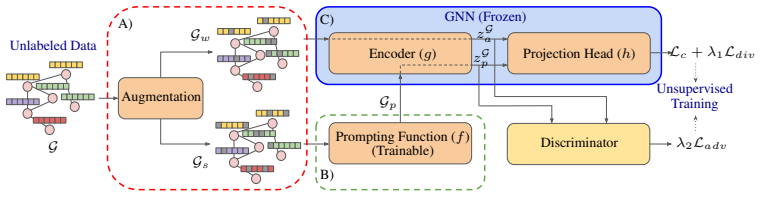
The load-bearing object is the prompting function $f(.;\theta_f)$, instantiated as a small set of trainable prompt vectors $t^*_j$ added to node features through soft attention weights $\alpha_{i,j}=\exp(x_i^\top t^*_j)/\sum_l \exp(x_i^\top t^*_l)$, so each node receives a prompt vector $\sum_j \alpha_{i,j}t^*_j$. The GNN $\varphi = h\circ g$ stays frozen, and the prompt function is trained by the consistency loss $L_c$ in Eq. (3), which uses confident pseudo-labels from the weakly augmented graph; the diversity loss $L_{div}$ in Eq. (4); and the adversarial domain loss $L_{adv}$ in Eq. (6), with a discriminator $d$ over encoder embeddings. The prompted graph is deliberately treated as a strongly augmented instance, which is what lets pseudo-labeling and consistency regularization operate with no target labels and no source-data access.
What would settle it
Construct a target split where the source-trained GNN's confident predictions are known to be wrong, for example a homophily-reversed split in which high-confidence predictions are anti-correlated with true labels, and run UGPrompt; if F1 still improves over the frozen base model, the pseudo-label assumption is not load-bearing, and if it degrades, the claim that the method adapts under arbitrary covariate shift is refuted.
Extended reading notes
Core claim
The central claim is that prompting alone, training only input-side prompt vectors while the encoder and projection head of a pretrained GNN stay completely frozen, can adapt the model to a new unlabeled target distribution under covariate shift. The training signal is consistency: each target graph is weakly and strongly augmented, the strongly augmented version is passed through the learnable prompting function, and the prompt parameters are optimized so that the GNN's predictions for the prompted graph match the frozen GNN's high-confidence pseudo-label from the weak augmentation. Diversity regularization maximizes the entropy of the average batch prediction, and an adversarial discriminator over encoder representations penalizes prompted graphs that leave the distribution of non-prompted augmented graphs. In the paper's experiments on six datasets with GCN and GAT base models, this objective improves over the frozen base model in every configuration and, in most cases, achieves higher F1 than supervised prompting baselines that use 25% or more labeled target data.
Load-bearing premise
The load-bearing premise is that the frozen GNN's confident predictions on weakly augmented target graphs are correct enough to serve as pseudo-labels, and if covariate shift makes those confident predictions systematically wrong, the training signal amplifies the error instead of correcting it.
Editorial extensions
If this is right
- UGPP removes the need for labeled target data and source-data access, so prompting can be applied to large unlabeled graph collections, including private or inaccessible source graphs.
- A frozen GNN can be adapted by training only a small set of prompt vectors, preserving the parameter efficiency that motivates prompting in the first place.
- In the reported experiments, supervised prompt baselines often hurt the frozen model under covariate shift, while the unsupervised method consistently improves it across datasets, GNN architectures, and shift types.
- When a few labels do exist, the same consistency objective can be augmented with a supervised term, and the paper reports further gains with as little as 5% labeled data.
- The framework is not tied to one prompting function: swapping in a different prefix-prompting module still yields gains, indicating the unsupervised training recipe rather than the specific prompt design is what carries the result.
Reading between the lines
- A testable extension is to measure the accuracy of the confident pseudo-labels on a held-out labeled slice of the target set; if UGPrompt's gains shrink when pseudo-label accuracy is low, the method's robustness claim is bounded by the frozen GNN's calibration under shift.
- The weak/strong augmentation pairing is matched to a feature-prefix prompt, which suggests the recipe would need a structurally aligned prompt (e.g., edge-level prompting) to handle pure structural shifts, a direction the paper leaves open.
- The adversarial discriminator could be reused at inference as an out-of-distribution score for prompted graphs, letting users abstain on low-scoring inputs; the paper does not evaluate this use.
- By analogy with source-free domain adaptation, the same input-prompt training loop might transfer to other frozen encoders (tabular, point-cloud, or time-series models) whose inputs can be weakly and strongly augmented.
Editorial analysis
A structured set of objections, weighed in public.
Referee Report
Summary. The paper proposes a new problem setting, Unsupervised Graph Prompting Problem (UGPP), in which a pre-trained GNN is frozen, the source data is inaccessible, the target labels are unavailable, and the target distribution is shifted. The authors introduce UGPrompt, an unsupervised prompting framework that trains a feature-level prompting function by consistency regularization with confident pseudo-labels from the frozen GNN, plus diversity and domain-adversarial regularization. Experiments on graph and node classification under several covariate shifts claim that UGPrompt, with no labels, outperforms existing supervised GNN prompting methods in most cases at 25% label budgets, and remains competitive at higher label budgets.
Significance. If the main comparison is valid, UGPrompt would be the first unsupervised GNN prompting method to beat supervised GNN prompting in the low-label regime, and it would demonstrate a practical source-free, label-free adaptation paradigm for frozen GNNs. The paper ships code, runs a large benchmark across multiple base architectures (GCN and GAT), distribution shifts (homophily, PageRank, graph density, clustering coefficient), and includes several ablations and a few-shot extension. The framework is model-agnostic with respect to the prompting function, which is an interesting and useful property. The significance is, however, conditional on resolving two load-bearing issues: whether any target labels are used for hyperparameter selection, and whether the central claim of consistency across label budgets can be supported without overstatement.
major comments (3)
- [A.3.3] The statement 'We tune hyper-parameters based on the average F1 score on validation sets' is load-bearing for the central claim that UGPrompt is fully unsupervised. If the validation set is drawn from the target domain and its labels are used to select lambda_1, lambda_2, tau, p_s, p_w, and n_p, then UGPrompt is not label-free; it merely uses labels for model selection rather than parameter training. The manuscript must clarify whether these validation labels are from the target set. If they are, the comparison against baselines that use 25% labels for training is not a no-labels evaluation, and the authors should either re-tune on source validation only, use an unsupervised validation criterion, or explicitly report the sensitivity of the results to the validation labels.
- [Abstract, Tables 13 and 14] The abstract claims UGPrompt 'consistently outperforms state-of-the-art supervised prompting methods with access to labeled data', but the appendix results do not support 'consistently'. In Table 14 (50% label budget), UGPrompt is not the best method on Cora (57.3 vs GPF-Plus 58.2), CiteSeer (45.7 vs GPF-Plus 46.8), or PubMed (61.2 vs GraphPrompt+ 64.9). Figure 4 similarly shows that at 75% and 100% labels UGPrompt is often second-best rather than best on node classification. The claim should be made precise, e.g., 'in most cases' as in the introduction, or supported by a statistical significance test across the reported seeds that justifies 'consistently'.
- [Section 4.1, Eq. (3)] The consistency objective treats the frozen GNN's confident predictions on weakly augmented target graphs as pseudo-labels. The paper assumes P^t_{Y|X} = P^s_{Y|X} (Section 3.2) but provides no evidence about the correctness of these pseudo-labels under the constructed covariate shifts. If the frozen model is confidently wrong on a large fraction of target samples, the consistency, diversity, and domain losses would jointly reinforce those errors. The manuscript reports no pseudo-label accuracy, no sensitivity analysis for the confidence threshold tau, and no comparison with a baseline that minimizes predictive entropy without using pseudo-labels. I request at least one such diagnostic to support the claim that the label-free training signal is not self-reinforcingly biased.
minor comments (5)
- [Section 4.1, Eq. (1)] The denominator in the softmax expression for alpha_{i,j} is missing parentheses: it should read \sum_{l=1}^{n_t} \exp(x_i^T t_l^*).
- [Section 5.4.2] There is a typo: 'CireSeer' should be 'CiteSeer'.
- [Algorithm 2] In the Input line, 'freezed' should be 'frozen'.
- [References] Reference [31] appears to be a duplicate of reference [30]; the same paper by Liang et al. is listed twice.
- [Table 12 caption] The caption reads 'Statistic of the datasets'; it should be 'Statistics of the datasets'.
Circularity Check
No significant circularity; UGPrompt's self-referential pseudo-labeling is a bootstrap, not a construction that forces the claimed results.
full rationale
The paper's central claim is empirical: UGPrompt is evaluated with held-out labels on target graphs (Tables 1, 2, 13, 14), so the headline comparison against supervised prompting methods is not forced by the training objective. The training signal in Eq. 3 does use the frozen GNN's own confident predictions on weak augmentations as pseudo-labels, and the final objective (Eq. 7) only enforces consistency, diversity, and domain alignment; this is a self-referential bootstrap of the standard pseudo-labeling/consistency-regularization type, not a construction in which the predicted quantity equals the input quantity. No parameter is fitted to held-out labels and then renamed as a prediction; no load-bearing self-citation chain or imported uniqueness theorem is used. The assumption P^t_{Y|X}=P^s_{Y|X} (Sec. 3.2) and the absence of pseudo-label accuracy analysis are robustness and correctness concerns, but the paper states the assumption explicitly and does not derive its empirical gains from it by definition. The comparisons are against external baselines and a public benchmark [76], which makes the evaluation self-contained.
Assumptions & free parameters
free parameters (6)
- confidence threshold tau =
selected from {0.1, 0.3, 0.5, 0.7}
- diversity weight lambda_1 =
selected from {0.25, 0.5, 0.75, 1.0, 1.25, 1.5}
- domain adaptation weight lambda_2 =
selected from {0.25, 0.5, 0.75, 1.0, 1.25, 1.5}
- strong augmentation probability p_s =
values in {0.0, 0.1, 0.2, 0.3, 0.4} in ablation
- weak augmentation probability p_w =
from {0.05, 0.1, 0.2}
- number of prompting vectors n_p =
from {10, 20, 30, 50, ENG}
assumptions (4)
- domain assumption P^t_{Y|X} = P^s_{Y|X} (conditional label distribution is preserved under covariate shift)
- domain assumption The frozen GNN's confident predictions on weakly augmented target graphs are reliable enough to serve as pseudo-labels
- domain assumption Feature masking augmentation preserves the label of the graph or node
- ad hoc to paper The prompting function f has enough capacity to align target with source
Cite this review
Pith. "Pith review of Freeze, Prompt, and Adapt: A Framework for Source-free Unsupervised GNN Prompting." pith.science (2026). https://pith.science/paper/WSBQ7RUZ
@misc{pith2026250516903,
  author       = {Pith},
  title        = {Pith review of: Freeze, Prompt, and Adapt: A Framework for Source-free Unsupervised GNN Prompting},
  year         = {2026},
  howpublished = {\url{https://pith.science/paper/WSBQ7RUZ}},
  note         = {Machine review of arXiv:2505.16903}
}
read the original abstract
Prompt tuning has become a key mechanism for adapting pre-trained Graph Neural Networks (GNNs) to new downstream tasks. However, existing approaches are predominantly supervised, relying on labeled data to optimize the prompting parameters and typically fine-tuning a task-specific prediction head -- practices that undermine the promise of parameter-efficient adaptation. We propose Unsupervised Graph Prompting Problem (UGPP), a challenging new setting where the pre-trained GNN is kept entirely frozen, labels on the target domain are unavailable, the source data is inaccessible, and the target distribution exhibits covariate shift. To address this, we propose UGPrompt, the first fully unsupervised GNN prompting framework. UGPrompt leverages consistency regularization and pseudo-labeling to train a prompting function, complemented with diversity and domain regularization to mitigate class imbalance and distribution mismatch. Our extensive experiments demonstrate that UGPrompt consistently outperforms state-of-the-art supervised prompting methods with access to labeled data, demonstrating the viability of unsupervised prompting as a practical adaptation paradigm for GNNs.
Figures


Figures from the paper (2 more)


Reference graph
Works this paper leans on
-
[1]
Learning with pseudo-ensembles
Philip Bachman, Ouais Alsharif, and Doina Precup. Learning with pseudo-ensembles. In Proceedings of the 27th International Conference on Neural Information Processing Systems - Volume 2, page 3365–3373, 2014
work page 2014
-
[2]
Evaluating robustness and uncertainty of graph models under structural dis- tributional shifts
Gleb Bazhenov, Denis Kuznedelev, Andrey Malinin, Artem Babenko, and Liudmila Prokhorenkova. Evaluating robustness and uncertainty of graph models under structural dis- tributional shifts. In Thirty-seventh Conference on Neural Information Processing Systems , 2023
work page 2023
-
[3]
Borgwardt, Cheng Soon Ong, Stefan Schönauer, S
Karsten M. Borgwardt, Cheng Soon Ong, Stefan Schönauer, S. V . N. Vishwanathan, Alex J. Smola, and Hans-Peter Kriegel. Protein function prediction via graph kernels. Bioinformatics, 21:i47–i56, 2005
work page 2005
-
[4]
Introduction to Statistical Learning Theory, pages 169–207
Olivier Bousquet, Stéphane Boucheron, and Gábor Lugosi. Introduction to Statistical Learning Theory, pages 169–207. Springer Berlin Heidelberg, 2004
work page 2004
-
[5]
Language models are few-shot learners
Tom Brown, Benjamin Mann, Nick Ryder, Melanie Subbiah, Jared D Kaplan, Prafulla Dhariwal, Arvind Neelakantan, Pranav Shyam, Girish Sastry, Amanda Askell, Sandhini Agarwal, Ariel Herbert-V oss, Gretchen Krueger, Tom Henighan, Rewon Child, Aditya Ramesh, Daniel Ziegler, Jeffrey Wu, Clemens Winter, Chris Hesse, Mark Chen, Eric Sigler, Mateusz Litwin, Scott G...
work page 1901
-
[6]
A simple framework for contrastive learning of visual representations
Ting Chen, Simon Kornblith, Mohammad Norouzi, and Geoffrey Hinton. A simple framework for contrastive learning of visual representations. In Proceedings of the 37th International Conference on Machine Learning, 2020
work page 2020
-
[7]
BERT: Pre-training of deep bidirectional transformers for language understanding
Jacob Devlin, Ming-Wei Chang, Kenton Lee, and Kristina Toutanova. BERT: Pre-training of deep bidirectional transformers for language understanding. In Proceedings of the 2019 Conference of the North American Chapter of the Association for Computational Linguistics: Human Language Technologies, Volume 1 (Long and Short Papers), pages 4171–4186, 2019
2019
-
[8]
A closer look at distribution shifts and out-of-distribution generalization on graphs
Mucong Ding, Kezhi Kong, Jiuhai Chen, John Kirchenbauer, Micah Goldblum, David Wipf, Furong Huang, and Tom Goldstein. A closer look at distribution shifts and out-of-distribution generalization on graphs. In NeurIPS 2021 Workshop on Distribution Shifts: Connecting Methods and Applications, 2021
work page 2021
Show all 77 references
-
[9]
Generalizing graph neural networks on out-of-distribution graphs
Shaohua Fan, Xiao Wang, Chuan Shi, Peng Cui, and Bai Wang. Generalizing graph neural networks on out-of-distribution graphs. IEEE Transactions on Pattern Analysis and Machine Intelligence, 46(1):322–337, 2024
2024
-
[10]
Universal prompt tuning for graph neural networks
Taoran Fang, Yunchao Mercer Zhang, Yang Yang, Chunping Wang, and Lei CHEN. Universal prompt tuning for graph neural networks. In Neural Information Processing Systems, 2023
2023
-
[11]
Abolfazl Farahani, Sahar V oghoei, Khaled Rasheed, and Hamid R. Arabnia. A brief review of domain adaptation. In Robert Stahlbock, Gary M. Weiss, Mahmoud Abou-Nasr, Cheng-Ying Yang, Hamid R. Arabnia, and Leonidas Deligiannidis, editors,Advances in Data Science and Information ...
2021
-
[12]
Talk like a graph: Encoding graphs for large language models
Bahare Fatemi, Jonathan Halcrow, and Bryan Perozzi. Talk like a graph: Encoding graphs for large language models. In The Twelfth International Conference on Learning Representations, 2024
2024
-
[13]
Schoenholz, Patrick F
Justin Gilmer, Samuel S. Schoenholz, Patrick F. Riley, Oriol Vinyals, and George E. Dahl. Neural message passing for quantum chemistry. In Proceedings of the 34th International Conference on Machine Learning - Volume 70, page 1263–1272, 2017
2017
-
[14]
GOOD: A graph out-of-distribution benchmark
Shurui Gui, Xiner Li, Limei Wang, and Shuiwang Ji. GOOD: A graph out-of-distribution benchmark. In Thirty-sixth Conference on Neural Information Processing Systems Datasets and Benchmarks Track, 2022. 11
2022
-
[15]
Parameter-efficient fine- tuning for large models: A comprehensive survey
Zeyu Han, Chao Gao, Jinyang Liu, Jeff Zhang, and Sai Qian Zhang. Parameter-efficient fine- tuning for large models: A comprehensive survey. Transactions on Machine Learning Research, 2024
2024
-
[16]
Open graph benchmark: Datasets for machine learning on graphs
Weihua Hu, Matthias Fey, Marinka Zitnik, Yuxiao Dong, Hongyu Ren, Bowen Liu, Michele Catasta, and Jure Leskovec. Open graph benchmark: Datasets for machine learning on graphs. In Advances in Neural Information Processing Systems, volume 33, pages 22118–22133, 2020
2020
-
[17]
Learning discrete representations via information maximizing self-augmented training
Weihua Hu, Takeru Miyato, Seiya Tokui, Eiichi Matsumoto, and Masashi Sugiyama. Learning discrete representations via information maximizing self-augmented training. In Proceedings of the 34th International Conference on Machine Learning - Volume 70, page 1558–1567, 2017
2017
-
[18]
Prodigy: Enabling in-context learning over graphs
Qian Huang, Hongyu Ren, Peng Chen, Gregor Kržmanc, Daniel Zeng, Percy Liang, and Jure Leskovec. Prodigy: Enabling in-context learning over graphs. ArXiv, abs/2305.12600, 2023
2023 arXiv
-
[19]
Domain adaptation without source data.IEEE Transactions on Artificial Intelligence, 2:508–518, 2021
Youngeun Kim, Donghyeon Cho, Kyeongtak Han, Priyadarshini Panda, and Sungeun Hong. Domain adaptation without source data.IEEE Transactions on Artificial Intelligence, 2:508–518, 2021
2021
-
[20]
Kipf and Max Welling
Thomas N. Kipf and Max Welling. Semi-supervised classification with graph convolutional networks. In International Conference on Learning Representations, 2017
2017
-
[21]
Understanding attention and gener- alization in graph neural networks
Boris Knyazev, Graham W Taylor, and Mohamed Amer. Understanding attention and gener- alization in graph neural networks. In Advances in Neural Information Processing Systems, volume 32, 2019
2019
-
[22]
Large language models are zero-shot reasoners
Takeshi Kojima, Shixiang (Shane) Gu, Machel Reid, Yutaka Matsuo, and Yusuke Iwasawa. Large language models are zero-shot reasoners. In Advances in Neural Information Processing Systems, volume 35, pages 22199–22213, 2022
2022
-
[23]
Temporal ensembling for semi-supervised learning
Samuli Laine and Timo Aila. Temporal ensembling for semi-supervised learning. In Interna- tional Conference on Learning Representations, 2017
2017
-
[24]
Pseudo-label : The simple and efficient semi-supervised learning method for deep neural networks
Dong-Hyun Lee. Pseudo-label : The simple and efficient semi-supervised learning method for deep neural networks. ICML 2013 Workshop : Challenges in Representation Learning (WREPL), 2013
2013
-
[25]
The power of scale for parameter-efficient prompt tuning
Brian Lester, Rami Al-Rfou, and Noah Constant. The power of scale for parameter-efficient prompt tuning. In Marie-Francine Moens, Xuanjing Huang, Lucia Specia, and Scott Wen-tau Yih, editors, Proceedings of the 2021 Conference on Empirical Methods in Natural Language Processin...
2021
-
[26]
Ood-gnn: Out-of-distribution gen- eralized graph neural network
Haoyang Li, Xin Wang, Ziwei Zhang, and Wenwu Zhu. Ood-gnn: Out-of-distribution gen- eralized graph neural network. IEEE Trans. on Knowl. and Data Eng. , 35(7):7328–7340, 2023
2023
-
[27]
Learning invariant graph representations for out-of-distribution generalization
Haoyang Li, Ziwei Zhang, Xin Wang, and Wenwu Zhu. Learning invariant graph representations for out-of-distribution generalization. In Alice H. Oh, Alekh Agarwal, Danielle Belgrave, and Kyunghyun Cho, editors, Advances in Neural Information Processing Systems, 2022
2022
-
[28]
A comprehensive survey on source-free domain adaptation
Jingjing Li, Zhiqi Yu, Zhekai Du, Lei Zhu, and Heng Tao Shen. A comprehensive survey on source-free domain adaptation. IEEE Transactions on Pattern Analysis and Machine Intelligence, 46(8):5743–5762, 2024
2024
-
[29]
Prefix-tuning: Optimizing continuous prompts for generation
Xiang Lisa Li and Percy Liang. Prefix-tuning: Optimizing continuous prompts for generation. In Proceedings of the 59th Annual Meeting of the Association for Computational Linguistics and the 11th International Joint Conference on Natural Language Processing, pages 4582–4597, 2021
2021
-
[30]
Do we really need to access the source data? source hypothesis transfer for unsupervised domain adaptation
Jian Liang, Dapeng Hu, and Jiashi Feng. Do we really need to access the source data? source hypothesis transfer for unsupervised domain adaptation. In International Conference on Machine Learning, pages 6028–6039, 2020. 12
2020
-
[31]
Do we really need to access the source data? source hypothesis transfer for unsupervised domain adaptation
Jian Liang, Dapeng Hu, and Jiashi Feng. Do we really need to access the source data? source hypothesis transfer for unsupervised domain adaptation. In International Conference on Machine Learning (ICML), pages 6028–6039, 2020
2020
-
[32]
Large scale learning on non-homophilous graphs: New bench- marks and strong simple methods
Derek Lim, Felix Matthew Hohne, Xiuyu Li, Sijia Linda Huang, Vaishnavi Gupta, Omkar Prasad Bhalerao, and Ser-Nam Lim. Large scale learning on non-homophilous graphs: New bench- marks and strong simple methods. In Advances in Neural Information Processing Systems , 2021
2021
-
[33]
Pre-train, prompt, and predict: A systematic survey of prompting methods in natural language processing
Pengfei Liu, Weizhe Yuan, Jinlan Fu, Zhengbao Jiang, Hiroaki Hayashi, and Graham Neubig. Pre-train, prompt, and predict: A systematic survey of prompting methods in natural language processing. ACM Comput. Surv., 55(9), 2023
2023
-
[34]
Graphprompt: Unifying pre-training and downstream tasks for graph neural networks
Zemin Liu, Xingtong Yu, Yuan Fang, and Xinming Zhang. Graphprompt: Unifying pre-training and downstream tasks for graph neural networks. In Proceedings of the ACM Web Conference 2023, page 417–428. Association for Computing Machinery, 2023
2023
-
[35]
Position: Graph foundation models are already here, 2024
Haitao Mao, Zhikai Chen, Wenzhuo Tang, Jianan Zhao, Yao Ma, Tong Zhao, Neil Shah, Mikhail Galkin, and Jiliang Tang. Position: Graph foundation models are already here, 2024
2024
-
[36]
Refram- ing instructional prompts to GPTk’s language
Swaroop Mishra, Daniel Khashabi, Chitta Baral, Yejin Choi, and Hannaneh Hajishirzi. Refram- ing instructional prompts to GPTk’s language. In Findings of the Association for Computational Linguistics: ACL 2022, pages 589–612, 2022
2022
-
[37]
Future directions in the theory of graph machine learning, 2024
Christopher Morris, Fabrizio Frasca, Nadav Dym, Haggai Maron, ˙Ismail ˙Ilkan Ceylan, Ron Levie, Derek Lim, Michael Bronstein, Martin Grohe, and Stefanie Jegelka. Future directions in the theory of graph machine learning, 2024
2024
-
[38]
Automatic differentiation in pytorch
Adam Paszke, Sam Gross, Soumith Chintala, Gregory Chanan, Edward Yang, Zachary DeVito, Zeming Lin, Alban Desmaison, Luca Antiga, and Adam Lerer. Automatic differentiation in pytorch. 2017
2017
-
[39]
Geom-gcn: Geo- metric graph convolutional networks
Hongbin Pei, Bingzhe Wei, Kevin Chen-Chuan Chang, Yu Lei, and Bo Yang. Geom-gcn: Geo- metric graph convolutional networks. In International Conference on Learning Representations, 2020
2020
-
[40]
Improving language understanding by generative pre-training
Alec Radford and Karthik Narasimhan. Improving language understanding by generative pre-training. 2018
2018
-
[41]
Language models are unsupervised multitask learners
Alec Radford, Jeff Wu, Rewon Child, David Luan, Dario Amodei, and Ilya Sutskever. Language models are unsupervised multitask learners. 2019
2019
-
[42]
Peters, Swabha Swayamdipta, and Thomas Wolf
Sebastian Ruder, Matthew E. Peters, Swabha Swayamdipta, and Thomas Wolf. Transfer learning in natural language processing. In Proceedings of the 2019 Conference of the North American Chapter of the Association for Computational Linguistics: Tutorials, pages 15–18, 2019
2019
-
[43]
Regularization with stochastic trans- formations and perturbations for deep semi-supervised learning
Mehdi Sajjadi, Mehran Javanmardi, and Tolga Tasdizen. Regularization with stochastic trans- formations and perturbations for deep semi-supervised learning. In Proceedings of the 30th International Conference on Neural Information Processing Systems, page 1171–1179, 2016
2016
-
[44]
Brenda, the enzyme database: updates and major new developments
Ida Schomburg, Antje Chang, Christian Ebeling, Marion Gremse, Christian Heldt, Gregor Huhn, and Dietmar Schomburg. Brenda, the enzyme database: updates and major new developments. Nucleic Acids Research, 32:D431–D433, 2004
2004
-
[45]
Understanding Machine Learning: From Theory to Algorithms
Shai Shalev-Shwartz and Shai Ben-David. Understanding Machine Learning: From Theory to Algorithms. Cambridge University Press, 2014
2014
-
[46]
Cubuk, Alex Kurakin, Han Zhang, and Colin Raffel
Kihyuk Sohn, David Berthelot, Chun-Liang Li, Zizhao Zhang, Nicholas Carlini, Ekin D. Cubuk, Alex Kurakin, Han Zhang, and Colin Raffel. Fixmatch: simplifying semi-supervised learning with consistency and confidence. In Proceedings of the 34th International Conference on Neural ...
2020
-
[47]
Unleashing the power of graph data augmentation on covariate distribution shift
Yongduo Sui, Qitian Wu, Jiancan Wu, Qing Cui, Longfei Li, Jun Zhou, Xiang Wang, and Xiangnan He. Unleashing the power of graph data augmentation on covariate distribution shift. In Advances in Neural Information Processing Systems, volume 36, pages 18109–18131, 2023. 13
2023
-
[48]
Gppt: Graph pre-training and prompt tuning to generalize graph neural networks
Mingchen Sun, Kaixiong Zhou, Xin He, Ying Wang, and Xin Wang. Gppt: Graph pre-training and prompt tuning to generalize graph neural networks. In Proceedings of the 28th ACM SIGKDD Conference on Knowledge Discovery and Data Mining, page 1717–1727. Association for Computing Mach...
2022
-
[49]
All in one: Multi-task prompting for graph neural networks
Xiangguo Sun, Hong Cheng, Jia Li, Bo Liu, and Jihong Guan. All in one: Multi-task prompting for graph neural networks. In ACM SIGKDD Conference on Knowledge Discovery and Data Mining, page 2120–2131, 2023
2023
-
[50]
Sutherland, Lee A
Jeffrey J. Sutherland, Lee A. O’Brien, and Donald F. Weaver. Spline-fitting with a genetic algorithm: A method for developing classification structure-activity relationships. Journal of Chemical Information and Computer Sciences, 43(6):1906–1915, 2003
1906
-
[51]
Representation learning with contrastive predictive coding
Aäron van den Oord, Yazhe Li, and Oriol Vinyals. Representation learning with contrastive predictive coding. ArXiv, abs/1807.03748, 2018
2018 arXiv
-
[52]
Graph attention networks
Petar Veliˇckovi´c, Guillem Cucurull, Arantxa Casanova, Adriana Romero, Pietro Liò, and Yoshua Bengio. Graph attention networks. In International Conference on Learning Representations, 2018
2018
-
[53]
Freematch: Self- adaptive thresholding for semi-supervised learning
Yidong Wang, Hao Chen, Qiang Heng, Wenxin Hou, Yue Fan, Zhen Wu, Jindong Wang, Marios Savvides, Takahiro Shinozaki, Bhiksha Raj, Bernt Schiele, and Xing Xie. Freematch: Self- adaptive thresholding for semi-supervised learning. In The Eleventh International Conference on Learni...
2023
-
[54]
Chain-of-thought prompting elicits reasoning in large language models
Jason Wei, Xuezhi Wang, Dale Schuurmans, Maarten Bosma, brian ichter, Fei Xia, Ed Chi, Quoc V Le, and Denny Zhou. Chain-of-thought prompting elicits reasoning in large language models. In Advances in Neural Information Processing Systems, volume 35, pages 24824–24837. Curran A...
2022
-
[55]
Discovering invariant rationales for graph neural networks
Yingxin Wu, Xiang Wang, An Zhang, Xiangnan He, and Tat-Seng Chua. Discovering invariant rationales for graph neural networks. In International Conference on Learning Representations, 2022
2022
-
[56]
Feinberg, Joseph Gomes, Caleb Geniesse, Aneesh S
Zhenqin Wu, Bharath Ramsundar, Evan N. Feinberg, Joseph Gomes, Caleb Geniesse, Aneesh S. Pappu, Karl Leswing, and Vijay Pande. Moleculenet: a benchmark for molecular machine learning. 9:513–530, 2018
2018
-
[57]
Jun Xia, Lirong Wu, Jintao Chen, Bozhen Hu, and Stan Z. Li. Simgrace: A simple framework for graph contrastive learning without data augmentation. In Proceedings of the ACM Web Conference 2022, page 1070–1079, 2022
2022
-
[58]
Hovy, Minh-Thang Luong, and Quoc V
Qizhe Xie, Eduard H. Hovy, Minh-Thang Luong, and Quoc V . Le. Self-training with noisy stu- dent improves imagenet classification. Conference on Computer Vision and Pattern Recognition (CVPR), pages 10684–10695, 2020
2020
-
[59]
Large language models as optimizers
Chengrun Yang, Xuezhi Wang, Yifeng Lu, Hanxiao Liu, Quoc V Le, Denny Zhou, and Xinyun Chen. Large language models as optimizers. In The Twelfth International Conference on Learning Representations, 2024
2024
-
[60]
Generalized out-of-distribution detection: A survey
Jingkang Yang, Kaiyang Zhou, Yixuan Li, and Ziwei Liu. Generalized out-of-distribution detection: A survey. Int. J. Comput. Vision, 132(12):5635–5662, 2024
2024
-
[61]
Generalized source-free domain adaptation
Shiqi Yang, Yaxing Wang, Joost van de Weijer, Luis Herranz, and Shangling Jui. Generalized source-free domain adaptation. In 2021 IEEE/CVF International Conference on Computer Vision (ICCV), pages 8958–8967, 2021
2021
-
[62]
Cohen, and Ruslan Salakhutdinov
Zhilin Yang, William W. Cohen, and Ruslan Salakhutdinov. Revisiting semi-supervised learning with graph embeddings. In Proceedings of the 33rd International Conference on International Conference on Machine Learning - Volume 48, page 40–48, 2016
2016
-
[63]
Gnnex- plainer: Generating explanations for graph neural networks
Zhitao Ying, Dylan Bourgeois, Jiaxuan You, Marinka Zitnik, and Jure Leskovec. Gnnex- plainer: Generating explanations for graph neural networks. In Advances in Neural Information Processing Systems, volume 32, 2019. 14
2019
-
[64]
Kaichao You, Mingsheng Long, Zhangjie Cao, Jianmin Wang, and Michael I. Jordan. Universal domain adaptation. In Proceedings of the IEEE/CVF Conference on Computer Vision and Pattern Recognition (CVPR), 2019
2019
-
[65]
Graph contrastive learning with augmentations
Yuning You, Tianlong Chen, Yongduo Sui, Ting Chen, Zhangyang Wang, and Yang Shen. Graph contrastive learning with augmentations. In Advances in Neural Information Processing Systems, volume 33, pages 5812–5823, 2020
2020
-
[66]
Generalized graph prompt: Toward a unification of pre-training and downstream tasks on graphs
Xingtong Yu, Zhenghao Liu, Yuan Fang, Zemin Liu, Sihong Chen, and Xinming Zhang. Generalized graph prompt: Toward a unification of pre-training and downstream tasks on graphs. IEEE Transactions on Knowledge and Data Engineering, 36(11):6237–6250, 2024
2024
-
[67]
Node-time conditional prompt learning in dynamic graphs
Xingtong Yu, Zhenghao Liu, Xinming Zhang, and Yuan Fang. Node-time conditional prompt learning in dynamic graphs. In The Thirteenth International Conference on Learning Represen- tations, 2025
2025
-
[68]
Multigprompt for multi-task pre-training and prompting on graphs
Xingtong Yu, Chang Zhou, Yuan Fang, and Xinming Zhang. Multigprompt for multi-task pre-training and prompting on graphs. In Proceedings of the ACM Web Conference 2024, page 515–526. Association for Computing Machinery, 2024
2024
-
[69]
H. Yuan, H. Yu, S. Gui, and S. Ji. Explainability in graph neural networks: A taxonomic survey. IEEE Transactions on Pattern Analysis and Machine Intelligence, 45(05):5782–5799, 2023
2023
-
[70]
Graphsaint: Graph sampling based inductive learning method
Hanqing Zeng, Hongkuan Zhou, Ajitesh Srivastava, Rajgopal Kannan, and Viktor Prasanna. Graphsaint: Graph sampling based inductive learning method. In International Conference on Learning Representations, 2020
2020
-
[71]
Flexmatch: Boosting semi-supervised learning with curriculum pseudo labeling
Bowen Zhang, Yidong Wang, Wenxin Hou, HAO WU, Jindong Wang, Manabu Okumura, and Takahiro Shinozaki. Flexmatch: Boosting semi-supervised learning with curriculum pseudo labeling. In Advances in Neural Information Processing Systems, volume 34, pages 18408–18419, 2021
2021
-
[72]
Large language models are human-level prompt engineers
Yongchao Zhou, Andrei Ioan Muresanu, Ziwen Han, Keiran Paster, Silviu Pitis, Harris Chan, and Jimmy Ba. Large language models are human-level prompt engineers. In The Eleventh International Conference on Learning Representations, 2023
2023
-
[73]
Beyond homophily in graph neural networks: Current limitations and effective designs
Jiong Zhu, Yujun Yan, Lingxiao Zhao, Mark Heimann, Leman Akoglu, and Danai Koutra. Beyond homophily in graph neural networks: Current limitations and effective designs. In Advances in Neural Information Processing Systems, volume 33, pages 7793–7804, 2020
2020
-
[74]
Shift-robust gnns: Overcoming the limitations of localized graph training data
Qi Zhu, Natalia Ponomareva, Jiawei Han, and Bryan Perozzi. Shift-robust gnns: Overcoming the limitations of localized graph training data. Advances in Neural Information Processing Systems, 34, 2021
2021
-
[75]
A comprehensive survey on transfer learning
Fuzhen Zhuang, Zhiyuan Qi, Keyu Duan, Dongbo Xi, Yongchun Zhu, Hengshu Zhu, Hui Xiong, and Qing He. A comprehensive survey on transfer learning. Proceedings of the IEEE, 109:43–76, 2021
2021
-
[76]
Prog: A graph prompt learning benchmark
Chenyi Zi, Haihong Zhao, Xiangguo Sun, Yiqing Lin, Hong Cheng, and Jia Li. Prog: A graph prompt learning benchmark. In The Thirty-eight Conference on Neural Information Processing Systems Datasets and Benchmarks Track, 2024. 15 A Appendix A.1 Algorithm Algorithm 1 presents our...
2024
-
[77]
All the results are reported for both GCN and GAT when we have distribution shifts based on edge homophily for graph classification and PR node classification. Graph classification results for both GCN and GAT base models in Tables 13 illustrate the superior performance of UGP...
Reviewed August 7, 2026 · model on record in the stance chip above.
Discussion (0). Continue with ORCID to comment.