REVIEW 5 major objections 5 minor 135 references
Active Speech Enhancement: Active Speech Denoising Decliping and Deveraberation
T0 review · 5 major / 5 minor · reviewed 2026-08-07 · deepseek-v4-flash
Pith's one-line read The paper claims that Active Speech Enhancement, in which a loudspeaker adds a learned correction signal to the degraded speech at the listener position, can outperform ANC-style cancellation filters across denoising, dereverberation, and…
desk verdict Residual speech enhancement in ANC clothing: the narrow experiments are real and rerunnable, but the 'new paradigm' and real-time claims outrun the evidence, and Section 6.4 contradicts its own causality budget. read the letter →
The pith
A machine-rendered reading of the paper's core claim, the machinery that carries it, and where it could break.
The reading
What carries the argument
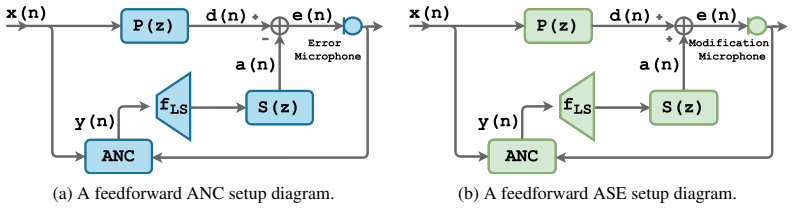
The load-bearing identity is the ASE superposition e_hat(n) = d(n) + a(n), where d(n) is the degraded signal arriving through the primary path P(z) and a(n) = S(z) * f_LS{y(n)} is the loudspeaker contribution through the secondary path S(z). The network, a Transformer-Mamba with Mamba2 blocks, an inserted multi-head attention block, and dense encoders and dual magnitude/phase decoders, is trained to output the complex spectrum of the loudspeaker signal y(n) under a combined loss L_G = gamma1 L_Time + gamma2 L_Mag + gamma3 L_Com + gamma4 L_Metric + gamma5 L_Pha + gamma6 L_Consist, with L_Time and L_Mag each combining L1 and L2 terms. This machinery converts speech enhancement from a filtering problem into a control problem: the optimizable object is an acoustic correction signal that physically recombines with the degraded signal, not a direct estimate of clean speech played to the listener.
What would settle it
A hardware experiment in a real 3 x 4 x 2 meter room with the same microphone and loudspeaker geometry, using a measured loudspeaker transfer function instead of the Scaled Error Function, would settle the central claim: if the real-path ASE-TM does not beat the ANC baselines by the reported PESQ and NMSE margins, the result is a simulation artifact rather than a working active enhancement paradigm.
Extended reading notes
Core claim
The central claim is that an active system with a reference microphone, a learned control filter, a loudspeaker, and a modification microphone can be trained so that the superposition e_hat(n) = d(n) + a(n) of the degraded primary signal and the loudspeaker anti-signal reconstructs a clean target speech signal c(n), rather than merely nulling the disturbance as in ANC. For additive noise the target is the clean speech after the primary path; for dereverberation and declipping the target is the original anechoic, unclipped utterance. The proposed ASE-TM predicts the complex spectrum of the loudspeaker input y(n), from which the anti-signal a(n) = S(z) * f_LS{y(n)} is formed and added to d(n). Across the three tasks, ASE-TM reaches PESQ 2.98, 2.43, and 3.09 respectively, with the ANC baselines staying below 2.45 in most conditions, and the paper presents this as evidence that active targeted modulation improves intelligibility and quality beyond cancellation.
Load-bearing premise
The load-bearing premise is that the simulated room, with 512-tap image-method impulse responses for both acoustic paths and a Scaled Error Function loudspeaker saturation, faithfully represents a real listen-through environment and that e_hat(n) = d(n) + a(n) at the modification microphone is physically realizable.
Editorial extensions
If this is right
- If the ASE claim holds, active acoustic systems can be trained for joint interference suppression and signal enrichment, extending the scope of active control from noise removal to general speech restoration.
- On the VoiceBank-DEMAND benchmark in the simulated room, ASE-TM exceeds the best ANC baseline by roughly 0.5 PESQ and improves NMSE to -21.76 dB, showing that the added correction does more than cancel the disturbance.
- The same model and loss, with task-specific targets, transfers to dereverberation and declipping, where the ANC baselines often degrade the input rather than restore it, which the paper attributes to the difficulty of these tasks for cancellation-only methods.
- With a future-frame prediction strategy, the model satisfies the causality condition T_ASE-TM < T_p - T_s (about 0.0043 seconds in the simulated geometry) and retains most of its quality, suggesting real-time operation is feasible.
- A single model handling all three tasks simultaneously, rather than one trained per task, is left as future work.
Reading between the lines
- Inference: If real rooms deviate from the 512-tap image-method RIRs and the Scaled Error Function model, the reported margins may shrink; a hardware prototype in a physical room of the simulated dimensions is the natural test of whether the paradigm transfers.
- Inference: Defining the dereverberation and declipping targets as the original anechoic, unclipped speech implies the loudspeaker must compensate for the room transfer function itself, which is a more demanding control problem than canceling a disturbance and may explain why those tasks show the largest gains over ANC baselines.
- Inference: Because NMSE and PESQ are computed against an unmeasurable clean target c(n) in real deployment, practical ASE systems would need a model of the room and the source or a separate reference signal, which could be a barrier the simulation does not expose.
- Inference: A natural extension is a multi-condition ASE model that jointly handles noise, reverberation, and clipping, and, further out, personalizing the target c(n) to hearing-impaired listeners' audibility needs rather than exact clean speech.
Editorial analysis
A structured set of objections, weighed in public.
Referee Report
Summary. The paper introduces Active Speech Enhancement (ASE), a paradigm in which a neural controller generates a correction signal rendered by a loudspeaker and added acoustically to the degraded speech at an error (modification) microphone. The proposed ASE-TM model is a Transformer-Mamba network trained with a composite loss including a PESQ-predicting adversarial discriminator. Experiments in a simulated room (image-method RIRs, SEF loudspeaker nonlinearity) on VoiceBank-DEMAND denoising, dereverberation, and declipping compare ASE-TM with THF-FxLMS, DeepANC, and ARN. The paper reports superior PESQ and secondary metrics in all three tasks, plus a runtime analysis claiming real-time feasibility via future-frame prediction.
Significance. If the claims were fully supported, the paper would offer a new and potentially useful extension of ANC to speech enhancement, with a clear formalization and a strong architecture. The authors provide a detailed simulation pipeline, an ablation study, and a robustness analysis across T60 and loudspeaker nonlinearity. However, the current evidence does not establish that the active paradigm is responsible for the gains: the baselines are all ANC methods, the headline metric is directly optimized, and the real-time claim is contradicted by the stated geometry and lookahead budget. The dereverberation and declipping targets are physically inconsistent with the measured signal. These problems are substantial but fixable with new experiments and analysis.
major comments (5)
- [§5.4, Tables 1–3] The claim in the abstract that ASE-TM "outperforms existing baselines" is not supported by the chosen comparators. All three baselines (THF-FxLMS, DeepANC, ARN) are ANC methods adapted to the ASE framework; no standard speech enhancement model is evaluated. In particular, ASE-TM is built on the SEmamba architecture (§4.1) and uses the MP-SENet/SEmamba loss framework, yet neither SEmamba nor any passive SE model (e.g., CMGAN or MetricGAN+) is run on the same simulated degraded signal d(n). A direct comparison with SEmamba applied to d(n) would isolate whether the active acoustic addition contributes anything beyond the backbone and loss. As it stands, Tables 1–3 support only the narrow claim that ASE-TM beats adapted ANC baselines.
- [§6.4] The causality claim is internally inconsistent. The paper states the feedforward causality condition is T_ASE-TM < Tp − Ts ≈ 0.0043 s, then says the model predicts 500 future frames (0.03125 s) to accommodate inference latency while "remaining within real-time limits." The lookahead is roughly 7× larger than the stated processing budget, so the implementation is non-causal in the described geometry. Because Tables 1–3 do not state whether the reported results are causal or full-utterance/non-causal, the gains may reflect future context rather than active speech shaping. The comparison with causal THF-FxLMS and low-latency ARN is therefore confounded; the experiments should be rerun with lookahead limited to the available budget, or the non-causal results should be explicitly labeled as an offline upper bound.
- [§4.2] The target definition for dereverberation and declipping is physically problematic. For additive noise, c(n) = s(n)*P(z), which is consistent with eh(n) being measured after the primary path. For dereverberation and declipping, however, c(n) is defined as the original anechoic, unclipped clean speech "prior to any acoustic path effects." Since eh(n) = d(n) + a(n) is measured at the modification microphone after P(z), driving eh(n) toward c(n) requires the secondary path S(z) to invert, at least approximately, the primary path P(z). Room impulse responses have delay and non-minimum-phase components, so such inversion is generally non-causal and ill-conditioned. The dereverberation and declipping experiments should either use c(n) = P(z)*s(n) as the target for all tasks, or the paper must justify how the active system realizes the required inverse filtering.
- [§4.2 (LMetric) and §5.3] The headline metric is directly optimized. The metric-based adversarial loss trains a discriminator to predict PESQ, and the final model is selected on validation PESQ. This creates a bias in favor of ASE-TM relative to the ANC baselines, which do not use a PESQ-based training or selection protocol. The paper should report an independent metric that was not used in training or model selection, or apply the same PESQ-guided training and validation procedure to the baselines, so that the PESQ comparisons are fair.
- [§5.2] The physical realizability of the active scheme is assumed rather than demonstrated. The simulation models the enhanced signal as the pointwise sum of a P(z)-filtered source and an S(z)-filtered loudspeaker output at a single modification microphone. In a real room, the loudspeaker radiates a spatially extended field and the microphone observes only one point of that field; the paper provides no experimental validation with measured RIRs or a real loudspeaker/microphone setup. The active-enhancement claim would be considerably strengthened by a real-world measurement or by a detailed discussion of the spatial and practical limitations of the point-to-point simulation.
minor comments (5)
- [Title/Abstract] The title contains typos: "Decliping" should be "Declipping" and "Deveraberation" should be "Dereverberation." The abstract's "outperforms existing baselines" overstates the experimental scope; recommend "outperforms the evaluated ANC baselines."
- [§4.1] Equation citations are incorrect: the text says the anti-signal a(n) is "as defined in Eq. 3" and that eh(n) is "as defined in Eq. 3," but Eq. (3) defines e(n)=d(n)−a(n), while a(n) is defined in Eq. (2) and eh(n) in Eq. (4).
- [§5.2, §6.4] There are typos: "respectivly" should be "respectively," and "η2 = ∞" in §6.4 should be "λ2 = ∞." In §6.3, "non-nonlinearities" should be "strong nonlinearities."
- [§3 and §4.2] The relation between the task distortions in Eqs. (5)–(7) and the acoustic path model d(n)=P(z)*x(n) is not specified. For example, is the model input the degraded speech after the primary path, or is the degradation inserted before P(z)? Defining the complete signal flow for each task in a single equation block would make the simulations reproducible.
- [Figures 2–4] The architecture diagram (Figure 2) omits the acoustic path blocks (P(z), S(z), fLS{·}) that are central to the ASE formulation; adding them would make the signal flow clearer. Figure 4 would benefit from a statement about whether the plotted spectra are averages over the test set or representative examples, since the caption says "over the entire test set" while the text could be read either way.
Circularity Check
No significant circularity: the core benchmark comparisons are held-out and self-contained; the runtime lookahead discrepancy is a feasibility concern rather than a circular reduction.
full rationale
The paper's central empirical claim rests on Tables 1-3, where ASE-TM and baselines are evaluated on the same test sets with fixed acoustic conditions, so the reported PESQ, STOI, and NMSE values are not produced by the training loss by construction. The LMetric discriminator is trained to predict PESQ and the final checkpoint is selected by validation PESQ, but the test PESQ is an independent measurement; this is a training-objective choice, not a fitted parameter renamed as a prediction. The formal ASE relation eh=d+a with the objective min ||eh-c|| is a residual parameterization: the optimal correction is mathematically c-d, yet the network must still learn that correction through the nonlinear secondary path, so the reported gains are not forced by the definition. The runtime section (Section 6.4) does contain a serious internal tension: it derives a 4.3 ms causal budget and then describes 31.25 ms of future-frame context as 'remaining within real-time limits'; this is a non-causal-lookahead feasibility risk, not a circular derivation. The only self-citation (ref [37]) is a related-work mention and is not load-bearing. Hence no step in the derivation chain reduces to its own input by construction.
Assumptions & free parameters
free parameters (3)
- Loss weights gamma_i
- Future-frame prediction count =
500 frames (0.03125 s)
- Training T60 and loudspeaker nonlinearity lambda2 =
T60 in {0.15, 0.175, 0.2, 0.225, 0.25} s, lambda2 in {0.1, 1, 10, inf}
assumptions (4)
- domain assumption Image-method RIRs and the Scaled Error Function loudspeaker model accurately represent real acoustic behavior
- domain assumption The acoustic field obeys superposition so that the enhanced signal is d(n) + a(n) at the modification microphone
- ad hoc to paper Dereverberation and declipping targets are defined as clean anechoic speech before primary path effects, while denoising target is clean speech after the primary path
- domain assumption The metric-based adversarial discriminator predicts PESQ and optimizing against it transfers to the objective metric
Cite this review
Pith. "Pith review of Active Speech Enhancement: Active Speech Denoising Decliping and Deveraberation." pith.science (2026). https://pith.science/paper/VF3M6JN5
@misc{pith2026250516911,
  author       = {Pith},
  title        = {Pith review of: Active Speech Enhancement: Active Speech Denoising Decliping and Deveraberation},
  year         = {2026},
  howpublished = {\url{https://pith.science/paper/VF3M6JN5}},
  note         = {Machine review of arXiv:2505.16911}
}
read the original abstract
We introduce a new paradigm for active sound modification: Active Speech Enhancement (ASE). While Active Noise Cancellation (ANC) algorithms focus on suppressing external interference, ASE goes further by actively shaping the speech signal -- both attenuating unwanted noise components and amplifying speech-relevant frequencies -- to improve intelligibility and perceptual quality. To enable this, we propose a novel Transformer-Mamba-based architecture, along with a task-specific loss function designed to jointly optimize interference suppression and signal enrichment. Our method outperforms existing baselines across multiple speech processing tasks -- including denoising, dereverberation, and declipping -- demonstrating the effectiveness of active, targeted modulation in challenging acoustic environments.
Figures


Figures from the paper (1 more)

Reference graph
Works this paper leans on
-
[1]
Suppression of acoustic noise in speech using spectral subtraction
Steven Boll. Suppression of acoustic noise in speech using spectral subtraction. IEEE Transactions on acoustics, speech, and signal processing, 27(2):113–120, 2003
2003
-
[2]
All-pole modeling of degraded speech
Jae Lim and Alan Oppenheim. All-pole modeling of degraded speech. IEEE Transactions on Acoustics, Speech, and Signal Processing, 26(3):197–210, 1978
1978
-
[3]
Speech enhancement using a mini- mum mean-square error short-time spectral modulation magnitude estimator
Kuldip Paliwal, Belinda Schwerin, and Kamil Wójcicki. Speech enhancement using a mini- mum mean-square error short-time spectral modulation magnitude estimator. Speech Commu- nication, 54(2):282–305, 2012
2012
-
[4]
Segan: Speech enhancement generative adversarial network
Santiago Pascual, Antonio Bonafonte, and Joan Serra. Segan: Speech enhancement generative adversarial network. arXiv preprint arXiv:1703.09452, 2017
arXiv 2017
-
[5]
A wavenet for speech denoising
Dario Rethage, Jordi Pons, and Xavier Serra. A wavenet for speech denoising. In 2018 IEEE International Conference on Acoustics, Speech and Signal Processing (ICASSP), pages 5069–5073. IEEE, 2018
2018
-
[6]
A new framework for supervised speech enhancement in the time domain
Ashutosh Pandey and DeLiang Wang. A new framework for supervised speech enhancement in the time domain. In Interspeech, pages 1136–1140, 2018
2018
-
[7]
Dccrn: Deep complex convolution recurrent network for phase-aware speech enhancement
Yanxin Hu, Yun Liu, Shubo Lv, Mengtao Xing, Shimin Zhang, Yihui Fu, Jian Wu, Bihong Zhang, and Lei Xie. Dccrn: Deep complex convolution recurrent network for phase-aware speech enhancement. arXiv preprint arXiv:2008.00264, 2020
arXiv 2008
-
[8]
Metricgan: Generative adversarial networks based black-box metric scores optimization for speech enhancement
Szu-Wei Fu, Chien-Feng Liao, Yu Tsao, and Shou-De Lin. Metricgan: Generative adversarial networks based black-box metric scores optimization for speech enhancement. InInternational Conference on Machine Learning, pages 2031–2041. PmLR, 2019
2019
Show all 135 references
-
[9]
Metricgan+: An improved version of metricgan for speech enhancement
Szu-Wei Fu, Cheng Yu, Tsun-An Hsieh, Peter Plantinga, Mirco Ravanelli, Xugang Lu, and Yu Tsao. Metricgan+: An improved version of metricgan for speech enhancement. In Interspeech 2021. ISCA, August 2021. doi: 10.21437/interspeech.2021-599. URL http: //dx.doi.org/10.21437/inter...
2021 doi
-
[10]
A multi-resolution approach to gan-based speech enhancement
Hyung Yong Kim, Ji Won Yoon, Sung Jun Cheon, Woo Hyun Kang, and Nam Soo Kim. A multi-resolution approach to gan-based speech enhancement. Applied Sciences, 11(2):721, 2021
2021
-
[11]
Metricgan-okd: multi-metric optimization of metricgan via online knowledge distillation for speech enhancement
Wooseok Shin, Byung Hoon Lee, Jin Sob Kim, Hyun Joon Park, and Sung Won Han. Metricgan-okd: multi-metric optimization of metricgan via online knowledge distillation for speech enhancement. In International Conference on Machine Learning, pages 31521– 31538. PMLR, 2023
2023
-
[12]
Gan-based speech enhance- ment for low snr using latent feature conditioning
Shrishti Saha Shetu, Emanuël AP Habets, and Andreas Brendel. Gan-based speech enhance- ment for low snr using latent feature conditioning. In ICASSP 2025-2025 IEEE International Conference on Acoustics, Speech and Signal Processing (ICASSP), pages 1–5. IEEE, 2025
2025
-
[13]
Tstnn: Two-stage transformer based neu- ral network for speech enhancement in the time domain
Kai Wang, Bengbeng He, and Wei-Ping Zhu. Tstnn: Two-stage transformer based neu- ral network for speech enhancement in the time domain. In ICASSP 2021 - 2021 IEEE International Conference on Acoustics, Speech and Signal Processing (ICASSP) , page 7098–7102. IEEE, June 2021. do...
2021
-
[14]
Efficient transformer-based speech en- hancement using long frames and stft magnitudes
Danilo de Oliveira, Tal Peer, and Timo Gerkmann. Efficient transformer-based speech en- hancement using long frames and stft magnitudes. In Interspeech 2022, page 2948–2952. ISCA, September 2022. doi: 10.21437/interspeech.2022-10781. URL http://dx.doi.org/ 10.21437/Interspeech...
2022 doi
-
[15]
Cross-attention is all you need: Real-time streaming transformers for personalised speech enhancement
Shucong Zhang, Malcolm Chadwick, Alberto Gil CP Ramos, and Sourav Bhattacharya. Cross-attention is all you need: Real-time streaming transformers for personalised speech enhancement. arXiv preprint arXiv:2211.04346, 2022. 11
2022 arXiv
-
[16]
Cmgan: Conformer-based metric gan for speech enhancement
Ruizhe Cao, Sherif Abdulatif, and Bin Yang. Cmgan: Conformer-based metric gan for speech enhancement. arXiv preprint arXiv:2203.15149, 2022
2022 arXiv
-
[17]
Improved transformer-based dual-path network with amplitude and complex domain feature fusion for speech enhancement
Moujia Ye and Hongjie Wan. Improved transformer-based dual-path network with amplitude and complex domain feature fusion for speech enhancement. Entropy, 25(2):228, 2023
2023
-
[18]
An exploration of length generalization in transformer-based speech enhancement
Qiquan Zhang, Hongxu Zhu, Xinyuan Qian, Eliathamby Ambikairajah, and Haizhou Li. An exploration of length generalization in transformer-based speech enhancement. In Interspeech 2024, page 1725–1729. ISCA, September 2024. doi: 10.21437/interspeech.2024-1831. URL http://dx.doi.o...
2024 doi
-
[19]
Guimarães, Jiaqi Su, Rithesh Kumar, Tiago H
Heitor R. Guimarães, Jiaqi Su, Rithesh Kumar, Tiago H. Falk, and Zeyu Jin. Ditse: High- fidelity generative speech enhancement via latent diffusion transformers, 2025
2025
-
[20]
Conditional diffusion probabilistic model for speech enhancement
Yen-Ju Lu, Zhong-Qiu Wang, Shinji Watanabe, Alexander Richard, Cheng Yu, and Yu Tsao. Conditional diffusion probabilistic model for speech enhancement. In ICASSP 2022-2022 IEEE International Conference on Acoustics, Speech and Signal Processing (ICASSP), pages 7402–7406. Ieee, 2022
2022
-
[21]
Speech enhancement with score-based generative models in the complex stft domain
Simon Welker, Julius Richter, and Timo Gerkmann. Speech enhancement with score-based generative models in the complex stft domain. arXiv preprint arXiv:2203.17004, 2022
2022 arXiv
-
[22]
Speech enhancement and dereverberation with diffusion-based generative models
Julius Richter, Simon Welker, Jean-Marie Lemercier, Bunlong Lay, and Timo Gerkmann. Speech enhancement and dereverberation with diffusion-based generative models. IEEE/ACM Transactions on Audio, Speech, and Language Processing , 31:2351–2364, 2023. ISSN 2329-9304. doi: 10.1109...
2023
-
[23]
Storm: A diffusion- based stochastic regeneration model for speech enhancement and dereverberation
Jean-Marie Lemercier, Julius Richter, Simon Welker, and Timo Gerkmann. Storm: A diffusion- based stochastic regeneration model for speech enhancement and dereverberation. IEEE/ACM Transactions on Audio, Speech, and Language Processing , 31:2724–2737, 2023. ISSN 2329-9304. doi:...
2023
-
[24]
Revisiting denoising diffusion probabilistic models for speech enhancement: Condition collapse, efficiency and refinement
Wenxin Tai, Fan Zhou, Goce Trajcevski, and Ting Zhong. Revisiting denoising diffusion probabilistic models for speech enhancement: Condition collapse, efficiency and refinement. In Proceedings of the AAAI conference on artificial intelligence, volume 37, pages 13627–13635, 2023
2023
-
[25]
Diffusion-based speech en- hancement with a weighted generative-supervised learning loss
Jean-Eudes Ayilo, Mostafa Sadeghi, and Romain Serizel. Diffusion-based speech en- hancement with a weighted generative-supervised learning loss. In ICASSP 2024 - 2024 IEEE International Conference on Acoustics, Speech and Signal Processing (ICASSP) , page 12506–12510. IEEE, Ap...
2024
-
[26]
Process of silencing sound oscillations
Paul Lueg. Process of silencing sound oscillations. US patent 2043416, 1936
1936
-
[27]
Active control of sound
Philip Arthur Nelson and Stephen J Elliott. Active control of sound. Academic press, 1991
1991
-
[28]
Active control of vibration
Christopher C Fuller, Sharon Elliott, and Philip Arthur Nelson. Active control of vibration. Academic press, 1996
1996
-
[29]
E & Fn Spon London, 1997
Colin H Hansen, Scott D Snyder, Xiaojun Qiu, Laura A Brooks, and Danielle J Moreau.Active control of noise and vibration. E & Fn Spon London, 1997
1997
-
[30]
Active noise control: a tutorial review
Sen M Kuo and Dennis R Morgan. Active noise control: a tutorial review. Proceedings of the IEEE, 87(6):943–973, 1999
1999
-
[31]
Deep anc: A deep learning approach to active noise control
Hao Zhang and DeLiang Wang. Deep anc: A deep learning approach to active noise control. Neural Networks, 141:1–10, 2021. 12
2021
-
[32]
Had-anc: A hybrid system comprising an adaptive filter and deep neural networks for active noise control
JungPhil Park, Jeong-Hwan Choi, Yungyeo Kim, and Joon-Hyuk Chang. Had-anc: A hybrid system comprising an adaptive filter and deep neural networks for active noise control. In Proceedings of the Annual Conference of the International Speech Communication Associa- tion, INTERSPE...
2023
-
[33]
Deep learning-based active noise control on construction sites
Alireza Mostafavi and Young-Jin Cha. Deep learning-based active noise control on construction sites. Automation in Construction, 151:104885, 2023
2023
-
[34]
Dnoisenet: Deep learning-based feedback active noise control in various noisy environments
Young-Jin Cha, Alireza Mostafavi, and Sukhpreet S Benipal. Dnoisenet: Deep learning-based feedback active noise control in various noisy environments. Engineering Applications of Artificial Intelligence, 121:105971, 2023
2023
-
[35]
Enhancing active noise control through stacked autoencoders: Training strategies, comparative analysis, and evaluation with practical setup
Deepali Singh, Rinki Gupta, Arun Kumar, and Rajendar Bahl. Enhancing active noise control through stacked autoencoders: Training strategies, comparative analysis, and evaluation with practical setup. Engineering Applications of Artificial Intelligence, 135:108811, 2024
2024
-
[36]
Generalized performance of neural network controllers for feedforward active control of nonlinear systems
Alexander Pike and Jordan Cheer. Generalized performance of neural network controllers for feedforward active control of nonlinear systems. 2023
2023
-
[37]
Deep active speech cancellation with multi-band mamba network, 2025
Yehuda Mishaly, Lior Wolf, and Eliya Nachmani. Deep active speech cancellation with multi-band mamba network, 2025. URL https://arxiv.org/abs/2502.01185
2025 arXiv
-
[38]
Perceptual evaluation of speech quality (pesq)-a new method for speech quality assessment of telephone networks and codecs
Antony W Rix, John G Beerends, Michael P Hollier, and Andries P Hekstra. Perceptual evaluation of speech quality (pesq)-a new method for speech quality assessment of telephone networks and codecs. In 2001 IEEE international conference on acoustics, speech, and signal processin...
2001
-
[39]
Real time speech enhancement in the waveform domain
Alexandre Defossez, Gabriel Synnaeve, and Yossi Adi. Real time speech enhancement in the waveform domain. arXiv preprint arXiv:2006.12847, 2020
2006 arXiv
-
[40]
Conformer: Convolution- augmented transformer for speech recognition, 2020
Anmol Gulati, James Qin, Chung-Cheng Chiu, Niki Parmar, Yu Zhang, Jiahui Yu, Wei Han, Shibo Wang, Zhengdong Zhang, Yonghui Wu, and Ruoming Pang. Conformer: Convolution- augmented transformer for speech recognition, 2020. URL https://arxiv.org/abs/2005. 08100
2020
-
[41]
At- tention is all you need in speech separation, 2021
Cem Subakan, Mirco Ravanelli, Samuele Cornell, Mirko Bronzi, and Jianyuan Zhong. At- tention is all you need in speech separation, 2021. URL https://arxiv.org/abs/2010. 13154
2021
-
[42]
Attentive recurrent network for low-latency active noise control
Hao Zhang, Ashutosh Pandey, and DeLiang Wang. Attentive recurrent network for low-latency active noise control. In INTERSPEECH, pages 956–960, 2022
2022
-
[43]
Selective fixed- filter active noise control based on convolutional neural network
Dongyuan Shi, Bhan Lam, Kenneth Ooi, Xiaoyi Shen, and Woon-Seng Gan. Selective fixed- filter active noise control based on convolutional neural network. Signal Processing, 190: 108317, 2022
2022
-
[44]
A hybrid sfanc-fxnlms algorithm for active noise control based on deep learning
Zhengding Luo, Dongyuan Shi, and Woon-Seng Gan. A hybrid sfanc-fxnlms algorithm for active noise control based on deep learning. IEEE Signal Processing Letters, 29:1102–1106, 2022
2022
-
[45]
An improved artificial bee colony algorithm for model-free active noise control: algorithm and implementation
Xing Ren and Hongwei Zhang. An improved artificial bee colony algorithm for model-free active noise control: algorithm and implementation. IEEE Transactions on Instrumentation and Measurement, 71:1–11, 2022
2022
-
[46]
Genetic algorithm-based adaptive active noise control without secondary path identification
Yang Zhou, Haiquan Zhao, and Dongxu Liu. Genetic algorithm-based adaptive active noise control without secondary path identification. IEEE Transactions on Instrumentation and Measurement, 2023
2023
-
[47]
Unsupervised learning based end-to-end delayless generative fixed-filter active noise control
Zhengding Luo, Dongyuan Shi, Xiaoyi Shen, and Woon-Seng Gan. Unsupervised learning based end-to-end delayless generative fixed-filter active noise control. In ICASSP 2024-2024 IEEE International Conference on Acoustics, Speech and Signal Processing (ICASSP), pages 441–445. IEE...
2024
-
[48]
What is behind the meta-learning initialization of adaptive filter?—a naive method for accelerating convergence of adaptive multichannel active noise control
Dongyuan Shi, Woon-seng Gan, Xiaoyi Shen, Zhengding Luo, and Junwei Ji. What is behind the meta-learning initialization of adaptive filter?—a naive method for accelerating convergence of adaptive multichannel active noise control. Neural Networks, 172:106145, 2024
2024
-
[49]
Deep mcanc: A deep learning approach to multi-channel active noise control
Hao Zhang and DeLiang Wang. Deep mcanc: A deep learning approach to multi-channel active noise control. Neural Networks, 158:318–327, 2023
2023
-
[50]
Remote micro- phone technique for active noise control over distributed networks
Christian Antoñanzas, Miguel Ferrer, Maria De Diego, and Alberto Gonzalez. Remote micro- phone technique for active noise control over distributed networks. IEEE/ACM Transactions on Audio, Speech, and Language Processing, 31:1522–1535, 2023
2023
-
[51]
Spatially selective active noise control systems
Tong Xiao, Buye Xu, and Chuming Zhao. Spatially selective active noise control systems. The Journal of the Acoustical Society of America, 153(5):2733–2733, 2023
2023
-
[52]
A time- domain multi-channel directional active noise control system
Huawei Zhang, Jihui Zhang, Fei Ma, Prasanga N Samarasinghe, and Huiyuan Sun. A time- domain multi-channel directional active noise control system. In 2023 31st European Signal Processing Conference (EUSIPCO), pages 376–380. IEEE, 2023
2023
-
[53]
Multichannel two-gradient direction filtered reference least mean square algorithm for output-constrained multichannel active noise control
Dongyuan Shi, Bhan Lam, Xiaoyi Shen, and Woon-Seng Gan. Multichannel two-gradient direction filtered reference least mean square algorithm for output-constrained multichannel active noise control. Signal Processing, 207:108938, 2023
2023
-
[54]
Low-latency active noise control using attentive recurrent network
Hao Zhang, Ashutosh Pandey, et al. Low-latency active noise control using attentive recurrent network. IEEE/ACM transactions on audio, speech, and language processing, 31:1114–1123, 2023
2023
-
[55]
V oicefixer: A unified framework for high-fidelity speech restoration
Haohe Liu, Xubo Liu, Qiuqiang Kong, Qiao Tian, Yan Zhao, DeLiang Wang, Chuanzeng Huang, and Yuxuan Wang. V oicefixer: A unified framework for high-fidelity speech restoration. arXiv preprint arXiv:2204.05841, 2022
2022 arXiv
-
[56]
An investigation of incorporating mamba for speech enhance- ment
Rong Chao, Wen-Huang Cheng, Moreno La Quatra, Sabato Marco Siniscalchi, Chao-Han Huck Yang, Szu-Wei Fu, and Yu Tsao. An investigation of incorporating mamba for speech enhance- ment. arXiv preprint arXiv:2405.06573, 2024
2024
-
[57]
A short-time objective intelligibility measure for time-frequency weighted noisy speech
Cees H Taal, Richard C Hendriks, Richard Heusdens, and Jesper Jensen. A short-time objective intelligibility measure for time-frequency weighted noisy speech. In 2010 IEEE international conference on acoustics, speech and signal processing, pages 4214–4217. IEEE, 2010
2010
-
[58]
Evaluation of objective quality measures for speech enhancement
Yi Hu and Philipos C Loizou. Evaluation of objective quality measures for speech enhancement. IEEE Transactions on audio, speech, and language processing, 16(1):229–238, 2007
2007
-
[59]
Tf-mamba: A time-frequency network for sound source localization
Yang Xiao and Rohan Kumar Das. Tf-mamba: A time-frequency network for sound source localization. arXiv preprint arXiv:2409.05034, 2024
2024 arXiv
-
[60]
Transformers are ssms: Generalized models and efficient algorithms through structured state space duality
Tri Dao and Albert Gu. Transformers are ssms: Generalized models and efficient algorithms through structured state space duality. arXiv preprint arXiv:2405.21060, 2024
2024 arXiv
-
[61]
Mamba: Linear-time sequence modeling with selective state spaces
Albert Gu and Tri Dao. Mamba: Linear-time sequence modeling with selective state spaces. arXiv preprint arXiv:2312.00752, 2023
2023 arXiv
-
[62]
Jamba: A hybrid transformer-mamba language model
Opher Lieber, Barak Lenz, Hofit Bata, Gal Cohen, Jhonathan Osin, Itay Dalmedigos, Erez Safahi, Shaked Meirom, Yonatan Belinkov, Shai Shalev-Shwartz, et al. Jamba: A hybrid transformer-mamba language model. arXiv preprint arXiv:2403.19887, 2024
2024 arXiv
-
[63]
Mp-senet: A speech enhancement model with parallel denoising of magnitude and phase spectra
Ye-Xin Lu, Yang Ai, and Zhen-Hua Ling. Mp-senet: A speech enhancement model with parallel denoising of magnitude and phase spectra. arXiv preprint arXiv:2305.13686, 2023
2023 arXiv
-
[64]
Investigating rnn-based speech enhancement methods for noise-robust text-to-speech
Cassia Valentini Botinhao, Xin Wang, Shinji Takaki, and Junichi Yamagishi. Investigating rnn-based speech enhancement methods for noise-robust text-to-speech. In 9th ISCA speech synthesis workshop, pages 159–165, 2016. 14
2016
-
[65]
The voice bank corpus: Design, collection and data analysis of a large regional accent speech database
Christophe Veaux, Junichi Yamagishi, and Simon King. The voice bank corpus: Design, collection and data analysis of a large regional accent speech database. In 2013 international conference oriental COCOSDA held jointly with 2013 conference on Asian spoken language research an...
2013
-
[66]
The diverse environments multi- channel acoustic noise database (demand): A database of multichannel environmental noise recordings
Joachim Thiemann, Nobutaka Ito, and Emmanuel Vincent. The diverse environments multi- channel acoustic noise database (demand): A database of multichannel environmental noise recordings. In Proceedings of Meetings on Acoustics, volume 19. AIP Publishing, 2013
2013
-
[67]
Open- source conversational ai with speechbrain 1.0
Mirco Ravanelli, Titouan Parcollet, Adel Moumen, Sylvain de Langen, Cem Subakan, Peter Plantinga, Yingzhi Wang, Pooneh Mousavi, Luca Della Libera, Artem Ploujnikov, et al. Open- source conversational ai with speechbrain 1.0. Journal of Machine Learning Research, 25 (333):1–11, 2024
2024
-
[68]
Image method for efficiently simulating small-room acoustics
Jont B Allen and David A Berkley. Image method for efficiently simulating small-room acoustics. The Journal of the Acoustical Society of America, 65(4):943–950, 1979
1979
-
[69]
Room impulse response generator
Emanuel AP Habets. Room impulse response generator. Technische Universiteit Eindhoven, Tech. Rep, 2(2.4):1, 2006
2006
-
[70]
Decoupled weight decay regularization
Ilya Loshchilov and Frank Hutter. Decoupled weight decay regularization. arXiv preprint arXiv:1711.05101, 2017
2017 arXiv
-
[71]
Nonlinear thf-fxlms algorithm for active noise control with loudspeaker nonlinearity
Sepehr Ghasemi, Raja Kamil, and Mohammad Hamiruce Marhaban. Nonlinear thf-fxlms algorithm for active noise control with loudspeaker nonlinearity. Asian Journal of Control, 18 (2):502–513, 2016
2016
-
[72]
Scaling learning algorithms towards AI
Yoshua Bengio and Yann LeCun. Scaling learning algorithms towards AI. In Large Scale Kernel Machines. MIT Press, 2007
2007
-
[73]
Hinton, Simon Osindero, and Yee Whye Teh
Geoffrey E. Hinton, Simon Osindero, and Yee Whye Teh. A fast learning algorithm for deep belief nets. Neural Computation, 18:1527–1554, 2006
2006
-
[74]
Deep learning , volume 1
Ian Goodfellow, Yoshua Bengio, Aaron Courville, and Yoshua Bengio. Deep learning , volume 1. MIT Press, 2016
2016
-
[75]
Just relax: Convex programming methods for identifying sparse signals in noise
Joel A Tropp. Just relax: Convex programming methods for identifying sparse signals in noise. IEEE transactions on information theory, 52(3):1030–1051, 2006
2006
-
[76]
Computationally efficient fixed-filter anc for speech based on long-term predic- tion for headphone applications
Yurii Iotov, Sidsel Marie Nørholm, Valiantsin Belyi, Mads Dyrholm, and Mads Græsbøll Christensen. Computationally efficient fixed-filter anc for speech based on long-term predic- tion for headphone applications. In ICASSP 2022-2022 IEEE International Conference on Acoustics, S...
2022
-
[77]
Adaptive sparse linear prediction in fixed-filter anc headphone applications for multi-speaker speech reduction
Yurii Iotov, Sidsel Marie Nørholm, Valiantsin Belyi, and Mads Græsbøll Christensen. Adaptive sparse linear prediction in fixed-filter anc headphone applications for multi-speaker speech reduction. In 2023 IEEE Workshop on Applications of Signal Processing to Audio and Acoustic...
2023
-
[78]
Spmamba: State-space model is all you need in speech separation
Kai Li and Guo Chen. Spmamba: State-space model is all you need in speech separation. arXiv preprint arXiv:2404.02063, 2024
2024 arXiv
-
[79]
Mamba in speech: Towards an alternative to self-attention
Xiangyu Zhang, Qiquan Zhang, Hexin Liu, Tianyi Xiao, Xinyuan Qian, Beena Ahmed, Eliathamby Ambikairajah, Haizhou Li, and Julien Epps. Mamba in speech: Towards an alternative to self-attention. arXiv preprint arXiv:2405.12609, 2024
2024 arXiv
-
[80]
Dual-path mamba: Short and long-term bidirectional selective structured state space models for speech separation
Xilin Jiang, Cong Han, and Nima Mesgarani. Dual-path mamba: Short and long-term bidirectional selective structured state space models for speech separation. arXiv preprint arXiv:2403.18257, 2024
2024 arXiv
-
[81]
Wave-u-mamba: An end-to-end framework for high-quality and efficient speech super resolution
Yongjoon Lee and Chanwoo Kim. Wave-u-mamba: An end-to-end framework for high-quality and efficient speech super resolution. arXiv preprint arXiv:2403.09337, 2024
2024 arXiv
-
[82]
Multichannel long-term streaming neural speech enhance- ment for static and moving speakers
Changsheng Quan and Xiaofei Li. Multichannel long-term streaming neural speech enhance- ment for static and moving speakers. arXiv preprint arXiv:2403.07675, 2024. 15
2024 arXiv
-
[83]
Audio mamba: Bidirec- tional state space model for audio representation learning
Mehmet Hamza Erol, Arda Senocak, Jiu Feng, and Joon Son Chung. Audio mamba: Bidirec- tional state space model for audio representation learning. arXiv preprint arXiv:2406.03344, 2024
2024 arXiv
-
[84]
Seld-mamba: Selective state-space model for sound event localization and detection with source distance estimation
Da Mu, Zhicheng Zhang, Haobo Yue, Zehao Wang, Jin Tang, and Jianqin Yin. Seld-mamba: Selective state-space model for sound event localization and detection with source distance estimation. arXiv preprint arXiv:2408.05057, 2024
2024 arXiv
-
[85]
Rawbmamba: End-to-end bidirectional state space model for audio deepfake detection
Yujie Chen, Jiangyan Yi, Jun Xue, Chenglong Wang, Xiaohui Zhang, Shunbo Dong, Siding Zeng, Jianhua Tao, Lv Zhao, and Cunhang Fan. Rawbmamba: End-to-end bidirectional state space model for audio deepfake detection. arXiv preprint arXiv:2406.06086, 2024
2024 arXiv
-
[86]
Audio mamba: Pretrained audio state space model for audio tagging
Jiaju Lin and Haoxuan Hu. Audio mamba: Pretrained audio state space model for audio tagging. arXiv preprint arXiv:2405.13636, 2024
2024 arXiv
-
[87]
Audio mamba: Selective state spaces for self-supervised audio representations
Sarthak Yadav and Zheng-Hua Tan. Audio mamba: Selective state spaces for self-supervised audio representations. arXiv preprint arXiv:2406.02178, 2024
2024 arXiv
-
[88]
Spherical loudspeaker array for local active control of sound
Boaz Rafaely. Spherical loudspeaker array for local active control of sound. The Journal of the Acoustical Society of America, 125(5):3006–3017, 2009
2009
-
[89]
Mambagan: Mamba based metric gan for monau- ral speech enhancement
Tianhao Luo, Feng Zhou, and Zhongxin Bai. Mambagan: Mamba based metric gan for monau- ral speech enhancement. In 2024 International Conference on Asian Language Processing (IALP), pages 411–416. IEEE, 2024
2024
-
[90]
Ssamba: Self- supervised audio representation learning with mamba state space model
Siavash Shams, Sukru Samet Dindar, Xilin Jiang, and Nima Mesgarani. Ssamba: Self- supervised audio representation learning with mamba state space model. arXiv preprint arXiv:2405.11831, 2024
2024 arXiv
-
[91]
Rethinking mamba in speech processing by self-supervised models
Xiangyu Zhang, Jianbo Ma, Mostafa Shahin, Beena Ahmed, and Julien Epps. Rethinking mamba in speech processing by self-supervised models. arXiv preprint arXiv:2409.07273, 2024
2024 arXiv
-
[92]
Speech slytherin: Examining the performance and efficiency of mamba for speech separation, recognition, and synthesis
Xilin Jiang, Yinghao Aaron Li, Adrian Nicolas Florea, Cong Han, and Nima Mesgarani. Speech slytherin: Examining the performance and efficiency of mamba for speech separation, recognition, and synthesis. arXiv preprint arXiv:2407.09732, 2024
2024 arXiv
-
[93]
Active speech control using wave- domain processing with a linear wall of dipole secondary sources
Jacob Donley, Christian Ritz, and W Bastiaan Kleijn. Active speech control using wave- domain processing with a linear wall of dipole secondary sources. In 2017 IEEE International Conference on Acoustics, Speech and Signal Processing (ICASSP) , pages 456–460. IEEE, 2017
2017
-
[94]
Speech emission control using active cancellation
Kazuhiro Kondo and Kiyoshi Nakagawa. Speech emission control using active cancellation. Speech communication, 49(9):687–696, 2007
2007
-
[95]
Soundstream: An end-to-end neural audio codec
Neil Zeghidour, Alejandro Luebs, Ahmed Omran, Jan Skoglund, and Marco Tagliasacchi. Soundstream: An end-to-end neural audio codec. IEEE/ACM Transactions on Audio, Speech, and Language Processing, 30:495–507, 2021
2021
-
[96]
High fidelity neural audio compression
Alexandre Défossez, Jade Copet, Gabriel Synnaeve, and Yossi Adi. High fidelity neural audio compression. arXiv preprint arXiv:2210.13438, 2022
2022 arXiv
-
[97]
Adam: A method for stochastic optimization
Diederik P Kingma. Adam: A method for stochastic optimization. arXiv preprint arXiv:1412.6980, 2014
2014 arXiv
-
[98]
Dual-path rnn: efficient long sequence modeling for time-domain single-channel speech separation
Yi Luo, Zhuo Chen, and Takuya Yoshioka. Dual-path rnn: efficient long sequence modeling for time-domain single-channel speech separation. In ICASSP 2020-2020 IEEE International Conference on Acoustics, Speech and Signal Processing (ICASSP), pages 46–50. IEEE, 2020
2020
-
[99]
Timit acoustic phonetic continuous speech corpus
John S Garofolo. Timit acoustic phonetic continuous speech corpus. Linguistic Data Consor- tium, 1993, 1993
1993
-
[100]
Assessment for automatic speech recognition: Ii
Andrew Varga and Herman JM Steeneken. Assessment for automatic speech recognition: Ii. noisex-92: A database and an experiment to study the effect of additive noise on speech recognition systems. Speech communication, 12(3):247–251, 1993. 16
1993
-
[101]
Attention is all you need
A Vaswani. Attention is all you need. Advances in Neural Information Processing Systems, 2017
2017
-
[102]
Active adaptive sound control in a duct: A computer simulation
John C Burgess. Active adaptive sound control in a duct: A computer simulation. The Journal of the Acoustical Society of America, 70(3):715–726, 1981
1981
-
[103]
Effect of errors in the plant model on the performance of algorithms for adaptive feedforward control
CC Boucher, SJ Elliott, and PA Nelson. Effect of errors in the plant model on the performance of algorithms for adaptive feedforward control. In IEE Proceedings F (Radar and Signal Processing), volume 138, pages 313–319. IET, 1991
1991
-
[104]
Active mitigation of nonlinear noise processes using a novel filtered-s lms algorithm
Debi Prasad Das and Ganapati Panda. Active mitigation of nonlinear noise processes using a novel filtered-s lms algorithm. IEEE Transactions on Speech and Audio Processing, 12(3): 313–322, 2004
2004
-
[105]
Nonlinear adaptive bilinear filters for active noise control systems
Sen M Kuo and Hsien-Tsai Wu. Nonlinear adaptive bilinear filters for active noise control systems. IEEE Transactions on Circuits and Systems I: Regular Papers, 52(3):617–624, 2005
2005
-
[106]
Atten- tion is all you need in speech separation
Cem Subakan, Mirco Ravanelli, Samuele Cornell, Mirko Bronzi, and Jianyuan Zhong. Atten- tion is all you need in speech separation. InICASSP 2021-2021 IEEE International Conference on Acoustics, Speech and Signal Processing (ICASSP), pages 21–25. IEEE, 2021
2021
-
[107]
Leaky-fxlms algorithm: Stochastic analysis for gaussian data and secondary path modeling error
Orlando José Tobias and Rui Seara. Leaky-fxlms algorithm: Stochastic analysis for gaussian data and secondary path modeling error. IEEE Transactions on speech and audio processing, 13(6):1217–1230, 2005
2005
-
[108]
Identification of nonlinear dynamic systems using functional link artificial neural networks
Jagdish Chandra Patra, Ranendra N Pal, BN Chatterji, and Ganapati Panda. Identification of nonlinear dynamic systems using functional link artificial neural networks. IEEE transactions on systems, man, and cybernetics, part b (cybernetics), 29(2):254–262, 1999
1999
-
[109]
Adaptive volterra filters for active control of nonlinear noise processes
Li Tan and Jean Jiang. Adaptive volterra filters for active control of nonlinear noise processes. IEEE Transactions on signal processing, 49(8):1667–1676, 2001
2001
-
[110]
Robust early echo cancellation and late echo suppression in the stft domain
Emanuël AP Habets, Sharon Gannot, and Israel Cohen. Robust early echo cancellation and late echo suppression in the stft domain. Proc. of 11th Int. Worksh. on Acoust. Echo and Noise Control IWAENC 2008, 2008
2008
-
[111]
Advances in network and acoustic echo cancellation
Jacob Benesty, Tomas Gänsler, Dennis R Morgan, M Mohan Sondhi, Steven L Gay, et al. Advances in network and acoustic echo cancellation. 2001
2001
-
[112]
Nonlinear acoustic echo cancellation with deep learning
Amir Ivry, Israel Cohen, and Baruch Berdugo. Nonlinear acoustic echo cancellation with deep learning. arXiv preprint arXiv:2106.13754, 2021
2021 arXiv
-
[113]
Noise cancellation with static mixtures of a nonstationary signal and stationary noise
Sharon Gannot and Arie Yeredor. Noise cancellation with static mixtures of a nonstationary signal and stationary noise. EURASIP Journal on Advances in Signal Processing, 2002:1–13, 2003
2002
-
[114]
Single- sensor active noise cancellation
Alan V Oppenheim, Ehud Weinstein, Kambiz C Zangi, Meir Feder, and Dan Gauger. Single- sensor active noise cancellation. IEEE Transactions on Speech and Audio Processing, 2(2): 285–290, 1994
1994
-
[115]
Kalmannet: Data-driven kalman filtering
Guy Revach, Nir Shlezinger, Ruud JG Van Sloun, and Yonina C Eldar. Kalmannet: Data-driven kalman filtering. In ICASSP 2021-2021 IEEE International Conference on Acoustics, Speech and Signal Processing (ICASSP), pages 3905–3909. IEEE, 2021
2021
-
[116]
Real-time implementation and explainable ai analysis of delayless cnn-based selective fixed-filter active noise control
Zhengding Luo, Dongyuan Shi, Junwei Ji, Xiaoyi Shen, and Woon-Seng Gan. Real-time implementation and explainable ai analysis of delayless cnn-based selective fixed-filter active noise control. Mechanical Systems and Signal Processing, 214:111364, 2024
2024
-
[117]
Gfanc-kalman: Generative fixed-filter active noise control with cnn-kalman filtering
Zhengding Luo, Dongyuan Shi, Xiaoyi Shen, Junwei Ji, and Woon-Seng Gan. Gfanc-kalman: Generative fixed-filter active noise control with cnn-kalman filtering. IEEE Signal Processing Letters, 2023
2023
-
[118]
On the lms algorithm with constant and variable leakage factor in a nonlinear environment
Orlando José Tobias and Rui Seara. On the lms algorithm with constant and variable leakage factor in a nonlinear environment. IEEE transactions on signal processing, 54(9):3448–3458, 2006. 17
2006
-
[119]
Self-attending rnn for speech enhancement to improve cross-corpus generalization
Ashutosh Pandey and DeLiang Wang. Self-attending rnn for speech enhancement to improve cross-corpus generalization. IEEE/ACM Transactions on Audio, Speech, and Language Processing, 30:1374–1385, 2022
2022
-
[120]
Feedforward selective fixed- filter active noise control: Algorithm and implementation
Dongyuan Shi, Woon-Seng Gan, Bhan Lam, and Shulin Wen. Feedforward selective fixed- filter active noise control: Algorithm and implementation. IEEE/ACM Transactions on Audio, Speech, and Language Processing, 28:1479–1492, 2020
2020
-
[121]
Transferable latent of cnn-based selective fixed-filter active noise control
Dongyuan Shi, Woon-Seng Gan, Bhan Lam, Zhengding Luo, and Xiaoyi Shen. Transferable latent of cnn-based selective fixed-filter active noise control. IEEE/ACM Transactions on Audio, Speech, and Language Processing, 31:2910–2921, 2023
2023
-
[122]
Deep generative fixed-filter active noise control
Zhengding Luo, Dongyuan Shi, Xiaoyi Shen, Junwei Ji, and Woon-Seng Gan. Deep generative fixed-filter active noise control. In ICASSP 2023-2023 IEEE International Conference on Acoustics, Speech and Signal Processing (ICASSP), pages 1–5. IEEE, 2023
2023
-
[123]
Delayless generative fixed- filter active noise control based on deep learning and bayesian filter
Zhengding Luo, Dongyuan Shi, Woon-Seng Gan, and Qirui Huang. Delayless generative fixed- filter active noise control based on deep learning and bayesian filter. IEEE/ACM Transactions on Audio, Speech, and Language Processing, 2023
2023
-
[124]
Integration of anomaly machine sound detection into active noise control to shape the residual sound
Chuang Shi, Mengjie Huang, Huitian Jiang, and Huiyong Li. Integration of anomaly machine sound detection into active noise control to shape the residual sound. In ICASSP 2022-2022 IEEE International Conference on Acoustics, Speech and Signal Processing (ICASSP), pages 8692–869...
2022
-
[125]
A new dropout leaky control strategy for multi-channel narrowband active noise cancellation in irregular reverberation room
Wenzhao Zhu, Bo Xu, Zong Meng, and Lei Luo. A new dropout leaky control strategy for multi-channel narrowband active noise cancellation in irregular reverberation room. In 2021 7th International Conference on Computer and Communications (ICCC), pages 1773–1777. IEEE, 2021
2021
-
[126]
Integrated 3d active noise cancellation simulation and synthesis platform using tcl
Seunghyun Park and Daejin Park. Integrated 3d active noise cancellation simulation and synthesis platform using tcl. In 2023 IEEE 16th International Symposium on Embedded Multicore/Many-core Systems-on-Chip (MCSoC), pages 111–116. IEEE, 2023
2023
-
[127]
Librispeech: an asr corpus based on public domain audio books
Vassil Panayotov, Guoguo Chen, Daniel Povey, and Sanjeev Khudanpur. Librispeech: an asr corpus based on public domain audio books. In 2015 IEEE international conference on acoustics, speech and signal processing (ICASSP), pages 5206–5210. IEEE, 2015
2015
-
[128]
Csr-i (wsj0) complete ldc93s6a
John Garofolo, David Graff, Doug Paul, and David Pallett. Csr-i (wsj0) complete ldc93s6a. Web Download. Philadelphia: Linguistic Data Consortium, 83, 1993
1993
-
[129]
Audio set: An ontology and human-labeled dataset for audio events
Jort F Gemmeke, Daniel PW Ellis, Dylan Freedman, Aren Jansen, Wade Lawrence, R Channing Moore, Manoj Plakal, and Marvin Ritter. Audio set: An ontology and human-labeled dataset for audio events. In 2017 IEEE international conference on acoustics, speech and signal processing (...
2017
-
[130]
Review of active noise control techniques with emphasis on sound quality enhancement
Jiguang Jiang and Yun Li. Review of active noise control techniques with emphasis on sound quality enhancement. Applied Acoustics, 136:139–148, 2018. doi: https://doi.org/10.1016/ j.apacoust.2018.02.021. URL https://www.sciencedirect.com/science/article/ pii/S0003682X17307351
2018
-
[131]
Signal processing challenges for active noise cancellation headphones
Stefan Liebich, Johannes Fabry, Peter Jax, and Peter Vary. Signal processing challenges for active noise cancellation headphones. In Speech Communication; 13th ITG-Symposium, pages 1–5, 2018
2018
-
[132]
Kuo and D.R
S.M. Kuo and D.R. Morgan. Active noise control: a tutorial review. Proceedings of the IEEE, 87(6):943–973, 1999. doi: 10.1109/5.763310
1999 doi
-
[133]
Active noise control at high frequencies
Erkan Kaymak, Mark Atherton, K Rotter, and B Millar. Active noise control at high frequencies. volume 1, 07 2006
2006
-
[134]
Adam: A method for stochastic optimization
P Kingma Diederik. Adam: A method for stochastic optimization. (No Title), 2014
2014
-
[135]
Acoustic path database for anc in-ear headphone development
Stefan Liebich, Johannes Fabry, Peter Jax, and Peter Vary. Acoustic path database for anc in-ear headphone development. 2019. URL https://api.semanticscholar.org/CorpusID: 204793245. 18
2019
Reviewed August 7, 2026 · model on record in the stance chip above.
Discussion (0). Sign in to comment.