REVIEW 2 major objections 6 minor 48 references
PIIvot: A Lightweight NLP Anonymization Framework for Question-Anchored Tutoring Dialogues
T0 review · 2 major / 6 minor · reviewed 2026-08-07 · deepseek-v4-flash
Pith's one-line read PIIvot reframes PII detection as potential-PII labeling and uses LLM-generated, conversation-consistent surrogate replacements to anonymize a large real-world tutoring dataset without meaningfully changing its text statistics.
desk verdict Useful new tutoring dataset, but the detection F1 rests on a ground truth the model helped shape. read the letter →
The pith
A machine-rendered reading of the paper's core claim, the machinery that carries it, and where it could break.
The reading
What carries the argument
The load-bearing mechanism is two-step: (1) recall-first potential-PII labeling—an NER system that deliberately over-labels entities rather than judging whether a span is truly identifying, using an inside/outside (IO) token scheme with a centered context window and punctuation cleaning; and (2) Hidden-In-Plain-Sight (HIPS) surrogate generation—an LLM creates a mapping from original spans to fake but contextually appropriate replacements, conditioned on the entire chat so the same entity gets the same surrogate throughout, with feedback-based reprompting enforcing that replacements differ enough from originals and preserve requested qualities. This mapping, kept consistent across turns, is what preserves referential coherence while removing identifying content.
What would settle it
Run a downstream tutoring-quality evaluation (for example, word-problem solving accuracy or human ratings of tutor helpfulness) on the original versus PIIvot-anonymized dialogues: if the anonymized version performs materially worse, the Hidden-In-Plain-Sight assumption fails for this domain. A complementary check is a linkage attack: if surrogate names combined with external records recover a student or tutor identity, the privacy guarantee is broken.
Extended reading notes
Core claim
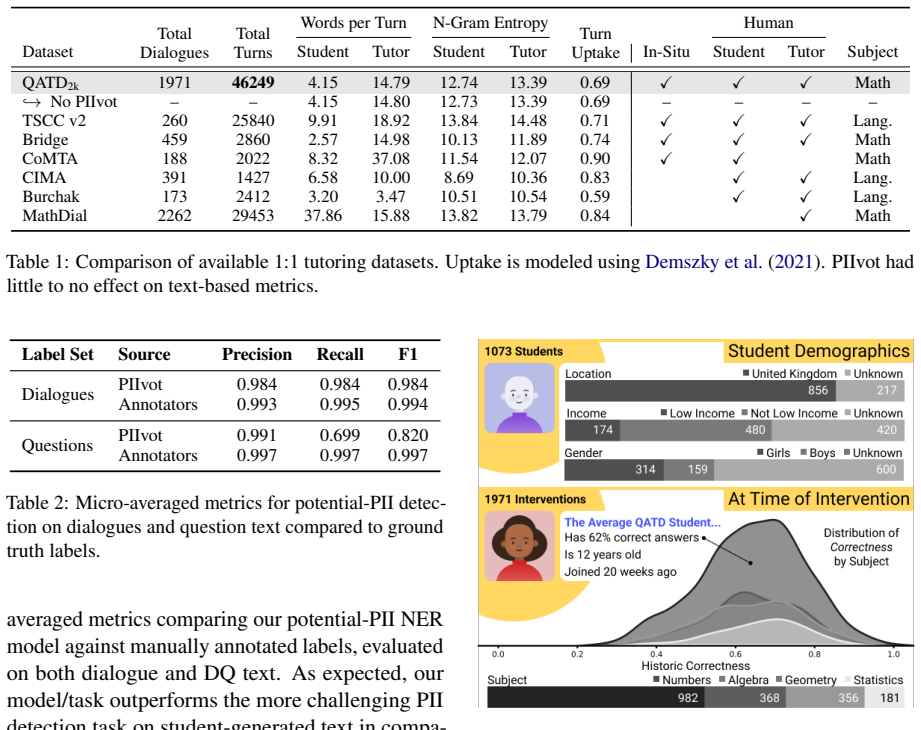
The central claim is that anonymization for question-anchored tutoring can be decomposed into two simpler steps without sacrificing utility. First, a fine-tuned DeBERTa NER model labels spans with word-level IO tags for seven entity types, treating over-detection as acceptable—hence 'potential-PII' rather than PII. Second, GPT-4o builds a per-dialogue mapping from each original span to a surrogate, conditioned on the full chat history and on qualities the prompt asks it to preserve (e.g., gender and ethnic background), with feedback-based reprompting to ensure the replacement is materially different; emails and URLs are obfuscated directly. The empirical demonstration is QATD2k: 1,971 dialogues and 46,249 turns collected from real tutor-student interactions, moderated, tutor-consented, and downsampled by talk-move diversity. On this dataset the anonymized text matches the original on the paper's text-based metrics, and potential-PII detection reaches 0.984 micro-F1 on dialogues, though only 0.820 on LaTeX-formatted question text, where the authors fall back on human annotation.
Load-bearing premise
The method assumes that the names, locations, schools, and similar labeled entities in these dialogues carry no meaning for the task the data will serve, so replacing them with consistent fakes cannot degrade dataset quality; the authors state this is true for their math word problems but not for many other domains.
Editorial extensions
If this is right
- Other text domains where entity content is decorative—fictional assessment items, templated exercises, simulated scenarios—can adopt the same two-step pipeline and expect similar utility preservation.
- Dataset publishers can treat PII detection as a recall-first labeling task rather than a precision-sensitive classification task, lowering the cost and raising the recall of anonymization pipelines.
- QATD2k provides real human-to-human tutoring dialogues with talk-move labels, question metadata, and train/test splits, giving modelers an alternative to synthetic or crowd-sourced tutoring data for training and benchmarking.
- Because PIIvot keeps surrogates consistent within a conversation, downstream models retain cross-turn reference coherence, which is the main reason text-based metrics stay flat.
Reading between the lines
- The paper measures utility only with surface text statistics; a stronger test it does not run is downstream tutoring quality (e.g., whether a tutor model's responses or student outcomes change on anonymized data), and that is the natural next experiment.
- The authors concede that question text (LaTeX) defeated their NER model and required human annotation; a format-aware variant or a policy of not anonymizing question metadata (which carries no student PII) could remove that bottleneck at scale.
- The paper promises within-dialogue surrogate consistency but does not analyze cross-dialogue entity frequency; a practical extension would enforce globally unique surrogates or measure whether repeated names across the corpus enable linkage attacks.
- The surrogate generator is a proprietary API, and the authors themselves warn about prompt logging; a self-hosted open-weights LLM with the same prompt-and-reprompt loop would test whether the method is reproducible without commercial dependence.
Editorial analysis
A structured set of objections, weighed in public.
Referee Report
Summary. This paper presents PIIvot, a two-stage anonymization framework. The first stage uses a fine-tuned DeBERTa model to label potential-PII spans with a recall-first objective; the second uses GPT-4o to replace those spans with context-consistent surrogates under a 'Hidden-In-Plain-Sight' assumption. As a case study, the authors release QATD2k, about 1,971 real tutoring dialogues with metadata and talk-move labels, claiming it is the largest open-source real-world tutoring dataset of its kind. They report micro-averaged dialogue F1=0.984 and question F1=0.820 for the detection stage, a held-out model F1=0.94, and surface text statistics suggesting minimal impact of anonymization. The central claim is that reframing PII detection as potential-PII labeling, followed by context-aware surrogate replacement, enables practical anonymization at scale for educational dialogue data.
Significance. Strengths: the dataset and code are publicly released, the NER model is evaluated on an independent held-out test set (Table 3), the annotation codebook shows high inter-rater reliability (minimum weighted F1 of 0.98), and the ethics and limitations sections are candid about residual PII risk and the domain dependence of the Hidden-In-Plain-Sight assumption. If the detection and replacement claims are validated, PIIvot would be a practical recipe for opening sensitive educational dialogue data, and QATD2k would fill a real gap in real-world tutoring benchmarks. The main concerns below concern the validity of the headline detection numbers and the evidence for the data-integrity claim; both are addressable without changing the scope of the paper.
major comments (2)
- [§2.3, Table 2] The evaluation ground truth for Table 2 is established by 'resolving discrepancies between the machine and annotator labels' (§2.3). If the PIIvot model's predictions are visible to or influence the adjudicators, then the model's false positives can be converted into gold labels, mechanically inflating the reported precision/recall (dialogue F1=0.984, question F1=0.820) and making the annotator row in the same table a resubstitution estimate rather than an independent benchmark. The manuscript does not say who resolved the discrepancies, whether they were blind to the model outputs, or how many disagreements were settled in the model's favor. Please add a blind re-annotation of a random sample in which gold labels are defined by annotator agreement alone (or by an independent adjudicator blind to machine labels), report inter-annotator agreement on the new sample, and quantify how often the machine label disagreed with the final gold label. Without this, the core detection result and the privacy guarantee for QATD2k are not established.
- [§2.1.2, §5.1, Table 1] The claim that anonymization preserves data integrity and has little to no effect on text-based metrics is supported only by surface statistics in Table 1, namely words per turn, n-gram entropy, and turn uptake. These metrics do not test whether surrogate replacements preserve semantic coherence, consistency of named entities across a dialogue, or the mathematical content of word problems. The paper itself states that the Hidden-In-Plain-Sight assumption 'is not true across many domains' (§5.1), which is an honest limitation; however, for QATD2k the assumption is asserted rather than validated. Please add at least one content-level validation, for example a small downstream reading or math comprehension probe before and after anonymization, human judgments of coherence and replacement consistency, or a check that all references to a replaced entity remain aligned in the released dataset. This is load-bearing because data utility is a central part of the contribution.
minor comments (6)
- [§2.2.1] The filtering thresholds (at least 20 total messages and 7 from either participant, at most 8 dialogues per DQ, and a 1000 unique DQ cap) are presented without rationale; a sentence justifying each choice would improve replicability.
- [Table 1] The 'No PIIvot' row is undefined; clarify whether it is the same dialogues before replacement, a separate baseline, or a re-computation on pre-anonymized text, and report the number of dialogues in that row.
- [Appendix B, Table 5] The <Getting Students to Relate> F1 is 0.0000 in the validation set; while the paper excludes this label from downsampling and reports metrics without it, the talk-move labels are part of the released dataset, so the dataset documentation should flag this label as unreliable for 1:1 tutoring.
- [§5.2] In the final paragraph of Section 5.2, 'we acknowledge the positionally of the authors' appears to be a typo for 'positionality'.
- [References] The reference entry 'Commission and others' is not a proper author name; replace it with 'Federal Trade Commission' and the full report title and year.
- [Abstract and Introduction] The abstract uses 'QATD-2k' while the rest of the paper uses 'QATD2k'; please unify the notation throughout.
Circularity Check
Ground truth in §2.3 is built by resolving machine–annotator disagreements, so Table 2's detection F1 is not a fully external benchmark; a blind re-annotation is needed for a clean estimate.
-
other
[Section 2.3 (Annotations) and Table 2]
"The first and second authors and two tutors from the original initiative independently applied the codebook to 68,717 messages and 1000 questions. Discrepancies between the machine and annotator labels were resolved to establish a ground truth."
The gold standard used to score PIIvot in Table 2 is constructed by resolving disagreements between the machine's own predictions and annotator labels. Because the model's outputs are an input to the resolution process, the resulting ground truth is not independent of the system being evaluated: any false positive that an adjudicator accepts becomes a true positive in the final labels, directly inflating the reported precision/recall/F1 (dialogues 0.984, questions 0.820). The paper does not state that the resolver was blind to the model's labels or that machine predictions were excluded from adjudication, so the Table 2 results do not demonstrate detection performance against an external benchmark.
full rationale
The paper's main deliverable is the QATD2k dataset plus the claim that PIIvot anonymization has little effect on data integrity. The anonymization comparison in Table 1 (QATD2k vs. No PIIvot) is an empirical before/after comparison of surface statistics and is not circular. The HIPS assumption that replaced names/locations do not affect quality is explicitly stated and acknowledged by the authors as domain-dependent (Section 5.1); it is an assumption rather than a self-derived conclusion. The talk-move classifier is taken from prior work by different authors and validated on 200 hand-annotated messages, so it is not a self-citation chain. The one significant circularity concern is the evaluation protocol in Section 2.3: the ground truth for Table 2 is produced by resolving discrepancies between the machine's labels and annotator labels, meaning the model can influence the very labels used to score it. Because the paper does not document a blind adjudication process or exclude the model's outputs, the headline detection F1 values are not fully self-contained evidence. However, the held-out test in Table 3, the pre-existing codebook with reported 0.98 inter-rater reliability, and the independently validated talk-move classifier keep the paper from being wholly circular; hence score 4 rather than higher.
Assumptions & free parameters
free parameters (4)
- Minimum session length threshold =
20 total messages, 7 from either participant
- Per-DQ dialogue cap =
8
- Unique DQ cap =
1000
- Talk-move sample flattening factor =
0.8
assumptions (3)
- domain assumption HIPS content-insignificance assumption: non-PII spans can be replaced without impacting dataset quality if replacements are consistent through the document.
- domain assumption Potential-PII labels are a sufficient proxy for actual PII risk.
- domain assumption GPT-4o can generate coherent, consistent surrogate replacements conditioned on chat history.
Cite this review
Pith. "Pith review of PIIvot: A Lightweight NLP Anonymization Framework for Question-Anchored Tutoring Dialogues." pith.science (2026). https://pith.science/paper/X27ATVDD
@misc{pith2026250516931,
  author       = {Pith},
  title        = {Pith review of: PIIvot: A Lightweight NLP Anonymization Framework for Question-Anchored Tutoring Dialogues},
  year         = {2026},
  howpublished = {\url{https://pith.science/paper/X27ATVDD}},
  note         = {Machine review of arXiv:2505.16931}
}
read the original abstract
Personally identifiable information (PII) anonymization is a high-stakes task that poses a barrier to many open-science data sharing initiatives. While PII identification has made large strides in recent years, in practice, error thresholds and the recall/precision trade-off still limit the uptake of these anonymization pipelines. We present PIIvot, a lighter-weight framework for PII anonymization that leverages knowledge of the data context to simplify the PII detection problem. To demonstrate its effectiveness, we also contribute QATD-2k, the largest open-source real-world tutoring dataset of its kind, to support the demand for quality educational dialogue data.
Figures

Reference graph
Works this paper leans on
-
[1]
online" 'onlinestring :=
ENTRY address archivePrefix author booktitle chapter edition editor eid eprint eprinttype howpublished institution journal key month note number organization pages publisher school series title type volume year doi pubmed url lastchecked label extra.label sort.label short.list INTEGERS output.state before.all mid.sentence after.sentence after.block STRING...
-
[2]
write newline
" write newline "" before.all 'output.state := FUNCTION n.dashify 't := "" t empty not t #1 #1 substring "-" = t #1 #2 substring "--" = not "--" * t #2 global.max substring 't := t #1 #1 substring "-" = "-" * t #2 global.max substring 't := while if t #1 #1 substring * t #2 global.max substring 't := if while FUNCTION word.in bbl.in capitalize " " * FUNCT...
-
[3]
Thomas, Simon Woodhead, and Wanli Xing
Vincent Aleven, Richard Baraniuk, Emma Brunskill, Scott Crossley, Dora Demszky, Stephen Fancsali, Shivang Gupta, Kenneth Koedinger, Chris Piech, Steve Ritter, Danielle R. Thomas, Simon Woodhead, and Wanli Xing. 2023. Towards the Future of AI - Augmented Human Tutoring in Math Learning . In Artificial Intelligence in Education . Posters and Late Breaking R...
work page 2023
-
[4]
Rodolfo Stoffel Antunes, Cristiano André da Costa, Arne Küderle, Imrana Abdullahi Yari, and Björn Eskofier. 2022. https://doi.org/10.1145/3501813 Federated Learning for Healthcare : Systematic Review and Architecture Proposal . ACM Trans. Intell. Syst. Technol., 13(4). Place: New York, NY, USA Publisher: Association for Computing Machinery
doi:10.1145/3501813 2022
-
[5]
Nigel Bosch, R. Wes Crues, Najmuddin Shaik, and Luc Paquette. 2020. https://api.semanticscholar.org/CorpusID:219107088 " Hello , [ REDACTED ]": Protecting Student Privacy in Analyses of Online Discussion Forums . In Educational Data Mining
work page 2020
-
[6]
Irshad A Buchh. 2024. https://doi.org/10.1109/APWiMob64015.2024.10792959 Enhancing PII Detection in Student Essays : A Longformer -based Approach with Synthetic Data Augmentation . In 2024 IEEE Asia Pacific Conference on Wireless and Mobile ( APWiMob ) , pages 143--149
arXiv 2024
-
[7]
Andrew Caines, Helen Yannakoudakis, Helena Edmondson, Helen Allen, Pascual Pérez-Paredes, Bill Byrne, and Paula Buttery. 2020. https://aclanthology.org/2020.nlp4call-1.2/ The Teacher - Student Chatroom Corpus . In Proceedings of the 9th Workshop on NLP for Computer Assisted Language Learning , pages 10--20, Gothenburg, Sweden. LiU Electronic Press
work page 2020
-
[8]
Michela Carlana and Eliana La Ferrara. 2024. Apart but connected: Online tutoring, cognitive outcomes, and soft skills. Technical report, National Bureau of Economic Research
work page 2024
Show all 48 references
-
[9]
Nicholas Carlini, Florian Tramèr, Eric Wallace, Matthew Jagielski, Ariel Herbert-Voss, Katherine Lee, Adam Roberts, Tom Brown, Dawn Song, Úlfar Erlingsson, Alina Oprea, and Colin Raffel. 2021. https://www.usenix.org/conference/usenixsecurity21/presentation/carlini-extracting E...
2021
-
[10]
David Carrell, Bradley Malin, John Aberdeen, Samuel Bayer, Cheryl Clark, Ben Wellner, and Lynette Hirschman. 2013. https://doi.org/10.1136/amiajnl-2012-001034 Hiding in plain sight: use of realistic surrogates to reduce exposure of protected health information in clinical text...
2013 doi
-
[11]
Feuston, and Jayhyun Chang
Stevie Chancellor, Jessica L. Feuston, and Jayhyun Chang. 2023. https://doi.org/10.1145/3610181 Contextual Gaps in Machine Learning for Mental Illness Prediction : The Case of Diagnostic Disclosures . Proc. ACM Hum.-Comput. Interact., 7(CSCW2). Place: New York, NY, USA Publish...
2023 doi
-
[12]
Guanliang Chen, Rafael Ferreira, David Lang, and Dragan Gasevic. 2019. Predictors of Student Satisfaction : A Large - Scale Study of Human - Human Online Tutorial Dialogues . International Educational Data Mining Society. Publisher: ERIC
2019
-
[13]
Protecting Consumer Privacy in an Era of Rapid Change — Recommendations for Businesses and Policymakers , FTC Report , Mar
Federal Trade Commission and others . Protecting Consumer Privacy in an Era of Rapid Change — Recommendations for Businesses and Policymakers , FTC Report , Mar . 2012
2012
-
[14]
Dorottya Demszky, Jing Liu, Zid Mancenido, Julie Cohen, Heather Hill, Dan Jurafsky, and Tatsunori Hashimoto. 2021. https://doi.org/10.18653/v1/2021.acl-long.130 Measuring Conversational Uptake : A Case Study on Student - Teacher Interactions . In Proceedings of the 59th Annual...
2021 doi
-
[15]
Jacob Devlin, Ming - Wei Chang, Kenton Lee, and Kristina Toutanova. 2018. https://arxiv.org/abs/1810.04805 BERT: pre-training of deep bidirectional transformers for language understanding . CoRR, abs/1810.04805
2018 arXiv
-
[16]
Maya Escueta, Vincent Quan, Andre Joshua Nickow, and Philip Oreopoulos. 2017. Education technology: An evidence-based review. Publisher: National Bureau of Economic Research
2017
-
[17]
Hossein Esfandiari, Vahab Mirrokni, and Jon Schneider. 2022. Anonymous bandits for multi-user systems. Advances in Neural Information Processing Systems, 35:12422--12434
2022
-
[18]
Lucas Gortazar, Claudia Hupkau, and Antonio Roldán-Monés. 2024. https://doi.org/10.1016/j.jpubeco.2024.105082 Online tutoring works: Experimental evidence from a program with vulnerable children . Journal of Public Economics, 232:105082
2024
-
[19]
Aryan Gulati, Brando Miranda, Eric Chen, Emily Xia, Kai Fronsdal, Bruno de Moraes Dumont, and Sanmi Koyejo. 2024. https://openreview.net/forum?id=YXnwlZe0yf Putnam- AXIOM : A Functional and Static Benchmark for Measuring Higher Level Mathematical Reasoning . In The 4th Worksho...
2024
-
[20]
Pengcheng He, Jianfeng Gao, and Weizhu Chen. 2021. https://arxiv.org/abs/2111.09543 Debertav3: Improving deberta using electra-style pre-training with gradient-disentangled embedding sharing . Preprint, arXiv:2111.09543
2021 arXiv
-
[21]
Langdon Holmes, Wesley Morris, Harshvardhan Sikka, and Anne Trumbore. 2023. https://doi.org/10.1007/978-3-031-36336-8_109 Deidentifying Student Writing with Rules and Transformers . pages 708--713
2023 doi
-
[22]
Baker, Michael Mogessie Ashenafi, Juan Miguel Andres-Bray, and Christopher Brooks
Stephen Hutt, Ryan S. Baker, Michael Mogessie Ashenafi, Juan Miguel Andres-Bray, and Christopher Brooks. 2022. https://doi.org/10.1111/bjet.13231 Controlled outputs, full data: A privacy-protecting infrastructure for MOOC data . British Journal of Educational Technology, 53(4)...
2022 doi
-
[23]
Shouling Ji, Prateek Mittal, and Raheem Beyah. 2017. https://doi.org/10.1109/COMST.2016.2633620 Graph Data Anonymization , De - Anonymization Attacks , and De - Anonymizability Quantification : A Survey . IEEE Communications Surveys & Tutorials, 19(2):1305--1326
2017
-
[24]
Wenda Li, Lei Yu, Yuhuai Wu, and Lawrence C. Paulson. 2021. https://openreview.net/forum?id=Pzj6fzU6wkj IsarStep : a Benchmark for High -level Mathematical Reasoning . In International Conference on Learning Representations
2021
-
[25]
Jakub Macina, Nico Daheim, Sankalan Chowdhury, Tanmay Sinha, Manu Kapur, Iryna Gurevych, and Mrinmaya Sachan. 2023 a . https://doi.org/10.18653/v1/2023.findings-emnlp.372 MathDial : A Dialogue Tutoring Dataset with Rich Pedagogical Properties Grounded in Math Reasoning Problem...
2023 doi
-
[26]
Jakub Macina, Nico Daheim, Ido Hakimi, Manu Kapur, Iryna Gurevych, and Mrinmaya Sachan. 2025. https://arxiv.org/abs/2502.18940 MathTutorBench : A Benchmark for Measuring Open -ended Pedagogical Capabilities of LLM Tutors . \_eprint: 2502.18940
2025
-
[27]
Jakub Macina, Nico Daheim, Lingzhi Wang, Tanmay Sinha, Manu Kapur, Iryna Gurevych, and Mrinmaya Sachan. 2023 b . https://doi.org/10.18653/v1/2023.eacl-main.173 Opportunities and Challenges in Neural Dialog Tutoring . In Proceedings of the 17th Conference of the European Chapte...
2023 doi
-
[28]
Abdul Majeed and Sungchang Lee. 2021. https://doi.org/10.1109/ACCESS.2020.3045700 Anonymization Techniques for Privacy Preserving Data Publishing : A Comprehensive Survey . IEEE Access, 9:8512--8545
2021
-
[29]
Hamarsha Manal and Kopp Erika. 2024. EduTech Revolution : The Dynamic Role of ICT in Shaping Learning Environments
2024
-
[30]
Varun Mandalapu and Jiaqi Gong. 2019. https://doi.org/10.1145/3372300.3372303 Understanding Affective Dynamics of Learning Toward a Ubiquitous Learning System . GetMobile: Mobile Comp. and Comm., 23(2):9--15. Place: New York, NY, USA Publisher: Association for Computing Machinery
2019
-
[31]
Manpreet Singh Manna, Balamurugan Balusamy, Kiran Sood, Naveen Chilamkurti, and Ignisha Rajathi George. 2022. Edutech Enabled Teaching : Challenges and Opportunities . Publisher: CRC Press
2022
-
[32]
T Marwala. 2023. Algorithm bias—synthetic data should be option of last resort when training ai systems. United Nations University
2023
-
[33]
Pepper Miller and Kristen DiCerbo. 2024. LLM Based Math Tutoring : Challenges and Dataset
2024
-
[34]
Baptiste Moreau-Pernet, Yu Tian, Sandra Sawaya, Peter Foltz, Jie Cao, Brent Milne, and Thomas Christie. 2024. https://doi.org/10.1145/3657604.3664664 Classifying Tutor Discursive Moves at Scale in Mathematics Classrooms with Large Language Models . In Proceedings of the Eleven...
2024
-
[35]
Hiroki Nakayama, Takahiro Kubo, Junya Kamura, Yasufumi Taniguchi, and Xu Liang. 2018. https://github.com/doccano/doccano doccano : Text annotation tool for human . Software available from https://github.com/doccano/doccano
2018
-
[36]
Scaling Down
Catherine O'Connor, Sarah Michaels, and Suzanne Chapin. 2015. https://doi.org/10.3102/978-0-935302-43-1_9 " Scaling Down " to Explore the Role of Talk in Learning : From District Intervention to Controlled Classroom Study . In Socializing Intelligence through Talk and Dialogue...
2015 doi
-
[37]
Iyiola Olatunji, Jens Rauch, Matthias Katzensteiner, and Megha Khosla. 2022. https://doi.org/10.1089/big.2021.0169 A Review of Anonymization for Healthcare Data . Big Data, 12
2022
-
[38]
Arkil Patel, Satwik Bhattamishra, and Navin Goyal. 2021. https://doi.org/10.18653/v1/2021.naacl-main.168 Are NLP Models really able to Solve Simple Math Word Problems ? In Proceedings of the 2021 Conference of the North American Chapter of the Association for Computational Lin...
2021 doi
-
[39]
Nitin Rane. 2023. Enhancing mathematical capabilities through ChatGPT and similar generative artificial intelligence: Roles and challenges in solving mathematical problems. Available at SSRN 4603237
2023
-
[40]
Aniruddha Sen, Christine Task, Dhruv Kapur, Gary Howarth, and Karan Bhagat. 2024. Diverse community data for benchmarking data privacy algorithms. Advances in Neural Information Processing Systems, 36
2024
-
[41]
Shreya Singhal, Andres Felipe Zambrano, Maciej Pankiewicz, Xiner Liu, Chelsea Porter, and Ryan S. Baker. 2024. https://doi.org/10.5281/zenodo.12729884 De- Identifying Student Personally Identifying Information with GPT -4 . In Proceedings of the 17th International Conference o...
2024 doi
-
[42]
Hwanjun Song, Taewon Yun, Yuho Lee, Jihwan Oh, Gihun Lee, Jason Cai, and Hang Su. 2025. https://arxiv.org/abs/2410.13116 Learning to Summarize from LLM -generated Feedback . \_eprint: 2410.13116
2025 arXiv
-
[43]
Katherine Stasaski, Kimberly Kao, and Marti A. Hearst. 2020. https://doi.org/10.18653/v1/2020.bea-1.5 CIMA : A Large Open Access Dialogue Dataset for Tutoring . In Proceedings of the Fifteenth Workshop on Innovative Use of NLP for Building Educational Applications , pages 52--...
2020 doi
-
[44]
Frank Stinar, Zihan Xiong, and Nigel Bosch. 2024. https://doi.org/10.5281/zenodo.11056083 An Approach to Improve k- Anonymization Practices in Educational Data Mining . Journal of Educational Data Mining, 16(1):61--83. Section: EDM 2024 Journal Track
2024 doi
-
[45]
Rose Wang, Qingyang Zhang, Carly Robinson, Susanna Loeb, and Dorottya Demszky. 2024. https://doi.org/10.18653/v1/2024.naacl-long.120 Bridging the Novice - Expert Gap via Models of Decision - Making : A Case Study on Remediating Math Mistakes . In Proceedings of the 2024 Confer...
2024 doi
-
[46]
Yanchao Yu, Arash Eshghi, Gregory Mills, and Oliver Lemon. 2017. https://doi.org/10.18653/v1/W17-2001 The BURCHAK corpus: a Challenge Data Set for Interactive Learning of Visually Grounded Word Meanings . In Proceedings of the Sixth Workshop on Vision and Language , pages 1--1...
2017 doi
-
[47]
Matthew Zent, Seraphina Yong, Dhruv Bala, Stevie Chancellor, Joseph A Konstan, Loren Terveen, and Svetlana Yarosh. 2025. Beyond the Individual : A Community - Engaged Framework for Ethical Online Community Research . arXiv preprint arXiv:2503.13752
2025 arXiv
-
[48]
Chunting Zhou, Pengfei Liu, Puxin Xu, Srini Iyer, Jiao Sun, Yuning Mao, Xuezhe Ma, Avia Efrat, Ping Yu, LILI YU, Susan Zhang, Gargi Ghosh, Mike Lewis, Luke Zettlemoyer, and Omer Levy. 2023. https://openreview.net/forum?id=KBMOKmX2he LIMA : Less Is More for Alignment . In Thirt...
2023
Reviewed August 7, 2026 · model on record in the stance chip above.
Discussion (0). Continue with ORCID to comment.