REVIEW 3 major objections 5 minor 1 cited by
Topological Phase Transitions and Mixed State Order in a Hubbard Quantum Simulator
T0 review · 3 major / 5 minor · reviewed 2026-08-07 · deepseek-v4-flash
Pith's one-line read The paper reports the observation of a topological quantum phase transition between two crystalline symmetry-protected topological phases in a Hubbard quantum simulator, detected by the sign of an odd-length parity string, and shows that…
desk verdict A careful analog simulation of a 1D SPT transition with clean parity-string data, but the disorder-averaging claim is underpowered and needs a matched-statistics control. read the letter →
The pith
A machine-rendered reading of the paper's core claim, the machinery that carries it, and where it could break.
The reading
What carries the argument
The load-bearing object is the parity string operator $P_{x_0}(r)$, the expectation value of the $Z_2$ parity $\prod_x e^{i\pi \hat n_x}$ over a contiguous region; its sign for odd-length, site-centered-inversion-symmetric regions is the CSPT invariant. Two derived order parameters, $p_1=\langle(-1)^r P_{x_0}(r)\rangle$ and $p_2=\langle P_{x_0}(r)\rangle$, are used to distinguish the phases. To test the group structure, the paper uses a particle-hole mapping that converts the proposed pairing term $H_\perp=\Delta_\perp\sum_x(a^\dagger_{T,x}a^\dagger_{B,x}+\mathrm{h.c.})$ into an inter-chain tunneling term that can be implemented experimentally, and it checks that the energy gap at the would-be critical point opens with increasing $t_\perp$. To test average-SPT order, the paper applies programmable chemical-potential disorder with a symmetric distribution and compares single-realization order parameters with the disorder-averaged ensemble $\rho=\sum_D p_D|\psi_D\rangle\langle\psi_D|$.
What would settle it
Re-analyze the existing raw snapshots without any of the data-selection cuts listed in the paper (atom-number, photon-count, and spin-half-mapping), and check whether the odd-length parity string still changes sign at the same $\mu_S/U$; the paper's central claim predicts the sign flip survives, while a post-selection artifact would make it disappear.
Extended reading notes
Core claim
On the paper's own terms, the central discovery is that the sign of the parity string operator $P_{x_0}(r)=\langle\prod_{x=x_0}^{x_0+r} e^{i\pi \hat n_x}\rangle$ for odd $r$ is a valid topological invariant for the two crystalline SPT phases of the staggered dipolar Bose-Hubbard model at unit filling. In the atomic limit, the unity-filled state $|1111\cdots\rangle$ has negative parity on any odd-length region, while the state $|2020\cdots\rangle$ has positive parity; the paper argues that, with parity and site-centered inversion symmetry and an open gap, the sign of this parity cannot change, so the measured crossover from negative to positive values of the odd-length parity string across $\mu_S/U$ locates a quantum phase transition between CSPT-1 and CSPT-2. The paper further claims that this topological distinction has the defining SPT properties: coupling two chains with a pairing term opens a gap and removes the transition, and breaking inversion symmetry with known disorder removes the transition, but averaging over disorder realizations restores it, so the two phases are distinct mixed-state phases protected by average inversion symmetry.
Load-bearing premise
The central claim assumes that the post-selection of imaging data, which keeps only about 1.4% of chains for the main measurement, does not bias the measured parity-string order; if the discarded chains preferentially realize different fillings, the apparent topological transition could be a selection artifact.
Editorial extensions
If this is right
- If the parity-string sign is a valid invariant, then no local observable can distinguish CSPT-1 from CSPT-2, and the observed transition is genuinely nonlocal.
- Stacking and weakly coupling an even number of chains trivializes the topology, so the quantum critical point between the stacks disappears; this confirms the $\mathbb{Z}_2$ group structure and invertibility of symmetry-protected topological phases.
- Because known disorder removes the transition but disorder averaging restores it, the two phases are distinct average-symmetry-protected mixed states: the criticality between them depends on whether the observer knows the disorder pattern.
- The CSPT-1/2 transition connects continuously to the Mott-to-Haldane transition, so the same topological criticality can be studied with and without a staggered potential.
- The same experimental toolbox can probe topological criticality in parameter regimes that are inaccessible to conventional solid-state systems.
Reading between the lines
- Once post-selection bias is conclusively ruled out, the signed parity string could become a routine diagnostic for SPT order in larger programmable quantum simulators, where entanglement-spectrum measurements are impractical.
- The single-realization-versus-disorder-averaged contrast can be turned into a quantitative witness: a protocol that compares the string order parameters before and after averaging would directly estimate the strength of average symmetry protection.
- The stacking result suggests a preparation strategy for two-dimensional SPT phases protected by particle-parity symmetry, where explicit symmetry breaking is impractical but pairwise coupling trivializes the topology only for even stacks.
- Finite-size scaling of the parity-string sign across $\mu_S/U$ could extract critical exponents of the CSPT transition and test whether it shares the universality class of the Haldane-to-Mott transition.
Editorial analysis
A structured set of objections, weighed in public.
Referee Report
Summary. Su et al. report experiments with 164Er atoms in one-dimensional optical lattices realizing a staggered dipolar Bose-Hubbard model. They measure the parity string operator on odd-length regions and observe a sign change as the staggered chemical potential increases, which they identify with a quantum phase transition between two crystalline symmetry-protected topological phases, CSPT-1 and CSPT-2. They further report that coupling two chains through a pairing-type term, implemented via a particle-hole mapping, opens an energy gap and removes the transition, and that quenched disorder destroys the transition for a single known disorder realization while disorder averaging restores the string order; this is interpreted as average-SPT mixed-state order. Finally, with zero staggering they observe Haldane-type string order and associate it with the Haldane-to-Mott insulator transition. The experimental observations are supported by DMRG/TEBD simulations, exact diagonalization for small coupled systems, and a control without the spin-half mapping data selection.
Significance. If correct, this is a significant advance: it would be the first analog-simulator observation of a quantum critical point between two SPT phases detected through the sign of a nonlocal parity string, and it directly tests the group-structure and invertibility predictions for Z2 SPTs through the stacking experiment. The disorder-averaging part would be a notable demonstration of average-SPT mixed-state order, with the striking implication that criticality depends on the observer's disorder information. Strong elements include the control without spin-half mapping data selection (Fig. 7b), the finite-size DMRG study of local observables at L=100-200 (Fig. 9), and the honest discussion of finite-size and fidelity limitations. However, two load-bearing concerns—the statistical power of the disorder-averaging contrast and the heavy post-selection of the main CSPT measurement—prevent me from endorsing the central claims as presently stated.
major comments (3)
- [Sec. IV, Fig. 4, Table I] The claim that disorder averaging restores the transition is not yet distinguished from a pure reduction of statistical noise. Table I reports for Fig. 4 a smallest post-selection sample of 74 and an average of 204 shots per point, with 1429 total after data selection; the single-realization curves are therefore much noisier than the disorder-averaged curve, whose error bars are standard errors of the mean over realizations. If each realization contains a weak underlying trend hidden by shot noise, averaging over realizations will appear sharp even though no single realization shows a transition. The paper does not show a single realization measured to the same total statistics as the averaged data, nor a per-realization model comparison (e.g., step versus constant fit). Please add either single-realization data at matched total statistics or a quantitative per-realization analysis demonstrating that no single realization has a significant transition signature while the ensemble average does.
- [Sec. II, Table I, Fig. 7] The main CSPT measurement in Fig. 2 retains only 1.36% of chains after the atom-number, photon-count, and spin-half mapping data selections (Table I). The control without the spin-half mapping (Fig. 7b) is useful, but the atom-number and photon-count selections are still applied there, so the behavior of the fully unselected data is not demonstrated. Because the claimed invariant is the sign of a nonlocal parity string, a selection procedure that preferentially removes doublons, empties, or particular total atom numbers could in principle bias the inferred sign. Please provide a quantitative stability check of the parity-string sign under relaxing or removing the remaining data-selection steps, for example by comparing order parameters for several selection thresholds or by simulating the selection on unselected numerical snapshots.
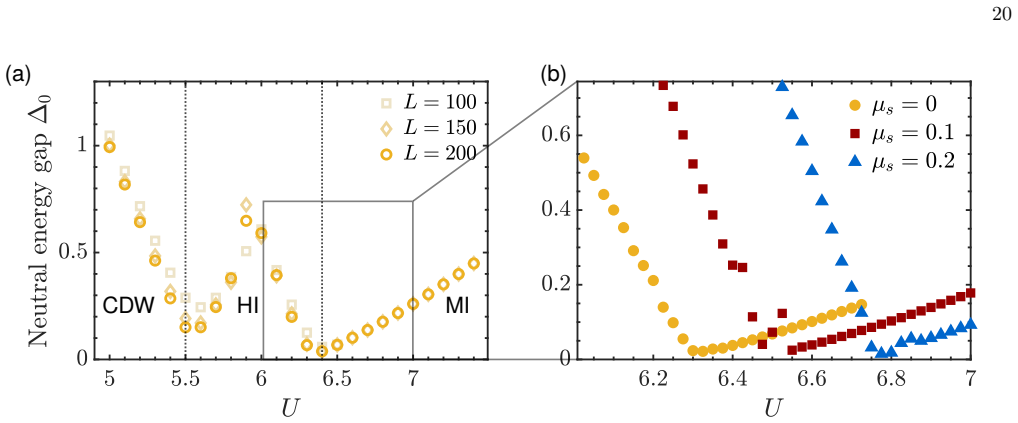
- [Sec. V and SM (Haldane-to-Mott transition)] The Haldane-to-Mott identification in Sec. V rests on the normalized Haldane string order parameter with the normalization eta computed from the state with maximum string order in the probed parameter space, and the SM itself states that the 10-site system may be in the quantum critical regime and 'strictly speaking not insulating.' This caveat should appear in the main text, and the sensitivity of the two-regime conclusion to the choice of eta and to finite-size/critical-regime effects should be reported. As written, the section claims a transition while the data and simulations only demonstrate consistency with a smooth crossover in a finite system.
minor comments (5)
- [SM, Eq. (8)] The notation around Eq. (8) is garbled: the passage defining |px⟩ contains '|px⟩ ⟨px| | px⟩ = ...' and should be rewritten for clarity.
- [Sec. V, Fig. 5] Please clarify whether the normalization eta is a single constant applied to all U values or is re-computed for each U, and state explicitly how the reported results depend on this choice.
- [SM, Fig. 12a] The histogram evidence for approximate charge-conjugation symmetry is qualitative; a quantitative symmetry metric, such as a normalized overlap or chi-squared statistic between the original and charge-conjugated histograms, would strengthen the claim.
- [SM, Data selection] The paper says data and code are available 'upon request'; for a result that depends heavily on post-selection and numerical simulation, depositing the analysis code and processed datasets would substantially improve reproducibility.
- [Sec. III, Fig. 3] The white-noise decoherence strength sigma0 is introduced and set to 20 Hz to match the coupled-chain data; it would be helpful to state explicitly how many independent aspects of the data are constrained by this single parameter and whether the conclusions survive if sigma0 is varied within a reasonable range.
Circularity Check
No significant circularity: the experimental observables are measured against externally derived invariants and independent numerical simulations, with no load-bearing reduction to inputs.
full rationale
The paper's central claims are experimental measurements of theoretically predicted phase structure, not derivations of that structure from the data. The CSPT invariant—the sign of the odd-length parity string—is derived in the Supplementary Materials from a purification/fractionalization argument using standard SPT theory, and the atomic-limit signs are computed directly from the product states |1111...> and |2020...>, so the distinction is fixed by the Hamiltonian's symmetries rather than by the measured values. The stacking result is supported by independent numerical gap calculations and by direct energy-histogram temperature measurements; the white-noise strength sigma0=20 Hz is explicitly described as a modeling parameter ('we find that sigma0 = 20 Hz successfully models the experimental results for all t_perp/t in Fig. 3b'), not as a parameter-free prediction, and the qualitative gap-opening claim is separately shown in no-decoherence simulations. The Haldane string-order normalization eta is a data-dependent standard rescaling for finite-size string order, but it sets only an overall scale and does not determine the transition location or the sign of the order parameter. The disorder-averaging mixed-state claim is supported by a self-contained proof in the Supplementary Materials that the sign of the averaged parity string is an invariant under finite-depth quantum channels, with the average-SPT framework cited from external literature [4]. Although Ref. [38] points to the same authors' forthcoming theoretical work, the Supplementary Materials state that the present work is self-contained and provide the invariant derivation explicitly, so that self-citation is not load-bearing. Statistical concerns about single-disorder-realization noise are correctness risks, not circularity, because they do not involve a quantity being defined in terms of itself or a fitted parameter being renamed as a prediction.
Assumptions & free parameters
free parameters (2)
- White-noise decoherence strength σ0 =
20 Hz
- Haldane string order normalization η =
1/⟨|δni||δni+r|⟩ computed for the state with maximum string order
assumptions (5)
- standard math The sign of the odd-length parity string expectation value is a topological invariant for 1D SPTs protected by parity and inversion symmetry
- domain assumption The staggered dipolar Bose-Hubbard Hamiltonian (Eq. 1) faithfully describes the experimental system, including the calibrated t, U, V, and µS
- domain assumption Finite-size chains of 10 or 16 sites with approximate inversion symmetry represent the bulk topological phases
- domain assumption The ensemble of disorder realizations is inversion-symmetric on average
- ad hoc to paper The white-noise/Lindblad model captures the dominant decoherence in the coupled-chain experiment
Cite this review
Pith. "Pith review of Topological Phase Transitions and Mixed State Order in a Hubbard Quantum Simulator." pith.science (2026). https://pith.science/paper/5BSLCWKX
@misc{pith2026250517009,
  author       = {Pith},
  title        = {Pith review of: Topological Phase Transitions and Mixed State Order in a Hubbard Quantum Simulator},
  year         = {2026},
  howpublished = {\url{https://pith.science/paper/5BSLCWKX}},
  note         = {Machine review of arXiv:2505.17009}
}
read the original abstract
Topological phase transitions challenge conventional paradigms in many-body physics by separating phases that are locally indistinguishable yet globally distinct. Using a quantum simulator of interacting erbium atoms in an optical lattice, we observe such a transition between one-dimensional crystalline symmetry-protected topological phases (CSPTs). We detect the critical point through non-local string order parameters and reveal its connection to the transition predicted between the Mott and Haldane insulators. Moreover, we demonstrate a striking property: stacking two identical systems eliminates the transition, confirming the predicted group structure and invertibility of SPTs. Finally, while introducing symmetry-breaking disorder also removes the transition, disorder averaging restores it. Consequently, the adjacent phases realize a form of mixed-state quantum order wherein the criticality between them depends on the observer's information. Our results demonstrate how topology and information influence quantum phase transitions, opening the doors to probing novel critical phenomena in programmable quantum matter.
Figures


Figures from the paper (10 more)




Forward citations
Cited by 1 Pith paper
-
Topology meets superconductivity in a one-dimensional $t-J$ model of magnetic atoms
A realistic lanthanide-atom t-J model is shown by bosonization and DMRG to host a topological triplet superconductor in its ground state for attractive U and a ferromagnetic J_perp.
Reference graph
Works this paper leans on
-
[1]
E. G. Dalla Torre, E. Berg, and E. Altman, Hidden order in 1d bose insulators, Phys. Rev. Lett. 97, 260401 (2006)
2006
-
[2]
E. Berg, E. G. Dalla Torre, T. Giamarchi, and E. Alt- man, Rise and fall of hidden string order of lattice bosons, Phys. Rev. B 77, 245119 (2008)
2008
-
[3]
Y. Fuji, F. Pollmann, and M. Oshikawa, Distinct trivial phases protected by a point-group symmetry in quantum spin chains, Phys. Rev. Lett. 114, 177204 (2015)
2015
-
[4]
Ma and C
R. Ma and C. Wang, Average symmetry-protected topo- logical phases, Phys. Rev. X 13, 031016 (2023)
2023
-
[5]
Sachdev, Quantum phase transitions, Physics World 12, 33 (1999)
S. Sachdev, Quantum phase transitions, Physics World 12, 33 (1999)
1999
-
[6]
Senthil, Symmetry-protected topological phases of quantum matter, Annu
T. Senthil, Symmetry-protected topological phases of quantum matter, Annu. Rev. Condens. Matter Phys. 6, 299 (2015)
2015
-
[7]
Pollmann, A
F. Pollmann, A. M. Turner, E. Berg, and M. Oshikawa, Entanglement spectrum of a topological phase in one di- mension, Phys. Rev. B 81, 064439 (2010)
2010
-
[8]
A. M. Turner, F. Pollmann, and E. Berg, Topological phases of one-dimensional fermions: An entanglement point of view, Phys. Rev. B 83, 075102 (2011)
2011
Show all 86 references
-
[9]
Fidkowski and A
L. Fidkowski and A. Kitaev, Topological phases of fermions in one dimension, Phys. Rev. B 83, 075103 (2011)
2011
-
[10]
Pollmann, E
F. Pollmann, E. Berg, A. M. Turner, and M. Os- hikawa, Symmetry protection of topological phases in one-dimensional quantum spin systems, Phys. Rev. B85, 075125 (2012)
2012
-
[11]
Schuch, D
N. Schuch, D. P´ erez-Garc ´ ıa, and I. Cirac, Classifying quantum phases using matrix product states and pro- jected entangled pair states, Phys. Rev. B 84, 165139 (2011)
2011
-
[12]
Chen, Z.-C
X. Chen, Z.-C. Gu, and X.-G. Wen, Complete classifica- tion of one-dimensional gapped quantum phases in inter- acting spin systems, Phys. Rev. B 84, 235128 (2011)
2011
-
[13]
Chen, Z.-C
X. Chen, Z.-C. Gu, Z.-X. Liu, and X.-G. Wen, Symmetry- protected topological orders in interacting bosonic sys- tems, Science 338, 1604 (2012)
2012
-
[14]
Atala, M
M. Atala, M. Aidelsburger, J. T. Barreiro, D. Abanin, T. Kitagawa, E. Demler, and I. Bloch, Direct measure- ment of the zak phase in topological bloch bands, Nature Physics 9, 795 (2013)
2013
-
[15]
E. J. Meier, F. A. An, and B. Gadway, Observation of the topological soliton state in the su–schrieffer–heeger model, Nature communications 7, 13986 (2016)
2016
-
[16]
de L´ es´ eleuc, V
S. de L´ es´ eleuc, V. Lienhard, P. Scholl, D. Barredo, S. We- ber, N. Lang, H. P. B¨ uchler, T. Lahaye, and A. Browaeys, Observation of a symmetry-protected topological phase of interacting bosons with rydberg atoms, Science 365, 775 (2019)
2019
-
[17]
Sompet, S
P. Sompet, S. Hirthe, D. Bourgund, T. Chalopin, J. Bibo, J. Koepsell, P. Bojovi´ c, R. Verresen, F. Pollmann, G. Sa- lomon, C. Gross, T. A. Hilker, and I. Bloch, Realizing the symmetry-protected haldane phase in fermi–hubbard ladders, Nature 606, 484 (2022)
2022
-
[18]
W. Cai, J. Han, F. Mei, Y. Xu, Y. Ma, X. Li, H. Wang, Y. P. Song, Z.-Y. Xue, Z.-q. Yin, S. Jia, and L. Sun, Observation of topological magnon insulator states in a superconducting circuit, Phys. Rev. Lett. 123, 080501 (2019)
2019
-
[19]
O. Katz, L. Feng, D. Porras, and C. Monroe, Observing topological insulator phases with a programmable quan- tum simulator, arXiv 2401, 10362 (2024)
2024
-
[20]
K. Choo, C. W. von Keyserlingk, N. Regnault, and T. Ne- upert, Measurement of the entanglement spectrum of a symmetry-protected topological state using the ibm quantum computer, Phys. Rev. Lett.121, 086808 (2018)
2018
-
[21]
Smith, B
A. Smith, B. Jobst, A. G. Green, and F. Pollmann, Cross- ing a topological phase transition with a quantum com- puter, Phys. Rev. Res. 4, L022020 (2022)
2022
-
[22]
Herrmann, S
J. Herrmann, S. M. Llima, A. Remm, P. Zapletal, N. A. McMahon, C. Scarato, F. Swiadek, C. K. Andersen, C. Hellings, S. Krinner, et al., Realizing quantum convo- lutional neural networks on a superconducting quantum processor to recognize quantum phases, Nature commu- nications...
2022
-
[23]
Bloch, J
I. Bloch, J. Dalibard, and W. Zwerger, Many-body physics with ultracold gases, Rev. Mod. Phys. 80, 885 (2008)
2008
-
[24]
Gross and I
C. Gross and I. Bloch, Quantum simulations with ultra- cold atoms in optical lattices, Science 357, 995 (2017)
2017
-
[25]
Bohrdt, L
A. Bohrdt, L. Homeier, C. Reinmoser, E. Demler, and F. Grusdt, Exploration of doped quantum magnets with ultracold atoms, Annals of Physics 435, 168651 (2021)
2021
-
[26]
F. D. M. Haldane, Nonlinear field theory of large-spin heisenberg antiferromagnets: Semiclassically quantized solitons of the one-dimensional easy-axis n´ eel state, Phys. Rev. Lett. 50, 1153 (1983)
1983
-
[27]
L. Su, A. Douglas, M. Szurek, R. Groth, S. F. Ozturk, A. Krahn, A. H. H´ ebert, G. A. Phelps, S. Ebadi, S. Dick- erson, F. Ferlaino, O. Markovi´ c, and M. Greiner, Dipolar quantum solids emerging in a hubbard quantum simula- tor, Nature 622, 724 (2023)
2023
-
[28]
C. Chin, R. Grimm, P. Julienne, and E. Tiesinga, Fesh- bach resonances in ultracold gases, Rev. Mod. Phys. 82, 1225 (2010)
2010
-
[29]
W. S. Bakr, A. Peng, M. E. Tai, R. Ma, J. Simon, J. I. Gillen, S. F¨ olling, L. Pollet, and M. Greiner, Probing the superfluid–to–mott insulator transition at the single- atom level, Science 329, 547 (2010)
2010
-
[30]
J. F. Sherson, C. Weitenberg, M. Endres, M. Cheneau, I. Bloch, and S. Kuhr, Single-atom-resolved fluorescence imaging of an atomic mott insulator, Nature 467, 68 (2010)
2010
-
[31]
L. Su, A. Douglas, M. Szurek, A. H. Hebert, A. Krahn, R. Groth, G. A. Phelps, O. Markovic, and M. Greiner, 15 Fast single atom imaging for optical lattice arrays, Nat Commun 16, 1017 (2025)
2025
-
[32]
Fu, Topological crystalline insulators, Phys
L. Fu, Topological crystalline insulators, Phys. Rev. Lett. 106, 106802 (2011)
2011
-
[33]
A. M. Turner, Y. Zhang, and A. Vishwanath, Entangle- ment and inversion symmetry in topological insulators, Phys. Rev. B 82, 241102 (2010)
2010
-
[34]
T. L. Hughes, E. Prodan, and B. A. Bernevig, Inversion- symmetric topological insulators, Phys. Rev. B 83, 245132 (2011)
2011
-
[35]
Song, S.-J
H. Song, S.-J. Huang, L. Fu, and M. Hermele, Topological phases protected by point group symmetry, Phys. Rev. X 7, 011020 (2017)
2017
-
[36]
T. A. Hilker, G. Salomon, F. Grusdt, A. Omran, M. Boll, E. Demler, I. Bloch, and C. Gross, Revealing hidden antiferromagnetic correlations in doped hubbard chains via string correlators, Science 357, 484 (2017), https://www.science.org/doi/pdf/10.1126/science.aam8990
2017 doi
-
[37]
D. Wei, D. Adler, K. Srakaew, S. Agrawal, P. Weckesser, I. Bloch, and J. Zeiher, Observation of brane parity or- der in programmable optical lattices, Phys. Rev. X 13, 021042 (2023)
2023
-
[38]
(to appear) (2025)
Sahay et al. (to appear) (2025)
2025
-
[39]
Gu and X.-G
Z.-C. Gu and X.-G. Wen, Tensor-entanglement-filtering renormalization approach and symmetry-protected topo- logical order, Phys. Rev. B 80, 155131 (2009)
2009
-
[40]
D. S. Freed, Short-range entanglement and invertible field theories, arXiv 1406, 7278 (2014)
2014
-
[41]
Fu and C
L. Fu and C. L. Kane, Topology, delocalization via av- erage symmetry and the symplectic anderson transition, Phys. Rev. Lett. 109, 246605 (2012)
2012
-
[42]
Ringel, Y
Z. Ringel, Y. E. Kraus, and A. Stern, Strong side of weak topological insulators, Phys. Rev. B 86, 045102 (2012)
2012
-
[43]
R. S. K. Mong, J. H. Bardarson, and J. E. Moore, Quan- tum transport and two-parameter scaling at the surface of a weak topological insulator, Phys. Rev. Lett. 108, 076804 (2012)
2012
-
[44]
I. C. Fulga, B. van Heck, J. M. Edge, and A. R. Akhmerov, Statistical topological insulators, Phys. Rev. B 89, 155424 (2014)
2014
-
[45]
Ma, J.-H
R. Ma, J.-H. Zhang, Z. Bi, M. Cheng, and C. Wang, Topological phases with average symmetries: The deco- hered, the disordered, and the intrinsic (2025)
2025
-
[46]
de Groot, A
C. de Groot, A. Turzillo, and N. Schuch, Symmetry pro- tected topological order in open quantum systems, Quan- tum 6, 856 (2022)
2022
-
[47]
Coser and D
A. Coser and D. P´ erez-Garc ´ ıa, Classification of phases for mixed states via fast dissipative evolution, Quantum 3, 174 (2019)
2019
-
[48]
R. Fan, Y. Bao, E. Altman, and A. Vishwanath, Diag- nostics of mixed-state topological order and breakdown of quantum memory, PRX Quantum 5, 020343 (2024)
2024
-
[49]
Y. Bao, R. Fan, A. Vishwanath, and E. Altman, Mixed-state topological order and the errorfield double formulation of decoherence-induced transitions (2023), arXiv:2301.05687 [quant-ph]
2023 arXiv
-
[50]
Verstraete, M
F. Verstraete, M. M. Wolf, and J. Ignacio Cirac, Quan- tum computation and quantum-state engineering driven by dissipation, Nature physics 5, 633 (2009)
2009
-
[51]
Diehl, A
S. Diehl, A. Micheli, A. Kantian, B. Kraus, H. P. B¨ uchler, and P. Zoller, Quantum states and phases in driven open quantum systems with cold atoms, Nature Physics 4, 878–883 (2008)
2008
-
[52]
S. Sang, Y. Zou, and T. H. Hsieh, Mixed-state quantum phases: Renormalization and quantum error correction, Phys. Rev. X 14, 031044 (2024)
2024
-
[53]
Sang and T
S. Sang and T. H. Hsieh, Stability of mixed-state quan- tum phases via finite markov length, Phys. Rev. Lett. 134, 070403 (2025)
2025
-
[54]
W. J. L. Buyers, R. M. Morra, R. L. Armstrong, M. J. Hogan, P. Gerlach, and K. Hirakawa, Experimental ev- idence for the haldane gap in a spin-1 nearly isotropic, antiferromagnetic chain, Phys. Rev. Lett. 56, 371 (1986)
1986
-
[55]
G. Xu, J. F. DiTusa, T. Ito, K. Oka, H. Takagi, C. Bro- holm, and G. Aeppli, y2banio5: A nearly ideal realization of the s = 1 heisenberg chain with antiferromagnetic in- teractions, Phys. Rev. B 54, R6827 (1996)
1996
-
[56]
den Nijs and K
M. den Nijs and K. Rommelse, Preroughening transitions in crystal surfaces and valence-bond phases in quantum spin chains, Phys. Rev. B 40, 4709 (1989)
1989
-
[57]
Pollmann and A
F. Pollmann and A. M. Turner, Detection of symmetry- protected topological phases in one dimension, Phys. Rev. B 86, 125441 (2012)
2012
-
[58]
Patscheider, L
A. Patscheider, L. Chomaz, G. Natale, D. Petter, M. J. Mark, S. Baier, B. Yang, R. R. W. Wang, J. L. Bohn, and F. Ferlaino, Determination of the scattering length of erbium atoms, Phys. Rev. A 105, 063307 (2022)
2022
-
[59]
Semeghini, H
G. Semeghini, H. Levine, A. Keesling, S. Ebadi, T. T. Wang, D. Bluvstein, R. Verresen, H. Pichler, M. Kali- nowski, R. Samajdar, A. Omran, S. Sachdev, A. Vish- wanath, M. Greiner, V. Vuleti´ c, and M. D. Lukin, Prob- ing topological spin liquids on a programmable quantum simul...
2021
-
[60]
Scholl, M
P. Scholl, M. Schuler, H. J. Williams, A. A. Eberharter, D. Barredo, K.-N. Schymik, V. Lienhard, L.-P. Henry, T. C. Lang, T. Lahaye, et al., Quantum simulation of 2d antiferromagnets with hundreds of rydberg atoms, Na- ture 595, 233 (2021)
2021
-
[61]
Ebadi, T
S. Ebadi, T. T. Wang, H. Levine, A. Keesling, G. Se- meghini, A. Omran, D. Bluvstein, R. Samajdar, H. Pich- ler, W. W. Ho, et al., Quantum phases of matter on a 256-atom programmable quantum simulator, Nature 595, 227 (2021)
2021
-
[62]
Chen, F.-J
X. Chen, F.-J. Wang, Z. Bi, and Z.-D. Song, Intrinsic axion statistical topological insulator (2025)
2025
-
[63]
Levin and Z.-C
M. Levin and Z.-C. Gu, Braiding statistics approach to symmetry-protected topological phases, Phys. Rev. B86, 115109 (2012)
2012
-
[64]
Zhang, T
Y. Zhang, T. H. Hsieh, Y. B. Kim, and Y. Zou, Prob- ing mixed-state phases on a quantum computer via renyi correlators and variational decoding, arXiv 2505, 02900 (2025)
2025
-
[65]
Yue, Y.-F
Z. Yue, Y.-F. Mao, X. Liang, Z.-X. Hua, P. Ge, Y.-X. Chao, K. Li, C. Jia, M. K. Tey, Y. Xu, and L. You, Ob- serving structural disorder induced interacting topologi- cal phase in an atom array, arXiv 2505, 06286 (2025)
2025
-
[66]
Chomaz, S
L. Chomaz, S. Baier, D. Petter, M. J. Mark, F. W¨ achtler, L. Santos, and F. Ferlaino, Quantum-fluctuation-driven crossover from a dilute bose-einstein condensate to a macrodroplet in a dipolar quantum fluid, Phys. Rev. X 6, 041039 (2016)
2016
-
[67]
M. L. Wall and L. D. Carr, Dipole–dipole interactions in optical lattices do not follow an inverse cube power law, New Journal of Physics 15, 123005 (2013)
2013
-
[68]
X. Deng, R. Citro, E. Orignac, A. Minguzzi, and L. San- tos, Bosonization and entanglement spectrum for one- dimensional polar bosons on disordered lattices, New 16 Journal of Physics 15, 045023 (2013)
2013
-
[69]
Lv and J.-S
J.-P. Lv and J.-S. Wang, Bosonic haldane insulator in the presence of local disorder: A quantum monte carlo study, Europhysics Letters 123, 10004 (2018)
2018
-
[70]
Baier, M
S. Baier, M. J. Mark, D. Petter, K. Aikawa, L. Chomaz, Z. Cai, M. Baranov, P. Zoller, and F. Ferlaino, Extended bose-hubbard models with ultracold magnetic atoms, Sci- ence 352, 201 (2016)
2016
-
[71]
A. L. Gaunt, T. F. Schmidutz, I. Gotlibovych, R. P. Smith, and Z. Hadzibabic, Bose-einstein condensation of atoms in a uniform potential, Phys. Rev. Lett. 110, 200406 (2013)
2013
-
[72]
G. A. Phelps, A. H´ ebert, A. Krahn, S. Dickerson, F. ¨Ozt¨ urk, S. Ebadi, L. Su, and M. Greiner, Sub-second production of a quantum degenerate gas, arXiv preprint arXiv:2007.10807 (2020)
2020 arXiv
-
[73]
Frisch, M
A. Frisch, M. Mark, K. Aikawa, F. Ferlaino, J. L. Bohn, C. Makrides, A. Petrov, and S. Kotochigova, Quantum chaos in ultracold collisions of gas-phase erbium atoms, Nature 507, 475 (2014)
2014
-
[74]
Fishman, S
M. Fishman, S. R. White, and E. M. Stoudenmire, The ITensor Software Library for Tensor Network Calcula- tions, SciPost Phys. Codebases , 4 (2022)
2022
-
[75]
N. G. van Kampen, Stochastic processes in physics and chemistry, Elsevier, Amsterdam (1992)
1992
-
[76]
Seif, Y.-X
A. Seif, Y.-X. Wang, and A. A. Clerk, Distinguishing be- tween quantum and classical markovian dephasing dissi- pation, Phys. Rev. Lett. 128, 070402 (2022)
2022
-
[77]
Hauschild and F
J. Hauschild and F. Pollmann, Efficient numerical sim- ulations with Tensor Networks: Tensor Network Python (TeNPy), SciPost Phys. Lect. Notes , 5 (2018)
2018
-
[78]
M. P. Zaletel, R. S. K. Mong, C. Karrasch, J. E. Moore, and F. Pollmann, Time-evolving a matrix product state with long-ranged interactions, Phys. Rev. B 91, 165112 (2015)
2015
-
[79]
Weinberg and M
P. Weinberg and M. Bukov, QuSpin: a Python package for dynamics and exact diagonalisation of quantum many body systems part I: spin chains, SciPost Phys. 2, 003 (2017)
2017
-
[80]
L. D. Landau et al., On the theory of phase transitions, Zh. eksp. teor. Fiz 7, 926 (1937)
1937
-
[81]
A. J. Beekman, L. Rademaker, and J. van Wezel, An introduction to spontaneous symmetry breaking, SciPost Phys. Lect. Notes , 11 (2019)
2019
-
[82]
Chen, Z.-C
X. Chen, Z.-C. Gu, and X.-G. Wen, Local unitary trans- formation, long-range quantum entanglement, wave func- tion renormalization, and topological order, Phys. Rev. B 82, 155138 (2010)
2010
-
[83]
Chen and T
Y.-H. Chen and T. Grover, Separability transitions in topological states induced by local decoherence, Phys. Rev. Lett. 132, 170602 (2024)
2024
-
[84]
Fraxanet, D
J. Fraxanet, D. Gonz´ alez-Cuadra, T. Pfau, M. Lewen- stein, T. Langen, and L. Barbiero, Topological quantum critical points in the extended bose-hubbard model, Phys. Rev. Lett. 128, 043402 (2022)
2022
-
[85]
Deng and L
X. Deng and L. Santos, Entanglement spectrum of one- dimensional extended bose-hubbard models, Phys. Rev. B 84, 085138 (2011)
2011
-
[86]
M. C. Tran, D. K. Mark, W. W. Ho, and S. Choi, Mea- suring arbitrary physical properties in analog quantum simulation, Phys. Rev. X 13, 011049 (2023). 17 (a) (b) Digital Micromirror Device (DMD) Tunable spacing accordion lattice ObjectiveObjective Retro-reflected Lattice for s...
2023
Reviewed August 7, 2026 · model on record in the stance chip above.
Discussion (0). Continue with ORCID to comment.