REVIEW 3 major objections 6 minor 56 references
ARB: A Comprehensive Arabic Multimodal Reasoning Benchmark
T0 review · 3 major / 6 minor · reviewed 2026-08-07 · deepseek-v4-flash
Pith's one-line read This paper introduces ARB, the first benchmark to score step-by-step reasoning in Arabic across both text and images, and shows twelve leading multimodal models produce fluent Arabic reasoning yet frequently land on the wrong final answer.
desk verdict A genuinely useful first Arabic multimodal step-reasoning benchmark, with reference-chain validation weaker than the claims. read the letter →
The pith
A machine-rendered reading of the paper's core claim, the machinery that carries it, and where it could break.
The reading
What carries the argument
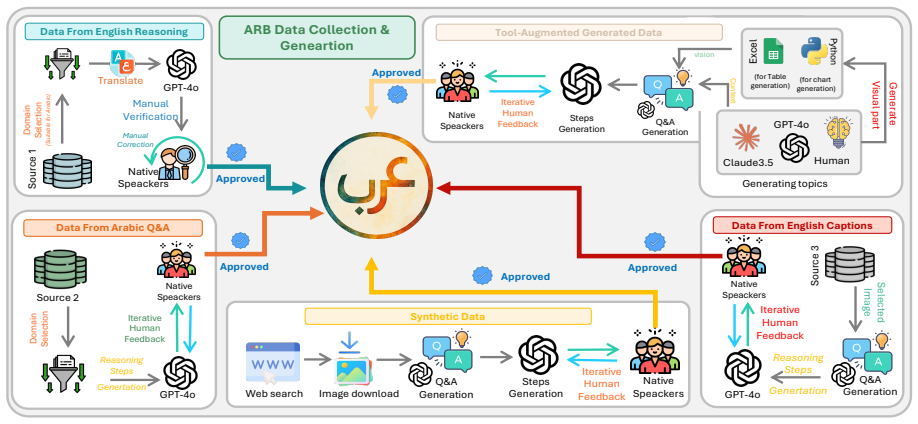
The carrying object is the step-action pair: each of the 1,356 ARB samples couples an image, an Arabic question, and a reference solution broken into explicit reasoning steps, each step bound to the action that executes it, so a model output can be matched against a reference chain rather than a single answer label. Around that structure the paper builds an Arabic ten-dimension rubric, scoring faithfulness at step and token level, informativeness, repetition, hallucination, redundancy, semantic coverage, reasoning alignment, commonsense, and missing steps, with GPT-4o acting as an LLM-as-judge on a 1–10 scale and inter-annotator agreement of 83.56% among humans and 87.62% once the judge model is included to show the rubric is stable. The reference chains themselves are generated through five sourcing categories (translated English reasoning data, Arabic QA benchmarks, caption-derived pairs, synthetic samples, and tool-augmented chart and table content) and pass native-speaker review, with over 200 samples discarded for cultural misalignment or shallow reasoning.
What would settle it
Independently reconstruct the reference chains: have native speakers solve each of the 1,356 questions from scratch, without seeing the model-generated drafts, and compare their chains to the published references; if a substantial fraction (for instance, more than 10%) of reference chains contain material errors, missing steps, or culturally wrong readings, then the step-quality scores and the reported reasoning-answer gap would have to be recomputed. A cheaper, domain-local check: recompute every arithmetic step in the Math & Logic and chart domains and count how often the reference chain's own numbers produce the stated final answer.
Extended reading notes
Core claim
ARB's central claim is that it is the first benchmark purpose-built to evaluate step-by-step reasoning in Arabic across textual and visual modalities, and that step-level evaluation shows current LMMs reasoning less reliably in Arabic than their final-answer or English-language performance suggests. The paper reports a consistent reasoning-answer gap: GPT-4.1 and o4-mini score above 80% on Arabic reasoning-step quality while answering only 58–60% of questions correctly, and open-weight models show the same pattern at lower levels (Qwen2.5-VL-7B at 64.03% steps versus 37.02% answers; Llama-3.2-11B at 25.58% answers). A controlled comparison of the same model on identical visual input finds correct, constraint-aware reasoning in English and flawed reasoning in Arabic, including miscounted elements and ignored structural constraints. The paper's conclusion is that Arabic, with its linguistic and cultural specificity, requires its own step-level, culturally grounded evaluation, and that coherent-looking Arabic reasoning cannot be trusted as evidence of correct reasoning.
Load-bearing premise
The load-bearing premise is that the 5,119 reference reasoning steps, drafted largely by GPT-4o and Claude and then reviewed by native speakers, are correct and complete enough to serve as ground truth for step-level scoring, and the paper's inter-annotator study covers only 5% of the dataset and rates model outputs, not the reference chains themselves.
Editorial extensions
If this is right
- Final-answer accuracy understates the problem: a model can score above 80% on Arabic step quality while answering only about 59% of questions correctly, so evaluations that skip the steps will misread model competence.
- The consistent gap between all models' reasoning scores and their final-answer accuracy means well-structured Arabic reasoning does not guarantee correct conclusions, so step-level scoring is needed to distinguish fluent chains from valid ones.
- Because the same model solves the same visual task correctly in English and wrongly in Arabic, English-language benchmark results should not be assumed to transfer to Arabic, and language-specific, culturally grounded evaluation is required.
- Domain breakdowns show the gap persists across task categories, with perceptual-heavy domains (complex visual perception, remote sensing) hardest and OCR and scientific reasoning relatively strongest, identifying where Arabic-specific training data is most needed.
- The released benchmark, rubric, and evaluation suite let other groups score new models against the same step-level reference chains, turning ARB into a reusable diagnostic rather than a one-off study.
Reading between the lines
- Editorial inference: because the reference chains were drafted mostly by GPT-4o and Claude and only reviewed, not independently reconstructed, by native speakers, the benchmark's step scores should be read with the caveat that hidden reference errors would inflate judged coherence; a cheap audit of the math and chart domains against independent recomputation would settle how much this matters.
- Editorial inference: the coherence-without-correctness pattern echoes behaviors observed in chain-of-thought research on English tasks, and ARB's contribution is to measure the same failure at larger scale in a language with different morphology and tokenization, which suggests testable extensions comparing Arabic- and English-prompted reasoning under identical step-level rubrics.
- Editorial inference: a natural next use of ARB is as training signal, for instance preference data for an Arabic-native model that rewards step-level faithfulness, in which case the reported reasoning-answer gap makes a specific prediction: step scores should improve before final-answer accuracy does.
- Editorial inference: the dataset's composition (41% math and logic, 24% charts and tables) means aggregate scores mostly reflect structured-reasoning domains, so conclusions about conversational, dialectal, or free-form Arabic would be an overreach, a limitation the paper itself acknowledges.
Editorial analysis
A structured set of objections, weighed in public.
Referee Report
Summary. The paper introduces ARB, a benchmark for step-by-step multimodal reasoning in Arabic, consisting of 1,356 image-question samples with 5,119 reference reasoning steps and actions across 11 domains. The construction pipeline combines translated English reasoning benchmarks, Arabic QA benchmarks, English caption-derived data, synthetic data, and tool-augmented chart/table data; all content is reported to pass native-speaker and domain-expert review. The paper evaluates 12 open- and closed-weight LMMs using final-answer accuracy, lexical and semantic similarity metrics, and a GPT-4o-based LLM-as-a-judge that scores model reasoning against the reference steps on a 1-10 multi-attribute rubric. The central reported finding is a consistent gap between high reasoning-step scores and lower final-answer accuracy, along with cross-lingual and domain-specific qualitative differences.
Significance. If the reference reasoning chains can be shown to be correct and complete, ARB would be the first step-level Arabic multimodal reasoning benchmark, filling a real gap in the evaluation of underrepresented languages. The release of the dataset, rubric, and evaluation suite is a concrete contribution, and the detailed pipeline description, the cross-lingual comparison in Figure 6, and the qualitative error analyses in Figures 17 and 18 are valuable diagnostic illustrations. However, the current evidence for reference-chain validity is narrower than the claims require, so the quantitative headline numbers should be treated as provisional pending additional validation.
major comments (3)
- [§3.2, Table 3] The ground-truth reasoning chains are the load-bearing component for every step-level score, but their correctness and completeness are not directly validated. The chains were generated mainly by GPT-4o and Claude (with GPT-4o for translation in Category 1, GPT-4o for most reasoning generation, and Claude-3.5 for table data), then reviewed by native speakers and domain experts. The only quantitative reliability evidence, Krippendorff's alpha over 5% of the dataset, rates model outputs on a 1-5 compatibility scale (Figure 8), not the correctness, necessity, or completeness of the reference chains themselves, and it does not use the 1-10 multi-attribute rubric applied by the actual judge (Figure 9). Consequently, every step-quality score and the reported reasoning-answer gap inherit any errors, omissions, or culturally misaligned assumptions in the references. Section 6 acknowledges reliance on human judgment and prompt-induced biases, but this limitation is not operationalized. Please add a direct human-validation study of the reference chains on a representative stratified sample, independent of the annotators involved in construction, and report agreement on step correctness and completeness.
- [§3.2, Table 3] The LLM-as-judge validation involves circularity pressure and a task mismatch. GPT-4o helped generate the reference steps and also serves as the judge scoring model outputs against those references; the reported 87.62% Krippendorff's alpha is obtained by including GPT-4o's judgments in the agreement calculation on a 5% sample rated with a different 1-5 scale. The paper does not report human-judge agreement on the actual 1-10 Arabic rubric, nor per-domain agreement, nor confidence intervals or significance tests for the final-answer and reasoning-step numbers in Table 3. Without this, it is difficult to know whether the differences between models, such as the 80.41% versus 61.02% reasoning-step scores for GPT-4.1 and GPT-4o-mini, are meaningful. Please report judge-human agreement on the real rubric on a stratified sample and provide confidence intervals or statistical tests for the headline comparisons.
- [Section 4, Figure 19] The claim of persistent challenges in cultural grounding rests heavily on domains that are small after the Math & Logic and CDT dominance. With 1,356 total samples and a 41% Math & Logic split and 24% CDT split, culturally rich domains such as Hist. (4%), Soc.Cult. (8%), and MED (4%) contain roughly 50-110 samples each. A small number of reference errors or evaluation-instability artifacts in these domains could drive the culture-related conclusions. The domain-level analyses in Figures 13-16 should report per-domain sample sizes, confidence intervals, and ideally per-domain judge reliability so the reader can assess how much weight to place on the domain-specific claims.
minor comments (6)
- [Table 4] The model name 'IntenVL3' in Table 4 should be 'InternVL3' to match the text and other tables.
- [Figure 21] The caption for Figure 21(b) contains the placeholder text '[describe the second figure]' and must be completed before publication.
- [§3.2, Table 3] Table 3 labels step scores as percentages ('Reasoning Steps (%)'), although the underlying judge scores are on a 1-10 scale; please clarify how the normalization and aggregation to percentages were performed.
- [§3.2, Table 4] The text reports LaBSE averages as '81.5%±2' and '71.5%±5', but Table 4 gives only point estimates; please include the variances or confidence intervals, or state the number of samples over which the intervals were computed.
- [Figures 13-16] The abbreviation 'Argo' in the domain abbreviations appears to be intended as 'Agro' for Agricultural Image Understanding; please harmonize the abbreviation across figures and the appendix table.
- [References] The reference for Anthropic lists the year as '20254'; this appears to be a typo and should be corrected to '2025'.
Circularity Check
No significant circularity: the benchmark construction and the reasoning-answer gap are grounded in independent measurements; minor self-citation and judge/reference overlap do not force the conclusions.
full rationale
ARB's central claims are the construction of a 1,356-sample Arabic multimodal reasoning benchmark and the empirical finding that LMMs show a reasoning-answer gap. Neither claim is circular by construction. The 5,119 reference steps are drafted by GPT-4o/Claude but then pass through native-speaker review, iterative human-in-the-loop feedback, and multi-stage filtering (Sections 2.2 and 2.3); the released references are not fitted to any evaluated model's outputs. Final-answer accuracy in Table 3 is computed independently of the LLM-as-judge step scores, and GPT-4o—the model that helped generate references and also serves as judge—finishes behind GPT-4.1 and o4-mini on reasoning-step quality, so the judge does not simply rank itself first. The evaluation prompt is adapted from the authors' own LlamaV-o1 suite (Thawakar et al., 2025), and data sources include CAMEL-Bench, TimeTravel, and VRC-Bench from the same research group; this is self-citation, but it is not load-bearing because the headline comparison tables and final-answer numbers are external to those citations. The strongest validity concern—that the reported 5% inter-annotator agreement study rates model outputs rather than validating every reference chain—is an evidence limitation, not a circular reduction: no benchmark score is defined in terms of the judge's own output, and no fitted parameter is renamed as a prediction. Accordingly, there is no equation-level or definitional circularity; the score reflects only the minor self-citation and the overlap between the reference-generation model and the judge.
Assumptions & free parameters
assumptions (4)
- domain assumption The 11-domain taxonomy and the actual 41% Math and Logic and 24% Charts, Diagrams, and Tables distribution are representative enough to support the claim of a comprehensive Arabic multimodal reasoning benchmark.
- ad hoc to paper GPT-4o and Claude generated reasoning chains that pass native-speaker review constitute correct and complete ground-truth reasoning steps.
- ad hoc to paper GPT-4o as an LLM-as-judge with Arabic prompts provides a valid proxy for human judgment of reasoning quality across all 11 domains.
- domain assumption Source benchmarks such as VRC-Bench, CAMEL-Bench, AgriCLIP, TimeTravel, and AI2D provide accurate visual content and questions for the new domains.
Cite this review
Pith. "Pith review of ARB: A Comprehensive Arabic Multimodal Reasoning Benchmark." pith.science (2026). https://pith.science/paper/XXKLVIGA
@misc{pith2026250517021,
  author       = {Pith},
  title        = {Pith review of: ARB: A Comprehensive Arabic Multimodal Reasoning Benchmark},
  year         = {2026},
  howpublished = {\url{https://pith.science/paper/XXKLVIGA}},
  note         = {Machine review of arXiv:2505.17021}
}
read the original abstract
As Large Multimodal Models (LMMs) become more capable, there is growing interest in evaluating their reasoning processes alongside their final outputs. However, most benchmarks remain focused on English, overlooking languages with rich linguistic and cultural contexts, such as Arabic. To address this gap, we introduce the Comprehensive Arabic Multimodal Reasoning Benchmark (ARB), the first benchmark designed to evaluate step-by-step reasoning in Arabic across both textual and visual modalities. ARB spans 11 diverse domains, including visual reasoning, document understanding, OCR, scientific analysis, and cultural interpretation. It comprises 1,356 multimodal samples paired with 5,119 human-curated reasoning steps and corresponding actions. We evaluated 12 state-of-the-art open- and closed-source LMMs and found persistent challenges in coherence, faithfulness, and cultural grounding. ARB offers a structured framework for diagnosing multimodal reasoning in underrepresented languages and marks a critical step toward inclusive, transparent, and culturally aware AI systems. We release the benchmark, rubric, and evaluation suit to support future research and reproducibility. Code available at: https://github.com/mbzuai-oryx/ARB
Figures


Figures from the paper (18 more)


Reference graph
Works this paper leans on
-
[1]
online" 'onlinestring :=
ENTRY address archivePrefix author booktitle chapter edition editor eid eprint eprinttype howpublished institution journal key month note number organization pages publisher school series title type volume year doi pubmed url lastchecked label extra.label sort.label short.list INTEGERS output.state before.all mid.sentence after.sentence after.block STRING...
-
[2]
write newline
" write newline "" before.all 'output.state := FUNCTION n.dashify 't := "" t empty not t #1 #1 substring "-" = t #1 #2 substring "--" = not "--" * t #2 global.max substring 't := t #1 #1 substring "-" = "-" * t #2 global.max substring 't := while if t #1 #1 substring * t #2 global.max substring 't := if while FUNCTION word.in bbl.in capitalize " " * FUNCT...
-
[3]
Fakhraddin Alwajih, Abdellah El Mekki, Samar Mohamed Magdy, Abdelrahim A Elmadany, Omer Nacar, El Moatez Billah Nagoudi, Reem Abdel-Salam, Hanin Atwany, Youssef Nafea, Abdulfattah Mohammed Yahya, et al. 2025. Palm: A culturally inclusive and linguistically diverse dataset for arabic llms. arXiv preprint arXiv:2503.00151
work page Pith review arXiv 2025
-
[4]
Fakhraddin Alwajih, El Moatez Billah Nagoudi, Gagan Bhatia, Abdelrahman Mohamed, and Muhammad Abdul-Mageed. 2024. Peacock: A family of arabic multimodal large language models and benchmarks. arXiv preprint arXiv:2403.01031
arXiv 2024
-
[5]
Anthropic . 20254. https://www.anthropic.com Claude . AI assistant
-
[6]
Ekaba Bisong and Ekaba Bisong. 2019. Matplotlib and seaborn. Building machine learning and deep learning models on google cloud platform: A comprehensive guide for beginners, pages 151--165
work page 2019
-
[7]
Yangyi Chen, Karan Sikka, Michael Cogswell, Heng Ji, and Ajay Divakaran. 2024 a . Measuring and improving chain-of-thought reasoning in vision-language models. In NAACL-HLT
work page 2024
-
[8]
Zhe Chen, Weiyun Wang, Yue Cao, Yangzhou Liu, Zhangwei Gao, Erfei Cui, Jinguo Zhu, Shenglong Ye, Hao Tian, Zhaoyang Liu, et al. 2024 b . Expanding performance boundaries of open-source multimodal models with model, data, and test-time scaling. arXiv preprint arXiv:2412.05271
arXiv 2024
Show all 56 references
-
[9]
Cohere-Labs. 2025. Aya vision 8b: A multilingual vision-language model. https://huggingface.co/CohereForAI/aya-vision-8b. Accessed: 2025-05-03
2025
-
[10]
Google DeepMind. 2024. Gemini 2.0 flash thinking: Unlocking transparent reasoning in ai. https://deepmind.google/technologies/gemini/flash-thinking/. Accessed: 2025-05-03
2024
-
[11]
Fangxiaoyu Feng, Yinfei Yang, Daniel Cer, Naveen Arivazhagan, and Wei Wang. 2020. Language-agnostic bert sentence embedding. arXiv preprint arXiv:2007.01852
2020 arXiv
-
[12]
Google Gemini Team. 2024. Gemini 1.5: Unlocking multimodal understanding across millions of tokens of context. https://arxiv.org/abs/2403.05530. Accessed: 2025-05-03
2024 arXiv
-
[13]
Sara Ghaboura, Ahmed Heakl, Omkar Thawakar, Ali Husain Salem Abdulla Alharthi, Ines Riahi, Abduljalil Saif, Jorma Laaksonen, Fahad Shahbaz Khan, Salman H Khan, and Rao Muhammad Anwer. 2025 a . Camel-bench: A comprehensive arabic lmm benchmark. NAACL
2025
-
[14]
Sara Ghaboura, Ketan More, Ritesh Thawkar, Wafa Alghallabi, Omkar Thawakar, Fahad Shahbaz Khan, Hisham Cholakkal, Salman Khan, and Rao Muhammad Anwer. 2025 b . Time travel: A comprehensive benchmark to evaluate lmms on historical and cultural artifacts. arXiv preprint arXiv:2502.14865
2025 arXiv
-
[15]
Olga Golovneva, Moya Chen, Spencer Poff, Martin Corredor, Luke Zettlemoyer, Maryam Fazel-Zarandi, and Asli Celikyilmaz. 2022. Roscoe: A suite of metrics for scoring step-by-step reasoning. arXiv preprint arXiv:2212.07919
2022 arXiv
-
[16]
Daya Guo, Dejian Yang, Haowei Zhang, Junxiao Song, Ruoyu Zhang, Runxin Xu, Qihao Zhu, Shirong Ma, Peiyi Wang, Xiao Bi, et al. 2025. Deepseek-r1: Incentivizing reasoning capability in llms via reinforcement learning. arXiv preprint arXiv:2501.12948
2025 arXiv
-
[17]
Ahmed Heakl, Sara Ghaboura, Omkar Thawkar, Fahad Shahbaz Khan, Hisham Cholakkal, Rao Muhammad Anwer, and Salman Khan. 2025. Ain: The arabic inclusive large multimodal model. arXiv preprint arXiv:2502.00094
2025 arXiv
-
[18]
Faris Hijazi, Somayah AlHarbi, Abdulaziz AlHussein, Harethah Abu Shairah, Reem AlZahrani, Hebah AlShamlan, Omar Knio, and George Turkiyyah. 2024. Arablegaleval: A multitask benchmark for assessing arabic legal knowledge in large language models. arXiv preprint arXiv:2408.07983
2024
-
[19]
Aaron Jaech, Adam Kalai, Adam Lerer, Adam Richardson, Ahmed El-Kishky, Aiden Low, Alec Helyar, Aleksander Madry, Alex Beutel, Alex Carney, et al. 2024. Openai o1 system card. arXiv preprint arXiv:2412.16720
2024 arXiv
-
[20]
Mingyu Jin, Qinkai Yu, Dong Shu, Haiyan Zhao, Wenyue Hua, Yanda Meng, Yongfeng Zhang, and Mengnan Du. 2024. The impact of reasoning step length on large language models. arXiv preprint arXiv:2401.04925
2024 arXiv
-
[21]
Karima Kadaoui, Hanin Atwany, Hamdan Al-Ali, Abdelrahman Mohamed, Ali Mekky, Sergei Tilga, Natalia Fedorova, Ekaterina Artemova, Hanan Aldarmaki, and Yova Kementchedjhieva. 2025. Jeem: Vision-language understanding in four arabic dialects. arXiv preprint arXiv:2503.21910
2025 arXiv
-
[22]
Aniruddha Kembhavi, Mike Salvato, Eric Kolve, Minjoon Seo, Hannaneh Hajishirzi, and Ali Farhadi. 2016. A diagram is worth a dozen images. In Computer Vision--ECCV 2016: 14th European Conference, Amsterdam, The Netherlands, October 11--14, 2016, Proceedings, Part IV 14, pages 2...
2016
-
[23]
Klaus Krippendorff. 2018. Content analysis: An introduction to its methodology. Sage publications
2018
-
[24]
Komal Kumar, Tajamul Ashraf, Omkar Thawakar, Rao Muhammad Anwer, Hisham Cholakkal, Mubarak Shah, Ming-Hsuan Yang, Phillip HS Torr, Fahad Shahbaz Khan, and Salman Khan. 2025. Llm post-training: A deep dive into reasoning large language models. arXiv preprint arXiv:2502.21321
2025 arXiv
-
[25]
Salima Lamsiyah, Kamyar Zeinalipour, Matthias Brust, Marco Maggini, Pascal Bouvry, Christoph Schommer, et al. 2025. Arabicsense: A benchmark for evaluating commonsense reasoning in arabic with large language models. In Proceedings of the 4th Workshop on Arabic Corpus Linguisti...
2025
-
[26]
Chin-Yew Lin. 2004. Rouge: A package for automatic evaluation of summaries. In Text summarization branches out, pages 74--81
2004
-
[27]
Meta-AI. 2024. Llama 3.2 11b vision instruct. https://huggingface.co/meta-llama/Llama-3.2-11B-Vision-Instruct. Accessed: 2025-05-03
2024
-
[28]
Meta-AI. 2025. Llama-4-scout-17b-16e-instruct. https://huggingface.co/meta-llama/Llama-4-Scout-17B-16E-Instruct. Accessed: 2025-05-03
2025
-
[29]
Kyle Moore, Jesse Roberts, Thao Pham, and Douglas Fisher. 2024. Reasoning beyond bias: A study on counterfactual prompting and chain of thought reasoning. arXiv preprint arXiv:2408.08651
2024 arXiv
-
[30]
Basel Mousi, Nadir Durrani, Fatema Ahmad, Md Arid Hasan, Maram Hasanain, Tameem Kabbani, Fahim Dalvi, Shammur Absar Chowdhury, and Firoj Alam. 2024. Aradice: Benchmarks for dialectal and cultural capabilities in llms. arXiv preprint arXiv:2409.11404
2024 arXiv
-
[31]
Ahmad Mustapha, Hadi Al-Khansa, Hadi Al-Mubasher, Aya Mourad, Ranam Hamoud, Hasan El-Husseini, Marwah Al-Sakkaf, and Mariette Awad. 2024. Arastem: A native arabic multiple choice question benchmark for evaluating llms knowledge in stem subjects. arXiv preprint arXiv:2501.00559
2024 arXiv
-
[32]
Umair Nawaz, Awais Muhammad, Hanan Gani, Muzammal Naseer, Fahad Shahbaz Khan, Salman Khan, and Rao Anwer. 2025. Agriclip: Adapting clip for agriculture and livestock via domain-specialized cross-model alignment. In Proceedings of the 31st International Conference on Computatio...
2025
-
[33]
OpenAI. 2024 a . https://openai.com/index/gpt-4o-mini-advancing-cost-efficient-intelligence/ Gpt-4o mini: Advancing cost-efficient intelligence . Accessed: 2025-05-03
2024
-
[34]
OpenAI. 2024 b . https://arxiv.org/abs/2410.21276 Gpt-4o system card . Preprint, arXiv:2410.21276
2024 arXiv
-
[35]
OpenAI. 2025 a . https://openai.com/index/gpt-4-1/ Introducing gpt-4.1 in the api . Accessed: 2025-05-03
2025
-
[36]
OpenAI. 2025 b . https://openai.com/index/o3-o4-mini-system-card/ Openai o3 and o4-mini system card . Accessed: 2025-05-03
2025
-
[37]
Kishore Papineni, Salim Roukos, Todd Ward, and Wei-Jing Zhu. 2002. Bleu: a method for automatic evaluation of machine translation. In Proceedings of the 40th annual meeting of the Association for Computational Linguistics, pages 311--318
2002
-
[38]
Pinterest. 2025. Pinterest platform. https://www.pinterest.com/
2025
-
[39]
Qwen-Team. 2025. https://qwenlm.github.io/blog/qwen2.5-vl/ Qwen2.5-vl . Accessed: 2025-05-03
2025
-
[40]
Leonardo Ranaldi and Andr \`e Freitas. 2024. Self-refine instruction-tuning for aligning reasoning in language models. arXiv preprint arXiv:2405.00402
2024 arXiv
-
[41]
Mohammed Al-Maghrabi Research. 2025. Allam-thinking: Arabic large language model with enhanced reasoning capabilities. https://huggingface.co/almaghrabima/ALLaM-Thinking
2025
-
[42]
Abdelrahman Sadallah, Junior Cedric Tonga, Khalid Almubarak, Saeed Almheiri, Farah Atif, Chatrine Qwaider, Karima Kadaoui, Sara Shatnawi, Yaser Alesh, and Fajri Koto. 2025. Commonsense reasoning in arab culture. arXiv preprint arXiv:2502.12788
2025 arXiv
-
[43]
Neha Sengupta, Sunil Kumar Sahu, Bokang Jia, Satheesh Katipomu, Haonan Li, Fajri Koto, William Marshall, Gurpreet Gosal, Cynthia Liu, Zhiming Chen, et al. 2023. Jais and jais-chat: Arabic-centric foundation and instruction-tuned open generative large language models. arXiv pre...
2023 arXiv
-
[44]
Hao Shao, Shengju Qian, Han Xiao, Guanglu Song, Zhuofan Zong, Letian Wang, Yu Liu, and Hongsheng Li. 2024. Visual cot: Advancing multi-modal language models with a comprehensive dataset and benchmark for chain-of-thought reasoning. Advances in Neural Information Processing Sys...
2024
-
[45]
Zhihong Shao, Yeyun Gong, Yelong Shen, Minlie Huang, Nan Duan, and Weizhu Chen. 2023. Synthetic prompting: generating chain-of-thought demonstrations for large language models. In Proceedings of the 40th International Conference on Machine Learning, pages 30706--30775
2023
-
[46]
Fanar Team, Ummar Abbas, Mohammad Shahmeer Ahmad, Firoj Alam, Enes Altinisik, Ehsannedin Asgari, Yazan Boshmaf, Sabri Boughorbel, Sanjay Chawla, Shammur Chowdhury, et al. 2025. Fanar: An arabic-centric multimodal generative ai platform. arXiv preprint arXiv:2501.13944
2025 arXiv
-
[47]
Omkar Thawakar, Dinura Dissanayake, Ketan More, Ritesh Thawkar, Ahmed Heakl, Noor Ahsan, Yuhao Li, Mohammed Zumri, Jean Lahoud, Rao Muhammad Anwer, et al. 2025. Llamav-o1: Rethinking step-by-step visual reasoning in llms. arXiv preprint arXiv:2501.06186
2025 arXiv
-
[48]
Emily Vaillancourt and Christopher Thompson. 2024. Instruction tuning on large language models to improve reasoning performance. Authorea Preprints
2024
-
[49]
Lei Wang, Wanyu Xu, Yihuai Lan, Zhiqiang Hu, Yunshi Lan, Roy Ka-Wei Lee, and Ee-Peng Lim. 2023. Plan-and-solve prompting: Improving zero-shot chain-of-thought reasoning by large language models. In Proceedings of the 61st Annual Meeting of the Association for Computational Lin...
2023
-
[50]
Xuezhi Wang, Jason Wei, Dale Schuurmans, Quoc Le, Ed Chi, Sharan Narang, Aakanksha Chowdhery, and Denny Zhou. 2022. Self-consistency improves chain of thought reasoning in language models. arXiv preprint arXiv:2203.11171
2022 arXiv
-
[51]
Jason Wei, Xuezhi Wang, Dale Schuurmans, Maarten Bosma, Fei Xia, Ed Chi, Quoc V Le, Denny Zhou, et al. 2022. Chain-of-thought prompting elicits reasoning in large language models. Advances in neural information processing systems, 35:24824--24837
2022
-
[52]
Guowei Xu, Peng Jin, Hao Li, Yibing Song, Lichao Sun, and Li Yuan. 2025. https://arxiv.org/abs/2411.10440 Llava-cot: Let vision language models reason step-by-step . Preprint, arXiv:2411.10440
2025 arXiv
-
[53]
Shunyu Yao, Dian Yu, Jeffrey Zhao, Izhak Shafran, Tom Griffiths, Yuan Cao, and Karthik Narasimhan. 2023. Tree of thoughts: Deliberate problem solving with large language models. Advances in neural information processing systems, 36:11809--11822
2023
-
[54]
Zheng-Xin Yong, M Farid Adilazuarda, Jonibek Mansurov, Ruochen Zhang, Niklas Muennighoff, Carsten Eickhoff, Genta Indra Winata, Julia Kreutzer, Stephen H Bach, and Alham Fikri Aji. 2025. Crosslingual reasoning through test-time scaling. arXiv preprint arXiv:2505.05408
2025 arXiv
-
[55]
Ruohong Zhang, Bowen Zhang, Yanghao Li, Haotian Zhang, Zhiqing Sun, Zhe Gan, Yinfei Yang, Ruoming Pang, and Yiming Yang. 2024. Improve vision language model chain-of-thought reasoning. arXiv preprint arXiv:2410.16198
2024 arXiv
-
[56]
Tianyi Zhang, Varsha Kishore, Felix Wu, Kilian Q Weinberger, and Yoav Artzi. 2019. Bertscore: Evaluating text generation with bert. arXiv preprint arXiv:1904.09675
2019 arXiv
Reviewed August 7, 2026 · model on record in the stance chip above.
Discussion (0). Sign in to comment.