REVIEW 2 major objections 6 minor 1 cited by
Boosting Binomial Exotic Option Pricing with Tensor Networks
T0 review · 2 major / 6 minor · reviewed 2026-08-15 · deepseek-v4-flash
Pith's one-line read This paper claims that binomial pricing of Asian and multi-asset American basket options can be compressed with tensor networks so the cost scales linearly in the number of time steps or assets instead of exponentially.
desk verdict TTCross parts are believable; the variational lower bound rests on an incorrect MPS tensor formula that is fixable but must be repaired before the claim is accepted. read the letter →
The pith
A machine-rendered reading of the paper's core claim, the machinery that carries it, and where it could break.
The reading
What carries the argument
The machinery has four pieces. First, the matrix product state (MPS) representation stores an $N$-variable tensor as a chain of local tensors with bond dimension $D$, so memory and contraction cost scale linearly in $N$. Second, the tensor-train cross (TTCross) interpolation builds an MPS from a small number of evaluations of the target function. Third, the variational Asian method uses a binary MPS ansatz whose left and right tensors are constrained so that contracting them yields binary unit vectors, leaving only the central tensor free and keeping the entire state binary. Fourth, the decoupled-trees transform converts $m$ correlated assets into $m$ independent binomial trees via a Cholesky decomposition, which factorizes the pricing recursion over assets. Together these convert exponential path or asset sums into linear-time contractions.
What would settle it
Contract the tensors in Eqs. (21)–(27) for $N=2$ and compare the result with the exact product of path probability and (average price minus strike) for each of the four binary price paths; any mismatch disproves the exact-representation premise, and then the variational price could be compared with brute force on small $N$ to see whether it ever exceeds the exact binomial price.
Extended reading notes
Core claim
On the paper's own terms, the central discovery is that the exponential sums defining binomial prices for Asian and multi-asset American basket options admit low-rank tensor approximations that can be built and contracted in time linear in the problem size. For Asian options, the product $p(x)v_A(x)$ is approximated by an MPS via tensor-train cross, and the price follows from contracting that MPS with vectors of ones. The variational method instead maximizes a binary-filtered cost function over a binary MPS ansatz, and the paper argues that the optimum equals the exact binomial price while providing a lower bound. For American baskets, the terminal payoff is learned as an MPS, after which backward induction with early exercise is interleaved with repeated tensor-train cross recompressions so the value stays in MPS format at every step.
Load-bearing premise
The variational lower-bound claim rests on the assertion that the product of path probability and the average-minus-strike function has exactly the tensor form displayed in Eqs. (21)–(27); if that representation is not exact for every price path, the proof that the variational result is a rigorous lower bound does not go through.
Editorial extensions
If this is right
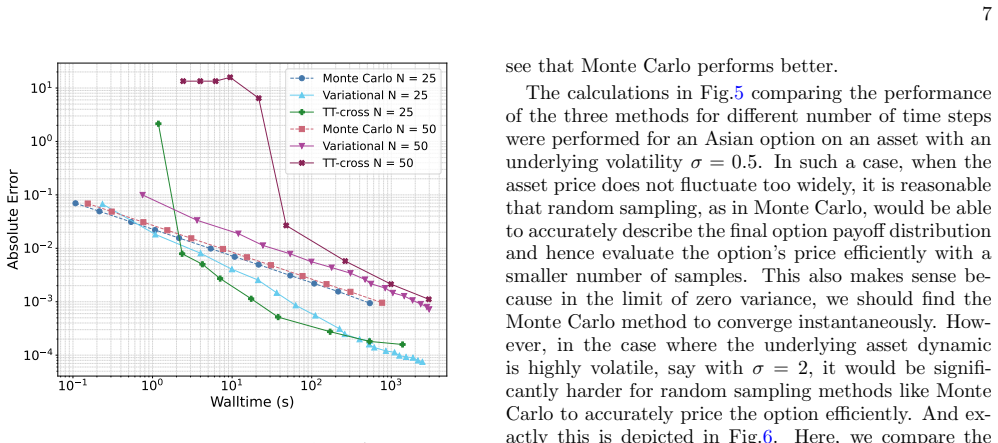
- For Asian options with smaller numbers of steps, the TTCross method reaches Monte Carlo accuracy at roughly 50–100 times less walltime in the reported tests.
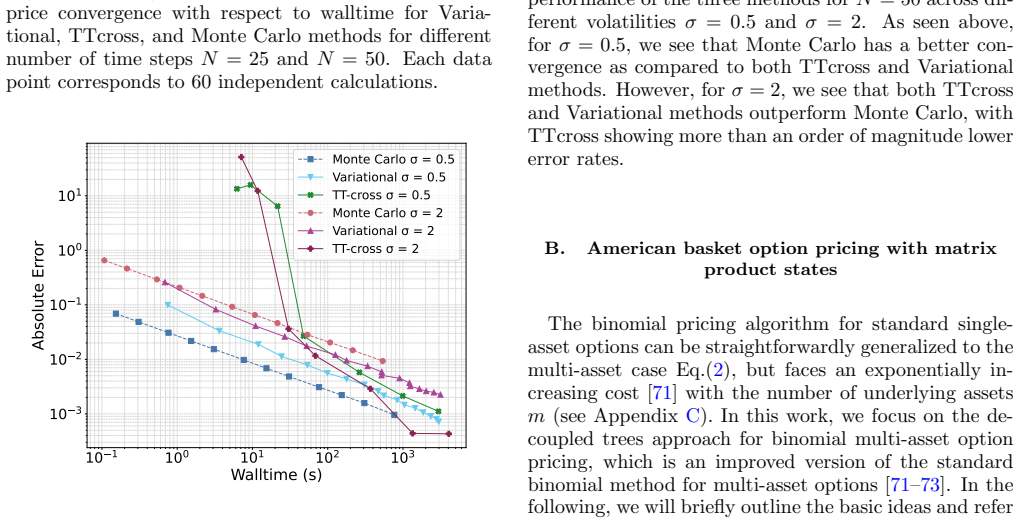
- At high volatility ($\sigma=2$) and $N=50$, both TTCross and variational MPS reduce the pricing error by more than an order of magnitude compared with Monte Carlo.
- The variational Asian method is constructed to return a price at or below the exact binomial value, a guaranteed one-sided error that Monte Carlo estimates do not provide.
- American basket options on $m=4$ and $m=8$ correlated assets converge rapidly and monotonically with bond dimension on an $N=40$ tree, with the $m=4$ case validated against brute force.
- The speed advantage is regime-dependent: at low volatility and larger $N$, Monte Carlo remains competitive, while tensor networks win at high volatility and smaller $N$.
Reading between the lines
- The constrained binary-MPS parametrization is a general device for restricting a tensor network to binary 0/1 values, so it could be transferred to discrete optimization problems with binary variables, such as portfolio selection or constraint satisfaction; the paper only demonstrates it on Asian payoffs.
- The TTCross-plus-backward-induction loop is not specific to basket payoffs; it should extend to Bermudan swaptions or barrier options, with the open question being how the required bond dimension grows with the frequency of early-exercise decisions.
- A direct check of the exact MPS representation for $N=2$ would settle whether the variational lower bound is rigorous as stated; if the check fails, the method might still converge from below numerically, but the proof would need to be amended.
Signed reviews
Editorial analysis
A structured set of objections, weighed in public.
Referee Report
Summary. The paper combines binomial-tree option pricing with matrix-product-state/tensor-train techniques. For arithmetic Asian options it proposes (i) a TTCross approximation of p(x)v_A(x) followed by a linear contraction, and (ii) a variational MPS method that maximizes an indicator-weighted sum over paths and claims to provide a rigorous lower bound. For multi-asset American basket options it combines decoupled trees with TTCross to approximate the early-exercise value at each backward step. Numerical experiments compare against Monte Carlo (up to 10^11 samples) and brute-force binomial prices for N up to 50 and baskets up to m=8, reporting faster convergence in low-N/high-volatility regimes. The central performance claims are linear scaling in N and m at fixed bond dimension and the 'stringent lower bound' property of the variational Asian method.
Significance. The TTCross results are a useful, if incremental, demonstration that low-rank tensor formats can reduce binomial exotic-pricing cost, and the numerical study is reasonably careful: prices are benchmarked against independent brute-force or large-sample Monte Carlo estimates, and each experiment is repeated multiple times. The paper is also honest about regime-dependent performance. If the variational lower-bound claim were established, it would be a distinctive selling point over Monte Carlo. As written, however, the claim rests on an unproven exact MPS representation that fails a two-step contraction check, so the main theoretical contribution is not yet supported. The paper would be publishable in revised form once the representation is corrected or the claim is appropriately weakened.
major comments (2)
- [Sec. IV.A.2, Eqs. (21)-(27)] The claimed exact MPS representation of p(x)tilde_v_A(x) is not exact as written. For N=2 and x=(0,0), Eqs. (13) and (18) give p(x)tilde_v_A(x) = (1-p_u)^2 [ S_0/2 (d+d^2) - K ]. Contracting the boundary tensors in Eqs. (24) and (26), with no interior tensors, gives B_1^0 B_2^0 = [S_0/2 d (1-p_u), S_0/2 d (1-p_u) - K] dot [d (1-p_u), 1-p_u]^T = S_0/2 d (1-p_u)^2 + S_0/2 d^2 (1-p_u)^2 - K(1-p_u). The strike term carries only one factor of (1-p_u) rather than the full path probability (1-p_u)^2. The same mis-weighting occurs for other binary strings. Because the cost K in Eq. (29) is evaluated by contracting the filter MPS with this tensor, the lower-bound statement in Eq. (30) and the finite-bond-dimension argument are unsupported. The authors should either provide a corrected exact MPS construction, with boundary tensors and a proof, or downgrade the claim to an approximation with controlled error.
- [Sec. IV.A.2, Eqs. (31)-(37) and Appendix B] The lower-bound interpretation also requires that every MPS produced by the greedy sweep is a feasible binary tensor satisfying Eq. (28). Appendix A shows that products of matrices whose rows (for L) or columns (for R) have at most one nonzero entry are binary, but the greedy row-merge and row-drop procedure in Appendix B is not proved to preserve that structural invariant at every iteration, and the 'logical OR' merge of filter entries is not defined in terms of the tensor elements constrained by Eqs. (33)-(34). Without a feasibility invariant, an optimized psi could take non-binary values and K could exceed the true option price, which would void the lower-bound claim even if Eq. (21) were corrected. Please add a formal feasibility proof for the greedy update, or restrict the claim to the feasible subset of the ansatz.
minor comments (6)
- [Eq. (24)] Equation (24) contains an unmatched square bracket in the second entry of the row vector; it should read [ S_0/N d(1-p_u), S_0/N d(1-p_u) - K ].
- [Appendix B, Eq. (B2)] The symbol A is overloaded: it denotes both the site tensor in Eq. (31) and the derivative matrix A = partial K / partial A in Eq. (B2). Please use distinct symbols.
- [Algorithm 1, line 9] The notation on line 9 is garbled: 'M[N],YN 1 M[N],Y1 N 2 ...' should be written consistently with Eq. (45), e.g. M_1^{[N],Y_N^1} M_2^{[N],Y_N^2} ... M_m^{[N],Y_N^m}.
- [Fig. 3 and surrounding text] The sentence 'Fig. 3 shows a higher convergence speed of the option price with the number of samples' lacks a comparison; it should say which method is being compared with which. Also, the y-axis is labeled 'Pricing Error' but the text says the standard deviation is used as a proxy for the error; the caption should state this explicitly.
- [Appendix D] The equation label (D5) is used twice, once for the outcome labeling and once for the transition-matrix definition; please renumber.
- [General] No code or data repository is provided, so the wall-clock comparisons in Figs. 3, 5, and 6 are not independently reproducible from the manuscript alone.
Circularity Check
No circularity: the pricing methods are validated against independent brute-force and Monte Carlo benchmarks, and the variational lower bound is a genuine subset-maximization bound.
full rationale
The paper's central derivations are self-contained. The TTcross Asian and basket methods approximate the payoff-weighted probability function or the payoff function with a tensor train cross approximation and benchmark against exact brute-force or Monte Carlo prices; no parameter is fitted to the target option price. The variational Asian method defines a binary filter psi, maximizes a cost K = e^{-rT} sum_x psi(x) p(x) tilde_v_A(x), and correctly observes that the unconstrained maximizer gives the exact price while an MPS-restricted binary ansatz can only reach a lower value, hence a rigorous lower bound. This is a standard variational argument, not a circular reduction. The exact MPS representation in Eq. (21) is asserted as a construction from the definitions of p(x) and tilde_v_A(x); if that representation is algebraically faulty, that is a technical correctness concern, not circularity, because the claim does not assume the target option price as an input. Self-citations to the authors' TensorNetwork package and prior tensor-network literature are tool citations and do not carry the load-bearing mathematical content. The numerical comparisons rely on independent Monte Carlo and brute-force references, so the reported benchmarks do not reduce to the paper's own fitted values.
Assumptions & free parameters
free parameters (1)
- MPS bond dimension D =
10 to 250 (chosen by hand)
assumptions (5)
- domain assumption Assets follow geometric Brownian motion with constant volatility and risk-neutral drift (Eq.2).
- standard math Binomial tree parameters (CRR/RB) converge to Black-Scholes as N increases.
- domain assumption The decoupled-trees transformation via Cholesky decomposition produces m independent binomial trees that correctly approximate the joint asset process (Eqs.38-42).
- ad hoc to paper The binary MPS parametrization in Eqs.(32)-(34) with the greedy compression in Appendix B produces feasible binary tensors and the sweep reaches a near-optimal objective.
- ad hoc to paper The exact MPS representation in Eqs.(21)-(27) equals p(x)tilde_v_A(x).
Cite this review
Pith. "Pith review of Boosting Binomial Exotic Option Pricing with Tensor Networks." pith.science (2026). https://pith.science/paper/KYRWW6JB
@misc{pith2026250517033,
  author       = {Pith},
  title        = {Pith review of: Boosting Binomial Exotic Option Pricing with Tensor Networks},
  year         = {2026},
  howpublished = {\url{https://pith.science/paper/KYRWW6JB}},
  note         = {Machine review of arXiv:2505.17033}
}
abstract
Pricing of exotic financial derivatives, such as Asian and multi-asset American basket options, poses significant challenges for standard numerical methods such as binomial trees or Monte Carlo methods. While the former often scales exponentially with the parameters of interest, the latter often requires expensive simulations to obtain sufficient statistical convergence. This work combines the binomial pricing method for options with tensor network techniques, specifically Matrix Product States (MPS), to overcome these challenges. Our proposed methods scale linearly with the parameters of interest and significantly reduce the computational complexity of pricing exotics compared to conventional methods. For Asian options, we present two methods: a tensor train cross approximation-based method for pricing, and a variational pricing method using MPS, which provides a stringent lower bound on option prices. For multi-asset American basket options, we combine the decoupled trees technique with the tensor train cross approximation to efficiently handle baskets of up to $m = 8$ correlated assets. All approaches scale linearly in the number of discretization steps $N$ for Asian options, and the number of assets $m$ for multi-asset options. Our numerical experiments underscore the high potential of tensor network methods as highly efficient simulation and optimization tools for financial engineering.
Figures


Figures from the paper (4 more)


Forward citations
Cited by 1 Pith paper
-
Conditional Deep Levy Models for Exotic Derivatives: History-Aware Path Generation and P-Q Payoff Diagnostics
The abstract presents a history-aware diffusion path generator and P-Q payoff diagnostic with reported CRPS improvements, but the body does not contain the corresponding method or results.
Reference graph
Works this paper leans on
-
[1]
Asian option pricing with TTcross For anN-period binomial model, the asset trajectories Stk can be represented as an N-bit binary string x = x1x2...x N with xk∈{ 0, 1}, i.e. ST (x) =S0ΠN k=1d1−xkuxk, (12) The probability of a path x, the average asset price⟨ST⟩ and payoff v(x) are given by p(x) = NY k=1 pxk u (1−pu)1−xk, ⟨ST (x)⟩ = S0 N NX i=1 iY k=1 d1−x...
-
[2]
d(1−pu) d(1−pu) 0 1 −pu # for 1<i<N (22) B1 i =
Variational approach for Asian option pricing The second method to price Asian options is based on a variational optimization approach. Consider the function ˜vA(x) obtained from dropping the max function in Eq.(5), ˜vA =⟨ST (x)⟩− K = S0 N NX i=1 iY k=1 d1−xkuxk−K (18) ˜vA(x)≤vA(x) ∀x. (19) From Eq.(19) it follows immediately that e−rTX x p(x)˜vA(x)≤e−rTX...
-
[3]
This formalism, although artificial, enables us to capture the correlation between assets using a single parameter. Additionally, this form also ensures that the correlation matrix is positive definite as required by the decoupling trees approach. A common risk-free interest rate of r = 0.1 was also used. 5 10 15 20 25 30 Bond Dimension 32 33 34 35 36Opti...
-
[4]
∀i. At any discrete time step k of the multi- dimensional tree, the original random variables Stk are given by Stk = exp(GYtk). (43) To reduce the burden on index notation, we will in the following use the abbreviation Yk≡ Ytk. The key quantity in the decoupling approach to multi- asset binomial option pricing is the payoff function at expiration tN =T of...
-
[5]
Buchen, An Introduction to Exotic Option Pricing (Chapman and Hall/CRC, 2012)
P. Buchen, An Introduction to Exotic Option Pricing (Chapman and Hall/CRC, 2012)
work page 2012
-
[6]
Hull, Options, Futures, and Other Derivatives Global Edition (Pearson Deutschland, 2021) p
J. Hull, Options, Futures, and Other Derivatives Global Edition (Pearson Deutschland, 2021) p. 880
work page 2021
-
[7]
F. Black and M. Scholes, The pricing of options and corporate liabilities, Journal of political economy 81, 637 (1973)
work page 1973
-
[8]
J. C. Cox, S. A. Ross, and M. Rubinstein, Option pricing: A simplified approach, Journal of financial Economics 7, 229 (1979)
work page 1979
Show all 80 references
-
[9]
R. J. Rendleman, Two-state option pricing, The Journal of Finance 34, 1093 (1979)
1979
-
[10]
Patel, C.-W
R. Patel, C.-W. Hsing, S. Sahin, S. S. Jahromi, S. Palmer, S. Sharma, C. Michel, V. Porte, M. Abid, S. Aubert, P. Castellani, C.-G. Lee, S. Mugel, and R. Orus, Quantum-inspired tensor neural networks for partial differential equations (2022)
2022
-
[11]
Ruf and W
J. Ruf and W. Wang, Neural networks for option pric- ing and hedging: A literature review, SSRN Electronic Journal 10.2139/ssrn.3486363 (2019)
2019 doi
-
[12]
K. Glau, D. Kressner, and F. Statti, Low-rank tensor approximation for chebyshev interpolation in parametric option pricing, SIAM Journal on Financial Mathematics 11, 897 (2020), https://doi.org/10.1137/19M1244172
2020 doi
-
[13]
Sakurai, H
R. Sakurai, H. Takahashi, and K. Miyamoto, Learn- ing fourier-based parametric option pricing with tensor trains, JSAI Technical Report, Type 2 SIG 2024, 213 (2024)
2024
-
[14]
Kobayashi, Y
N. Kobayashi, Y. Suimon, and K. Miyamoto, Time series generation for option pricing on quantum computers us- ing tensor network (2024), arXiv:2402.17148 [quant-ph]
2024 arXiv
-
[15]
Mugel, E
S. Mugel, E. Lizaso, and R. Orus, Use Cases of Quantum Optimization for Finance (2020), arXiv:2010.01312 [q- fin]
2020 arXiv
-
[16]
M. J. Kastoryano and N. Pancotti, A highly efficient tensor network algorithm for multi-asset fourier options pricing (2022)
2022
-
[17]
Cassel, Fast high-dimensional integration using tensor networks, Papers (arXiv.org, 2022)
S. Cassel, Fast high-dimensional integration using tensor networks, Papers (arXiv.org, 2022)
2022
-
[18]
Antonov and V
A. Antonov and V. Piterbarg, Alternatives to Deep Neu- ral Networks in Finance (2021)
2021
-
[19]
Y. L. Xu, G. G. Calvi, and D. P. Mandic, Tensor-Train Recurrent Neural Networks for Interpretable Multi-Way Financial Forecasting (2021), arXiv:2105.04983 [cs]
2021 arXiv
-
[20]
Verstraete, V
F. Verstraete, V. Murg, and J. Cirac, Matrix product states, projected entangled pair states, and variational renormalization group methods for quantum spin systems, Advances in Physics 57, 143 (2008), publisher: Taylor & Francis eprint: https://doi.org/10.1080/14789940801912366
2008 doi
-
[21]
Mugel, C
S. Mugel, C. Kuchkovsky, E. Sanchez, S. Fernandez- Lorenzo, J. Luis-Hita, E. Lizaso, and R. Orus, Dy- namic Portfolio Optimization with Real Datasets Us- ing Quantum Processors and Quantum-Inspired Tensor Networks, Physical Review Research 4, 013006 (2022), arXiv:2007.00017 [q...
2022 arXiv
-
[22]
R. G. Patel, C.-W. Hsing, S. Sahin, S. Palmer, S. S. Jahromi, S. Sharma, T. Dominguez, K. Tziritas, 11 C. Michel, V. Porte, M. Abid, S. Aubert, P. Castellani, S. Mugel, and R. Orus, Quantum-Inspired Tensor Neural Networks for Option Pricing (2022), arXiv:2212.14076 [quant-ph, q-fin]
2022 arXiv
-
[23]
R. G. Patel, T. Dominguez, M. Dib, S. Palmer, A. Cadarso, F. D. L. Contreras, A. Ratnani, F. G. Casanova, S. Hern´ andez-Santana, ´Alvaro D´ ıaz- Fern´ andez, E. Andr´ es, J. Luis-Hita, E. S´ anchez- Mart´ ınez, S. Mugel, and R. Orus, Application of tensor neural networks to p...
2024 arXiv
-
[24]
Perez-Garcia, F
D. Perez-Garcia, F. Verstraete, M. M. Wolf, and J. I. Cirac, Matrix Product State Representations, quant- ph/0608197 (2006), quantum Inf. Comput. 7, 401 (2007)
2006
-
[25]
R. Orus, A Practical Introduction to Tensor Net- works: Matrix Product States and Projected Entangled Pair States, arXiv:1306.2164 [cond-mat, physics:hep-lat, physics:hep-th, physics:quant-ph] (2013)
2013 arXiv
-
[26]
Schollwoeck, The density-matrix renormalization group in the age of matrix product states, Annals of Physics 326, 96 (2011), arXiv: 1008.3477
U. Schollwoeck, The density-matrix renormalization group in the age of matrix product states, Annals of Physics 326, 96 (2011), arXiv: 1008.3477
2011 arXiv
-
[27]
Evenbly and G
G. Evenbly and G. Vidal, Algorithms for entanglement renormalization, Physical Review B 79, 144108 (2009)
2009
-
[28]
G. K.-L. Chan, A. Keselman, N. Nakatani, Z. Li, and S. R. White, Matrix product operators, matrix prod- uct states, and ab initio density matrix renormalization group algorithms, The Journal of Chemical Physics 145, 014102 (2016)
2016
-
[29]
Evenbly, A Practical Guide to the Numerical Imple- mentation of Tensor Networks I: Contractions, Decom- positions and Gauge Freedom (2022), arXiv:2202.02138
G. Evenbly, A Practical Guide to the Numerical Imple- mentation of Tensor Networks I: Contractions, Decom- positions and Gauge Freedom (2022), arXiv:2202.02138
2022 arXiv
-
[30]
S. R. White, Density matrix formulation for quantum renormalization groups, Physical Review Letters 69, 2863 (1992)
1992
-
[31]
J. I. Cirac, D. P´ erez-Garc´ ıa, N. Schuch, and F. Ver- straete, Matrix product states and projected entangled pair states: Concepts, symmetries, theorems, Reviews of Modern Physics 93, 045003 (2021), publisher: American Physical Society
2021
-
[32]
K. G. Wilson, The renormalization group: Critical phe- nomena and the Kondo problem, Reviews of Modern Physics 47, 773 (1975)
1975
-
[33]
Affleck, T
I. Affleck, T. Kennedy, E. H. Lieb, and H. Tasaki, Rig- orous results on valence-bond ground states in antiferro- magnets, Physical Review Letters 59, 799 (1987)
1987
-
[34]
Rommer and S
S. Rommer and S. ¨Ostlund, Class of ansatz wave func- tions for one-dimensional spin systems and their rela- tion to the density matrix renormalization group, Phys- ical Review B 55, 2164 (1997), copyright (C) 2009 The American Physical Society; Please report any problems to p...
1997
-
[35]
J. R. ¨O. LEGEZA and B. A. HESS, Qc-dmrg study of the ionic-neutral curve crossing of lif, Molecular Physics 101, 2019 (2003)
2003
-
[36]
S. R. White, Density-matrix algorithms for quantum renormalization groups, Physical Review B 48, 10345 (1993), copyright (C) 2009 The American Physical Soci- ety; Please report any problems to prola@aps.org
1993
-
[37]
Verstraete and J
F. Verstraete and J. I. Cirac, Renormalization algo- rithms for Quantum-Many Body Systems in two and higher dimensions (2004), arXiv:cond-mat/0407066
2004 arXiv
-
[38]
Vidal, Entanglement Renormalization, Physical Review Letters 99, 10.1103/PhysRevLett.99.220405 (2007)
G. Vidal, Entanglement Renormalization, Physical Review Letters 99, 10.1103/PhysRevLett.99.220405 (2007)
2007 doi
-
[39]
Vidal, Class of Quantum Many-Body States That Can Be Efficiently Simulated, Physical Review Letters 101, 110501 (2008)
G. Vidal, Class of Quantum Many-Body States That Can Be Efficiently Simulated, Physical Review Letters 101, 110501 (2008)
2008
-
[40]
Ganahl, M
M. Ganahl, M. Aichhorn, H. G. Evertz, P. Thunstr¨ om, K. Held, and F. Verstraete, Efficient DMFT impurity solver using real-time dynamics with matrix product states, Physical Review B 92, 155132 (2015), publisher: American Physical Society
2015
-
[41]
S. R. White and R. L. Martin, Ab initio quantum chem- istry using the density matrix renormalization group, The Journal of Chemical Physics 110, 4127 (1999), pub- lisher: American Institute of Physics
1999
-
[42]
G. K.-L. Chan and S. Sharma, The Density Matrix Renormalization Group in Quantum Chemistry, Annual Review of Physical Chemistry 62, 465 (2011)
2011
-
[43]
D. J. Garc´ ıa, K. Hallberg, and M. J. Rozenberg, Dynam- ical Mean Field Theory with the Density Matrix Renor- malization Group, Physical Review Letters 93, 246403 (2004), publisher: American Physical Society
2004
-
[44]
Ganahl, P
M. Ganahl, P. Thunstr¨ om, F. Verstraete, K. Held, and H. G. Evertz, Chebyshev expansion for impurity mod- els using matrix product states, Physical Review B 90, 045144 (2014), publisher: American Physical Society
2014
-
[45]
Dolgov, K
S. Dolgov, K. Anaya-Izquierdo, C. Fox, and R. Scheichl, Approximation and sampling of multivariate probability distributions in the tensor train decomposition (2019), arXiv:1810.01212 [cs, math, stat]
2019 arXiv
-
[46]
Bauernfeind, M
D. Bauernfeind, M. Zingl, R. Triebl, M. Aichhorn, and H. G. Evertz, Fork Tensor-Product States: Efficient Mul- tiorbital Real-Time DMFT Solver, Physical Review X 7, 031013 (2017), publisher: American Physical Society
2017
-
[47]
Menczer, K
A. Menczer, K. Kap´ as, M. A. Werner, and O. Legeza, Two-dimensional quantum lattice models via mode opti- mized hybrid CPU-GPU density matrix renormalization group method, Physical Review B 109, 195148 (2024)
2024
-
[48]
F. A. Wolf, I. P. McCulloch, O. Parcollet, and U. Schollw¨ ock, Chebyshev matrix product state impu- rity solver for dynamical mean-field theory, Physical Re- view B 90, 115124 (2014), publisher: American Physical Society
2014
-
[49]
F. A. Wolf, I. P. McCulloch, and U. Schollw¨ ock, Solv- ing nonequilibrium dynamical mean-field theory using matrix product states, Physical Review B 90, 235131 (2014), publisher: American Physical Society
2014
-
[50]
The Monte Carlo sampling was performed by drawing Ns length-N random bit strings x = x1x2...x N from (a) p(x)vA(x) =A1 x1 A2 x2
The x-axis shows the elapsed walltime in seconds for both the TTcross and Monte Carlo methods, and they-axis shows the corresponding option pricing error. The Monte Carlo sampling was performed by drawing Ns length-N random bit strings x = x1x2...x N from (a) p(x)vA(x) =A1 x1 ...
-
[51]
Dolgov and D
S. Dolgov and D. Savostyanov, Parallel cross interpola- tion for high-precision calculation of high-dimensional integrals, Computer Physics Communications 246, 106869 (2020)
2020
-
[52]
Oseledets and E
I. Oseledets and E. Tyrtyshnikov, Tt-cross approxima- tion for multidimensional arrays, Linear Algebra and its Applications 432, 70 (2010)
2010
-
[53]
Glasser, R
I. Glasser, R. Sweke, N. Pancotti, J. Eisert, and J. I. Cirac, Expressive power of tensor-network factorizations for probabilistic modeling, in Proceedings of the 33rd In- ternational Conference on Neural Information Process- ing Systems , 134 (Curran Associates Inc., Red Hook...
2019
-
[54]
Glasser, N
I. Glasser, N. Pancotti, and J. I. Cirac, From Probabilis- tic Graphical Models to Generalized Tensor Networks 12 for Supervised Learning, IEEE Access 8, 68169 (2020), conference Name: IEEE Access
2020
-
[55]
Cichocki, N
A. Cichocki, N. Lee, I. Oseledets, A.-H. Phan, Q. Zhao, and D. P. Mandic, Tensor networks for dimensional- ity reduction and large-scale optimization: Part 1 low- rank tensor decompositions, Foundations and Trends ® in Machine Learning 9, 249–429 (2016)
2016
-
[56]
Cichocki, N
A. Cichocki, N. Lee, I. Oseledets, A.-H. Phan, Q. Zhao, M. Sugiyama, and D. P. Mandic, Tensor networks for dimensionality reduction and large-scale optimization: Part 2 applications and future perspectives, Foundations and Trends® in Machine Learning 9, 249–429 (2017)
2017
-
[57]
Goeßmann, M
A. Goeßmann, M. G¨ otte, I. Roth, R. Sweke, G. Kutyniok, and J. Eisert, Tensor network ap- proaches for learning non-linear dynamical laws (2020), arXiv:2002.12388 [quant-ph, stat]
2020 arXiv
-
[58]
A. M. Ali, A. M. F. d. Leceta, and J. L. Rubio, Anomaly Detection from a Tensor Train Perspective (2024), arXiv:2409.15030
2024 arXiv
-
[59]
J. Wang, C. Roberts, G. Vidal, and S. Leichenauer, Anomaly Detection with Tensor Networks (2020), arXiv:2006.02516 [quant-ph, stat]
2020 arXiv
-
[60]
E. M. Stoudenmire, Learning Relevant Features of Data with Multi-scale Tensor Networks, Quantum Science and Technology 3, 034003 (2018), arXiv:1801.00315 [cond- mat, stat]
2018 arXiv
-
[61]
W. Wang, V. Aggarwal, and S. Aeron, Principal Com- ponent Analysis with Tensor Train Subspace (2018), arXiv:1803.05026 [cs, math]
2018 arXiv
-
[62]
S. Lu, M. Kan´ asz-Nagy, I. Kukuljan, and J. I. Cirac, Ten- sor networks and efficient descriptions of classical data (2021), arXiv:2103.06872
2021 arXiv
-
[63]
J. Liu, S. Li, J. Zhang, and P. Zhang, Tensor net- works for unsupervised machine learning, Physical Re- view E 107, L012103 (2023), arXiv:2106.12974 [cond- mat, physics:quant-ph, stat]
2023 arXiv
-
[64]
Konstantinidis, Y
K. Konstantinidis, Y. L. Xu, D. P. Mandic, Q. Zhao, and T. L. Team, Bayesian tensor networks with structured posteriors, in the Second Workshop on Quantum Ten- sor Networks in Machine Learning, 35th Conference on Neural Information Processing Systems (NIPS) (2021) p. 22
2021
-
[65]
Kirstein, D
M. Kirstein, D. Sommer, and M. Eigel, Tensor-train ker- nel learning for gaussian processes, in Proceedings of the Eleventh Symposium on Conformal and Probabilis- tic Prediction with Applications, Proceedings of Machine Learning Research, Vol. 179, edited by U. Johansson, H. B...
2022
-
[66]
Izmailov, A
P. Izmailov, A. Novikov, and D. Kropotov, Scalable Gaussian Processes with Billions of Inducing Inputs via Tensor Train Decomposition (2018), arXiv:1710.07324 [cs, stat]
2018 arXiv
-
[67]
Z.-Y. Han, J. Wang, H. Fan, L. Wang, and P. Zhang, Un- supervised Generative Modeling Using Matrix Product States, Physical Review X 8, 031012 (2018), publisher: American Physical Society
2018
-
[68]
Y. Peng, Y. Chen, E. M. Stoudenmire, and Y. Khoo, Generative Modeling via Hierarchical Tensor Sketching (2023), arXiv:2304.05305
2023
-
[69]
Strashko and E
A. Strashko and E. M. Stoudenmire, Generalization and Overfitting in Matrix Product State Machine Learning Architectures (2022), arXiv:2208.04372
2022 arXiv
-
[70]
Jasra and P
A. Jasra and P. Del Moral, Sequential monte carlo meth- ods for option pricing, Stochastic Analysis and Applica- tions 29, 292–316 (2011)
2011
-
[71]
D. J. Duffy, Finite Difference Methods in Financial Engi- neering: A Partial Differential Equation Approach (Wi- ley, 2006)
2006
-
[72]
Bouchard and X
B. Bouchard and X. Warin, Monte-carlo valuation of american options: Facts and new algorithms to im- prove existing methods, in Numerical Methods in Fi- nance (Springer Berlin Heidelberg, 2012) p. 215–255
2012
-
[73]
J. C. Bridgeman and C. T. Chubb, Hand-waving and in- terpretive dance: an introductory course on tensor net- works, Journal of Physics A: Mathematical and Theo- retical 50, 223001 (2017)
2017
-
[74]
Steinlechner, Riemannian Optimization for High- Dimensional Tensor Completion, SIAM Journal on Sci- entific Computing 38, S461 (2016)
M. Steinlechner, Riemannian Optimization for High- Dimensional Tensor Completion, SIAM Journal on Sci- entific Computing 38, S461 (2016)
2016
-
[75]
Roberts, A
C. Roberts, A. Milsted, M. Ganahl, A. Zalcman, B. Fontaine, Y. Zou, J. D. Hidary, G. Vidal, and S. Le- ichenauer, Tensornetwork: A library for physics and ma- chine learning, ArXiv abs/1905.01330 (2019)
2019 arXiv
-
[76]
M¨ uller, The binomial approach to option valuation: Getting binomial trees into shape (2009)
S. M¨ uller, The binomial approach to option valuation: Getting binomial trees into shape (2009)
2009
-
[77]
Korn and S
R. Korn and S. M¨ uller, The decoupling approach to bino- mial pricing of multi-asset options, The Journal of Com- putational Finance 12, 1 (2009)
2009
-
[78]
Korn and S
R. Korn and S. M¨ uller, Getting multi-dimensional trees into a new shape, Wilmott Journal 1, 145 (2009), https://onlinelibrary.wiley.com/doi/pdf/10.1002/wilj.12
2009 doi
-
[79]
Ito, Stochastic integral (1944)
K. Ito, Stochastic integral (1944)
1944
-
[80]
Jacobs, Stochastic Processes for Physicists: Under- standing Noisy Systems (Cambridge University Press, 2010)
K. Jacobs, Stochastic Processes for Physicists: Under- standing Noisy Systems (Cambridge University Press, 2010). 13 Appendix A: Explanation on the binary nature of L and R tensors As stated in Eq.(32), ψx1...xN =Lx1 1 ...L xc−1 c−1 Axc c Rxc+1 c+1 ...R xN N , the tensors Lxk ...
2010
Reviewed August 15, 2026 · model on record in the stance chip above.
Discussion (0). Continue with ORCID to comment.