REVIEW 4 major objections 5 minor 10 references
Prompt Engineering: How Prompt Vocabulary affects Domain Knowledge
T0 review · 4 major / 5 minor · reviewed 2026-08-15 · deepseek-v4-flash
Pith's one-line read The paper claims that LLM performance peaks inside a mid-range of prompt vocabulary specificity, not at maximum specificity.
desk verdict The paper's real finding is a null/negative controlled result about prompt specificity; its headline 'optimal specificity range' is a post-hoc descriptive artifact, not a tested design rule. read the letter →
The pith
A machine-rendered reading of the paper's core claim, the machinery that carries it, and where it could break.
The reading
What carries the argument
The load-bearing mechanism is a five-step synonymization pipeline: part-of-speech tagging, word sense disambiguation (performed by Llama-3.1-70B-Instruct, measured at 0.79 accuracy), crawling of synonyms through WordNet hypernym and hyponym relations, assignment of continuous specificity scores, and replacement of words at 33, 67, and 100 percent rates. For nouns and verbs, specificity is computed as distance from the taxonomy root plus a normalized hyponym count minus a sense-count penalty; for adjectives, a new fractional measure is introduced based on counts of similar words, synonyms, antonyms, and senses. These scores convert coarse low/intermediate/high categories into a continuous prompt-level specificity value, which is what lets the paper locate the performance peaks as specific numerical bands.
What would settle it
Take the same prompts, correct the word senses by hand before synonymizing, and re-measure the accuracy-versus-specificity curves: if the reported optimal bands for nouns and verbs shift or disappear, the ranges were artifacts of sense errors rather than effects of specificity. A quicker check is to tabulate the disambiguation error rate per specificity category (low, intermediate, high) across the three datasets.
Extended reading notes
Core claim
Prompt specificity has a non-monotonic effect on LLM performance: for nouns and verbs there is an optimal specificity interval, shared across four differently sized and differently trained models, within which question-answering and reasoning accuracy peaks, with performance degrading or plateauing outside it. The claim is supported by a stepwise synonymization of sampled instructions, where prompts are assigned continuous specificity scores and correlated with accuracy. Beyond the optimal range, raising noun specificity leaves performance largely unchanged, while raising verb specificity in the reasoning benchmark (GSM8K) yields strong negative correlations, for example -0.89 for Llama-3.1-70B-Instruct and -0.87 for Mistral-Large 2. Only 5 of 24 model-dataset evaluations reach statistical significance, so the paper's headline negative result is concentrated in verbs on reasoning tasks; the paper presents the optimal band as the actionable discovery, correcting the intuition that maximally specific expert wording is always best.
Load-bearing premise
The pipeline assumes that the 21 percent of word senses the disambiguation step gets wrong only add random noise and do not systematically push wrong-sense synonyms into particular specificity categories.
Editorial extensions
If this is right
- Prompt designers in specialized domains should target the mid-specificity band instead of maximizing term precision, since over-specific nouns do not help and over-specific verbs measurably degrade reasoning.
- The optimal band's consistency across four models of different families and sizes suggests a shared property of how LLMs process prompt wording rather than a quirk of any single model.
- Verb specificity is the more consequential lever: the significant negative correlations concentrate in verbs on the chain-of-thought math task, implying that rewording actions and relations disrupts stepwise reasoning more than rewording entities.
- The WordNet-based specificity score offers a cheap, parameter-free diagnostic that could complement existing prompt-sensitivity methods in deciding when a prompt rewrite is worth testing.
Reading between the lines
- A natural testable extension is variance: within the optimal band, model outputs may be more stable across seeds and paraphrases; if the band is where performance peaks and jitter drops, it becomes a genuine operating point rather than a statistical artifact.
- The adjective-specificity equation, validated only in passing (median Spearman 0.50 against an LLM judge), may be the most portable piece: it could be tested on sentiment or concreteness benchmarks where adjectives carry the semantics, and if it survives there it becomes a general lexical tool.
- Because the noun optimum (about 17.7 to 19.7) sits below the corpus mean specificity (21.37) while verbs cluster near their own mean, the band may track the lexical density of pretraining text; that predicts the band shifts for other languages or heavily technical corpora.
- Read together with the mostly flat noun results, the findings suggest specificity is a cost curve with a flat middle: a prompt-selection heuristic that holds specificity inside the band while minimizing verb perturbation could be evaluated on held-out benchmarks as a practical optimization rule.
Signed reviews
Editorial analysis
A structured set of objections, weighed in public.
Referee Report
Summary. The paper develops a synonymization framework that replaces nouns, verbs, and adjectives in domain-specific prompts with synonyms of varying WordNet-based specificity, at replacement ratios of 33%, 67%, and 100%. It evaluates four LLMs (Llama-3.1-70B-Instruct, Granite-13B-Instruct-V2, Flan-T5-XL, and Mistral-Large 2) on MMLU, GPQA, and GSM8K tasks. The main reported findings are that increasing prompt specificity generally has little or negative impact on accuracy, and that there exists an 'optimal specificity range' (noun specificity roughly 17.7–19.7, verb specificity roughly 8.1–10.6) within which LLMs perform best. The paper also introduces an adjective-specificity measure and presents a GPT-4o-based validation of that measure.
Significance. If the optimal-range claim were supported, it would provide a practical, actionable rule for prompt design. The controlled manipulation experiments are a useful negative result: they suggest that blanket increases in specificity do not help and can hurt, especially for verbs in reasoning tasks. The framework is transparent, spans four models and three task formats, and includes a WSD validation step; this is a solid basis for follow-up work. However, the central design rule is not supported by the controlled experiments as reported, and the current evidence supports only a descriptive, exploratory statement about where correct answers concentrate on original prompts.
major comments (4)
- [Section 4, Q3; Fig. 10; Table 8] The claimed optimal specificity range is derived entirely from original, unmodified prompts, not from the specificity-manipulation experiments. The histograms in Fig. 10 are marginal associations: original questions with higher specificity may differ in domain, topic, or difficulty, so the concentration of correct answers near a given specificity value is confounded. The abstract's design rule ('manipulating prompts within this range could maximize LLM performance') would require a prospective test in which prompts are independently varied to fall inside versus outside the range; no such test is presented. At minimum, the claim should be reframed as an exploratory hypothesis, not a design rule.
- [Tables 8 and 9] The numeric 'optimal ranges' in Table 8 appear to be the minimum-to-maximum span of the nine prompt-specificity values produced by the synonymization grid in Table 9, not performance peaks estimated from accuracy. Table 9 reports specificity values per replacement ratio and specificity level but does not report any accuracy associated with those values, and its caption calls them 'Optimal Specificities' without a performance criterion. The abstract's 17.7–19.7 noun range mixes the Q1 KDE boundary (17.74) with one model's median (19.70), and Fig. 10's histogram modes are yet another set of numbers; the paper should specify exactly which statistic defines the optimal range and justify why that statistic identifies an optimum.
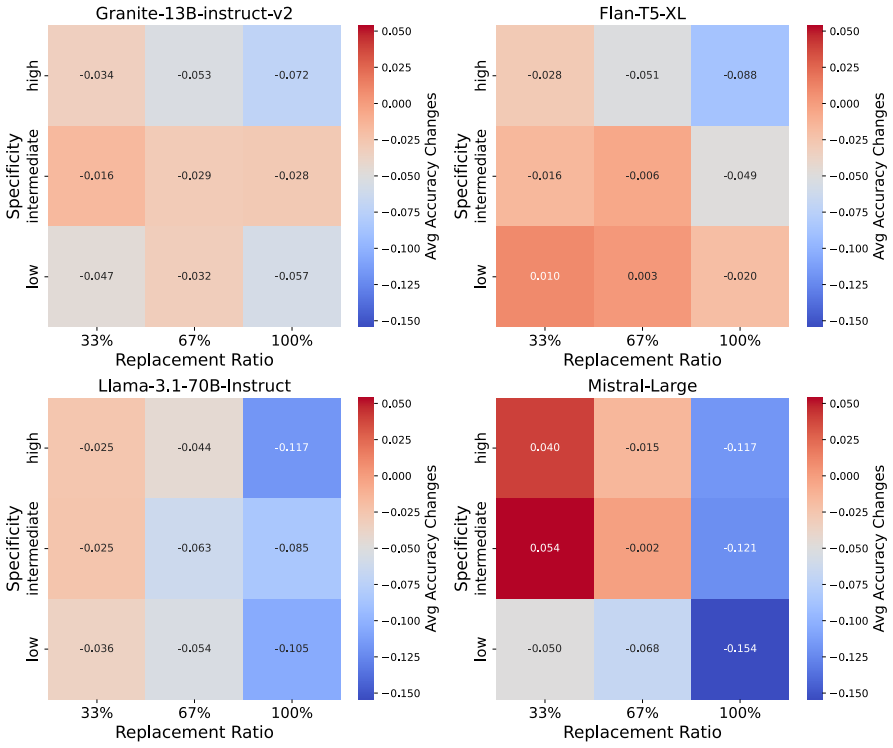
- [Section 4, Q2; Table 7; Figs. 8–9] The controlled manipulation experiments directly undercut the optimal-range claim. Table 7 shows that only 5 of 24 correlations are significant, and the significant correlations are negative, e.g., verb specificity in GSM8K for Llama-3.1-70B-Instruct (rho = -0.89, p = 5.4e-4) and Mistral-Large 2 (rho = -0.87, p = 0.001). No condition in the controlled experiments shows an interior performance peak inside the claimed optimal ranges. If the optimal-range claim is to be retained, the authors must explain why the controlled manipulation does not produce the predicted non-monotonic pattern, or they must soften the conclusion to a descriptive observation about original prompts.
- [Section 6 and Section 3.3] The WSD accuracy of 0.79 means that roughly one in five synonym choices may use the wrong sense, and the paper assumes this adds only noise. That assumption is load-bearing for Q2: if misidentified senses concentrate in particular specificity categories, the observed accuracy differences could reflect semantic corruption rather than specificity per se. The limitation is acknowledged in Section 6, but the manuscript should provide a sensitivity analysis, for instance by re-running the key correlations on a human-verified subset of synonym substitutions, before the null effect for nouns and the negative effect for verbs can be attributed to specificity.
minor comments (5)
- [Section 4, Q1] The text says 'Since all p-values are smaller than 0.05, we cannot reject the null hypothesis and therefore the distributions cannot be considered as normal distributions.' This is backwards: a p-value below 0.05 leads to rejection of the null hypothesis of normality, which is the intended conclusion. The wording should be corrected.
- [Section 2, Q2 (categorical approach)] The phrase 'precentral changes in accuracy' appears to be a typo; it should read 'percentage changes in accuracy'.
- [Section 3.1; Table 1] The dataset name 'MMMUL' appears once in Table 1; this should be 'MMLU'.
- [Figure 10 and Table 8] Figure 10's dashed line is described as marking 'the prompt specificity associated with the highest number of correct answers,' but Table 8 reports medians. The paper should clarify whether the optimal specificity is defined by the histogram mode, the median, or some other statistic, and use that definition consistently.
- [Section 3.3, adjective specificity] The adjective specificity equation is based on four equal-weight additive assumptions, and the GPT-4o validation reports a median Spearman correlation of 0.50 with 32 of 91 negative correlations. The paper should state more explicitly that this is a preliminary measure, and that the small adjective sample sizes (e.g., 4 GSM8K samples) preclude any conclusions about adjective effects on performance.
Circularity Check
The claimed 'optimal specificity range' is constructed from the experimental grid: Table 8 is the min/median/max of the nine prompt-specificity inputs in Table 9, renamed as a performance finding.
-
fitted input called prediction
[Section 4, Q3 Answer (Tables 8 and 9)]
"We apply this approach to the modified instructions, examining each replacement level, specificity level, model, and dataset combination. The resulting prompt specificities for each parameter combination are displayed in Appendix B, Tab. 9. ... Based on this assessment, we derive the ranges of optimal prompt specificity for each model and part of speech, displayed in Tab. 8, where the LLM achieves the highest performance across all datasets."
Table 8's Lower/Upper/Median values are exactly the minimum, median, and maximum of the nine prompt-specificity values in Table 9 ('All' rows), which are the independent-variable settings produced by the synonymization grid. For example, Granite-13b nouns: Table 8 gives 17.24 / 22.00 / 18.95, matching Table 9's All rows Low-33% = 17.23, High-100% = 22.00, and High-33% = 18.95 (the median of the nine values). The grid was deliberately built to span low-to-high specificity (Section 3.1, steps IV-V), so the 'optimal range' is just the range of the manipulated input values. Calling it 'where the LLM achieves the highest performance' renames the experimental design as an empirical discovery; no performance metric enters Table 9 or the construction of Table 8.
-
self definitional
[Section 4, Q3 (Figure 10 analysis)]
"In each histogram, the x-axis represents the prompt specificity for the respective part of speech, while the y-axis indicates the count of correct answers. A dashed line marks the prompt specificity associated with the highest number of correct answers for each model. ... From these observations, we can infer that for the original, unmodified samples, a moderate level of specificity improves model performance."
The 'optimal' specificity is defined as the bin with the highest count of correct answers, i.e., the mode of the correct-answer distribution. Inferring that 'a moderate level of specificity improves model performance' from the location of that mode restates the definition: every histogram has a mode, and labeling the mode as 'optimal' adds no independent performance comparison. The controlled manipulation (Q2, Table 7) mostly showed null or negative effects, so the Q3 marginal histogram mode cannot support the causal design rule; it is a descriptive summary of the original-prompt data by construction.
full rationale
The paper's negative verb-specificity correlations (Table 7) are genuine empirical findings from controlled synonym manipulation, and the adjective-specificity measure is benchmarked against GPT-4o, so those parts are not circular. The WSD pipeline cites prior work from the same research group (Wahle et al., 2021), but it is benchmarked in Table 3 and is not the load-bearing step for the central claim. The central design rule, however, is circular in its construction: the 'optimal specificity ranges' in Table 8 are the min/median/max of the prompt-specificity grid in Table 9 — i.e., the range of the experimental inputs — rather than any performance-derived optimum. The Q3 histogram analysis used only original, unmodified prompts, so the 'optimal' range is the mode of the correct-answer distribution, a tautological label rather than a prospective test. The abstract's 17.7–19.7 range mixes the Q1 KDE boundary (17.74) with one model's median (19.70), further indicating that the claimed range was assembled from the framework's own inputs rather than from a performance peak. Overall, the central 'optimal specificity range' reduces by construction to the experimental grid and the histogram mode, warranting a partial circularity score of 6.
Assumptions & free parameters
free parameters (3)
- Noun specificity category boundaries =
low-intermediate: 17.74; intermediate-high: 20.90
- Verb specificity category boundaries =
low-intermediate: 11.17; intermediate-high: 13.74
- Adjective specificity weights (ssw, s, a, l) =
1, 1, 1, 1
assumptions (5)
- domain assumption WordNet hypernym/hyponym depth and hyponym counts are valid proxies for semantic specificity.
- domain assumption The 21% WSD misclassification rate (accuracy 0.79) adds only noise and does not systematically bias specificity comparisons.
- ad hoc to paper Adjective specificity is inversely proportional to ssw, s, a, and l, with equal weights and additive combination.
- ad hoc to paper The mode of the correct-answer distribution on original prompts identifies a causal optimal specificity range.
- domain assumption Substituting a same-sense synonym preserves the task meaning and difficulty of the prompt.
Cite this review
Pith. "Pith review of Prompt Engineering: How Prompt Vocabulary affects Domain Knowledge." pith.science (2026). https://pith.science/paper/Y3DBRITT
@misc{pith2026250517037,
  author       = {Pith},
  title        = {Pith review of: Prompt Engineering: How Prompt Vocabulary affects Domain Knowledge},
  year         = {2026},
  howpublished = {\url{https://pith.science/paper/Y3DBRITT}},
  note         = {Machine review of arXiv:2505.17037}
}
read the original abstract
Prompt engineering has emerged as a critical component in optimizing large language models (LLMs) for domain-specific tasks. However, the role of prompt specificity, especially in domains like STEM (physics, chemistry, biology, computer science and mathematics), medicine, and law, remains underexplored. This thesis addresses the problem of whether increasing the specificity of vocabulary in prompts improves LLM performance in domain-specific question-answering and reasoning tasks. We developed a synonymization framework to systematically substitute nouns, verbs, and adjectives with varying specificity levels, measuring the impact on four LLMs: Llama-3.1-70B-Instruct, Granite-13B-Instruct-V2, Flan-T5-XL, and Mistral-Large 2, across datasets in STEM, law, and medicine. Our results reveal that while generally increasing the specificity of prompts does not have a significant impact, there appears to be a specificity range, across all considered models, where the LLM performs the best. Identifying this optimal specificity range offers a key insight for prompt design, suggesting that manipulating prompts within this range could maximize LLM performance and lead to more efficient applications in specialized domains.
Figures


Figures from the paper (24 more)




Reference graph
Works this paper leans on
-
[1]
Ang, L. and K. Tan (2018). “Specificity in En- glish for Academic Purposes (EAP): A Corpus Analysis of Lexical Bundles in Academic Writ- ing”. In: 24, pp. 82–94. doi: 10.17576/3L- 2018-2402-07. Bach, Stephen H. et al. (Mar. 2022). Prompt- Source: An Integrated Development Environ- ment and Repository for Natural Language Prompts. arXiv: 2202.01279 [cs]. B...
arXiv 2018
-
[5]
Kaplan, Jared et al. (2020). Scaling Laws for Neural Language Models . arXiv: 2001.08361 [cs.LG]. url: https : / / arxiv . org / abs / 2001.08361. Kojima, Takeshi et al. (2023). Large Language Models are Zero-Shot Reasoners. arXiv:
arXiv 2020
-
[7]
Direct Prefer- ence Optimization: Your Language Model is Secretly a Reward Model
6, pp. 380–384. Ouyang, Long et al. (Mar. 4, 2022).Training Lan- guage Models to Follow Instructions with Hu- man Feedback. doi: 10.48550/arXiv.2203. 02155. arXiv: 2203.02155 [cs] . url: http: //arxiv.org/abs/2203.02155. preprint. Petrov, Slav, Dipanjan Das, and Ryan McDonald (2011). A Universal Part-of-Speech Tagset . arXiv: 1104 . 2086 [cs.CL]. url: htt...
-
[36]
An Information- theoretic Approach to Prompt Engineering Without Ground Truth Labels
Curran Associates, Inc., pp. 53728–53741. url: https : / / proceedings . neurips . cc / paper _ files / paper / 2023 / file / a85b405ed65c6477a4fe8302b5e06ce7 - Paper-Conference.pdf. Rawte, Vipula et al. (Sept. 2023). Exploring the Relationship between LLM Hallucinations and Prompt Linguistic Nuances: Readability, For- mality, and Concreteness. arXiv: 230...
arXiv 2023
-
[41]
Prompt Learning with Structured Semantic Knowl- edge Makes Pre-Trained Language Mod- els Better
issn: 2398-6352. doi: 10.1038/s41746-024-01029-4 . Wang, Yizhong et al. (Oct. 2022). Super- NaturalInstructions: Generalization via Declarative Instructions on 1600+ NLP Tasks. arXiv: 2204.07705 [cs]. White, Jules et al. (2023). A Prompt Pattern Catalog to Enhance Prompt Engineering with ChatGPT. arXiv: 2302.11382 [cs.SE] . url: https://arxiv.org/abs/2302...
arXiv 2023
- [494]
-
[1128]
Measuring Mas- sive Multitask Language Understanding
Dubey, Abhimanyu et al. (2024). The Llama 3 Herd of Models. arXiv: 2407.21783 [cs.AI] . url: https://arxiv.org/abs/2407.21783. Fellbaum, Christiane (1998). WordNet: An elec- tronic lexical database. MIT press. Hendrycks, Dan et al. (2021). “Measuring Mas- sive Multitask Language Understanding”. In: Proceedings of the International Conference on Learning R...
arXiv 2024
-
[2005]
A tutorial on kernel den- sity estimation and recent advances
14165 [cs]. Chen, Banghao et al. (2024). Unleashing the po- tential of prompt engineering in Large Lan- guage Models: a comprehensive review. arXiv: 2310.14735 [cs.CL] . url: https://arxiv. org/abs/2310.14735. 21 Chen, Yen-Chi (2017). “A tutorial on kernel den- sity estimation and recent advances”. In: Bio- statistics & Epidemiology 1.1, pp. 161–187. doi:...
arXiv 2024
Show all 10 references
-
[2205]
Pre-Train, Prompt, and Predict: A Systematic Survey of Prompting Methods in Natural Language Processing
11916 [cs.CL]. Leidinger, Alina, Robert van Rooij, and Ekate- rina Shutova (Nov. 2023). The Language of Prompting: What Linguistic Properties Make a Prompt Successful? arXiv: 2311 . 01967 [cs]. Liu, Pengfei et al. (Sept. 2023). “Pre-Train, Prompt, and Predict: A Systematic Sur...
2024 arXiv
-
[3281]
issn: 2079-9292. doi: 10 . 3390 / electronics12153281. 23 A Figures Figure 11: Prompt Templates. Overview of all the prompt templates used for performing the question- answering and reasoning tasks (MMLU, GPQA and GSM8K), and the LLM-as-a-Judge experiment for the adjective spe...
Reviewed August 15, 2026 · model on record in the stance chip above.
Discussion (0). Continue with ORCID to comment.