REVIEW 4 major objections 5 minor 107 references
Role of Nonstabilizerness in Quantum Optimization
T0 review · 4 major / 5 minor · reviewed 2026-08-07 · deepseek-v4-flash
Pith's one-line read QAOA must cross a nonstabilizerness 'magic barrier' to reach solution states, and quantum annealing shows the same barrier.
desk verdict Magic barrier is real for TQA-initialized QAOA, but the universality and fitted scaling claims outrun the data. read the letter →
The pith
A machine-rendered reading of the paper's core claim, the machinery that carries it, and where it could break.
The reading
What carries the argument
The machinery is the pair of computable nonstabilizerness measures used layer by layer and along the annealing sweep: the Stabilizer Rényi Entropy (SRE), which quantifies how a pure state spreads over Pauli strings, and Mana, the logarithmic negativity of the discrete Wigner function, defined for odd-prime-dimensional qudits. The argument is carried by exact simulation of QAOA on the Sherrington–Kirkpatrick model for up to 8 qubits and 4 qutrits, the scaling collapse of Eq. (4) that organizes magic curves of different depth onto one universal curve, and analytic SRE formulas for superpositions of two and three computational basis states, which bound the allowed region of the final fidelity–magic plane. For the annealing protocol, the computation uses a matrix-product-state ansatz with the Pauli-MPS formalism to evaluate SRE on a truncated spin-glass Hamiltonian.
What would settle it
Run QAOA on the same Sherrington–Kirkpatrick instances with non-annealing parameter initializations (e.g., all circuit angles set to zero or drawn randomly) for N = 6–8 qubits and depths 4–12, and measure the SRE after each layer; if the SRE does not rise to a peak and then fall during the run, the magic barrier is inherited from the Trotterized-annealing initialization rather than being intrinsic to QAOA.
Extended reading notes
Core claim
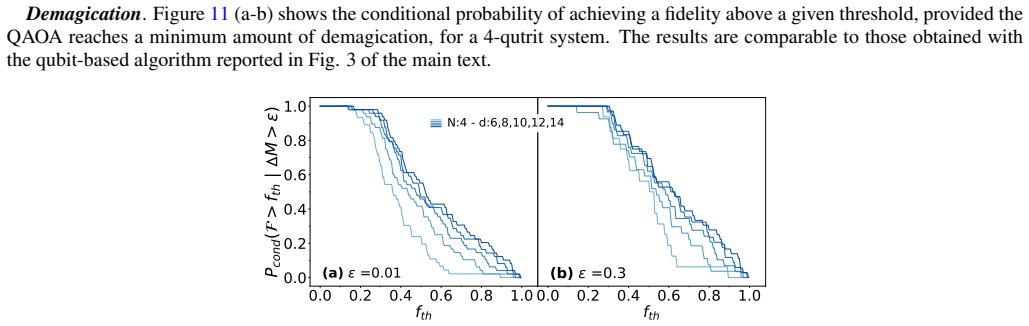
The paper's central claim is that QAOA, despite starting in a stabilizer state with zero magic and ideally ending in a (classical) stabilizer state, must traverse a regime of elevated nonstabilizerness in order to reach the solution. Exact simulations for qubit and qutrit systems on the SK model show that the average SRE density (and Mana, for qutrits) rises during the early layers, peaks at roughly half the circuit depth—the 'magic barrier'—and then decreases as the final state approaches the target ground state. The peak value of magic remains approximately constant across circuit depths and system sizes, and stays below the Haar-random typical value, so a device able to produce only a limited amount of magic may be sufficient for QAOA. For fixed system size, magic curves at different depths collapse under the scaling function $M/N = d^{-\mu} f[(\lambda - \xi d^{\nu}) d^{\eta}]$ with $\lambda = p/d$; for qubits the collapse can be written in a critical-point form with $\lambda_c \approx 0.2$–$0.3$. The paper also establishes a characteristic relation between final magic and fidelity, with a 'forbidden region' in the fidelity–magic plane that is explained analytically by superpositions of two and three computational basis states. Finally, a magic barrier with a peak near $\lambda \approx 0.35$ appears in the ground-state SRE along an adiabatic quantum annealing path, and 'demagication' (the drop in magic after the peak) is positively correlated with the probability of achieving high final fidelity.
Load-bearing premise
The claim that the magic barrier is generic to QAOA assumes that the Trotterized-quantum-annealing initialization used in every run is representative, even though that initialization already traces a path that exhibits a magic barrier.
Editorial extensions
If this is right
- Every successful QAOA run must cross a magic barrier, making transient nonstabilizerness an intrinsic resource cost even for optimization problems whose target solution is a classical (stabilizer) state.
- Because the peak magic is nearly independent of depth and system size and remains below the Haar-random value, a device that can generate only a limited amount of magic may be sufficient to run QAOA at arbitrary depth.
- The appearance of the same barrier in adiabatic quantum annealing indicates that the nonstabilizerness peak is a shared feature of quantum-optimization dynamics, not an artifact of the discrete QAOA circuit.
- The analytic bounds for two- and three-basis-state superpositions explain the observed empty region in the fidelity–magic plane, so medium-to-high-fidelity outcomes (fidelity around 0.6–0.9) unavoidably carry some magic.
- Stronger demagication—a larger drop in magic after the barrier—is associated with a higher conditional probability of reaching high fidelity, giving a nonstabilizerness-based diagnostic for QAOA performance.
Reading between the lines
- The paper tests only one parameter initialization (Trotterized quantum annealing), so the claim that the barrier is a generic feature of QAOA is an extrapolation; repeating the SRE-per-layer measurement with random or zero parameter initialization would directly test this.
- The scaling collapse and the apparent critical point near 0.2–0.3 for qubits hint at a possible universal, phase-transition-like description of the barrier; if the collapse survives at larger system sizes, the per-qubit peak magic may saturate, which would moderate fault-tolerant resource estimates.
- The analytic two- and three-basis-state bounds leave open the possibility of a tighter, fully general bound on the fidelity–magic region; proving such a bound would turn the empirical 'forbidden region' into a theorem.
- The annealing barrier peak near an interpolation value of 0.35 is suggestive of the system crossing the quantum critical region of the spin glass; nonlinear or reverse annealing schedules might shift or suppress the barrier, which the paper does not explore.
Editorial analysis
A structured set of objections, weighed in public.
Referee Report
Summary. The paper studies the role of nonstabilizerness (magic) in quantum optimization, focusing on QAOA and adiabatic quantum annealing for the Sherrington--Kirkpatrick (SK) spin-glass model. Using exact numerics on small qubit and qutrit systems, it reports a 'magic barrier': the stabilizer Rényi entropy (SRE) and Mana rise during the initial QAOA layers, peak near the middle of the circuit, and then fall as the final state is approached. The paper proposes a scaling collapse of the barrier, derives analytic SRE formulas for superpositions of two or three computational basis states, and reports a similar barrier in the ground-state SRE along an annealing path of a truncated SK model. On this basis it concludes that a limited amount of magic is needed for successful QAOA and that magic generation is a resource cost relevant for fault-tolerant implementations.
Significance. If the magic barrier is a generic feature of QAOA and adiabatic annealing, the result would be significant for resource estimation in fault-tolerant quantum optimization and would complement earlier work on entanglement barriers in the same settings. The analytic SRE expressions for few-component superpositions, Eqs. (6) and (7), are a clean and useful contribution independent of the barrier claim. The exact small-system numerics establish the barrier for the TQA-initialized protocol studied here, but the broader claims of universality across depths and initializations are not yet supported by the presented evidence.
major comments (4)
- [QAOA on SK model / Magic barrier / Conclusions] The layer-resolved magic curves in Fig. 1 are generated exclusively from QAOA runs initialized by Trotterized quantum annealing (TQA), selecting the best of 20 runs per realization. Because TQA fixes the initial (beta, gamma) parameters to a discretized annealing schedule, and Fig. 4 shows that this same annealing path already exhibits a magic barrier peaking near lambda ~ 0.35, the layer-resolved barrier in Fig. 1 may be inherited from the initialization rather than being an intrinsic feature of QAOA parameter optimization. The Conclusions claim 'Irrespective of the depth of the QAOA, magic rises to a peak and falls' is therefore stronger than the evidence. A concrete test would be to repeat the layer-resolved analysis with random parameter initialization, with parameters initialized on the opposite side of the schedule, and with a different classical optimizer; if the barrier persists across these choices, the genericity claim would be supported.
- [Eq. (4) and SM Tables I-II] The claimed universal scaling collapse is obtained by fitting four or five free parameters (mu, xi, nu, eta, or mu, lambda_c, eta) to the same curves that are then displayed as collapsed. The fitted exponents vary non-monotonically with system size (SM Table I: mu = -6.47e-2, 5.11e-3, -6.83e-2 and nu = 0.76, -0.34, 0.95 for N=4,6,8), and no fit uncertainties or collapse-quality metrics are reported. The main text states that lambda_c is 'consistently found around 0.2', while SM Table II gives 0.27, 0.27, and 0.29. With only 5-7 depths per system, a four-parameter fit is prone to overfitting. To support the 'universal curve' claim, the authors should provide an out-of-sample prediction (e.g., fit depths up to d=8 and predict d=10,12), report residuals, and include parameter uncertainties.
- [Magic barrier in quantum annealing] The annealing barrier is computed on the ground state of a Hamiltonian truncated to fifth-neighbor couplings, using MPS with bond dimension chi=60. The text says 'We verified that this truncation does not qualitatively affect the key features of the observed magic dynamics,' but no truncation-order comparison or bond-dimension convergence data are shown in the main text or SM. Since this section is the basis for the conclusion that a magic barrier also exists in adiabatic quantum annealing, the authors should show comparisons for different truncation ranges and for several bond dimensions, or at least quantify the convergence of the SRE as a function of chi.
- [Final Magic and Fidelity / Demagication and success of QAOA] The analytic two- and three-basis-state SRE formulas, Eq. (6) and Eq. (7), are a useful contribution and explain the void region in Fig. 2 for final states. However, the text then states that this 'suggest[s] a reduced likelihood of obtaining a medium-to-high-fidelity state ... with low magic, further indicating that QAOA has to go through a high-magic state to reach a good solution.' This inference from final-state statistics to intermediate dynamics is not justified by Eq. (6): a state ending in the two-state region could have reached that point along many different magic trajectories. The same distinction between correlation and causation applies to the conditional-probability analysis in Eq. (8); the authors should either remove the dynamical inference or support it with an explicit analysis of the intermediate states.
minor comments (5)
- [Fig. 4 caption] The phrase 'compute numerically exact ground the ground state' is a typo; it should read 'compute the ground state numerically exactly.'
- [SM Sec. II] The sentence 'Hi correspond to local Hilbert space for each qubits of size DN' is unclear; it should state that H_i is a local Hilbert space of dimension D and that the total Hilbert space dimension is D^N.
- [Main text around Eq. (4) and SM Table II] The main text states that lambda_c is 'consistently found around 0.2', but SM Table II reports 0.27, 0.27, and 0.29; the text and table should be aligned.
- [Reference list] Reference [77] has a formatting error ('C. D. Niroula, Pradeep andWhite'); the author list should be corrected.
- [Conclusions] The phrase 'falls again during the approach to the final solution state' overstates the numerics: in SM Fig. 6 the final fidelity is often far from 1 and the final SRE remains nonzero. The more careful formulation 'falls towards the end of the protocol' is preferable throughout the abstract and conclusions.
Circularity Check
The 'universal' scaling collapse in Eq. (4) is fitted to the same curves it is claimed to collapse; the central magic-barrier numerics are otherwise self-contained.
-
fitted input called prediction
[Eq. (4) and Fig. 1(b-d) insets; SM Sec. IV, Table I]
"using a simple scaling function f [·], M/N = d^{−µ} f[(λ−ξ·d^ν)·d^η]; µ,ξ,ν,η ∈ R; λ=p/d. (4) ... the data for different depths, both for average SRE density and Mana, collapse onto a single curve. ... Values obtained from fitting QAOA magic curves for N = 4, 6, 8."
The four exponents (µ, ξ, ν, η) in Eq. (4) are obtained by fitting to the very magic curves whose collapse they are then used to display. The SM explicitly states that the values are 'obtained from fitting QAOA magic curves', so the collapse is imposed by construction rather than tested. No hold-out depths, cross-validation, or parameter-free prediction is reported, so the abstract's claim that the curves 'collapse under a simple rescaling' is a fitted description of the same data, not an independent universal law. This is a statistical forcing of the collapse, although the barrier data themselves come from direct exact numerics and retain independent content.
full rationale
The paper's central magic-barrier observation is obtained from direct exact numerics for QAOA and annealing (Figs. 1 and 4) and is not circular; the final-magic/fidelity bounds in Eqs. (5)-(7) and Fig. 2 are derived analytically and checked against random states. The scaling collapse of Eq. (4), however, is a fitted input presented as a universal finding: the exponents are adjusted to the same curves shown in the insets, so the collapse is guaranteed in-sample rather than predicted. The use of Trotterized-annealing initialization is a legitimate concern about the genericity of the QAOA barrier, but it is not a circularity because the reported curves are optimized QAOA runs, not the annealing schedule itself. Self-citations to related entanglement-barrier works are contextual and not load-bearing. Overall, one partial circularity appears in the scaling-law presentation, while the core barrier claim remains independently supported.
Assumptions & free parameters
free parameters (2)
- Scaling exponents mu, xi, nu, eta (and lambda_c) =
e.g., (5.11e-3, 1.28, -0.34, 0.60) for N=6 qubits; different for N=4,8
- Bias field standard deviation (variance 0.3) in SK Hamiltonian =
0.3
assumptions (6)
- standard math SRE and Mana are faithful monotones of nonstabilizerness
- domain assumption The SK model with random Gaussian couplings is a representative hard optimization problem
- domain assumption Trotterized quantum annealing is a representative QAOA initialization
- ad hoc to paper Truncation of SK interactions to fifth-neighbor does not qualitatively change magic dynamics in annealing
- ad hoc to paper MPS bond dimension chi=60 is converged for ground-state SRE
- standard math Additivity of SRE used in analytic multi-qubit derivations
Cite this review
Pith. "Pith review of Role of Nonstabilizerness in Quantum Optimization." pith.science (2026). https://pith.science/paper/3TQW6AVE
@misc{pith2026250517185,
  author       = {Pith},
  title        = {Pith review of: Role of Nonstabilizerness in Quantum Optimization},
  year         = {2026},
  howpublished = {\url{https://pith.science/paper/3TQW6AVE}},
  note         = {Machine review of arXiv:2505.17185}
}
read the original abstract
Quantum optimization has emerged as a promising approach for tackling complicated classical optimization problems using quantum devices. However, the extent to which such algorithms harness genuine quantum resources and the role of these resources in their success remain open questions. In this work, we investigate the resource requirements of the Quantum Approximate Optimization Algorithm (QAOA) through the lens of the resource theory of nonstabilizerness. We demonstrate that the nonstabilizerness in QAOA increases with circuit depth before it reaches a maximum, to fall again during the approach to the final solution state -- creating a barrier that limits the algorithm's capability for shallow circuits. We find curves corresponding to different depths to collapse under a simple rescaling, and we reveal a nontrivial relationship between the final nonstabilizerness and the success probability. Finally, we identify a similar nonstabilizerness barrier also in adiabatic quantum annealing. Our results provide deeper insights into how quantum resources influence quantum optimization.
Figures


Figures from the paper (8 more)


Reference graph
Works this paper leans on
-
[1]
Lucas, Ising formulations of many NP problems, Frontiers in physics 2, 5 (2014)
A. Lucas, Ising formulations of many NP problems, Frontiers in physics 2, 5 (2014)
2014
-
[2]
Mannhold, H
R. Mannhold, H. Kubinyi, and H. Timmerman, Combinatorial Chemistry: A practical approach (John Wiley & Sons, 2009)
2009
-
[3]
Yu, Industrial applications of combinatorial optimization , V ol
G. Yu, Industrial applications of combinatorial optimization , V ol. 16 (Springer Science & Business Media, 2013)
2013
-
[4]
J. B. Odili, Combinatorial optimization in science and engi- neering, Current Science , 2268 (2017)
2017
-
[5]
Yarkoni, E
S. Yarkoni, E. Raponi, T. B ¨ack, and S. Schmitt, Quantum an- nealing for industry applications: Introduction and review, Re- ports on Progress in Physics 85, 104001 (2022)
2022
-
[6]
Wang, J.-H
P.-H. Wang, J.-H. Chen, Y .-Y . Yang, C. Lee, and Y . J. Tseng, Recent advances in quantum computing for drug discovery and development, IEEE Nanotechnology Magazine 17, 26 (2023)
2023
- [7]
- [8]
Show all 107 references
-
[9]
Preskill, Quantum computing in the nisq era and beyond, Quantum 2, 79 (2018)
J. Preskill, Quantum computing in the nisq era and beyond, Quantum 2, 79 (2018)
2018
-
[10]
Weidenfeller, L
J. Weidenfeller, L. C. Valor, J. Gacon, C. Tornow, L. Bello, S. Woerner, and D. J. Egger, Scaling of the quantum approx- imate optimization algorithm on superconducting qubit based hardware, Quantum 6, 870 (2022)
2022
-
[11]
P. C. Lotshaw, T. Nguyen, A. Santana, A. McCaskey, R. Her- rman, J. Ostrowski, G. Siopsis, and T. S. Humble, Scaling quantum approximate optimization on near-term hardware, Scientific Reports 12, 12388 (2022)
2022
-
[12]
Pelofske, A
E. Pelofske, A. B ¨artschi, and S. Eidenbenz, Quantum anneal- ing vs. qaoa: 127 qubit higher-order ising problems on nisq computers, in International Conference on High Performance Computing (Springer, 2023) pp. 240–258
2023
-
[13]
Bottarelli, S
A. Bottarelli, S. Schmitt, and P. Hauke, Inequality constraints in variational quantum circuits with qudits, arXiv preprint arXiv:2410.07674 (2024)
2024
-
[14]
Shaydulin, C
R. Shaydulin, C. Li, S. Chakrabarti, M. DeCross, D. Herman, N. Kumar, J. Larson, D. Lykov, P. Minssen, Y . Sun, et al. , Evidence of scaling advantage for the quantum approximate optimization algorithm on a classically intractable problem, Science Advances 10, eadm6761 (2024)
2024
-
[15]
Zhou, S.-T
L. Zhou, S.-T. Wang, S. Choi, H. Pichler, and M. D. Lukin, Quantum approximate optimization algorithm: Performance, mechanism, and implementation on near-term devices, Phys. Rev. X 10, 021067 (2020)
2020
-
[16]
Farhi and A
E. Farhi and A. W. Harrow, Quantum supremacy through the quantum approximate optimization algorithm, arXiv:1602.07674 (2016). 6
2016 arXiv
-
[17]
Boulebnane, A
S. Boulebnane, A. Khan, M. Liu, J. Larson, D. Her- man, R. Shaydulin, and M. Pistoia, Evidence that the quantum approximate optimization algorithm optimizes the sherrington-kirkpatrick model efficiently in the average case, arXiv:2505.07929 (2025)
2025 arXiv
-
[18]
Omanakuttan, Z
S. Omanakuttan, Z. He, Z. Zhang, T. Hao, A. Babakhani, S. Boulebnane, S. Chakrabarti, D. Herman, J. Sullivan, M. A. Perlin, et al. , Threshold for fault-tolerant quantum advan- tage with the quantum approximate optimization algorithm, arXiv:2504.01897 (2025)
2025 arXiv
-
[19]
Brandhofer, D
S. Brandhofer, D. Braun, V . Dehn, G. Hellstern, M. H¨uls, Y . Ji, I. Polian, A. S. Bhatia, and T. Wellens, Benchmarking the per- formance of portfolio optimization with qaoa, Quantum Infor- mation Processing 22, 25 (2022)
2022
-
[20]
G. G. Guerreschi and A. Y . Matsuura, Qaoa for max-cut re- quires hundreds of qubits for quantum speed-up, Scientific re- ports 9, 6903 (2019)
2019
-
[21]
Deller, S
Y . Deller, S. Schmitt, M. Lewenstein, S. Lenk, M. Federer, F. Jendrzejewski, P. Hauke, and V . Kasper, Quantum approx- imate optimization algorithm for qudit systems, Phys. Rev. A 107, 062410 (2023)
2023
-
[22]
Ekstrom, H
L. Ekstrom, H. Wang, and S. Schmitt, Variational quan- tum multiobjective optimization, Phys. Rev. Res. 7, 023141 (2025)
2025
-
[23]
Bravyi, A
S. Bravyi, A. Kliesch, R. Koenig, and E. Tang, Hybrid quantum-classical algorithms for approximate graph coloring, Quantum 6, 678 (2022)
2022
-
[24]
Chitambar and G
E. Chitambar and G. Gour, Quantum resource theories, Rev. Mod. Phys. 91, 025001 (2019)
2019
-
[25]
Amico, R
L. Amico, R. Fazio, A. Osterloh, and V . Vedral, Entanglement in many-body systems, Rev. Mod. Phys. 80, 517 (2008)
2008
-
[26]
Eisert, M
J. Eisert, M. Cramer, and M. B. Plenio, Colloquium: Area laws for the entanglement entropy, Rev. Mod. Phys.82, 277 (2010)
2010
-
[27]
J. I. Cirac and P. Zoller, Goals and opportunities in quantum simulation, Nature physics 8, 264 (2012)
2012
-
[28]
Lanting, A
T. Lanting, A. J. Przybysz, A. Y . Smirnov, F. M. Spedalieri, M. H. Amin, A. J. Berkley, R. Harris, F. Altomare, S. Boixo, P. Bunyk, N. Dickson, C. Enderud, J. P. Hilton, E. Hoskin- son, M. W. Johnson, E. Ladizinsky, N. Ladizinsky, R. Neufeld, T. Oh, I. Perminov, C. Rich, M. C...
2014
-
[29]
Hauke, L
P. Hauke, L. Bonnes, M. Heyl, and W. Lechner, Probing entan- glement in adiabatic quantum optimization with trapped ions, Frontiers in Physics 3, 21 (2015)
2015
-
[30]
D ´ıez-Valle, D
P. D ´ıez-Valle, D. Porras, and J. J. Garc ´ıa-Ripoll, Quantum variational optimization: The role of entanglement and prob- lem hardness, Phys. Rev. A 104, 062426 (2021)
2021
-
[31]
Dupont, N
M. Dupont, N. Didier, M. J. Hodson, J. E. Moore, and M. J. Reagor, Calibrating the classical hardness of the quantum ap- proximate optimization algorithm, PRX Quantum 3, 040339 (2022)
2022
-
[32]
Sreedhar, P
R. Sreedhar, P. Vikstål, M. Svensson, A. Ask, G. Johansson, and L. Garc ´ıa- ´Alvarez, The quantum approximate optimiza- tion algorithm performance with low entanglement and high circuit depth, arXiv:2207.03404 (2022)
2022 arXiv
-
[33]
Y . Chen, L. Zhu, N. J. Mayhall, E. Barnes, and S. E. Economou, How much entanglement do quantum optimiza- tion algorithms require?, Quantum 2.0 Conference and Exhi- bition , QM4A.2 (2022)
2022
-
[34]
Hauke, M
P. Hauke, M. Heyl, L. Tagliacozzo, and P. Zoller, Measur- ing multipartite entanglement through dynamic susceptibili- ties, Nat. Phys. 12, 778 (2016)
2016
-
[35]
G. C. Santra, F. Jendrzejewski, P. Hauke, and D. J. Egger, Squeezing and quantum approximate optimization, Phys. Rev. A 109, 012413 (2024)
2024
-
[36]
Vitale, A
V . Vitale, A. Rath, P. Jurcevic, A. Elben, C. Branciard, and B. Vermersch, Robust estimation of the quantum fisher in- formation on a quantum processor, PRX Quantum 5, 030338 (2024)
2024
-
[37]
G. C. Santra, S. S. Roy, D. J. Egger, and P. Hauke, Gen- uine multipartite entanglement in quantum optimization, Phys. Rev. A 111, 022434 (2025)
2025
-
[38]
Gottesman, Stabilizer codes and quantum error correction, arXiv: quant-ph/9705052 (1997)
D. Gottesman, Stabilizer codes and quantum error correction, arXiv: quant-ph/9705052 (1997)
1997 arXiv
-
[39]
Gottesman, The heisenberg representation of quantum computers, arXiv quant-ph/9807006 (1998)
D. Gottesman, The heisenberg representation of quantum computers, arXiv quant-ph/9807006 (1998)
1998 arXiv
-
[40]
Gottesman, Theory of fault-tolerant quantum computation, Phys
D. Gottesman, Theory of fault-tolerant quantum computation, Phys. Rev. A 57, 127 (1998)
1998
-
[41]
Bravyi and A
S. Bravyi and A. Kitaev, Universal quantum computation with ideal clifford gates and noisy ancillas, Phys. Rev. A71, 022316 (2005)
2005
-
[42]
Bravyi and J
S. Bravyi and J. Haah, Magic-state distillation with low over- head, Phys. Rev. A 86, 052329 (2012)
2012
-
[43]
E. T. Campbell, B. M. Terhal, and C. Vuillot, Roads towards fault-tolerant universal quantum computation, Nature549, 172 (2017)
2017
-
[44]
A. W. Harrow and A. Montanaro, Quantum computational supremacy, Nature 549, 203 (2017)
2017
-
[45]
Gross, Hudson’s theorem for finite-dimensional quantum systems, Journal of mathematical physics 47 (2006)
D. Gross, Hudson’s theorem for finite-dimensional quantum systems, Journal of mathematical physics 47 (2006)
2006
-
[47]
Buˇzek, A
V . Buˇzek, A. Vidiella-Barranco, and P. L. Knight, Superposi- tions of coherent states: Squeezing and dissipation, Phys. Rev. A 45, 6570 (1992)
1992
-
[48]
Veitch, C
V . Veitch, C. Ferrie, D. Gross, and J. Emerson, Negative quasi- probability as a resource for quantum computation, New Jour- nal of Physics 14, 113011 (2012)
2012
-
[49]
Bravyi and D
S. Bravyi and D. Gosset, Improved classical simulation of quantum circuits dominated by clifford gates, Phys. Rev. Lett. 116, 250501 (2016)
2016
-
[50]
Bravyi, G
S. Bravyi, G. Smith, and J. A. Smolin, Trading classical and quantum computational resources, Phys. Rev. X 6, 021043 (2016)
2016
-
[51]
Howard and E
M. Howard and E. Campbell, Application of a resource theory for magic states to fault-tolerant quantum computing, Phys. Rev. Lett. 118, 090501 (2017)
2017
-
[52]
Heinrich and D
M. Heinrich and D. Gross, Robustness of magic and symme- tries of the stabiliser polytope, Quantum 3, 132 (2019)
2019
-
[53]
X. Wang, M. M. Wilde, and Y . Su, E fficiently computable bounds for magic state distillation, Phys. Rev. Lett. 124, 090505 (2020)
2020
-
[54]
Heimendahl, F
A. Heimendahl, F. Montealegre-Mora, F. Vallentin, and D. Gross, Stabilizer extent is not multiplicative, Quantum 5, 400 (2021)
2021
-
[55]
Veitch, S
V . Veitch, S. A. H. Mousavian, D. Gottesman, and J. Emerson, The resource theory of stabilizer quantum computation, New Journal of Physics 16, 013009 (2014)
2014
-
[56]
Leone, S
L. Leone, S. F. E. Oliviero, and A. Hamma, Stabilizer r ´enyi entropy, Phys. Rev. Lett.128, 050402 (2022)
2022
-
[57]
Haug and L
T. Haug and L. Piroli, Stabilizer entropies and nonstabilizer- ness monotones, Quantum 7, 1092 (2023)
2023
-
[58]
Leone and L
L. Leone and L. Bittel, Stabilizer entropies are monotones for magic-state resource theory, Phys. Rev. A 110, L040403 (2024)
2024
-
[59]
Sarkar, C
S. Sarkar, C. Mukhopadhyay, and A. Bayat, Characterization of an operational quantum resource in a critical many-body 7 system, New Journal of Physics 22, 083077 (2020)
2020
-
[60]
S. F. E. Oliviero, L. Leone, and A. Hamma, Magic-state re- source theory for the ground state of the transverse-field ising model, Phys. Rev. A 106, 042426 (2022)
2022
-
[61]
Liu and A
Z.-W. Liu and A. Winter, Many-body quantum magic, PRX Quantum 3, 020333 (2022)
2022
-
[62]
Viscardi, M
M. Viscardi, M. Dalmonte, A. Hamma, and E. Tirrito, Inter- play of entanglement structures and stabilizer entropy in spin models, arXiv:2503.08620 (2025)
2025
-
[63]
P. R. N. Falc˜ao, P. Sierant, J. Zakrzewski, and E. Tirrito, Magic dynamics in many-body localized systems, arXiv:2503.07468 (2025)
2025
-
[64]
G. C. Santra, A. Windey, S. Bandyopadhyay, A. Legramandi, and P. Hauke, Complexity transitions in chaotic quantum sys- tems, arXiv:2505.09707 (2025)
2025
-
[65]
D. A. Korbany, M. J. Gullans, and L. Piroli, Long-range non- stabilizerness and phases of matter, arXiv:2502.19504 (2025)
2025
-
[66]
Turkeshi, E
X. Turkeshi, E. Tirrito, and P. Sierant, Magic spreading in random quantum circuits, Nature Communications 16, 2575 (2025)
2025
-
[67]
T. Haug, L. Aolita, and M. Kim, Probing quantum com- plexity via universal saturation of stabilizer entropies, arXiv:2406.04190 (2024)
2024 arXiv
-
[68]
N. D. Varikuti, S. Bandyopadhyay, and P. Hauke, Impact of clifford operations on non-stabilizing power and quantum chaos, arXiv:2505.14793 (2025)
2025
-
[69]
C. D. White, C. Cao, and B. Swingle, Conformal field theories are magical, Phys. Rev. B 103, 075145 (2021)
2021
-
[70]
P. S. Tarabunga, Critical behaviors of non-stabilizerness in quantum spin chains, Quantum 8, 1413 (2024)
2024
-
[71]
Hoshino, M
M. Hoshino, M. Oshikawa, and Y . Ashida, Stabilizer r\’enyi entropy and conformal field theory, arXiv:2503.13599 (2025)
2025
-
[72]
Spriggs, A
T. Spriggs, A. Ahmadi, B. Chen, and E. Greplova, Quantum resources of quantum and classical variational methods, Ma- chine Learning: Science and Technology 6, 015042 (2025)
2025
-
[73]
Sinibaldi, A
A. Sinibaldi, A. F. Mello, M. Collura, and G. Carleo, Non- stabilizerness of neural quantum states, arXiv:2502.09725 (2025)
2025
-
[74]
Panchenko, The sherrington-kirkpatrick model (Springer Science & Business Media, 2013)
D. Panchenko, The sherrington-kirkpatrick model (Springer Science & Business Media, 2013)
2013
-
[75]
Dupont, N
M. Dupont, N. Didier, M. J. Hodson, J. E. Moore, and M. J. Reagor, Entanglement perspective on the quantum ap- proximate optimization algorithm, Phys. Rev. A 106, 022423 (2022)
2022
-
[76]
S. F. Oliviero, L. Leone, A. Hamma, and S. Lloyd, Measuring magic on a quantum processor, npj Quantum Information 8, 148 (2022)
2022
-
[77]
C. D. Niroula, Pradeep andWhite, Q. Wang, S. Johri, D. Zhu, C. Monroe, C. Noel, and M. J. Gullans, Phase transition in magic with random quantum circuits, Nature Physics 20, 1786–1792 (2024)
2024
-
[78]
Bluvstein, S
D. Bluvstein, S. J. Evered, A. A. Geim, S. H. Li, H. Zhou, T. Manovitz, S. Ebadi, M. Cain, M. Kalinowski, D. Hangleiter, et al. , Logical quantum processor based on reconfigurable atom arrays, Nature 626, 58 (2024)
2024
-
[79]
Gross, S
D. Gross, S. Nezami, and M. Walter, Schur–weyl duality for the cli fford group with applications: Property testing, a ro- bust hudson theorem, and de finetti representations, Commun. Math. Phys. 385, 1325 (2021)
2021
-
[80]
W. K. Wootters, A wigner-function formulation of finite-state quantum mechanics, Annals of Physics 176, 1 (1987)
1987
-
[81]
Streif and M
M. Streif and M. Leib, Comparison of qaoa with quantum and simulated annealing, arXiv:1901.01903 (2019)
2019 arXiv
-
[82]
Bottrill, M
G. Bottrill, M. Pandey, and O. Di Matteo, Exploring the po- tential of qutrits for quantum optimization of graph coloring, 2023 IEEE International Conference on Quantum Computing and Engineering (QCE) 01, 177 (2023)
2023
-
[83]
Kar ´acsony, L
M. Kar ´acsony, L. Oroszl ´any, and Z. Zimbor ´as, Efficient qu- dit based scheme for photonic quantum computing, SciPost Physics Core 7, 032 (2024)
2024
-
[84]
Using the additive property,M(|+⟩⊗N) = NM(|+⟩) = 0
The |+⟩ = 1√ D PD−1 i=0 |i⟩ qudit state is a stabilizer state because it is a ( +1) eigenstate of a d-element subgroup of the Pauli group; for example, it is {I, X} for d = 2. Using the additive property,M(|+⟩⊗N) = NM(|+⟩) = 0
-
[85]
Sherrington and S
D. Sherrington and S. Kirkpatrick, Solvable model of a spin- glass, Phys. Rev. Lett. 35, 1792 (1975)
1975
-
[86]
Venturelli, S
D. Venturelli, S. Mandr`a, S. Knysh, B. O’Gorman, R. Biswas, and V . Smelyanskiy, Quantum optimization of fully connected spin glasses, Phys. Rev. X 5, 031040 (2015)
2015
-
[87]
Mugel, C
S. Mugel, C. Kuchkovsky, E. S´anchez, S. Fern´andez-Lorenzo, J. Luis-Hita, E. Lizaso, and R. Or ´us, Dynamic portfolio op- timization with real datasets using quantum processors and quantum-inspired tensor networks, Phys. Rev. R 4, 013006 (2022)
2022
-
[88]
S. H. Sack and M. Serbyn, Quantum annealing initialization of the quantum approximate optimization algorithm, Quantum5, 491 (2021)
2021
-
[89]
Turkeshi, A
X. Turkeshi, A. Dymarsky, and P. Sierant, Pauli spectrum and nonstabilizerness of typical quantum many-body states, Phys. Rev. B 111, 054301 (2025)
2025
-
[90]
Hauke, H
P. Hauke, H. G. Katzgraber, W. Lechner, H. Nishimori, and W. D. Oliver, Perspectives of quantum annealing: methods and implementations, Reports on Progress in Physics 83, 054401 (2020)
2020
-
[91]
G. E. Santoro, R. Marto ˇn´ak, E. Tosatti, and R. Car, Theory of quantum annealing of an ising spin glass, Science 295, 2427 (2002)
2002
-
[92]
Morita and H
S. Morita and H. Nishimori, Mathematical foundation of quan- tum annealing, Journal of Mathematical Physics 49 (2008)
2008
-
[93]
Rajak, S
A. Rajak, S. Suzuki, A. Dutta, and B. K. Chakrabarti, Quan- tum annealing: An overview, Philosophical Transactions of the Royal Society A 381, 20210417 (2023)
2023
-
[94]
Schollw ¨ock, The density-matrix renormalization group in the age of matrix product states, Annals of physics 326, 96 (2011)
U. Schollw ¨ock, The density-matrix renormalization group in the age of matrix product states, Annals of physics 326, 96 (2011)
2011
-
[95]
Or ´us, A practical introduction to tensor networks: Matrix product states and projected entangled pair states, Annals of physics 349, 117 (2014)
R. Or ´us, A practical introduction to tensor networks: Matrix product states and projected entangled pair states, Annals of physics 349, 117 (2014)
2014
-
[96]
Or ´us, Tensor networks for complex quantum systems, Na- ture Reviews Physics 1, 538 (2019)
R. Or ´us, Tensor networks for complex quantum systems, Na- ture Reviews Physics 1, 538 (2019)
2019
-
[97]
S.-J. Ran, E. Tirrito, C. Peng, X. Chen, L. Tagliacozzo, G. Su, and M. Lewenstein, Tensor network contractions: methods and applications to quantum many-body systems (Springer Nature, 2020)
2020
-
[98]
P. S. Tarabunga, E. Tirrito, M. C. Ba ˜nuls, and M. Dalmonte, Nonstabilizerness via matrix product states in the pauli basis, Physical Review Letters 133, 010601 (2024)
2024
-
[99]
O’Gorman and E
J. O’Gorman and E. T. Campbell, Quantum computation with realistic magic-state factories, Phys. Rev. A 95, 032338 (2017)
2017
-
[100]
A. M. Souza, J. Zhang, C. A. Ryan, and R. Laflamme, Ex- perimental magic state distillation for fault-tolerant quantum computing, Nature communications 2, 169 (2011)
2011
-
[101]
Beverland, E
M. Beverland, E. Campbell, M. Howard, and V . Kliuchnikov, Lower bounds on the non-cli fford resources for quantum computations, Quantum Science and Technology 5, 035009 (2020). 8
2020
-
[102]
E. T. Campbell, Early fault-tolerant simulations of the hubbard model, Quantum Science and Technology 7, 015007 (2021)
2021
-
[103]
Pagano, A
G. Pagano, A. Bapat, P. Becker, K. S. Collins, A. De, P. W. Hess, H. B. Kaplan, A. Kyprianidis, W. L. Tan, C. Baldwin, et al., Quantum approximate optimization of the long-range ising model with a trapped-ion quantum simulator, Proceed- ings of the National Academy of Sciences...
2020
-
[104]
Huber, J
P. Huber, J. Haber, P. Barthel, J. Garc´ıa-Ripoll, E. Torrontegui, and C. Wunderlich, Realization of a quantum perceptron gate with trapped ions, arXiv:2111.08977 (2021)
2021 arXiv
-
[105]
M. J. Powell, A direct search optimization method that models the objective and constraint functions by linear interpolation (Springer, 1994)
1994
-
[106]
Gheorghiu, Standard form of qudit stabilizer groups, Physics Letters A 378, 505 (2014)
V . Gheorghiu, Standard form of qudit stabilizer groups, Physics Letters A 378, 505 (2014)
2014
-
[107]
Q. Liu, I. Low, and Z. Yin, Maximal magic for two-qubit states, arXiv:2502.17550 (2025)
2025
-
[108]
Farhi, J
E. Farhi, J. Goldstone, S. Gutmann, and L. Zhou, The quan- tum approximate optimization algorithm and the sherrington- kirkpatrick model at infinite size, Quantum 6, 759 (2022). Supplementary Material: Role of Nonstabilizerness in Quantum Optimization This supplementary materi...
2022
Reviewed August 7, 2026 · model on record in the stance chip above.
Discussion (0). Sign in to comment.