REVIEW 4 major objections 5 minor 69 references
Towards VM Rescheduling Optimization Through Deep Reinforcement Learning
T0 review · 4 major / 5 minor · reviewed 2026-08-07 · deepseek-v4-flash
Pith's one-line read VM rescheduling: RL matches optimal within 3% in 1.1 seconds
desk verdict Solid RL-for-scheduling paper with a useful latency-aware formulation, but the '2.86% from optimal' headline is not backed by a certified MIP gap. read the letter →
The pith
A machine-rendered reading of the paper's core claim, the machinery that carries it, and where it could break.
The reading
What carries the argument
The load-bearing machinery is a deterministic-transition reinforcement learning setup plus three customizations: a two-stage actor decomposition in which a VM actor first picks which VM to move and a PM actor then picks a destination from the machines that remain feasible; sparse local attention that lets each VM attend only to the physical machine and sibling VMs in its own placement tree; and risk-seeking evaluation, which samples multiple full migration trajectories from the trained policy and deploys the single trajectory the simulator predicts to be best. The paper also uses a dense reward based on the change in fragment size on the source and destination physical machines rather than a single sparse final fragment-rate reward.
What would settle it
Deploy a VMR2L policy in a live cluster, record the actual VM arrivals and exits during its 1.1-second planning window, then execute the plan the simulator ranks best and measure the realized fragment rate; if the realized fragment rate is no better than a simple greedy heuristic run under the same five-second budget, the deterministic-simulator assumption that carries the argument fails.
Extended reading notes
Core claim
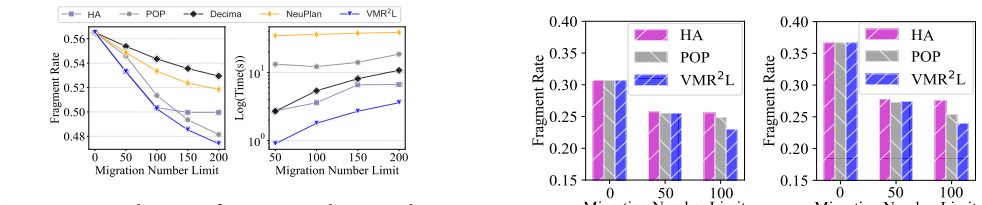
The central claim is that VM rescheduling should be modeled as a sequential decision problem, not a one-shot optimization, and that a reinforcement learning agent trained on a perfect simulator can make the problem tractable at data-center scale. The fragment rate is the share of CPU capacity too fragmented to host a 16-core VM, and the agent's policy decomposes the action 'migrate this VM to that PM' into two choices, uses sparse local attention so each VM sees its sibling VMs on the same physical machine, and, at deployment, samples several candidate migration trajectories and deploys only the one the simulator ranks best. The measured consequence is that VMR2L achieves a fragment rate of 0.2941 versus 0.2859 for the near-optimal mixed-integer programming reference at a migration limit of 50, while keeping inference at 1.1 seconds and scaling to a cluster with 4,546 VMs and 1,176 PMs.
Load-bearing premise
The whole approach assumes the simulator is perfect: given the current state and a migration action, the next state and the objective change are known exactly, so the best sampled trajectory in simulation is also the best plan in the real cluster.
Editorial extensions
If this is right
- A planner that returns within seconds can be used during off-peak rescheduling windows, because its plan remains feasible while VM state churns.
- The same trained agent can serve different migration-number limits, saving the operational cost of maintaining one model per limit.
- Hard constraints such as anti-affinity can be enforced by masking candidate physical machines in the second stage, with only mild fragment-rate degradation even when the conflict ratio is high.
- Risk-seeking evaluation converts extra GPU parallelism directly into solution quality, because more sampled trajectories mean a better best trajectory without retraining.
- A policy trained on high and low workloads generalizes to a middle workload it never saw, suggesting that extreme-workload training data can cover the distribution gap.
Reading between the lines
- If the latency-quality coupling holds generally, then any online reoptimization problem should report time-to-solution alongside final objective, because slow solvers quietly degrade the value of their own answers.
- The same risk-seeking recipe could transfer to other deterministic combinatorial problems with expensive planning and cheap simulation, such as bin packing, compiler phase ordering, or network traffic engineering.
- A direct production test of VMR2L would measure the realized fragment rate after the chosen plan is executed under real VM churn; if the realized rate systematically trails the simulator-predicted rate, the deterministic-environment assumption would need to be relaxed with prediction or replanning.
- The success of training on extreme workloads suggests that resource-management RL policies may need less data variety than expected, as long as the training distribution brackets the test distribution.
Editorial analysis
A structured set of objections, weighed in public.
Referee Report
Summary. The paper studies the problem of virtual machine rescheduling (VMR) in large data centers, where the objective is to minimize the fragment rate by migrating a limited number of VMs under strict latency constraints. The authors formulate VMR as a mixed-integer program, argue that the inference time of the optimizer matters because VM states change dynamically, and propose VMR2L, a deep reinforcement learning system with three main components: a two-stage action decomposition that separates VM selection from PM selection, a sparse-attention feature extractor that captures VM-PM tree-level relations, and a risk-seeking evaluation procedure that samples multiple trajectories and deploys the best one. The system is evaluated on two real-world datasets of cluster mappings, comparing against heuristic, MIP, search-based, and learning baselines, and is reported to achieve fragment rates close to the MIP solution while taking only seconds per mapping. The authors also open-source their code and datasets.
Significance. If the results hold, this is a practically important contribution: VM rescheduling is indeed understudied relative to initial VM placement, and the paper provides a complete system with a strong experimental setup, including two real datasets, seven baselines across method families, ablations, constraint handling, and generalization tests. The open-sourced code and datasets are valuable to the community. The risk-seeking evaluation idea is interesting and clearly motivated by the deterministic simulator. However, the central quantitative claim—that VMR2L is only 2.86% behind the optimal solution—is not currently supported because the MIP baseline is not certified optimal, and the performance numbers are all produced inside a perfect deterministic simulator rather than under dynamic conditions. These issues affect the headline claims and must be addressed before the results can be considered established.
major comments (4)
- [Section 5.2, Fig. 9] The central claim that VMR2L is 2.86% behind the 'optimal MIP solution' (0.2941 vs. 0.2859 at MNL=50) is unsupported because the Gurobi baseline is never certified optimal. The paper refers to the same result as 'near-optimal' (Sections 2.1, 5.3) and does not report termination status, MIPGap, or best-bound values. With 2089 VMs, 280 PMs, and 2 NUMAs per PM, the MILP contains on the order of 1.17 million binary variables plus integer variables, so proving optimality within a 50.55-minute time limit is not automatic. Please report the solver termination status, relative/absolute MIP gap, or use a certified optimum (or a lower bound) in the comparison. If the true optimum is lower, the gap from VMR2L to the optimal solution is larger than 2.86% and the headline claim would need to be revised.
- [Section 3.1, Section 2.2] All reported FR values are computed using the deterministic simulator described in Section 3.1, which assumes that 'given the current state and action, we can exactly know the next state and the change in objective.' This simulator does not model VM arrivals or exits during the 1.1s/2.2s/3.8s inference windows, yet the motivating experiment in Section 2.2 (Fig. 5) explicitly shows that inference time degrades the achieved performance because VM states change dynamically. The production claim that VMR2L achieves near-optimal performance needs a dynamic replay evaluation in which the computed plan is replayed against a stream of VM changes; without it, the current evaluation only establishes performance in a static, simulated setting. Please either add such an evaluation or clearly and prominently state that the claims are limited to the static problem.
- [Section 5.2, Tables 2-5] The main quantitative comparisons are presented as point estimates without confidence intervals or statistical significance. Section 4 states that the authors report averages over 3-5 runs with different random seeds and show confidence intervals in the convergence plots, but Fig. 9 and Tables 2-5 do not include any variance information. Given that the key difference between VMR2L (0.2941) and MIP (0.2859) is small, error bars or a significance test are essential to assess whether VMR2L's gap to MIP and its advantages over baselines are meaningful. Please add confidence intervals or standard deviations to the main result tables and figures.
- [Section 4, Datasets] The dataset anonymization procedure randomly removes some VMs and redeploys the remaining VMs to any PMs that can fit them. This may alter the natural fragmentation patterns, VM size distributions, and workload correlations that make the real VMR problem hard, potentially biasing results in favor of the learned policy. The paper should quantify how the anonymized datasets differ from the raw traces (e.g., FR distribution, VM type distribution, workload distribution) and, if possible, evaluate on at least one held-out set that is closer to the original traces. This would strengthen the external validity of the 'industry-scale data center' claims.
minor comments (5)
- [Abstract] The system name is inconsistent: the abstract calls it 'VM2RL' while the rest of the paper uses 'VMR2L' (e.g., Section 3.1, Section 5.2). Please unify the name.
- [Section 5.2, first paragraph] The sentence 'VMR2L achieves a lower FR compared to all baselines' is contradicted by the same paragraph, which reports MIP FR 0.2859 versus VMR2L FR 0.2941 at MNL=50. Please rephrase to 'lower FR than all non-MIP baselines' or otherwise clarify.
- [Section 5.3, first paragraph] The phrase 'FR performance reduces 16.46% without the two-stage framework' is ambiguous: does FR worsen or improve? Since FR is a cost metric, 'reduces' likely means 'degrades by 16.46%', but the wording should be made explicit.
- [Section 2.2, Fig. 5] The description of the experiment in Section 2.2 is under-specified: it says 'we use Gurobi to compute a near-optimal solution... which takes 50.55 minutes' and then 'compute the final performance that could be achieved as if the near-optimal solution was instead returned in a shorter period of time,' but does not explain how the 'as if' simulation handles infeasible actions over time. Please provide a precise description of the simulation procedure.
- [Section 5.4, Table 2] The affinity constraint table reports results for 'Aff. Level 0' which is not defined in the text (it appears in Fig. 13 and Section 5.4 but the relation between 'Aff. Ratio' and 'Aff. Level' is not stated). Please clarify.
Circularity Check
No significant circularity: VMR2L's performance is benchmarked against independent MIP and heuristic baselines, and its inference-time trajectory selection is not a fitted prediction.
full rationale
I traced the paper's claimed derivation chain: the MIP formulation (Eqs. 1-7), the RL state/action/reward design (Eqs. 8-9), the two-stage action decomposition, the sparse-attention architecture, and the risk-seeking evaluation. The MIP formulation defines the fragment-rate objective that is later used as the evaluation metric, but VMR2L is not constructed from that objective by definition; it is trained with a surrogate dense reward and then compared against the same objective as an external benchmark. Risk-seeking evaluation samples multiple trajectories from a fixed policy and uses the deterministic simulator to keep the best one; this is inference-time search, not fitting a parameter and then reporting a forced prediction. The only self-citation ([20], for 'each PM can host multiple VMs that run independently') is co-located with an independent citation [28] and is not load-bearing for any central claim. The paper repeatedly calls the Gurobi result 'near-optimal' (Sections 2.1 and 5.3) without reporting an optimality gap, so the headline 'optimal MIP solution' in Section 5.2 is an evidentiary concern about certification, not circular reasoning. No equation or fitted parameter reduces to the claimed result by construction.
Assumptions & free parameters
free parameters (3)
- reward normalization constant c =
64
- action threshold quantiles for risk-seeking =
grid-searched over {0.95, 0.98, 0.99, 0.995}; best combination on validation set
- number of sampled trajectories =
16 (with 8 GPUs, 2.2s)
assumptions (5)
- domain assumption Given the current state and action, the next state and objective change are exactly known.
- domain assumption Live migration of VMs incurs low overhead and requires transferring only memory due to compute-storage separation.
- domain assumption 16-core FR is the operational metric at ByteDance; other metrics are extensions.
- domain assumption Gurobi returns a near-optimal solution within 50 minutes for a single mapping.
- domain assumption Anonymized mappings remain representative of real production workloads.
Cite this review
Pith. "Pith review of Towards VM Rescheduling Optimization Through Deep Reinforcement Learning." pith.science (2026). https://pith.science/paper/2FTN35LC
@misc{pith2026250517359,
  author       = {Pith},
  title        = {Pith review of: Towards VM Rescheduling Optimization Through Deep Reinforcement Learning},
  year         = {2026},
  howpublished = {\url{https://pith.science/paper/2FTN35LC}},
  note         = {Machine review of arXiv:2505.17359}
}
read the original abstract
Modern industry-scale data centers need to manage a large number of virtual machines (VMs). Due to the continual creation and release of VMs, many small resource fragments are scattered across physical machines (PMs). To handle these fragments, data centers periodically reschedule some VMs to alternative PMs, a practice commonly referred to as VM rescheduling. Despite the increasing importance of VM rescheduling as data centers grow in size, the problem remains understudied. We first show that, unlike most combinatorial optimization tasks, the inference time of VM rescheduling algorithms significantly influences their performance, due to dynamic VM state changes during this period. This causes existing methods to scale poorly. Therefore, we develop a reinforcement learning system for VM rescheduling, VM2RL, which incorporates a set of customized techniques, such as a two-stage framework that accommodates diverse constraints and workload conditions, a feature extraction module that captures relational information specific to rescheduling, as well as a risk-seeking evaluation enabling users to optimize the trade-off between latency and accuracy. We conduct extensive experiments with data from an industry-scale data center. Our results show that VM2RL can achieve a performance comparable to the optimal solution but with a running time of seconds. Code and datasets are open-sourced: https://github.com/zhykoties/VMR2L_eurosys, https://drive.google.com/drive/folders/1PfRo1cVwuhH30XhsE2Np3xqJn2GpX5qy.
Figures



Figures from the paper (10 more)



Reference graph
Works this paper leans on
-
[1]
Cluster design in data center.https://core.vmware.com/resource/vsan- cluster-design-large-clusters-versus-small-clusters#section1
-
[2]
Cplex optimizer.https://www.ibm.com/analytics/cplex-optimizer
-
[3]
Gurobi solver.https://www.gurobi.com/
-
[4]
Kubernetes scheduler.https://kubernetes.io/docs/concepts/ scheduling-eviction/kube-scheduler/
-
[5]
Numa architecture platforms.https://uefi.org/htmlspecs/ACPI_Spec_ 6_4_html/17_NUMA_Architecture_Platforms/NUMA_Architecture_ Platforms.html. Accessed: 2024-10-05
work page 2024
-
[6]
Ahmad, R. W., Gani, A., Hamid, S. H. A., Shiraz, M., Yousafzai, A., and Xia, F.A survey on virtual machine migration and server consolidation frameworks for cloud data centers.Journal of network and computer applications 52(2015), 11–25
work page 2015
-
[7]
InProceedings of the 61st ACM/IEEE Design Automation Conference (2024), pp
An, Z., Ding, X., and Du, W.Go beyond black-box policies: Rethinking the design of learning agent for interpretable and verifiable hvac con- trol. InProceedings of the 61st ACM/IEEE Design Automation Conference (2024), pp. 1–6. [8]Ba, J. L., Kiros, J. R., and Hinton, G. E.Layer normalization, 2016
work page 2024
-
[9]
InProceed- ings of the AAAI Conference on Artificial Intelligence(2020), vol
Barrett, T., Clements, W., Foerster, J., and Lvovsky, A.Exploratory combinatorial optimization with reinforcement learning. InProceed- ings of the AAAI Conference on Artificial Intelligence(2020), vol. 34, pp. 3243–3250
work page 2020
Show all 69 references
-
[10]
M.Pattern Recognition and Machine Learning (Information Science and Statistics), 1 ed
Bishop, C. M.Pattern Recognition and Machine Learning (Information Science and Statistics), 1 ed. Springer, 2007
2007
-
[11]
Brockman, G., Cheung, V., Pettersson, L., Schneider, J., Schulman, J., Tang, J., and Zaremba, W.Openai gym, 2016
2016
-
[12]
Cai, Q., Hang, W., Mirhoseini, A., Tucker, G., W ang, J., and Wei, W.Reinforcement learning driven heuristic optimization.Workshop on Deep Reinforcement Learning for Knowledge Discovery (DRL4KDD) abs/1906.06639(2019)
2019 arXiv
-
[13]
M., and Du, W.Marlp: Time-series forecasting control for agricultural managed aquifer recharge
Chen, Y., Y ang, K., An, Z., Holder, B., Paloutzian, L., Bali, K. M., and Du, W.Marlp: Time-series forecasting control for agricultural managed aquifer recharge. InProceedings of the 30th ACM SIGKDD Conference on Knowledge Discovery and Data Mining(2024)
2024
-
[14]
G., Jul, E., Limpach, C., Pratt, I., and W arfield, A.Live migration of virtual machines
Clark, C., Fraser, K., Hand, S., Hansen, J. G., Jul, E., Limpach, C., Pratt, I., and W arfield, A.Live migration of virtual machines. In Proceedings of the 2nd Conference on Symposium on Networked Systems Design & Implementation - Volume 2(Berkeley, CA, USA, 2005), USENIX Asso...
2005
-
[15]
arXiv preprint arXiv:1810.04805v2(2018)
Devlin, J., Chang, M.-W., Lee, K., and Toutanova, K.Bert: Pre- training of deep bidirectional transformers for language understanding. arXiv preprint arXiv:1810.04805v2(2018)
2018 arXiv
-
[16]
Ding, X., An, Z., Rathee, A., and Du, W.A safe and data-efficient model-based reinforcement learning system for hvac control.IEEE Internet of Things Journal(2025)
2025
-
[17]
Ding, X., Cerpa, A., and Du, W.Exploring deep reinforcement learn- ing for holistic smart building control.ACM Transactions on Sensor Networks 20, 3 (2024), 1–28
2024
-
[18]
Ding, X., Cerpa, A., and Du, W.Multi-zone hvac control with model- based deep reinforcement learning.IEEE Transactions on Automation Science and Engineering(2024)
2024
-
[19]
Ding, X., and Du, W.Optimizing irrigation efficiency using deep rein- forcement learning in the field.ACM Transactions on Sensor Networks 20, 4 (2024), 1–34
2024
-
[20]
Ding, X., Zhang, Y., Chen, B., Ying, D., Zhang, T., Chen, J., Zhang, L., Cerpa, A., and Du, W.Vmr2l: Virtual machines rescheduling using reinforcement learning in data centers, 2023
2023
-
[21]
InInternational Conference on Learning Representations(2021)
Dosovitskiy, A., Beyer, L., Kolesnikov, A., Weissenborn, D., Zhai, X., Unterthiner, T., Dehghani, M., Minderer, M., Heigold, G., Gelly, S., Uszkoreit, J., and Houlsby, N.An image is worth 16x16 words: Transformers for image recognition at scale. InInternational Conference on L...
2021
-
[22]
A multi-task selected learning approach for solving 3d flexible bin packing problem
Duan, L., Hu, H., Qian, Y., Gong, Y., Zhang, X., Wei, J., and Xu, Y. A multi-task selected learning approach for solving 3d flexible bin packing problem. InProceedings of the 18th International Conference on Autonomous Agents and MultiAgent Systems(Richland, SC, 2019), AAMAS ’...
2019
-
[23]
Reinforcement learning for variable selection in a branch and bound algorithm
Etheve, M., Alès, Z., Bissuel, C., Juan, O., and Kedad-Sidhoum, S. Reinforcement learning for variable selection in a branch and bound algorithm. InInternational Conference on Integration of Constraint Programming, Artificial Intelligence, and Operations Research(2020), Spring...
2020
-
[24]
Pytorch: An open source machine learning framework.https://pytorch.org/, 2019
Facebook AI Research. Pytorch: An open source machine learning framework.https://pytorch.org/, 2019. Accessed: April 23, 2023
2019
-
[25]
Advances in Neural Information Processing Systems 32(2019)
Gasse, M., Chételat, D., Ferroni, N., Charlin, L., and Lodi, A.Exact combinatorial optimization with graph convolutional neural networks. Advances in Neural Information Processing Systems 32(2019)
2019
-
[26]
Gupta, P., Gasse, M., Khalil, E., Mudigonda, P., Lodi, A., and Ben- gio, Y.Hybrid models for learning to branch.Advances in neural information processing systems 33(2020), 18087–18097
2020
-
[27]
T., Nguyen, T
Ha, C. T., Nguyen, T. T., Bui, L. T., and W ang, R.An online pack- ing heuristic for the three-dimensional container loading problem in dynamic environments and the physical internet. InApplications of Evolutionary Computation: 20th European Conference, EvoApplications 2017, A...
2017
-
[28]
E., Dion, D., Dorminey, S., Joshi, S., Chen, Y., Russinovich, M., et al.Protean: Vm allocation service at scale
Hadary, O., Marshall, L., Menache, I., Pan, A., Greeff, E. E., Dion, D., Dorminey, S., Joshi, S., Chen, Y., Russinovich, M., et al.Protean: Vm allocation service at scale. InProceedings of the 14th USENIX Conference on Operating Systems Design and Implementation(2020)
2020
-
[29]
Haj-Ali, A., Huang, Q. J., Xiang, J., Moses, W., Asanovic, K., W awrzynek, J., and Stoica, I.Autophase: Juggling hls phase order- ings in random forests with deep reinforcement learning.Proceedings of Machine Learning and Systems 2(2020), 70–81
2020
-
[30]
InProceedings of the AAAI conference on artificial intelligence(2018), vol
Henderson, P., Islam, R., Bachman, P., Pineau, J., Precup, D., and Meger, D.Deep reinforcement learning that matters. InProceedings of the AAAI conference on artificial intelligence(2018), vol. 32
2018
-
[31]
Hong, Z., Yuan, Z., Zhang, Q., Chen, H., Dong, J., Huang, F., and Huang, X.Next-generation database interfaces: A survey of llm-based text-to-sql.arXiv preprint arXiv:2406.08426(2024)
2024
-
[32]
InProceedings of the 36th Interna- tional Conference on Machine Learning(2019)
Houlsby, N., Giurgiu, A., Jastrzebski, S., Morrone, B., De Larous- silhe, Q., Gesmundo, A., Attariyan, M., and Gelly, S.Parameter- efficient transfer learning for NLP. InProceedings of the 36th Interna- tional Conference on Machine Learning(2019)
2019
-
[33]
InProceedings of the 56th Annual Meeting of the Association for Computational Linguistics (Volume 1: Long Papers) (Melbourne, Australia, July 2018), I
Howard, J., and Ruder, S.Universal language model fine-tuning for text classification. InProceedings of the 56th Annual Meeting of the Association for Computational Linguistics (Volume 1: Long Papers) (Melbourne, Australia, July 2018), I. Gurevych and Y. Miyao, Eds., Associati...
2018
-
[34]
J., Shen, Y., W allis, P., Allen-Zhu, Z., Li, Y., W ang, S., W ang, L., and Chen, W.Lora: Low-rank adaptation of large language models
Hu, E. J., Shen, Y., W allis, P., Allen-Zhu, Z., Li, Y., W ang, S., W ang, L., and Chen, W.Lora: Low-rank adaptation of large language models. arXiv preprint arXiv:2106.09685(2021)
2021 arXiv
-
[35]
Hu, H., Zhang, X., Y an, X., W ang, L., and Xu, Y.Solving a new 3d bin packing problem with deep reinforcement learning method, 2017
2017
-
[36]
Huang, S., Dossa, R. F. J., Ye, C., Braga, J., Chakraborty, D., Mehta, K., and Araújo, J. G.Cleanrl: High-quality single-file implementa- tions of deep reinforcement learning algorithms.Journal of Machine Learning Research 23, 274 (2022), 1–18
2022
-
[37]
L., Likitha, V., Suneetha, B., and Vignesh, T.Analysis of ci/cd application in kubernetes architec- ture.Mathematical Statistician and Engineering Applications 71, 4 (Mar
Janani, K., Anuhya, K., Manaswini, V. L., Likitha, V., Suneetha, B., and Vignesh, T.Analysis of ci/cd application in kubernetes architec- ture.Mathematical Statistician and Engineering Applications 71, 4 (Mar. 2023), 11091–11097
2023
-
[38]
P., Littman, M
Kaelbling, L. P., Littman, M. L., and Moore, A. W.Reinforcement learning: A survey.Journal of Artificial Intelligence Research 4(1996). 15
1996
-
[39]
In2022 IEEE 9th International Confer- ence on Data Science and Advanced Analytics (DSAA)(2022), pp
Kumar, D., and Li, S.Separating storage and compute with the databricks lakehouse platform. In2022 IEEE 9th International Confer- ence on Data Science and Advanced Analytics (DSAA)(2022), pp. 1–2
2022
-
[40]
Levine, S., Kumar, A., Tucker, G., and Fu, J.Offline reinforcement learning: Tutorial, review, and perspectives on open problems.ArXiv abs/2005.01643(2020)
2020 arXiv
-
[41]
Li, D., Ren, C., Gu, Z., W ang, Y., and Lau, F.Solving packing problems by conditional query learning, 2020
2020
-
[42]
InProceedings of the 24th ACM SIGKDD International Conference on Knowledge Discovery & Data Mining(New York, NY, USA, 2018), KDD ’18, Association for Computing Machinery, p
Li, X., Yuan, M., Chen, D., Y ao, J., and Zeng, J.A data-driven three- layer algorithm for split delivery vehicle routing problem with 3d container loading constraint. InProceedings of the 24th ACM SIGKDD International Conference on Knowledge Discovery & Data Mining(New York, ...
2018
-
[43]
InProceedings of the 5th Workshop on Machine Learning and Systems(New York, NY, USA, 2025), EuroMLSys ’25, Association for Computing Machinery
Lin, M., and Jeon, H.Understanding oversubscribed memory manage- ment for deep learning training. InProceedings of the 5th Workshop on Machine Learning and Systems(New York, NY, USA, 2025), EuroMLSys ’25, Association for Computing Machinery
2025
-
[44]
Lin, M., Zhou, K., and Su, P.Drgpum: Guiding memory optimiza- tion for gpu-accelerated applications. InProceedings of the 28th ACM International Conference on Architectural Support for Programming Lan- guages and Operating Systems, Volume 3(New York, NY, USA, 2023), Associatio...
2023
-
[45]
B., Meng, Z., and Alizadeh, M.Learning scheduling algorithms for data processing clusters
Mao, H., Schwarzkopf, M., Venkatakrishnan, S. B., Meng, Z., and Alizadeh, M.Learning scheduling algorithms for data processing clusters. InProceedings of the ACM special interest group on data communication. 2019, pp. 270–288
2019
-
[46]
Mazyavkina, N., Sviridov, S., Ivanov, S., and Burnaev, E.Reinforce- ment learning for combinatorial optimization: A survey, 2020
2020
-
[47]
F., Uhlig, V., Krieger, O., and Xenidis, J.Virtualization for high-performance computing.SIGOPS Oper
Mergen, M. F., Uhlig, V., Krieger, O., and Xenidis, J.Virtualization for high-performance computing.SIGOPS Oper. Syst. Rev. 40, 2 (apr 2006), 8–11
2006
-
[48]
InProceedings of the ACM SIGOPS 28th Symposium on Operating Systems Principles(2021)
Narayanan, D., Kazhamiaka, F., Abuzaid, F., Kraft, P., Agrawal, A., Kandula, S., Boyd, S., and Zaharia, M.Solving large-scale granular resource allocation problems efficiently with pop. InProceedings of the ACM SIGOPS 28th Symposium on Operating Systems Principles(2021)
2021
-
[49]
Padberg, M., and Rinaldi, G.A branch-and-cut algorithm for the resolution of large-scale symmetric traveling salesman problems.SIAM review 33, 1 (1991), 60–100
1991
-
[50]
microsoft
Panigrahy, R., Talwar, K., Uyeda, L., and Wieder, U.Heuristics for vector bin packing.research. microsoft. com(2011)
2011
-
[51]
M., and Oliveira, J
Parreño, F., Alvarez-V aldés, R., Tamarit, J. M., and Oliveira, J. F.A maximal-space algorithm for the container loading problem.INFORMS Journal on Computing 20, 3 (2008), 412–422
2008
-
[52]
K., Larma, M
Petersen, B. K., Larma, M. L., Mundhenk, T. N., Santiago, C. P., Kim, S. K., and Kim, J. T.Deep symbolic regression: Recovering math- ematical expressions from data via risk-seeking policy gradients. In International Conference on Learning Representations(2021)
2021
-
[53]
E., Perescu-Popescu, L., and Mastorakis, N.Multilayer perceptron and neural networks.WSEAS Transactions on Circuits and Systems 8, 7 (2009), 579–588
Popescu, M.-C., Balas, V. E., Perescu-Popescu, L., and Mastorakis, N.Multilayer perceptron and neural networks.WSEAS Transactions on Circuits and Systems 8, 7 (2009), 579–588
2009
-
[54]
Rengarajan, D., V aidya, G., Sarvesh, A., Kalathil, D., and Shakkot- tai, S.Reinforcement learning with sparse rewards using guidance from offline demonstration.arXiv preprint arXiv:2202.04628(2022)
2022 arXiv
-
[55]
T.Learn- ing by playing solving sparse reward tasks from scratch
Riedmiller, M., Hafner, R., Lampe, T., Neunert, M., Degrave, J., van de Wiele, T., Mnih, V., Heess, N., and Springenberg, J. T.Learn- ing by playing solving sparse reward tasks from scratch. InProceedings of the 35th International Conference on Machine Learning(10–15 Jul 2018)...
2018
-
[56]
Schulman, J., Wolski, F., Dhariwal, P., Radford, A., and Klimov, O.Proximal policy optimization algorithms.arXiv preprint arXiv:1707.06347(2017)
2017 arXiv
-
[57]
H., Rahmani, A
Shirvani, M. H., Rahmani, A. M., and Sahafi, A.A survey study on virtual machine migration and server consolidation techniques in dvfs-enabled cloud datacenter: taxonomy and challenges.Journal of King Saud University-Computer and Information Sciences 32, 3 (2020)
2020
-
[58]
Silver, D., Schrittwieser, J., Simonyan, K., Antonoglou, I., Huang, A., Guez, A., Hubert, T., Baker, L., Lai, M., Bolton, A., et al.Mas- tering the game of go without human knowledge.nature(2017)
2017
-
[59]
Song, J., Yue, Y., Dilkina, B., et al.A general large neighborhood search framework for solving integer linear programs.Advances in Neural Information Processing Systems 33(2020), 20012–20023
2020
-
[60]
A., Yousafzai, A., V asilakos, A
Talebian, H., Gani, A., Sookhak, M., Abdelatif, A. A., Yousafzai, A., V asilakos, A. V., and Yu, F. R.Optimizing virtual machine place- ment in iaas data centers: taxonomy, review and open issues.Cluster Computing 23(2020), 837–878
2020
-
[61]
InPro- ceedings of the Seventeenth European Conference on Computer Systems (2022), pp
Thalheim, J., Okelmann, P., Unnibhavi, H., Gouicem, R., and Bha- totia, P.Vmsh: hypervisor-agnostic guest overlays for vms. InPro- ceedings of the Seventeenth European Conference on Computer Systems (2022), pp. 678–696
2022
-
[62]
N., Kaiser, Ł., and Polosukhin, I.Attention is all you need.Ad- vances in neural information processing systems 30(2017)
V aswani, A., Shazeer, N., Parmar, N., Uszkoreit, J., Jones, L., Gomez, A. N., Kaiser, Ł., and Polosukhin, I.Attention is all you need.Ad- vances in neural information processing systems 30(2017)
2017
-
[63]
K., Shenoy, P., V an Der Merwe, J., Hwang, J., Liu, G., and Chaufournier, L.Cloudnet: dynamic pool- ing of cloud resources by live wan migration of virtual machines
Wood, T., Ramakrishnan, K. K., Shenoy, P., V an Der Merwe, J., Hwang, J., Liu, G., and Chaufournier, L.Cloudnet: dynamic pool- ing of cloud resources by live wan migration of virtual machines. IEEE/ACM Trans. Netw. 23, 5 (Oct. 2015), 1568–1583
2015
-
[64]
Xia, Y., Tsugawa, M., Fortes, J. A., and Chen, S.Large-scale vm placement with disk anti-colocation constraints using hierarchical decomposition and mixed integer programming.IEEE Transactions on Parallel and Distributed Systems 28, 5 (2016), 1361–1374
2016
-
[65]
InProceedings of the 22nd International Conference on Information Processing in Sensor Networks(2023)
Y ang, K., Chen, Y., Chen, X., and Du, W.Link quality modeling for lora networks in orchards. InProceedings of the 22nd International Conference on Information Processing in Sensor Networks(2023)
2023
-
[66]
InACM MobiSys(2024)
Y ang, K., Chen, Y., and Du, W.OrchLoc: In-Orchard Localization via a Single LoRa Gateway and Generative Diffusion Model-based Fingerprinting. InACM MobiSys(2024)
2024
-
[67]
Zhang, J., Zi, B., and Ge, X.Attend2pack: Bin packing through deep reinforcement learning with attention.ArXiv abs/2107.04333(2021)
2021 arXiv
-
[68]
Zhang, Q., Chen, S., Bei, Y., Yuan, Z., Zhou, H., Hong, Z., Dong, J., Chen, H., Chang, Y., and Huang, X.A survey of graph retrieval- augmented generation for customized large language models.arXiv preprint arXiv:2501.13958(2025)
2025
-
[69]
S., Tian, Y., Zhang, Y., and Jin, X
Zhu, H., Gupta, V., Ahuja, S. S., Tian, Y., Zhang, Y., and Jin, X. Network planning with deep reinforcement learning. InProceedings of the 2021 ACM SIGCOMM 2021 Conference(2021), pp. 258–271
2021
-
[70]
Learning to pack: A data-driven tree search algorithm for large-scale 3d bin packing problem
Zhu, Q., Li, X., Zhang, Z., Luo, Z., Tong, X., Yuan, M., and Zeng, J. Learning to pack: A data-driven tree search algorithm for large-scale 3d bin packing problem. InProceedings of the 30th ACM International Con- ference on Information & Knowledge Management(New York, NY, USA,...
2021
Reviewed August 7, 2026 · model on record in the stance chip above.
Discussion (0). Sign in to comment.